Treten Sie mit TCPEL in Kontakt

Updated July 2026 · Reviewed by the TCPEL technical team
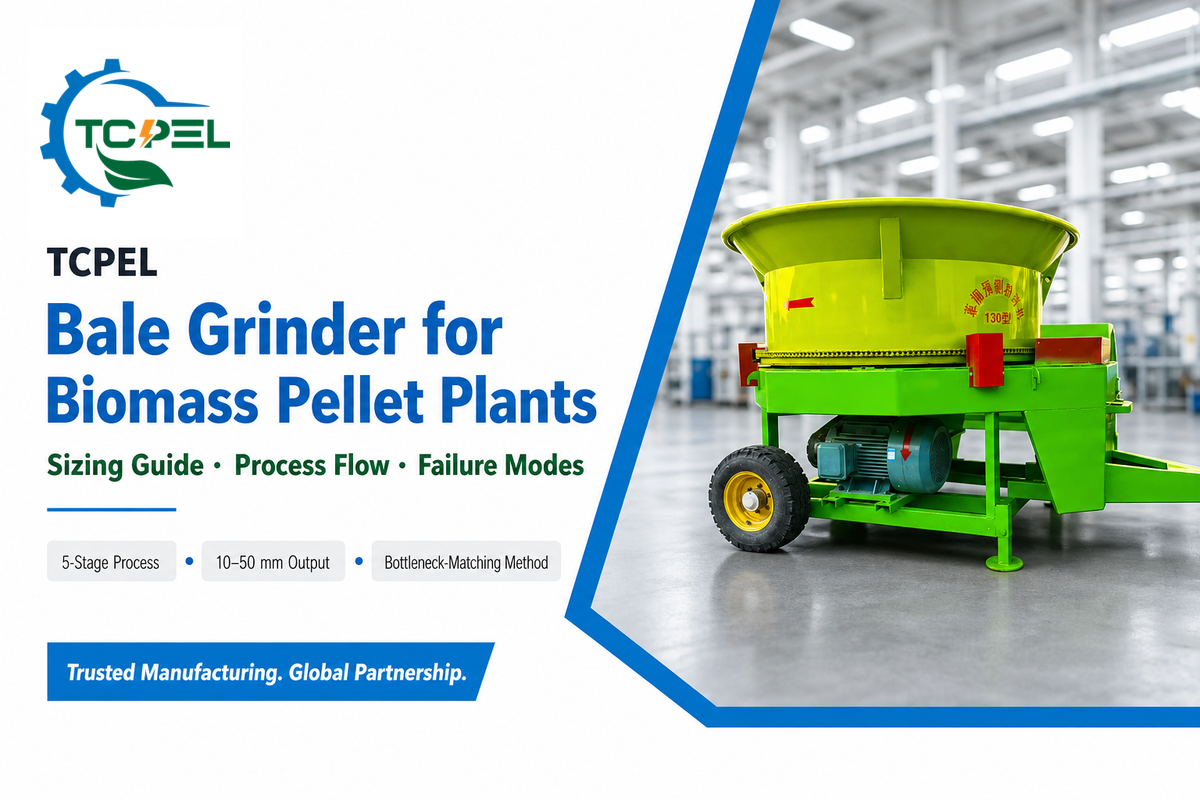
A bale grinder for biomass pellet plants is the first step in turning straw, corn stalk or grass into the uniform input a hammer mill and pellet press can process. If it’s underestimated against the rest of a pellet plant line, it becomes the bottleneck that causes jamming, roller wear and unscheduled downtime downstream, the difference between a plant that reliably turn baled residue into renewable biomass fuel and one that fights its own front end every shift.
A bale grinder for biomass pellet plants is the first size-reduction stage that converts pressed straw bales into a uniform feedstock hammer mills and pellet presses can actually handle. Skip it, or size it wrong against the rest of the line, and it becomes what makes a new pellet plant either never meet its rated output or fight itself every shift.
Key Points
- Much of the sizing shortfall traces to price squeezes eroding the safety margin, rather than buyers requesting over-sized machines just-in-case.
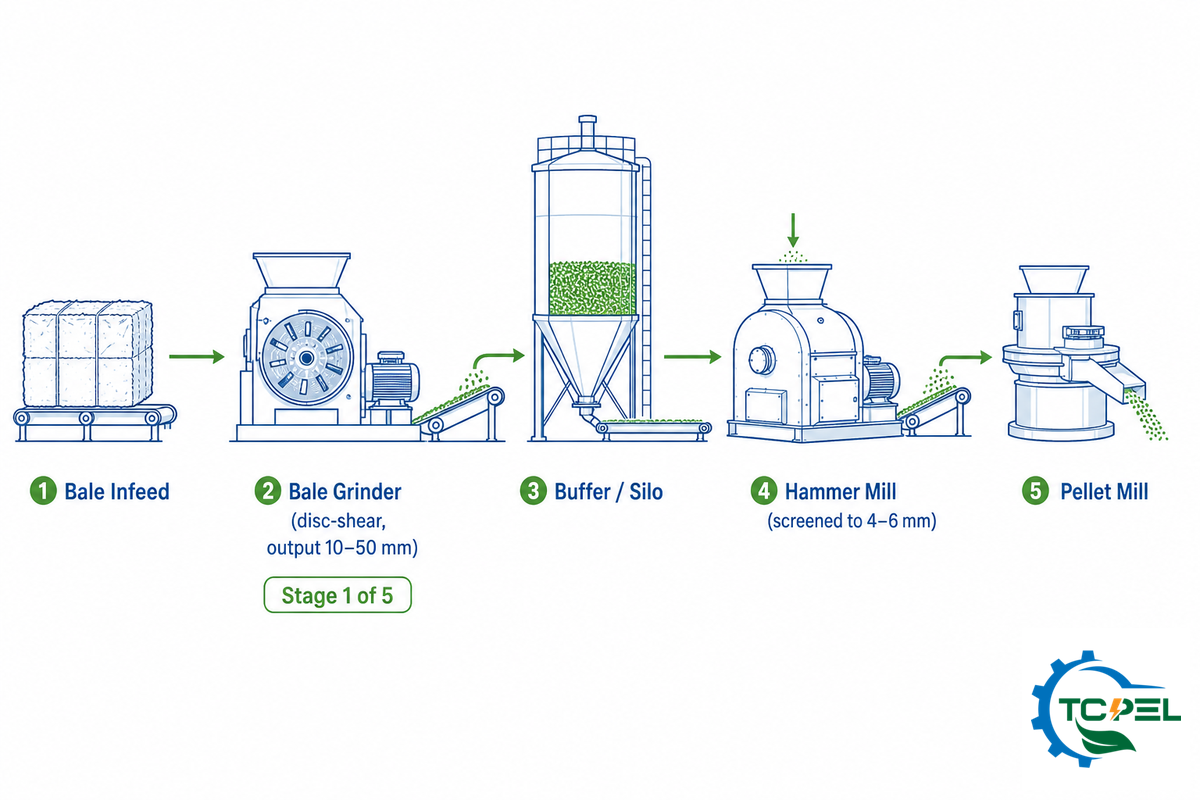
- Stage 1 of 5 is the bale grinder: grinder → buffer/silo → hammer mill → dryer → pellet mill.
- Industrial disc-shear bale grinders and agricultural PTO-driven tub grinders are different equipment classes built for different jobs – the search term overlaps, the machines don’t.
- Feedstock type changes the sizing math: bulk density of raw wheat straw can vary from approximately 24 kg/m³ to 266 kg/m³ depending on the moisture content.
- NFPA 660, published December 2024, now regulates combustible-dust standards for bale-fed biomass facilities, replacing the previous split between NFPA 61/664.
Schnelle Spezifikationen
| Process position | Stage 1 of 5, upstream of buffer/silo, hammer mill, dryer, pellet mill |
| Typical pre-shredded output | 10–50 mm, feeding a hammer mill screened to roughly 4–6 mm for pelletizing |
| Two machine categories | Industrial stationary disc-shear vs. agricultural PTO-driven mobile tub grinder |
| Feedstocks covered here | Rice straw, wheat straw, corn stalk, grass and energy-crop bales |
What Is a Bale Grinder? Industrial Disc Crushers vs. Agricultural Tub Grinders
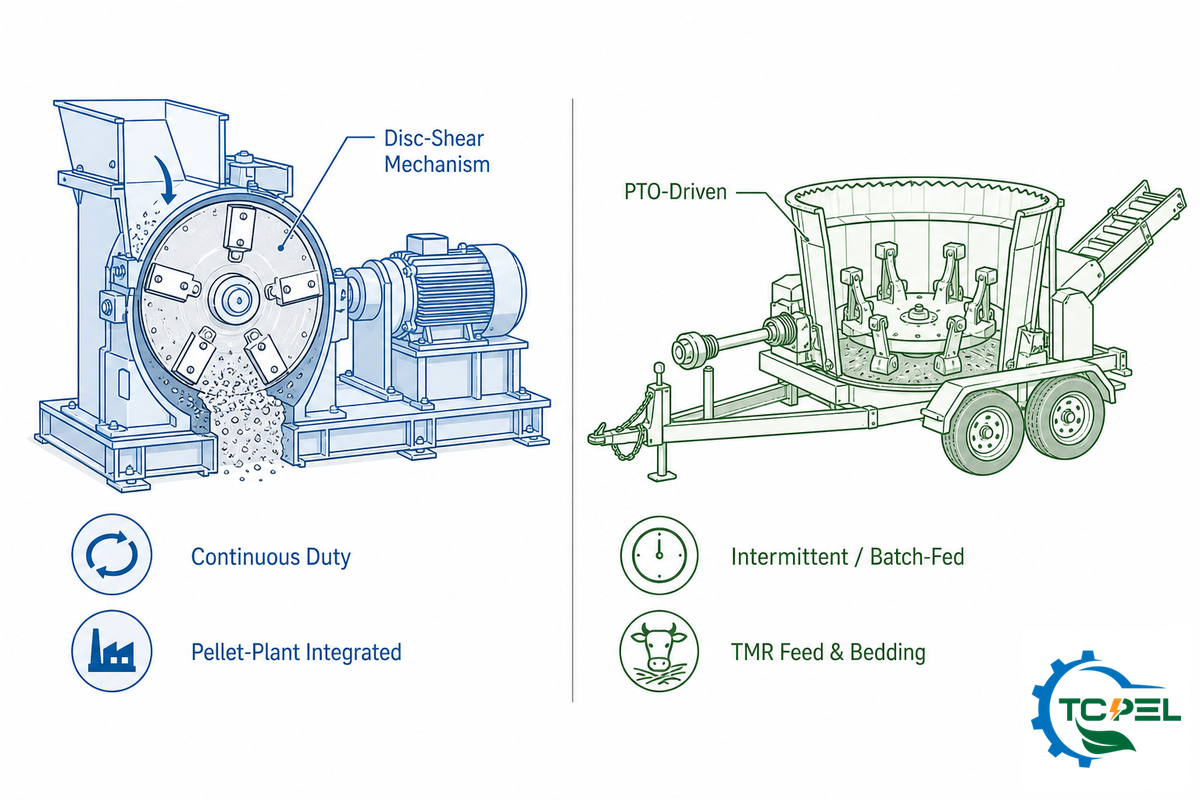
A “bale grinder” describes two different types of specialized equipment, and combining them will delay procurement schedules. An industrial, stationary disc-shear bale grinder is designed for insertion into a commercial biomass pellet plant or feed mill process line, using a high-strength shearing disc to convert compressed raw material — baled straw — into a consistent, free-flowing fraction ready for hammer milling downstream.
Bale processing this way is a distinct step from anything a tractor-mounted implement is built to do, and it’s the entry point to a full biomass pellet production line.
There’s also an agricultural tub grinder or bale processor, which is a PTO-driven, mobile system intended for chopping hay or straw bales to prepare it for cattle TMR mixing or commercial barn bedding. The latter is usually towed by a tractor and operated intermittently.
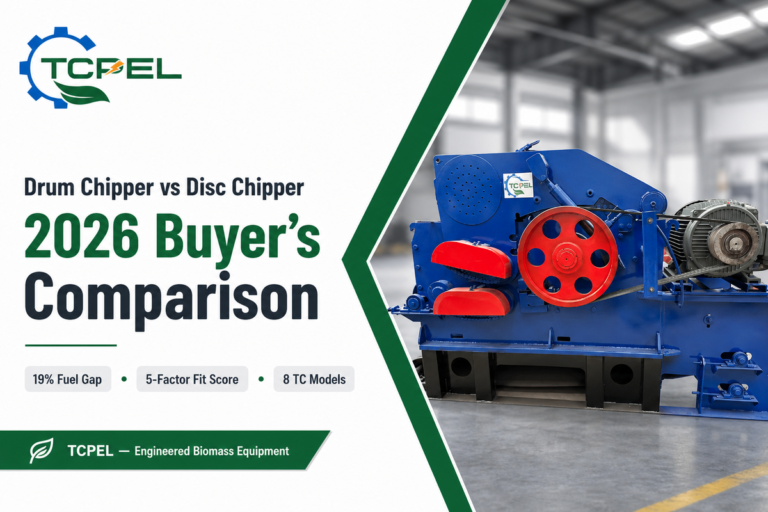
This distinction is mechanically important, not just semantic. One U.S. patent for biomass processing equipment describes one category in this group as a “shredder-shearer train,” which has a shredding step followed by rotating knife cutters that break down the size of the raw biomass feedstock prior to entry into the downstream conversion which is closer in architecture to the industrial disk-grinder category than the tractor-towed tub grinder. Don’t confuse either machine with a drum or disk wood chipper, which employs high-speed knives working against a stationary anvil to make uniform chips out of clean wood logs and branches, not baled agricultural material or general wood waste streams. Chipper machines process whole tree wood, not bales of ag residues, and TCPEL manufactures them in a separate product line specifically to avoid this confusion — each category has its own duty cycle and service life expectations built around the material it’s designed to handle.
| Equipment Type | Mechanismus | Typical Output Size | Best-Fit Feedstock | Duty Cycle |
|---|---|---|---|---|
| Industrial disc bale grinder | Shear (disc-mounted blades) | 10–50 mm | Baled straw, corn stalk, grass | Continuous, integrated into a fixed process line |
| Agricultural tub grinder (PTO) | Impact (hammer/flail in a rotating tub) | Variable, feed/bedding grade | Hay and straw bales for livestock | Intermittent, batch-fed, mobile |
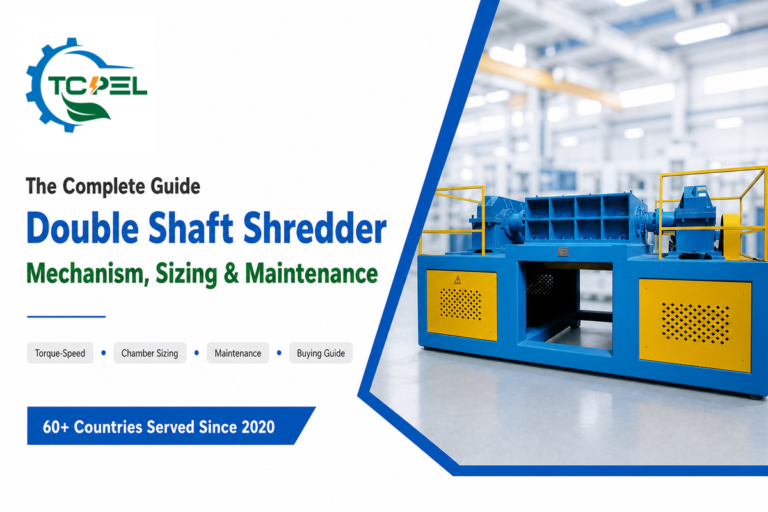
| Twin-shaft shredder | Low-speed, high-torque shear/tear | 20–100 mm, coarse | Mixed or dirty biomass, nailed pallets, whole round bales | Continuous, front-end/primary reduction |
| Einwellenschredder | Cutting against a screen | 10–40 mm, screen-controlled | Cleaner offcuts, consistent waste streams | Continuous, medium-duty |
| Drum wood chipper | High-speed knife vs. anvil | 10–30 mm, uniform | Clean logs, branches, whole-tree wood | Kontinuierlich |
| Disc wood chipper | High-speed knife vs. anvil | 10–30 mm, uniform | Clean logs, papermaking-grade wood | Kontinuierlich |
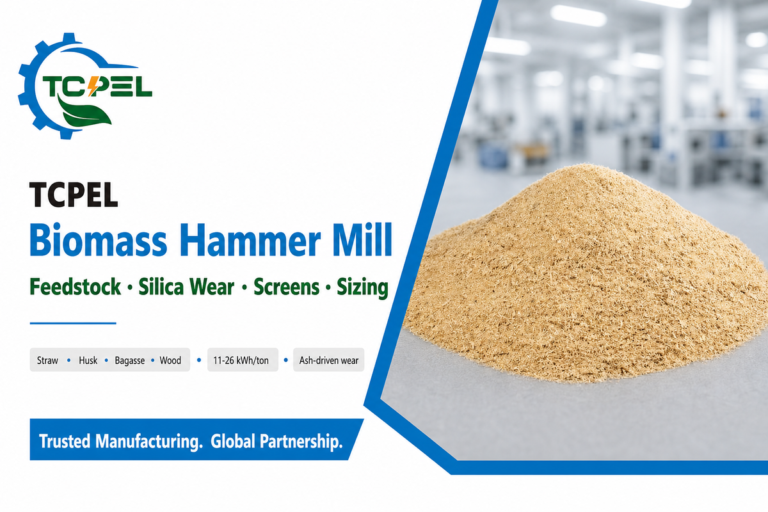
| Hammer Mühle | Impact | 1–8 mm, widest particle distribution of the group | Already-chipped or pre-shredded material, secondary stage only | Continuous, always secondary |
| Rotary shear crumbler | Shear | Tightest particle distribution of the group (tested on corn stover) | Fractionated agricultural residue | Continuous, research/production scale |
| Knife mill | Cutting | On-spec sizing at the lowest energy draw of the group (corn stover test) | Corn stover fractions | Kontinuierlich |
If your process is a continuous-feed biomass pellet process, TCPEL’s TCSC industrial bale grinder line covers the applicable “disc-shear” category. Model-level throughput and FOB specifications are listed on that page. What follows here’s concerned with the larger question that page doesn’t address: that of integration into the line that surrounds it and how to appropriately size the component in question.
💡 Pro-Tipp
Any search hit or specification that uses the terms “PTO shafts”, “shear pins”, or “towing hitch” suggests the product in question belongs to the “ag” category — that information can be useful context, but should not be used as a specification comparison to an industrial-process bale grinder.
The 5-Stage Process Flow, Where the Bale Grinder Fits in a Biomass Pellet Plant
How Do You Integrate a Bale Grinder Into a Pellet Plant or Briquette Line?
Five elements make up the basic process line for commercial biomass pellet plants: the bale grinder, a buffer or surge bin, a hammer mill, a dryer, and the pelletizing unit itself, followed by a pellet cooler and a pellet packing machine. While narrow, the grinder’s role is essential — it must break down an irregularly shaped, often-entangled bale into a much smaller, more uniform size that flows consistently into the stages after it.
Get every stage of a complete biomass pellet production line lined up correctly and the production of biomass fuel from raw bales becomes a repeatable process rather than a daily improvisation — the “packer” at the far end just bags what the front end already got right.
A peer-reviewed review of bioenergy storage and preprocessing systems covers this same handling chain in more general terms: physical and mechanical challenges compound at every handoff between stages, which is exactly why each stage’s output has to match the next stage’s input tolerance, not just its own spec sheet.
Between the grinder and hammer mill sits a buffer or surge bin, easy to design around when costs are primary, and hard to tolerate when it’s in operation. Its purpose is to accommodate the intermittent feeding behavior of the bale grinder (it’s difficult to get any other machine to operate at a stable throughput rate and moisture content when it’s being fed batches of discrete bales), and provide a continuous feed into the downstream, typically continuous-feed, dryer and hammer mill. For example, consider a dryer that receives material at 25 tons per hour and a plant’s design call for a maximum 8-hour inventory. In this case the buffer should have capacity for at least 25 × 8 = 200 tons, a figure you would want to adjust to fit your own operational shift schedule and risk assessment, but the method itself, target hours of buffer × throughput rate, transfers directly to any scale.
Effective control over moisture content really boils down to the grinder upstream; efficient drying (typically a hot air rotary or flash dryer) will only bring the material down to its consistent target of a low moisture content — a fairly common figure for wood pellet production is between 10-15 percent, on a wet basis — provided that what comes to it has fairly uniform particle cross-section – your target here’s the sawdust grade fraction to which your hammer mill will eventually bring the stuff – dump into it everything from boulders down to dust and you end up with burned skins over damp interiors that translate to a sticky die or soft press die on a wood pellet press — granulation quality at the far end of the pellet production line traces straight back to how consistently the grinder did its job at the front. Another observation worth taking into serious consideration from a known industry operator comes from Jason Kessler, founder of the KESCO company that specializes in integrated pellet plants, that he has repeatedly spoken out against structuring a pellet mill plant as a sequence of unconnected “islands” –
“The wood pelleting industry has historically developed projects using an ‘island’ philosophy: the dryer island, the dry hammermilling island, the pelleting island, the wood yard, etcetera… This has often resulted in choppy operations that are designed around a series of small successes, in an industry that is judged on one thing: finished pellets out the door.”
And that’s precisely the bale grinder, it’s not a standalone purchase, but a step that dictates the rhythm for every other island.
Technische Anmerkung
Pellet material screens are generally run at 4-6mm; the bale grinder is designed to output material to feed to the hammer mill that’s of sufficient fineness (ideally in the 20-40mm range but as fine as 10-50mm is useful) that it isn’t being forced to undertake coarse and fine reduction in one step. As a rule of thumb, if your hammer mill amp load swings by roughly 20-30% under normal circumstances the first culprit is going to be too big or too varied of an output from the grinder.
Failure Modes When Whole Bales Bypass Pre-Shredding
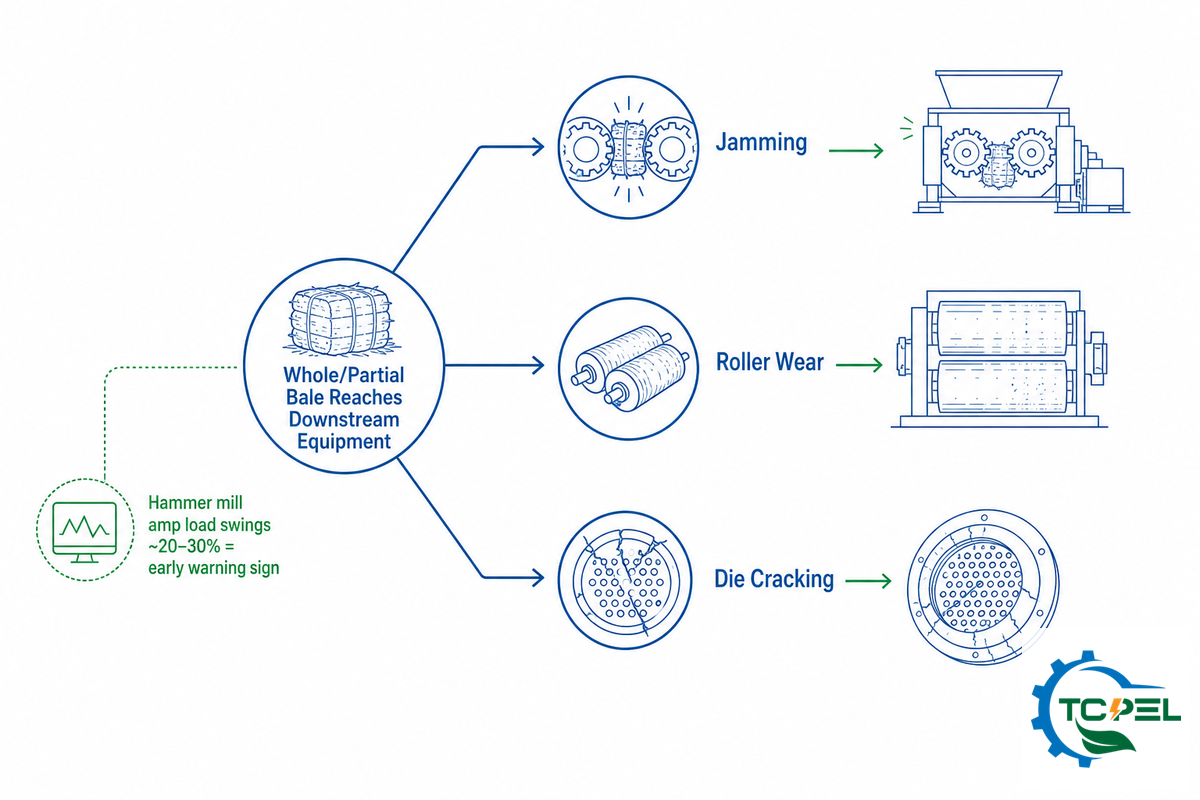
Omit the pre-shredding step or underestimate its size, and the failure modes are physical, not philosophical. Throwing whole bales or partial ones at a hammer mill or pellet press leads to pluggages at the infeed, imbalanced loading of the rollers, and-in the case of the pellet press-die cracking because an oversized product has forced itself through a die sized for much more uniform material. Kessler’s description of blockages in new plants indicates a related, less visible type of failure: on paper, pre-shredded material and micro-chips might look quite similar (particle size, bulk density, and moisture content) but when handling, the pre-shredded material “can nest together” and cause discharge and chute pluggages where finer microchips wouldn’t.
This is a material handling failure rather than a grinding failure, though it will be blamed on the grinding equipment — and every hour spent clearing a chute jam is an hour of lost uptime the plant doesn’t get back.
The second failure type: combustible dust. This isn’t a matter of general precautions; there’s a specific, recently updated standard that governs it directly. In December 2024, NFPA published NFPA 660, Standard für brennbare Stäube und partikuläre Feststoffe, which consolidates former NFPA standards that covered various dust categories, including those specific to agriculture (NFPA 61), wood (NFPA 664), and the combined dust hazards standard (NFPA 652) into a single document, with agricultural and food industry-specific requirements in Chapter 21 and biomass-industry-specific requirements in Chapter 24. NFPA 660 requires any facility handling combustible dust to perform a Dust Hazard Analysis (DHA) — an engineering assessment that reviews the “explosion pentagon”: fuel, oxygen, dispersion, containment, and ignition. This analysis must be reviewed and updated at least every five years, or whenever production rate, moisture content, or equipment changes materially.
“Fine wood particles required for pellet production behave much like gasoline in dust form. They are highly ignitable, easily dispersed and capable of reaching explosive concentrations when suspended in air… Most wood dust used in pellet production falls within well-documented explosibility ranges. Fine, dry wood dust is typically classified as ST1 under NFPA standards, meaning it has a Kst value between 1 and 200 bar·m/s.”
OSHA’s own technical manual has long recognized combustible dust as a high-priority inspection topic, and the US Chemical Safety Board investigation into the Didion Milling grain dust explosion in 2017 is a well-documented example of the consequences of permitting dust accumulation and ignition sources in agricultural facilities. A bale grinder producing dry, finely sized agricultural materials is directly within the scope of this failure class. Therefore, the designers of a facility focused around a bale grinder must incorporate a contemporary DHA as a critical input to design, not merely a regulatory checkbox — and that includes sizing every dust collector on the line to the actual fines load the grinder generates, not a generic catalog figure.
How Shear-Type Disc Mill Defibration Actually Works
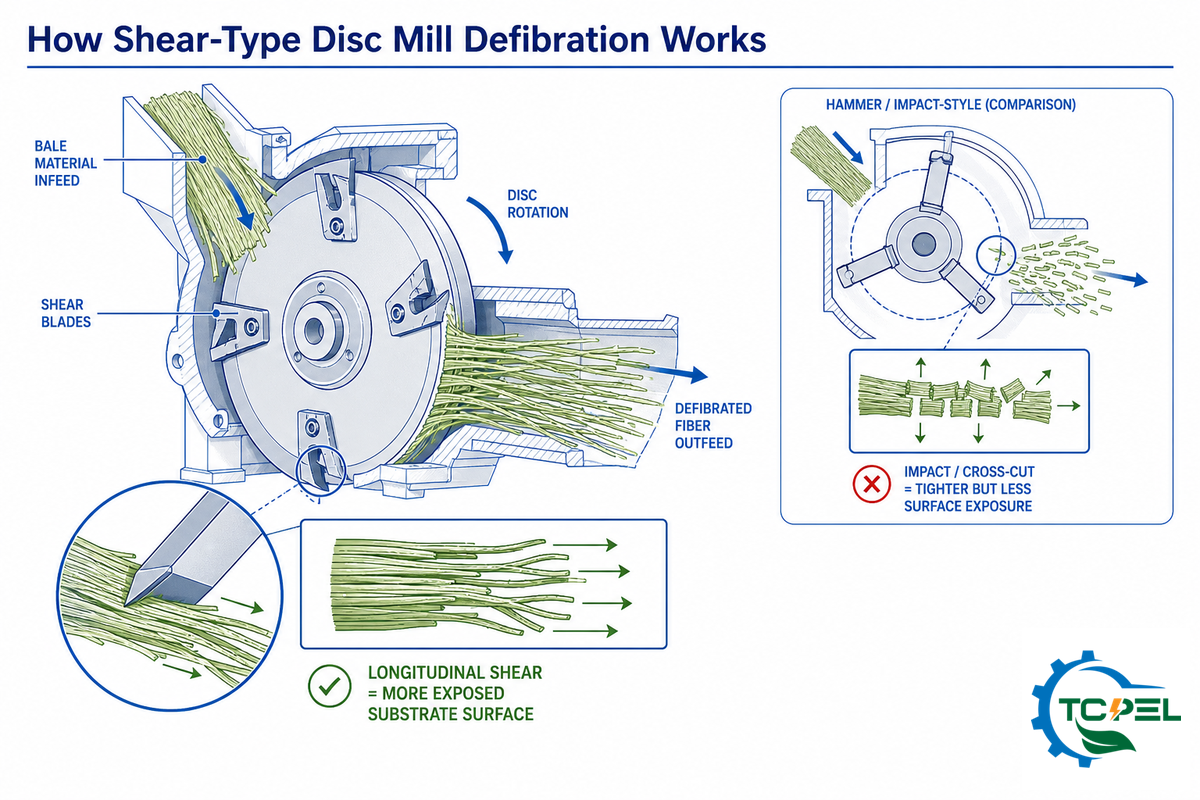
How a machine works doesn’t matter simply on an academic level – it matters what comes out the back end. Lignocellulosic biomass undergoes mechanical pre-treatment via cutting, shearing, compression, tearing and breaking processes, according to a review of mechanical pretreatment methods for lignocellulosic biomass. The dominant mechanism in a given machine directly shapes the material’s physical properties downstream.
A widely cited study of lignocellulosic biomass recalcitrance indicates that reduction of particle size enhances access to the cellulose within plant fibers via an enzymatic or thermal pathway; by size-reducing, one is quite literally “dissecting” the structure which resists breaking down. Separate research on particle-size reduction and enzymatic hydrolysis has shown that meaningful improvements in yield for a high-solids process occur when lignocellulosic biomass is size-reduced to 2.5mm or less. These principles aren’t unique to pelletizing and apply broadly across lignocellulosic biomass, from biomass wood and agricultural residue to biofuel production feedstocks generally. However, they do explain why, in many instances, shearing a biomass material along the fiber grain results in a more uniform and thus more readily processed fraction than impacting the material and breaking it apart.
That difference plays out directly in a comparative test on corn stover conducted at Idaho National Laboratory’s Biomass Feedstock National User Facility that tested the same material on a rotary shear crumbler, a knife mill, a hammer mill, and a shredder. Result: “the hammer mill has the widest particle size distribution while the rotary shear crumbler has the tightest,” with the knife mill best at matching both the target particle size range and lowest energy consumption for that specific feedstock. In plain language: impact mechanism (hammer mill) gave least consistent results, shear mechanisms offered tighter control. That’s a real research infrastructure result, not a vendor claim, and it’s one of few published pieces that compare mechanism choice directly rather than just assert it. Getting this wrong isn’t just a theoretical problem: because impact-type mills produce a wider particle spread, they hand the downstream dryer and press a more inconsistent feed than a shear-type mechanism working the same feedstock. In practice, TCPEL builds its TCSC line around the shear mechanism for exactly this reason.
One point is worth emphasizing directly: the most readily available data on silica- and ash-driven wear for biomass milling relates to the final grinding stage of a hammer mill, not specifically this earlier bale-opening step. Lower wear on a shear mechanism (cuts fiber, doesn’t abrade a surface) versus an impact mechanism is a reasonable expectation given the underlying mechanics, but specific independent, published wear rates aren’t yet available for the pre-shredder stage alone. Consider that a mechanistic inference.
Feedstock Diversity, Why Rice Straw, Wheat Straw, Corn Stalk, and Grass Bales Aren’t Interchangeable
What Types of Biomass Can a Bale Grinder Process, Rice Straw, Corn Stalk, Wheat?
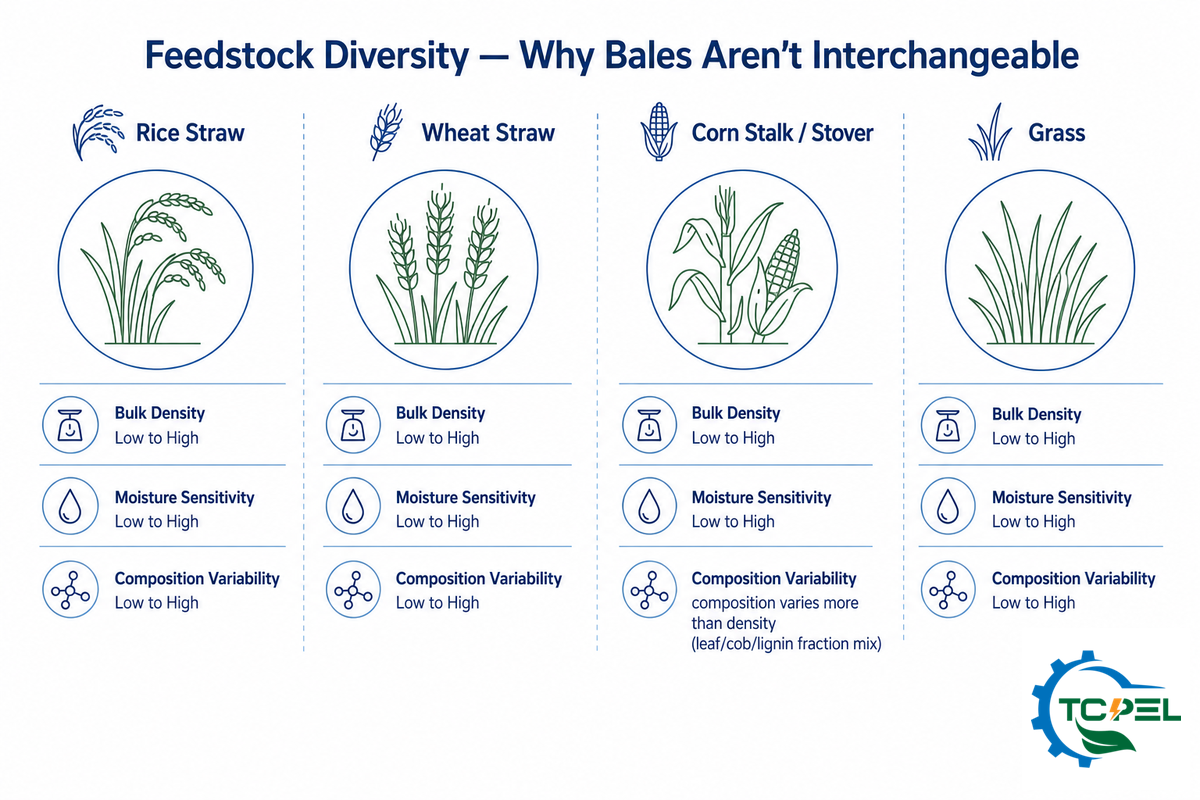
A bale grinder built for straw can generally handle a wider array of baled organic materials, whether that’s agricultural waste like rice straw, wheat straw, and corn stalk, or energy-crop bales such as miscanthus and baled sugarcane residue. But “can handle” and “processes exactly the same way” are quite different claims: density and moisture vary enough within each feedstock to change the sizing math, regardless of whether the end product is a standard-size or small pellet.
A published study of wet and dry wheat straw and switchgrass bulk density reports it across a very wide range, largely as a function of moisture content-approximately 24-266 kg/m³ as moisture varies (increasing moisture, higher density); a different study of a specific wheat variety yielded densities of 97.5-177.2 kg/m³ across 5-8% moisture. That variability all goes away when you pelletize the feedstock-a comparative pellet-density study found wheat straw pellets had the highest bulk density (495.8 kg/m³) of the four biomass types tested, but your raw, baled material won’t have that level of homogeneity as it goes in. The bale that was field-harvested with 20% moisture will process very differently than the one that was stored indoors under a roof with 12% moisture content, despite carrying the same official bulk density on paper.
Corn stalks introduce a second axis of variability beyond moisture: composition, a factor a U.S. Department of Energy review of lignocellulosic biomass variability treats as central to size-reduction planning. Corn stover – stalks, leaves, cobs and husks – totals some 144 million dry tons per year in the U.S., and an Idaho National Laboratory database indicates compositional variations: leaf percentage from 6% to 36% of total mass, cob percentage from 9% to 34%, and lignin percentage from 11.5% to 24%. This variation is large enough that two truckloads of stover might behave very differently. Research into pre-blending stover for targeted compositions – one paper shows that mixing 40% cob, 30% leaf, 15% stalk and 15% husk can increase total carbohydrates by 8% and decrease total ash by 66%, producing a final pellet with roughly 500 kg/m³ bulk density and 98.5% durability – demonstrates its potential benefits. A bale grinder for a single feedstock line won’t require this complexity, but it’s a lesson nonetheless: bales of stover from different fields, harvested at different times, or grown in different regions aren’t interchangeable inputs, and a sizing decision based on one sample might prove incorrect for the next. Underestimating this variability is a common and expensive mistake: a bale grinder specified against one density sample can hit a real problem the first time a denser regional harvest shows up, because raw bale density swings with moisture and composition far more than a single spec sheet implies. TCPEL sizes its TCSC line with that swing in mind — in practice, a feed mill or pellet plant running mixed regional supply needs a documented density and moisture check at intake, not a one-time calibration against the first truckload.
| Ausgangsmaterial | Raw bulk density range | Primary variability driver |
|---|---|---|
| Wheat straw (raw) | ~24–266 kg/m³ (moisture-dependent); ~97.5–177.2 kg/m³ at 5–8% moisture | Moisture content |
| Switchgrass (raw) | ~49–266 kg/m³ (moisture-dependent) | Moisture content |
| Maiskolben | Composition varies more than density: leaf 6–36%, cob 9–34%, lignin 11.5–24% | Fraction mix (leaf/cob/stalk/husk ratio) |
| Wheat straw (pelletized) | 495.8 kg/m³ (highest of 4 biomass types in the cited study) | N/A — post-processing, density stabilizes |
Sizing the Bale Grinder to Your Real Plant Throughput, Not Its Own Maximum
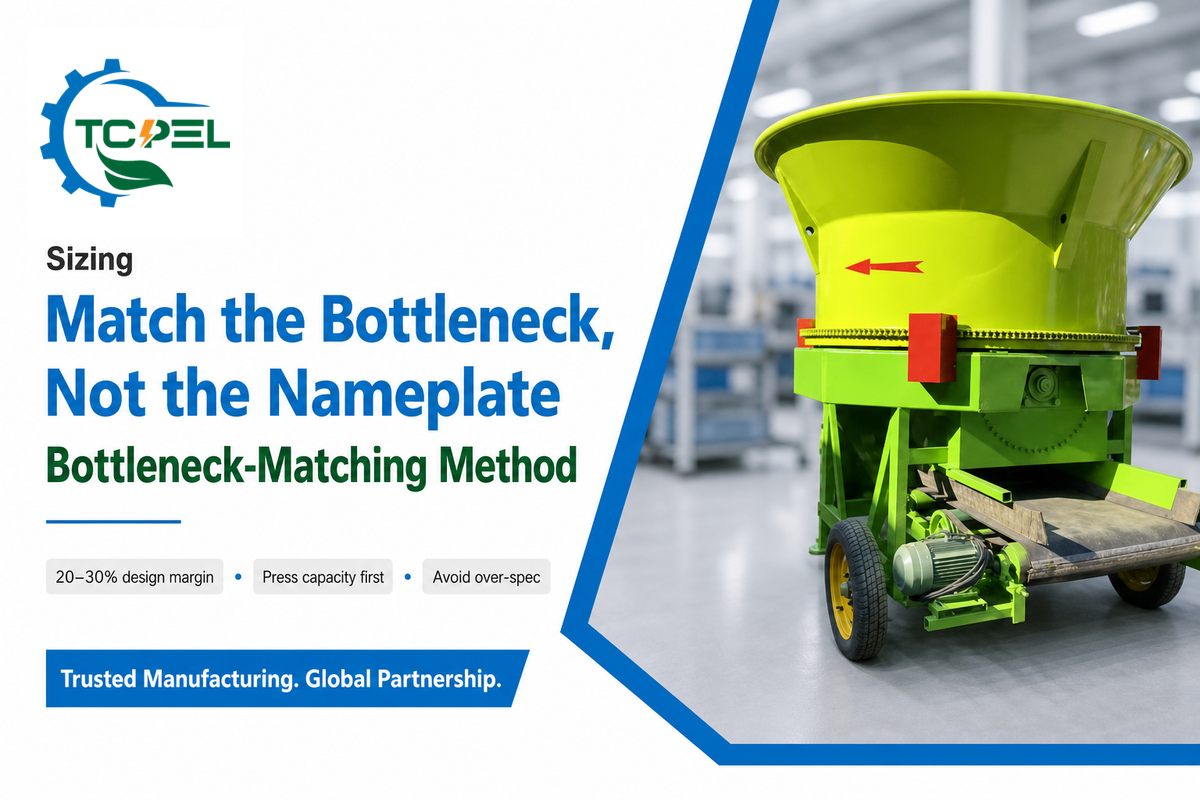
This is the research finding most relevant to specifying a bale grinder: The most significant real-world factor that leads to process-flow bottlenecks isn’t buyer caution and over-specifying equipment, but the opposite. When asked to pinpoint the source of process-flow bottlenecks in new facilities, KESCO’s Jason Kessler’s response centered on price:
“It’s easy for producers to ask why manufacturers aren’t more conservative in their sizing of equipment, the short answer is price. Most pellet plant purchasing decisions are being made on price… The greatest cost to a pellet plant is not producing pellets at the design rate, quality or within a timeframe that meets their contractual commitments. Establishing a design safety factor with the client is one of the most effective ways to eliminate potential bottlenecks while managing expectations of the system price.”
In essence, the problem isn’t a buyer accidentally overbuying a bale grinder “just in case”; it’s that the competitive bidding process systematically chips away at the plant’s actual safety margins in favor of lower prices on quotes. The approach, the Bottleneck-Matching Method, is to size the bale grinder based on the actual choke point of the line – normally the hammer mill or dryer – not the grinder’s maximum output rating, and to treat any margin as a conscious design choice.
Worked Example: Sizing a Bale Grinder Against a 1 t/h Pellet Mill
- Focus on your true constraint, not the grinder. For instance, assume your pellet press is rated for 1.0 t/h of final product.
- Implement a safety factor upstream. It’s common practice for integrators to design shredding and feeding equipment with a 20% to 30% buffer over the downstream press’s capacity – so, for a 1.0 t/h press, your bale grinder and feeding system should supply around 1.2 to 1.3 t/h to the buffer, rather than the 1.0 t/h that exactly matches the press.
- Sizing of the buffer / surge bin – you need to size it for your hours of coverage, not your grinder cycle time. Using the “target-hours × throughput” method, if you want approximately 30 minutes of coverage with a 1.2 t/h grinder output, your bin size will be approximately 0.6 tons – a very small number here, but if the 1.2 t/h becomes a 25 t/h production line with an 8-hour buffer requirement, you would need about 200 tons of silo storage.
- Verify that your hammer mill screen and dryer can handle the grinder’s maximum output, not just its average. If your grinder produces 1.2 t/h on average, but during a dense bale you spike to 2 t/h, the grinder will likely plug the hammer mill that you sized based on average throughput.
Note: The 20-30% design margin figure presented above is a rule of thumb followed by most integrators, not a published engineering standard. Consider this a guideline for discussion with your equipment supplier, rather than a hard and fast rule.
For specific model throughput and FOB data (after determining your target bottleneck), consult TCPEL’s TCSC disc-crusher specifications, which cover throughput in the range of 2-12 t/h across three frame sizes.
A 4-Point Bale Readiness Protocol Before You Feed the Grinder
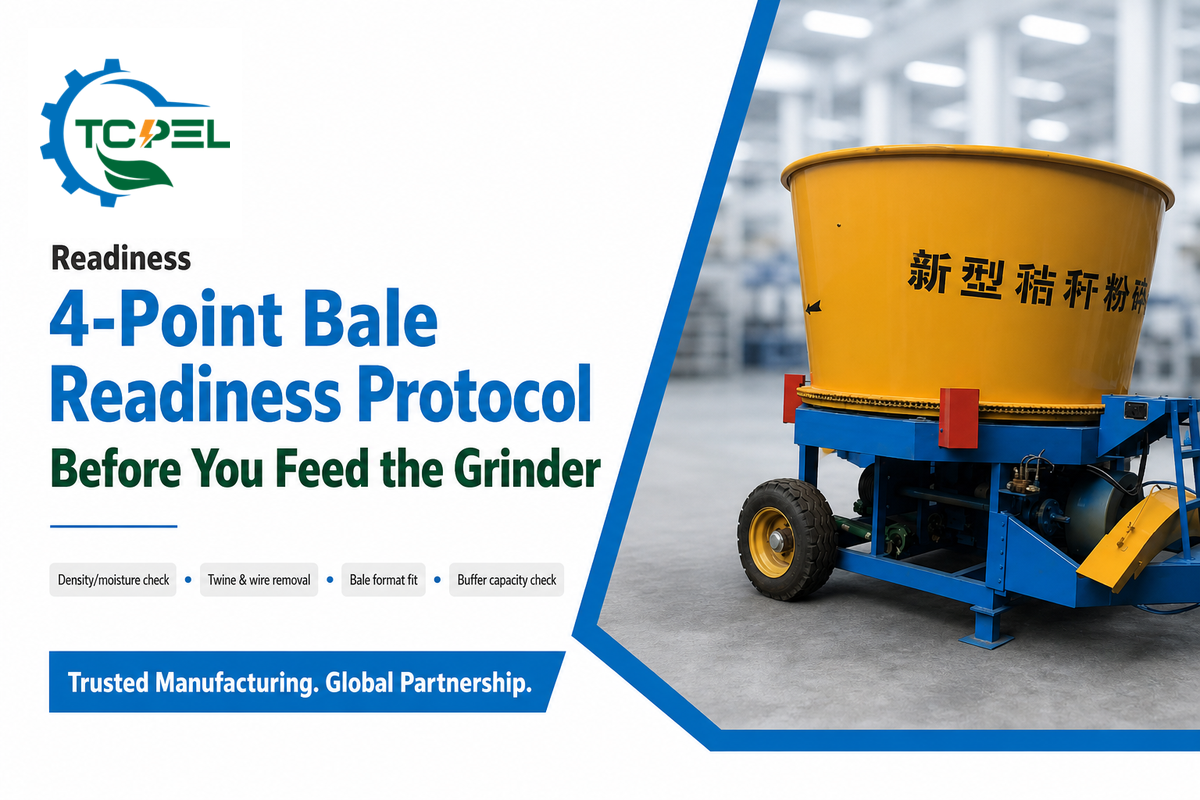
Most unnecessary grinder problems aren’t the fault of the machine, but the material being fed into it — a well-specified direct-drive motor and gearbox will still jam on a bad bale. Here are four checks to run at the in-feed, prior to each bale loading, that catch the vast majority of potential issues before they lead to a jam or an equipment failure related to a metal detector activation. Running through them takes a few extra seconds and keeps the whole line in easy operation instead of firefighting mode:
- Density and moisture spot check. Because raw straw bulk density can vary widely based on moisture, check the current density against the last known calibration of a good bale before you feed it to your grinder. This flags bales that will behave unexpectedly when you introduce them into the grinder.
- Twine, wire, and net wrap removal. Undesired baling twine and net wrap is one of the primary causes of rotors and shaft wrapping, while baling wire poses a direct threat to blades and could potentially be an ignition source under the same conditions OSHA’s combustible dust guidance covers.
- Bale format compatibility. Make sure to verify round vs. square bale dimensions and ensure they conform to your grinder’s maximum rated intake. Your machine, for instance, may be specified for a particular size of round bale and yet it may not handle a slightly larger square bale, which could cause plugging at the infeed.
- Staging and buffer check. Ensure the buffer bin following the grinder has sufficient capacity to handle the discharge of the upcoming bale; this step often prevents many problems before they happen. Feeding an already-full buffer is a very common and completely avoidable error.
Industry Outlook, The Shift Toward Multi-Feedstock Pellet Plants
Relying on a single feedstock represents a supply-and-price risk, and that risk is now readily visible in the design of new pellet plants. Two independent perspectives confirm this shift. First, a recent industry analysis of 2026 milling-equipment trends reports a movement that’s “decisively toward multi-feedstock plant designs capable of processing wood residues, agricultural straws, and energy crops.” Second, KESCO’s Jason Kessler observes in relation to current wood-pellet projects that “green chip shredding is being incorporated into most new wood pellet plants,” adding a pre-shredding stage that improves input flexibility. When two entities with different vantage points – a trend analysis and a system integrator – both independently highlight the same trend, the signal becomes stronger. A U.S. Department of Energy review of biomass feedstock variability gives that shift a technical foundation: documented composition swings within a single feedstock category are exactly what a multi-feedstock-capable line is built to absorb. Whatever the end use — pellets bound for a residential boiler, an industrial power plant, or export as a renewable fuel — fuel production that starts with a flexible bale grinder is better positioned than a line locked to one crop.
This implies a practical lesson for selecting a bale grinder in 2026: a plant designed around a single feedstock assumes that the input won’t change during the equipment’s lifespan. Since the composition even of a single type of feedstock can vary considerably – for instance, the lignin content in corn stover alone can range from 11.5% to 24%, depending on the source – a plant that can accept straw, stalk, and grass bales without modification is at an advantage, regardless of whether it ever actually does so. Although the volume of the global biomass pellet market is expected to continue increasing into the 2030s according to most projections, the true impetus for building in multi-feedstock capacity is the desire to manage supply-side risks, not just to cater to market growth.
Unsere Perspektive
This guide focuses on the systems and sizing questions we see come up repeatedly once a plant has already decided on an industrial bale grinder, where it sits in the line, how feedstock variability changes the sizing math, and why the price-vs-safety-factor tension in Jason Kessler’s account of KESCO’s project history matches what shows up across the wider preprocessing literature. TCPEL builds the disc-crusher hardware described in the comparison table above; the process-flow and sizing methodology here’s meant to be useful whether or not that hardware is the one you end up specifying.
Häufig gestellte Fragen
Q: What is a bale grinder, and how is it different from a bale shredder or bale processor?
Antwort anzeigen
In practice, the terms bale grinder, bale shredder, and bale processor overlap heavily and are often used interchangeably by manufacturers, which is part of why the search results for this term are so mixed. A more useful distinction than the name is the equipment category: a stationary, continuous-duty industrial machine built into a biomass pellet plant’s process line versus a mobile, PTO-driven machine built for on-farm cattle feed or bedding preparation. Both grind or shred bales; they are specified, bought, and operated by completely different buyers for completely different jobs.
Q: What are the main components of a biomass shredder or bale grinder system?
Antwort anzeigen
An industrial bale grinder system is rarely just the grinder itself. Its complete front-end typically includes a bale infeed system (apron conveyor or hydraulic pusher for round bales and heavy offcuts), the grinder or shredder unit itself, an overband or drum magnet for metal separation immediately after discharge, a belt conveyor to the buffer bin, and a surge or live-bottom buffer bin that decouples the grinder’s cycling from the steady feed the dryer and hammer mill need downstream. Dust extraction and explosion-venting equipment are also part of a compliant system given the combustible-dust classification of dry agricultural material under NFPA 660.
Q: Why does a bale grinder produce uneven particle size, and how is that fixed?
Antwort anzeigen
Eine ungleichmäßige Partikelgröße außerhalb einer Ballenmühle ist meist ein Symptom einer Futterinkonsistenz und kein Defekt in der Maschine. Ballen, die in Feuchtigkeit und Dichte variieren (wie in der obigen Rohstofftabelle gezeigt, kann die Rohweizenstrohdichte allein etwa 24266 kg/m³ betragen), werden selbst durch einen identischen Rotor unterschiedlich zerkleinern. Abgenutzte Klingen oder hamm erweitern die Partikelgrößenverteilung über die Zeit, unabhängig vom Ausgangsmaterial, bei dem es sich um in Vergleichstests gemessene Schermaschinen handelt, um eine engere Partikelgröße als Schlagmaschinen auf demselben Material zu halten sind es wert, die Spezifikation zu verstehen, nicht nur die Wartungsstufe, Drift und Drift des Driftplans/des Ballen, ein konsistentes Ballen, ein Ballen, ein Ballen, ein Ballen, ein Ballen, ein Ballen, ein Ballen, ein Ballen, ein Blech, ein Blech, ein Blech, ein Blech, ein Blech, ein Blech, ein Blech, ein Blech, ein Blech, ein Blech, ein Blech, ein Blech, ein Blech, ein Blech, ein Blech, ein Blech, das am meisten dokumentiert.
Q: Can a biomass pellet plant run without a dedicated pre-shredding stage?
Antwort anzeigen
Technisch ja, einige sehr kleine Betriebe speisen loses oder vorgebrochenes Material direkt in eine hammer-Mühle ein, aber für eine Ballenpflanze ist dies ein bekannter Fehlermodus, keine Konstruktionskurzfassung Das Zuführen ganzer oder teilweise gebrochener Ballen direkt in eine hammer-Mühle oder Pelletpresse verursacht jamming, ungleichmäßige Walzenbelastung und Gesenkrisse durch übergroßes Material, das sich durch eine feine Matrize drängt.
Q: What types of biomass bales can a bale grinder process?
Antwort anzeigen
Eine industrielle Ballenmühle, die für landwirtschaftliche Rückstände ausgelegt ist, verarbeitet typischerweise Reisstroh, Weizenstroh, Maisstängel sowie Gras- oder Energieballen im runden oder quadratischen Format. Maisstängelballen laufen tendenziell dichter und variabler in der Zusammensetzung als Stroh und benötigen oft eine größere Rahmengröße für den äquivalenten Durchsatz.
Q: How do I know if my bale grinder is undersized for my pellet line?
Antwort anzeigen
Recurring hammer mill amperage swings, frequent buffer-bin empty alarms, or a pattern of the pellet mill cavitating during peak demand are the practical warning signs. Per the Bottleneck-Matching Method above, compare your grinder’s real delivered throughput — not its nameplate rating — against your pellet mill’s rated capacity plus a margin; a gap under roughly 10–15% is worth reviewing before it becomes a recurring stoppage.
Q: Does bale moisture affect bale grinder performance?
Antwort anzeigen
Yes, measurably. Raw wheat straw and switchgrass bulk density has been measured rising from roughly 24 kg/m³ toward 266 kg/m³ as moisture content increases, and that density swing changes feed behavior, throughput, and downstream drying load. Bales sourced at inconsistent moisture are one of the most common reasons a correctly sized grinder still produces inconsistent output.
Referenzen und Quellen
- OSHA Technical Manual, Section IV: Chapter 6, Combustible DustsUS-amerikanische Arbeitsschutzbehörde
- Consolidated Dust: NFPA 660, Standard for Combustible Dusts and Particulate SolidsNationaler Brandschutzverband
- Didion Milling Factual Investigative UpdateU.S. Chemical Safety and Hazard Investigation Board
- Understanding the Impact of Lignocellulosic Biomass Variability on Size ReductionU.S. Department of Energy, Office of Scientific and Technical Information
- Lignocellulosic Biomass: Understanding Recalcitrance and Predicting HydrolysisNational Institutes of Health, PubMed Central
- Current Challenges in Commercially Producing Biofuels from Lignocellulosic BiomassNational Institutes of Health, PubMed Central
- Review on Bioenergy Storage Systems for Preserving and Preprocessing BiomassNational Institutes of Health, PubMed Central
- Mechanical Pretreatment of Lignocellulosic Biomass Toward Enzymatic/Fermentative ValorizationScienceDirect
- Impact of Particle Size Reduction on High-Gravity Enzymatic HydrolysisSN Applied Sciences / Springer
- Bulk Density of Wet and Dry Wheat Straw and Switchgrass ParticlesApplied Engineering in Agriculture / FAO AGRIS
- Physical Properties of Pellets Made from Sorghum Stalk, Corn Stover, Wheat Straw, and Big BluestemScienceDirect
- Enhancing Pellet Quality: Advanced Preprocessing Techniques for Corn StoverBiomass Magazine (Zachary P. Smith, Idaho National Laboratory)
- Five Questions with KESCOBiomasse-magazin
- From Reactive to Proactive: Dust Hazard Analyses Strengthen Safety in Pellet MillsBiomass Magazine (Alysha Yinger, RoboVent)
- ISO 17225-1:2021, Solid Biofuels, Fuel Specifications and ClassesInternationale Organisation für Normung
- CA2902255C, Processing BiomassGoogle Patents
Verwandte Artikel
- Biomass Hammer Mill: The Feedstock-Driven Guide to Grinding Straw, Husk, Bagasse & Woodthe next stage downstream of the bale grinder
- Feed Grinding Hammer Mill: A Particle-Size Guide for Animal Feed Producers
- Biomasse-Pelletmaschine: Kompletter technischer Leitfadenwhere the material ends up after drying
- TCPEL Rotary Dryersstage 4 of the process flow described above
- TCPEL Drum Chippersthe equivalent size-reduction stage for clean whole-tree wood instead of baled residue
- TCPEL Biomass Equipment Overview