Entre em Contato com a TCPEL


Atualizado em julho de 2026 · Revisado pela equipe técnica da TCPEL
Um moedor de fardos para fábricas de pellets de biomassa é a primeira etapa da transformação de palha, talos de milho ou capim em uma matéria-prima uniforme que o moinho de martelos e a prensa peletizadora conseguem processar. Se for subdimensionado em relação ao restante da linha da fábrica de pellets, ele se tornará o gargalo responsável por obstruções, desgaste dos roletes e paradas não programadas nas etapas seguintes, fazendo a diferença entre uma fábrica que transforma resíduos enfardados em combustível renovável de biomassa com confiabilidade e outra que enfrenta problemas na alimentação do processo a cada turno.
O moedor de fardos para fábricas de pellets de biomassa é a primeira etapa de redução granulométrica, convertendo fardos de palha prensada em uma matéria-prima uniforme que os moinhos de martelos e as prensas peletizadoras realmente conseguem processar. Elimine essa etapa ou dimensione-a incorretamente em relação ao restante da linha, e ela será o motivo pelo qual uma nova fábrica de pellets nunca alcançará sua capacidade nominal ou enfrentará problemas a cada turno.
Pontos principais
- Grande parte do déficit de capacidade decorre da pressão para reduzir preços, que elimina a margem de segurança, e não de compradores que pedem máquinas superdimensionadas apenas por precaução.
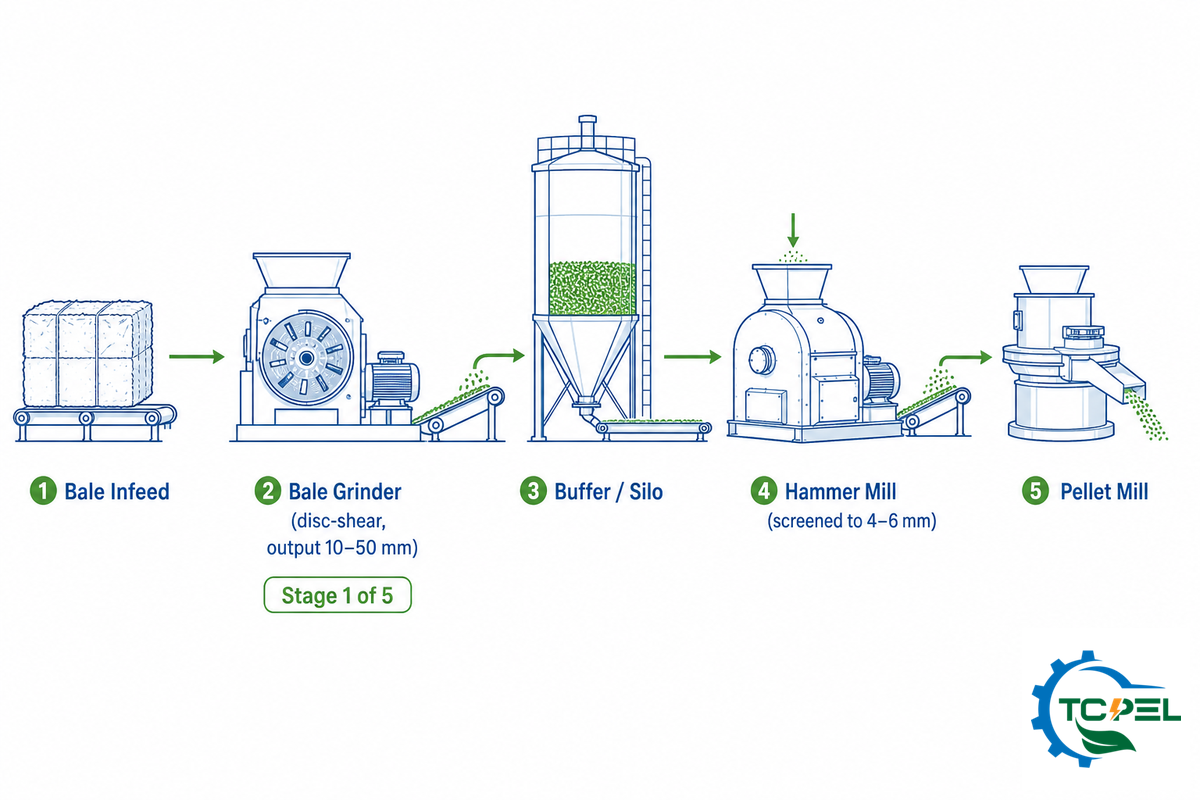
- A etapa 1 de 5 é o moedor de fardos: moedor → silo de pulmão → moinho de martelos → secador → peletizadora.
- Moedores industriais de fardos por cisalhamento com discos e trituradores agrícolas de cuba acionados pela tomada de força pertencem a classes diferentes de equipamentos, desenvolvidas para trabalhos distintos — o termo de pesquisa coincide, mas as máquinas não.
- O tipo de matéria-prima altera o cálculo de dimensionamento: a densidade aparente da palha de trigo bruta pode variar de aproximadamente 24 kg/m³ a 266 kg/m³, dependendo do teor de umidade.
- A NFPA 660, publicada em dezembro de 2024, agora regulamenta as normas relativas a poeiras combustíveis em instalações de biomassa alimentadas com fardos, substituindo a divisão anterior entre as normas NFPA 61/664.
Especificações rápidas
| Posição no processo | Etapa 1 de 5, antes do silo de pulmão, moinho de martelos, secador e peletizadora |
| Granulometria típica após a pré-trituração | 10–50 mm, alimentando um moinho de martelos com peneira de aproximadamente 4–6 mm para peletização |
| Duas categorias de máquinas | Moedor industrial estacionário por cisalhamento com discos versus triturador agrícola móvel de cuba acionado pela tomada de força |
| Matérias-primas abordadas aqui | Fardos de palha de arroz, palha de trigo, talos de milho, capim e culturas energéticas |
O que é um moedor de fardos? Trituradores industriais de discos versus trituradores agrícolas de cuba
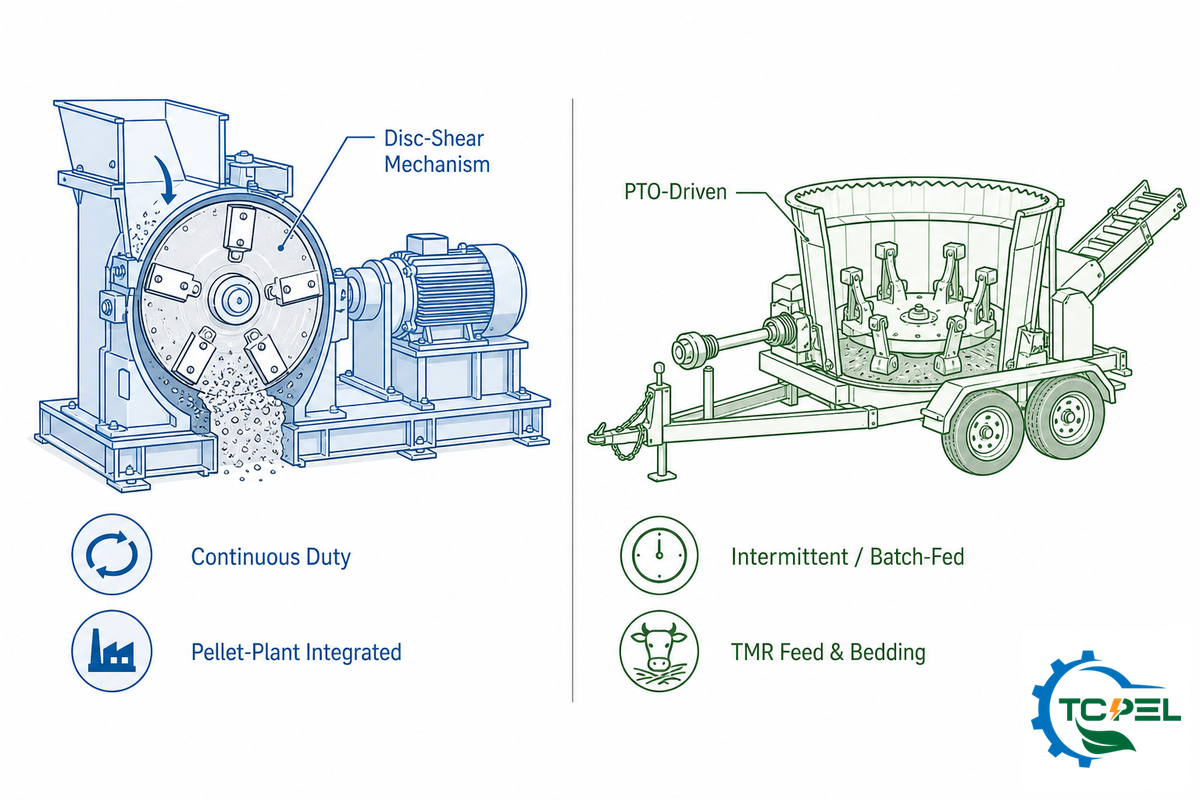
A expressão “moedor de fardos” descreve 2 tipos diferentes de equipamentos especializados, e confundi-los atrasará o cronograma de aquisição. Um moedor industrial estacionário de fardos por cisalhamento com discos foi projetado para integração à linha de processo de uma fábrica comercial de pellets de biomassa ou de ração, usando um disco de cisalhamento de alta resistência para transformar a matéria-prima comprimida — palha enfardada — em uma fração uniforme e de fluxo livre, pronta para a moagem posterior no moinho de martelos.
O processamento de fardos dessa forma é uma etapa distinta de qualquer operação para a qual um implemento acoplado a trator é construído, além de ser o ponto de entrada de uma linha completa de produção de pellets de biomassa.
Há também o triturador agrícola de cuba ou processador de fardos, um sistema móvel acionado pela tomada de força e destinado a picar fardos de feno ou palha para preparar o material para mistura de ração total de bovinos ou cama comercial de estábulos. Esse último equipamento geralmente é rebocado por um trator e opera de forma intermitente.
Essa distinção é importante do ponto de vista mecânico, não apenas semântico. Uma patente dos Estados Unidos para equipamentos de processamento de biomassa descreve uma das categorias desse grupo como um “conjunto triturador-cisalhador”, no qual uma etapa de trituração é seguida por cortadores com facas rotativas que reduzem o tamanho da matéria-prima de biomassa antes de sua entrada na conversão posterior, uma arquitetura mais próxima da categoria dos moedores industriais de discos do que do triturador de cuba rebocado por trator. Não confunda nenhuma dessas máquinas com um picador de madeira de tambor ou de disco, que utiliza facas de alta velocidade contra uma contrafaca fixa para produzir cavacos uniformes a partir de toras e galhos de madeira limpa, e não de material agrícola enfardado ou fluxos gerais de resíduos de madeira. Os picadores processam madeira de árvores inteiras, e não fardos de resíduos agrícolas, e a TCPEL os fabrica em uma linha de produtos separada especificamente para evitar essa confusão — cada categoria tem seu próprio ciclo de trabalho e sua própria vida útil esperada, definidos de acordo com o material que deve processar.
| Tipo de equipamento | Mecanismo | Granulometria típica de saída | Matéria-prima mais adequada | Ciclo de trabalho |
|---|---|---|---|---|
| Moedor industrial de fardos com discos | Cisalhamento (lâminas montadas em discos) | 10–50 mm | Palha, talos de milho e capim enfardados | Contínuo, integrado a uma linha de processo fixa |
| Triturador agrícola de cuba (tomada de força) | Impacto (martelos/batedores em uma cuba rotativa) | Variável, adequada para ração/cama animal | Fardos de feno e palha para animais de criação | Intermitente, alimentado em lotes e móvel |
| Triturador de dois eixos | Cisalhamento/rasgamento em baixa velocidade e com alto torque | 20–100 mm, grosseira | Biomassa misturada ou contaminada, paletes com pregos e fardos cilíndricos inteiros | Contínuo, redução primária na entrada da linha |
| Triturador de eixo único | Corte contra uma peneira | 10–40 mm, controlada pela peneira | Retalhos mais limpos e fluxos consistentes de resíduos | Contínuo, serviço médio |
| Picador de madeira a tambor | Faca de alta velocidade contra contrafaca | 10–30 mm, uniforme | Toras limpas, galhos e madeira de árvores inteiras | Contínuo |
| Picador de madeira de disco | Faca de alta velocidade contra contrafaca | 10–30 mm, uniforme | Toras limpas e madeira própria para fabricação de papel | Contínuo |
| Moinho de martelos | Impacto | 1–8 mm, a mais ampla distribuição granulométrica do grupo | Material já picado ou pré-triturado, somente como etapa secundária | Contínuo, sempre secundário |
| Desintegrador rotativo por cisalhamento | Cisalhamento | A distribuição granulométrica mais estreita do grupo (testado com resíduo de milho) | Resíduo agrícola fracionado | Contínuo, em escala de pesquisa/produção |
| Moinho de facas | Corte | Granulometria dentro da especificação com o menor consumo de energia do grupo (teste com resíduo de milho) | Frações de resíduo de milho | Contínuo |
Se o seu processo de produção de pellets de biomassa tem alimentação contínua, a linha TCSC de moedores industriais de fardos da TCPEL abrange a categoria aplicável de equipamentos por “cisalhamento com discos”. As capacidades de processamento e especificações FOB de cada modelo estão disponíveis nessa página. O conteúdo a seguir trata da questão mais ampla que aquela página não aborda: como integrar o componente à linha ao seu redor e dimensioná-lo adequadamente.
💡 Dica profissional
Qualquer resultado de pesquisa ou especificação que use os termos “eixos da tomada de força”, “pinos de cisalhamento” ou “engate de reboque” sugere que o produto em questão pertence à categoria “agrícola” — essa informação pode oferecer um contexto útil, mas não deve ser usada para comparar especificações com as de um moedor de fardos para processos industriais.
O fluxo do processo em 5 etapas: onde o moedor de fardos se encaixa em uma fábrica de pellets de biomassa
Como integrar um moedor de fardos a uma fábrica de pellets ou linha de briquetes?
5 elementos compõem a linha básica de processo das fábricas comerciais de pellets de biomassa: o moedor de fardos, um silo de pulmão ou de compensação, um moinho de martelos, um secador e a própria unidade de peletização, seguidos por um resfriador de pellets e uma máquina de ensacamento de pellets. Embora tenha uma função específica, o moedor é essencial — ele precisa desagregar um fardo de formato irregular, muitas vezes com fibras entrelaçadas, em uma fração muito menor e mais uniforme, capaz de fluir de maneira consistente para as etapas seguintes.
Quando todas as etapas de uma linha completa de produção de pellets de biomassa estão corretamente alinhadas, a produção de combustível de biomassa a partir de fardos brutos torna-se um processo repetível, em vez de uma improvisação diária — a “ensacadora” na extremidade final apenas ensaca o que a entrada da linha já processou corretamente.
Uma revisão por pares dos sistemas de armazenamento e pré-processamento de bioenergia aborda essa mesma cadeia de manuseio em termos mais gerais: os desafios físicos e mecânicos se acumulam em cada transferência entre as etapas, exatamente por isso a saída de cada etapa precisa corresponder à tolerância de entrada da próxima, e não apenas à sua própria ficha técnica.
Entre o moedor e o moinho de martelos fica um silo de pulmão ou de compensação, que parece fácil de dimensionar quando o custo é a prioridade, mas se torna difícil de tolerar durante a operação. Sua finalidade é absorver o comportamento intermitente da alimentação do moedor de fardos (é difícil fazer qualquer outra máquina operar com capacidade de processamento e teor de umidade estáveis quando recebe lotes de fardos individuais) e fornecer alimentação contínua ao secador e ao moinho de martelos posteriores, que normalmente operam em fluxo contínuo. Por exemplo, considere um secador que receba material a 25 toneladas por hora e uma fábrica projetada para manter um estoque máximo de 8 horas. Nesse caso, o silo de pulmão deve ter capacidade para pelo menos 25 × 8 = 200 toneladas, valor que deverá ser ajustado à programação dos turnos e à avaliação de riscos da sua operação, embora o método — horas desejadas de estoque no silo × capacidade de processamento — seja diretamente aplicável a qualquer escala.
O controle eficaz do teor de umidade começa, na prática, pelo moedor instalado na entrada da linha; a secagem eficiente (normalmente realizada por um secador rotativo de ar quente ou secador instantâneo) só reduzirá o material de forma uniforme até o baixo teor de umidade desejado — um valor bastante comum na produção de pellets de madeira fica entre 10–15 por cento, em base úmida — se o material recebido apresentar seção transversal relativamente uniforme, tendo como objetivo a fração com granulometria de serragem à qual o moinho de martelos finalmente reduzirá o material; despeje no secador partículas que variem de blocos grandes a pó, e o resultado serão superfícies queimadas com o interior úmido, o que causará aderência à matriz ou pellets macios na prensa peletizadora de madeira — a qualidade da peletização no final da linha de produção de pellets está diretamente ligada à consistência do trabalho realizado pelo moedor na entrada. Outra observação que merece consideração séria vem de Jason Kessler, fundador da empresa KESCO, especializada em fábricas integradas de pellets, que se manifestou repetidamente contra estruturar uma fábrica de pellets como uma sequência de “ilhas” desconectadas —
“Historicamente, a indústria de peletização de madeira desenvolveu projetos usando uma filosofia de ‘ilhas’: a ilha do secador, a ilha da moagem a seco em moinho de martelos, a ilha da peletização, o pátio de madeira e assim por diante… Isso muitas vezes resultou em operações fragmentadas, projetadas em torno de uma série de pequenos sucessos, em uma indústria avaliada por uma única coisa: pellets acabados saindo pela porta.”
E esse é precisamente o papel do moedor de fardos: ele não é uma compra isolada, mas uma etapa que determina o ritmo de todas as outras ilhas.
📐 Nota de engenharia
As peneiras para material destinado à peletização geralmente operam com aberturas de 4–6 mm; o moedor de fardos deve produzir material fino o bastante para alimentar o moinho de martelos (idealmente na faixa de 20–40 mm, embora uma faixa de 10–50 mm seja útil), evitando que esse moinho precise realizar a redução grosseira e fina em uma única etapa. Como regra prática, se a carga de corrente do seu moinho de martelos oscilar aproximadamente 20–30% em condições normais, a primeira causa provável será uma granulometria de saída do moedor excessivamente grande ou variável.
Modos de falha quando fardos inteiros dispensam a pré-trituração
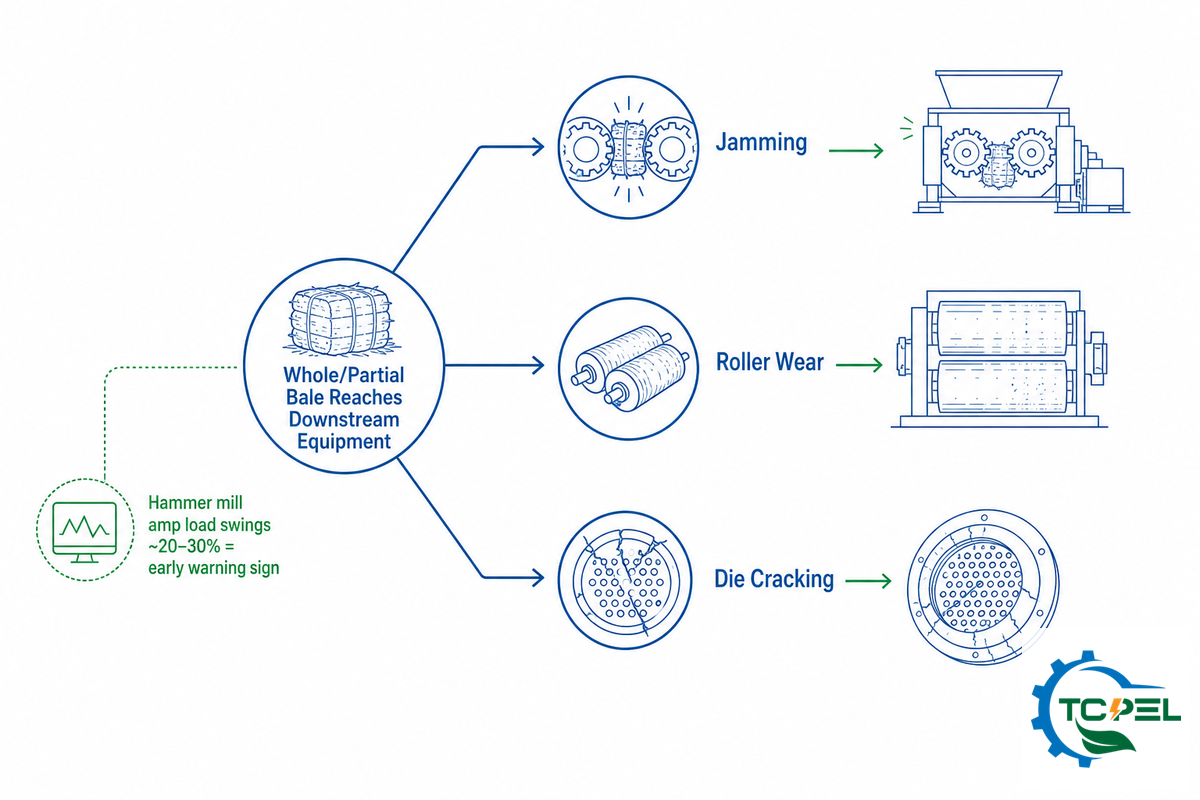
Elimine a etapa de pré-trituração ou subdimensione-a, e os modos de falha serão físicos, não filosóficos. Alimentar um moinho de martelos ou uma prensa peletizadora com fardos inteiros ou parciais provoca obstruções na entrada, carga desequilibrada dos roletes e, no caso da prensa peletizadora, trincas na matriz, pois um material superdimensionado foi forçado a passar por uma matriz dimensionada para matéria-prima muito mais uniforme. A descrição de Kessler sobre obstruções em fábricas novas aponta outro tipo de falha relacionado e menos visível: no papel, o material pré-triturado e os microcavacos podem parecer bastante semelhantes (granulometria, densidade aparente e teor de umidade), mas, durante o manuseio, o material pré-triturado “pode se entrelaçar” e causar obstruções na descarga e nas calhas onde microcavacos mais finos não causariam. Essa é uma falha no manuseio do material, e não na moagem, embora a culpa recaia sobre o equipamento de moagem — e cada hora gasta desobstruindo uma calha representa uma hora de disponibilidade perdida que a fábrica não recuperará.
O segundo tipo de falha: poeira combustível. Não se trata de precauções gerais; existe uma norma específica, atualizada recentemente, que regulamenta diretamente essa questão. Em dezembro de 2024, a NFPA publicou a NFPA 660, Norma para Poeiras Combustíveis e Sólidos Particulados, que reúne em um único documento as antigas normas da NFPA relativas a diversas categorias de poeira, incluindo as específicas para agricultura (NFPA 61), madeira (NFPA 664) e a norma conjunta sobre riscos de poeira (NFPA 652), com requisitos específicos para os setores agrícola e alimentício no Capítulo 21 e para o setor de biomassa no Capítulo 24. A NFPA 660 exige que qualquer instalação que manipule poeira combustível realize uma Análise de Risco de Poeira (DHA) — uma avaliação de engenharia que examina o “pentágono da explosão”: combustível, oxigênio, dispersão, confinamento e ignição. Essa análise deve ser revisada e atualizada pelo menos a cada 5 anos ou sempre que houver alteração significativa na taxa de produção, no teor de umidade ou nos equipamentos.
“As partículas finas de madeira necessárias para a produção de pellets se comportam de forma muito semelhante à gasolina em forma de poeira. Elas apresentam alta inflamabilidade, dispersam-se facilmente e podem atingir concentrações explosivas quando suspensas no ar… A maior parte da poeira de madeira usada na produção de pellets encontra-se em faixas de explosividade bem documentadas. A poeira de madeira fina e seca normalmente é classificada como ST1 pelas normas NFPA, o que significa que apresenta um valor Kst entre 1 e 200 bar·m/s.”
Há muito tempo, o próprio manual técnico da OSHA reconhece a poeira combustível como tema prioritário de inspeção, e a investigação do US Chemical Safety Board sobre a explosão de poeira de grãos ocorrida em 2017 na Didion Milling é um exemplo bem documentado das consequências de permitir o acúmulo de poeira e a presença de fontes de ignição em instalações agrícolas. Um moedor de fardos que produz material agrícola seco e com granulometria fina se enquadra diretamente nessa classe de falha. Portanto, os projetistas de uma instalação centrada em um moedor de fardos devem incorporar uma DHA atualizada como dado essencial do projeto, e não como mera formalidade regulatória — isso inclui dimensionar cada coletor de pó da linha conforme a carga real de finos gerada pelo moedor, e não com base em um valor genérico de catálogo.
Como funciona de fato o desfibramento em um moinho de discos por cisalhamento
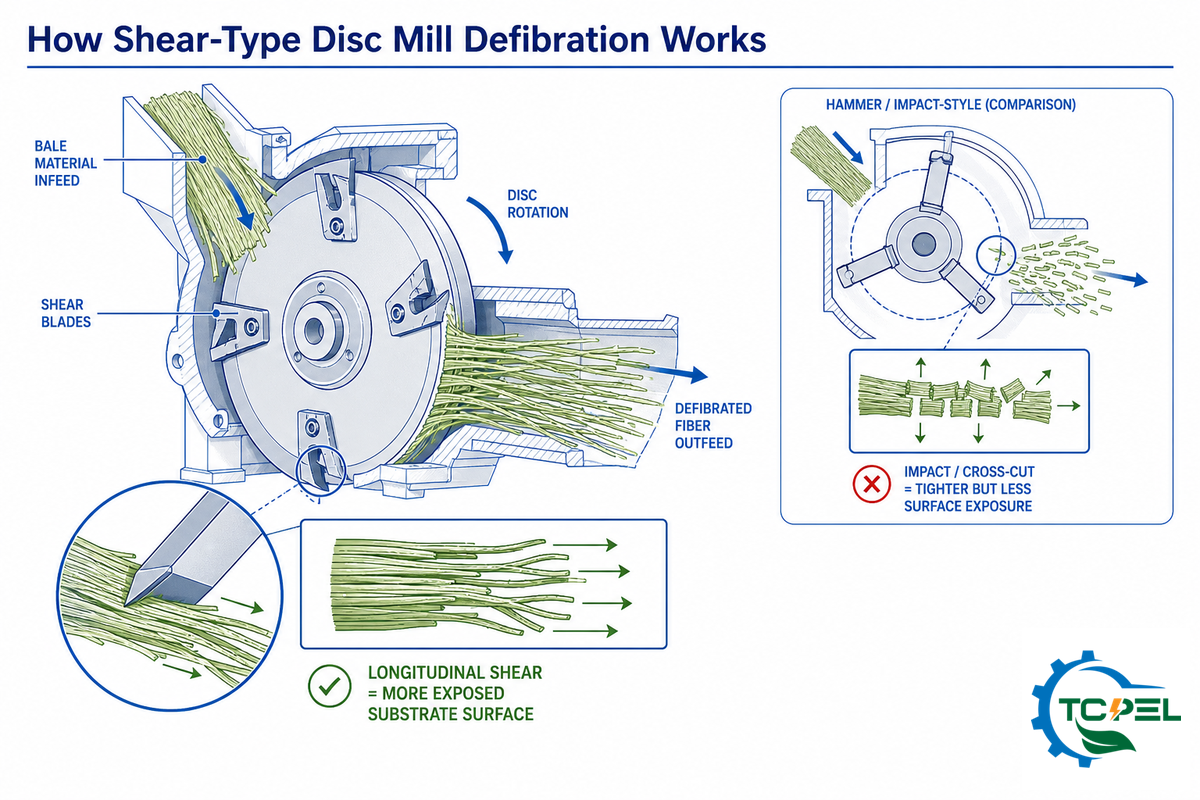
O funcionamento de uma máquina não importa apenas no âmbito acadêmico — o que sai na outra extremidade também importa. Segundo uma revisão dos métodos de pré-tratamento mecânico de biomassa lignocelulósica, esse material passa por pré-tratamento mecânico mediante processos de corte, cisalhamento, compressão, rasgamento e ruptura. O mecanismo predominante de cada máquina determina diretamente as propriedades físicas do material nas etapas posteriores.
Um estudo amplamente citado sobre a recalcitrância da biomassa lignocelulósica indica que a redução granulométrica facilita o acesso à celulose presente nas fibras vegetais por uma rota enzimática ou térmica; ao reduzir a granulometria, literalmente se “disseca” a estrutura resistente à decomposição. Outra pesquisa sobre redução granulométrica e hidrólise enzimática demonstrou que há melhorias significativas no rendimento de um processo com alto teor de sólidos quando a biomassa lignocelulósica é reduzida a 2,5 mm ou menos. Esses princípios não são exclusivos da peletização e se aplicam amplamente à biomassa lignocelulósica, desde madeira e resíduos agrícolas até matérias-primas para a produção de biocombustíveis em geral. No entanto, eles explicam por que, em muitos casos, cisalhar um material de biomassa no sentido das fibras produz uma fração mais uniforme e, portanto, mais fácil de processar do que submetê-lo a impactos para fragmentá-lo.
Essa diferença aparece diretamente em um teste comparativo com resíduo de milho realizado na Biomass Feedstock National User Facility do Idaho National Laboratory, que testou o mesmo material em um desintegrador rotativo por cisalhamento, um moinho de facas, um moinho de martelos e um triturador. Resultado: “o moinho de martelos apresenta a distribuição granulométrica mais ampla, enquanto o desintegrador rotativo por cisalhamento apresenta a mais estreita”, e o moinho de facas foi o melhor tanto para atingir a faixa granulométrica desejada quanto para oferecer o menor consumo de energia com essa matéria-prima específica. Em termos simples: o mecanismo de impacto (moinho de martelos) apresentou os resultados menos consistentes, enquanto os mecanismos de cisalhamento proporcionaram controle mais preciso. Esse é um resultado obtido em uma infraestrutura real de pesquisa, não uma alegação de fornecedor, e constitui uma das poucas publicações que comparam diretamente a escolha do mecanismo, em vez de apenas fazer afirmações sobre ela. Uma escolha incorreta não representa apenas um problema teórico: como os moinhos de impacto produzem uma faixa granulométrica mais ampla, eles fornecem ao secador e à prensa instalados posteriormente uma matéria-prima menos uniforme do que um mecanismo de cisalhamento processando o mesmo material. Na prática, é exatamente por esse motivo que a TCPEL constrói sua linha TCSC com base no mecanismo de cisalhamento.
Um ponto merece destaque direto: os dados mais acessíveis sobre o desgaste causado pela sílica e pelas cinzas na moagem de biomassa referem-se à etapa final de moagem em moinho de martelos, não especificamente a esta etapa anterior de abertura dos fardos. É razoável esperar menor desgaste em um mecanismo de cisalhamento (que corta a fibra sem desgastar uma superfície por abrasão) do que em um mecanismo de impacto, considerando os princípios mecânicos envolvidos, mas ainda não existem taxas específicas e independentes de desgaste publicadas apenas para a etapa de pré-trituração. Considere isso uma inferência baseada no mecanismo.
Diversidade de matérias-primas: por que fardos de palha de arroz, palha de trigo, talos de milho e capim não são intercambiáveis
Quais tipos de biomassa um moedor de fardos consegue processar: palha de arroz, talos de milho e trigo?
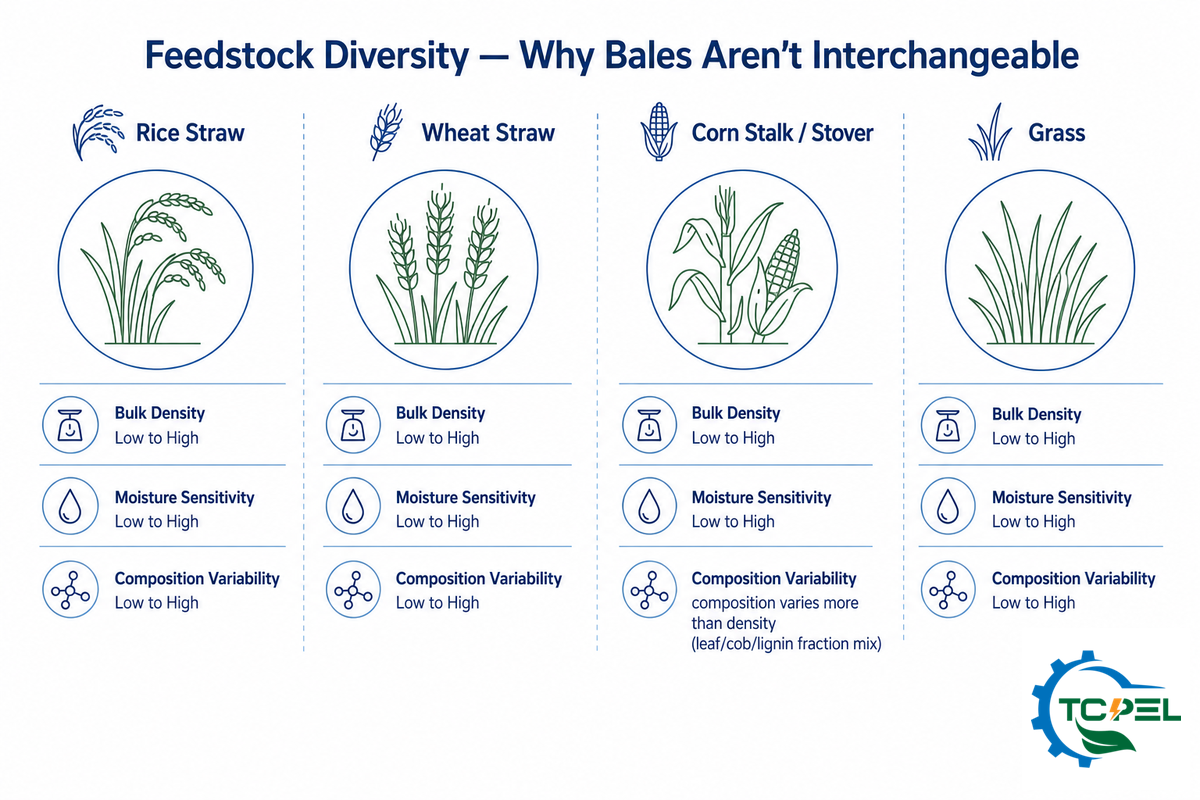
Um triturador de fardos projetado para palha geralmente consegue processar uma variedade maior de materiais orgânicos enfardados, sejam resíduos agrícolas, como palha de arroz, palha de trigo e talos de milho, sejam fardos de culturas energéticas, como miscanthus e resíduo de cana-de-açúcar enfardado. Mas “consegue processar” e “processa exatamente da mesma maneira” são afirmações bem diferentes: a densidade e o teor de umidade variam o suficiente em cada matéria-prima para alterar os cálculos de dimensionamento, independentemente de o produto final ser um pellet de tamanho padrão ou pequeno.
Um estudo publicado sobre a densidade aparente da palha de trigo e do switchgrass úmidos e secos registra uma faixa muito ampla, em grande parte em função do teor de umidade — aproximadamente 24–266 kg/m³ conforme a umidade varia (quanto maior a umidade, maior a densidade); outro estudo, realizado com uma variedade específica de trigo, obteve densidades de 97,5–177,2 kg/m³ com teor de umidade de 5–8%. Toda essa variabilidade desaparece quando a matéria-prima é peletizada — um estudo comparativo da densidade de pellets constatou que os pellets de palha de trigo apresentaram a maior densidade aparente (495,8 kg/m³) entre os 4 tipos de biomassa testados, mas o material bruto enfardado não terá esse grau de homogeneidade ao entrar no processo. O fardo colhido no campo com teor de umidade de 20% será processado de modo muito diferente daquele armazenado em local coberto com teor de umidade de 12%, apesar de ambos apresentarem oficialmente a mesma densidade aparente no papel.
Os talos de milho introduzem um segundo eixo de variabilidade além do teor de umidade: a composição, fator que uma análise do U.S. Department of Energy sobre a variabilidade da biomassa lignocelulósica considera essencial para o planejamento da redução de tamanho. Os resíduos da cultura do milho — talos, folhas, sabugos e palhas — totalizam cerca de 144 milhões de toneladas secas por ano nos Estados Unidos, e um banco de dados do Idaho National Laboratory indica variações de composição: a porcentagem de folhas corresponde a 6%–36% da massa total, a de sabugos a 9%–34% e a de lignina a 11,5%–24%. Essa variação é grande o suficiente para que 2 cargas de resíduos de milho apresentem comportamentos muito diferentes. Pesquisas sobre a pré-mistura desses resíduos para atingir composições específicas — um artigo mostra que misturar 40% de sabugo, 30% de folhas, 15% de talos e 15% de palha pode aumentar o total de carboidratos em 8% e reduzir o total de cinzas em 66%, produzindo um pellet final com densidade aparente de aproximadamente 500 kg/m³ e durabilidade de 98,5% — demonstram seus possíveis benefícios. Um triturador de fardos destinado a uma linha com uma única matéria-prima não exigirá essa complexidade, mas ainda há uma lição: fardos de resíduos de milho provenientes de campos diferentes, colhidos em épocas distintas ou cultivados em regiões diferentes não são insumos intercambiáveis, e uma decisão de dimensionamento baseada em uma amostra pode se mostrar incorreta para a próxima. Subestimar essa variabilidade é um erro comum e caro: um triturador de fardos especificado com base em uma única amostra de densidade pode enfrentar um problema real assim que chegar uma colheita regional mais densa, pois a densidade dos fardos brutos oscila com o teor de umidade e a composição muito mais do que sugere uma única ficha técnica. A TCPEL dimensiona sua linha TCSC levando essa oscilação em conta — na prática, uma fábrica de ração ou de pellets que trabalha com matéria-prima de várias regiões precisa realizar e documentar a verificação de densidade e teor de umidade no recebimento, em vez de depender de uma calibração única baseada na primeira carga.
| Matéria-prima | Faixa de densidade aparente do material bruto | Principal fator de variabilidade |
|---|---|---|
| Palha de trigo (bruta) | ~24–266 kg/m³ (dependente do teor de umidade); ~97,5–177,2 kg/m³ com teor de umidade de 5–8% | Teor de umidade |
| Switchgrass (bruto) | ~49–266 kg/m³ (dependente do teor de umidade) | Teor de umidade |
| Resíduos da cultura do milho | A composição varia mais do que a densidade: folhas 6–36%, sabugos 9–34%, lignina 11,5–24% | Mistura das frações (proporção de folhas/sabugos/talos/palha) |
| Palha de trigo (peletizada) | 495,8 kg/m³ (a maior entre os 4 tipos de biomassa do estudo citado) | N/A — após o processamento, a densidade se estabiliza |
Dimensionamento do triturador de fardos conforme a capacidade real da fábrica, não a capacidade máxima do equipamento

Esta é a conclusão da pesquisa mais relevante para especificar um triturador de fardos: o fator mais significativo no mundo real para o surgimento de gargalos no fluxo do processo não é o excesso de cautela do comprador ao superdimensionar os equipamentos, mas o contrário. Ao ser questionado sobre a origem dos gargalos no fluxo de processo de novas instalações, Jason Kessler, da KESCO, concentrou sua resposta no preço:
“É fácil para os produtores perguntarem por que os fabricantes não são mais conservadores ao dimensionar os equipamentos; a resposta curta é o preço. A maioria das decisões de compra para fábricas de pellets está sendo tomada com base no preço… O maior custo para uma fábrica de pellets é não produzir pellets na capacidade de projeto, na qualidade prevista ou dentro de um prazo que atenda aos compromissos contratuais. Definir um fator de segurança de projeto com o cliente é uma das maneiras mais eficazes de eliminar possíveis gargalos e, ao mesmo tempo, alinhar as expectativas em relação ao preço do sistema.”
Em essência, o problema não é o comprador adquirir por engano um triturador de fardos superdimensionado “por precaução”; é o processo de concorrência entre fornecedores que reduz sistematicamente as margens de segurança reais da fábrica em favor de preços mais baixos nas propostas. A abordagem, chamada Método de Compatibilização de Gargalos, consiste em dimensionar o triturador de fardos com base no verdadeiro ponto de estrangulamento da linha — normalmente o moinho de martelos ou o secador —, e não na capacidade máxima de produção do triturador, tratando qualquer margem como uma decisão consciente de projeto.
Exemplo prático: dimensionamento de um triturador de fardos para uma peletizadora de 1 t/h
- Concentre-se na verdadeira restrição do processo, não no triturador. Por exemplo, suponha que sua prensa peletizadora tenha capacidade nominal de 1,0 t/h de produto final.
- Aplique um fator de segurança a montante. É prática comum entre integradores projetar os equipamentos de trituração e alimentação com uma margem de 20%–30% acima da capacidade da prensa a jusante — portanto, para uma prensa de 1,0 t/h, o triturador de fardos e o sistema de alimentação devem fornecer cerca de 1,2–1,3 t/h ao pulmão, em vez dos 1,0 t/h que correspondem exatamente à capacidade da prensa.
- Dimensionamento do silo pulmão — ele deve ser dimensionado pelas horas de autonomia necessárias, não pelo tempo de ciclo do triturador. Pelo método “horas-alvo × capacidade de processamento”, se você quiser aproximadamente 30 minutos de autonomia com uma produção do triturador de 1,2 t/h, seu silo deverá ter cerca de 0,6 toneladas — um valor muito pequeno neste caso, mas, se os 1,2 t/h passarem a ser uma linha de produção de 25 t/h com exigência de 8 horas de autonomia, serão necessárias cerca de 200 toneladas de armazenamento em silos.
- Verifique se a peneira do moinho de martelos e o secador suportam a capacidade máxima de produção do triturador, não apenas a média. Se o triturador produzir em média 1,2 t/h, mas atingir um pico de 2 t/h ao processar um fardo denso, ele provavelmente obstruirá o moinho de martelos dimensionado com base na capacidade média de processamento.
Observação: a margem de projeto de 20–30% apresentada acima é uma regra prática adotada pela maioria dos integradores, não uma norma de engenharia publicada. Considere-a uma orientação para discutir com seu fornecedor de equipamentos, e não uma regra rígida.
Para consultar a capacidade de processamento de modelos específicos e os dados FOB (depois de determinar seu gargalo-alvo), veja as especificações dos trituradores de discos TCSC da TCPEL, que abrangem capacidades de 2–12 t/h em 3 tamanhos de estrutura.
Protocolo de preparo dos fardos em 4 pontos antes da alimentação do triturador

A maioria dos problemas desnecessários no triturador não é causada pela máquina, mas pelo material introduzido nela — mesmo um motor de acionamento direto e um redutor bem especificados travarão com um fardo inadequado. Veja 4 verificações a serem realizadas na entrada antes de carregar cada fardo, capazes de detectar a grande maioria dos possíveis problemas antes que provoquem um travamento ou uma falha do equipamento relacionada ao acionamento do detector de metais. Essas verificações levam apenas alguns segundos a mais e mantêm toda a linha operando com facilidade, em vez de funcionar em modo de combate a emergências:
- Verificação pontual da densidade e do teor de umidade. Como a densidade aparente da palha bruta pode variar muito em função do teor de umidade, compare a densidade atual com a última calibração conhecida de um fardo adequado antes de alimentá-lo no triturador. Isso identifica os fardos que apresentarão um comportamento inesperado ao serem introduzidos no triturador.
- Remoção de barbantes, arames e telas de enfardamento. Barbantes e telas de enfardamento indesejados estão entre as principais causas de enrolamento em rotores e eixos, enquanto o arame de enfardamento representa uma ameaça direta às lâminas e pode se tornar uma fonte de ignição nas mesmas condições abordadas pelas orientações da OSHA sobre poeiras combustíveis.
- Compatibilidade com o formato do fardo. Verifique as dimensões dos fardos redondos e quadrados e confirme se elas estão dentro da capacidade máxima de admissão especificada para o triturador. Sua máquina, por exemplo, pode ser especificada para determinado tamanho de fardo redondo e, ainda assim, não conseguir processar um fardo quadrado ligeiramente maior, o que pode causar obstrução na entrada.
- Verificação da área de espera e do pulmão. Confirme se o silo pulmão após o triturador tem capacidade suficiente para receber a descarga do próximo fardo; muitas vezes, essa etapa evita diversos problemas antes que ocorram. Alimentar um pulmão que já está cheio é um erro muito comum e totalmente evitável.
Perspectivas do setor: a transição para fábricas de pellets com múltiplas matérias-primas

Depender de uma única matéria-prima representa um risco de fornecimento e preço, e esse risco já é claramente perceptível no projeto de novas fábricas de pellets. Duas perspectivas independentes confirmam essa mudança. Primeiro, uma análise recente das tendências de equipamentos de moagem para 2026 aponta uma transição “decidida para projetos de fábricas com múltiplas matérias-primas, capazes de processar resíduos de madeira, palhas agrícolas e culturas energéticas”. Segundo, Jason Kessler, da KESCO, observa, a respeito dos atuais projetos de pellets de madeira, que “a trituração de cavacos verdes está sendo incorporada à maioria das novas fábricas de pellets de madeira”, acrescentando uma etapa de pré-trituração que amplia a flexibilidade dos insumos. Quando 2 entidades com pontos de vista diferentes — uma análise de tendências e um integrador de sistemas — destacam de forma independente a mesma tendência, o sinal se torna mais forte. Uma análise do U.S. Department of Energy sobre a variabilidade das matérias-primas de biomassa oferece uma base técnica para essa mudança: as oscilações documentadas de composição dentro de uma única categoria de matéria-prima são exatamente o que uma linha capaz de processar múltiplas matérias-primas foi projetada para absorver. Seja qual for o uso final — pellets destinados a uma caldeira residencial, uma usina industrial ou à exportação como combustível renovável —, a produção de combustível que começa com um triturador de fardos flexível está mais bem preparada do que uma linha limitada a uma única cultura.
Isso traz uma lição prática para a escolha de um triturador de fardos em 2026: uma fábrica projetada para uma única matéria-prima pressupõe que o insumo não mudará durante a vida útil do equipamento. Como até mesmo a composição de um único tipo de matéria-prima pode variar consideravelmente — por exemplo, o teor de lignina apenas nos resíduos da cultura do milho pode variar de 11,5% a 24%, dependendo da origem —, uma fábrica capaz de receber fardos de palha, talos e capim sem modificações tem uma vantagem, mesmo que nunca chegue a fazer isso. Embora a maioria das projeções indique que o volume do mercado global de pellets de biomassa continuará crescendo durante a década de 2030, o verdadeiro incentivo para incorporar a capacidade de processar múltiplas matérias-primas é a intenção de gerenciar riscos de fornecimento, não apenas atender ao crescimento do mercado.
Nossa perspectiva
Este guia aborda as questões de sistemas e dimensionamento que vemos surgir repetidamente depois que uma fábrica já decidiu usar um triturador industrial de fardos: onde ele fica na linha, como a variabilidade da matéria-prima altera os cálculos de dimensionamento e por que a tensão entre preço e fator de segurança relatada por Jason Kessler no histórico de projetos da KESCO corresponde ao que aparece na literatura mais ampla sobre pré-processamento. A TCPEL fabrica os trituradores de discos descritos na tabela comparativa acima; a metodologia de fluxo do processo e dimensionamento apresentada aqui pretende ser útil, independentemente de esse ser ou não o equipamento que você acabará especificando.
Perguntas frequentes
P: O que é um triturador de fardos e como ele difere de um desfibrador ou processador de fardos?
Ver resposta
Na prática, os termos triturador de fardos, desfibrador de fardos e processador de fardos têm significados muito semelhantes e são frequentemente usados de forma intercambiável pelos fabricantes, o que ajuda a explicar por que os resultados de busca para esse termo são tão variados. Uma distinção mais útil do que o nome é a categoria do equipamento: uma máquina industrial estacionária, para operação contínua e integrada à linha de processo de uma fábrica de pellets de biomassa, em contraste com uma máquina móvel, acionada pela tomada de potência e desenvolvida para preparar ração de bovinos ou material de cama na própria fazenda. Ambas trituram ou desfibram fardos; porém, são especificadas, compradas e operadas por compradores totalmente diferentes para trabalhos completamente distintos.
P: Quais são os principais componentes de um sistema triturador de biomassa ou de fardos?
Ver resposta
Um sistema industrial de trituração de fardos raramente consiste apenas no próprio triturador. Seu conjunto completo de entrada normalmente inclui um sistema de alimentação de fardos (transportador de taliscas ou empurrador hidráulico para fardos redondos e aparas pesadas), a própria unidade trituradora ou desfibradora, um separador magnético suspenso ou de tambor para remover metais imediatamente após a descarga, um transportador de correia até o silo pulmão e um silo pulmão ou de fundo móvel que desacopla os ciclos do triturador da alimentação constante exigida pelo secador e pelo moinho de martelos a jusante. Equipamentos de extração de pó e alívio de explosão também fazem parte de um sistema em conformidade, considerando a classificação do material agrícola seco como poeira combustível segundo a NFPA 660.
P: Por que um triturador de fardos produz granulometria irregular e como isso é corrigido?
Ver resposta
A granulometria irregular na descarga de um triturador de fardos costuma ser um sintoma de inconsistência na alimentação, não um defeito da máquina. Fardos com diferentes teores de umidade e densidades (como mostra a tabela de matérias-primas acima, somente a densidade da palha de trigo bruta pode variar aproximadamente entre 24–266 kg/m³) serão triturados de formas diferentes, mesmo passando por um rotor idêntico. Lâminas ou martelos desgastados ampliam a distribuição granulométrica ao longo do tempo, independentemente da matéria-prima, por isso vale a pena compreender, já na etapa de especificação e não apenas na de manutenção, os mecanismos de cisalhamento — que, em testes comparativos com o mesmo material, mantiveram uma distribuição granulométrica mais estreita do que os mecanismos de impacto. O fornecimento consistente de fardos, a verificação de densidade e teor de umidade antes da alimentação e um cronograma documentado de substituição por desgaste das lâminas corrigem a maior parte dessa variação.
P: Uma fábrica de pellets de biomassa pode operar sem uma etapa específica de pré-trituração?
Ver resposta
Tecnicamente, sim: algumas operações muito pequenas alimentam o moinho de martelos diretamente com material solto ou previamente fragmentado, mas, em uma fábrica alimentada por fardos, esse é um modo de falha conhecido, não um atalho de projeto. Alimentar um moinho de martelos ou uma prensa peletizadora diretamente com fardos inteiros ou parcialmente fragmentados causa travamentos, carga irregular nos roletes e trincas na matriz devido à passagem forçada de material superdimensionado por uma matriz fina.
P: Quais tipos de fardos de biomassa um triturador de fardos consegue processar?
Ver resposta
Um triturador industrial de fardos especificado para resíduos agrícolas normalmente processa fardos redondos ou quadrados de palha de arroz, palha de trigo, talos de milho e capim ou culturas energéticas. Os fardos de talos de milho tendem a ser mais densos e apresentar maior variabilidade de composição do que os de palha, exigindo muitas vezes uma estrutura maior para atingir capacidade de processamento equivalente.
P: Como saber se meu triturador de fardos está subdimensionado para minha linha de produção de pellets?
Ver resposta
Oscilações recorrentes na corrente elétrica do moinho de martelos, alarmes frequentes de silo pulmão vazio ou um padrão de operação da peletizadora sem alimentação durante os picos de demanda são sinais práticos de alerta. Conforme o Método de Compatibilização de Gargalos apresentado acima, compare a capacidade de processamento efetivamente entregue pelo triturador — não a capacidade indicada na placa — com a capacidade nominal da peletizadora acrescida de uma margem; uma diferença inferior a aproximadamente 10–15% deve ser analisada antes que se transforme em uma parada recorrente.
P: O teor de umidade dos fardos afeta o desempenho do triturador de fardos?
Ver resposta
Sim, de forma mensurável. Medições da densidade aparente da palha de trigo bruta e do switchgrass mostraram um aumento de aproximadamente 24 kg/m³ para cerca de 266 kg/m³ conforme o teor de umidade aumenta, e essa oscilação da densidade altera o comportamento da alimentação, a capacidade de processamento e a carga de secagem a jusante. Fardos provenientes de fontes com teores de umidade inconsistentes estão entre os motivos mais comuns para um triturador corretamente dimensionado ainda apresentar uma capacidade de produção irregular.
Referências e fontes
- Manual Técnico da OSHA, Seção IV: Capítulo 6, Poeiras CombustíveisU.S. Occupational Safety and Health Administration
- Consolidated Dust: NFPA 660, Norma para Poeiras Combustíveis e Sólidos ParticuladosNational Fire Protection Association
- Atualização da investigação factual da Didion MillingU.S. Chemical Safety and Hazard Investigation Board
- Compreensão do impacto da variabilidade da biomassa lignocelulósica na redução de tamanhoU.S. Department of Energy, Office of Scientific and Technical Information
- Biomassa lignocelulósica: compreensão da recalcitrância e previsão da hidróliseNational Institutes of Health, PubMed Central
- Desafios atuais da produção comercial de biocombustíveis a partir de biomassa lignocelulósicaNational Institutes of Health, PubMed Central
- Análise dos sistemas de armazenamento de bioenergia para conservação e pré-processamento de biomassaNational Institutes of Health, PubMed Central
- Pré-tratamento mecânico de biomassa lignocelulósica visando à valorização enzimática/fermentativaScienceDirect
- Impacto da redução da granulometria na hidrólise enzimática com alta carga de sólidosSN Applied Sciences / Springer
- Densidade aparente de partículas úmidas e secas de palha de trigo e switchgrassApplied Engineering in Agriculture / FAO AGRIS
- Propriedades físicas de pellets produzidos com talos de sorgo, resíduos da cultura do milho, palha de trigo e big bluestemScienceDirect
- Melhoria da qualidade dos pellets: técnicas avançadas de pré-processamento para resíduos da cultura do milhoBiomass Magazine (Zachary P. Smith, Idaho National Laboratory)
- Cinco perguntas para a KESCOBiomass Magazine
- Da reação à prevenção: análises de risco de poeira reforçam a segurança em fábricas de pelletsBiomass Magazine (Alysha Yinger, RoboVent)
- ISO 17225-1:2021, Biocombustíveis sólidos, especificações e classes de combustíveisInternational Organization for Standardization
- CA2902255C, processamento de biomassaGoogle Patents
Artigos relacionados
- Moinho de martelos para biomassa: guia de moagem orientado pela matéria-prima para palha, casca, bagaço e madeiraa próxima etapa a jusante do triturador de fardos
- Moinho de martelos para moagem de ração: guia de granulometria para produtores de ração animal
- Peletizadora de biomassa: guia completo de engenhariao destino do material após a secagem
- Secadores rotativos TCPELetapa 4 do fluxo de processo descrito acima
- Picadores de tambor TCPELa etapa equivalente de redução de tamanho para madeira limpa de árvores inteiras, em vez de resíduos enfardados
- Visão geral dos equipamentos para biomassa TCPEL