Get in Touch with TCPEL
TCPEL MS Series · Premium Industrial Solution
Double Shaft Shredder For Biomass Pellet Production
TCPEL MS Series — Engineered For Continuous 24/7 Industrial Operation
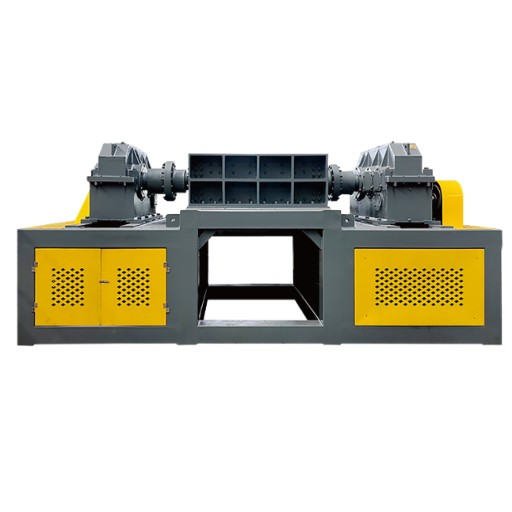
TCPEL MS Series double shaft shredder is the ideal step before size reduction into a pellet plant, bio fuel processing line, forestry recycling and waste management. The MS range of seven different models ranges from hourly capacities of 0.5ton/hr to 20tons/hr, fitted with M6V or Cr12MoV alloy blades and twin industrial gearboxes, through to a CE orientated design able to operate continuously 24/7 in an industrial environment.
MS-SERIES · EQUIPMENT
Double Shaft Shredder
Operational 24/7
Twin Industrial Gearboxes
Models
7
Capacity Range
0.5–20
t/h
Blade Hardness
HRC
54–60
Export Countries
60
+
The Biomass Feedstock Bottleneck — How The MS Series Solves It
All wood pellet plants and biofuel prep lines have one critical point of failure, one single choke point where they hemorrhage productivity and money. That choke point is the in-feed on the hammer mill — the long pallets stop the chips from entering; the straw bales grab ahold of the grind shafts; the large log off-cuts bring the line to a halt, and you remove the chamber and change the very expensive Jones Hammers.
50–150mm
Uniform Pellet-Mill-Ready Output
2× shafts
Counter-Rotating · Low RPM · High Torque
7models
MS Series Field-Proven Globally
02
Three Pain Points Dominate Biomass Primary Size Reduction
 01
01
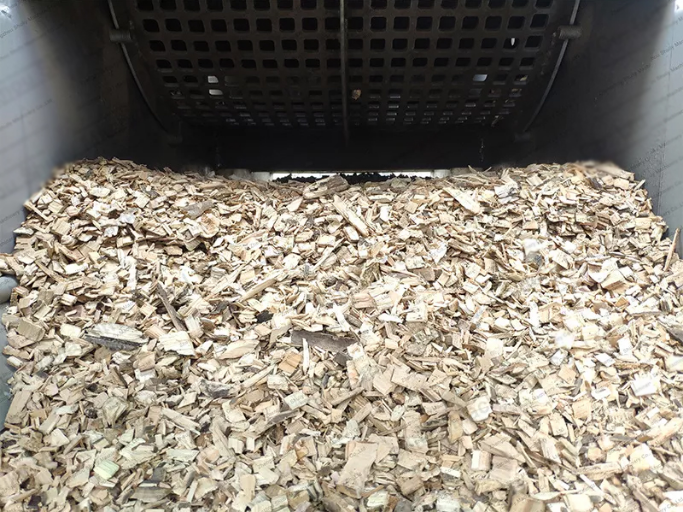
FIG · 01 / Feedstock GeometryTCPEL MS Series
Unbalanced Feedstock Geometry
Geometry Variance · Feed Bridging
 02
02
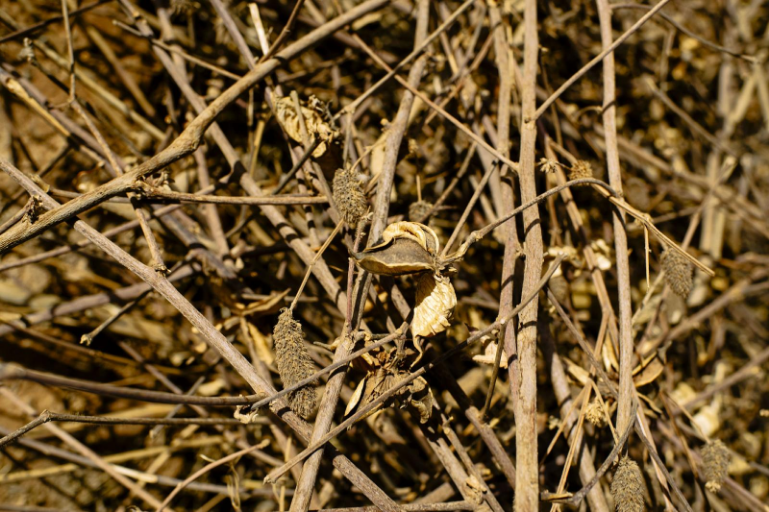
FIG · 02 / Feed ContaminantsTCPEL MS Series
Contaminants Within The Feed
Metal · Stone · Wire Strap
 03
03
FIG · 03 / Power & DustTCPEL MS Series
Power Spikes And Dust Production
kWh / Ton · Dust Load
03
A Double Shaft Shredder Addresses These Issues Up Front
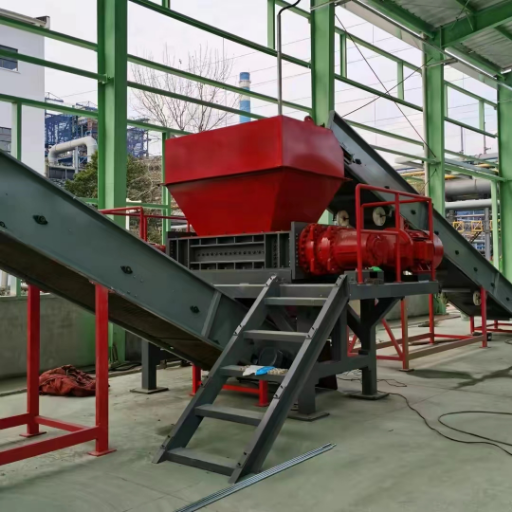
Two counter-rotating shafts with hook-type alloy blades break and shear the biomass (cutting, tearing) at low RPM and high torque, generating a uniform 50–150 mm output that can be fed straight into a hammer mill or pellet plant. Design of the MS Series is aimed at this first size reduction step — not as a standard plastic or metal shredder would be outfitted for wood, but as the dedicated primary reducer for biomass.
01
Hook-Type Alloy Blades
Engineered For Wood & Fibrous Stock — Aggressive Tear Profile
02
Low RPM · High Torque Profile
Tolerates Tramp Metal — Resists Jamming On Hard Inclusions
03
Uniform 50–150 mm Output
Pellet-Mill Ready — No Re-Sizing Stage Required Downstream
Input
Mixed Biomass
Primary Reduction
MS Series · Double Shaft
Output
50–150 mm Uniform
MS · Schematic
Rev. 24 / EN
Output50–150 mm Uniform
Shafts2 · Counter-Rotating
Drive ProfileLow RPM · High Torque
Blade TypeHook-Type Alloy
ApplicationDedicated Biomass Primary
04
Plant Operators View The Benefits Of A Stable Feed Line As
↓
Less Energy Per Ton Of Finished Pellet
Energy · kWh / Ton
↑
Longer Hammer Mill & Pellet Die Service Life
Wear · Service Interval
↓
Less Unplanned Downtime On The Line
OEE · Availability
No. 05 / Selection Guide
Request MS Series Sizing
→
Guide to seven of the MS models below — their engineering specifics, real-life in the field of material compatibility, and the shell we at TCPEL create for the buyer globally to purchase the correct machine for global project requirements.
Buyer roles covered in this guide: Engineering P.O.O
MS Series
Model Selection & Decision Matrix
MS Series Double Shaft Shredder Lineup — 7 Models, 0.5–20 t/h Capacity
TCPEL manufactures 7 seven MS Series double shaft shredder models that match the throughput needs of any biomass pellet plant from pilot line (0.5 t/h) to large industrial line (20 t/h). All models feature the same high-torque/low-sped tearing principle and 6-sided shaft design, with size parameters adjusted to trip, blade diameter, motor strength, gear box .
Tap A Model To View Full Engineering Specifications
Capacity subject to material density and moisture content. All 7 models share the same 6-sided shaft design and twin industrial gear box architecture.
MS Series · Pilot Line
MS500
Capacity
0.5–1.5t/h
Chamber Width
500mm
Blade Diameter
270–300mm
Blade Thickness
20 / 30mm
Motor Power
15kW
~20 HP equivalent
Rotation Speed
13–18rpm
Hopper Volume
550L
Machine Dimensions (L × W × H)
2060 × 1600 × 1840mm
Twin Gear Box
Standard
Duty cycle rated continuous
MS Series · Small LineMS600
Capacity1–3t/h
Chamber Width
600mm
Blade Diameter
270–300mm
Blade Thickness
20 / 30mm
Motor Power
18.5kW
~25 HP equivalent
Rotation Speed
9–32rpm
Hopper Volume
650L
Machine Dimensions (L × W × H)
2170 × 1600 × 1840mm
Twin Gear Box
Standard
Duty cycle rated continuous
MS Series · Medium LineMS800
Capacity2–5t/h
Chamber Width
800mm
Blade Diameter
270–450mm
Blade Thickness
30mm
Motor Power
30 × 2kW
~80 HP total
Rotation Speed
10–32rpm
Hopper Volume
750L
Machine Dimensions (L × W × H)
2700 × 1300 × 1850mm
Twin Gear Box
Standard
Duty cycle rated continuous
MS Series · Industrial LineMS1000
Capacity4–8t/h
Chamber Width
1000mm
Blade Diameter
320–520mm
Blade Thickness
30 / 40mm
Motor Power
37 × 2kW
~100 HP total
Rotation Speed
7–32rpm
Hopper Volume
1130L
Machine Dimensions (L × W × H)
3300 × 1900 × 2200mm
Twin Gear Box
Standard
Duty cycle rated continuous
MS Series · Industrial+ LineMS1200
Capacity6–10t/h
Chamber Width
1200mm
Blade Diameter
320–520mm
Blade Thickness
40mm
Motor Power
55 × 2kW
~150 HP total
Rotation Speed
7–32rpm
Hopper Volume
1360L
Machine Dimensions (L × W × H)
3600 × 2000 × 2200mm
Twin Gear Box
Standard
Duty cycle rated continuous
MS Series · Large LineMS1400
Capacity8–12t/h
Chamber Width
1400mm
Blade Diameter
450mm
Blade Thickness
50mm
Motor Power
75 × 2kW
~200 HP total
Rotation Speed
6–15rpm
Hopper Volume
2000L
Machine Dimensions (L × W × H)
4400 × 2000 × 2400mm
Twin Gear Box
Standard
Duty cycle rated continuous
MS Series · Extra Large LineMS1600
Capacity10–20t/h
Chamber Width
1600mm
Blade Diameter
450–800mm
Blade Thickness
50 / 75mm
Motor Power
90 × 2kW
~240 HP total
Rotation Speed
5–14rpm
Hopper Volume
3000L
Machine Dimensions (L × W × H)
5200 × 2210 × 2600mm
Twin Gear Box
Standard
Duty cycle rated continuous
Decision Matrix — Material × Required Throughput → Recommended Model
Pellet plant capacity. Capacity of a pellet plant is seldom found to be a textbook value. Use the matrix below to match your actual biomass material to the most appropriate MS model. Capacity figures are based on a common biomass moisture content; oversized or excessively wet feeds may shift you to a bigger model to achieve rated capacity.
Required Throughput
Wood Logs / Offcuts
Wood Pallets
Straw / Corn Stalk
Bagasse / Palm Fiber
Forestry Residues / RDF
0.5–1.5t/h
PilotMS500
MS500
MS500
MS500
MS500
1–3t/h
SmallMS600
MS600
MS600
MS600
MS600
2–5t/h
MediumMS800
MS800
MS800
MS800
MS800
4–8t/h
IndustrialMS1000
MS1000
MS1000
MS1000
MS1000
6–10t/h
Industrial+MS1200
MS1200
MS1200
MS1200
MS1200
8–12t/h
LargeMS1400
MS1400
MS1400
MS1400
MS1400
10–20t/h
Extra LargeMS1600
MS1600
MS1600
MS1600
MS1600
All models come standard with PLC automatic control, overload auto-reverse and two industrial gear boxes duty cycle rated continuous. Adjusts for desired output particle size of 50 to 150mm to fit the in-feed window of your Hammermill or Pellet Mill.
PLC Automatic Control
Programmable Logic
Overload Auto-Reverse
Jam Protection
Two Industrial Gear Boxes
Continuous Duty Rated
Output 50–150 mm
Hammermill / Pellet Mill Ready
Need Help Sizing For Your Specific Feedstock?
Download the MS Series Sizing Guide (PDF) — a one-page decision tree mapping biomass material, moisture, and pellet plant capacity to a recommended MS model.
Engineering Highlights — Why MS Series Delivers Industrial-Grade Performance
Uniquely, generic shredders carry out biomass primary reduction for one principle — what is provided to them is general waste streams, not the particular abrasion, fiber length and moisture content of pallets, logs and straw. Every engineering decision to the MS Series was made solely to overcome one genuine biomass failure mode encountered over thousands of field sites in 60+ countries. (Buyer role: Engineering.)
01
Core Operating Principle
Low-Speed High-Torque Tearing
MS Series shafts operate at 5 to 32 rpm for different varieties. These blades operate at lower speed and with dual industrial gearbox torque, they tear fibrous biomass rather than crush them. The benefits are visible in terms of: lower dusts, lower noise level and increased blade life vis-à-vis high-speed cutting systems.
5–32 RPM
Twin Gearbox Torque
Lower Dust · Lower Noise
Longer Blade Life
No.01 · Tearing Mechanism

02
M6V / Cr12MoV Alloy Blades, HRC54–60 Hardness
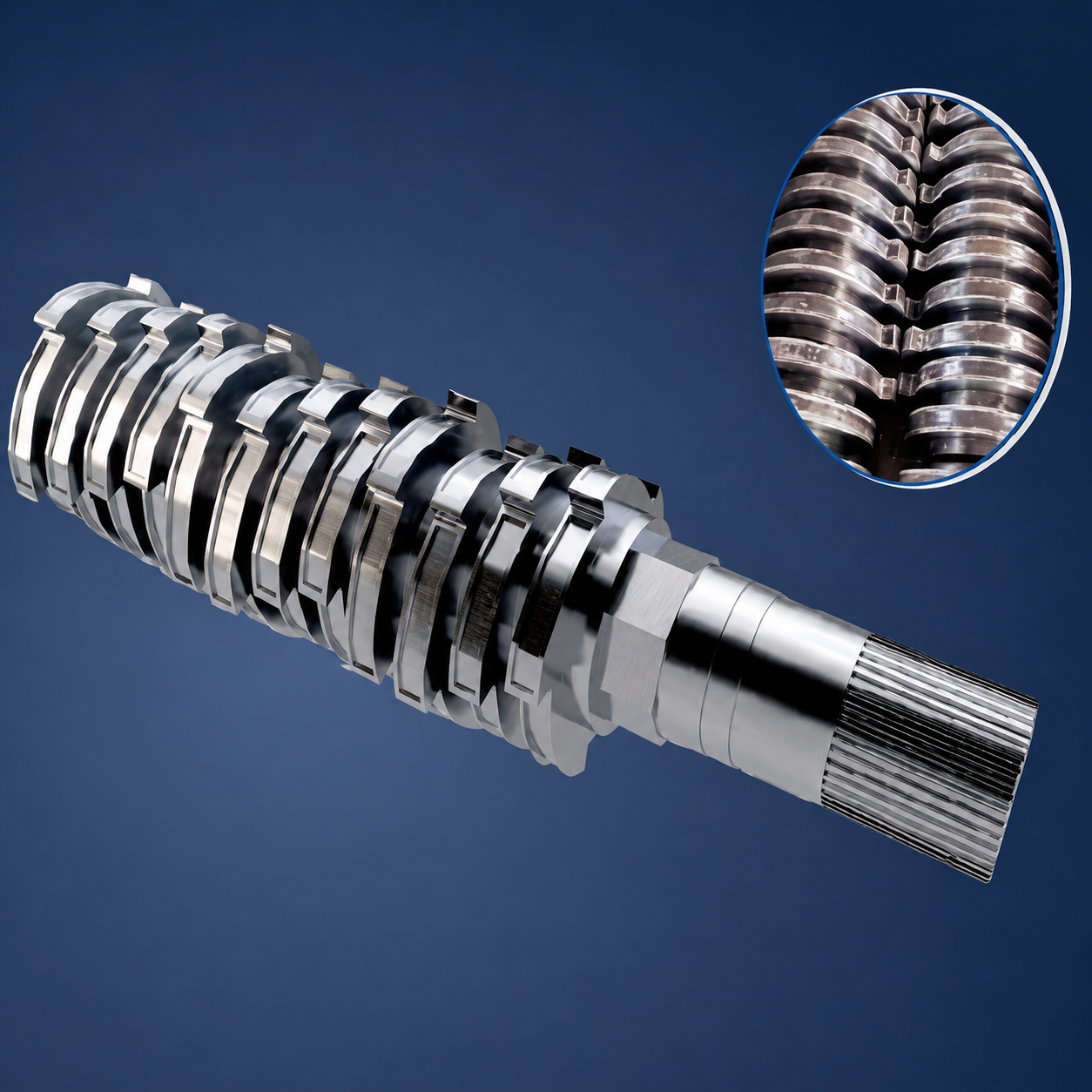
Blade material is the single largest operating cost in a biomass shredder. MS Series is shipped with the recommended industry standards M6V or Cr12MoV alloy tool steel blades (HRC 54–60). This range of hardness exceeds most other industrial blade manufacturers recommendations for wood, pallet and contaminated feedstock applications. Hook type geometry grabs the heavy material and induces tearing on impact.
HRC 54–60
M6V Tool Steel
Cr12MoV Alloy
Hook Geometry
№ 02 · Hook Blade Profile
03
40Cr Quenched & Tempered Hexagonal Shaft
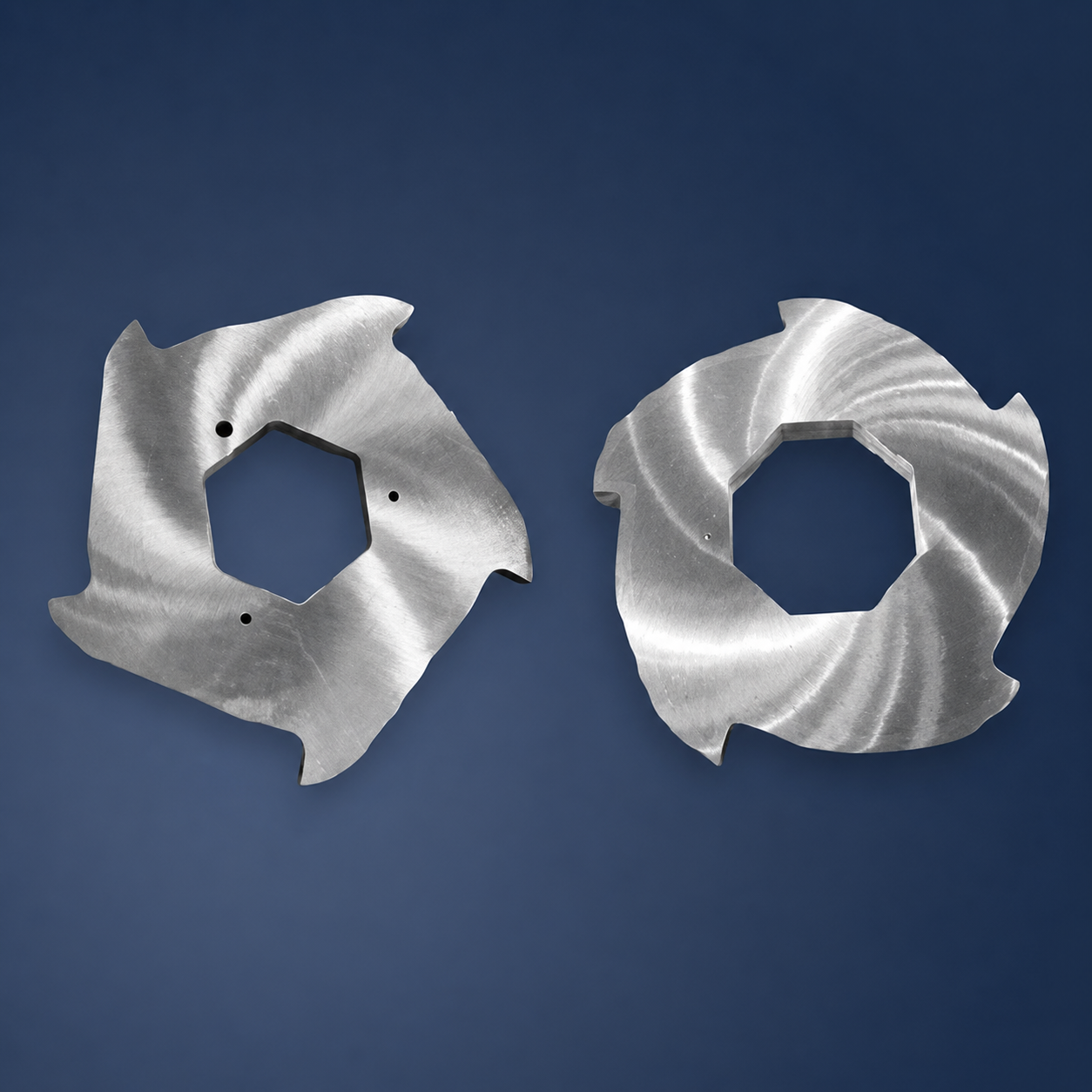
Hexagonal heavy-duty shaft construction first begins with 40Cr alloy steel forged from 40Cr alloy steel, then quenched and tempered to resist fatigue under a continuous high-torque load. Hexagonal shape prevents the blades from slipping in rotation — a common failure mode among round-shaft designs while chopping nail-saturated pallets or stringy bagasse.
40Cr Alloy
Q + T Treated
Hex Cross-Section
No-Slip Blade Stack
№ 03 · Hex Shaft Section
04
PLC Auto-Reverse & Overload Protection
The PLC automatically monitors the motor current and, if it exceeds the safe level while feeding jam-prone material (eg a knotted root, a bundled pallet, a wire-bound bale), the controller reverses the shaft direction to blow the jam, then reverts to forward shredding. This occurs without intervention and without tripping a motor breaker.
Auto-Reverse
Current Monitoring
Overload Protected
No Manual Reset
№ 04 · PLC Reversal Loop
05
Dual Industrial Gearbox For 24/7 Duty
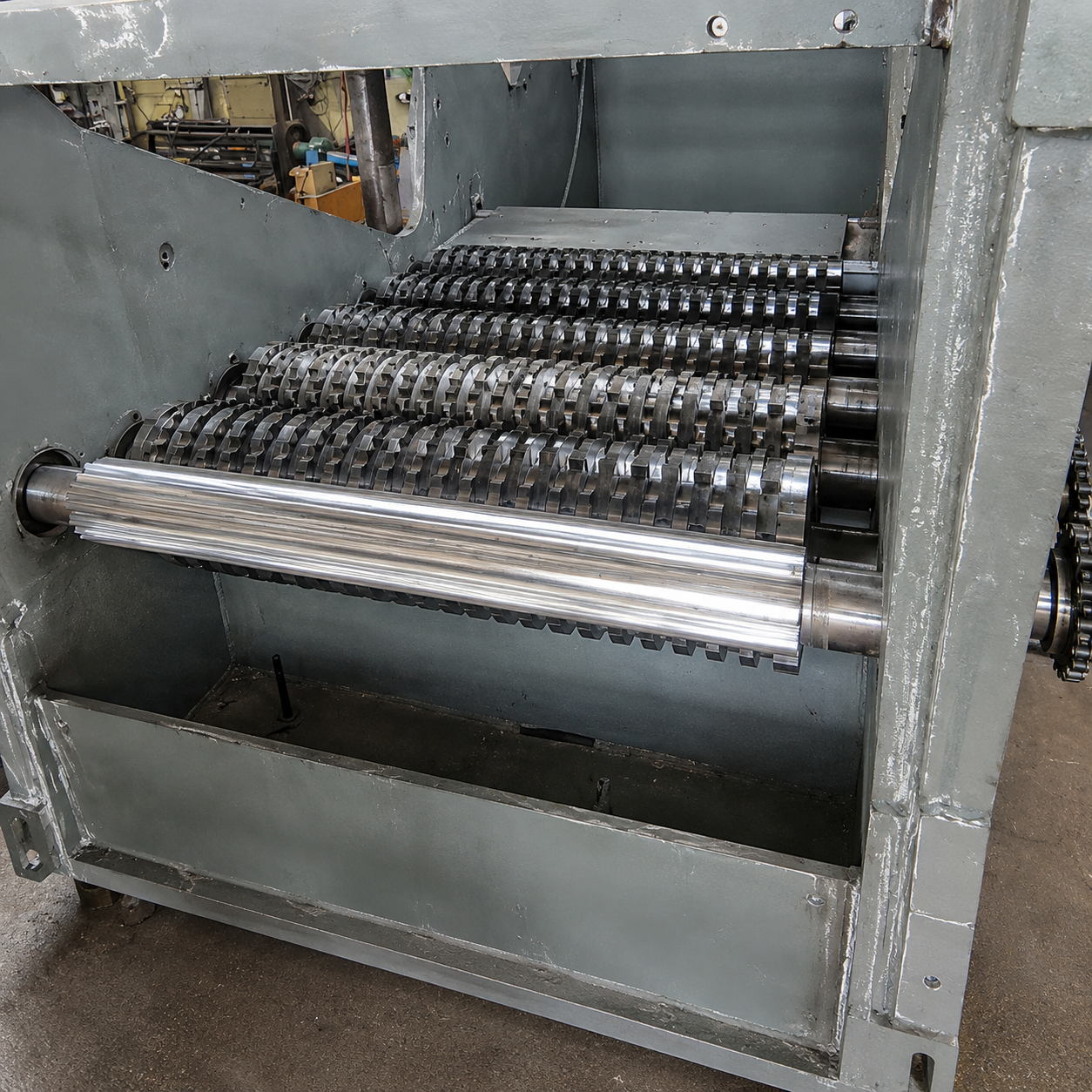
Each shaft has its own industrial gearbox (Tecknova, RSP). The drive on each shaft is independent, allowing each shaft to respond to its individual load profile. When a gearbox requires maintenance, neither the whole shredder is stranded: modular blade replacement keep planned downtimes in the order of hours not days.
Tecknova
RSP
Independent Drives
24/7 Duty Cycle
№ 05 · Twin Gearbox Layout

№ 07 · Engineering Note
Biomass cutters fall off the blades' edge of life that early as the shaft-to-blade interface drops dead. Hexagonal shafts and the bolted hook blades don't just make market sense — these are the only shaft design capable of withstanding nail-rich pallet feed without slipping angle in the blade stack.
Signed
TCPEL Engineering Team
ALLWIN INTERNATIONAL CO.,LTD
Industrial Shredding Division · 60+ Countries Served
Industrial Shredding Division · 60+ Countries Served
TCPEL · MS
QC PASS
FIELD VERIFIED
MS Series Vs Single-Shaft & Hammer Mill — Capacity, Cost, And Compatibility
Frequently, pellet plant operators want to know if one-shaft shredder (which architecture is frequently the one which is used in tire being shredded and all the plastic constituents) or a direct hammer mills feed could substitute a double shaft pre-reducer dedicated one. Honest response: it depends on the material, its throughput goal and downstream wear expense strategy. In the following table 3 three options are compared by the parameters which influence the real total cost of ownership: Primary: Engineering & Operations Secondary: Procurement & Purchasing
Table 3 · Primary Size Reduction Comparison
Performance Dimension
7 Decision Vectors
MS Series Double Shaft
TCPEL · Dedicated Pre-Reducer
Single-Shaft Shredder
Generic Architecture
Direct Hammer Mill Feed
No Pre-Reduction
Dimension · 01Throughput On Bulky Biomass
Optimal
0.5–20 t/h
Model-dependent across MS500 → MS1600
Limited
Lower Throughput
On large, bulky feedstock
Not Suited
Severely Limited
Oversized material blocks the in-feed
Dimension · 02Output Particle Size
50–150 mm Adjustable
Pellet-mill in-feed ready
20–80 mm Fixed
Fixed by screen, typical range
1–5 mm
Pellet-mill ready, but requires upstream reduction first
Dimension · 03Rotation Speed
5–32 RPM
Low-speed · High-torque tearing
60–200 RPM
Generally cutting architecture
1500–3000 RPM
Hammer impact rotation
Dimension · 04Dust And Noise Generation
Low
Low
Tearing action, not impact heat
Medium
Medium
Cutting + screening
High
High
High-speed impact
Dimension · 05Tolerance To Embedded Metal (Nails, Wire)
High
High
With optional magnetic separator
Medium
Medium
Screen damage risk
Low
Low
Hammer damage + pellet die contamination
Dimension · 06Role In Pellet Line
Primary Size Reduction
Upstream of hammer / pellet mill
Precision Sizing
Mid-stream operation
Fine Grinding
Downstream of shredder
Dimension · 07Best-Fit Material
Wood Logs, Pallets, Straw Bales, Bagasse
Heavy, contaminated biomass
Plastic, Film, Light Wood
Light / homogeneous streams
Pre-Shredded Biomass < 50 mm
Already size-reduced upstream
↕
Scroll To View All 7 / 7 Decision Vectors
Table 3 · MS Series
№ 09 · TCO Comparison Request
Request TCO Comparison
→
Ready To Compare TCO For Your Specific Plant?
Request a custom comparison — we will run the MS Series numbers against your current setup using your feedstock data.
Biomass Materials & Applications — From Wood Pellet Plants To Forestry Recycling
MS Series double shaft shredder handles every biomass raw material type experienced in industrial pellet production, biofuel production, and agricultural waste recycling. Below matrix summarizes the bi-modal material categories TCPEL has sent units into around the world, (panels indicate typical buyer job functions):
Table 4 — Suitable Biomass Materials And Typical Application
| Material Category | Specific Examples | Typical Application | Recommended MS Range |
|---|---|---|---|
| Wood Logs & Offcuts | Untreated logs, sawmill offcuts, branches | Wood pellet production plants | MS800–MS1600 |
| Wood Pallets | Pallets with embedded nails, crates, cable drums | Pallet recycling, biofuel preparation | MS1000–MS1400 |
| Rice Straw / Wheat Straw | Baled straw, loose straw, threshing residue | Straw pellet plants, biomass boilers | MS500–MS1200 |
| Corn Stalks | Field-dried corn stalk, stover | Agricultural waste-to-energy | MS600–MS1400 |
| Palm Fiber / Bagasse | Empty palm fruit bunches, sugarcane bagasse | Tropical biomass fuel plants, biogas | MS800–MS1600 |
| Forestry Residues | Bark, stumps, slash, woodchips | Wood waste recycling, mulch production | MS1000–MS1600 |
| RDF Biomass Preprocessing | Mixed organic waste, source-separated biomass, mixed paper-and-card residue | Waste-to-energy facilities, municipal solid waste pre-sorting, industrial waste streams | MS1200–MS1600 |
MS Series units have been shipped into pellet plants and other biomass processing facilities in more than 60 countries world-wide. Examples include Germany, Finland, Russia, New Zealand, South Korea, Pakistan, India, Bangladesh, Vietnam, Malaysia, and Turkey. In Europe, customers usually combine the MS Series with a drum chipper and rotary dryer, since they produce whole wood pellet lines; in Southeast Asia, production streams are almost always palm fiber, rice straw, or bagasse based, for power/heat generation or conversion.
Recycled wood pallets create the most difficult form of biomass in terms of shredding performance, since nails, staples, and metal bands are commonplace. MS Series blades are engineered with alloy alloy blades that batch in such material with no prior nail removal, and optionally include an inline magnetic separator on the discharge conveyor to remove any ferrous remains before reaching the downstream hammer mill or pellet mill. This is established best industry practice and is intended to safeguard the highly valued wear components in your pellet line.
Integration With TCPEL Biomass Pellet Production Line
Most shredder makers will try to sell you one machine. Since TCPEL designs the entire biomass pellet conversion line, the MS Series double shaft shredder has been engineered to be the first of an eight step process chain. Using all the same brands when defining shredder, hammer mill, dryer, and pellet mill - rather than cobbling together various brands - provides consistent capacity utilization, feeding steps, and stock length, protects both your machine warranty and the integrity of your entire four story workflow process. Zegbrk_0007.
Drum Chipper
Raw logs → chips
MS Double Shaft Shredder
Primary size reduction
Hammer Mill
Fine grinding
Rotary Dryer
Moisture control
Pellet Mill
Densification
Pellet Cooler
Stabilization
Pellet Packing
Bagging / bulk
Three Integration Values The MS Series Delivers
01
Loading Consistency For The Hammer Mill
Consistent 50-150 mm output of the MS Series aligns with the typical hammer mill in-feed window. The variation is handled upstream in the shredder, no need to touch each pallet or log for Pre-sort before it gets to your hammer mill.
02
Line-wide Energy Efficiency
Slow-impact tearing priming torque, not impact energy. Downstream of the shredder, the hammer mill is fed premilled material, normally operating much closer to its intended dimension and power draw setpoint, therefore creating a lower GWhr/ton cost of finished pellet than a hammer mill that is responsible for both Rough Reduction and Fines Grinding.
03
Fines Milling Wear Profiles Of Downstream Equipment
The most costly wear items in a pellet line are pellet mill rolls, pellet mill dies and hammer mill hammers. A double shaft shredder pre-reducer, optionally combined with a inline ferrous separator, isolates the abrasive contaminants and zeroes out their impact on downstream wear side components. Pellet ring die and hammer mill hammers see clean, sized biomass. The pellet mill ring dies see clean, consistently sized powder.
The single-supplier arrival is also the shortest commissioning run. Instead of having the shredder controls from manufacturer A, the throttle valves from manufacturer B and the dryer touchscreen from manufacturer C, TCPEL is able to ship a line with one set of electrical schematics and one commissioning team.
CE-Oriented Safety & Compliance Design
All MS Series double shaft shredders are built inline with core EU directives regulating industrial shredding machinery entering the EU zone. Points of reference for the design matrix include the following harmonized directives:(RFQ buyer role: Procurement, secondary for engineering/standards applicability).
Packaging Machine
NTS2307069S · MD
Dust Collector
NTS2307070S · MD
Shredder & Crusher
NTS2307071S · MD
Pellet Mill
NTS2307072S · MD
Cooler System
NTS2307073S · MD
Wood Chipper
NTS2307074S · MD
Packaging Machine
NTS2307069S · MD
Dust Collector
NTS2307070S · MD
Shredder & Crusher
NTS2307071S · MD
Pellet Mill
NTS2307072S · MD
Cooler System
NTS2307073S · MD
Wood Chipper
NTS2307074S · MD
Machinery Safety
Directive 2006/42/EC
Power Safety
Low Voltage Directive 2014/35/EU
Electromagnetic
EMC Directive 2014/30/EU
Built-In Safety Features
Emergency Shutdown Design
Operator-accessible rated category 0 E-start on every MS Series machine.
Electrical Overload Detection
Continuous motor current detection through the PLC; overload invokes automatic reverse, avoiding motor damage.
Reverse Cycle On Obstruction
Program-reduced reverse Cycle – no operator override required.
Sealed Transmission Systems
Completely sealed gear housings avoiding exposed moving parts within the operator zone.
Silent And Clean Operation
Low rotational speeds cut down impact and dispersive noise versus high speed shredders.
Industrial Safety Guarding (CE Optional)
Integrated safety enclosure with interlocked access doors available as a CE bundle upgrade.
Importing into the EU? Request the full compliance package — Declaration of Conformity, Technical Construction File reference, and safety circuit drawings for the MS model in your RFQ.
Procurement Guide — Capacity-Tier Pricing, Lead Time, And Aftersales Network
A purchase of an industrial shredder, in the biomass category, takes several months and touches the department responsible for engineering, procurement, and expenditure control. Below are the common buyer questions answered by TCPEL prior to submission of a PO. (Buyer roles: Procurement + Operations for budget approval)
Pricing Factors Framework
MS Series price is adapted to the sizing tier and configuration. Dimensions listed here determine the final price on your special RFQ quotation from TCPEL, not a generic list price of the MS Series.
Sizing Category
Entry level (MS500-MS600, 0.5-3 ton/hr), mid level (MS800-MS1200, 2-10 ton/hr), large category (MS1400-MS1600, 8-20 ton/hr). Capex scales proportionally with chamber width, blade diameter, motor power, and gearbox sizing.
Blade Specification
Standard M6V or Cr12MoV alloy, optionally upgraded to wear resistant blade if feedstock is very high-abrasion (bagasse, palm fiber, RDF).
Optional Add-Ons
Hydraulically operated feeding system, VFD, automatic lubrication system, customized size hopper, in-line magnetic separator if recycling pallets.
CE Package Level
Standard CE-oriented design or full safety-guarded CE layout with interlocked enclosure.
Pellet Line Scope
Single shredder of integrated supply with drum chipper, hammer mill, rotary dryer, pellet mill, cooler, and packer.
Manufacturer Background
Operates as ALLWIN INTERNATIONAL CO.,LTD, a Chinese biomass machinery manufacturer formed in 2020. Factory occupies c20,000 m² with more than 100 workshop staff and a dedicated design and engineering team. Factory is located on East Side, Second Factory, Zhangjia Industrial Park, Mingshui Street, Zhangqiu District, Jinan City, Shandong Province, China 250203. MS Series is one of eight different families of biomass production machinery, which represent the complete line from drum chipper, screw feeder, hammer mill, rotary dryer, pellet mill, and packer.
Lead Time And Aftersales
Standard Models
MS Series lead times begin in weeks from order confirmation (ex-works) depending on current manufacturing schedule.
Customized Builds
Lead times are several weeks longer for non-standard hopper sizes, custom blade configuration, or bundling of complete pellet line package.
Global Aftersales
Proven aftersales team provides rapid worldwide fulfillment of spare parts for 60+ export markets. Customer files are accumulated for every shipment, which assists with fast spare parts and technical support service.
Interactive Engineering Tools & Resources
Access our suite of professional engineering utilities designed for the MS Series Double Shaft Shredder. Whether you are sizing equipment for your specific facility, calculating long-term operational costs, or verifying regulatory compliance, these tools provide immediate, data-driven insights to support your procurement process.
MS Series Sizing Selector
Determine the optimal MS Series model based on your required throughput, material type, and dimensional constraints.
Launch SelectorTCO Comparison Calculator
Analyze and compare the 5-year Total Cost of Ownership between the MS Series and traditional direct-feed methods.
Calculate TCOCE Compliance Self-Check
Verify safety standards and regulatory compliance requirements for importing and operating the MS Series in the EU.
Start Self-CheckFrequently Asked Questions
A double shaft shredder, also called a dual shaft or twin shaft shredder, is a type of industrial shredder mounted with two parallel shafts, each equipped with hook alloy blades, which defend a dual sheering action of the feedstock as the shafts rotate in opposite directions at relatively low rpm and high torque. Used alone or in combination with a waste shredder or a single shaft shredder, dual shaft shredding equipment is the most commonly specified technology type for biomass material reduction in a process stream. For primary reduction of high volume feedstock arriving in large pieces-wood logs, pallets and roll goods-both have main advantages over single shaft shredders 200mm diameter in that dual shaft machines can process a higher throughput and tolerate greater contaminant loadings when the feedstock’s physical properties are variable.
Two heavy-duty hexagon shafts rotate to oppose at 5 to 32 rpm. Hook alloy blades affixed to each shaft grip the incoming biomass and force an exert shear load between two parallel stacks of blade sets on opposite shafts. Hook geometry shape prevents blocky particles from running off the top of the shaft pairs and dragging during the shear process, while the low rotational speed keeps impact loading relatively low on the blades and minimizes damage to the material.
MS Series processes woody debris and offcuts, PL billets and pallets with embedded nails with optional magnetic separator, rice straw, wheat straw, corn stalks, palm fiber, sugar cane bagasse, forestry residues, and RDF biomass. Engineering targets include size reduction on large feedstock for pellet plants, biogas plants and biofuels production.
2 t/h pellet output options, MS800 (requiring 2 to 5 t/h on biomass) is generally the starting point, as it is sized to allow for moisture fluctuations, plus oversized log offcuts. MS800 is supplied as standard with 30 kW 2 motors, a 40Cr six sided shaft, and a 750 L hopper. A free sizing check, on basis of your feedstock profile, is possible using the TCPEL application engineering team.
A low speed of rotation produces motor input work as torque rather than impact velocity. Using high torque to tear biomass consumes less energy per m 3 of feedstock than using high impact velocity to tear biomass where some of the input work is dissipated as heat, dust, and noise. The MS Series 5 to 32 rpm working range is designed for this torque effective regime.
MS Series blades are hardened-forged on M6V or Cr12MoV alloy tool steel and heat-treated to HRC54-60. Service interval is solely limited by feedstock abrasion: fresh logs of wood and straw bales have nearly ten-fold longer intervals between blades rotations than nail-coffin pallets or stony forestry residuals, and easy wear-one-step visual check during the scheduled downtimes reveals when the blades require rotation. Modular blade mounting provides individual blade rotation/replacements without have to dismantle of the complete shaft assembly, so planned down time is in hours.
MS Series is designed to the standards as specified in all current European Union machinery directives and standards, Machinery Directive 2006/42/EC, Low Voltage Directive 2014/35/EU and EMC Directive 2014/30/EU, and each unit will carry a Declaration of Conformity as well as the corresponding Technical Construction File reference for any EU purchases and customer orders. EU purchasers should consult their Notified Body to determine whether this configuration requires further documentation outside the normal CE Group.
Yes. Blade like TCPEL's two hook types will hold both NRP and pallet wood and tear it up without grabbing the nail bed. For a continuous recycling operation TCPEL recommends that the customer specify an inline magnetic separator on the discharge conveyor to screen out nails and ferrous contaminants prior to the downstream hammer mill or pellet mill.
MS Series standard models are shipped within weeks (subject to current production schedule and final destination when order is confirmed). CustomizedMS Series, as well as complete pellet lines, are subject to longer shipment lead times. TCPEL tracks and archive customer data for all export shipments to fulfill spares, remote technical support, and field service requirements into 60+ export countries. Warranty/guarantee details are included in the signed sales contract.