Get in Touch with TCPEL

By GW · Last updated: October 2026
The top wood pellet production line manufacturers for different projects include TCPEL for small to midsize sawdust lines, ANDRITZ and PRODESA for industrial plant engineering, AMANDUS KAHL for flat-die wood processing, and SALMATEC or MÜNCH for compact systems. This guide compares 20 manufacturers by supplied stages, published capabilities and buying fit.
A good shortlist starts by tracking the materials entering and exiting your site. Pellet machine manufacturer companies, equipment-package suppliers and plant integrators can all help with a wood pellet production line, but their quotes may cover different work. The following example illustrates the differences in the pellet processing equipment for each.
Quick Picks
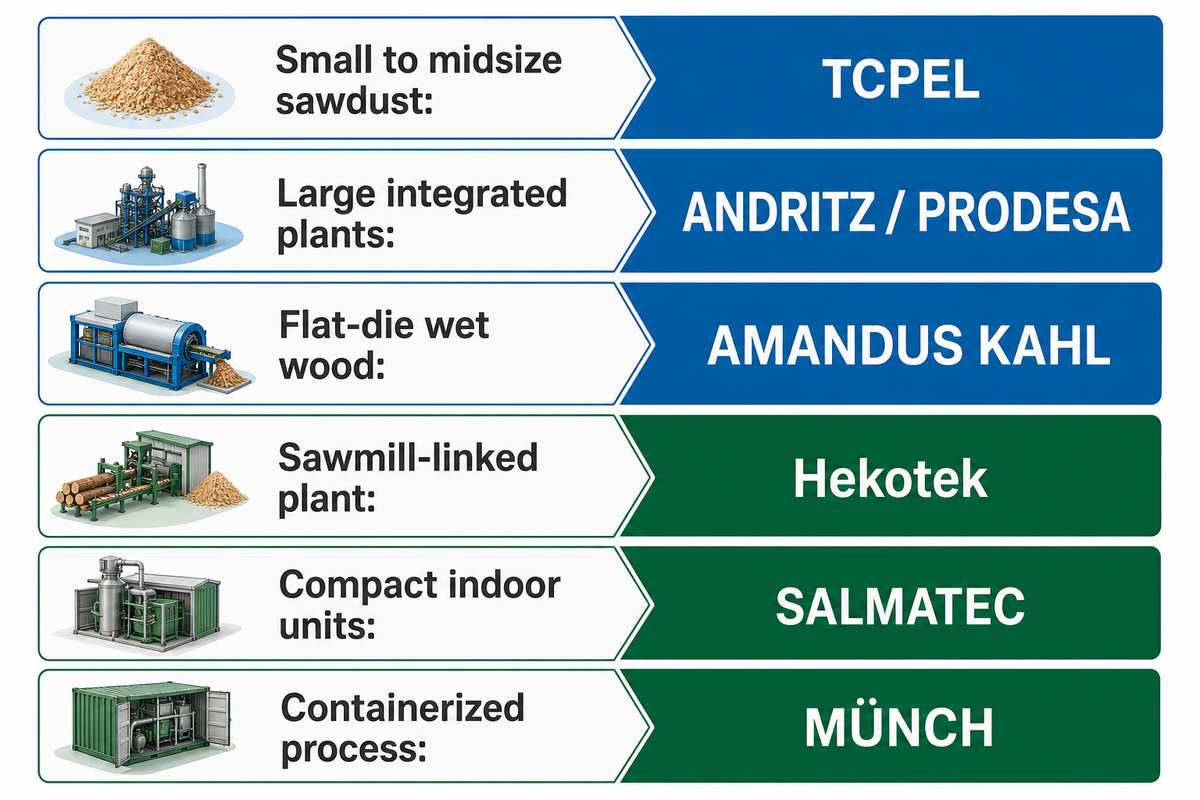
- Best for small to midsize sawdust equipment packages: TCPEL.
- Best for large integrated plant projects: ANDRITZ and PRODESA.
- Best for flat-die processing from wet wood: AMANDUS KAHL.
- Best for a sawmill-linked pellet plant: Hekotek.
- Best for compact indoor pellet units: SALMATEC.
- Best for a containerized wood process: MÜNCH.
Disclosure: This guide is published by TCPEL. We list ourselves first because this is our website, not because we claim to be the market leader. The other 19 manufacturers are grouped by what they’re best for, in no particular order within each group.
How We Selected These Manufacturers
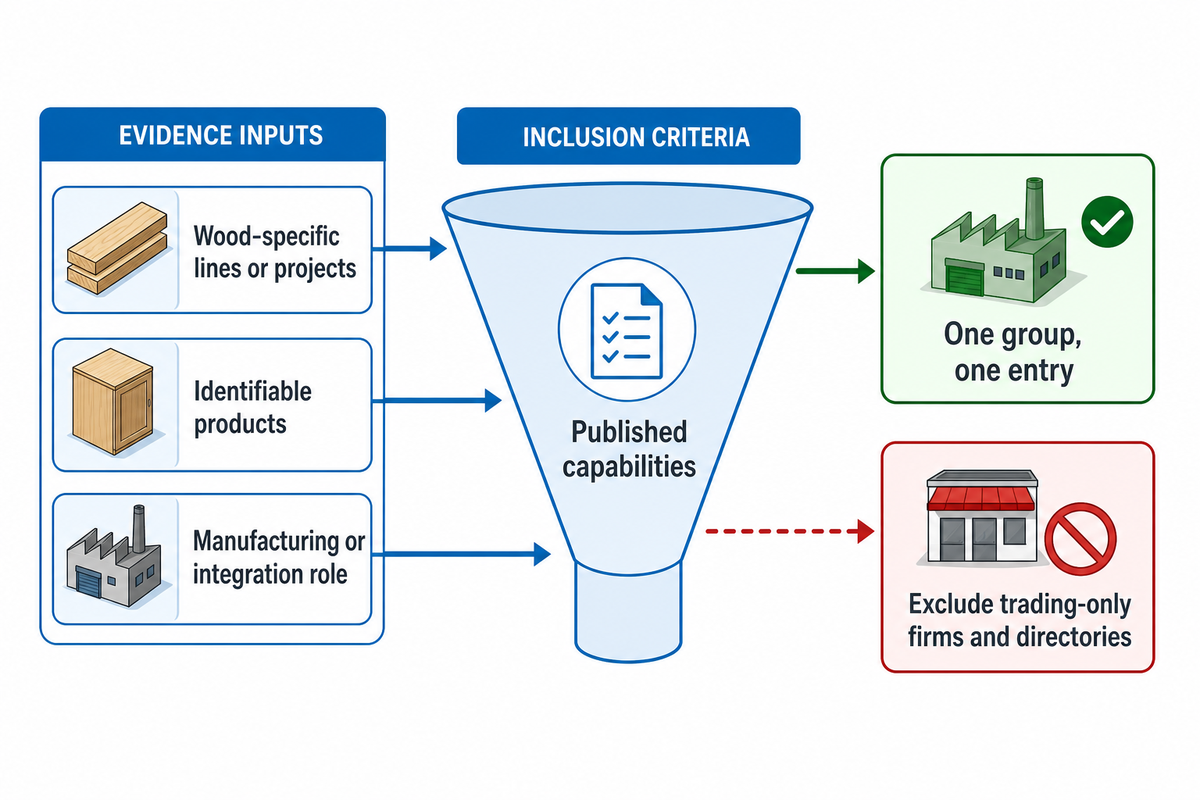
We assessed companies and engineering firms with publicly available information on wood-specific production lines, process systems or plant projects. We looked for a body of work containing identifiable products, a manufacturing or integration role, as well as published capabilities. We excluded trading-only firms, sourcing platforms and directories, as well as candidates supported only by feed-pellet machines or unrelated briquetting examples. In October 2026, we verified company information on their respective web sites and other publicly available information.
One group receives one entry: ABC Machinery and GEMCO appear together, and CPM is represented once. Founding dates refer to the named business or the group origins stated in the profile. Capacities, projects and quality statements are attributed company information, while the Best-for labels are our editorial assessment of the published scope. The numbers identify entries; they don’t measure market share or product quality.
Compare 20 Wood Pellet Production Line Manufacturers
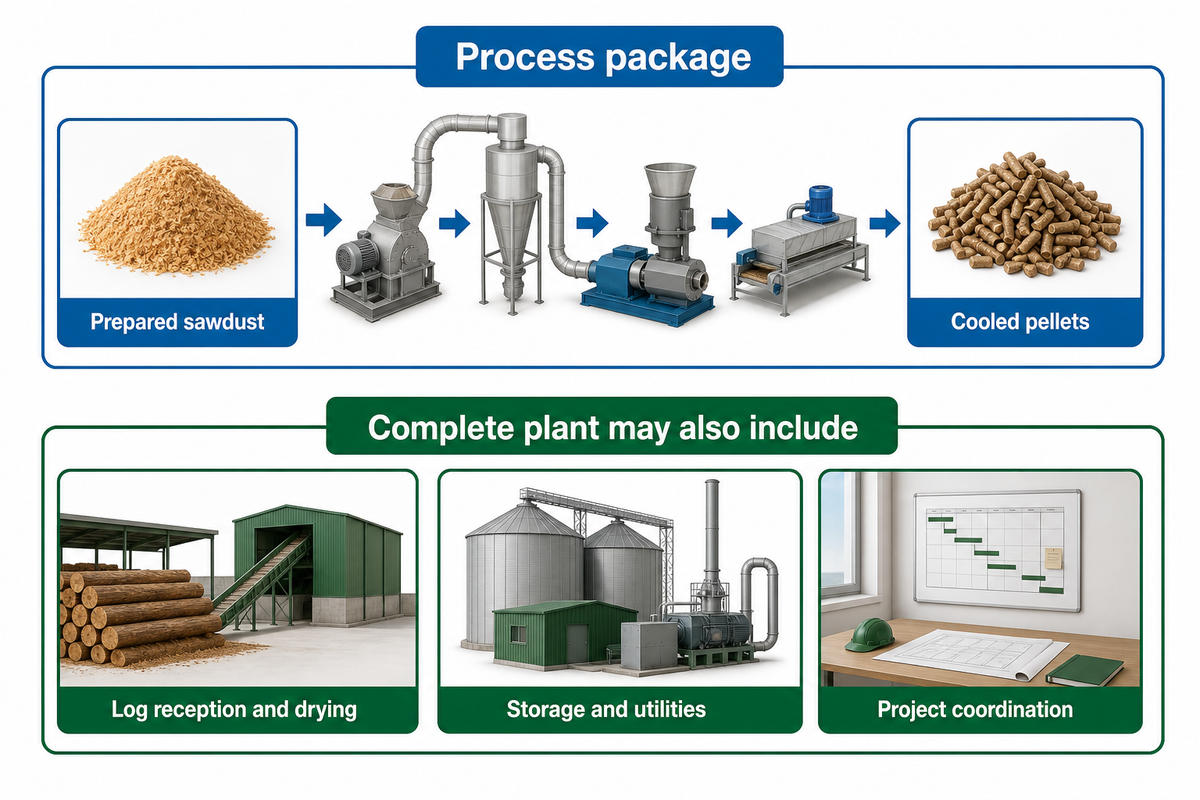
20-Maker Wood Pellet Plant Scope Map
Use the Plant Scope column first. A process package may start with prepared sawdust and finish with cooled pellets; a complete wood pellet plant can also include log reception, drying, storage, utilities and project coordination. Those boundaries explain why the same throughput can lead to different equipment lists. For a broader comparison covering presses and integrated systems, see our guide to wood pellet equipment manufacturers.
The table groups companies by their most useful buying fit. A manufacturer may serve more than one project size, and annual project capacity is shown separately from hourly machine output. Scroll horizontally on smaller screens to read all ten comparison fields.
| No. | Company Name | Headquarters | Founded Year | Best For | Brief Introduction | Plant Scope | Key Advantages | Potential Disadvantages | Official Website |
|---|---|---|---|---|---|---|---|---|---|
| 1 | TCPEL | Jinan, Shandong, China | 2020 | Sawdust equipment packages | Wood-line equipment maker | Chipping through packing | Published 0.3–10 t/h options | Published wood tiers end at 6–10 t/h | https://tcpel.net/ |
| 2 | ABC Machinery / GEMCO | Anyang, China | 2014 | Starter and expansion projects | ABC’s GEMCO biomass division | Mini plants to industrial lines | Australia and Vietnam project examples | Mini-machine and industrial-plant duties differ | https://www.abcmach.com/ |
| 3 | RICHI | Zhengzhou, Henan, China | 1995 | Capacity and budget options | Custom pellet-line builder | Configured complete process | 1–45 t/h published line range | Site costs sit outside indicative equipment budgets | https://richipelletizer.com/ |
| 4 | Yulong | Zhangqiu, Jinan, Shandong, China | 1998 | Parallel vertical ring dies | Biomass equipment producer | Wood-residue line packages | Two-press Vietnam reference | Project output covers several machines | https://www.pelletmachine.com/ |
| 5 | Kingoro | Mingshui, Shandong, China | 1995 | Small-bag or bulk-bag output | Integrated biomass equipment maker | Preparation through bagging | Two packing formats and output bands | Small-bag packer limits finishing rate | http://www.kingoro.com/ |
| 6 | DoubleCrane | Leling, Dezhou, Shandong, China | 2005 | Small commercial references | Wood-pellet equipment producer | Complete configured lines | Morocco 1 t/h; Austria 3 t/h | Broad catalogue spans different plant classes | https://www.woodpelletmaker.com/ |
| 7 | ANDRITZ | Graz, Austria | 1852 | Large integrated projects | Industrial equipment and engineering group | Major process systems and integration | Bioena: four production lines | Multiple supplier interfaces remain | https://www.andritz.com/ |
| 8 | AMANDUS KAHL | Reinbek, Germany | 1876 | Logs and wet chips | Flat-die technology manufacturer | Whole-tree preparation to loading | 16 mill sizes; pilot facilities | Whole logs add substantial preparation stages | https://www.akahl.com/ |
| 9 | CPM | Blaine, Minnesota | 1883 | Industrial process upgrades | Process equipment group | Grinding through screening | Direct-drive and 7900-series mills | Log yard and drying separately scoped | https://onecpm.com/ |
| 10 | PRODESA | Zaragoza, Spain | 1999 | Engineering plus own mills | Biomass plant and machinery group | Turnkey projects or equipment packages | TORO, THOR and PelletBOX | Equipment purchase differs from turnkey contract | https://www.prodesa.net/ |
| 11 | Bühler | Uzwil, Switzerland | 1860 | Grinding to bagging | Industrial process manufacturer | Pelleting process and service | RWPR presses; spark and dust systems | Upstream drying is a separate scope decision | https://www.buhlergroup.com/ |
| 12 | Hekotek | Jüri, Estonia | 1992 | Sawmill integration | Wood-processing equipment integrator | Plant engineering and material handling | Warmeston: 80,000 tonnes/year | Core presses may come from another manufacturer | https://hekotek.ee/ |
| 13 | Zhengchang | Liyang, Jiangsu, China | 1918 | Industrial log processing | Turnkey machinery group | Log-to-pellet project engineering | Brazil project rated at 16 t/h | Large front-end and site requirement | https://en.zhengchang.com/ |
| 14 | SALMATEC | Gödenstorf, Germany | 1972 | Compact indoor units | Pellet-system manufacturer | Preassembled pelletizing and finishing | Siemens S7; integrated screen-cooler | Indoor frost protection required | https://www.salmatec.de/ |
| 15 | MÜNCH | Hilden, Germany | 1981 | Containerized systems | Pellet machinery manufacturer | Two-container process package | 200 kW connection; integrated fines return | Dryer and log yard outside standard package | https://www.muench-edelstahl-gmbh.de/ |
| 16 | La Meccanica | Cittadella, Italy | 1961 | Testing and retrofits | Pelleting machinery manufacturer | Wood mills, cooling and screening | Material laboratory; 3D retrofit support | Log preparation and drying separately scoped | https://lameccanica.it/ |
| 17 | Yemmak | Bandirma, Balikesir, Türkiye | 1965 | Compact automated plants | Turnkey machinery engineer | Integrated designed facility | Megapel 2–2.5 t/h reference | Example facility occupies roughly 700 square metres | https://www.yemmak.com/ |
| 18 | Nawrocki | Żnin, Poland | 1996 | Automated European lines | Pelleting equipment and line designer | Biomass lines and press upgrades | GRB2 press; AIAC controls | Wood input needs 10–14% moisture | https://npt880.com/ |
| 19 | General Dies | Colognola ai Colli, Verona, Italy | 1960 | Custom wet-wood plants | Pelleting equipment manufacturer | Eight-stage wood processing line | Rotary/belt dryer and packing choices | Configured layout rather than fixed package | https://www.generaldies.com/en/ |
| 20 | Rosal-Mabrik | Santa Perpetua de Mogoda, Barcelona, Spain | 1956 | Flexible press layouts | Rosal engineering with Mabrik machinery | Configured biomass processing systems | PVR/PVB layouts; adjustable rollers | Feed-table capacity is not wood capacity | https://rosal-feedmills.com/ |
Equipment Packages for Small and Midsize Wood Pellet Lines
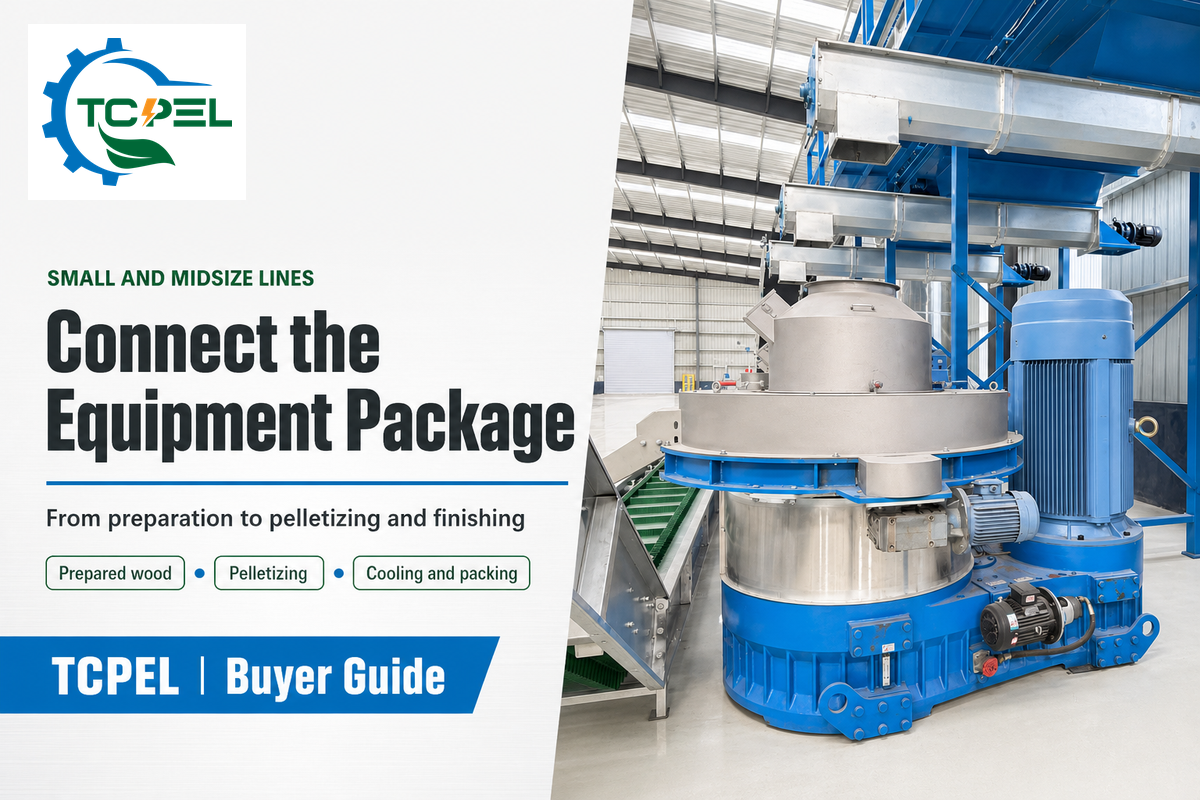
Equipment packages provided by these manufacturers connect the dots in a system from preparation to pelletizing and finishing. Their published solutions for smaller wood projects help buyers planning for specific residue streams and production volumes.
1. TCPEL: Best for small to midsize sawdust pellet lines with equipment supplied across the process
Headquarters: Jinan, Shandong, China · Founded: 2020 · Type: Equipment manufacturer and line supplier
Official website: https://tcpel.net/
Main products: Drum chippers, hammer mills, rotary dryers, pellet mills, coolers and packing machines.
Published capability: Published wood-pellet-line configuration tiers: 0.3–0.5, 1–2, 3–5 and 6–10 t/h for wood pellet production.
Certifications / notable work: According to its official website, TCZL560 through TCZL850B options for wood residue processing.
TCPEL combines the main wood-processing machines within one equipment range, which makes it a practical shortlist entry for a buyer planning to make wood pellets from a defined sawdust supply in a small or midsize plant. According to TCPEL’s wood-specific line page, its options are separated into 0.3–0.5, 1–2, 3–5 and 6–10 t/h bands, while the TCZL850B press is listed separately at 280 kW and 4 t/h; that distinction helps keep a single machine rating separate from a production-line quotation.
Buying limitation: The published wood-line options top out at 6–10 t/h; larger projects need a separate engineered configuration.
The TCPEL company profile identifies the business as ALLWIN INTERNATIONAL CO., LTD.
2. ABC Machinery / GEMCO: Best for biomass equipment packages from starter plants to larger projects
Headquarters: Anyang, China · Founded: 2014 (ABC Machinery joint venture) · Type: Machinery manufacturer and turnkey engineering group
Official website: https://www.abcmach.com/
Main products: Ring-die pellet mills, mini pellet plants, industrial pellet plants and briquetting equipment.
Published capability: Published wood projects include 2 t/h in Australia and 20 t/h in Vietnam.
Certifications / notable work: According to its official website, the brands page describes GEMCO as ISO9000 and CE certified; this is a company claim.
ABC Machinery brings Anyang Gemco Energy Machinery Co., Ltd and KMEC into one group entry, combining biomass machinery with plant engineering rather than appearing twice in this list. Its official project examples span a 2 t/h Australian wood pellet plant and a 20 t/h Vietnamese project, giving buyers more useful scale references than the price of an individual flat die pellet mill. The product range also includes briquetting, so a pellet project should be framed around the required pellet output and finishing system.
Buying limitation: Small pellet machines and industrial plant projects are separate product classes; their prices and production duties aren’t interchangeable.
3. RICHI: Best for custom wood pellet lines with published capacity and budget bands
Headquarters: Zhengzhou, Henan, China · Founded: 1995 · Type: Pellet machinery manufacturer and turnkey line supplier
Official website: https://richipelletizer.com/
Main products: MZLH pellet mills, wood crushers, dryers, coolers, screeners and bagging equipment.
Published capability: Custom wood pellet line range of 1–45 t/h.
Certifications / notable work: According to its official website, a 5 t/h Austrian wood pellet project dated December 2018.
RICHI publishes enough configuration detail to compare a proposed wood pellet line with a target output before requesting a detailed layout. Its six-stage wood process covers preparation, drying, pelleting, cooling and packing, and the Austrian 5 t/h reference gives the wider 1–45 t/h catalogue a named application. In the production-capacity explanation on RICHI’s price page, a 1–2 t/h equipment line is indicated at $100,000–$250,000, which is useful for early screening when read with the stated quotation scope.
Buying limitation: Published equipment budgets aren’t all-in site prices; installation and overseas commissioning costs are itemized in the quotation.
4. Yulong: Best for parallel vertical ring-die mills processing wood residues
Headquarters: Zhangqiu, Jinan, Shandong, China · Founded: 1998 · Type: Biomass equipment manufacturer and line supplier
Official website: https://www.pelletmachine.com/
Main products: Vertical ring-die pellet mills, crushers, drying equipment, coolers and conveyors.
Published capability: An Indonesian rubberwood line is listed at 9–12 t/h.
Certifications / notable work: According to its official website, the official website states ISO9001 quality-system certification.
Yulong’s wood-project pages show how multiple presses can be combined for a larger residue stream: its Vietnamese 6–8 t/h example uses two 850 machines, while the Indonesian rubberwood project is listed at 9–12 t/h. That makes the company relevant to sawmills considering parallel pellet machines rather than treating one larger motor as the whole expansion plan. The published product architecture centers on vertical ring-die equipment, with drying and downstream handling supplied around it.
Buying limitation: The cited line outputs belong to specified feedstocks and multi-machine options, rather than a single pellet press.
5. Kingoro: Best for wood pellet lines with small-bag and bulk-bag finishing options
Headquarters: Mingshui, Shandong, China · Founded: 1995 (group origins) · Type: Biomass machinery manufacturer
Official website: http://www.kingoro.com/
Main products: Crushing, drying, pelletizing, cooling and packaging equipment.
Published capability: DCS-A50 packing capacity 2–3 t/h; DCS-A1000 packing capacity 8–10 t/h.
Certifications / notable work: According to its official website, the website lists ISO, CE and SGS credentials without specifying an ISO edition.
Kingoro gives the finishing end of a wood pellet plant more definition than a catalogue that stops at the press. The DCS-A50 and DCS-A1000 packing systems distinguish small-bag output from bulk-bag handling, while the broader company offer covers crushing, drying, forming and cooling. For a supplier of pellets for heating, that packaging choice connects pellet manufacturing to the actual production and distribution format customers will receive.
Buying limitation: Its listed 2–3 t/h small-bag packer has a lower throughput than the 8–10 t/h bulk-bag option, making bag format a line-sizing decision.
6. DoubleCrane: Best for small commercial wood pellet plants with published 1–3 t/h references
Headquarters: Leling, Dezhou, Shandong, China · Founded: 2005 · Type: Machinery manufacturer and complete-line supplier
Official website: https://www.woodpelletmaker.com/
Main products: Wood crushers, dryers, pellet mills, coolers, sifters and packing machines.
Published capability: Published cases include a 1 t/h Moroccan line and a 3 t/h Austrian line.
Certifications / notable work: According to its official website, the company states ISO9001 certification on its certificates page.
DoubleCrane’s published Moroccan 1 t/h and Austrian 3 t/h installations make it an accessible comparison for a small commercial project using industrial equipment. The company also supplies the surrounding crusher, dryer, cooler, sifter and packaging machines, so the discussion can start with a whole material path instead of a wood pelletizer alone. Its catalogue extends from 200 kg/h to 20 t/h, but the named examples here are more useful for judging the smaller project sizes.
Buying limitation: The broad 200 kg/h to 20 t/h catalogue covers different plant sizes; the named 1–3 t/h references represent the small commercial end.
Industrial Wood Pellet Plant Engineering
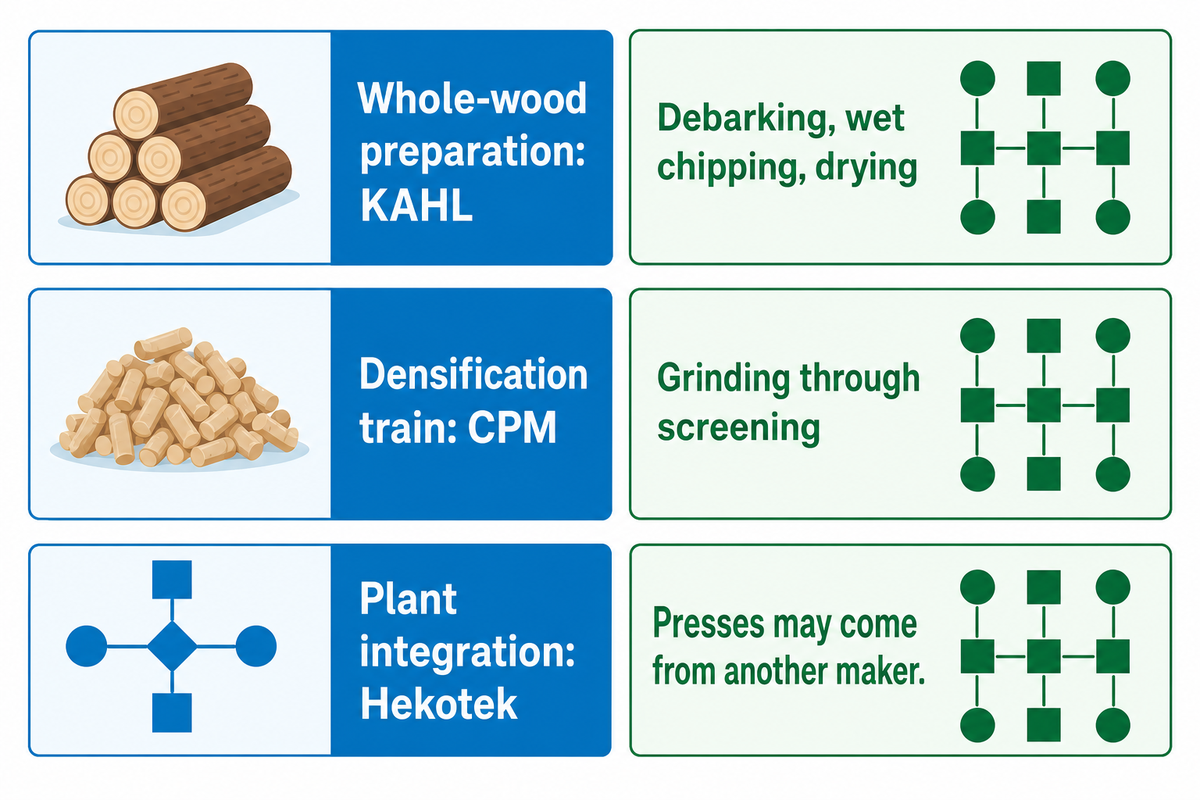
The following companies offer industrial process machinery, engineering or plant integration. Their references differentiate equipment orders from the integration work required for the construction and commissioning of a larger production facility.
7. ANDRITZ: Best for large wood pellet projects requiring process integration
Headquarters: Graz, Austria · Founded: 1852 (group origins) · Type: Industrial technology group and plant engineering supplier
Official website: https://www.andritz.com/
Main products: Grinding, conditioning, pelleting, process controls and associated plant systems.
Published capability: Bioena has four wood pellet lines with a stated annual capacity of 125,000 tons.
Certifications / notable work: According to its official website, Bioena plant design, installation, testing and commissioning.
ANDRITZ’s Bioena reference shows the difference between a major process-equipment supplier and a simple machine seller: the stated work includes layout, process integration, installation, testing and commissioning for four lines. The project is described as a 125,000-ton-per-year facility, and its automation work includes material-flow coordination rather than only starting individual motors. That combination fits a large wood pellet plant where the performance of several connected stages matters as much as the pellet mill itself.
Buying limitation: The Bioena project combined suppliers from 11 countries, so a large integrated plant still has equipment interfaces beyond one manufacturer’s supply.
8. AMANDUS KAHL: Best for flat-die wood pellet plants starting with logs or wet chips
Headquarters: Reinbek, Germany · Founded: 1876 · Type: Pelleting machinery manufacturer and turnkey plant builder
Official website: https://www.akahl.com/
Main products: Debarking, wet chipping, drying, grinding, flat-die presses, cooling and loading systems.
Published capability: Published mill range includes 16 sizes with drives from 3 to 630 kW.
Certifications / notable work: According to its official website, the Reinbek factory lists DIN EN ISO 9001:2015 certification.
KAHL’s flat-die approach is paired with a detailed whole-wood process, from debarking and wet chipping through drying, refining, conditioning, pelleting and loading. The supplier lists 16 mill sizes with drives from 3 to 630 kW, and states that most wood duties fall within 1.5–12 t/h per mill, giving the buyer a distinct architecture to compare with ring die pellet mills. Its Reinbek manufacturing site and pilot-plant capability also connect equipment selection with material trials.
Buying limitation: Whole-log production adds debarking, wet chipping and drying before pelleting, with the corresponding plant footprint and utilities.
9. CPM: Best for industrial grinding-to-cooling pellet systems and plant upgrades
Headquarters: Blaine, Minnesota, USA · Founded: 1883 (CPM business origins) · Type: Process equipment manufacturing group
Official website: https://onecpm.com/
Main products: Hammer mills, conditioners, pellet mills, coolers and screening equipment.
Published capability: Biomass systems cover grinding, conditioning, pelleting, cooling and screening.
Certifications / notable work: According to its official website, integrated biomass equipment including 7900-series and direct-drive pellet mills.
CPM is particularly relevant when a pellet manufacturing plant needs an integrated densification train or a replacement for an existing press-and-cooler arrangement. Its biomass offering covers grinding, conditioning, pelletizing, cooling and screening, with 7900-series and direct-drive mills among the listed technologies. The group also supplies associated spare parts and service, which makes lifecycle support a concrete part of the equipment discussion rather than an unsupported promise of maintenance-free production.
Buying limitation: The listed biomass process begins with grinding; a log yard and dryer must be scoped separately from that densification equipment package.
10. PRODESA: Best for wood pellet plant engineering backed by in-house mills and aftermarket services
Headquarters: Zaragoza, Spain · Founded: 1999 · Type: Plant engineering and biomass machinery manufacturing group
Official website: https://www.prodesa.net/
Main products: TORO pellet mills, THOR hammer mills, TITAN green mills and integrated plant systems.
Published capability: Project history spans Europe, North America and Asia; PelletBOX was developed in Texas in 2020.
Certifications / notable work: According to its official website, three Canadian pellet plants recorded in 2018.
PRODESA combines plant engineering with its own TORO pellet mills, THOR hammer mills and later green-grinding equipment, so describing it only as a third-party integrator would miss part of its offer. Its history records three Canadian pellet plants in 2018 and the PelletBOX container concept in Texas in 2020, showing both plant-scale and compact system development. The company’s separate engineering, equipment and service activities let an owner discuss an entire pellet plant project or a defined machinery upgrade.
Buying limitation: Its equipment and turnkey divisions have different supply boundaries; a standalone TORO or THOR order isn’t a complete plant contract.
11. Bühler: Best for integrated wood grinding-to-bagging systems with service support
Headquarters: Uzwil, Switzerland · Founded: 1860 · Type: Industrial process machinery manufacturer
Official website: https://www.buhlergroup.com/
Main products: Grinding equipment, RWPR pellet mills, conveying, bagging and aspiration systems.
Published capability: Published wood process scope runs from grinding to bagging.
Certifications / notable work: According to its official website, wood pelleting plant history includes a 1982 installation in Sweden.
Bühler’s wood-pelleting offer connects grinding to bagging and places RWPR presses within a broader process rather than presenting the wood pellet mill as a complete factory. Its published system features include spark detection, extinguishing and dust aspiration, while service options include die refurbishment. A history that includes a Swedish wood installation in 1982 is useful background, but the practical buying case rests on the current process range and the service available for that equipment.
Buying limitation: Its published wood process starts at grinding, so log reception and upstream drying are additional project-scope decisions.
12. Hekotek: Best for sawmill-linked wood pellet plant engineering and material handling
Headquarters: Jüri, Estonia · Founded: 1992 · Type: Wood-processing equipment manufacturer and plant integrator
Official website: https://hekotek.ee/
Main products: Wood handling, drying integration, conveying and complete pellet-plant engineering.
Published capability: Warmeston’s Estonian plant is listed at 80,000 tonnes per year and operating since 2014.
Certifications / notable work: According to its official website, the company records its first ISO9001 certification in 2009.
Hekotek’s strength is the connection between wood-processing operations and a pellet plant, especially where sawmill material handling already shapes the site. Its Warmeston reference describes an Estonian facility operating since 2014 at 80,000 tonnes per year, while the earlier Sawmill 25 example shows how its plant engineering can combine equipment from several manufacturers. The company records its first ISO9001 certification in 2009, a dated quality-system statement rather than a claim that every project has the same certification.
Buying limitation: Integrated projects can use another manufacturer’s pellet presses; its Sawmill 25 project used ANDRITZ Sprout-Matador equipment.
13. Zhengchang: Best for automated industrial plants processing logs into wood pellets
Headquarters: Liyang, Jiangsu, China · Founded: 1918 (group origins) · Type: Machinery manufacturer and turnkey engineering group
Official website: https://en.zhengchang.com/
Main products: Wood grinders, MZLH768 pellet equipment, automation and weighing systems.
Published capability: A Brazilian wood pellet project published in October 2026 is rated at 16 t/h.
Certifications / notable work: According to its official website, the group website lists ISO9001 quality management certification.
Zhengchang’s Brazilian wood project, published in October 2026, gives this entry a wood-specific basis beyond the group’s longer feed-equipment history. The described 16 t/h installation uses MZLH768 equipment and integrates log preparation, controls and automated weighing, with incoming logs stated as 400–500 mm in diameter. Those details make it relevant to an industrial wood pellet project handling large raw material pieces rather than buying only a press for dry shavings.
Buying limitation: The cited log-processing project is an engineered 16 t/h plant, with a larger feed-preparation and site requirement than a small sawdust workshop.
Configurable Pellet Processing and Line Systems
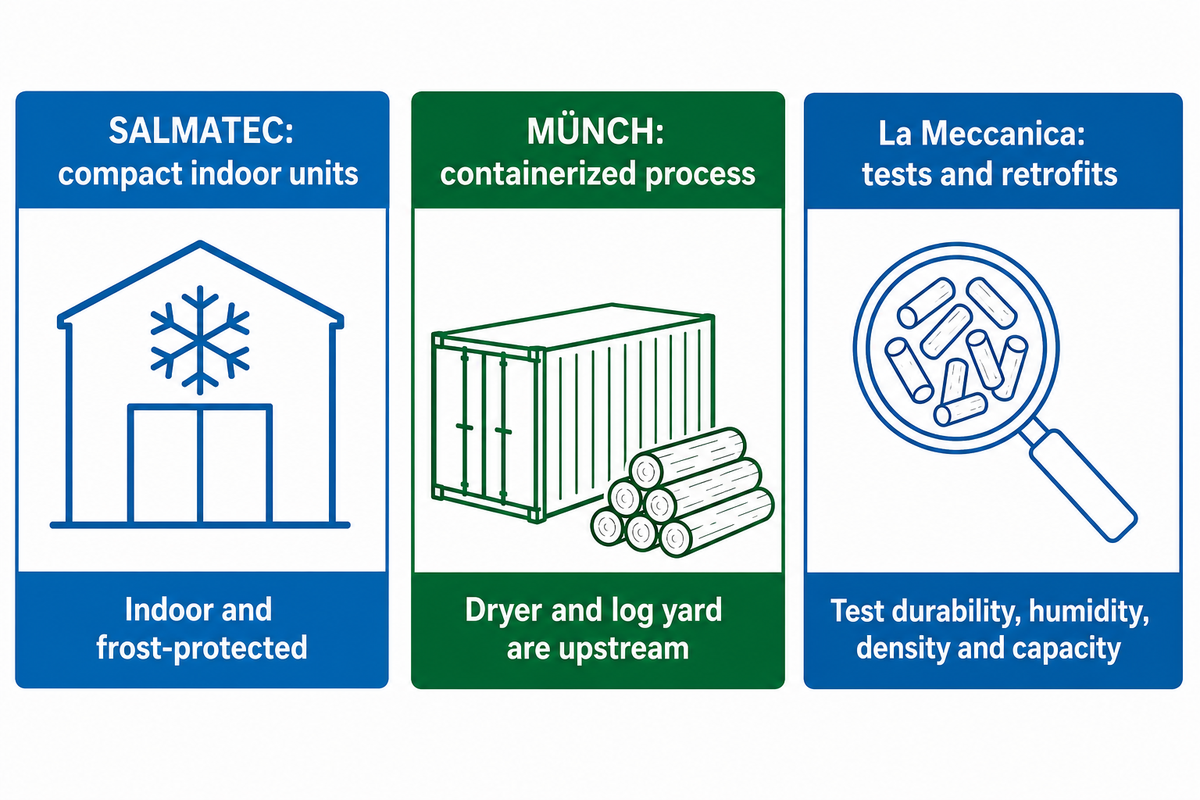
These companies offer wood-processing equipment, retrofit systems or material testing. For projects with an existing facility and dryer/conveyor systems, these companies publish wood-specific equipment packages or system integrations.
14. SALMATEC: Best for indoor compact pellet units for sawmill by-products
Headquarters: Gödenstorf, Germany · Founded: 1972 · Type: Pellet equipment manufacturer and system supplier
Official website: https://www.salmatec.de/
Main products: Maxima presses, compact pellet units, screen-coolers and Siemens S7 controls.
Published capability: Compact wood units span published options from 0.5–1 to 6–7 t/h.
Certifications / notable work: According to its official website, compact units combine cooling, screening and dedusting with spark protection.
SALMATEC’s compact units combine the press with a screen-cooler that handles cooling, screening and dedusting, reducing the number of separate downstream items a buyer must arrange. Its Maxima options span 0.5–1 t/h at the smaller end to 6–7 t/h at the larger end, and the published specification includes Siemens S7 controls plus spark detection and extinguishing. This is a defined system offer for residual wood, with more detail on installation conditions than a stand-alone pellet machine listing.
Buying limitation: The compact unit is specified for indoor, frost-protected installation.
15. MÜNCH: Best for containerized wood pellet processing with compact installation
Headquarters: Hilden, Germany · Founded: 1981 (current company) · Type: Pellet machinery and system manufacturer
Official website: https://www.muench-edelstahl-gmbh.de/
Main products: Pellet presses, blower mills, conditioning, coolers, screening and big-bag stations.
Published capability: Wood system arranged in two 40-foot containers with a 200 kW electrical connection.
Certifications / notable work: According to its official website, container system includes fines return, aspiration and compressor.
MÜNCH packages its woodpelleting system into two 40-foot containers and states a 200 kW electrical connection, making the physical and utility boundaries unusually clear. The package includes a blower mill, feeding and conditioning, cooling, screening, fines return and a big-bag station, with press-drive options of 75, 110 or 132 kW. A buyer with suitable prepared material can therefore compare a compact process package with a building-based layout without confusing compact installation with an absent preparation stage.
Buying limitation: A log yard and dryer aren’t in the standard container equipment list; wet-wood preparation sits upstream.
16. La Meccanica: Best for wood pelleting systems with material testing and retrofit support
Headquarters: Cittadella, Italy · Founded: 1961 · Type: Pellet equipment and plant manufacturer
Official website: https://lameccanica.it/
Main products: Pellet mills, hammer mills, counterflow coolers, vibrating sifters and rotary screeners.
Published capability: Its test line covers milling, mixing, pelleting, cooling and laboratory measurements.
Certifications / notable work: According to its official website, in-house tests include pellet durability, humidity, density and capacity.
La Meccanica’s wood-and-biomass range includes pellet mills, hammer mills, counterflow coolers and screening equipment, supported by a test line that runs from milling through cooling. The associated laboratory evaluates pellet durability, humidity, density and capacity, which gives material suitability a place in the equipment discussion before a plant owner settles on a die specification. Its 3D scanning capability also supports retrofit work where a new pellet processing component must fit an existing installation.
Buying limitation: The published wood range centers on milling through screening; raw-log handling and drying are separate scope items.
17. Yemmak: Best for compact turnkey wood pellet plants with integrated automation
Headquarters: Bandirma, Balikesir, Türkiye · Founded: 1965 · Type: Machinery manufacturer and turnkey plant engineer
Official website: https://www.yemmak.com/
Main products: Wood pellet equipment, process machinery, plant automation and steel construction.
Published capability: Megapel wood pellet project: 2–2.5 t/h in approximately 700 square metres.
Certifications / notable work: According to its official website, Megapel integrates Yemmak IQ automation and stock management.
Yemmak’s Megapel reference is a specific small-plant example: the company describes a turnkey wood pellet facility producing 2–2.5 t/h within approximately 700 square metres. The project combines two product types with Yemmak IQ automation and stock management, so the appeal is the coordination of production and material movement rather than a claimed universal output from one mill. Manufacturing, engineering, automation and steel construction sit within the company’s stated capabilities.
Buying limitation: The cited 2–2.5 t/h project occupies about 700 square metres, so it’s a designed facility rather than a container-sized installation.
18. Nawrocki: Best for automated European wood pelleting lines and press upgrades
Headquarters: Żnin, Poland · Founded: 1996 · Type: Pelleting machinery manufacturer and complete-line designer
Official website: https://npt880.com/
Main products: GRB2 880.264 presses, AIAC automation and biomass processing lines.
Published capability: Wood application guidance specifies approximately 10–14% feedstock moisture.
Certifications / notable work: According to its official website, the company states ISO9001 coverage for design, manufacture and service.
Nawrocki combines its GRB2 880.264 equipment with AIAC automation and complete-line design, giving European plant owners a system option as well as a press-upgrade candidate. The wood applications page describes forest chips and shavings and states a feedstock moisture range of about 10–14%, a useful input boundary for comparing a proposed biomass pellet processing line. Its remote diagnostic service and stated ISO9001 scope connect the machine offer with service and support after installation.
Buying limitation: The cited wood application needs feedstock at approximately 10–14% moisture, making conditioning or drying part of the upstream design.
19. General Dies: Best for custom wet-wood processing lines with dryer and packing choices
Headquarters: Colognola ai Colli, Verona, Italy · Founded: 1960 · Type: Pelleting machinery and plant manufacturer
Official website: https://www.generaldies.com/en/
Main products: Chipping, rotary or belt drying, refining, mixing, pelleting, cooling and packing systems.
Published capability: Wood line guidance reduces wet material toward approximately 12–13% moisture before pelleting.
Certifications / notable work: According to its official website, in-house manufacturing and a spare-parts archive of more than 35,000 drawings.
General Dies sets out a complete wood line in eight phases: chipping, drying, refining, mixing, pelleting, cooling, sieving and packing. The process description offers rotary or belt drying and brings wet material toward approximately 12–13% moisture before the press, while finishing can use sacks, big bags or bulk handling. In-house manufacture and an archive of more than 35,000 spare-part drawings support a buying case centered on customization and long-term component supply.
Buying limitation: Dryer type and manual, semi-automatic or automatic packing change the installation, so this is a configured plant rather than one fixed package.
20. Rosal-Mabrik: Best for configurable wood pelleting systems with flexible press layouts
Headquarters: Santa Perpetua de Mogoda, Barcelona, Spain · Founded: 1956 (Rosal origins) · Type: Process machinery manufacturing and plant engineering group
Official website: https://rosal-feedmills.com/
Main products: Mabrik PVR and PVB presses, hammer mills, conditioners, dryers and counterflow coolers.
Published capability: PVR uses top-mounted motors; PVB uses a rigid base-mounted arrangement.
Certifications / notable work: According to its official website, optional automatic roller adjustment and two- or three-roller options.
Rosal-Mabrik combines Rosal’s plant engineering with Mabrik pellet machinery and explicitly includes biomass and wood among its applications. Its PVR presses use top-mounted motors where layout matters, while PVB models use a rigid base-mounted arrangement for demanding products; the range also offers two or three rollers and optional automatic adjustment. AISI-304 contact components are a concrete construction detail, but the relevant wood duty still needs a configuration distinct from the group’s animal feed applications.
Buying limitation: Wood service requires its own die and roller setup; generic feed-capacity tables don’t establish wood-pellet output.
How to Choose a Wood Pellet Production Line Manufacturer
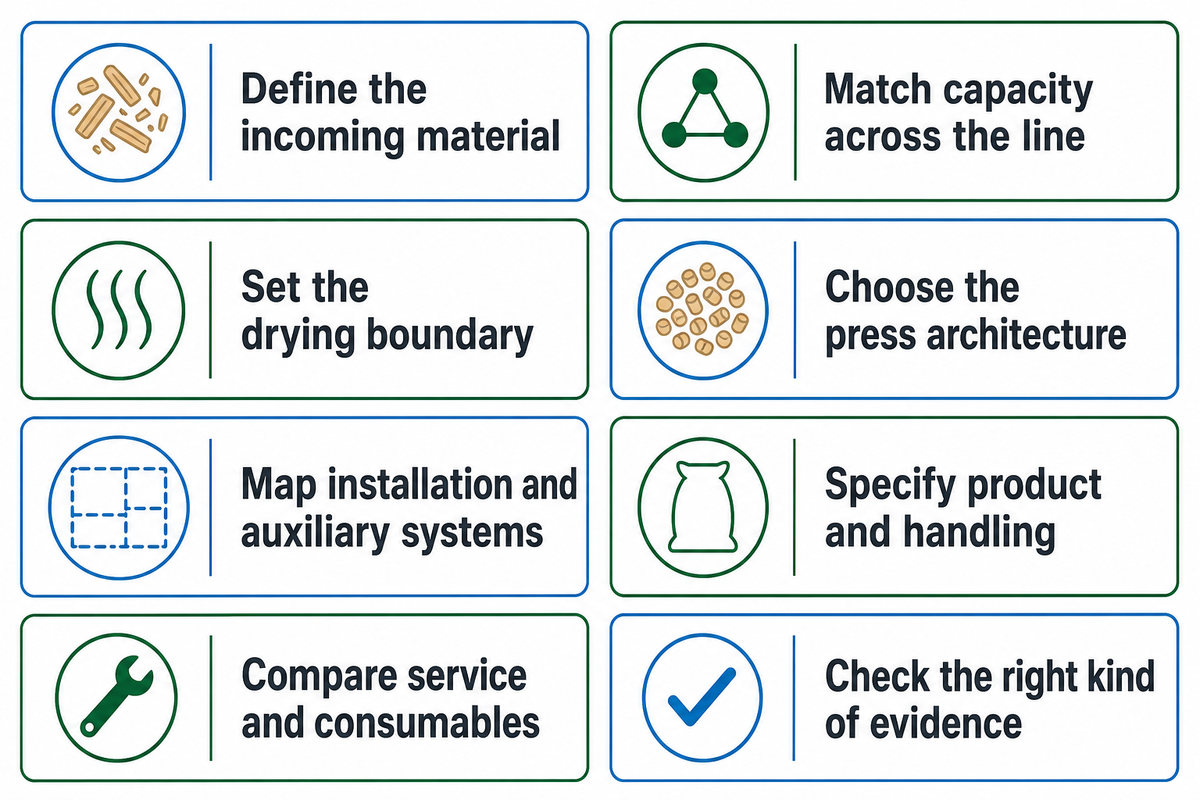
Find the manufacturer whose supplied stages, material experience and service arrangement match your intended plant. The least expensive total equipment may not be the best if it omits the dryer, the finishing rate doesn’t match the press, or the quoted capacity employs a different raw material. The difference in the arrangement should be made explicit in the form of a process and responsibility list.
What Is a Complete Wood Pellet Production Line?
A complete wood pellet production line connects the equipment needed to turn the specified incoming wood into finished, handled pellets. That normally means size reduction, moisture preparation where required, feeding and conditioning, pelleting, cooling, screening and packing or bulk storage. The pellet mill uses a die and rollers to compress the prepared material. The starting condition decides whether debarking, chipping and drying belong in the package.
Dry sawdust, wet wood chips and full logs need different front ends. General Dies describes an eight-stage wood process, while MÜNCH defines a container package whose standard list starts after raw-log preparation. Neither description can be compared fairly without the incoming material specification. Our wood pellet production process guide explains how these stages connect; this shortlist focuses on who supplies them.
What Must a Comparable Wood Pellet Plant Quote Include?
A comparable wood pellet plant quote should identify the feedstock, net finished output, included machines, utilities, installation work and performance-test conditions. Match those items before comparing the total. A quote for one ring die wood pellet mill, a configured biomass pellet plant and a turnkey facility represents three different purchases.
- Define the incoming material. Record wood species or residue type, particle size, moisture content and contamination limits. A wood pellet maker handling dry furniture-factory shavings has a different preparation duty from one receiving fresh forest chips. A biomass pellet machine advertised for several biomass materials still needs a wood-specific configuration. Keep usable feed volume separate from finished output, and describe the material you actually have rather than a favorable sample chosen only for a demonstration.
- Match capacity across the line. Ask for net saleable pellet output under stated operating hours and feed conditions. The feed rate, press, cooler, screening losses and bagging rate all matter. Kingoro’s published packer ranges illustrate the point: a smaller bagging machine can set the finishing limit even when the pellet press has more capacity.
- Set the drying boundary. List the dryer, heat source, air handling, controls and any fuel preparation in the same scope discussion. Nawrocki’s cited wood application uses approximately 10–14% feedstock moisture, while General Dies describes preparation toward 12–13%; these are supplier-specific starting points, not one setting for every wood material. See our rotary drying considerations for the drying-stage questions.
- Choose the press architecture for the material. Compare a horizontal ring die, a vertical ring die wood pellet machine and KAHL’s flat-die approach using the same test material and output definition. Die geometry, roller adjustment and conditioning belong in the supplier’s configuration. A small wood pellet machine sold for home use is a different purchasing class from equipment expected to run repeated industrial shifts.
- Map installation and auxiliary systems. Identify who supplies buildings or supports, conveyors, electrical distribution, dust collection, controls and commissioning. Include responsibility for the plant’s fire-protection design instead of treating a listed spark detector as proof of whole-plant suitability. Indoor space and electrical capacity are concrete constraints: SALMATEC specifies frost protection, and MÜNCH states a 200 kW connection for its container system.
- Specify the finished product and handling. For customers purchasing renewable fuel, state pellet dimensions, desired durability, fines limits and whether output goes to small bags, big bags or bulk dispatch. Wood pellets for home heating and other end markets can impose different handling and quality expectations. The end product may be sold as renewable biomass fuel, but that description alone establishes neither certified pellet quality nor the environmental performance of a particular operation.
- Compare service and consumables. Price dies, rollers, wear parts, training, commissioning and after-sales support with the initial equipment. Record response arrangements and the local availability of spare parts. Ask what the quoted energy use covers: the pellet press alone, the electrical line or the line plus thermal drying. A whole-plant figure needs a clearly stated measurement boundary.
- Check the right kind of evidence. Review current certificates for the named legal entity and their stated scope, together with a relevant wood project or material trial. A supplier quality system, a machine conformity statement and ENplus requirements for pellet companies refer to different subjects. None should be substituted for the others. Our guide to evaluating pellet line suppliers develops this procurement step.
What should be tested before a pellet machine is shipped?
During factory checks, ensure that the machinery bears the identity ordered, and check assembly, drive operation, controls and supplied accessories. Where a material trial is included, record the condition of the wood and the measurements taken. Separate factory inspection from the installed line test. A press running by itself can’t test the performance of the site drier, conveyors or final packing.
What Should Be Tested Before a Pellet Production Line Is Accepted?
A pellet production line acceptance test should measure saleable output, pellet quality, energy consumption and stable operation using agreed feedstock and moisture conditions. Record the test duration, sampling method and included equipment before the trial. A short demonstration of a pellet mill doesn’t establish sustained performance for an entire production line.
Observe the material from receiving to the final outlet. Note interruptions, fines that are returned to the process, packing losses and the actual power-measurement boundary. Test controls and operating handover with the operating personnel. This will indicate whether the installed line meets the agreed specification, without assuming that every catalogue capacity is a guarantee.
FAQ
Which manufacturers are best for small commercial wood pellet lines?
TCPEL, DoubleCrane and RICHI are useful small-commercial shortlist options because they publish wood-line options or projects at those scales.
TCPEL lists sawdust line tiers beginning at 0.3–0.5 t/h, DoubleCrane shows a 1 t/h Moroccan example, and RICHI publishes 1–2 t/h budget bands. Those are different kinds of evidence: a configuration, a project and an indicative equipment price. Compare the included preparation and finishing equipment before deciding which supplier fits the material, building and service requirements of your own operation.
Which manufacturers are best for a large industrial wood pellet plant?
ANDRITZ, PRODESA, AMANDUS KAHL and Hekotek are strong comparison candidates for industrial wood pellet plant engineering and integration.
Their documented offers cover different combinations of proprietary machinery, process engineering and equipment coordination. ANDRITZ’s Bioena story describes four lines, PRODESA combines plant work with its own mills, KAHL details whole-wood preparation, and Hekotek shows sawmill-linked integration. The useful comparison is the responsibility each accepts for the proposed project, including utilities and commissioning, rather than a universal largest-or-best label.
What is the difference between a wood pellet line manufacturer and a supplier?
A wood pellet line manufacturer makes relevant machinery, while a supplier may manufacture, integrate, distribute or combine equipment from several companies.
An integrator can provide valuable plant design and coordination without manufacturing every machine in the process. Hekotek’s use of ANDRITZ presses in a documented project illustrates that distinction. For a buyer, the decisive questions are which machines the contracting company makes, which it sources, and who takes responsibility for connecting and commissioning them as a working wood pellet production line.
How much does a complete wood pellet production line cost?
RICHI publishes an indicative $100,000–$250,000 equipment range for a 1–2 t/h wood pellet line.
This is one supplier’s published band, not an all-in industry price. Feed preparation, drying, installation and overseas commissioning change the quoted project scope.
Are Chinese wood pellet line manufacturers reliable?
Chinese candidates such as TCPEL, RICHI and Yulong can be compared through their published options, wood projects and service arrangements.
Country alone does not establish reliability. Match the supplier’s actual equipment scope and relevant operating references to the intended project.
Who is the largest wood pellet production line manufacturer?
This comparison does not assign a largest manufacturer because it has no comparable wood-line revenue or shipment dataset.
ANDRITZ, CPM, Bühler and KAHL are established industrial options in the list. Group size and a wood-pellet-specific market ranking are different measures.
Discuss Your Wood Pellet Plant Requirements
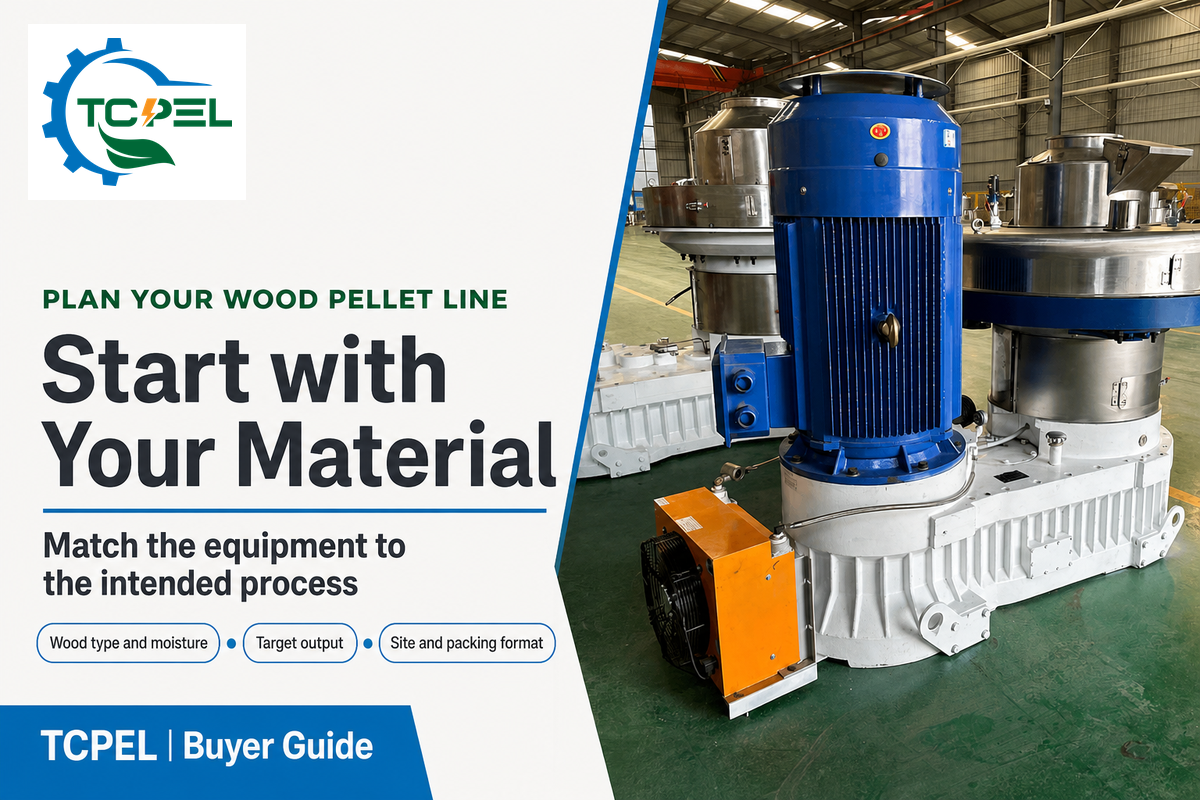
At TCPEL, we supply wood-pellet-line equipment across preparation, drying, pelleting, cooling and packing. Our published wood pellet production line configurations provide a starting point for small to midsize projects. The best equipment fit begins with your wood type, incoming moisture, available feed volume, target output, operating hours and preferred packing format.
Send those details together with the site location, available space and electrical supply so the proposed equipment can be matched to the process. A clear material and output brief makes the subsequent technical discussion more useful.
Discuss your wood pellet project
References & Sources
Company profiles use the official websites identified in each entry and their history, product, quality and project pages, reviewed in October 2026. Published capacities and company credentials retain their stated scope.
- ENplus technical documentation scheme requirements for pellet companies and product certification.