Get in Touch with TCPEL
Industrial Rotary Dryer for Biomass, Wood Chips & Bulk Solids — Single & Triple-Pass Systems
Industrial rotary dryers designed to reduce wet feedstock from 50% moisture to 15% , providing 14 proven models from 0.07 to 6 T/H in conditions for biomass pellet lines, sand processing and bulk-solid drying.
- 60+ Export Countries
- 14 Models Available
- 20,000 m² Factory
- 100+ Workshop Staff
- Since 2020

Drying Wet Biomass at Scale — Why Your Current Process Eats Your Margin
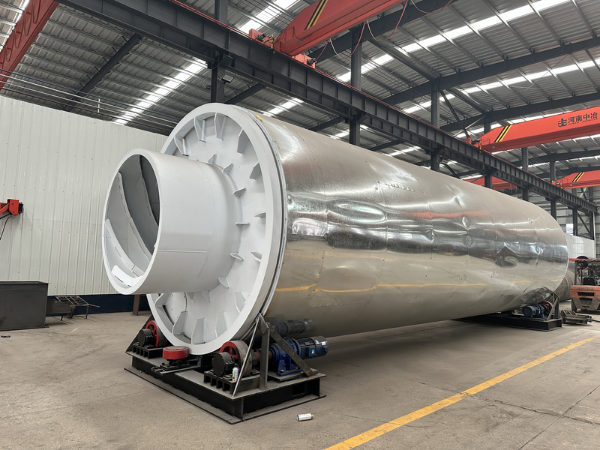
Industrial rotary dryers are here to solve one persistent economic problem wet feedstock crushes downstream economics. A rotary dryer is a rotating drum that lifts wet matter through a hot gas stream created by a burner combustion chamber, utilizing lifting flights to increase heat transfer between the drying air and the solid particles being dried in the rotating drum.
Costs are well-chronicled and the savings undeniable. For wood chips with a 45 percent moisture, maximum boiler efficiencies with conventional equipage is about 74 percent. With the same equipage burning wood at 10 to 15 percent moisture, efficiencies increases to approximately 80 percent.
That 6 percent swing can be the difference between a pellet line that recovers its capex on time or one that leaks latent heat losses all day long.
The Drying ROI Chain
Decreasing moisture level in biomass to 10-15% increases calorific value from an average of 2 kWh/kg to nearly 4.5 kWh/kg – an Energy Content per T/P increase of 125 percent. This biomass drying step boosts advanced usable energy from 8 MMBtu/ton to 12 MMBtu/ton, reduces transport weight, and halts the mildew-and-rot clock that collapses green-chip lot life spans to just four months.
What an industrial rotary dryer actually solves
- Intermittent moisture content in feedstock – sawmill output electric chains from 35% to 55% depending on source, season, and storage. A rotary drum dryer stabilizes the input your pelletizer, briquette press, or boiler sees in real-world practice.
- Capacity constrains – rotary dryers have the highest capacity of any continuous biomass drying options, allowing acceptance of flue gas at the hottest inlet barest temperatures, and degree of acceptable particle variation that would gum-up a flash dryer.
- Storage and logistics drag – green chips form clumps in uninsulated bins, freeze to truck bodies in winter. Dried product moves through material handling and ships lighter, good over and over on the shelf.
TCPEL Rotary Dryer Lineup — TCG Single-Pass & TCSG Triple-Pass
TCPEL offers two complementary product families: the TCG single-pass rotary dryer line for well-known, steady feedstock flows, and the TCSG triple-pass rotary drum dryer line for high-moisture, irregular, or space-limited locations. Both are available with direct or indirect heat sources, with co-current or counter-current flow depending on heat sensitivities.
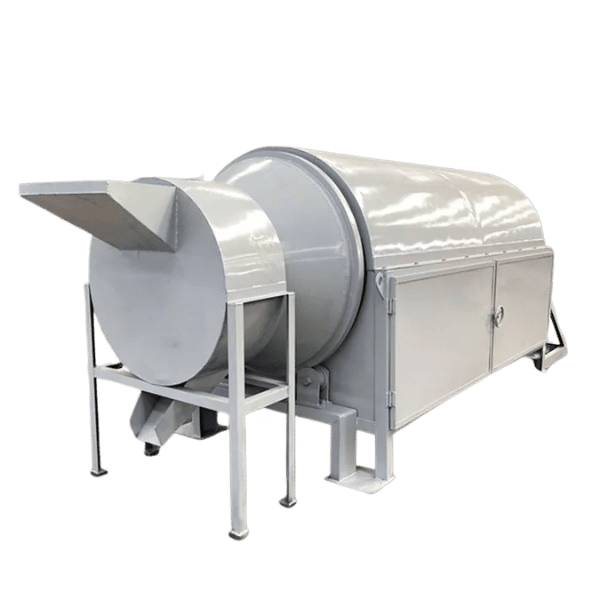
TCG Single-Pass Series
Heavy duty direct fired rotary drum dryer for maximizing throughput operation in a feed stock stable environment. Reduced capex / ton, less equipment down-time, more reliable.
Models
8 (TCG0.8 → TCG2.2)
Inner Diameter
800 – 2,200 mm
Evaporation
0.07 – 2.2 T/H
Drive Power
4 – 72 kW
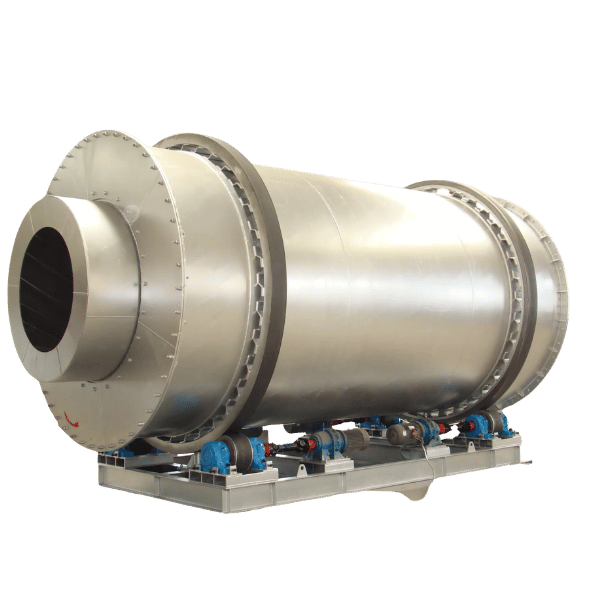
TCSG Triple-Pass Series
Three concentric cylinders provide 50% → 15% reduction in moisture. Sleek design provides a relative reduction in size through a design that accommodates “unpredictable feedstock standards”. Designed for biomass applications with more variable feedstock and use tighter site constraints.
Models
6 (TCSG10 → TCSG60)
Drum Shell Max
Φ3300 × 12420 mm
Capacity
1 – 6 T/H
Fan Power
15 – 90 kW
Complete TCG Single-Pass Specifications
| Model | Internal Ø (mm) | Length (mm) | Drive (kW) | Fan (kW) | Evaporation (T/H) | Weight (tons) |
|---|---|---|---|---|---|---|
| TCG0.8×10m | 800 | 10,000 | 4 | 11 | 0.07–0.15 | 3 |
| TCG1.0×10m | 1,000 | 10,000 | 5.5 | 11 | 0.10–0.23 | 4.6 |
| TCG1.2×10m | 1,200 | 10,000 | 5.5 | 15 | 0.25–0.35 | 5.6 |
| TCG1.4×10m | 1,400 | 10,000 | 5.5 | 15 | 0.25–0.50 | 7.8 |
| TCG1.6×22m | 1,600 | 22,000 | 11 | 37 | 0.80–1.20 | 19.7 |
| TCG1.8×22m | 1,800 | 22,000 | 15 | 45 | 0.90–1.50 | 27.8 |
| TCG2.0×22m | 2,000 | 22,000 | 45 | 45 | 1.00–1.80 | 30.9 |
| TCG2.2×22m | 2,200 | 22,000 | 72 | 75 | 1.20–2.20 | 34 |
All figures derived from the TCPEL factory specification sheet. Evaporation rates assume a direct-fired configuration and 50% moisture target (wet basis).
Complete TCSG Triple-Pass Specifications
| Model | Drum Shell | Drive Motor (kW) | Fan (kW) | Initial Moisture | Final Moisture | Capacity (T/H) |
|---|---|---|---|---|---|---|
| TCSG10 | Φ2000×5840 | 4×2 = 8 | 15 | 50% | 15% | 1 |
| TCSG20 | Φ2300×7340 | 5.5×2 = 11 | 22 | 50% | 15% | 2 |
| TCSG30 | Φ2400×10460 | 4×4 = 16 | 45 | 50% | 15% | 3 |
| TCSG40 | Φ2800×10460 | 4×4 = 16 | 55 | 50% | 15% | 4 |
| TCSG50 | Φ2950×12420 | 5.5×4 = 22 | 75 | 50% | 15% | 5 |
| TCSG60 | Φ3300×12420 | 5.5×4 = 22 | 90 | 50% | 15% | 6 |
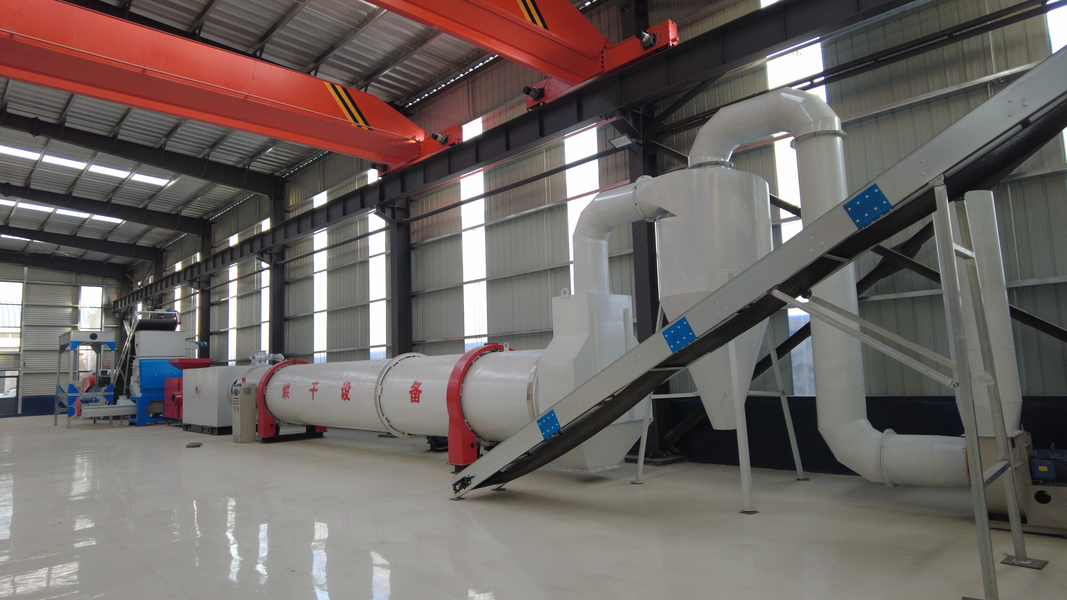
Every TCSG system placed has incoming feed screw conveyor, cyclone group, dust collector silo, air lock, wind pipes and integrated electric cabinet.
Sizing Note for Procurement Teams
Most pellet plant questions we receive through our Indian, German & Vietnamese regions are for the TCG1.6×22m or TCSG10-TCSG20 capacity band/scale for a 2 T/H pellet line configuration, which is the most common size for new biomass capacity/ applications. If your raw material supply is around 600 m³/month or your target throughput is in the 1–3 T/H window, those three models cover ~80% of equivalent applications we ship.
Single-Pass vs Triple-Pass — Which Rotary Dryer Fits Your Application
Choosing between a single-pass rotary dryer and a triple-pass rotary drum dryer is not a simple price-vs-quality trade-off. Each design solves a different problem, and picking the wrong one shows up either as wasted capex — an oversized triple-pass running on a stable single-pass application — or as inconsistent output moisture, with a single-pass struggling against variable feedstock.
Of course, one previously noted downside of conventional single pass rotary dryers is that, within one continuous drum, long lag times make it very difficult to contain material moisture within a narrow band. The triple-pass concept addresses this lag problem. By suspending particles in three nested cylinders of increasing diameter – and reducing air velocity accordingly – in the triple-pass design, larger particles only move to the next pass after losing a prespecified level of moisture.
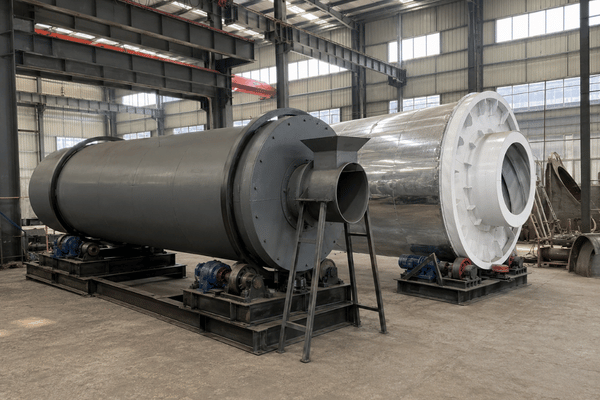
Single-Pass vs Triple-Pass Decision Matrix
| Dimension | TCG Single-Pass | TCSG Triple-Pass |
|---|---|---|
| Footprint per ton/hr | 10 m × Ø1.0–1.4 m (small) / 22 m × Ø1.6–2.2 m (large) | ~50% smaller — 3 cylinders nested vs 1 long drum |
| Initial moisture tolerance | ≤45% (works best with pre-screened stock) | Up to 55% (designed for high-moisture feedstock) |
| Moisture control precision | ±3% on stable input | ±1.5% — particles graduate only after defined dehydration |
| Retention time | ~20–40 min (single long pass) | ~10–20 min (three shorter passes, lower over-dry risk) |
| Heat transfer efficiency | Standard direct-fired efficiency | Higher — heat re-used across 3 passes before exhaust |
| Best feedstock types | Sand, slag, dried sludge, uniform particles | Wood chips, sawdust, bagasse, agricultural residues, biomass |
| Capex (relative) | Baseline | ~20–30% higher per ton/hr |
| Maintenance | Simpler — one cylinder, one drive train | Higher — three concentric drums require coordinated inspection |
| Service life expectation | 15+ years with rebuild cycles | 12+ years (more rotating mass, higher inspection rhythm) |
“Across 60+ export markets, we’ve used the TCPEL dryers for everything—high-moisture pine sawdust coming right off a chipper, to tight, seasonally-varying agriplastics. If your feedstock’s already prescreened, uniform, and predictable—one pass is fine. The triple pass justifies the additional capex when input moisture varies by the week, which is our experience at almost every pellet plant we build in SE Asia + Eastern Europe.”
How to Choose: Practical Decision Logic
01
Just switch to TCSG triple-pass if that is the case, when your input feedstock is wood chips or sawdust, biomass with an input moisture fluctuating over 5% from the week before. TCSG triple-pass is more economically viable considering the difference of the reduced inconsistent output moisture at the pelletizer (rejected batch, line stops, ash variability) exceeding the capex difference in 18-24 months.
02
For sand, slag, gypsum, or pre-screened mineral materials with steady input moisture TCG the single-pass. This longer single cycle lag time is a great benefit when high retention is desired but there is no concern about over drying.
03
In some cases where site footprint is limited (usual retrofit where you take a pellet line and add on a drier), the triple pass only requires about half the floor space for the same capacity. That’s justification for installing it at many of our Europe and Korea sites.
04
If your initial moisture is greater than 50% (usual for freshly harvested timber, bagasse or other crop wastes), then the first high speed pass in the triple-pass design will remove bulk moisture before slowing down to be handled by the gentler outer cylinders.
Performance & Capacity — Evaporation Rates Across 14 TCPEL Models
Evaporation rate, not capacity in syngas nameplate, is the number that determines whether a rotary dryer can match the throughput of the production line. A drum may rotate the correct number of revolutions per minute and still gag on a pellet line if its volumetric rate of evaporation is lower than the wet-input feed rate. Every TCPEL system is sized to feedstock evaporation appetite first, capacity second.
Evaporation density across the lineup
Industry stats peg rotary drum volumetric evaporation rate at about 13.9 kg of water per cubic meter of total dryer volume per hour; well-tuned bed-volume statistics are up to 78.8 kg/m³ h.
In a 2800 × 10,460 mm TCSG40 (total drum volume about 64 m³) is 2800 kg/h, so about 43.75 kg/m³ h—way over the industry average in total volume and creeping up on bed-volume statistics.
What This Means in Practice
A TCSG40 connected to a typical Vietnamese pellet plant moves about 4 T/H of sawdust, 50% inlet, via 2,800kg of water per hour. If it is fired up at 80 Kcal per kg of water, that is a thermal load of about 224,000 Kcal/hour.
If the system is fired at 60,000 Kcal per kg of water, that is only about 168,000 Kcal per hour—a lot. So pick your hot air furnace or waste-heat recovery system carefully.
Hot gas flow configurations
Every TCPEL delivery includes two options for heat flow between the combustion chamber and the rotating drum:
Co-current flow (parallel)
Hot gas and material passage is simultaneous. One application is heat-sensitive material predupping, where quick initial evaporation requires an exacting tolerance of final minimal moistness.
Co-current flow is installed in 70% of all biomass projects.
Counter-current flow
Hot gas pass occurs opposite the material flow, targeting the driest matter with the hottest air.
Statistically more efficient, reserved for profile material or mineral hardness where sensitivity is not an issue.
Lifting flights and retention
Every TCPEL rotary drum systems contains a set of meticulously engineered combinations of the lifting flights inside the barrel. Aggressive and short flights are used to loft sands and slags; longer, curved flights for woody feedstocks; duck-footed flights for friable material that needs to spend longer in the hot stream.
Optional blades are bolt-on, and we ship a flight wear template for every delivered system so that your in-field upkeep can be scheduled around your process, not your spare parts.
Proven Across 60+ Countries — Drying Solutions for Biomass, Wood Chips, Sand & More
Since 2020, the teams at TCPEL have produced over 60 rotary dryer systems for export. Many of these shipped into the biomass golden triangle of Germany, Finland, Russia, South Korea, Pakistan, India, Bangladesh, Vietnam, Malaysia, and Turkey.
Our factory in Zhangqiu, Jinan exists as an integrated 20,000 m² build cell, with over 100 workshop staff managing raw fabrication, drive kits and other pre-shipment testing in-house.
Application breakdown by industry
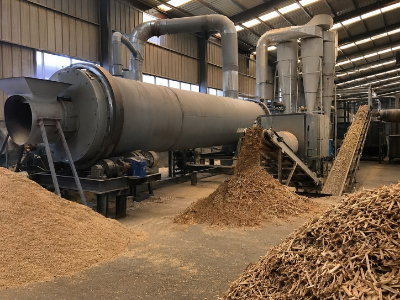
Biomass Pellet & Fuel Production
The dominant application by volume. Asian pellet industries rely on rotary dryers almost exclusively, and our TCSG10 through TCSG30 systems ship into wood pellet, sawdust pellet, and straw pellet plants running 1 to 3 T/H of output capacity. Drying takes raw biomass from harvested moisture — typically 45 to 55 percent — down into the 12 to 16 percent window where pelletizers form stable, low-fines pellets and boilers reach their efficiency peak. For plants integrating the full front-end, our industrial drum chipper line feeds the dryer with consistent particle size from log to chip.

Wood Processing & Particleboard
Wood chip drying for particleboard production demands tight moisture uniformity — variable input creates voids in the finished panel. Our TCSG40 through TCSG60 installations in Russian and Korean particleboard mills hold output moisture within ±1.5 percent across an 8-hour shift.
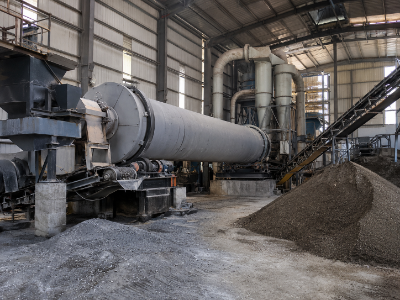
Sand, Slag & Mineral Drying
While, the 12~16% moisture product from our TCSG40-TCSG60 rotary technology set the world record for 8hr continuous operation within 1.5% moisture during 15 tonne blow daily projects in Kara, Russia and China.

Agricultural & Animal Feed
For the latter, built into every TCG single-pass rotary drum is the perfect selection of circumferential load profile. Thanks to continuous research and development, construction sand, foundry slag, gypsum, river sand, silica sand are all viable business lines.
The Drying ROI Picture (Industry Data)
+50%
Energy density gain
(8 → 12 MMBtu/ton)
+125%
Calorific value lift
(2 → 4.5 kWh/kg)
+6 pp
Boiler efficiency gain
(MC 45%→15%: 74% → 80%)
~30%
Dry-chip economics
favor at production scale
Sources: Biomass Magazine (“Watching Wood Dry”) quoting Adam Sherman (Biomass Energy Resource Center) on boiler efficiency, Mark Froling (Froling Energy) on scale economics, and Bertil Stromberg (VP Biofuels, Andritz Inc.) on calorific value. Industry-typical data; specific project ROI varies with feedstock, fuel cost, and plant scale — request a custom analysis with your operating parameters.
Market context: why drying capex is accelerating
The biomass power market is projected to grow from USD 154.79 billion in 2026 to USD 226.67 billion by 2033 at a 5.6 percent CAGR. US domestic densified biomass fuel sales averaged roughly $236 per ton in October 2024, with exports running 0.75 million tons a month — roughly four times domestic monthly consumption. Producers shipping into that export demand are the ones investing in rotary drying capacity now.
Want to see installations in your region? We’ll share active and recent TCPEL deployments matched to your application.
Request our Reference List by Country →Engineering Standards & Quality Assurance
Every TCPEL rotary dryer system is built against documented industry standards for biomass moisture measurement, particulate handling, and structural drum design. We ship technical documentation aligned with the standards procurement teams audit against most often.
ASTM E871
Moisture Analysis Particulate Wood Fuels
ISO 17827-1
Solid Biofuels Particle Size Distribution
EN 17225-4
Wood Chip Fuel Quality Standard
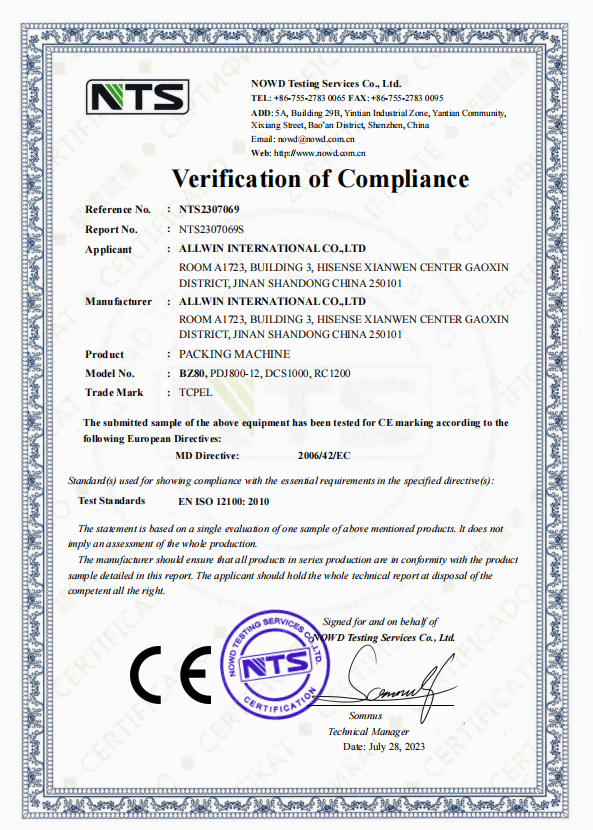
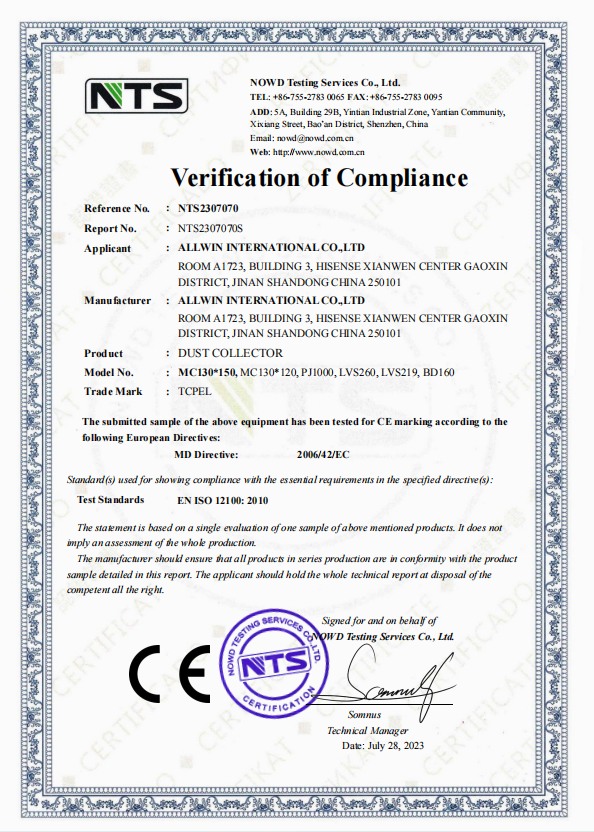
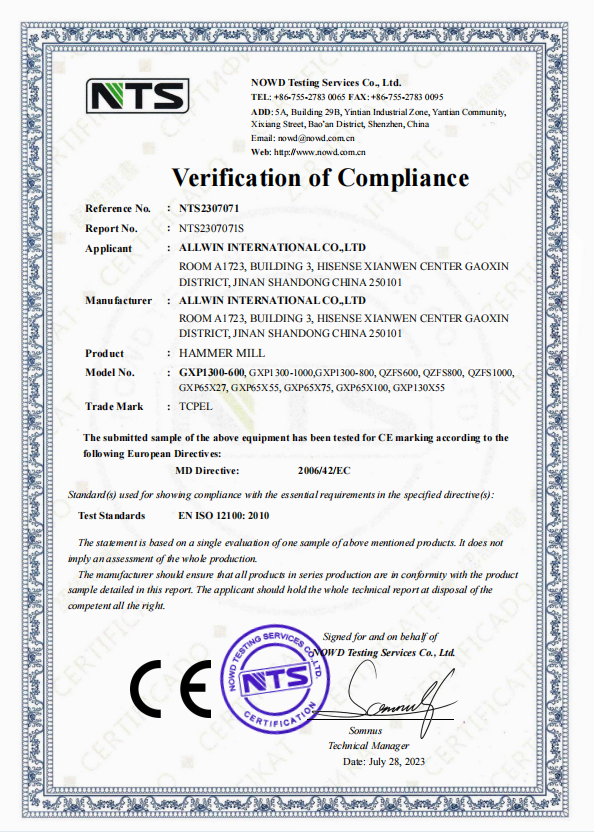
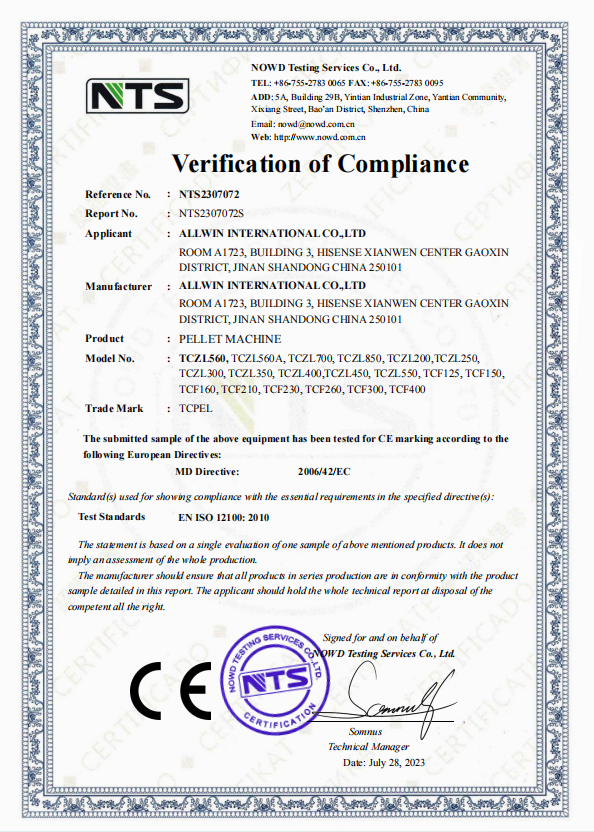
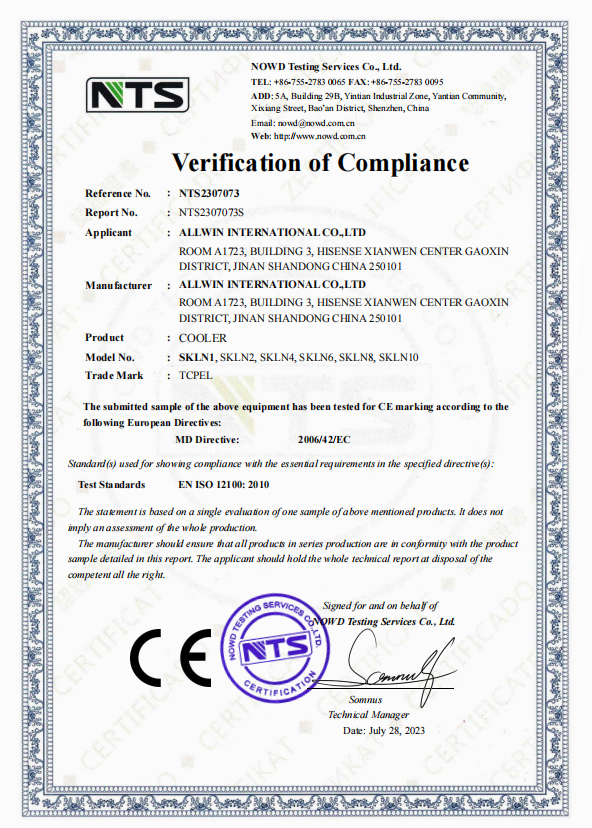
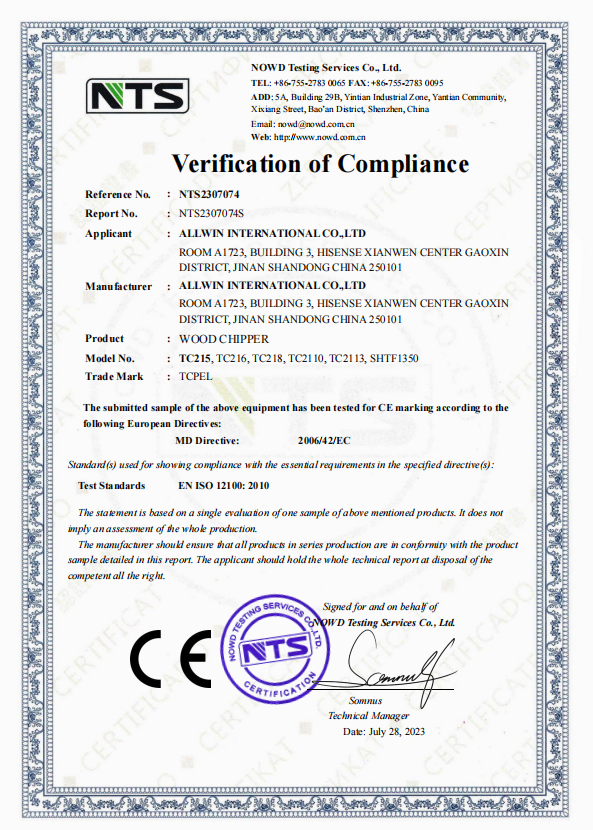
CE Compliant
Export to EU (certificate per order)
20,000 m²
Factory Floor Zhangqiu, Jinan
100+ Staff
In-House Build Engineering & Service
Built-in safety: the documented hazard rotary dryers must respect
Every TCSG rotary dryer system is designed against established industry standards for biomass moisture measurement, particulate handling, and structural drum design. We ship technical standards aligned with the standards procurement teams audit against most often.
The industrial hazard of inside rotary drum dryers is wellknown, especially in pellet and bioenergy plants where fine dust, lifted material, and high inlet temperatures encounter in the drum. Insure every TCSG system with the patented safety stack:
Ported diaphragm of high-temp alloys opens thermal cavitatio inside the entire drum in order to freshen the environment and deter Jumbo inlet ignitions.
Dust collector silo for final fine particulate capture.
Air lock (rotary valve) at the discharge – 3-8 k W depending on capacity – isolates the drum from downstream conveying air and prevents oxygen ingress.
Cyclone group (2 sets) for primary particulate separation before exhaust. Zegbrk_0012.
Wind pipe arrangement with documented gas-velocity bands to avoid stagnation zones where fine dust accumulates. Zegbrk_0013.
Temperature sensors at inlet, mid-drum, and exhaust with high-temp interlock to feed system.
Service and warranty terms
Standard delivery terms define a 5+ year structural guarantee on the drum shell and tire arrangement, and engineering support through the life cycle of the system. For our core export markets, turn-key scope of supply includes commissioning support from our traveling TCPEL engineers. Spare parts are stocked for all 14 option points on the model point chart.
×
![Enlarged Certificate]()
Procurement Guide — Pricing Factors, Lead Time & After-Sales
Pricing on single-drum industrial rotary dryer systems is often an elusive single number. The capital expenditure capex you will use to build your budget depends on five variables that impact total project cost more significantly than the price of the drum alone. Following is a full disclosure of those five variables so your purchasing department can model the capex budget when you are ready for full quotation.
Pricing factors framework
| Factor | Impact on Quotation |
|---|---|
| Capacity tier (T/H output) | Primary driver. TCG0.8–TCG1.4 (sub-0.5 T/H) versus TCG1.6–TCG2.2 or TCSG30+ (multi-T/H) span a wide capex band. |
| Configuration: single-pass vs triple-pass | Triple-pass adds roughly 20–30% to the dryer capex but compresses footprint and improves moisture precision. |
| Heat source pairing | Biomass-fired hot air furnace, natural gas burner, coal-fired furnace, or waste heat recovery — each pairing changes both capex and operating cost profile. |
| Material specification | Carbon steel (default) vs stainless steel vs AR steel for abrasive feedstock. Material choice changes shell cost meaningfully. |
| Auxiliary scope | Whether the order includes feed conveyor, cyclone group, dust collector, fan, exhaust ductwork, electric cabinet — full turn-key vs drum-only swings final invoice 30–50%. |
Lead time and logistics
- Stock-ready configuration of TCG1.6, TCG2.0, TCSG10, TCSG20: FOB Qingdao lead time approx. 30-45 days from confirmation of order.
- Custom configuration: (alloy specialty, larger capacity, integrated turn-key): lead time approx. 60-90 days depending on scope.
- MOQ: 1 unit. We regularly ship single-systems orders as well as coordinated multi-system lines.
- Trade terms: FOB China basis; CIF and DAP terms available on request to most export destinations.
Site-Visit and Commissioning Practice
For larger TCSG30+ orders and first-time export customers operating in new ports, TCPEL ships a commissioning engineer to site to supervise installation, run dry-up, and train operators. This effort will add roughly a week to the overall project duration but prevents the three weeks of e-mail ping-pong that would otherwise occur after delivery when trying to determine the optimal external heat source, capacity, number of drums in cascade, and desired outcome characteristics.
Interactive Engineering Tools & Calculators
Eliminate guesswork from your procurement process. Use our proprietary engineering calculators to model capacity requirements, evaluate comparative designs, and generate accurate Return on Investment (ROI) forecasts based on your specific feedstock variables.
Rotary Dryer Selection Calculator
Input your feedstock type, initial moisture, and target capacity to instantly generate TCPEL model recommendations and required evaporation rates in under 60 seconds.
Launch Calculator
Biomass Drying ROI Calculator
Model your capital expenditure against downstream operational savings. Calculate payback periods based on your localized energy, logistics, and feedstock costs.
Calculate ROI
Single-Pass vs Triple-Pass Comparison
Run a side-by-side technical evaluation. Objectively compare footprint requirements, thermal efficiencies, and moisture control precision tailored for your plant site.
Compare Systems
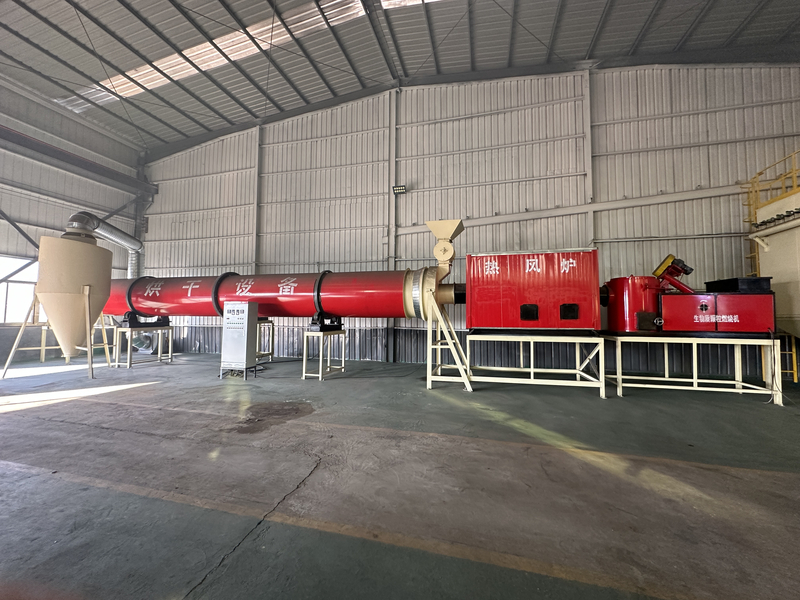
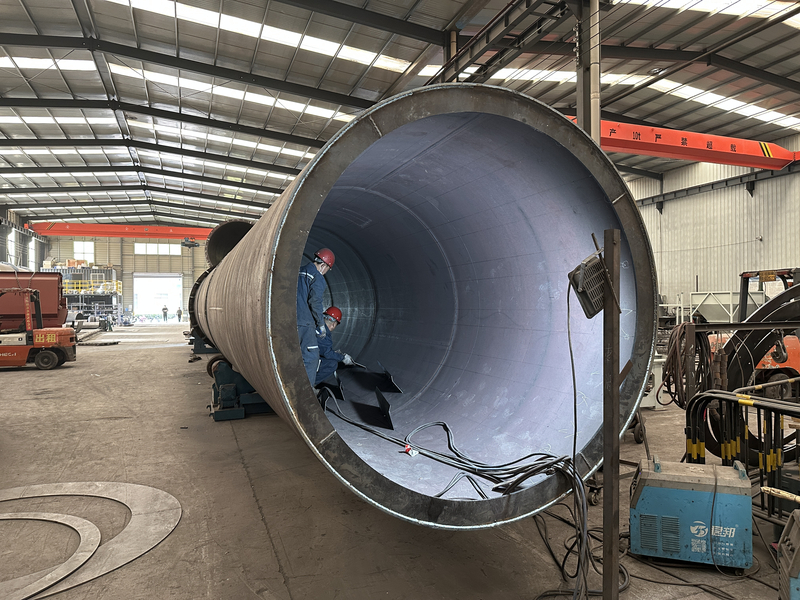
TCPEL Manufacturing Facility and Workshop
Inside our 20,000 m² Shandong factory: Precision engineering, rigorous quality control, and heavy-duty manufacturing of rotary dryer system.



×
Ready to specify your rotary dryer system?
Tell us your feed+material properties, target throughput, and moisture window. We will get back to you within 24 hours with a model and quotation.
Frequently Asked Questions
A single-pass rotary dryer processes one continuous drum with particles passing through along its entire length, configuring retention time via rotation per minute and length of drum. The triple-pass rotary drum nests three progressively larger drums in the same footprint, retaining particles within each until they shed a certain defined moisture fraction then drop into the next pass chamber. Triple-pass adds about a 50% smaller footprint per ton per hour (T/hr) capacity, can process moist feedstock up to approximately 55% initial moisture, and provides ±1.5% output moisture control compared to 3% for single-pass—against a capex premium of roughly 20-30%.
Here is what matter: (1) moisture stability in incoming feedstock—homogeneous pre-screened material behaves best with single-pass; variable biomass needs triple-pass configuration; (2) site footprint—limiting space favors triple-pass; and (3) desired throughput capacity in tons per hour T/hr—overlay those requirements against the models 14 different TCPEL options capacities. Either solution is within our under-a-minute calculator: zero wait.
Most of our export deployments process biomass (wood chips, sawdust, bagasse, straw), agricultural waste (alfalfa, cassava, manure), mineral byproduts (sand, slag, gypsum, river sand, silica sand), and pellet or briquette pre-form feed. Most thermally tolerant feedstocks are covered by direct-fired configurations; indirect-fired operation is available to processing options sensitive to contamination or heat.
Operational expense OPEX is driven by the heat input required and the target moisture goal. Industry knowhow suggests thermal needs are between approximately 60-80 kcal per kilo of water removed for biomass-fired applications, with electrical inputs for drive motors, fans, and air locks providing the balance. It is not the cost per kilo that makes or breaks a project—it is the value added downstream: approximately 50% gain in energy content of treated biomass (industry data from Biomass Magazine) and ~30% positive economics for dried chips on production scale(Froling Energy quote). Request a customized operating cost calculator with specific fuel costs for your project area.
How to order Feed&Ammunisyon-Agencies, Sustainability, Pricing, Delivery lead-times, Applications and Industry standards, Design options, Hot-blast versus indirect heat, Dust control, Performance, Target markets Two issues recur in industry literature: (a) moisture control drift on variable feedstock: our triple-pass design deals with this; (b) fire risk (disemoutsami g pail) in biomass applications: documented by the Biomass and Bioenergy Research Group as an industry-wide hazard. Every TCSG ships with an air lock at discharge, cyclone group, dust collector, and temp interlock to limit the dust+heat+oxygen mix behind dryer fires.
Stock-ready single pass and triple pass models ship 30-45 days from order confirmation FOB China; custom configurations: 60-90 days. On-site commissioning (TCSG30+ and 1 st time customers) adds 7-10 days for engineer site visit, dry-run testing, and operator training.
TCPEL manufactures to standards ASTM E871(2001) (biomass moisture testing), ISO 17827-1(2016) (particle size), and EN 17225-4(2016) (wood chip standard); Import-export applies CE certification (per order) for EU export. Standard Warranty: 5+ years on tunnel drum shell+ tire assembly, spare parts inventory kept for all 14 model points.
Yes – lifting flight geometry, drum length, fan sizing, and heat source pairings are configurable per intended application. 14 TCPEL model points address ~80% of inquiries: 20% config around targeted moisture level, footprint limits, downstream integration (pellet line/ briquette press/ boiler feed). Custom configurations tack on 15-45 days to standard lead time.