Get in Touch with TCPEL

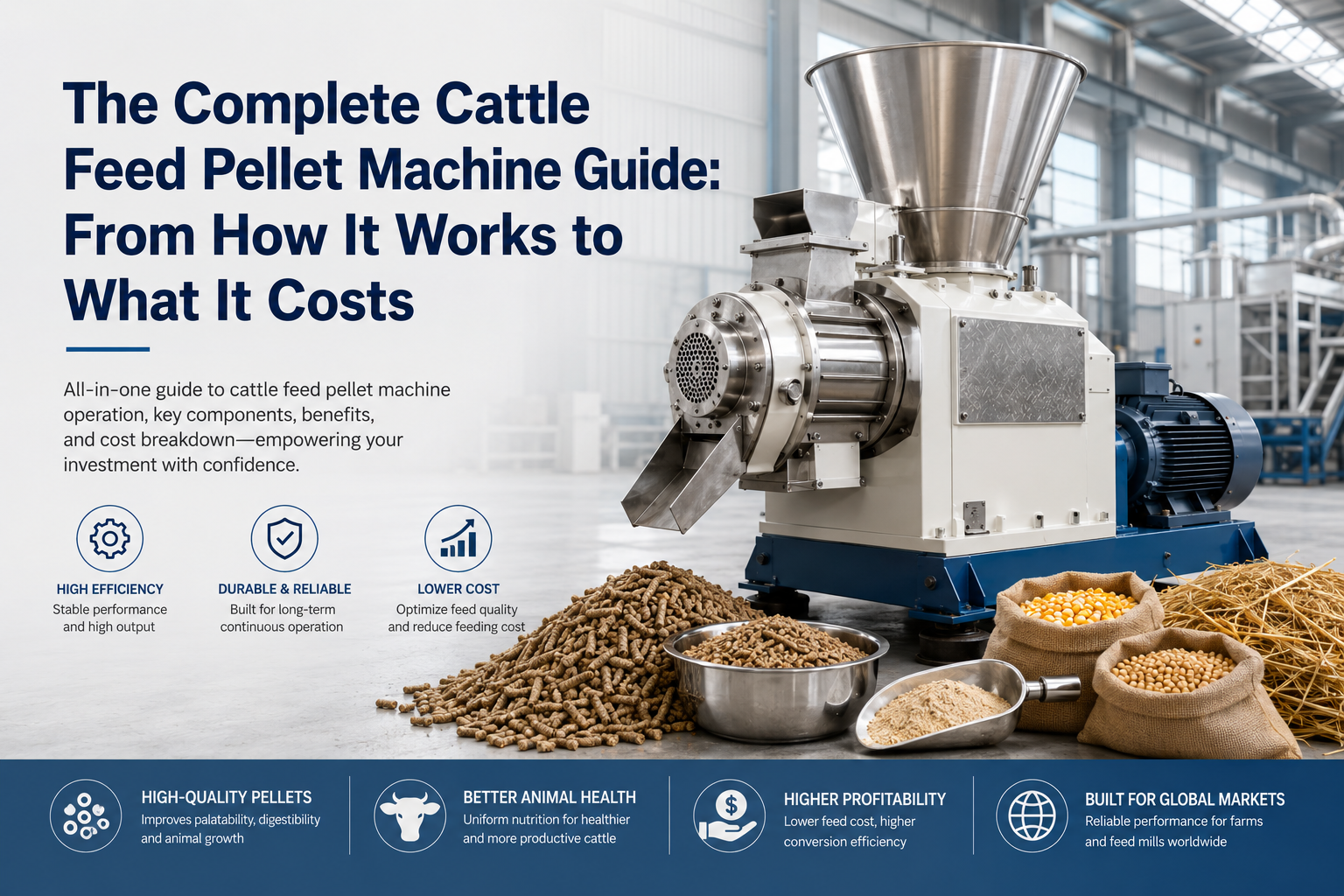
A cattle feed pellet machine compresses feed materials into compact, consistent pellets which cattle can eat with less sorting and less waste. Your choice – a 40-head cow-calf outfit or a big commercial feed mill, a flat or ring die, a diesel or a electric, an all-day or a five-tonne an hour operation – determines your feed cost for ten years to come. You’ll learn how the machines do what they do, what they really cost in 2026, the real issues owners run into with them, and how to choose a model appropriate for your herd, including a lesson most vendor websites won’t share: you can, of course, feed any diet as a pellet, but it’s not necessarily the right one.
Quick Specs: Cattle Feed Pellet Machine
| Typical capacity range | 60–800 kg/h (small flat die) up to 1–15+ tons/h (ring die lines) |
| Die hole sizes | 1.5–9.5 mm; 3–4 mm for calves, 6–8 mm for mature cattle |
| Power options | Electric (3–110 kW), diesel engine, gasoline engine, or tractor PTO |
| Indicative price band | ~$900 (small flat die) to ~$22,500+ FOB (industrial ring die); full lines higher |
| Pelleting energy (ruminant feed) | ~20–24 kWh per ton of feed |
Figures compiled from FAO feed-milling data and published machine specifications; capacity and prices depend upon the build and configuration.
What Is a Cattle Feed Pellet Machine? (And Why Pellets Beat Mash — Usually)

A cattle feed pellet machine – a feed pellet mill / a pelletizer as other species would call her – a device that squeezes ground dry feed through perforations in a harden steel die into compact pellets from loose powder. She is the same general class of machines that create a poultry feed, feed for pigs, sheep, rabbits, and fish… with a different die and recipe for each. That makes for a pellet feeding, which, being denser and cleaner and simpler to manage than a feed mash, is replacing mash feeding in cattle operations.
Pelleting changes the feed physically. The FAO chapter on feed milling processes records that pressing mash through a die raises bulk density from about 0.4 g/cc to 0.5–0.6 g/cc. Denser feed takes up less transport volume, throws off less dust, and curbs the selective feeding where cattle pick out the grain and leave the fibre behind at the bunk.
The performance case is real but specific. A 2025 study in Scientific Reports, run on Brahman crossbred cattle in a 4×4 Latin-square feeding trial, found that at 60% pelleted-feed inclusion, organic-matter digestibility rose to 39.22% (from 30.13% on the control ration) and NDF digestibility to 44.98% (from 28.35%). Enteric methane dropped to 20.79 from 25.81 mol/100 mol — an environmental gain rival product pages never mention.
⚠️ Important: pelleting is not automatically better for cattle
Cattle are ruminants, and that changes the rule. Grain has to be ground fine to pellet well — but fine grinding makes starch ferment faster in the rumen. NDSU Extension advises that fine grinding of corn for beef cattle should be avoided, because rapid fermentation raises the risk of acidosis and founder. Pelleting a high-concentrate ration concentrates that risk; pelleting a fibre-rich total mixed ration is far safer. Pellet the forage and by-product side of the ration with confidence — pellet the straight-grain side with caution.
Key takeaway: a cattle feed pellet machine cuts waste and lifts the digestibility of fibre-based rations — but match the ration to ruminant physiology before you pellet straight grain. The next section shows how the machine builds that pellet; if you are sizing a purchase, compare the cattle feed pellet machine models.
How a Cattle Feed Pellet Machine Works, Step by Step
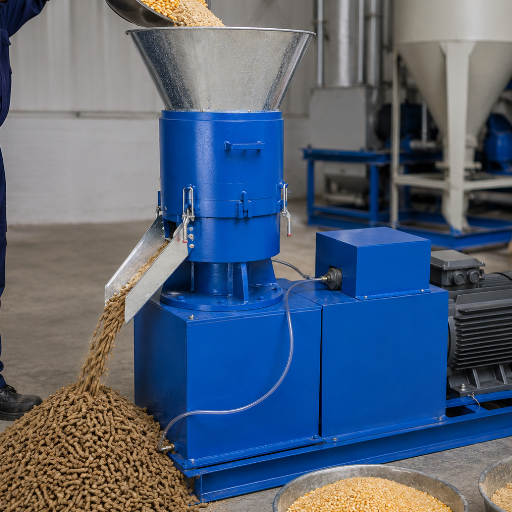
Inside the machine, loose powder becomes a hard pellet in five stages. Know them and you know which dial to turn when pellet quality is dropping.
- Grinding: raw materials — corn, oil cakes, straw, grass, wheat bran — pass through a hammer mill or grinder so the particle size is uniform enough to feed evenly through the die.
- Mixing: Ground inputs are combined into a homogeneous blend according to recipe. Each pellet will deliver uniform nutritional value.
- Conditioning: The mixed Mash flows into a conditioner to which steam is added. According to FAO, 4 to 6 percent added water from steam brings the Mash up to 85 to 90 C. This process gelatinizes raw starch into a natural binder for the Mash.
- Pressing: Heat-moistened Mash is then pressed through the die by rollers. FAO records show die pressure between 75 to 600 kg/cm 2 and die RPM of 130 to 400, and indicates heat from friction raises the pellet to 92 C exiting the die.
- Cooling: Newly made pellets exit the press hot and soft, to be immediately conveyed to a cooler, where they come to ambient temperature and a 13 percent moisture content or less within about 10 minutes, so that they can be stored.
The die is the heart of the equipment. Its Hole size varies from 1.5 to 9.5 mm and its thickness, up to approximately 90mm, dictates compaction pressure or the firmness of the finished pellet (feed pellet mill glossary).
📐 Engineering Note — The 4-M Pellet Quality FrameworkIf your pellets are falling apart, the most frequent causes, listed in order, fall into four categories we label M “M’s”: Material-including recipe selection and binders-Moisture-the Mash’s practical pelleting window is 12 to 15 percent moisture-Mesh-(or particle size); and Mold-the level of die compaction pressure and wear. The conditioning step alone provides 20 percent of the pellet’s strength-so fix your steam before you complain about your die.
One process detail most manufacturer pages skip: conditioning is not one-size-fits-all. In high-urea cattle supplements, steam is reduced or cut entirely, because heat and moisture behave differently with non-protein nitrogen than with the protein in grain or fibre (per FAO pelleting guidance). For rations heavy in molasses or urea, expect a different conditioner setpoint than the 85–90 °C used for a grain-and-fibre complete feed.
The bottom line is this: condition your Mash- steam it appropriately-before touching anything else.
Flat Die vs Ring Die: Which Type Fits Your Operation
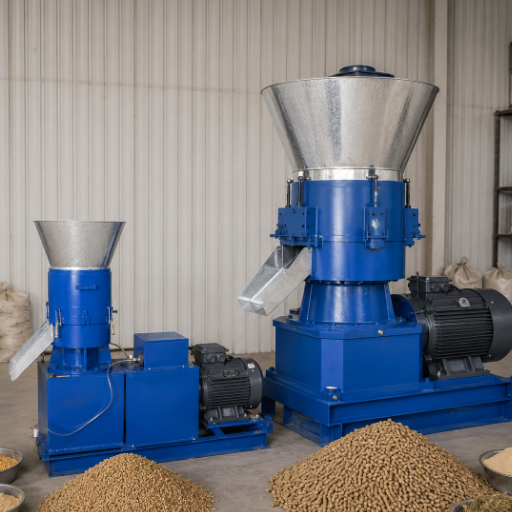
A large percentage of cattle feed pellet machine is manufactured on either a Flat Die or a Ring Die machine. Cost is usually the determining factor, not pellet quality.
| Factor | Flat Die Pellet Machine | Ring Die Pellet Machine |
|---|---|---|
| Typical capacity | 60–1,000 kg/h | 1–15+ tons/h |
| Die service life | ~300–500 operating hours (reversible — use both faces) | ~3,000 tons (standard) to 5,000–7,000 tons (premium) |
| Energy efficiency | Lower — roller slip adds friction and power draw | Higher — roller edges travel equal distance, less wear |
| Best fit | Single farms, on-site feed, start-up budgets | Commercial feed mills, custom-feed businesses |
| Indicative cost | Lower entry price | Higher capital cost, lower cost per ton at volume |
Mechanics as described on Wikipedia.org (pellet mill entry): the press mechanism includes two basic types. In the flat die system, rollers turn in or over a flat disk, with powder passing downward through holes in the flat die plate. In the ring die machine, the raw material is introduced into the interior of a horizontally positioned ring die which rotates as two rollers inside the ring force material through perforations into the die’s circumference. Ring die wear is generally more uniform and their expense is a reason they are common in large operations.
Decision rule: if you produce under roughly one ton of cattle feed an hour for your own herd, a flat die machine is the logical buy — lower cost, easy to operate, reversible die. If you pellet several tons an hour or sell feed commercially, a ring die machine pays back through lower energy cost and longer die life. TCPEL’s two-roller vs three-roller decision tool narrows it further.
Can a Cattle Feed Pellet Machine Make Wood Pellets?
This question comes up constantly, and the honest answer is “rarely well.” Feed pellet machines are built for soft, moist, protein-rich material. Wood needs much higher pressure and temperature to activate lignin, its natural binder. Some flat die machines run both with a die change, but output drops and wear climbs. Equipment forums warn that cheap online flat die mills are usually built for feed, not wood — and the wood-capable version often costs roughly twice as much without that being disclosed. If biomass is your real goal, read the dedicated biomass pellet machine guide instead.
Sizing the Machine: Capacity, Power and Die Holes
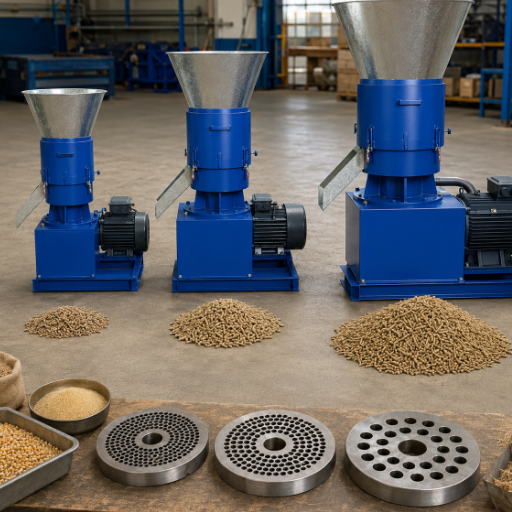
What we see as the most prevalent purchasing error is buying based on ultimate ambition and not your current herd requirements. Build the other way round – based on how much your livestock cows consume at every feeding, build back the throughput. It’s always better to overspec and under use a machine than buy and bust the specs!
| Operation size | Rough daily pellet need | Suggested machine class | Typical power |
|---|---|---|---|
| Smallholding, <20 cattle | 100–200 kg | Small flat die, 100–200 kg/h | 3–7.5 kW electric / 8 HP diesel |
| Family farm, 20–80 cattle | 300–800 kg | Flat die, 300–800 kg/h | 11–22 kW electric / 15–30 HP diesel |
| Large farm / co-op, 80–300 cattle | 1–3 tons | Small ring die line, 1–3 t/h | 37–75 kW electric |
| Commercial feed mill | 5+ tons | Ring die feed pellet production line, 5–15 t/h | 90 kW+ electric |
Herd-Size-to-Capacity Sizing Table – guide, amount to feed out depends on diet, weight and whether pellets the only ration source or supplement.
Power source. A cattle feed pellet machine runs on one of four drives: an electric motor, a diesel engine, a gasoline engine, or a tractor PTO. Electric is the cleanest and quietest where grid power is stable; a diesel engine model is the default where power is unreliable, which is why diesel units dominate sales across many farming regions. When you compare electric models, motor efficiency matters more than rated kW — a high-efficiency 15 kW motor can draw 20–30% less electricity than a low-efficiency 20 kW one.
Die holes. Match the hole to the animal: 3–4 mm pellets suit calves and starter feed, 6–8 mm suits mature cattle. TCPEL’s model recommender matches die size and capacity to a specific operation; for hobby-scale needs, the small pellet machine for home use guide is a better starting point.
| Die hole diameter | Animal and feed type | Typical use |
|---|---|---|
| 2.0 mm | Calf starter, young poultry | Early-stage feed, easy intake |
| 2.5 mm | Poultry, calf creep feed | Pre-weaning supplement |
| 3.0 mm | Calves, weaner pigs | Starter and grower rations |
| 4.0 mm | Growing cattle, sheep | General growing ration |
| 5.0 mm | Mature cattle, fattening | Finishing rations |
| 6.0 mm | Mature beef and dairy cattle | Standard complete feed |
| 8.0 mm | Adult cattle | Range and maintenance feed |
| 10 mm | Large cattle | Cattle cubes, pasture supplement |
| 12 mm | Breeding and range cattle | Range cubes, breeder feed |
Die hole diameter to animal-type guide — pellet size affects intake rate and sorting; confirm against your ration and animal age.
The takeaway: purchase based on the daily demand + an estimated 20% of it – not based on the highest figure listed in the brochure.
What Goes Into Cattle Feed Pellets: Formula and Raw Materials
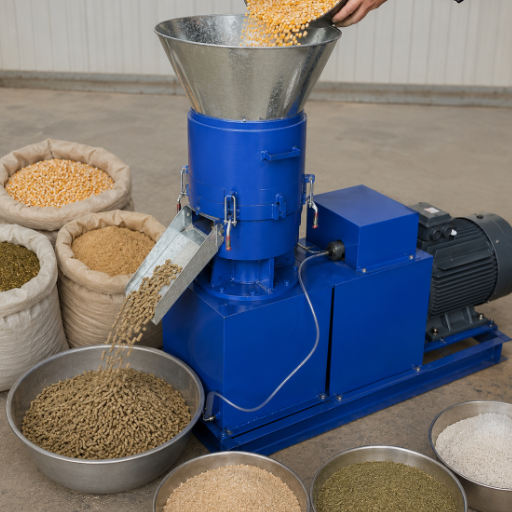
The pellet machine’ role as food-shape-processor is the sole purpose.It not a magic cure-all; it is of no assistance in improving the ill-chosen feed. Bad diet and careless feeding design make a poor cattle pellet.
Here’s a breakdown of a typical pelletable raw materials recipe for cattle – sources of energy (ground corn, barley), protein (oil cakes, soybean meal, cottonseed cake), fibre/roughage (chopped straw, grass, maize stalk, wheat bran), and binders or flavour enhancers like molasses. The mash should contain about 12-15% moisture before pelleting; it should be dry enough to maintain its shape, but still pliable enough to press together when fed into the die.
💡 Common mistake from the field
It’s tempting, I know, to run your cattle feed so fine that the powder comes out of the die looking like baby powder. Finer material gives a better-looking pellet, sure – mechanically. However, for cattle feed, finer powder creates a problem. NDSU Extension warns that grain ground too fine ferments too fast in the rumen, raising the risk of acidosis. Don’t go finer than what it takes to make pellets on your machine – and make sure it contains plenty of physically effective fibre. This is far and away the single most important dietary management difference when pelleting cattle versus poultry feed.
That’s why it’s as much about the recipe driving the machine selection as it is the machine driving the recipe. An energy-and-by-product based ration can be pelleted almost anything. High grain rations need more deliberate thought about particle size and feed quantity as the material enters the die.
Bottom line: form a ration to the needs of the rumen, and secondarily to the needs of the machine and die.
How Much Does a Cattle Feed Pellet Machine Cost?
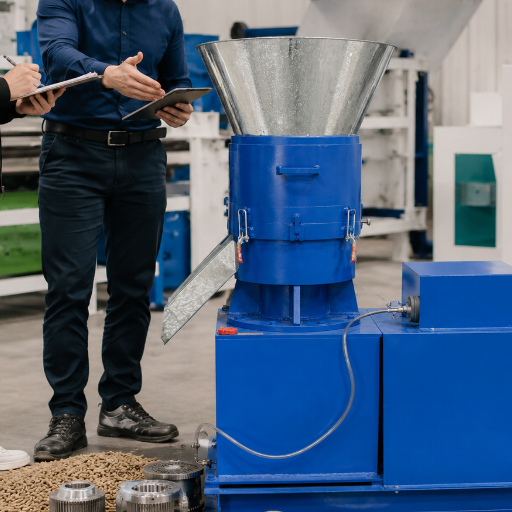
If you ask any feed processor what their biggest concern is about pelleting it will invariably come back to cost of ownership. While it is an issue and prices are going to vary for number of factors, the costs have fallen into a few predictable tiers.
The Cattle Feed Pellet Machine Cost Ladder (indicative, 2026)
- Tier 1 — Small flat die, 100–200 kg/h: roughly $900–$1,600. Single-farm, on-site feeding.
- Tier 2 — Mid flat die, 300–800 kg/h: roughly $1,600–$4,000. A family farm with steady daily demand.
- Tier 3 — Small ring die unit, 1–3 t/h: roughly $10,000–$20,000. A large farm or co-operative.
- Tier 4 — Industrial ring die, 5+ t/h: roughly $18,000–$35,000+ for the machine alone.
- Tier 5 — Complete feed pellet production line: $50,000 to $150,000+ for an 8–10 t/h line with grinding, mixing, cooling and packing.
Prices are syntheses from 2025-2026 supplier information. These should only be used as a reference for total purchasing expenditures. Energy and wear costs can exceed sticker prices as we review below.
What Is the Cost of a Pellet Machine for Animal Feed?
Beyond the sticker price, two running costs decide the real number. First, energy: pelleting ruminant feed draws roughly 20–24 kWh per ton, and pelleting accounts for about 40% of a feed mill’s total electricity use, per industry energy data. Second, wear parts: dies and rollers are consumables that need periodic replacement (see the maintenance section). A sound exercise is to add up the five-year cost of ownership — purchase price plus energy plus dies plus labour — and weigh it against simply buying bagged feed. TCPEL’s payback estimator runs that math for a specific herd.
Key takeaway: always account for the cost of kilowatts and dies when purchasing a pellet mill; these costs will likely surpass the purchase price of the unit alone within a decade.
Common Cattle Feed Pellet Machine Problems and How to Fix Them
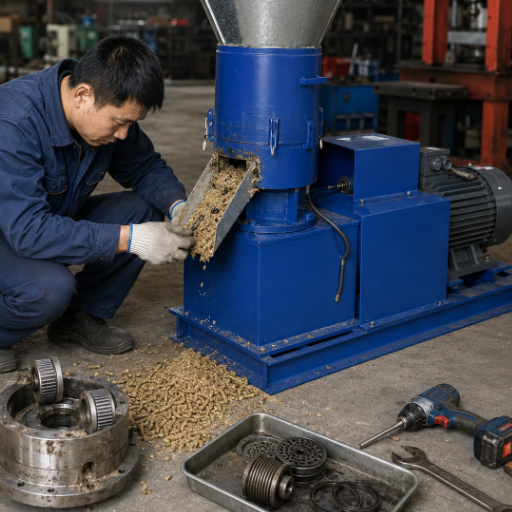
Most pellet machine problems stem from one of the few key causes detailed below, so you can find and fix them based on your specific issue.
| Symptom | Likely cause | Fix |
|---|---|---|
| Soft, crumbly pellets | Moisture too high or too low; conditioning temp too high; worn die holes | Bring mash to 12–15% moisture; check steam; inspect die wear |
| Low output / slipping rollers | Roller-to-die gap too wide; oversized particles bridging die holes | Reset gap to 0.1–0.3 mm; regrind to uniform particle size |
| Material enters, no pellets exit | Die holes blocked; gap above ~0.5 mm; wrong moisture | Clear die holes; correct gap; adjust moisture to 12–15% |
| Machine overheats / stalls | Motor under-powered for the load; feed rate too high | Reduce feed rate; confirm motor sized to capacity |
| Excessive fines and dust | Brittle pellets from low moisture; worn die; poor binders | Raise moisture slightly; replace die; review binder in recipe |
The roller-die gap, in particular, is worthy of close examination, inasmuch as it’s the most common adjustment. Crank it to 0.1-0.3 mm – narrower on a new die, wider as it wears. When the gap reaches 0.5 mm, the rollers cease to compress the material and merely rub across the die, jamming the machine. Machine operators uniformly declare moisture control and particle sizing as the two variables that divide machines that work from those that resist.
⚠️ Safety: feed mills are combustible-dust environments
Grinding and pelleting generate fine grain dust, which is combustible. In the US, OSHA 29 CFR 1910.272 applies directly to feed mills and dust-pelletizing plants. It requires a written housekeeping program; in designated priority areas — such as within 35 feet of inside bucket elevators — fugitive dust must be kept under 1/8 inch. Treat dust control, ignition-source management and operator training as part of running the machine, not as optional extras.
Bottom line: Most pellet problems, like moisture level, particle size and roller gap, can be resolved by tweaking just these factors, anddust is a safety hazard, not merely housekeeping.
Maintenance, Die Life and Machine Lifespan
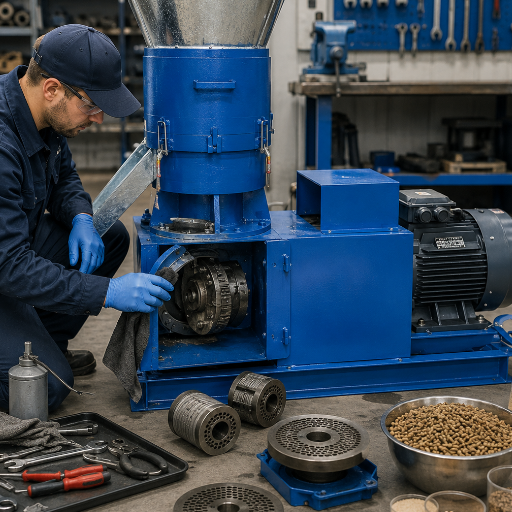
A cattle feed pellet machine relies upon two sacrificial components — the die and rollers — mounted within a sturdy frame that lasts substantially longer. Factor that maintenance dichotomy into your planning.
- Daily: clear leftover feed from the die and rollers; check the roller-to-die gap; listen for noise from the bearings.
- Weekly: lubricate the bearings; check die holes for wear or enlargement; check belt or coupling tension.
- Periodically: on a flat die, flip or rotate it when one face wears; track ring-die throughput against its rated tonnage.
Life span of a die. Machine conditions and materials vary widely, as do design variations in dies, so use reported industry performance numbers as guide lines and not guarantees. Industry reports suggest that 300-500 operating hours is about right for flat die life – and because it’s reversible, you then wear the other side. For ring dies, wear is measured by throughput instead of operating hours. Standard ring dies offer in the neighborhood of 3,000 tons while a high-quality unit could well hit 5,000 or 7,000 tons. Highly fibrous or abrasive diets drastically reduce die life, on either type. A well-maintained machine body typically outlasts several sets of dies.
It takes more than worn die to damage pelleted product quality. Industry uses a figure known as the pellet Durability Index (PDI) — an indication of percent of pellets that survives standardized tumbling or air transport testing. Commercial feed targets an 88-92% PDI; an 85% level is usually considered a minimum; cattle target levels are less definite, and vary with ration, pellet size, and the feed’s distance traveled before ingestion. Poor PDI manifests itself as dust and broken pellets that cattle eat less readily and that cost you more money than necessary. When fine-particle accumulation increases, examine causes other than the machine-cooling, handling and storage, not just hours clocked on the unit.
Key takeaway: treat dies as scheduled consumables, and judge the machine by PDI and fines, not just die hours. A new pellet cooler often does more for durability than a new die.
How to Choose a Cattle Feed Pellet Machine and Supplier
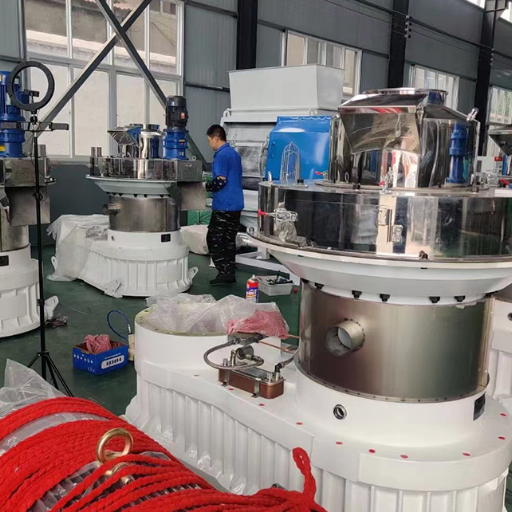
With capacity and die type accounted for, only one question remains: whose machine will do the job, and whose supplier can you really depend on?
Go through this checklist before you write any checks.
- Capacity to be aligned to stable average daily requirement +~20% headroom; not an expression of maximum ambition.
- Die selection matching throughput (flat die under 1 ton per hour, ring die above 1 ton per hour).
- Power source matches your site — electric where the grid is stable, diesel where it is not.
- Certification is real and current — CE marking for EU import, ISO 9001 for a quality-management system behind the build.
- Spare dies, rollers and bearings available upon request and quote.
- Provides documented after-sales service rather than merely providing a sale.
On certification, one distinction matters. CE marking is legally required to sell machinery into the EU, but for most machine categories it is a manufacturer self-declaration. ISO 9001 is different — it certifies a quality-management system that catches production drift before it reaches your machine. CE without ISO 9001 means no such system stands behind the build. As a reference point, TCPEL’s TCF series cattle feed pellet machines carry both CE and ISO 9001:2015. Equipment forums are also blunt about a real failure mode: buyers report cheap machines that arrive badly built, so a supplier with a verifiable factory and service record is worth paying for.
“The cheapest pellet mill is rarely the cheapest to own. Die wear, roller slip and downtime decide the real cost — so buy the machine whose spare parts and service you can actually get.”
⚠️ If you plan to make medicated feed
There are no regulations covering the production of standard cattle rations as animal drug products. However, it makes all the difference if you plan to manufacture custom medicated feed or feeds you associate with Veterinary Feed Directives: a number of medicated-feed mills need an FDA medicated-feed mill license, drug-establishment registration and current good manufacturing practice to make, market or import such feed in the US. Make sure you know your intended feed before you buy, because all this dictates what you’ll have in place regarding records, labelling, and facilities – not the feedmill.
The main lesson here: Ask the supplier for the certification and not just the price for a feed pellet machine. Check out the full feed pellet machine range to compare all the various configurations.
Industry Outlook: Where Cattle Feed Pelleting Is Heading (2026)
2026 Purchase 2 forces will define an cattle feed pellet machine buy, pulling you in opposite directions.
Demand is growing. Alltech’s annual global feed survey, drawing on 142 countries and nearly 39,000 feed mills, put world feed production at 1.44 billion tonnes in 2025 — up 2.9% year over year. Analysts forecast the feed-processing machinery market climbing from roughly $28 billion in 2025 toward $40 billion by 2031. More medium and large farms are buying on-site pelleting equipment to control feeding cost and recipe, producing their own animal feed pellets rather than buying bagged feed.
However, the US cattle cycle is contracting. USDA NASS reported 13.8 million head of cattle on feed on 1 January 2026 — down 3% from 14.3 million a year earlier — with the national herd at a multi-decade low. For a North American buyer, fewer cattle and firmer feed-grain prices mean sizing the machine for the herd that exists now, not the one a producer hopes to rebuild.
Technology trends on the technology side are also obvious. IoT sensors, along with preventive maintenance measures, are believed to reduce unplanned downtimes by 30-40%, optimized energy consumption via roller designs is reducing power, and smaller operations are using automation for smaller continuous lower-cost, lower labor, continuous running.
What to do for those buying in 2026: if operating in a contracting cattle region, prefer a right-sized machine matched to current feeding needs and backed by reliable service support, over a maximum line size on maximum credit, and value a methane- or feed- efficiency benefit for pelleting, after initial equipment costs.
Frequently Asked Questions
Q: How do you make cattle feed pellets at home?
View Answer
Grind your raw materials — grain, oil cake, straw, grass — to a uniform particle size, mix them to your ration, then bring the mash to about 12–15% moisture. Run it through a small flat die cattle feed pellet machine, then cool and screen the pellets to remove fines. A home setup usually needs a grinder, a mixer and the pellet mill; flat die machines are the practical choice for home and small-farm feeding.
Q: What machine is used to make hay pellets?
View Answer
A pellet mill is used to make Hay pellets. It belongs to the same family as the cattle feed pellet machine and works in much the same way. After being dried, the hay is pulverized in a grinder then pushed out from an aperture and severed to size.
Large-scale pelleting operations for commercial use will use a ring die mill but small farms wishing to convert hay into dense, low waste pellets will use a flat die mill.
Q: Can a cattle feed pellet machine make wood pellets?
View Answer
Generally not. feed pellet machines, for example are designed for soft, moist, high protein material, and wood require high temperatures and pressure to make the lign in – nature’s binder – activate. Some flatdie machines may be able to run with both using a new die, but output suffers greatly and wear increase significantly, with poor production.
For any real Biomass output, a designed-for-purpose, Wood pellet machine is best – don’t rely on a feed machine as it cannot make the conversion.
Q: Is a diesel or electric cattle feed pellet machine better?
View Answer
Well – that will depend on your site. An electric type machine gives you clean running with low wear rates and no running costs but that is only applicable to sites where there is a power supply available to the grid. Where there is no power the diesel engine machines have become the standard for farms requiring mobile or portable solutions.
For particular purposes there are also gasoline engine and tractor PTO power versions.
Q: Do I need to dry feed before pelleting?
View Answer
Typically you control moisture, you dont just dry it. Grain must come out at approx 12-15% before the die — any wetter and it blocks up the machine, any dryer, the pellet turns to brittle crumbs.
Q: How long does it take to pellet one ton of cattle feed?
View Answer
It depends entirely on the machine’s rated capacity. A small flat die machine at 200 kg/h needs about five hours to pellet one ton; a 1 t/h ring die unit does it in roughly an hour; a commercial 5 t/h line produces a ton in about 12 minutes. Size the machine to the tonnage you need on a normal day rather than running a small unit flat out for long stretches.
Q: Can I run a pellet machine without steam conditioning?
View Answer
Small flat die machines often run without a steam conditioner, relying on friction heat and added water. Steam conditioning improves pellet durability and is standard on larger mills — but high-urea cattle feeds deliberately use little or no steam.
Sizing a cattle feed pellet machine for your herd?
Compare our TCF series models from 150 to 6,000 kg/h — CE and ISO 9001:2015 certified, with after-sales support across 60+ countries.
About This Guide
This cattle feed pellet machine guide was compiled by the TCPEL engineering team — a pellet machinery manufacturer operating since 2020 — and draws its technical figures from FAO feed-milling reports, USDA and university-extension data, and peer-reviewed ruminant-nutrition research rather than vendor marketing. Where pricing or die-life figures come from industry sources rather than controlled studies, the text says so plainly — because for cattle feed, “it depends on your ration” is often the honest answer.
References & Sources
- Feed Milling Processes, Chapter 18 — Food and Agriculture Organization of the United Nations
- Effect of high-quality pellet feed level on intake, digestibility and rumen fermentation in beef cattle — Scientific Reports, 2025
- Feeding Corn to Beef Cattle — North Dakota State University Extension
- Should We Feed Calves Forage? — Penn State Extension
- 29 CFR 1910.272, Grain Handling Facilities — U.S. Occupational Safety and Health Administration
- Cattle Inventory Report, January 2026 — USDA National Agricultural Statistics Service
- Alltech Agri-Food Outlook — Global Feed Survey — Alltech
- Pellet mill — Wikipedia
- ISO 9001 — Quality management systems — International Organization for Standardization
Related Articles
- Cattle Feed Pellet Machine — TCF Series Models — capacity, specs and pricing
- Biomass Pellet Machine: Complete Engineering Guide — for wood and biomass pelleting
- Small Pellet Machine for Home Use: Buyer’s Guide — hobby and smallholding scale
- Pellet Cooler: How Counterflow Cooling Works — protecting pellet durability
- Feed Pellet Machine Range — full equipment line-up