Get in Touch with TCPEL
Pellet Production Line — Complete Wood & Biomass Pellet Plant Solutions
Every pellet production line converts loose biomass into cost effective, high quality, market ready fuel pellets in one continuous process — crushing, drying, pelletizing, cooling and packaging. It designs and supplies turnkey wood and biomass pellet plants from 1 ton per hour to 10+ tons per hour, custom sized to your raw material characteristics and desired output capacity, rather than sold as a conventional kit of unrelated equipment.
1–10+ T/H
Line capacity range
6 stages
Chipping → packing, one supplier
6/8/10/12 mm
Pellet diameter options
60+
Countries served
20,000 m²
TCPEL manufacturing base
ENplus A1
Target pellet quality grade
From Raw Biomass to Profitable Pellets — Why Half-Built Lines Fail
Most pellet projects that did not make it fail before the pellet mill. They fail because a line was purchased one machine at a time, from many suppliers and no one in charge of making it all work as a consistent whole. A 5 t/h chipper feeds a 2 t/h dryer, and a 3 t/h pellet mill stalls because the hammer mill feeding it cannot deliver fine enough particles. The result is a plant that never reaches its rated capacity.
The other, invisible trap is raw material. Pelleting is effective only in a tight moisture range – conservatively, 10-15% moisture. If your feedstock arrives at 40-50% moisture, the dryer stops being an optional add-on and becomes the most important machine in the line. Industry analysis of pellet plant failures repeatedly traces losses back to procurement and feedstock: a weak feedstock strategy pushes delivered material costs over budget and lets fibre quality fall below spec.
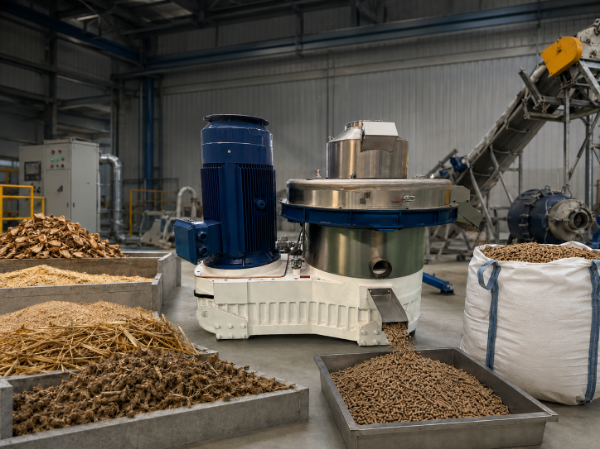
One complete pellet line solves this by treating all six stages as a single machine. Every machine — wood chipper, hammer mill, rotary dryer, ring die pellet mill, pellet cooler and packing machine — is specified against the same capacity target and the same raw material, then delivered as a turnkey project. That is the difference between a pellet plant that reaches its nameplate figure and one that never does. The three sections demonstrate the line set-up, the means of comparison and the cost of supply.
TCPEL Pellet Production Lines — Configurations & the 5-Stage Line
Biomass and wood pellet production lines are built around four standard capacity tiers. Each tier is a matched set — the chipper, hammer mill, dryer, pellet mill, cooler and packing machine are all sized to the same throughput, so no stage becomes a bottleneck. A complete wood pellet production plant runs through a single PLC automation layer, so the whole production process is monitored from one control panel instead of as six separate machines. Whether the project is a small pellet line or a complete biomass pellet plant making pellets at industrial scale, the wood pellet machines at every stage are matched in the same way. The basic configuration matrix below is the most basic role for each quotation – it specifies the exact model of equipment and pellet machine for each step.
Pellet Line Configuration Matrix by Capacity Tier
| Line capacity | Wood chipper | Ring die pellet mill | Pellet cooler | Pellet mill power | Indicative FOB range* |
|---|---|---|---|---|---|
| 1–1.5 T/H | TC216 | TCZL560 | SKLN1.5 | 90 kW | USD 65,000–110,000 |
| 2–2.5 T/H | TC217 | TCZL700 | SKLN2.5 | 160 kW | USD 95,000–165,000 |
| 3–4 T/H | TC218 | TCZL850A | SKLN4 | 250 kW | USD 150,000–270,000 |
| 5–6 T/H | TC2110 | 2 × TCZL850B | SKLN6 | 2 × 280 kW | USD 240,000–430,000 |
Indicative FOB Qingdao is assembled from TCPEL parts cost plus basic auxiliary equipment (hammer mill, rotary driers, conveyors, particle collection). Final price is configuration-dependent — contact us with your capacity and feedstock for a quotation.
All tiers make the same hammer mill, Rotary Dryer and Conveyor package for the headline equipment. Since the 5-6 T/H tier is peaking at about 4 T/H for a single ring die, two pellet mills are installed in parallel to ensure both dies stay within their usefully loaded envelopes rather than saddling one machine with a design overshoot.
Inside the Line — the 6-Stage Process
Each TCPEL pellet production line moves material through six machines in a fixed sequence — the pelletizing process is continuous, with each stage of pellet making feeding the next to produce pellets without manual transfer. Each card below explains what the stage does and the spec that matters when you size it.
STAGE 1 · SIZE REDUCTION
Wood Chipper
Stage one reduces logs, branches and slab wood to uniform chips so the hammer mill downstream is never overloaded. TCPEL’s industrial drum chipper line cuts chips to a consistent 30–50 mm length.
TC216–TC2116 · capacity 3–60 T/H · max log dia. 230–600 mm
STAGE 2 · GRINDING
Hammer Mill
Grinds chips and coarse biomass into 3–5 mm particles — the fineness a ring die needs for stable, dense pellets. Its rotor is motor-direct at 3,000 r/min with dual-side discharge.
Direct-drive rotor · works with cyclone + bag dust collector
STAGE 3 · DRYING
Rotary Dryer
Brings feedstock down to the 10–15% moisture window pelletizing requires. Single-pass (TCG) or triple-pass (TCSG) drum dryer units — see our industrial rotary dryer range — are selected by how wet your raw material arrives.
TCG 0.07–2.2 T/H · TCSG triple-pass 1–6 T/H evaporation
STAGE 4 · PELLETIZING
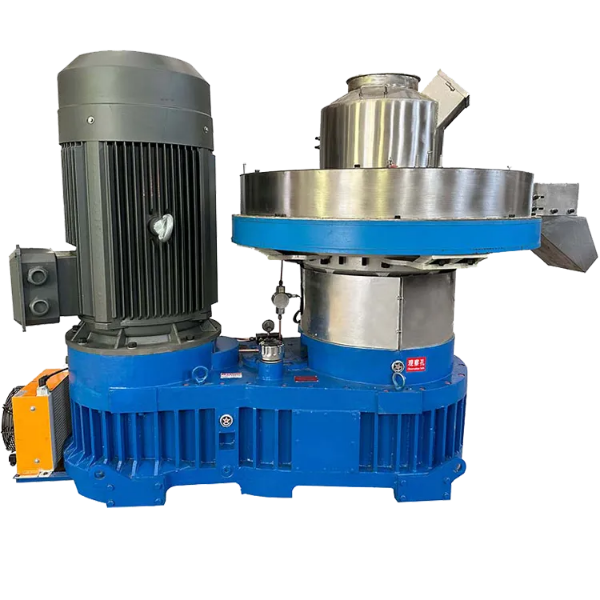
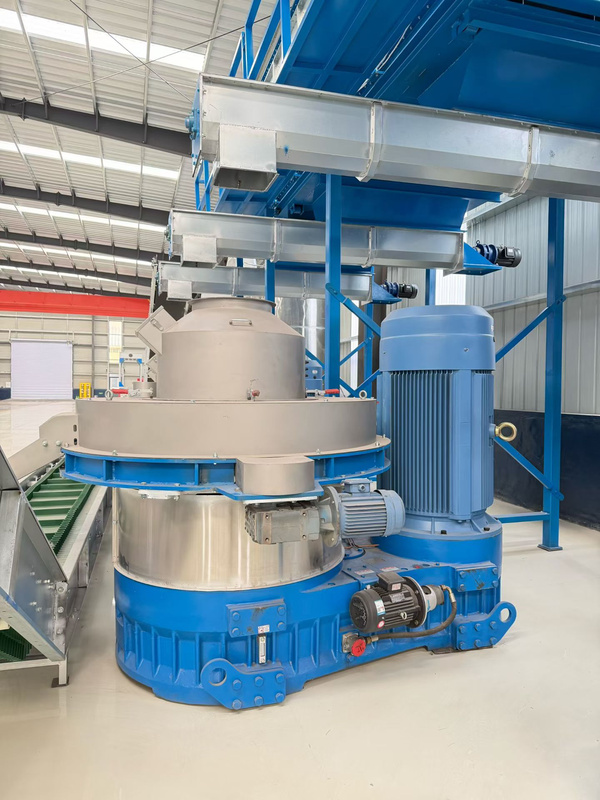
Ring Die Pellet Mill
Dried biomass is pressed through a ring die, where natural lignin binds the pellet under heat. TCPEL’s TCZL industrial wood pellet mill uses 20CrMnTi alloy steel dies with a 1,000–1,500-hour service life.
TCZL560–TCZL850B · 1–4 T/H · 90–280 kW · pellet 6/8/10/12 mm
STAGE 5 · COOLING
Counterflow Pellet Cooler
Fresh pellets leave the die near 80–90°C. Counterflow cooling then drops them to near-ambient temperature and screens off the fines, so pellets are hard, dry and storage-stable.
SKLN1.2–SKLN6 · output 0.5–10 T/H · counterflow design
STAGE 6 · PACKING
Pellet Packing Machine
Weighs, bags and seals finished pellets. The BZ80 uses 304 stainless-steel contact parts and holds ±0.2% weighing accuracy at 200–300 bags per hour.
BZ80 · 15–50 kg/bag · PLC-controlled weighing
“We size the line backwards. A customer tells us the capacity they want, but the first thing we ask is the moisture and type of their raw material. Get the dryer and hammer mill wrong and the best ring die in the world will still under-produce — the pellet mill is the last machine we lock down, never the first.”
For projects where only part of the line is required, each stage may be ordered on its own. For material-specific configurations, see our dedicated wood pellet production line page, or explore how a biomass pellet production line is built for agricultural residues.
Ring Die vs Flat Die · Wood Line vs Feed Line — Choosing Your Line
Two configuration choices decide more about your cost per ton than any other: the pellet mill type, and whether you are building a wood/biomass fuel line or an animal feed line. Both are decisions of fit, not of “better” — the matrices below use real numbers so you can place your own project.
Ring Die vs Flat Die Pellet Mill
| Factor | Ring Die (TCZL560–850B) | Flat Die (TCZL200–650) |
|---|---|---|
| Capacity per unit | 1–4 T/H | 0.1–1.4 T/H |
| Die service life | 1,000–1,500 h (20CrMnTi) | 600–800 h (industry typical) |
| Duty cycle | Continuous 24/7 industrial | Batch / small-scale |
| Pellet uniformity | High — multi-roller even compression | Moderate |
| Best fit | Commercial lines ≥ 1 T/H | Pilot, farm or trial < 1 T/H |
For any commercial pellet production line the ring die is the only realistic choice — it is the configuration in all four capacity tiers above. Flat die machines belong to pilot lines and farm-scale trials, where low capacity and lower capital cost matter more than continuous output.
Wood / Biomass Fuel Line vs Feed Pellet Line
| Factor | Wood / Biomass Fuel Line | Feed Pellet Line |
|---|---|---|
| Typical feedstock | Sawdust, chips, forestry residue, EFB, straw | Corn, soybean meal, grain, grass |
| What binds the pellet | Natural lignin, activated by heat | Formula-dependent, lower process temp |
| Pellet diameter | 6 / 8 / 10 / 12 mm | 2–8 mm |
| Drying stage | Usually required (wet feedstock) | Often skipped (dry ingredients) |
| Pelletizing temperature | ~80–90°C and above | Lower — protects nutrients |
If the project is for animal feed, then the line configuration is changed which enables lower moisture content, lower temperature pelleting, and often the elimination of the dryer altogether. TCPEL builds these as a dedicated feed pellet line for poultry, cattle and aqua feed, using the inclined-roller TCF pellet mill instead of the wood-grade TCZL series that is used in the other configurations.
Proven Across 60+ Countries — Line Deployments & Return on Investment
Today TCPEL biomass machinery operates in more than 60 countries, including Germany, Finland, Russia, New Zealand, South Korea, Pakistan, India, Bangladesh, Vietnam, Malaysia and Turkey. Pellet lines are deployed across three broad profiles, each configured differently because the feedstock — not the brand of machine — drives the design.
DEPLOYMENT PROFILE A
Sawmill by-product line
Sawmills already generating dry sawdust and shavings give the lowest-risk pellet project: feedstock is on-site, often near the pelletizing moisture window, and a single-pass TCG dryer is usually enough. A 2–2.5 T/H wood pellet plant on the TCZL700 fits this profile and turns a disposal cost into a saleable product.
DEPLOYMENT PROFILE B
Forestry residue line
Branches, slab wood and forest thinnings arrive wet and oversized, so the full six-stage line earns its place — chipper, hammer mill and a triple-pass TCSG dryer all carry real load here. This is the profile where buying machines piecemeal fails most often.
DEPLOYMENT PROFILE C
Agricultural residue line
EFB, straw, rice husk and bagasse have widely varying moisture and ash content. These lines are designed in a more conservative manner on the dryer and cooler, and the pellet diameter is often designated at 8-10mm for optimal stable combustion.
30–50%
of a pellet line’s operating cost is concentrated in drying wet feedstock. Matching the dryer to your real moisture content — not over-buying or under-buying it — is the single biggest lever on cost per ton, and the difference between a line running at a 15% or a 30% margin.
Source: industry operating-cost analysis (drying share of OPEX; electricity ~70–110 kWh/ton finished pellets). TCO guidance, not a guaranteed return.
Globally, the wood pellet market was valued near USD 10–11 billion in 2025 and is forecast to grow at roughly 4–8% per year, driven by demand for renewable pellet fuel. Demand for high-quality biofuel pellets is real and growing — but a project’s return still depends far more on disciplined feedstock sourcing and a correctly sized wood pellet line than on the headline market trend.
Want an operating-cost estimate for your feedstock?
Estimate Your Pellet Line ROI →Customer project · Australia
Plan a straw pellet project around your site
- Raw material
- Rice straw
- Complete-line design capacity
- 2 t/h
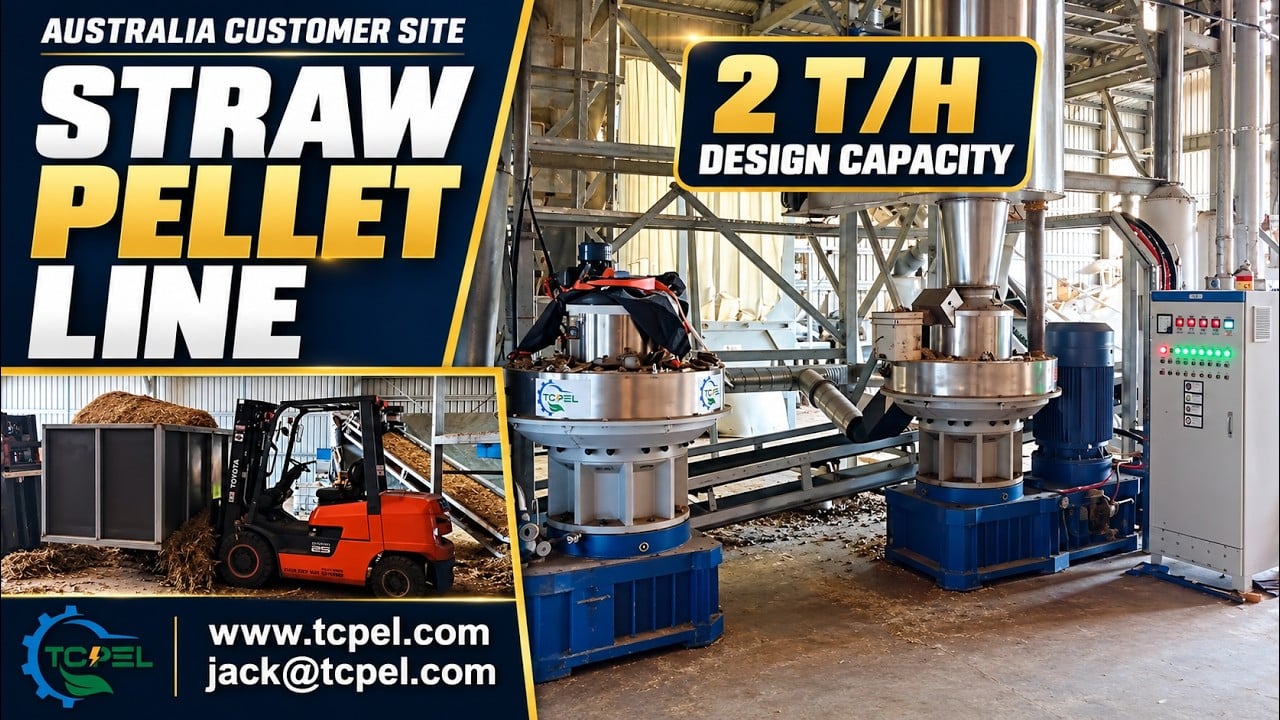
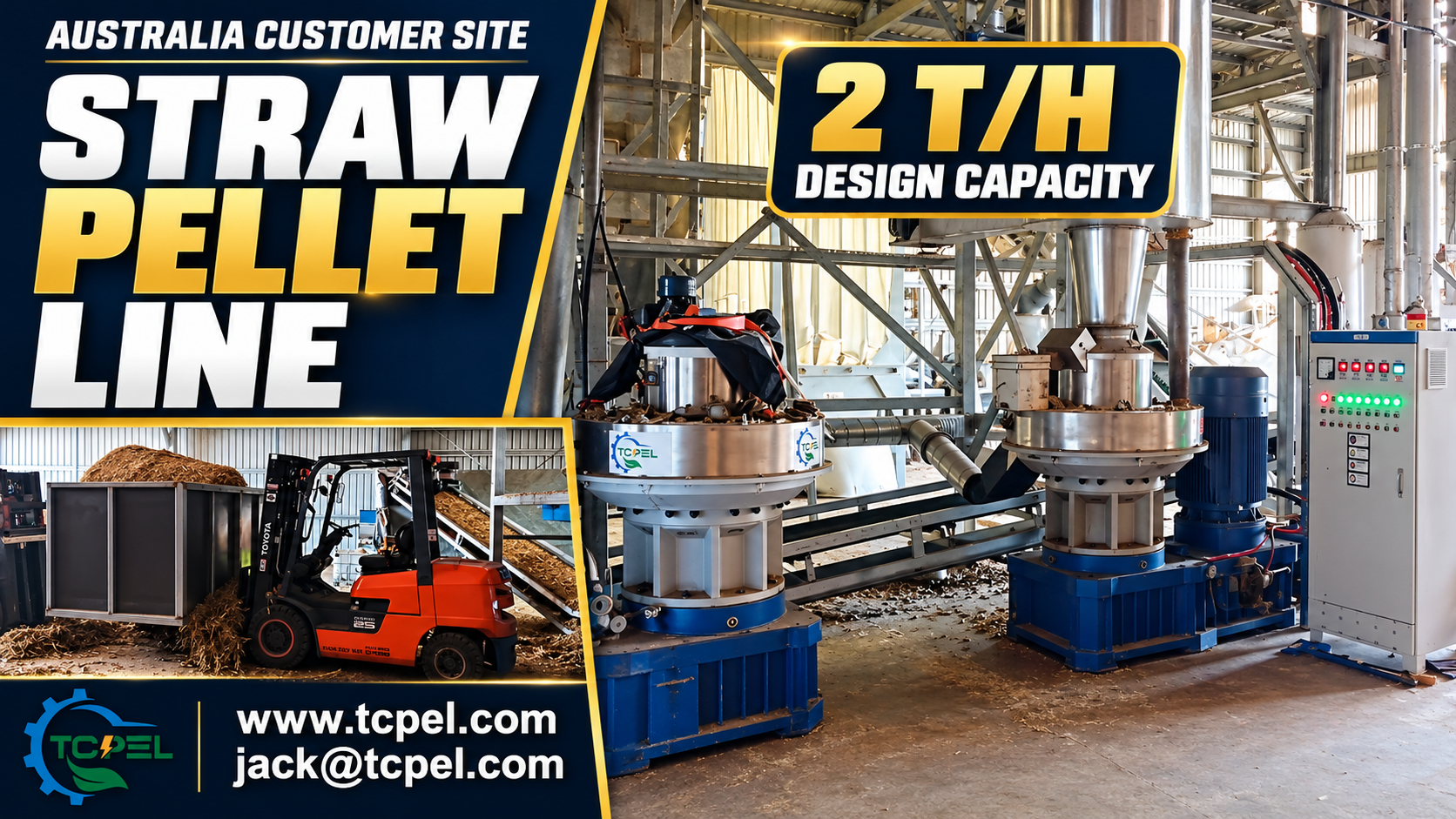
This Australian customer project uses rice straw and has a design capacity of 2 t/h. The line runs from bale shredding through sorting, grinding, pelleting and cooling to jumbo bag packing.
Three starting points for your plan
- Material: tell us how your straw arrives and its condition.
- Site: share the available floor space and material-handling route.
- Packing: describe bag size, storage and dispatch needs.
The video provides a concrete project reference for that conversation. Bring your own requirements to the discussion so the proposed line layout reflects your material flow and the way your team will operate it.
Engineering Standards, Certifications & Quality Assurance
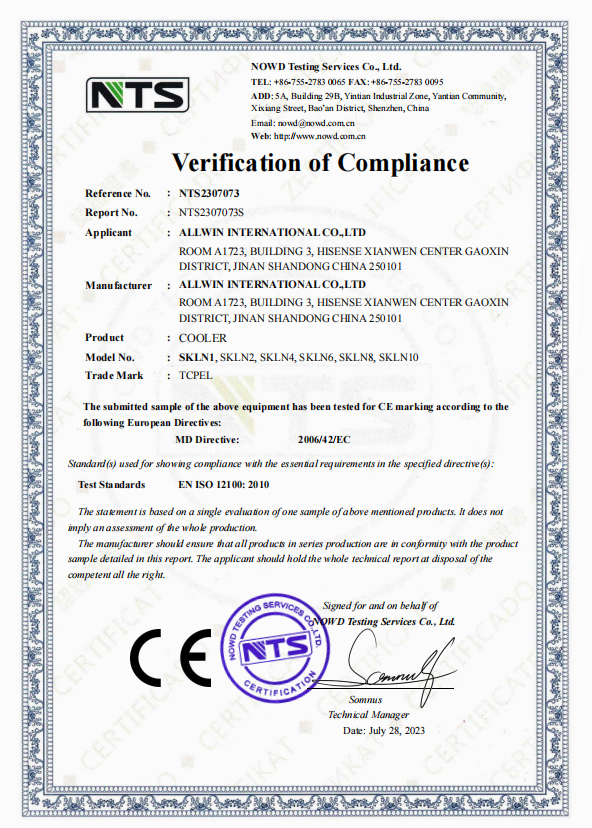
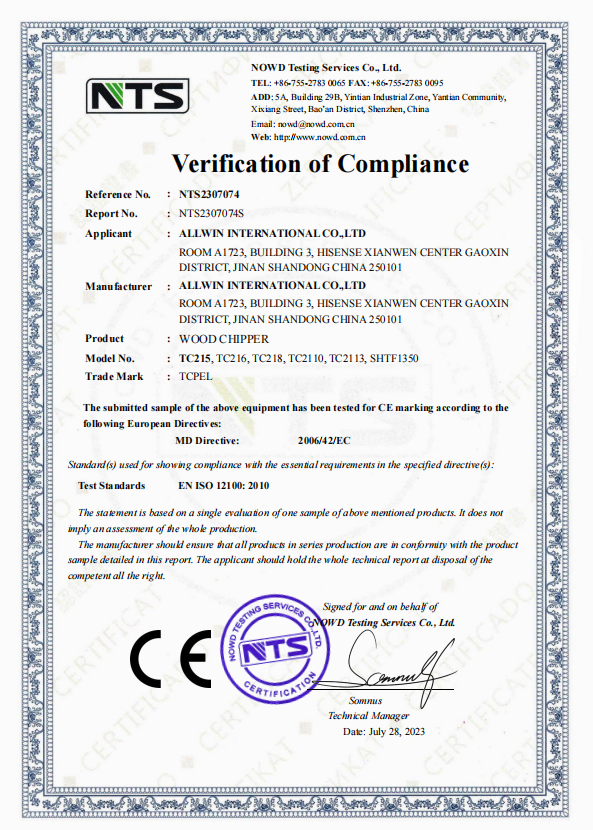
Buyers judge a pellet line by the documentation behind it. TCPEL machinery carries CE marking and machine-directive certification, and every line is engineered so the finished pellet can meet the ISO 17225-2 / ENplus quality framework when run on suitable feedstock.
EU machinery conformity
CE Marking
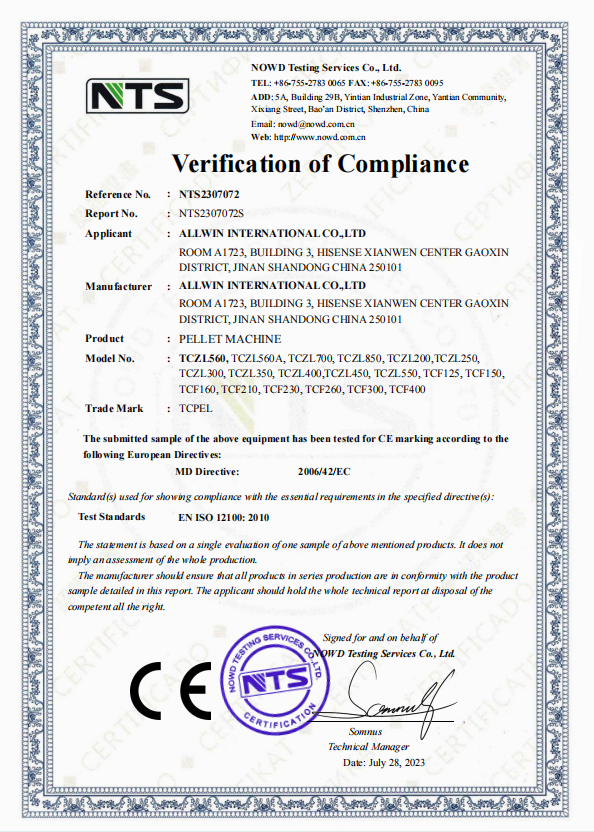
Pellet mill certification
MD NTS2307072S
Pellet cooler certification
MD NTS2307073S
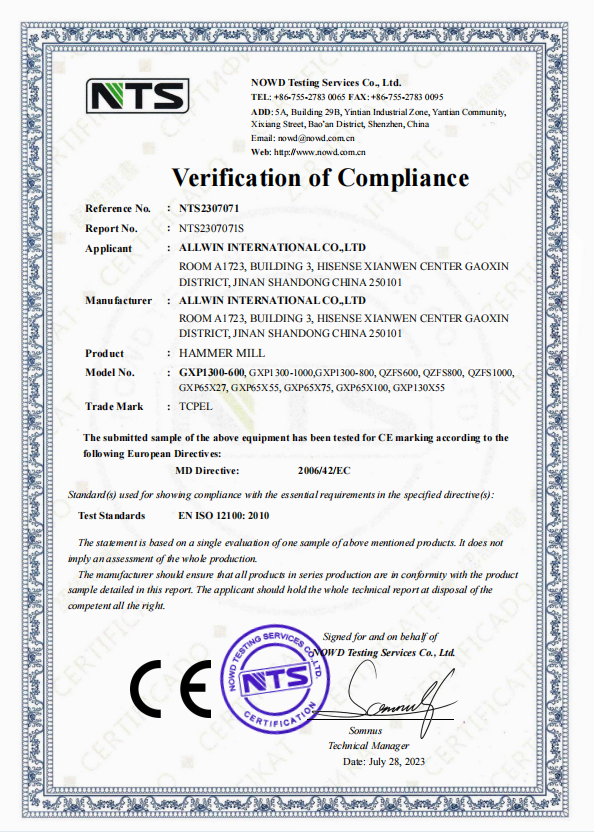
Hammer mill / crusher
MD NTS2307071S
Wood chipper certification
MD NTS2307074S
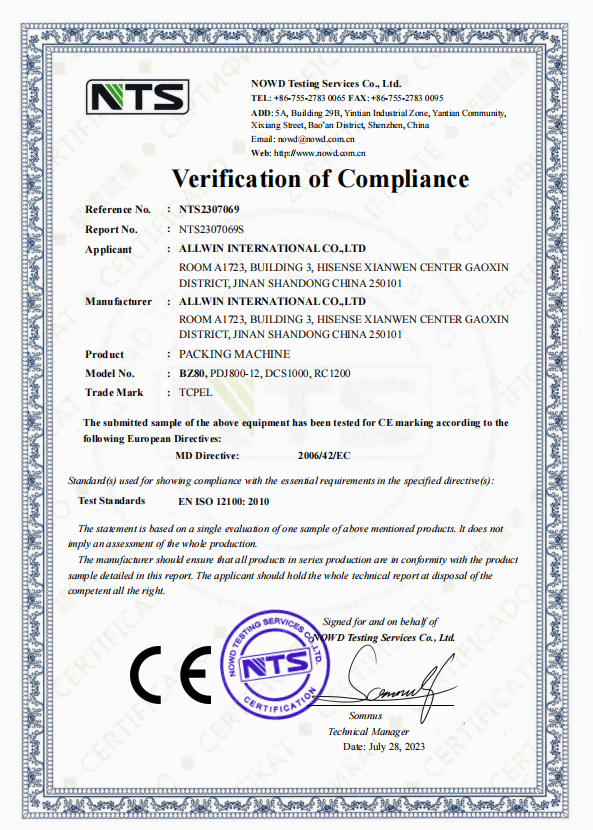
Packing machine certification
MD NTS2307069S
Pellet quality reference
ISO 17225-2
ENplus A1 — the grade most commercial buyers ask for — requires ash at or below 0.7%, moisture at or below 10%, and mechanical durability of at least 98%, all defined against the ISO 17225-2 standard. Whether a finished pellet actually hits that grade depends on feedstock as much as machinery, which is why TCPEL specifies the crushing and drying stages tightly: a correctly prepared particle and a controlled moisture level are what make A1-grade pellets achievable on the line.
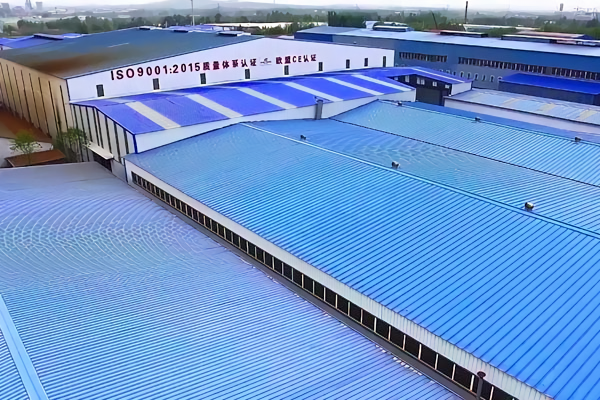
Since 2020, TCPEL has built biomass machinery from a 20,000 m² manufacturing base with over 100 workshop staff, and supports an after-sales network across its 60+ export markets.
Need the full certificate set for a tender?
Request compliance documentation →
Procurement Guide — Pricing, Lead Time & After-Sales
Pricing for a TCPEL pellet production line is built from the ground up – every machine has a published FOB figure, and the line total is the sum of the stages your project actually requires. That is deliberately different from a single opaque “contact us” number. Core machine FOB pricing is listed below, so you can build a realistic budget before you ever send an RFQ.
SPECIFICATION & FOB PRICING MATRIX
| Core machine | Model | Capacity | FOB Qingdao |
|---|---|---|---|
| Ring die pellet mill | TCZL560 | 1–1.5 T/H | USD 16,300 |
| Ring die pellet mill | TCZL700 | 2–2.5 T/H | USD 24,600 |
| Ring die pellet mill | TCZL850B | 4 T/H | USD 42,200 |
| Counterflow pellet cooler | SKLN2.5 | 2–3 T/H | USD 7,300 |
| Counterflow pellet cooler | SKLN6 | 6–10 T/H | USD 8,500 |
An entire line adds the chipper, hammer mill, rotary dryer, conveyors and dust collection to these core machines, so the indicative line ranges in the configuration matrix above (roughly USD 65,000 for an entry 1 T/H line up to USD 430,000 for a 5-6 T/H plant) reflect the full scope. Auxiliary equipment depends on feedstock — which is why the final figure always comes from a configuration-based quote rather than a price list.

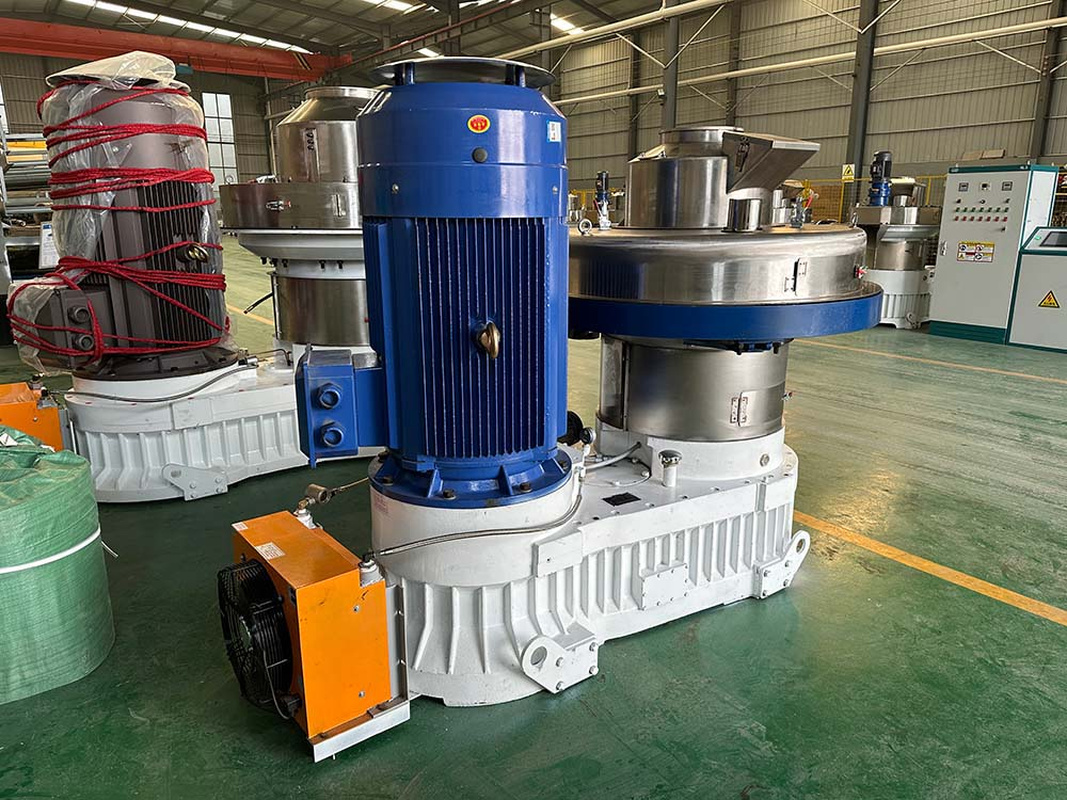
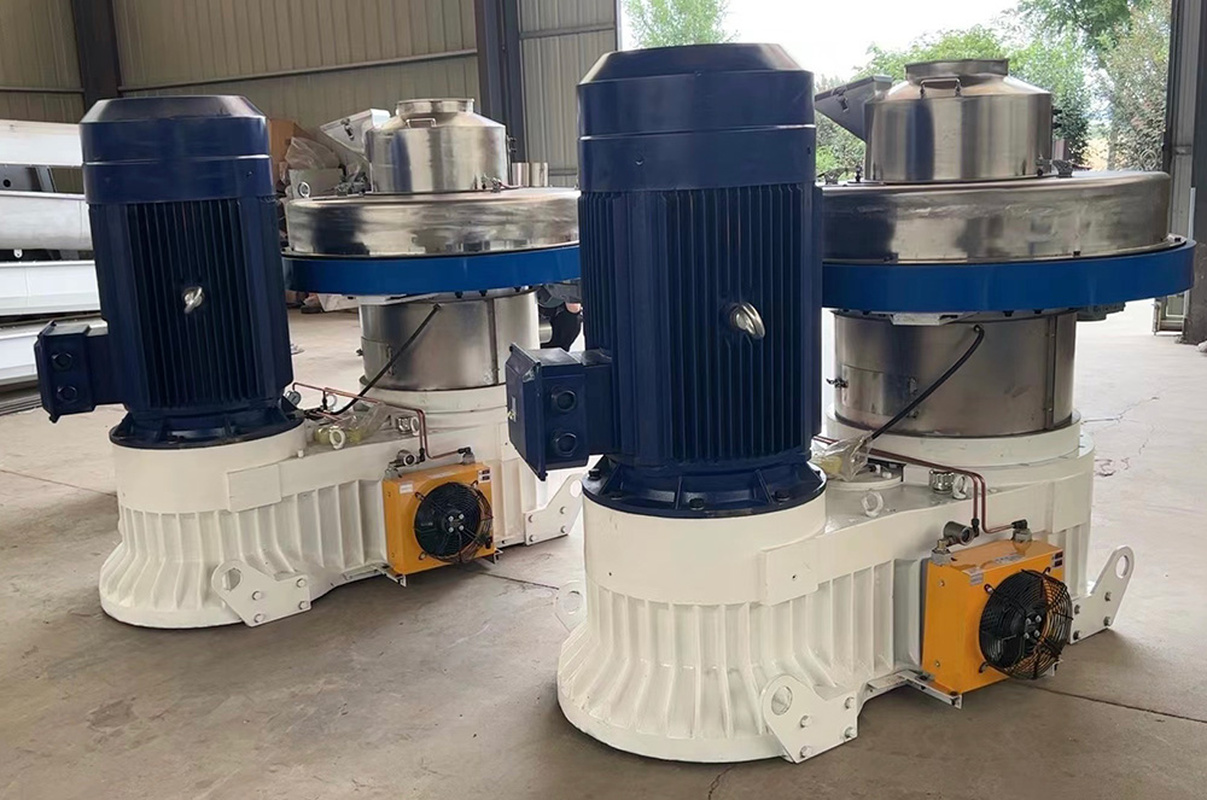
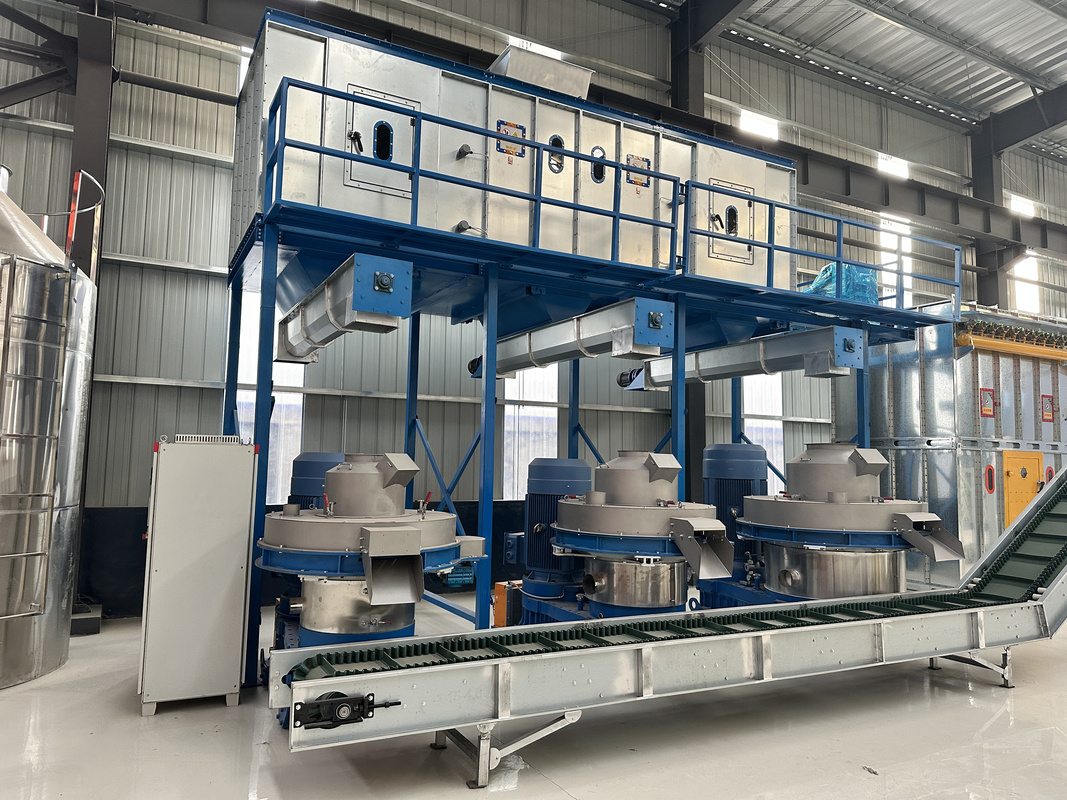
MANUFACTURING BASE INTERIOR
What to confirm before you sign
TCPEL works on 30% T/T deposit with the 70% balance before shipment for pellet and cooler machinery. Single machines ship in around 15 working days; a complete multi-stage line takes longer and the lead time should be agreed in writing for your specific configuration. Always agree the scope of installation and commissioning support – and the spare-parts package – as part of the same contract, not as an afterthought.
By far the most expensive procurement mistake is not the price paid – it is a line that under-produces because the dryer or crushing stages were under-specified to hit a lesser headline cost. Specify the line to your actual feedstock, and the cost per ton stays where your business plan needs it.
Technical Evaluation & Project Planning Tools
01
Pellet Line Capacity Matcher
Calculate and match the required equipment capacity for your specific pellet production line requirements.
02
Pellet Line Investment & Operating-Cost Estimator
Estimate initial capital investment and project ongoing operating costs for your pellet line setups.
03
TCZL Ring Die Pellet Mill Model Comparison
Compare technical specifications, dimensions, and output capabilities across TCZL ring die pellet mill models.
Manufacturing Facility & Workshop
Precision engineering at scale. Tour our state-of-the-art production environments where TCPEL Pellet Production Line equipment is fabricated, assembled, and quality-tested before global dispatch.


×
![Enlarged View]()
We build wood, biomass and feed pellet lines in four standard size classes — 1-1.5, 2-2.5, 3-4 and 5-6 T/H — and we customize line configurations beyond that range. Each size class is a matched set of chipper, hammer mill, rotary dryer, ring die pellet mill, cooler and packing machine. See the configuration matrix above for the model carried at each stage.
Start with the raw material, not the capacity. Tell us its type and moisture content — sawdust at 12% dries very differently from forestry residue at 45%, even at the same tonnage. We size the chipper, hammer mill and dryer to that feedstock first, then lock in the pellet mill and cooler to hit your target output.
Core machine pricing is published — a TCZL700 ring die pellet mill, for example, is USD 24,600 FOB Qingdao. A complete line runs roughly USD 65,000 for an entry 1 T/H plant up to USD 430,000 for a 5–6 T/H plant, depending on how much crushing and drying your feedstock needs. Exact pricing comes from a configuration-based quote.
Single machines ship in around 15 working days. A complete multi-stage line takes longer — the lead time is confirmed in writing once the configuration is fixed. TCPEL supports installation and commissioning across its 60+ export markets; agree the scope and the spare-parts package inside the purchase contract.
Every line is engineered to make A1-grade achievable — ash at or below 0.7%, moisture at or below 10%, durability at least 98% under ISO 17225-2. Reaching that grade depends on feedstock as much as machinery: clean wood with controlled moisture and correct particle size will meet it; high-ash agricultural residues will not, regardless of the equipment.
Different feedstocks require different equipment specifications, so the line is configured per raw material type — sawdust, wood shavings, wood chips, logs and forestry residue, plus agricultural and processing residues including EFB and palm fiber, wheat straw, bagasse, rice husk, bamboo and shells. It is never sold as one fixed line design.
It can be, but the honest answer is that margins are sensitive. Operators commonly plan around a 30% gross margin and find it settles closer to 15% once production runs, because raw material cost and drying energy move the numbers. Projects that hold their margin are the ones with secured low-moisture feedstock and a line sized correctly to it — which is why we push so hard on feedstock matching before quoting.