Get in Touch with TCPEL

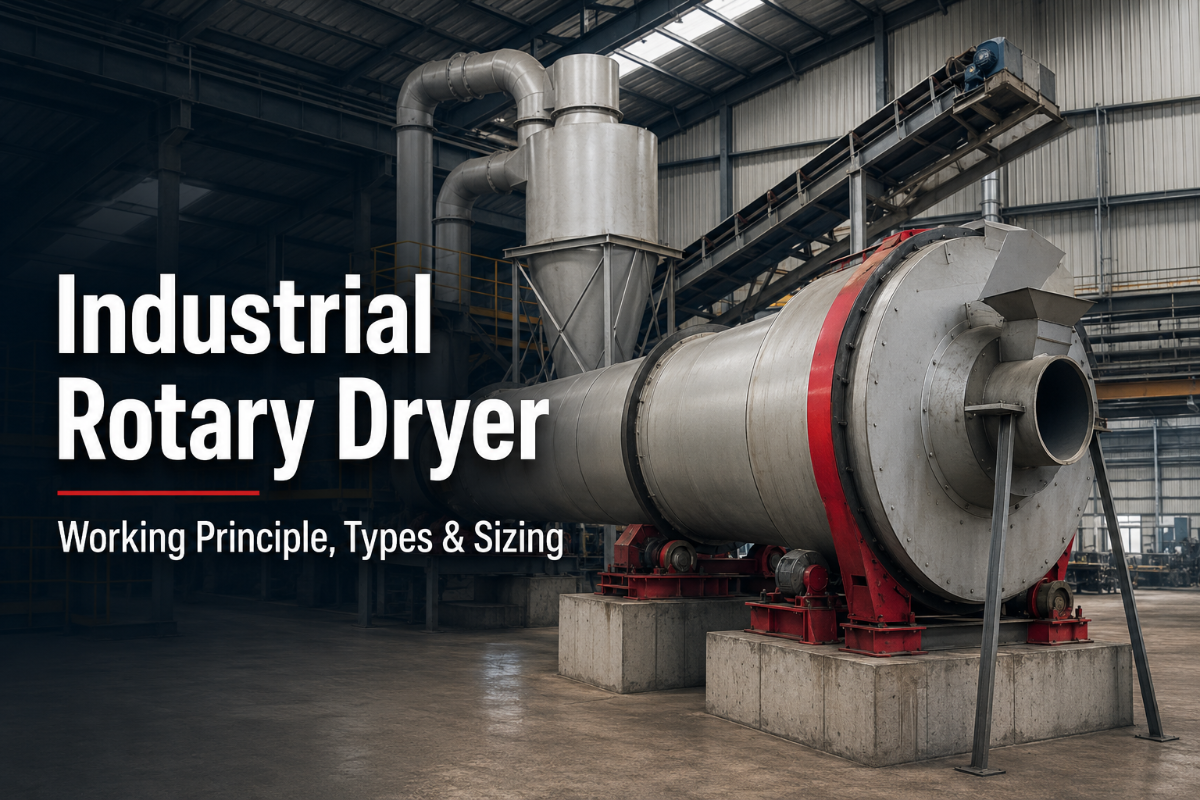
An industrial rotary dryer is the workhorse that turns wet, variable feedstock into a uniform, storable product, and choosing the wrong one is an expensive mistake to live with. This guide explains how a rotary dryer works, the main types, how engineers size one, and what actually drives cost – so you can specify the right machine instead of the cheapest brochure.The focus here is decision-grade detail: real numbers with sources, the trade-offs vendors rarely print, and the safety and emissions rules that quietly shape every wood- and biomass-drying project in 2026. Rotary drying systems handle many dry bulk materials, and the best drying solution depends on your feedstock, heat source, and footprint.
Quick Specs: Typical Industrial Rotary Dryer Envelope
| Throughput range | ~1 to 200+ TPH (material-dependent) |
| Drum diameter / length | ~1–14 ft dia; up to 60 ft single / 150 ft multi-segment (typical vendor range) |
| Moisture reduction | Wet feed → ~8–15% final (end-use specific; ~8–10% for pelletizing) |
| Evaporation energy | ~2,442 kJ/kg theoretical min; real biomass drying ~50% higher |
| Thermal efficiency | ~50–75% (66.88% measured on lateritic ore) |
| Heat type | Direct-fired, indirect (steam-tube / externally heated), or electric |
How an Industrial Rotary Dryer Works

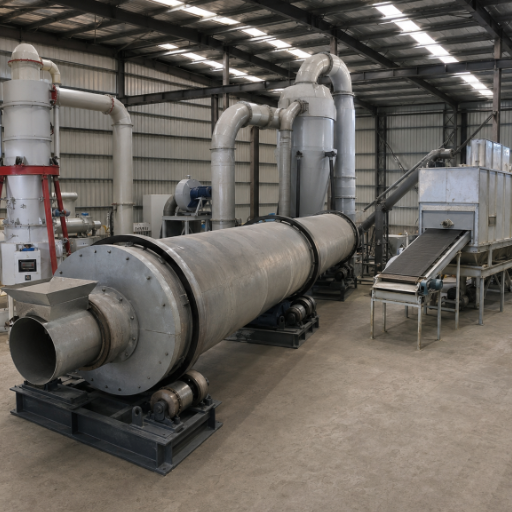
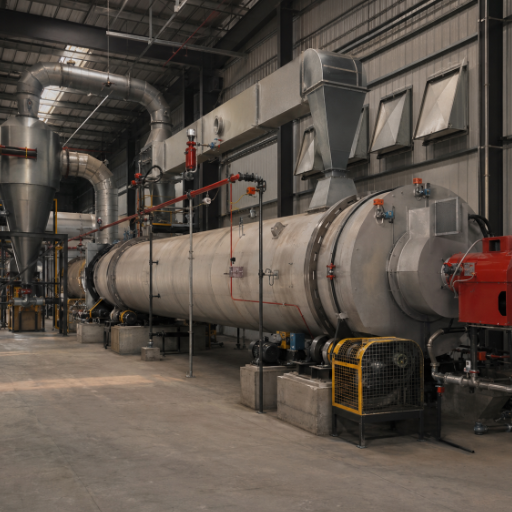
A rotary dryer – also called a rotary drum dryer – is the most common industrial dryer for high-volume bulk material, and it reduces the moisture content of that material by tumbling it through a long, slowly rotating cylinder – the drum – while a hot gas stream passes through. Inside the drum, rows of welded vanes called flights lift the feed up the wall as the shell rotates, then drop it through the gas in a cascading curtain.
That curtain is the whole point. Each particle spends most of its time falling through hot gas rather than sitting in a pile, which is what makes the contact between solid and gas efficient enough to drive water off quickly. As the drum is set on a slight incline, gravity and rotation move material from the feed end toward discharge.
Gas flow direction sets the drying personality. In co-current flow, the wettest feed meets the hottest gas, which protects heat-sensitive material and limits fines because the surface flashes off first. In counter-current flow, the driest material meets the hottest gas at the discharge end, squeezing out the last moisture for products that can take the heat.
📐 Engineering Note
Residence time is not “more is better.” Over-filling the drum lengthens how long material stays inside but kills the cascade – fewer particles veil through the gas, so heat transfer drops and you dry worse, not better. Good flight design and a fill of roughly 10-15% of drum volume keep the curtain dense. Better gas-solid contact lets a builder hit your moisture target with a shorter drum, not a bigger one.
How does a rotary dryer work, step by step?
Wet feed enters the elevated end of the rotating drum. Flights lift and shower it through a hot gas stream produced by a burner or, in indirect designs, by a heated shell. Water evaporates as the cascading material absorbs heat, and the slope plus rotation carry the now-drier solids toward the discharge end. Published drying correlations tie the volumetric heat-transfer coefficient closely to gas mass velocity, so airflow and flight geometry matter as much as temperature.
Direct-Fired vs Indirect (Steam-Tube) Rotary Dryers

The first real fork in specifying a rotary dryer is how heat reaches the material. In a direct-fired dryer, combustion gases from the burner move through the drum and touch the product. This is the most common and most thermally efficient arrangement, and it suits rugged feedstock like biomass, minerals, and aggregates.
In an indirect dryer, the burner gases never contact the product. The drum is heated indirectly: heat passes through an externally heated shell or through internal steam tubes, and bed disturbers replace flights to keep material moving. You give up some efficiency, but you protect the product from combustion gas and keep emissions cleaner.
The Direct-vs-Indirect Switch Rule
Default to direct-fired. Switch to indirect when any one of these is true: the material is heat-sensitive (food, certain chemicals, fine biomass that scorches), it cannot tolerate contamination from combustion products, or the process needs a controlled or inert atmosphere. Steam-tube indirect dryers are also a fire-and-emissions play where plant steam already exists.
What’s the difference between a direct and an indirect dryer?
A direct dryer mixes hot gas with the product for maximum heat transfer and lowest fuel cost per ton of water removed. An indirect dryer keeps gas and product separate, trading efficiency for product purity, lower dust carryover, and tighter emissions control. For most wood and biomass feedstock the answer is direct-fired with careful temperature control; for sticky, fine, or contamination-sensitive streams, indirect earns its higher cost.
✔ Direct-Fired Advantages
- Highest thermal efficiency, lowest fuel cost
- Handles rugged, variable feedstock
- Simpler, lower capital cost
⚠ Direct-Fired Limitations
- Combustion gas contacts product
- Higher exhaust volume to clean
- Scorch/fire risk on dry, fine material
Drum Configurations: Single-Pass vs Triple-Pass

The second selection axis is how many times gas and material travel the drum length. A single-pass drum is one open cylinder – simple, easy to clean, and forgiving of sticky or oversized feed. A triple-pass design nests three concentric drums, so material reverses direction twice and stays in contact with hot gas far longer within the same floor space.
For low-bulk-density feed like sawdust and wood chips, that extra contact matters. Light biomass needs longer residence to dry through, and a triple-pass drum delivers it without forcing you to install a 100-foot single shell. The trade-off is more internal surface to clean and a higher fines carryover risk with friable material.
If you are weighing the two for a wood or biomass line, TCPEL’s single-vs-triple-pass decision quiz walks through the same factors against your material.
| Factor | Single-Pass | Triple-Pass |
|---|---|---|
| Footprint per ton dried | Larger (long shell) | Compact (nested drums) |
| Residence time | Shorter per length | Longer (gas reverses twice) |
| Best feed | Sticky, coarse, oversized | Light biomass: sawdust, chips |
| Cleaning / fines risk | Easier; lower fines | More surface; higher fines |
What Materials and Industries Use Rotary Dryers

Rotary dryers earn their keep wherever feedstock is wet, heavy, and inconsistent. They dry minerals, ores, sand, limestone, gypsum, fertilizers, chemicals, sewage sludge and biosolids, plus many wood and biomass materials. Their common thread is tolerance: a rotary drum keeps drying when particle size, moisture, and density wander, which is exactly when more delicate dryers stall.
The matrix below maps common materials to a starting configuration and the risk to watch. Treat it as a first cut, not a final spec – every real project still needs a drying test.
| Material | Typical moisture in→out | Heat type | Pass config | Key risk |
|---|---|---|---|---|
| Sawdust | ~50% → ~10% | Direct | Triple-pass | Scorch / dust fire |
| Wood chips | ~45% → ~12% | Direct | Single or triple | Uneven size |
| Biomass / agri-residue | varies → ~8–10% | Direct | Triple-pass | Bridging, fines |
| Silica / frac sand | ~6% → ~0.5% | Direct | Single-pass | Abrasion |
| Sewage sludge / biosolids | high → ~10–20% | Indirect | Single-pass | Odor, stickiness |
| Fertilizer / organics | varies → spec | Direct/Indirect | Single-pass | Heat sensitivity |
| Minerals / ore concentrate | ~10% → ~1% | Direct | Single-pass | Abrasion, weight |
| Food / grain byproduct | varies → spec | Indirect | Single-pass | Contamination |
What types of materials can a rotary dryer process?
Nearly every free-flowing, non-cohesive bulk solid that will survive tumbling: gravels, sands, ores, fertilizers, salts and everything in between among the variety of wood and biomass feedstocks. Sticky pastes and delicate crystals are usually the outliers, since tumbling leads to particle wear and sticky slurries will agglomerate (or “ball up”). For many pellet makers, the rotary dryer is often where the moisture in the wood chips and shavings is “brought into” the required range for the pellet mill.
Consider running green sawdust in a pellet plant: moisture is around 50% from the log yard. The press only makes durable pellets near 10% moisture, so the dryer has to remove the bulk of that water reliably, batch after batch, as the wood species and particle size drift. A dryer rated for 5 TPH of dry sand will not do 5 TPH of wet sawdust — light, fluffy material bridges, mats, and needs far longer in the drum.
This is the number one common sizing mistake made on a wood drying system. Feedstock, not headline tonnage, dictates specs.
Rotary Dryer vs Fluid-Bed, Flash, and Belt Dryers
It is tempting to assume the rotary drum is simply the old, less efficient option, but the truth is more useful. A fluidized-bed dryer has a higher heat-transfer rate and a smaller footprint, and it can be more thermally efficient per unit of heat. The catch is that it needs a narrow, consistent particle size and chokes on lumps or sudden moisture swings.
Rotary dryers are less efficient per unit of heat, yet often draw less total energy and need far less supervision on heterogeneous feed because they keep running through variance that would shut a fluid bed down. Efficiency depends on the feed: rotary wins on rugged design and simple capital cost, while a fluid bed wins on compact, high-grade, uniform streams.
One lesson all process engineers learn is that the primary advantage of a rotary dryer is not highest efficiency with clean material, it’s staying in the production rate during upsets of a non uniform feed. The minute you can make an assumption that feed will be controlled and uniform, a fluid bed wins.
— Synthesis of industry drying-engineering practice
Which dryer is best — rotary drum or fluid bed?
Rotary — selected when feedstock particle size and moisture will vary considerably, tonnage is substantial, and product is harsh (biomass, minerals, aggregates). Fluid bed — selected when particle size is uniformly fine, floor space is limited, and product degradation should be held to an absolute minimum (pharmaceuticals, specialty chemicals, some foodstuffs). Flash — for very fine, surface-wet materials.
Belt — ideal for low-temperature/low-emission biomass drying, provided floor space is available.
How to Size and Specify a Rotary Dryer

Sizing comes down to the physics of putting in enough heat over enough time, to drive off a given mass of water per hour. The evaporation of water is, by a wide margin, your biggest single expense – it can be achieved in theory as low as about 2,442 kJ per kg of water removed, and with a practical biomass dryer you’ll likely be in the order of 50% higher once accounting for other energy losses.
This one fact in itself determines why inlet moisture matters, as opposed to throughput, more in establishing the required amount of fuel, and size of the dryer drum.
The 4-Input Drum Sizing Method
Only four numbers account for about 80% of any rotary dryer quote. Deliver these and a supplier can quickly scope a machine:
- Water removal rate (kg/h) – from moisture in % and out % at your throughput. This is the real “size”.
- Throughput (TPH) — dry-product tons per hour.
- Material temperature limit (C) – sets max gas temp and direct vs indirect.
- Bulk density (kg/m) – light biomass needs longer residence and often triple-pass.
Professional selection procedures go further. The ASHRAE dryer-selection method calls for preliminary cost estimates, drying tests in laboratory or pilot units, and product-quality testing before a full-scale order – and notes that product quality, dusting, space, and bulk density can outweigh purchase price in the final choice. Treat any vendor who skips a drying test as a risk.
You can pressure-test your own numbers with TCPEL’s rotary dryer sizing calculator before you ask for quotes.
What information do you need to design a rotary dryer?
At minimum: material name, inlet and target moisture content, throughput, bulk density, maximum safe material temperature, particle size range, and available fuel or heat source. Add any contamination limits and your local emissions rules. With those, an engineer can estimate drum diameter, length, slope, rotation speed, flight pattern, and burner duty – and tell you honestly whether rotary is even the right method.
Energy Efficiency, Fuel, and Operating Cost

Fuel is the lifetime cost that dwarfs the purchase price. rotary dryers run at roughly 50-75% thermal efficiency; an independent study of a flighted dryer on lateritic ore measured 66.88% efficiency and 79.66 kg of fuel per ton of water evaporated against an industry index near 7³ kg/ton. Those figures tell you the prize is not a slightly bigger burner – it is removing water you do not need to remove and recovering heat you would otherwise vent.
The biggest lever is inlet moisture: mechanical dewatering or pre-screening before the dryer cuts fuel directly. The next lever is heat recovery. Exhaust-heat capture through a condensing economizer or air-to-air exchanger – the subject of granted patents such as US20120233876A1 – preheats incoming air and can cut fuel use materially. In practice, pairing lower inlet moisture with exhaust-heat recovery is typically where the largest fuel savings on biomass lines come from.
💡 Pro Tip
Model fuel against an operating-cost calculator before you compare quotes. A cheaper machine that burns 15% more fuel can cost more within two years of running.
One more cost rarely shown on a spec sheet: emissions control. Wood and biomass dryers are regulated air-emission sources for particulate matter and volatile organic compounds under EPA AP-42 and the relevant 40 CFR wood-products rules, so cyclones, scrubbers, or baghouses are part of the real system cost, not an afterthought.
Safety: Why Drying Changes the Fire Equation
There’s a catch to drying your biomass: it increases its fire risk. Drying out this valuable residue “greens” it up, according to standard NFPA rules for wood processors, NFPA 664 (now incorporated into NFPA 660 Standard for Combustible Dusts and Particulate Solids, effective Dec.6, 2024).With a moisture content greater than 25%, it’s considered to have no deflagration hazard.
The dryer’s role is to push material under that moisture limit – that’s what makes it an explosion risk.
OSHA adds a sharp caveat: moisture content cannot be relied on as an explosion safeguard, because fugitive fines settle, dry below 25%, and accumulate. Rotary dryers carry a higher fire hazard than flash dryers, and fires usually come from a pileup of small failures — dirty ducting, poor temperature control, worn seals, and dust buildup — rather than one dramatic event.
⚠️ Important
Specify temperature control, spark detection, and dust housekeeping as design requirements, not optional upgrades. A biomass rotary dryer needs more than enough heat — it needs control, because dry product can ignite if retention runs long or hot spots form.
Buying an Industrial Rotary Dryer: Cost Factors and What to Ask Suppliers

Equipment price is only the opening number. As a historical estimating basis, the US Department of Energy (NETL) put a direct-contact rotary dryer at about $26,500 purchased and $42,400 installed for a 100 sq ft unit, rising to roughly $461,500 purchased and $603,500 installed at 2,000 sq ft (1998 dollars, carbon-steel basis — adjust for inflation and alloy). Current vendor quotes for biomass-scale machines commonly run from about $18,000 for small units to $110,000 and up for high-capacity, multi-model lines.
The real lesson hides in system cost. An EPA project example for a rotary-dryer thermal-desorption system carried a $7.5–9.0 million capital estimate — because the dryer came with a fabric filter, a wet scrubber, and carbon adsorption around it. Your project will not be that extreme, but the principle holds: feeders, cyclones, scrubbers, ducting, controls, installation, and emissions equipment can multiply the bare-drum price.
Your project might not involve a whole arsenal like that, but the ancillary equipment-feeders, cyclones, dryers, ducting, controls, emissions controls, and installation-will multiply your drum-type rotary dryers price by multiples, if not by one or more factors, beyond the published purchase cost.
Supplier Spec Checklist — What to Ask Before You Buy
- Will you dry a sample of my material prior to submitting an estimate?
- ✔ Single-pass or triple-pass, and why for my feedstock?
- ✔ Guaranteed water-removal rate and final moisture, in writing?
- What fuel are you proposing to use and what will be your predicted fuel cost per ton of water removed?
- Which pollution control devices are to be incorporated in your quotation, and how well will they meet my site specific environmental regulations?
- ✔ Material of construction, lead time, and after-sales support?
For context, TCPEL’s industrial rotary drying equipment line is built in single-pass and triple-pass model families sized across laboratory to commercial scales for biomass, wood chips, sawdust, sand, and minerals, with typical lead times of 35–50 working days.
Are rotary dryer specifications customizable?
Yes. Most industrial rotary dryers are custom-engineered processing equipment, built to your material rather than pulled from shelf stock. Drum diameter, length, slope, flight pattern, heat source, and the controls package are all tailored to your material, target moisture content, and drying tonnage. That is exactly why a drying test plus the four sizing inputs matters: it turns a custom build into a firm quote instead of a guess.
Industry Outlook: Where Rotary Drying Is Headed (2026 and Beyond)
This is far from the booming growth the renewable fuel world often seeks, but Market-research estimates suggests growth that is steady but unexciting.By the time the biomass-dryer market reaches $2.5 billion by 2033, it should achieve a healthy clip of about 8.5% growth.
Metal rotary dryers hold close to 45% of that segment. These are directional market-research estimates, not hard physics, but the trend is consistent across sources.
There are three shifts to watch for. First, energy efficiency has become the primary purchase driver shifting heat recovery up from an option to standard practice. Second, IoT remote-monitoring modules—on the market since about October 2025—are migrating temperature and moisture controls from the operator’s gut to the Cloud.
Third, more economical low-emission options like hot-oil and superheated-steam tube dryers and belt dryers are maturing in high fire risk and air-quality limited facilities.
Here’s the 2026 buyer take-away: Demand heat recovery and data-ready controls today. And make sure your dryer emissions package complies with combined NFPA 660, your state air code, and anything else they tell you at the inspection *before* you sign the equipment contract!
Frequently Asked Questions
Q: What is an industrial rotary dryer?
View Answer
An industrial rotary dryer is a large rotating-drum machine that reduces the moisture content of bulk material by tumbling it through a hot gas stream. Internal flights lift and cascade the feed so each particle contacts the gas, evaporating water as the slightly inclined drum carries material from feed to discharge. It is the standard tool for high-volume drying of biomass, minerals, sand, sludge, and fertilizers.
Q: How is a rotary dryer different from a rotary kiln?
View Answer
Both are rotating inclined drums, but a rotary dryer only removes moisture at relatively low gas temperatures, while a rotary kiln drives high-temperature reactions such as calcination, where the goal is chemical or physical change rather than drying. A dryer protects the product from overheating; a kiln deliberately heats it far hotter. The hardware looks similar, but operating temperature and intent are entirely different.
Q: What temperatures do rotary dryers typically operate at?
View Answer
Inlet gas temperature depends on the material’s heat tolerance and the heat source — from a few hundred degrees Celsius for heat-sensitive biomass up to much higher for rugged mineral drying. The controlling rule is the material’s maximum safe temperature, not the gas temperature: co-current designs let the wet feed buffer high inlet heat, while counter-current designs apply the hottest gas to the driest material. Always size temperature to the product, with margin for fire safety.
Q: What types of fuel can a rotary dryer use?
View Answer
Common options are natural gas, diesel or oil, coal, steam, and biomass furnaces that burn the plant’s own waste wood. Biomass fuel is attractive when fines or bark are already on site, but its real cost includes ash handling, spark risk, and emissions control.
Q: Can a rotary dryer be automated?
View Answer
Yes. Modern systems control burner output, drum speed, and feed rate against inlet and outlet moisture sensors, and IoT remote-monitoring modules introduced around 2025 now allow real-time tracking and alarms. Automation steadies final moisture, trims fuel, and improves fire safety by catching temperature excursions early.
Q: What other equipment is needed to support a rotary dryer?
View Answer
A rotary dryer rarely stands alone. Upstream, you need feed handling and often a metering feeder to hold a steady rate. The dryer itself pairs with a combustion chamber or burner and an induced-draft fan. Downstream, a cyclone separates dried product from the gas, and a wet scrubber or baghouse cleans the exhaust to meet particulate and VOC limits. Many lines add a cooler before storage. In a pellet operation, the dryer sits between size reduction and the press, so it must match the capacity of the pellet machine it feeds.
About This Analysis
Information for this industrial rotary dryer guide is based on data and conclusions drawn from existing, peer-reviewed publications on dryer operations, from the US NREL and DOE, from codes relating to NFPA and OSHA combustible dust standards, from assigned heat-recovery patents, and validated against sizing and cost information from actual dryer projects. Equipment specs for items based on the TCPEL rotary dryer product lines come from actual catalogs based on that specific range of dryers, not a singular run in the tests.
References & Sources
- Biomass Drying Energy Requirements — National Renewable Energy Laboratory (NREL)
- Overall Heat Transfer Coefficient in a Pilot-Scale Indirect Rotary Dryer (2024) — MDPI Processes
- Performance Evaluation of a Flighted Rotary Dryer — PMC / ScienceDirect
- Combustible Dust — Technical Manual — OSHA
- NFPA 660: The New Standard for Combustible Dust — Biomass Magazine
- Process Equipment Cost Estimation (DOE/NETL-2002/1169) — U.S. Department of Energy / NETL
- Sawdust Drying in a Large-Scale Pellet Facility: Energy and Exergy Analysis — ScienceDirect
Related Articles
Uncertain about the proper rotary dryer for your material?
Email your moisture in/out and desired throughput (or actual to target) to get a free size calculation.