Get in Touch with TCPEL

Biomass Pellet Machine
Biomass Pellet Machine Manufacturer — Industrial Pellet Mills 0.5-20 t/h
Industrial-grade ring-die and flat-die biomass pellet machines for continuous 24/7 operation engineered at TCPEL’s 20,000-sq.m. Shandong factory. Exported to 60+ nations since 2020. Suitable for wood, sawdust, straw, palms, grass feedstocks.
CE Certified
ISO 9001:2015
EAC for CIS Markets
60+ Export Countries
0.5-20 t/h Capacity
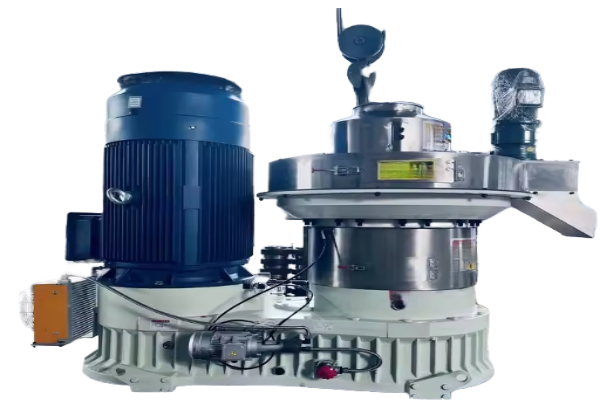
Capacity Range
100 kg/h to 20 t/h
Die Configurations
Ring Die · Vertical Ring Die · Flat Die
Power Sources
Electric / Diesel / PTO
Compatible Feedstocks
Wood · Sawdust · Straw · EFB · Grass · Bagasse
Lead Time
25-90 days from order
Warranty
12 months + lifetime spare parts
Why Buyers Switch to Industrial Pellet Mills (Beyond Workshop-Scale Pellet Makers)
Industrial-grade biomass pellet machines turn raw biomass such as wood chips, sawdust, straw, palm-kernel shells into densified, uniform fuel pellets ready for utility-scale heat markets, animal bedding or certified pellets markets. A biomass pellet mill crushes ground and hammer-milled feed-stock – usually pre-grind sawdust or fine wood chips – through a die equipped with hardened steel rollers at 200-400 MPa pressure; thanks to the natural lignin present in the biomass the pellet is bound together without the need for synthetic glues.
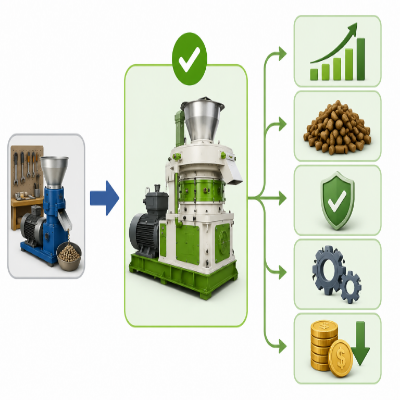
Pain 1: Bulk biomass waste burns money in transportation and storage
Sawmill operators, Palm oil plantations, Agricultural co-operatives own, or have access to millions of metric tons of low-value biomass in their regional hinterland. Transporting bulk sawdust or palm fiber across region borders is ill-advised from an economic standpoint – 40-foot fully-laden containers packed with loose feedstock encapsulate approx.8-12tons of infeed material, but filling the same package with densified pellets delivers in excess of 22-26 tons – a volume reduction of around 65% [WEBSEARCH: consensus opinion across several OEMs], equating directly to the lowest freight cost-per-delivered gigajoule.
Pain 2: Workshop makers cannot meet ENplus or DIN+ requirements
The European pellet market – the world’s largest destination for advanced biomass fuels- functions on the ENplus and DIN+ standards. ENplus class A1, as specified under EN 14961-2, calls for moisture 10%, ash 0.7%, and mechanical durability 97.5%. Few hundred-thousand-dollar single-roller flat-die machines aimed at farms can deliver consistent quality at that level, a level 2 or 3 cylinders is deemed necessary for certification-grade pellets. Closed-die, single- and multi-roller mills with controlled feed conditioning and integrated cooling system are the technical minimum.
Pain 3: Feedstock-die mismatch causes plant failures
Biomass Magazine, in its review of pellet plant failures, identifies “errors in feedstock procurement” and feedstock-machine mismatch as the leading root cause of project underperformance. Softwoods, hardwoods, agricultural residues, and oil-palm byproducts each demand different die compression ratios, hole diameters, and feed pre-treatment. A pellet machine optimized for sawdust will produce dense, durable pellets at 1 t/h with that feedstock — and choke at 200 kg/h on rice husk because the ash content burns the die surface inside 200 hours.
TCPEL Industrial Pellet Mill Lineup — Ring Die, Vertical Ring Die, and Flat Die Models
The 5-tier Product filter of the TCPEL biomass pelletizer range is summarised below according to each model’s competitive zone of throughput, feed-stock attributes and integration options.
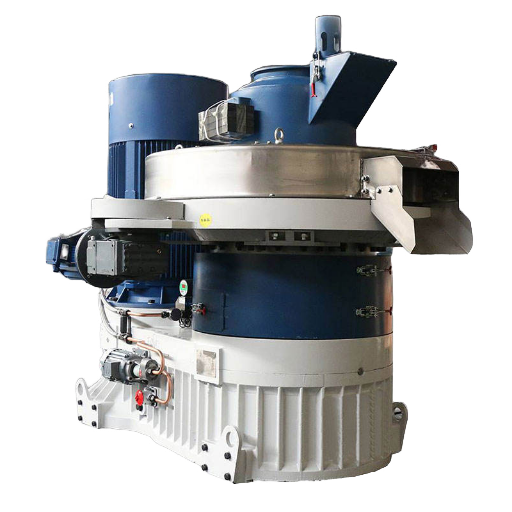
Horizontal Ring Die Pellet Mill (MKLH series)
Capacity: 500 kg/h – 4 t/h per unit
Best for: Continuous industrial wood and sawdust pellet production targeting ENplus or DIN+ certified markets.
- Closed-pattern hardened steel ring die
- Variable-frequency motor 22-160 kW
- Twin-roller compression with integrated overload protection
- Pellet diameter 6 mm or 8 mm (configurable)
- Designed for 18-24 hour daily duty cycles
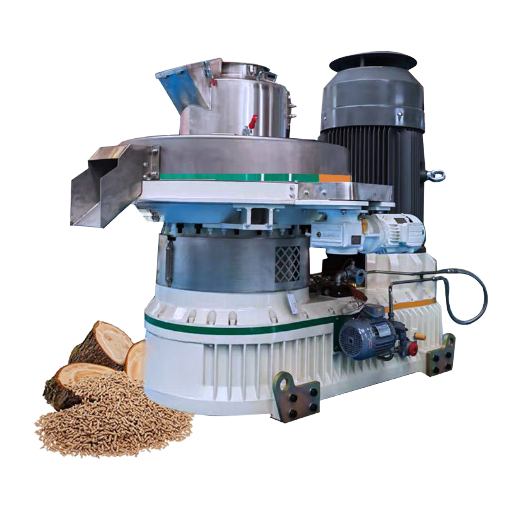
Vertical Ring Die Pellet Mill
Capacity: 800 kg/h – 4 t/h per unit
Best for: Mixed-feedstock commercial biomass plants where layout space is constrained.
- Vertical ring die layout (compact footprint)
- Arena of application: Suitable for sawdust, EFB fiber, alfalfa and other organic pellets fertilizer
- Lower feed-deck height simplifies operator loading
- Reduced civil works compared with horizontal ring die installations

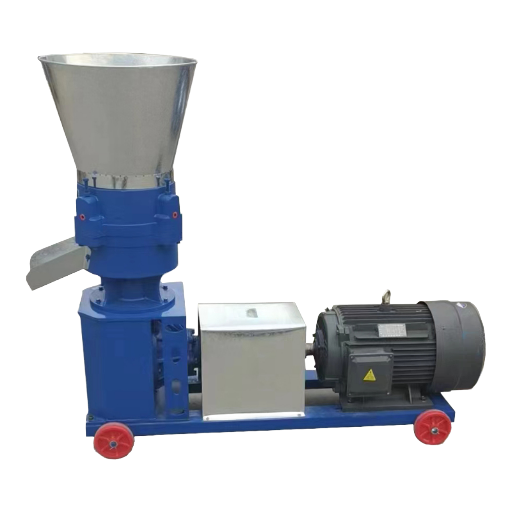
Electric Flat Die Pellet Machine
Capacity: 100 kg/h – 900 kg/h per unit
Best for: Workshop scale producers, small farms, on-site pellet generation and pilot-line research.
- Three-phase electric motor 7.5-37 kW
- Single or dual-roller flat die geometry
- Lower capital cost than ring die equivalents
- Ideal for grass, straw, animal feed pellets
Diesel Flat Die Pellet Machine
Capacity: 50 kg/h – 500 kg/h per unit
Best for: Off-grid, rural cooperatives, piggyback pellet processing of agricultural residues.
- Diesel engine 8-22 hp
- Trailer-mountable configurations
- Operates in remote or grid-unstable regions
- Same flat-die geometry as electric variant for predictably good pellet quality
Decision Matrix — Capacity, Power, Footprint, and Pellet Specification
Engineers choosing among the four main geometries need to consider throughput persistency, feedstock variety, kilowatt-hour cost per ton and facility layout. The matrix below substitutes concrete parameters, per P22 – no Yes/No or High/Medium/Low entries.
| Model Series | Output (t/h) | Main Motor (kW) | Pellet Ø (mm) | Best Feedstocks | Investment Tier |
|---|---|---|---|---|---|
| MKLH-200 Ring Die | 0.5 – 0.8 | 22 | 6, 8 | Sawdust, wood chips | Workshop industrial |
| MKLH-320 Ring Die | 1.0 – 1.5 | 55-75 | 6, 8 | Wood, EFB, alfalfa | Mid-industrial |
| MKLH-420 Ring Die | 2.0 – 3.0 | 110 | 6, 8, 10 | Hardwood, mixed waste | Mid-industrial |
| MKLH-560 Ring Die | 3.0 – 4.0 | 132-160 | 8, 10 | Wood, agricultural residue | Full plant |
| MKVT-Vertical Ring Die | 0.8 – 4.0 | 30-160 | 6, 8, 10 | Mixed biomass, fertilizer | Mid-industrial |
| MKFD-200 Electric Flat | 0.1 – 0.2 | 7.5-15 | 4, 6 | Grass, feed pellets | Workshop |
| MKFD-400 Electric Flat | 0.4 – 0.9 | 22-37 | 6, 8 | Sawdust, straw | Workshop industrial |
| MKFD-D Diesel Flat | 0.05 – 0.5 | 8-22 hp | 4, 6, 8 | Off-grid agricultural waste | Workshop |
Each TCPEL pellet mill is shipped factory tuned, according to a primary feedstock bin. Dialing from sawdust to rice husk requires only a die set change and roller clearance adjustment, both procedures documented in the operation manual and supported remotely by video.
“We reforge every die in our own metallography bench before shipment. Air-cooled alloy steel 40Cr or 4Cr13, vacuum hardened to 58-62 HRC. Customers running mixed wood feedstock generally change dies after 1,800-2,400 hours of operation; rice-husk feedstock generally require die change inside 600-900 hours of operation due to silica wear. We size the spare-die pack to your feedstock, not to a dummy kit.”
Want a model recommendation matched to your feedstock and capacity target?
Send raw material details for quote →
Industrial Pellet Mill Capacity Selector →
TCPEL vs European OEM vs Used / Refurbished Mills — Performance and 5-Year TCO
Procurement managers evaluating equipment sources for biomass pellet manufacturing must choose among three viable solutions: an established European Tier-1 OEM, a TCPEL-like Chinese industrial pellet mill manufacturer, or used and refurbished equipment through the auction circuit. Considerations include initial capital, lead time, spare parts supply and five-year Total Cost of Ownership (TCO).
| Comparison Dimension | European Tier-1 OEM | TCPEL (Chinese Industrial Manufacturer) | Used / Refurbished Equipment |
|---|---|---|---|
| Initial CapEx (1-4 t/h ring die) | $220k – $480k FOB Europe | $35k – $180k FOB Qingdao | $60k – $180k as-is |
| Lead time | 4-9 months | 25-90 days | Immediate (subject to inspection) |
| Spare die delivery | 6-12 weeks via European warehouse | 3-5 weeks air freight; 6-8 weeks sea | Variable — depends on legacy OEM survival |
| Field service response (overseas) | On-site engineer 10-21 days | Video diagnosis 24-48h; on-site engineer 14-28 days (region-dependent) | Buyer self-service typical |
| Documentation language | EN, DE, FR, RU | EN, RU, ES (custom on request) | Varies; original manuals often missing |
| Certification breadth | CE, ATEX, ISO 9001 | CE, ISO 9001:2015, EAC for CIS | Original certs may be invalidated by use |
| 5-year TCO position | Higher CapEx; lower spare-die premium | Lower CapEx; competitive spares; service flight cost added for distant markets | Lowest CapEx; highest unplanned-downtime risk |
Customer Results — Pellet Plant Cases from 60+ Countries
TCPEL biomass pellet machines and complete production lines are successfully operated in over 60 countries, including the dominant markets of Germany, Finland, Russia, Korea, Pakistan, India, Bangladesh, Vietnam, Malaysia and Turkey. Each of the four case studies presented below covers the range from small workshop application to multi-ton production capacity.

1 t/h Sawdust Pellet Line — Vietnam
Turnkey solution taken from a local sawmill converted to standard ENplus wood pellets for export to a utility in Korea. Line components: TCPEL hammer mill, rotary drum dryer, MKLH-320 ring die pellet mill, counter-flow cooler, auto-bag pack 25-kg bags.
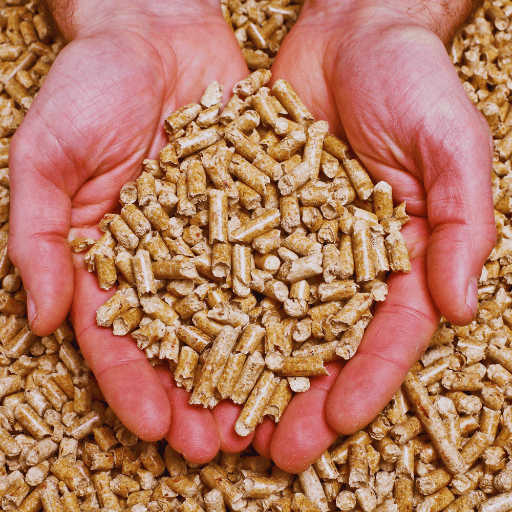
2 t/h Palm EFB Pellet Plant — Malaysia
EFB, the sole output stream from a palm oil mill pipeline. Co-located EFB processing from palm oil plantations. Vertical ring die geometry manages fibrous EFB to prevent bridging problems seen in horizontal line designs.

Wood Pellet Production Line — Romania
A western Ukrainian feed operation installed a small TCPEL line to enter the eastern Europe’s heating pellet market: log debarker, drum chipper, hammer mill, dryer, two MKLH-520 ring-die mills coupled in parallel for redundancy.

2 t/h Sawdust Line — Slovakia
A very small operation in Slovakia constructed a complete 2 t/h pellet line from sawdust for localfeedstockto-plant economics. Proximity of regional sawdust inputs and minimal transport were critical to the economics, exemplifying the <500 km rule.
5-Year TCO Advantage Card (Silver Tier)
Industrial Pellet Mill 5-Year Cost Profile
All ranges approximate general market OEM equipment ranges found in white papers and project deployment reports. Actual ROI is a factor of local economics (feedstock cost, pellet price, electrical tariff, run hours). Contact us for a customized TCO comparison of your project setup.
Market Insight
A biomass operator discussion on Quora found that the most profitable small-to-mid biomass investments of 500 kg/h (1200 lbs/h) or less often come from plants serving a local audience, relying on reduced freight, certification costs, and O&M complexity to gain the best ROI per dollar of CapEx. TCPEL has seen this repeat in workshop-size customers across India, Vietnam, and East Africa.
01
Workshop scale (100-900 kg/h)
Initial investment $8k-$25k. Typical 5-year operating cost dominated by labor and electricity. Best returns when selling locally to small heating operators or animal-bedding distributors.
02
Mid-industrial (1-4 t/h)
Initial investment $35k-$180k. Capital cost typically represents 30-45% of 5-year total spend; energy 25-35%; wear parts 10-15%; labor 10-20%; routine maintenance 5-10%. Payback commonly falls in the 24-48 month range subject to feedstock cost, pellet selling price, and electricity rate.
03
Full plant (5-20 t/h)
Initial investment $250k-$1.8M for the pellet line core (excluding civil works and storage). Higher automation reduces labor share but raises capital and maintenance. Payback commonly 36-60 months for export-oriented ENplus operations.
Want a quote sized to your target capacity and market type?
Send your project parameters for a tailored quote →
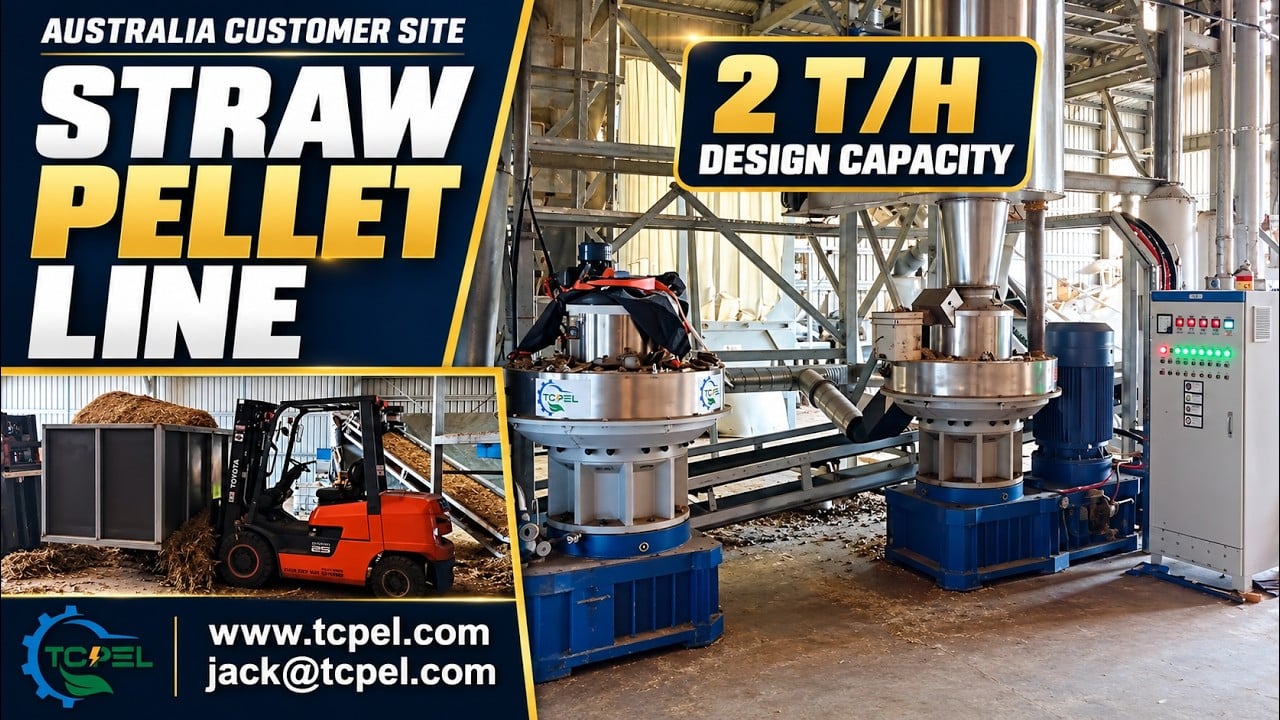
Customer project · Australia
Pelleting within a complete rice straw line
- Raw material
- Rice straw
- Complete-line design capacity
- 2 t/h
The pellet machine is one stage of this Australian rice straw project, whose complete line has a design capacity of 2 t/h. The project also includes a hammer mill, pellet cooler and jumbo bag packing machine.
For your machine enquiry, start with the material that will reach the pellet mill. Share these inputs so the discussion covers both the machine and its place in your process:
Inputs for machine selection
- Straw moisture and prepared particle size
- Required pellet size and intended use
- Planned line output and operating schedule
Certifications and Compliance — CE, ISO 9001:2015, EAC, ENplus Production Capability
In regulated markets with documented verification standards in place – EU, EAEU, GCC – certification, not declaration is necessary. Companies will be relieved to know that TCPEL equipment arrives with the following certification package.
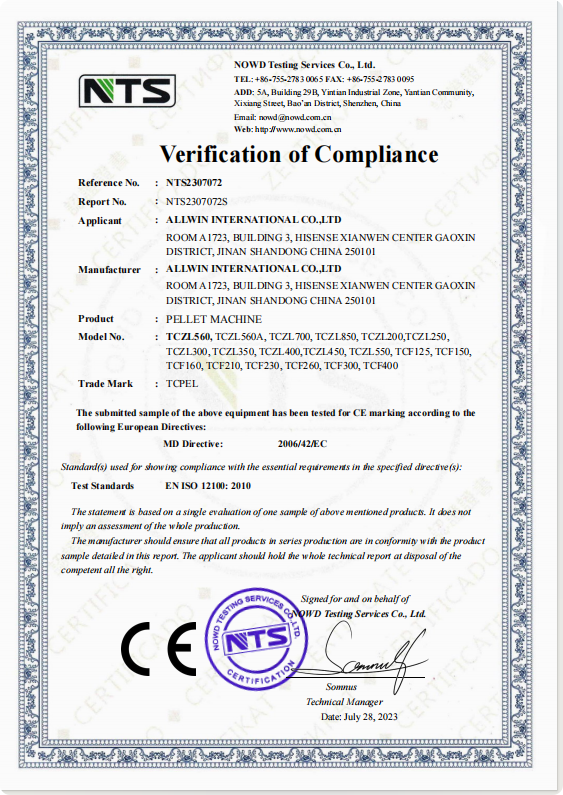
CE Marking
Per EU Machinery Directive 2006/42/EC. Conformity declaration covers TCPEL ring-die and flat-die series for sale into European Economic Area.
ISO 9001:2015
Quality management system covering product design, manufacturing, inspection, packaging, and after-sales service. Annual surveillance audit.
EAC (CU TR)
Customs Union Technical Regulations conformity for sale into Russia, Belarus, Kazakhstan, Armenia, Kyrgyzstan. Required for EAEU territory.
ENplus / DIN+ Production Capability
TCPEL ring-die mills configured for closed-pattern dies, controlled feed conditioning, and integrated cooling produce pellets meeting ENplus A1 thresholds (moisture ≤10%, ash ≤0.7%, mechanical durability ≥97.5%).
Technical Detail:
ENplus certifies the pellet, not the machine. TCPEL supplies the engineering capability (die geometry, conditioning) that makes ENplus A1-grade output achievable.
Technical Compliance Library — CE Certificates
Need full compliance documentation for your bid or audit?
Request Full Dossier →
Manufacturing Excellence and Capabilities
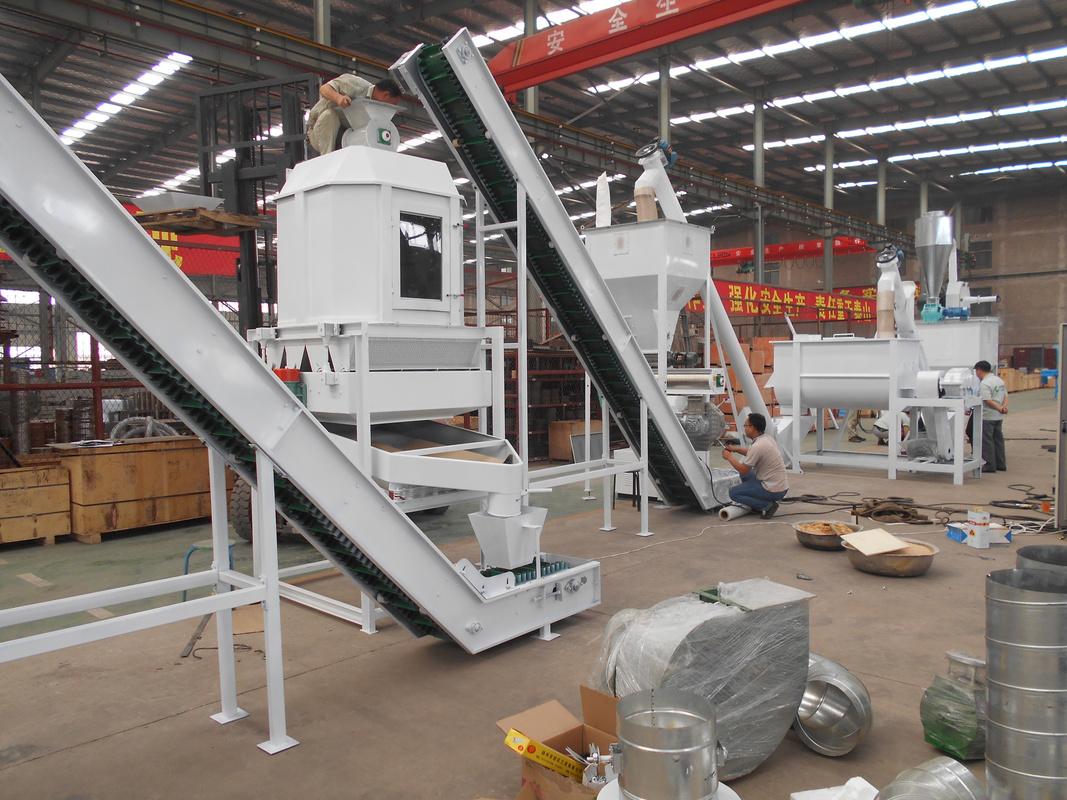
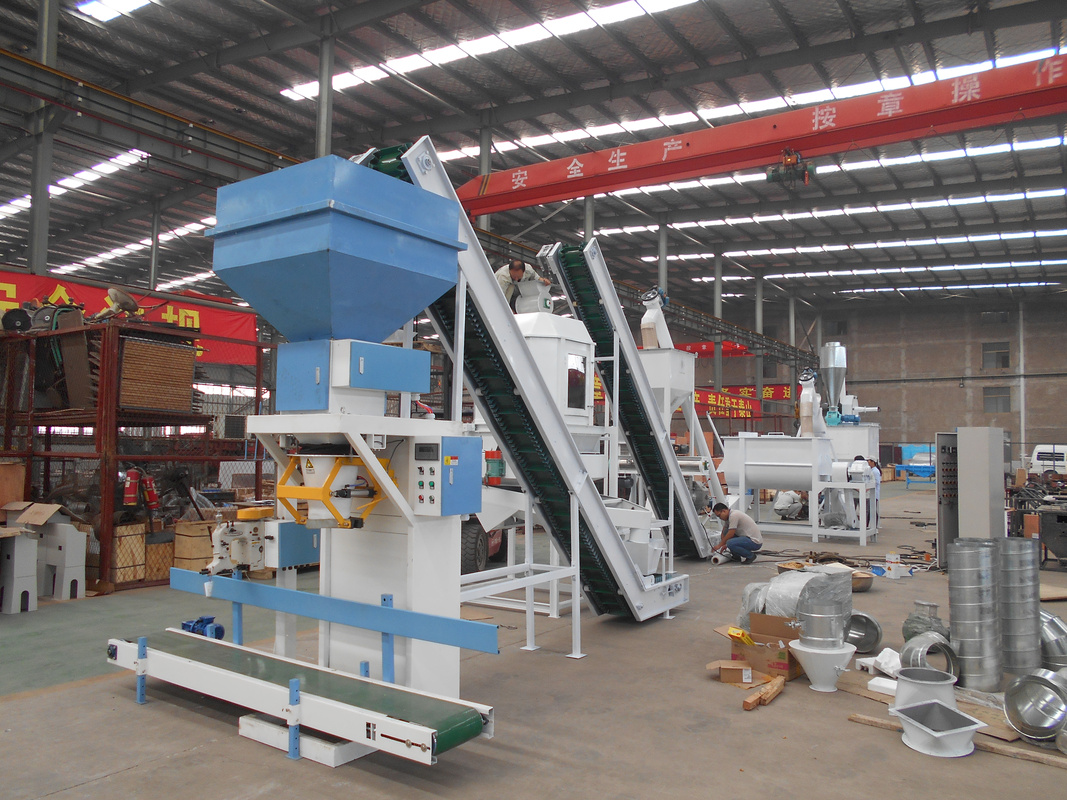
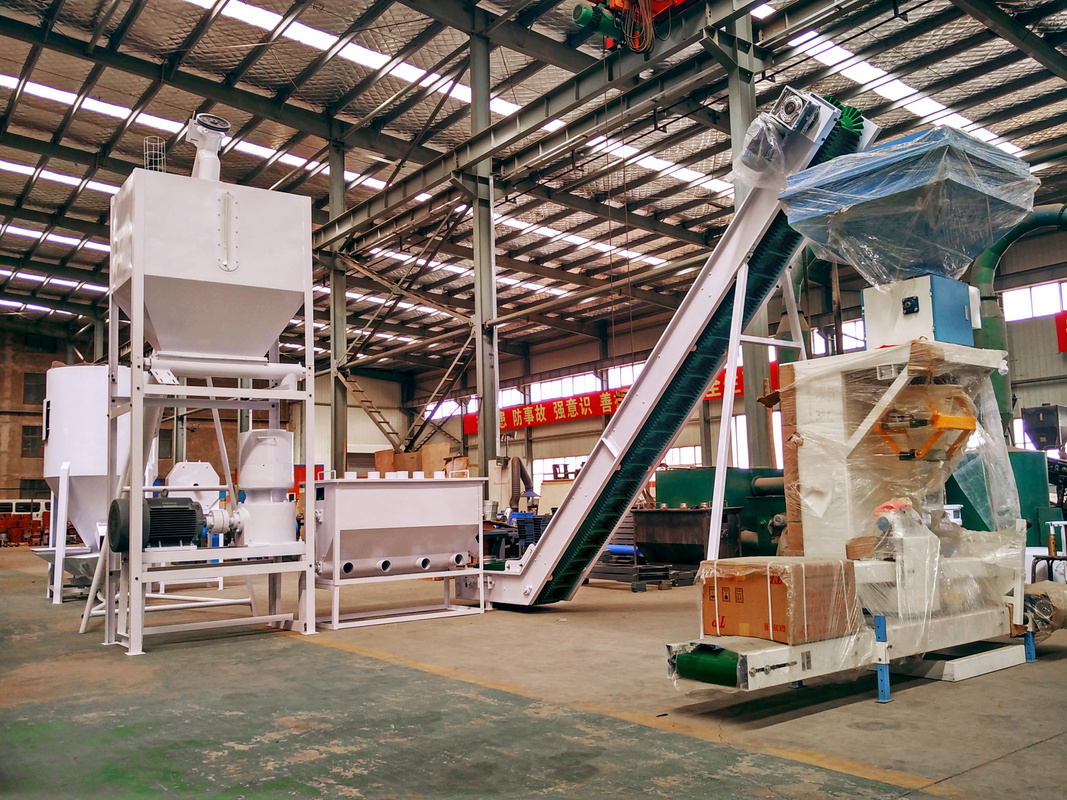
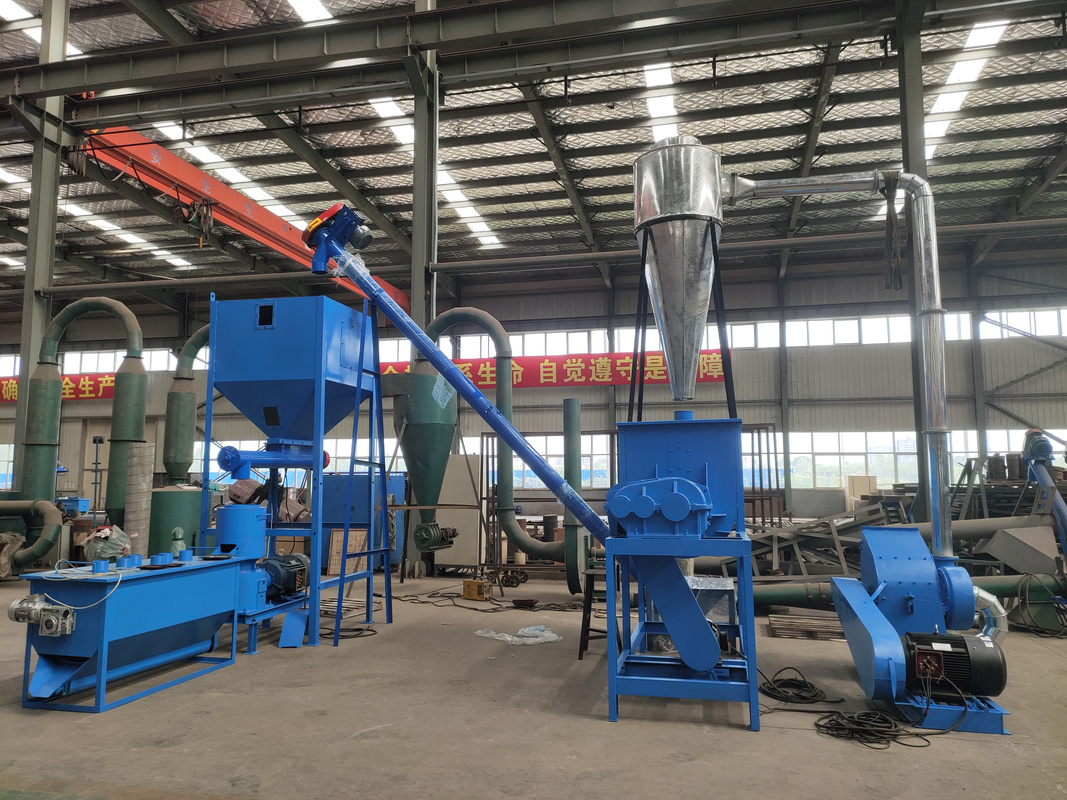
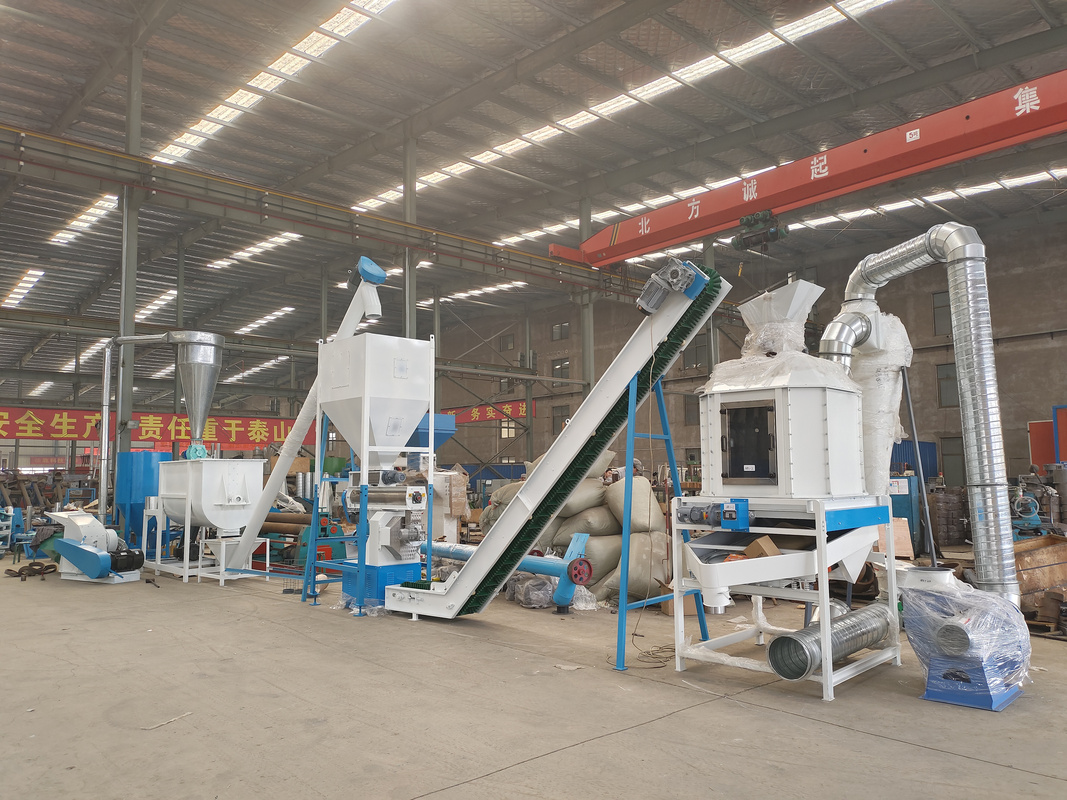
Engineered for scale. Step inside our manufacturing base where precision metallurgy, advanced fabrication, and rigorous quality control combine to produce world-class biomass pellet equipment. From heavy machining to automated fabrication, our facilities guarantee the 5-year durability of every TCPEL machine.



×
![Zoomed Factory Image]()
Procurement Guide — Pricing Factors, Lead Time, FOB Terms, and After-Sales Support
Pellet machine prices range widely—everything from $8,000’s workshop-scale flat-die units to $1.8M for a full 20 t/h ring-die line. Rather than publishing single-point price expectations that do more to confuse than inform, our framework below shows the factors that influence where on the spectrum a given TCPEL configuration would fall.
Pricing Factors Framework
- Capacity band (one of the single largest determinants for price1) - Workshop (100-900kg/h), mid-industrial (1-4t/h), full plant (5-20t/h). Each step a 4-8 CapEx jump to the next band.
- Die geometry - Ring die mills are more expensive than flat-die mills for similar throughput, but increase die lifespan and yield consistency.
- Power source - Electric (lowest energy cost where grid is available), diesel (off-grid premium), PTO (specialist farm applications).
- Automation level - Manual roller-gap adjustment vs hydraulic adjustment; basic feed hopper vs SCADA-integrated conditioning.2 Each automation step adds 8-15%.
- Line scope - Standalone mill vs full line (chipper + hammer mill + dryer + mill + cooler + packing).3 Full line adds a factor of 2.5-4 to mill cost.
- Materials package - Standard alloy steel die vs vacuum-hardened die for high-silica feedstocks.4 Die cost 20-30% higher but life service is proportionally longer.
- Documentation, language, and certification scope - Standard CE + ISO included; EAC, custom translations, and on-site commissioning add line items.
Lead Time
- Standard configurations: 25-45 days from purchase order, FOB Qingdao
- Custom-line projects: 60-90 days for engineering, fabrication, factory acceptance test, and packing
- Full plant projects: 90-150 days depending on scope and automation depth
Shipping & Incoterms
- FOB Qingdao: Standard quote basis. Buyer responsible for international freight from Shandong port.
- CIF Destination: Available for any port worldwide on request; freight cost added to invoice.
- Container loading: Workshop and mid-industrial mills ship in 20-foot or 40-foot containers; full lines split across multiple containers.
Payment Terms
Standard terms 30% T/T deposit on order, 70% balance against B/L copy or before shipment. Line of Credit terms available for orders above $80,000. Custom payment schedules accommodated for large turnkey projects.
After-Sales Service Package
- 12-month warranty on main mill structure and motor (excluding wear parts under normal-use definition)
- Lifetime spare parts supply - TCPEL maintains die, roller, bearing, and gearbox inventory for all current and legacy models
- Remote video commissioning support - Live troubleshooting via video link during installation and first-30-day operation
- On-site engineer dispatch - Available for project commissioning and major maintenance interventions; cost scales with destination region
- Operator training - Pre-shipment training at the Zhangqiu facility (buyer team visit) or post-shipment video training package
- Factory audit invitation - Buyers are welcome to inspect TCPEL's 20,000m2 Shandong manufacturing facility before placing large orders
For a fully detailed quotation reflecting your specific capacity target, feedstock, certification needs, destination port, and required automation level, contact us with your project parameters.
Ready for a detailed quote based on your project parameters?
Project Planning & Engineering Tools
Leverage our proprietary calculators and matching algorithms to plan your biomass pellet production line with industrial precision.
5-Year Pellet Plant TCO Calculator
Estimate total cost of ownership for an industrial biomass pellet mill across capital, energy, wear parts, labor, and maintenance.
Launch Calculator5-Signal Feedstock-to-Die Quick Check
Enter your feedstock signals to estimate die life, recommended compression ratio, and configuration risk before requesting a quote.
Run Quick CheckPellet Plant Investment Tier Matcher
Match your budget and capacity goal to the right TCPEL configuration tier — workshop, mid-industrial, or full plant.
Match Your TierFrequently Asked Questions — Buying and Operating Industrial Pellet Mills
Standalone TCPEL pellet mills range from approximately $8,000 for a workshop-scale flat-die unit to $250,000+ for a high-capacity ring-die mill. Complete production lines, including drying, milling, pelletizing, cooling, and packaging, range from $80,000 to $1.8 million depending on capacity and automation depth. Cost is driven primarily by capacity tier, die geometry, automation level, and line scope. Send your project parameters for a tailored quotation.
Profitability depends on three primary variables: feedstock cost, pellet selling price in the target market, and energy cost at the plant location. Workshop-scale operations selling locally to heating customers often deliver the strongest payback — frequently inside 12-24 months — because they avoid long-haul freight and certification overhead. Mid-industrial plants targeting regional B2B customers typically pay back in 24-48 months. Export-oriented ENplus operations targeting Northern Europe carry longer payback (36-60 months) but higher absolute returns. The wide range across publicly available analyses reflects how project-specific the answer is — request a custom TCO analysis for your situation.
Use the 5-Signal Material-to-Machine Decision Matrix above. The five inputs are moisture content, lignin ratio, hardness/silica content, target pellet density, and production capacity target. These determine die geometry, drying requirement, motor power, and mill tier. TCPEL engineers will run the matrix against your specific feedstock and return a recommended configuration before quoting.
Feedstocks: compatible input materials include domestic and construction wood waste: sawdust and wood chips, hardwood and softwood scrap, rice husk, straw - wheat / corn / rice, sugarcane bagasse, palm kernel shell, palm empty fruit bunch (EFB) fiber, alfalfa, hops, leaves, cotton stalk, plus feedstock that is including certified-grade organic fertilizer feedstock. Different die compression ratios and conditioning requirements apply to each input. Multiple feedstock options can be enabled through feedstock mixing on vertical ring die mills with some pre-treatment equipment.
The main factor affecting die service life is feedstock abrasiveness, generally rets-Softwood sawdust and clean wood chips are in the 1,800-2,400-hour range, hardwoods and mixed woods are slightly lower in the 1,200-1,800 hour range, then high-ash agricultural residues (for example, rice husk) tend to be lower still in the 600-900 hour range. Vacuum-hardened die options increase service life in hight-silica applications by 30-50%, at a 20-30% premium over the cost of standard dies.
ENplus certification is strictly for the pellet product, while DIN+ certifies both the product and pellet mill. TCPEL ring-die mills are engineered for closed pattern dies, dedicated feed conditioning, and integrated cooling, all of which are necessary features to produce ENplus A1 quality pellets (moisture 10%, ash 0.7%, mechanical durability 97.5%) when operated within design envelope conditions and fed with qualifying input material. Several of our customers' plants currently produce ENplus-certified pellets. We provide the checklist used for those certifications upon request.
Durability: to date, TCPEL has delivered equipment to over 60 countries, with a focus on Germany, Finland, Russia, South Korea, Pakistan, India, Bangladesh, Vietnam, Malaysia, and Turkey. We export to all major regions including: North America, Latin America, Europe, MENA, Sub-Saharan Africa, South Asia, Southeast Asia, Oceania. We also supply EAC certification options to support EAEU members, and CE mark to support EEA members. Ask us about your country/destination port combination.
Product warranty: one year from B/L date on main structure, primary motor, gearbox, with regular-use defined. Wear parts: die, roller, and bearing warranty separately for manufacturing defect; die life estimates by feedstock type are included herein. Permanent, on-demand stock of spare parts is supplied for every existing and legacy model, typically at the manufacturer within 3-5 weeks by air.
About This Industrial Pellet Mill Guide
This overview was created by the solutions engineering team of TCPEL, and incorporates our 5+ years of dedicated equipment innovation in professional biomass pellet manufacturing since 2020. Capacity estimates, die life, and TCO trends stated herein are based on our operational history in 60+ countries and publicly available industry sources cited in the References section. Individual project economics will vary widely based on local feedstock prices, energy price, and pellet value, so reach out for a project-specific TCO proposal.
Ready to Specify Your Pellet Mill?
Submit feedstock info, target capacity, and destination port, and our engineering team will have you a 5-Signal-rich configuration and formal quote within one business day.
Request Detailed Quote