Get in Touch with TCPEL

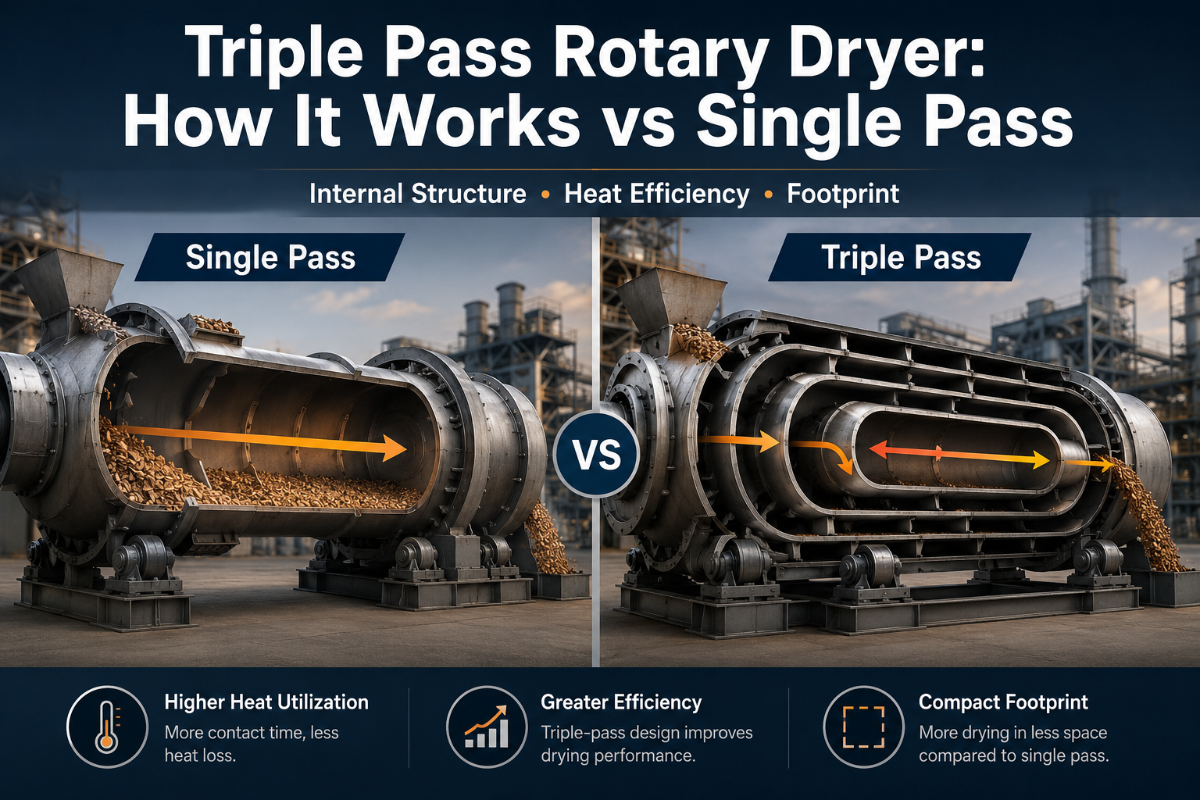
A triple pass rotary dryer moves wet material through three nested drums — inner, middle, and outer — so one machine length delivers roughly three drum-lengths of drying contact. That nesting is why a triple pass dryer takes up far less floor space than a single long drum, and why it has become the default for sawdust, wood chips, and other light biomass feeding a pellet line.This guide explains how the three-pass design actually works, when it beats a single pass dryer (and when it does not), what it costs you in energy and maintenance, and how to size one for your material.
Quick Specs: Typical Triple Pass Rotary Dryer
| Drum configuration | 3 concentric/nested cylinders (inner → middle → outer) |
| Gas flow | Co-current, out-in-out path; air velocity commonly cited around 0.5–2.5 m/s |
| Inlet moisture | Light biomass commonly 50–63% (wet basis) |
| Outlet moisture | ~10–15% for pelletizing |
| Capacity band | ~2.6–115 t/h (model-dependent) |
| Max inlet gas temp | ~700–750 °C (direct-fired) |
| Best-fit materials | Sawdust, wood shavings, wood chips, light biomass |
Figures are typical ranges; exact values depend on material, throughput, and heat source. Ask any supplier for a test-dry on your own feedstock before you commit.
What Is a Triple Pass Rotary Dryer?
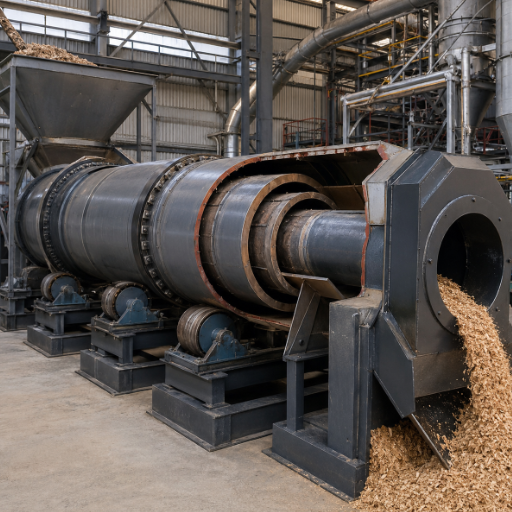
A triple pass rotary dryer is a rotary drum dryer built from three drums of different diameters nested one inside another, turning as a single rotating body. Wet material and hot gas enter together and travel out-in-out: down the inner drum, back through the middle drum, and forward again through the outer drum before discharge. Because the gas crosses the material three times in one shell, the design is also sold as a three-drum dryer, a triple pass drum dryer, or a 3-pass rotary dryer.
The point of all that nesting is contact. Lifting flights inside each drum pick material up and shower it through the hot gas stream, and three passes deliver roughly three times the contact length of ordinary rotary drying for a given footprint. That single idea — call it the Out-In-Out Gas Path — drives every practical advantage of the machine: its compact footprint, its energy behavior, and, as you will see, its maintenance trade-offs. For where this dryer sits among other drying types, see our overview of rotary dryer types.
How the Triple-Pass Airflow Path Works
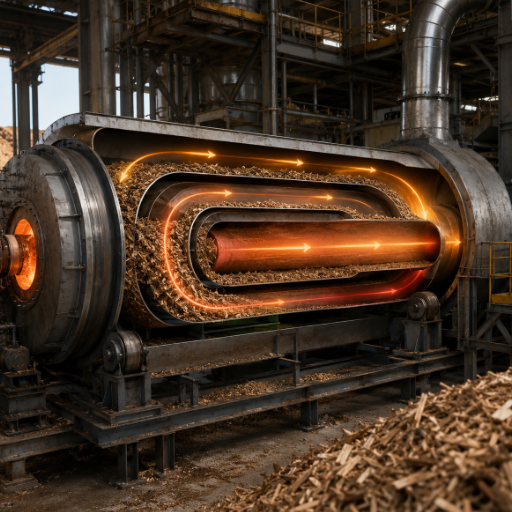
Hot gas from a furnace or air heater is pulled through the dryer by an induced-draft fan. Wet material enters the innermost drum first, where it pre-dries fastest against the hottest gas. As the body rotates, lifting flights raise the material and let it cascade down through the gas as a curtain, which is where most heat and moisture transfer happens.
What makes the three-pass version distinct is what the gas does between drums. Each successive drum has a larger cross-section, so as gas expands outward from inner to outer, its velocity changes across the passes. Co-current flow — gas and material moving the same direction — is the biomass standard, because it keeps the hottest gas away from the driest, most ignitable dust at the discharge end .
How does a triple pass rotary dryer work?
In short: material rides the gas through three nested drums while flights lift and shower it. The inner pass handles the heaviest evaporation, the middle pass continues drying as the material reverses direction, and the outer pass finishes it before discharge. Peer-reviewed modeling of wood-particle motion through a concurrent triple-pass rotary dryer shows particle residence time is set by drum geometry, rotation speed, and gas drag — the same three levers a supplier tunes to hit your target moisture. Rotary air velocity is commonly cited in the 0.5–2.5 m/s range for biomass duty.
📐 Engineering Note
Retention time is the design knob, not drum length alone. Longer retention means more evaporation per pass but a bigger machine. Because the three passes stack contact length into one footprint, a triple pass dryer reaches usable retention in a much shorter shell than a single long drum — which is the real reason it saves floor space.
Triple Pass vs Single Pass: When Each Wins
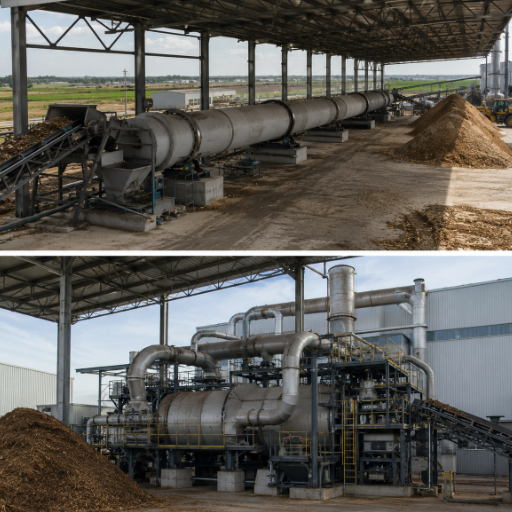
This is the question most buyers actually arrive with, and the honest answer is that triple pass is not simply “better.” A triple pass dryer is a lighter-duty machine optimized for compact, energy-efficient drying of light material. A single pass dryer is a single heavy-walled drum built to survive abrasive, coarse, high-tonnage duty for decades. They solve different problems.
| Factor | Triple Pass | Single Pass |
|---|---|---|
| Footprint (length) | ~20–35% of single-pass length for similar duty (vendor-reported) | Long single drum; largest footprint |
| Drum shell / durability | Lighter shells; shorter service life under stress | Heavy-duty; “lasts for decades” reputation |
| Material conveying | Needs high air velocity + larger ID fan | Gravity on a sloped drum |
| Best particle size | Fine, free-flowing, uniform | Coarse, >1 inch, variable |
| Abrasive material | Poor — flights wear fast | Tolerates abrasion better |
| Major-repair cost | 3–5× a single-drum repair (inner drum must come out first) | Direct access; lower |
| Service life | Shorter under stress (lighter shells) | Decades; “heavy-duty” reputation |
| Best-fit material | Sawdust, chips, light biomass, <20–40 mm minerals | Coarse, abrasive, dense, high-tonnage |
| Capital cost | Higher upfront, lower running cost | Lower upfront |
What is the difference between a single pass and a triple pass rotary dryer?
The core difference is drum count and duty. A single pass dryer passes material once through one heavy drum on gravity; a triple pass dryer passes it three times through nested lighter drums on airflow.
The practical rule — what we call the Single-to-Triple Crossover — is this: choose triple pass when your material is fine, free-flowing, non-abrasive, and floor space or fuel cost matters; choose single pass when the material is coarse, abrasive, or you run very high tonnage and need a machine that shrugs off decades of wear. For the broader family of direct, indirect, and steam-tube types, see our industrial rotary dryer guide.
⚠️ Common Mistake
Buyers chase the fuel savings and forget the wrench time. To reach the middle drum on a three-drum machine, you first remove the inner drum — a bearing swap can become a multi-day job needing rigging crews. Installers commonly report that a major triple-pass repair runs several times the cost of the same fix on a single-drum dryer — figures of three to five times are often quoted — which can erase the fuel savings that justified the purchase.
Thermal Efficiency & Energy Economy
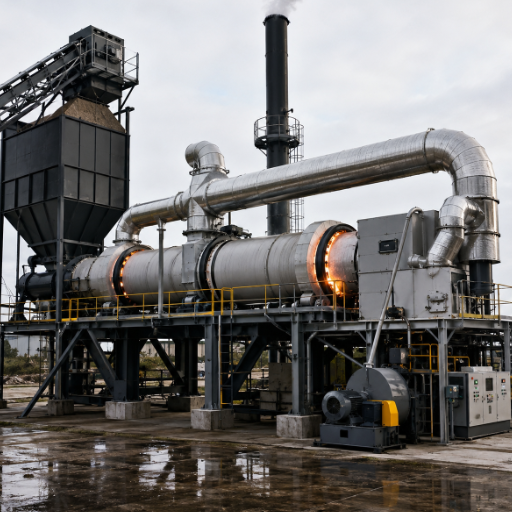
Drying is the most energy-hungry step in the whole pellet chain, so this section deserves real numbers rather than marketing. Start from physics: evaporating water takes about 2.26 MJ per kilogram of water removed (the latent heat of vaporization). That single constant sets the floor on your fuel bill.
In practice, published measurements put direct-fired rotary-dryer consumption at roughly 4.0–6.0 MJ per kg of water evaporated, with indirect systems nearer 2.8–3.6 MJ/kg. The gap between the 2.26 MJ/kg latent-heat floor and that 4–6 MJ/kg actual draw shows how much energy never reaches the water — it leaves as hot exhaust, sensible heat in the solids, and radiation. That gap is also why the “>70%” efficiency some brochures quote should be read carefully: it usually describes self-insulation heat retention, not whole-system fuel use.
“The compact footprint is real, but the savings that matter are at the burner. Spec the dryer around your actual water load — kilograms of water per hour, not just tonnes of product — and the fuel math decides single versus triple long before the floor plan does.”
Where the three-pass design genuinely helps is volume. At 50% inlet moisture, a plant burns roughly 25–30% of its fuel just to dry feedstock before any of it does useful work. Nesting the passes lets you recover more contact per square metre, and pairing the dryer with waste-heat recovery — flue-gas condensation preheating the drying air — can cut annual energy use by up to 41% with a payback often under two years .
Materials It Dries Best: Biomass Focus
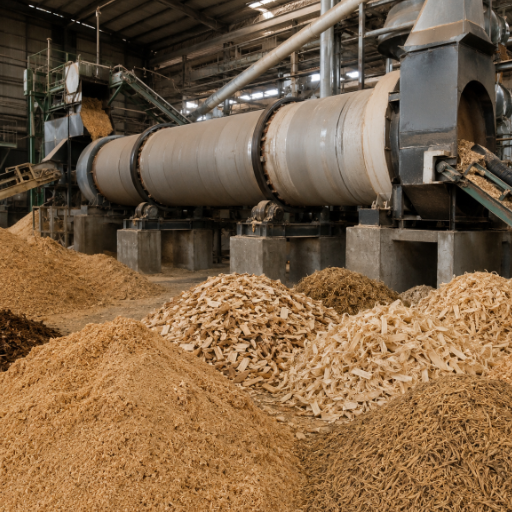
Triple pass rotary dryers were built for light, free-flowing biomass, and that is still where they shine. Sawdust, wood shavings, wood chips, rice husk, straw, and bagasse all move well on airflow and tolerate the high air velocity the design needs. These are also the feedstocks that most often head to a pellet press, which is why the dryer and the biomass pellet machine are usually specified together.
What moisture content can a triple pass rotary dryer achieve?
Most biomass arrives wet — commonly 50–63% moisture on a wet basis — and the target after drying depends on where it goes next. Many lines dry feedstock to roughly 10–15% for the press infeed, while some pellet operations dry further, to around 5–7%, for the finished product; graded wood pellet standards under ISO 17225-2 cap pellet moisture near 10%. A correctly sized triple pass dryer hits the window you specify in one continuous run.
Feedstock consistency matters more than the headline number. Mixed species, contaminants, and fines below 0.5 mm dry unevenly, which over-dries the small particles and raises both dust and fire risk — a primary operational hazard flagged in the wood-pellet sector’s safety guidance. Consistent particle size from a biomass hammer mill makes the drying far more even and the dust far more manageable.
Beyond Biomass: Sand, Minerals & Aggregates
Triple pass dryers are not limited to wood. The same nested-drum design dries yellow sand, silica sand, slag, clay, gypsum, and fertilizer granules, usually sized below 20–40 mm. Mineral drying is where the high-velocity, multi-pass airflow earns its keep on tonnage in a small footprint.
There is a firm caveat, though, and it is the same one from the comparison table: abrasion. Tribology research identifies particle size, shape, and hardness as the properties that drive abrasive wear, and sharp minerals or recycled glass chew through the internal flights and transfer points faster on a triple pass machine’s lighter internals than on a heavy single drum.
The published industrial record reinforces the point. Documented mineral-concentrate drying — for example a zinc and lead concentrate dryer studied at 22.2 m long and 3.9 m in diameter — uses long single-pass-style co-current rotary dryers, not compact triple-pass units, and still wrestles with scale buildup and fuel consumption. As a working rule: granular, non-abrasive minerals at moderate tonnage suit triple pass; sharp, abrasive, or very high-tonnage mineral duty leans back toward single pass, where durability outranks compactness.
How to Size & Select a Triple-Pass Dryer
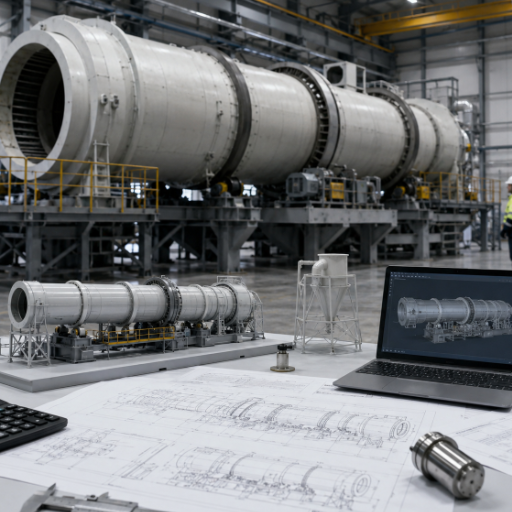
Sizing starts with water, not tonnes. Work out how many kilograms of water per hour you must remove (throughput × moisture drop), multiply by the latent heat, add system losses, and you have the heat duty that sets drum size and burner rating. From there, run what we call the 4-Check Triple-Pass Fit Test before asking any supplier for a quote.
The 4-Check Triple-Pass Fit Test
- Material: fine, free-flowing, non-abrasive? → triple pass fits. Coarse or abrasive? → single pass.
- Moisture delta: inlet and target outlet % — this sets your water load and heat duty.
- Throughput: tonnes/hour of product, converted to kg/hour of water removed.
- Heat source: biomass furnace, hot-air, or waste heat? — decides direct vs indirect and fuel cost.
Answer those four honestly and the choice between single and triple usually makes itself, along with a realistic drum size. A supplier who asks for these four inputs before quoting is sizing your dryer; one who quotes from a model number alone is selling you a drum. Browse the full wood pellet machine line if the dryer is one piece of a larger plant.
Where It Fits in a Pellet Production Line
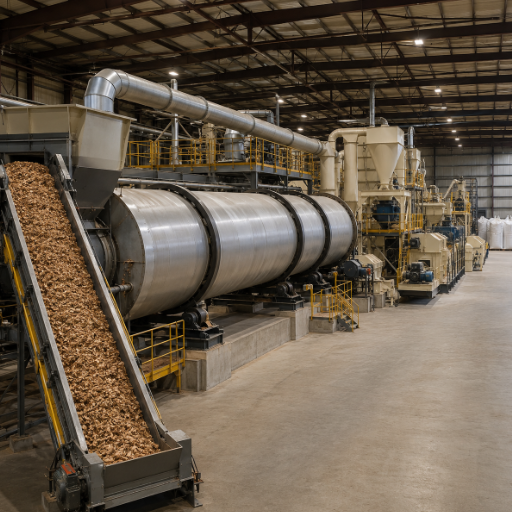
A triple pass dryer rarely works alone. In a biomass pellet plant it sits in the middle of a chain, taking sized, wet feedstock and handing off dry material to the press. The usual sequence runs: chipping, milling, drying, pelletizing, cooling, and packing.
- ✔ Drum chipper reduces logs and slabs to chips.
- ✔ Wood crusher or hammer mill brings particle size down to a uniform feed.
- ✔ Triple pass rotary dryer drops moisture to the ~10–15% pelletizing window.
- ✔ Pellet mill, cooler, and packing finish the line.
Getting the dryer’s outlet moisture right is what makes the whole line behave. Feed the press material that is too wet and pellets crumble; too dry and they will not bind. The dryer is the moisture gatekeeper for everything downstream, which is why it is sized against the press, not in isolation. To match a dryer to your specific feedstock and capacity, talk to us about a triple pass rotary dryer for your line.
Industry Outlook: Efficiency-Driven Biomass Drying
The pull behind better dryers is the pellet market itself, which market-research firms put in the tens of billions of dollars and growing at roughly 7% a year — exact figures vary widely with how “wood pellet” versus “biomass pellet” is defined — with Japan and South Korea scaling biomass co-firing fastest. Because heat in the drying step dominates pellet-chain energy, every efficiency gain in the dryer flows straight to the bottom line.
Four shifts are worth watching through 2025–2026. First, waste-heat recovery is moving from option to expectation — recovering flue-gas heat to preheat drying air can cut annual energy up to 41%. Second, combustible-dust rules are tightening: NFPA 664 and the new consolidated NFPA 660 standard push tighter dust control, and some insurers have begun excluding rotary-dryer coverage in wood-product plants. Third, EU REDIII chain-of-custody rules are reshaping which feedstocks qualify.
The fourth shift is the one buyers underestimate: emissions and fire. Rotary dryers were originally built for non-fibrous minerals, and drying fibrous biomass introduces real fire risk plus air-permitting exposure — on fresh softwood, a dryer can approach the Title V 100-ton/year VOC threshold and is often a plant’s single largest emissions source. That is also why lower-oxygen alternatives such as superheated-steam drying, which reports far lower energy use, are gaining attention for large plants. None of this disqualifies a triple pass dryer; it just means safety barriers and permitting belong in the selection decision, not as an afterthought.
The practical action for a buyer in 2026 is concrete: spec self-insulating shells and a waste-heat recovery option, confirm your dryer-and-dust setup meets current NFPA limits, and check your VOC/HAP permitting exposure before you sign.
Frequently Asked Questions
Q: How much can a triple pass rotary dryer reduce moisture in one pass?
View Answer
A correctly sized triple pass dryer takes light biomass from a typical 50–63% inlet moisture down to the 10–15% range pelletizing needs, in one continuous run. The exact drop depends on gas temperature, retention time, and throughput, so the same machine can be tuned for a smaller or larger moisture delta by changing feed rate and burner setting.
Q: Is a triple pass rotary dryer more efficient than a single pass dryer?
View Answer
For light, fine biomass it usually has lower running costs, because the nested passes pack more drying contact into a smaller footprint and lower-temperature, higher-velocity airflow. But “efficiency” claims above 70% generally describe heat retention, not whole-system fuel use, where much of the energy still leaves as exhaust and sensible heat. Single pass can still win on total cost when repairs and durability are counted.
Q: What materials is a triple pass rotary dryer best suited for?
View Answer
Light, free-flowing, non-abrasive materials with a fairly uniform particle size: sawdust, wood shavings, wood chips, rice husk, straw, and bagasse, plus granular minerals like sand, slag, and gypsum below about 20–40 mm. Sharp, abrasive, or very coarse materials are a poor fit because they wear the internal flights and favor a single pass dryer.
Q: How much floor space does a triple pass rotary dryer need?
View Answer
Much less than a single pass dryer of the same duty. Suppliers report drum lengths roughly 20–35% of an equivalent single-drum machine, because three passes fit into one shell.
Q: Can a triple pass rotary dryer dry sand or minerals?
View Answer
Yes — yellow sand, silica, slag, clay, and gypsum are common duties. Just watch abrasion: sharp minerals wear the flights faster than they would in a heavier single pass drum.
Q: Does a triple pass dryer need more maintenance than a single pass?
View Answer
Routine cleaning and inspection are similar, but major repairs are harder and costlier. Reaching the middle or inner drum means partially dismantling the nested assembly, so a bearing or flight repair that is straightforward on a single drum can run three to five times the cost on a three-drum machine. Matching the dryer to a non-abrasive material is the best way to keep those repairs rare.
About This Guide
This guide was prepared by the engineering team at TCPEL (ALLWIN INTERNATIONAL CO., LTD), a Shandong-based manufacturer of biomass drying and pelleting equipment exporting to 60+ countries. Energy and standards figures here are drawn from public research and ISO/NFPA sources cited below; vendor-specific efficiency and footprint claims are flagged as such rather than presented as independent fact.
References & Sources
- Report on Biomass Drying Technology — National Renewable Energy Laboratory (NREL)
- Simulation of Wood Particle Motion Through a Concurrent Triple-Pass Rotary Dryer — Drying Technology, Vol. 32 (Taylor & Francis)
- Modeling of Forage Drying in Single and Triple Pass Rotary Drum Dryers — ASABE
- Indirect Dryers for Biomass Drying — Comparison of Experimental Characteristics — ChemEngineering (MDPI)
- Energy analysis of wood dryers integrated with heat recovery units — Energy (ScienceDirect)
- Graded Wood Pellets (ISO 17225-2) — Natural Resources Canada
- NFPA 664: Preventing Fires and Explosions — Canadian Biomass Magazine
- Safer Operation of Rotary Drum Dryers — Wood Pellet Association of Canada (WPAC)
- Flight design and particle distribution in rotary drums (glass beads & quartz sand) — Granular Matter (Springer)
- Abrasive wear from sand particles: size, shape and hardness effects — Tribology Transactions (Taylor & Francis)