Get in Touch with TCPEL

By CYH · Last updated: October 2026
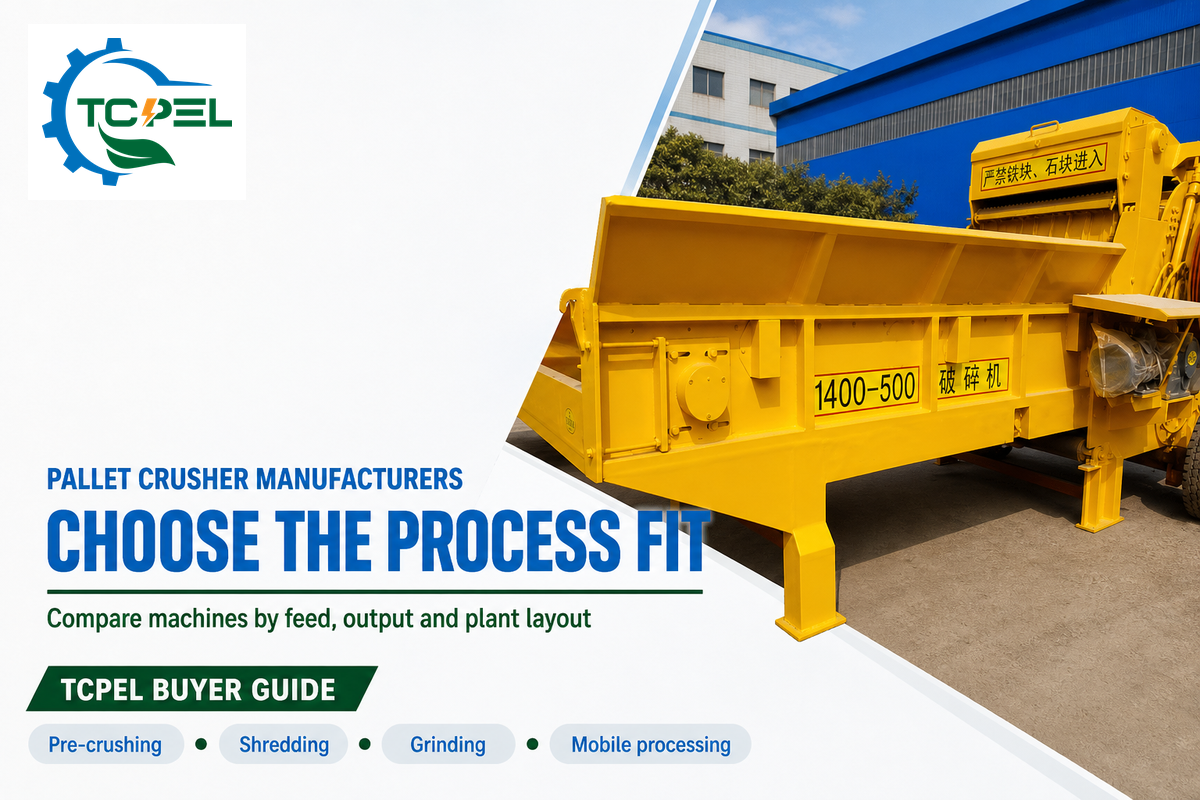
The top pallet crusher manufacturers for a practical shortlist include UNTHA for compact screened shredding, WEIMA and Vecoplan for primary crushing, Rotochopper for pallet grinding, and TCPEL for biomass-line preparation. Choose by the required output and feeding method: a machine that breaks whole pallets isn’t necessarily the machine that makes finished pellet feed.
The pallet recycling yard and the pellet plant both can receive waste pallets, but need different types of shredding equipment. One requires smaller pieces that occupy less space. Another needs a screened wood fraction, separated metal and a consistent feed for the next machine. Comparing motor power before deciding which of those jobs you need makes a supplier list harder to use.
This guide lists 15 manufacturers based on their demonstrated roles in the process. The numbered entries let you locate individual profiles; they don’t represent sales volume. If the process feed is regular and the available floor space is limited and the downstream equipment needs a controlled material stream, a small, dedicated pallet shredder may be a better choice than a large, mobile industrial shredder.
Quick picks by purchasing task
- Best for integrated biomass preparation: TCPEL.
- Best for compact stationary pallet shredding: UNTHA.
- Best for bulk pallet pre-breaking: WEIMA.
- Best for low-speed stationary pallet scrap grinding: Cresswood.
- Best for grinder-to-hammermill processing: Rotochopper.
- Best for compact mobile primary reduction: ARJES.
Disclosure: This guide is published by TCPEL. We list ourselves first because this is our website, not because we claim to be the market leader. The other 14 manufacturers are grouped by what they’re best for, in no particular order within each group.
How We Selected These Pallet Crusher Manufacturers
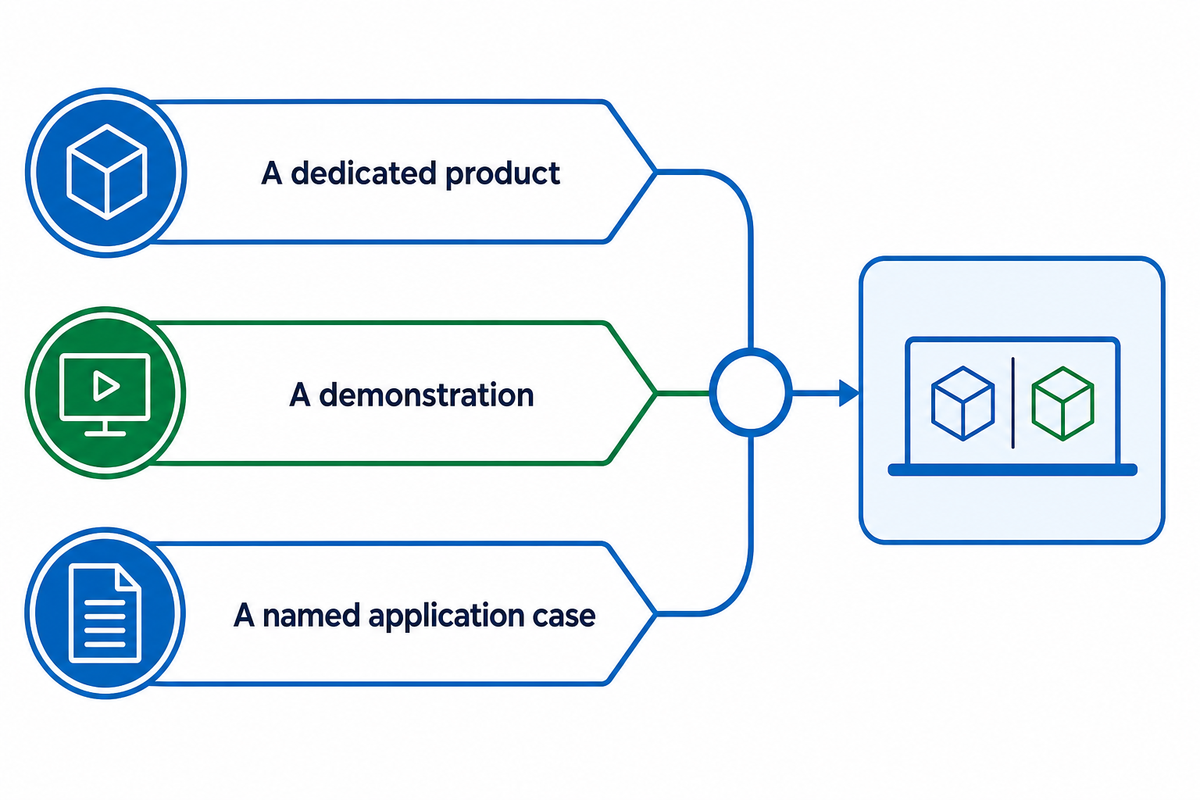
We used official evidence of wood-pallet processing to arrive at the listed manufacturers. Evidence included a dedicated product, demonstration or a named application case. Company information was checked against official websites and public sources in October 2026. Trading companies, distributors, sourcing platforms, directories, media websites and used-equipment dealers were excluded as standalone entries. Coverage includes hammer mills, primary crushers, and mobile equipment in several countries.
For each job listed, we included the actual machine. A recycling catalogue alone doesn’t prove that all models in the catalogue can shred wooden pallets. Dates the company was founded don’t mean that the machines listed have existed for that length of time. The locations are the company’s headquarters or where the company says they operate.
Specs are model and configuration-specific. The relevant comparison is what each supplier can do for your material flow and the equipment to complete that flow.
15-Company Pallet Process Map
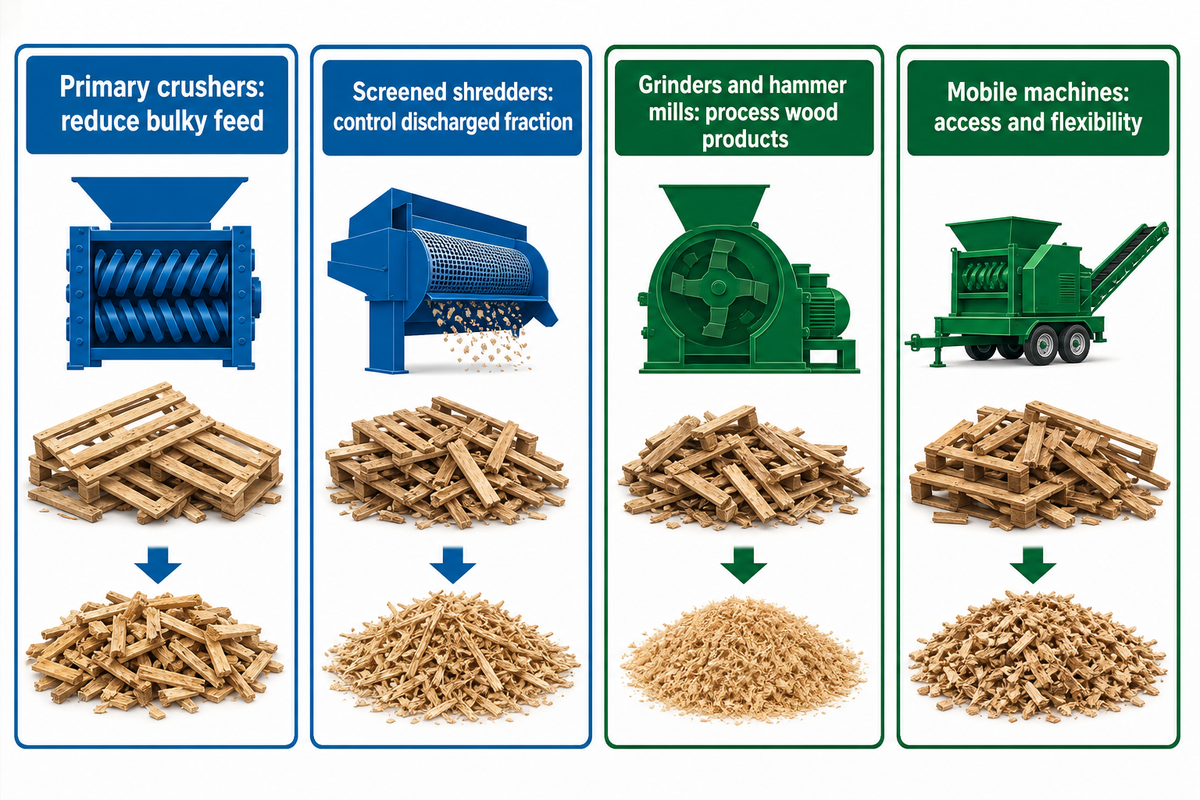
Use the Pallet Process Map to select a process group prior to requesting proposals. Primary crushers reduce bulky feed; screened shredders control the fraction discharged; grinders and hammer mills process different wood products. Mobile machines provide access and flexibility. Those categories overlap, so the representative machine and the next operation matter more than the brand label alone.
| No. | Company Name | Headquarters | Founded Year | Best For | Brief Introduction | Machine | Process Stage | Key Advantages | Potential Disadvantages | Official Website |
|---|---|---|---|---|---|---|---|---|---|---|
| 1 | TCPEL | Jinan, China | 2020 | Biomass-line preparation | Pallet crushing alongside pellet-production equipment | Chain-plate pallet crusher | Primary preparation | Hammer or blade tooling by feedstock | Further conditioning before pellet pressing | https://tcpel.net/ |
| 2 | UNTHA | Kuchl, Austria | 1970 | Compact screened processing | Dedicated stationary pallet shredder | PS1300 | Screened shredding | Nail-tolerant pallet reduction | Screen-specific capacity | https://www.untha.com/ |
| 3 | Cresswood | Cortland, Illinois, USA | 1963 roots | Stationary pallet scrap | Low-speed hopper-fed grinding equipment | XR700 | Screened grinding | Ram feed and service access | Fixed material-handling layout | https://cresswood.com/ |
| 4 | Franklin Miller | Livingston, New Jersey, USA | 1918 | Individual pallet loading | Direct-coupled pallet shredding equipment | TASKMASTER XL | Stationary shredding | Dedicated single-pallet hopper | Bulk loading needs engineered feed | https://franklinmiller.com/ |
| 5 | SSI Shredding Systems | Wilsonville, Oregon, USA | 1980 | Single-shaft pallet shredding | Industrial shredders with pallet demonstration | Uni-Shear SR500 | Size reduction | Documented wood-pallet application | Materials that contain minimal metal | https://www.ssiworld.com/ |
| 6 | WEIMA | Ilsfeld, Germany | 1980 | Bulk pre-breaking | Screw-type pallet pre-crusher | Woodwolf | Primary crushing | Whole-pallet hopper feeding | Secondary shredder for defined chips | https://weima.com/ |
| 7 | Vecoplan | Bad Marienberg, Germany | 1969 | Matched two-stage lines | Twin-rotor primary crushing system | VPC 1600 | Pre-shredding | Independent rotor reversal | Intermediate output requires sizing | https://vecoplan.com/ |
| 8 | HAAS | Dreisbach, Germany | 1989 | Bulky mixed waste wood | Independent-shaft primary shredder | TYRON stationary | Coarse primary shredding | Tool-dependent coarse fraction | Fine products need another stage | https://haas-recycling.de/ |
| 9 | Rotochopper | St. Martin, Minnesota, USA | 1990 | Grinding plus fine reduction | Horizontal grinders and connected processing options | EC-366 / B-66E / MP-2 | Grinding; optional secondary milling | Electric and diesel choices | Fine feed adds hammermill equipment | https://www.rotochopper.com/ |
| 10 | Schutte Hammermill | Buffalo, New York, USA | 1928 | Pallet hammer milling | Whole-pallet and scrap grinding models | HG Series | Hammer milling | HG56-35 accepts whole pallets | Smaller HG models target scrap boards | https://www.hammermills.com/ |
| 11 | Williams Patent Crusher | St. Louis, Missouri, USA | 1871 | Long pallet boards | Low-profile horizontal-feed wood hogs | Horizontal Feed Wood Hogs | Wood grinding | Long and oversized scrap intake | Feed width must match machine | https://www.williamscrusher.com/ |
| 12 | West Salem Machinery | Salem, Oregon, USA | 1947 | Integrated electric grinding | Wood and biomass processing machinery | 4864 / horizontal grinders | Pallet and wood-waste grinding | Configurable feed and screens | Line accessories require explicit scope | https://westsalem.com/ |
| 13 | Komptech | Frohnleiten, Austria | 1992 | Adaptable mobile processing | Convertible waste-wood shredding and chipping platform | Axtor 4510 / 6210 | Mobile size reduction | Tool and screen configurations | Chipping and waste-wood setups differ | https://www.komptech.com/ |
| 14 | ARJES | Merkers, Germany | 2007 | Compact mobile reduction | Two-shaft wood recycling shredders | COMPAKTOR 300 | Primary shredding | Mobile format; magnetic separation | Coarse output before fine sizing | https://www.arjes.de/ |
| 15 | Lindner | Spittal an der Drau, Austria | 1948 | Bulky mobile wood processing | Slow-speed mobile twin-shaft shredders | Urraco 75 | Primary volume reduction | Tracked and hook-lift formats | Further sizing for fine biomass products | https://www.lindner.com/ |
The table distinguishes what one machine in a system can do from what the remaining machines in the system may still be able to do. For example, a large hopper can receive bulky pallets, but it can’t determine the final chip size. A magnet removes ferrous material from the product stream; however, it can’t upgrade an ungraded wood fraction to a marketable product. Read the profiles with the intended outlet in mind.
Stationary Pallet Shredders and Integrated Biomass Systems
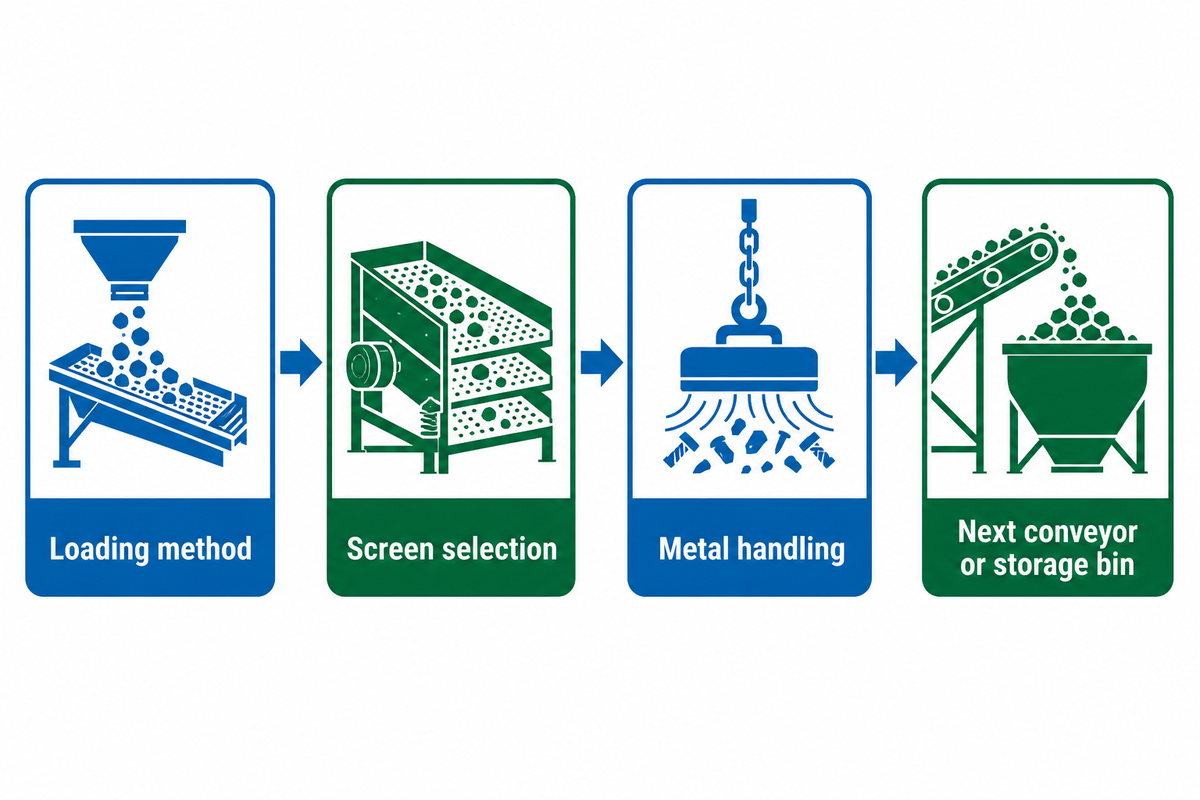
If your site has a repeatable pallet collection and discharge location, look at the five manufacturers below that cover different steps of that process, from a dedicated single-pallet hopper to larger feed systems. Start with how operators will load the machine, then work through screen selection, metal handling and the next conveyor or storage bin.
1. TCPEL: Best for integrated pallet-to-biomass preparation
Headquarters: Jinan, Shandong, China · Founded: 2020 · Company type: biomass equipment manufacturer and supplier.
Official website: https://tcpel.net/
Main products: chain-plate pallet crushers and associated biomass preparation equipment.
Notable capability: TCPEL describes selectable hammer and blade heads with a stated 2–10 cm output range. Its pallet page lists a CE Declaration of Conformity among the export documents.
According to the TCPEL company profile, the business is ALLWIN INTERNATIONAL CO., LTD, based in Jinan. The pallet-crusher offer is useful when the purchasing discussion includes both front-end wood reduction and the equipment that follows it. Hammer tooling is presented for nailed pallets; H12 blade tooling is presented for clean wood, making feedstock identification part of the machine choice.
Procurement limitation: the stated centimetre-scale output is preparation material, so a pellet project still needs the appropriate fine grinding and moisture conditioning before pressing. Treat the crusher and the finished-pellet line as connected purchases with separate output requirements.
2. UNTHA: Best for compact screened pallet shredding
Headquarters: Kuchl, Austria · Founded: 1970 · Company type: industrial shredder manufacturer.
Official website: https://www.untha.com/
Main products: PS1300 wood-pallet shredder and other industrial shredding systems.
Notable capability: UNTHA lists 30 pallets per hour with a 30 mm screen for the PS1300. In a November 2022 announcement, UNTHA UK reported ISO 9001, ISO 14001 and ISO 45001 recertification for its UK business.
The PS1300 gives buyers a focused starting point when they need a dedicated stationary machine for pallet scrap. UNTHA describes a compact unit that accepts pallets containing nails and screws, with ferrous separation handled through the discharge arrangement. A published figure tied to a specific screen is more useful for planning than an unqualified maximum capacity, because changing the discharged fraction changes the cutting work.
Procurement limitation: that pallet-per-hour figure belongs to the stated screen configuration. It shouldn’t be converted into a mass rate without the actual pallet weights and the proposed feed mix.
3. Cresswood: Best for low-speed, hopper-fed pallet scrap grinding
Operating base: Cortland, Illinois, USA · Founded: company roots in 1963 · Company type: low-speed grinder manufacturer.
Official website: https://cresswood.com/
Main products: XR700 hopper-fed wood grinder and other low-speed wood processing equipment.
Notable capability: the XR700 page lists 125, 150 or 200 hp, a 70 × 69 inch cutting chamber and a grinding head speed of 90–125 rpm.
Cresswood identifies pallets, pallet scraps, blocks and end cuts among this model’s applications. The large chamber, ram system and sectional screens make it a candidate for a fixed wood-waste collection point receiving irregular pieces. Its history traces back to Dun-Rite in 1963, with grinder development arriving later; the date describes the business roots rather than this machine’s age.
Procurement limitation: the installation needs a material-handling layout around a stationary hopper-fed machine. Feeding, access for service and removal of the ground wood belong in that layout, rather than being left as unpriced site work.
4. Franklin Miller: Best for direct individual-pallet loading
Operating base: Livingston, New Jersey, USA · Founded: 1918 · Company type: industrial size-reduction equipment manufacturer.
Official website: https://franklinmiller.com/
Main products: TASKMASTER XL pallet shredder, alongside other industrial shredders and grinders.
Notable capability: the TASKMASTER XL is presented for wood pallets containing nails, with a standard single-pallet hopper, stand and controls.
A defined single-pallet loading arrangement gives the buyer a concrete operating workflow to examine. Franklin Miller describes direct-coupled gearing and a machine intended to break pallets without first dismantling them into boards. That makes the offer relevant where operators handle pallets individually and want to remove a separate manual breakdown step from the routine.
Procurement limitation: receiving pallets in bulk is a different feeding requirement from the standard hopper. An engineered bulk-feed arrangement should be part of the equipment proposal when the site’s collection method can’t support individual loading.
5. SSI Shredding Systems: Best for a single-shaft pallet-shredding shortlist
Operating base: Wilsonville, Oregon, USA · Founded: 1980 · Company type: industrial shredder manufacturer.
Official website: https://www.ssiworld.com/
Main products: Uni-Shear single-shaft shredders and other industrial shredding platforms.
Notable capability: SSI’s official wood-pallet demonstration identifies the Uni-Shear SR500 and places it within its single-shaft shredder range.
SSI is therefore a useful comparison point for a buyer considering how a single-shaft machine receives and reduces pallet wood. The SR500 uses a pressure-sensing ram and replaceable, reversible cutters. Keep the discussion anchored to the demonstrated machine and the supplier’s proposed configuration, especially when an alternative SSI platform has a different number of shafts or a different discharge arrangement.
Procurement limitation: Actual pallet construction, loading pattern and required output still need to be represented in the proposed application test. SSI specifies materials that contain minimal metal for the SR500, so the proposed feed must address pallet fasteners.
Primary Pallet Crushers for Two-Stage Lines
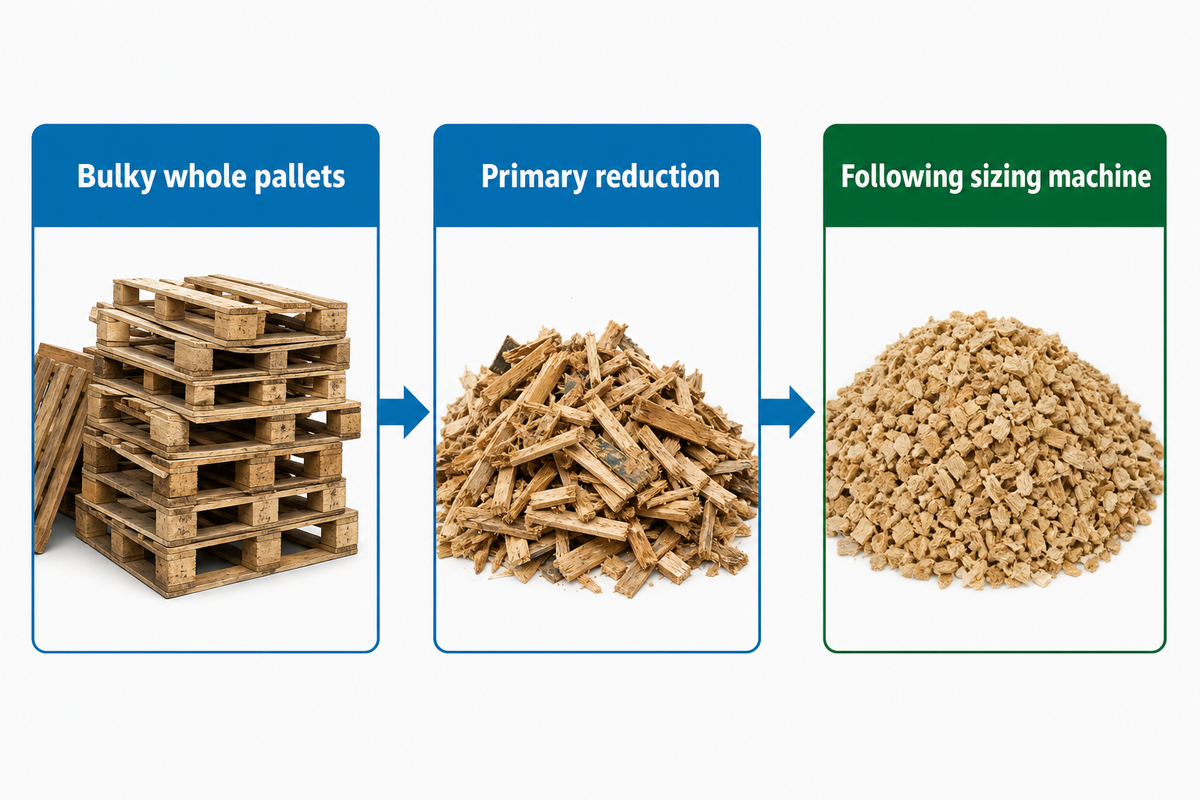
Primary pallet crushers are a strong option when bulky whole pallets are the bottleneck at the front of a recycling line. Their job is to reduce the feed into pieces that another machine can handle. WEIMA, Vecoplan and HAAS illustrate three different approaches, so compare their receiving and discharge arrangements before comparing their installed power.
6. WEIMA: Best for whole-pallet pre-breaking ahead of fine shredding
Headquarters: Ilsfeld, Germany · Founded: 1980 · Company type: industrial shredder manufacturer.
Official website: https://weima.com/
Main products: Woodwolf pallet pre-crusher and secondary wood shredders.
Notable capability: WEIMA describes one horizontal 1000 mm screw in the Woodwolf, which breaks pallets into pieces before secondary shredding.
The Woodwolf addresses the shape and bulk of incoming pallets rather than promising a finished fine fraction. Its hopper accepts multiple pallets, and the screw pulls material into the breaking zone. This arrangement makes sense when a plant wants to automate the transition from bulky collection material to a more manageable feed for a downstream machine. The manufacturer also describes downstream metal separation within the processing arrangement.
Procurement limitation: pre-breaking is only the first size-reduction stage. A buyer needing defined chips must include the secondary shredder and the transfer between the two machines in the project scope.
7. Vecoplan: Best for a matched pallet pre-crusher and secondary shredder
Headquarters: Bad Marienberg, Germany · Founded: 1969 · Company type: industrial shredding equipment manufacturer.
Official website: https://vecoplan.com/
Main products: VPC pallet crusher and VHZ wood shredders.
Notable capability: the VPC 1600 uses twin primary-crushing rotors with 2 × 9.2 kW drives. An undated Vecoplan corporate brochure states EN ISO 9001 certification.
Vecoplan presents the VPC as a pre-shredding machine that can be combined with a VHZ 1600. Independently reversible rotors give the primary machine a distinct operating arrangement from WEIMA’s single screw. For a buyer considering an integrated two-stage installation, the important feature is the defined relationship between pre-crushing and the next cutting stage, rather than a comparison of the first machine’s motor rating alone.
Procurement limitation: VPC discharge is an intermediate material stream. The secondary shredder determines the next sizing operation, and its power and material handling must be counted separately in the complete line.
8. HAAS: Best for coarse primary reduction of bulky waste wood
Headquarters: Dreisbach, Germany · Founded: 1989 · Company type: recycling machinery manufacturer.
Official website: https://haas-recycling.de/
Main products: TYRON stationary shredders and other recycling equipment.
Notable capability: HAAS describes two independently driven shafts and a tool-dependent output range of 150–500 mm for the stationary TYRON family.
The published application includes pallets within a broader wood-recycling duty. Its process role is opening up bulky material and preparing a coarse fraction, which makes the TYRON relevant when incoming waste wood is varied and pallet reduction is part of a larger primary-shredding operation. Independent shafts and tool choices are the useful comparison points for that job; the resulting material must still suit the next conveyor, separator or sizing machine.
Procurement limitation: this coarse primary output isn’t direct pellet-mill feed. A biomass project must provide the following reduction stage rather than treating primary throughput as finished-product capacity.
Hammer Mills and Horizontal Pallet Grinders
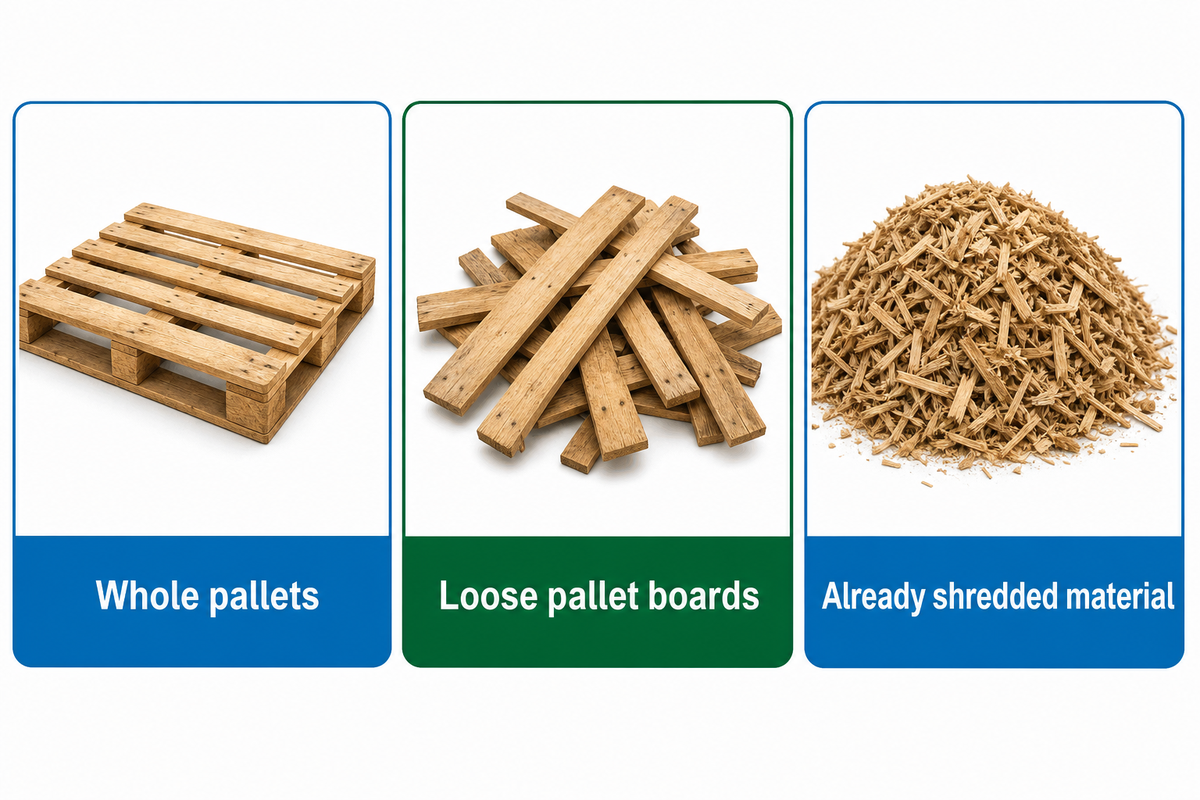
Grinders and hammer mills enter the shortlist when buyers need wood fiber, fuel preparation, mulch or another specified wood product. Rotochopper, Schutte Hammermill, Williams and West Salem Machinery have relevant pallet applications, but their feed arrangements differ. Whole pallets, loose pallet boards and already shredded material should be treated as separate incoming streams when choosing a model.
9. Rotochopper: Best for pallet grinding followed by secondary hammer milling
Headquarters: St. Martin, Minnesota, USA · Founded: 1990 · Company type: horizontal grinder and recycling-system manufacturer.
Official website: https://www.rotochopper.com/
Main products: EC-366, B-66E and MP-2 grinders, with RMT hammermill options.
Notable capability: Rotochopper’s pallet-processing page describes a grinder, magnet and RMT inline hammermill sequence, alongside electric and diesel equipment choices.
That sequence gives buyers a clear way to separate coarse grinding from further fiber preparation. A plant making mulch can examine screening and coloring options, while a biomass project can examine what the hammermill adds after the initial grinding and ferrous separation. These are different product routes built around related feed material, rather than one universal finished output from the grinder.
Procurement limitation: fine feed adds another machine and its associated transfer and collection equipment. The initial grinder price alone doesn’t describe the cost or installed power of the complete fine-grinding route.
10. Schutte Hammermill: Best for model-specific pallet hammer milling
Operating base: Buffalo, New York, USA · Founded: 1928 · Company type: hammer mill manufacturer.
Official website: https://www.hammermills.com/
Main products: HG Series pallet scrap grinding hammer mills.
Notable capability: Schutte identifies the HG56-35 for whole pallets, while the HG42-35 and HG30-35 address pallet scrap and boards.
The distinction matters to a yard deciding whether it will feed intact pallets or collect offcuts from a repair operation. A hammer mill advertised for pallet scrap isn’t automatically sized to receive a complete pallet. Schutte’s family therefore offers a useful model-level comparison: the receiving opening, the incoming piece dimensions and the target fraction should all be considered together before selecting the smaller or larger unit.
Procurement limitation: whole-pallet handling belongs to the designated whole-pallet model. Selecting a smaller HG machine requires an incoming material stream that matches its scrap-processing role.
11. Williams Patent Crusher: Best for long pallet boards and horizontal feeding
Headquarters: St. Louis, Missouri, USA · Founded: 1871 · Company type: crushing and pulverizing machinery manufacturer.
Official website: https://www.williamscrusher.com/
Main products: Horizontal Feed Wood Hogs and other forest-products size-reduction equipment.
Notable capability: Williams identifies pallets, flooring and long oversized wood scrap among the applications for its horizontal-feed wood hogs.
A low-profile receiving arrangement can be useful where the existing material flow already moves long boards along a conveyor. Rather than arranging a loading operation around a deep receiving hopper, the buyer can examine how the feed equipment presents those pieces to the hog. Williams describes a matching vibrating feeder, making the interface between the incoming wood and the grinding machine part of the selection.
Procurement limitation: the feed system must match the selected hog width and incoming piece geometry. A long-board application shouldn’t be specified only by a desired mass throughput.
12. West Salem Machinery: Best for integrated electric wood-waste grinding
Operating base: Salem, Oregon, USA · Founded: 1947 · Company type: wood and biomass processing machinery manufacturer.
Official website: https://westsalem.com/
Main products: horizontal grinders, wood hogs, screens and material-handling equipment.
Notable capability: a West Salem Machinery case describes an all-electric 4864 installation processing wood waste into fuel, with sorting-belt or excavator batch loading.
WSM’s horizontal-grinder page explicitly includes pallet grinding and describes screen and feeding choices. This makes the offer relevant to a site that wants the grinder integrated with its receiving and discharge arrangements. The named installation also helps distinguish an electric stationary project from a mobile diesel operation.
Procurement limitation: screens, conveyors and metal-handling equipment need an explicit line-level scope. They affect what material reaches the grinder and what the plant can do with the discharged wood.
Mobile Waste-Wood Shredders
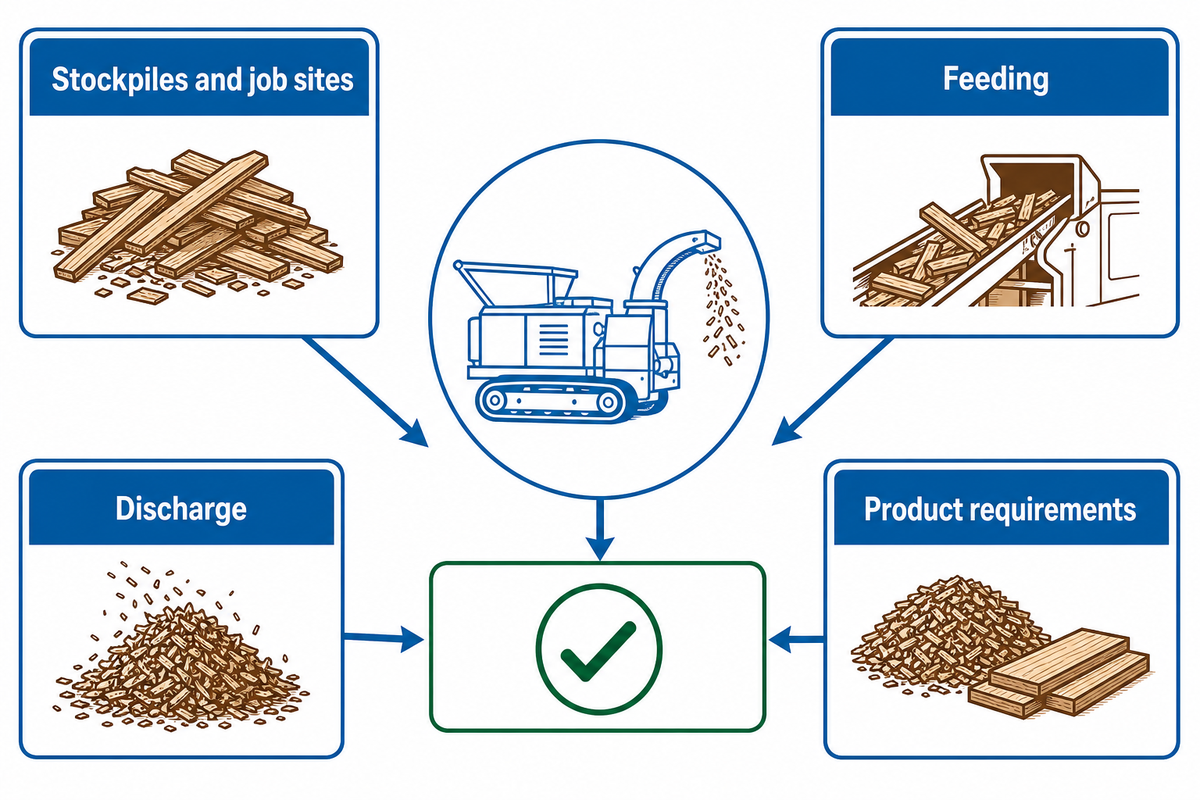
Mobile wood processing suits collection sites where material moves between stockpiles or where the machine must travel between jobs. Komptech, ARJES and Lindner offer different approaches to that work. Mobility is valuable only when the machine’s feeding, discharge and product requirements also match the site; a tracked chassis doesn’t replace the next sizing operation.
13. Komptech: Best for adaptable mobile waste-wood processing
Headquarters: Frohnleiten, Austria · Founded: 1992 · Company type: recycling equipment manufacturer.
Official website: https://www.komptech.com/
Main products: Axtor 4510 and 6210 mobile shredding and chipping machines.
Notable capability: Komptech’s 100th Axtor story describes a Japanese Ryokusan application that includes pallet wood. The current Axtor range offers configurable tools and screen baskets.
The Axtor is worth considering when a mobile operation needs to adapt its processing setup to different wood products. Komptech describes shredding and chipping configurations, so the tool arrangement is part of the purchasing decision rather than a minor accessory. The pallet case provides a relevant application reference for this platform, while the current product page identifies the available model range.
Procurement limitation: clean-wood chipping and waste-wood shredding are different operating setups. The quoted tool package must match the incoming pallet wood instead of assuming every Axtor configuration handles the same contamination.
14. ARJES: Best for compact mobile primary pallet reduction
Headquarters: Merkers, Germany · Founded: 2007 · Company type: mobile recycling shredder manufacturer.
Official website: https://www.arjes.de/
Main products: COMPAKTOR 300 and other two-shaft recycling shredders.
Notable capability: ARJES explicitly includes pallets in its wood-recycling application and describes magnetic separation for nails and screws.
The manufacturer positions the COMPAKTOR 300 toward smaller operations within its mobile range. That provides a useful starting point for yards that need primary wood reduction without organizing the whole project around a large fixed installation. Pallet wood is considered within a broader wood-recycling stream, making the incoming mixture and the required discharge fraction more useful selection criteria than mobility alone.
Procurement limitation: primary shredded wood still needs secondary processing when the outlet requires a fine fraction. Space and power for that following operation remain part of the project even if the first machine is mobile.
15. Lindner: Best for mobile volume reduction of bulky waste wood
Headquarters: Spittal an der Drau, Austria · Founded: 1948 · Company type: industrial recycling machinery manufacturer.
Official website: https://www.lindner.com/
Main products: Urraco mobile slow-speed twin-shaft shredders and other recycling machinery.
Notable capability: a 2016 Lindner case describes a Urraco 75 DK processing non-contaminated scrap wood, including pallets, for Canadian Nuclear Laboratories.
The application was wood-waste volume reduction for a material outlet described in that dated case. The present Urraco 75 range distinguishes mobile formats, including a tracked DK version and a hook-lift arrangement, giving buyers different ways to bring primary shredding to their material.
Procurement limitation: this primary reduction stage doesn’t by itself provide fine, consistently sized biomass feed. A more demanding product specification needs the appropriate follow-on sizing equipment.
How to Choose a Pallet Crusher Manufacturer
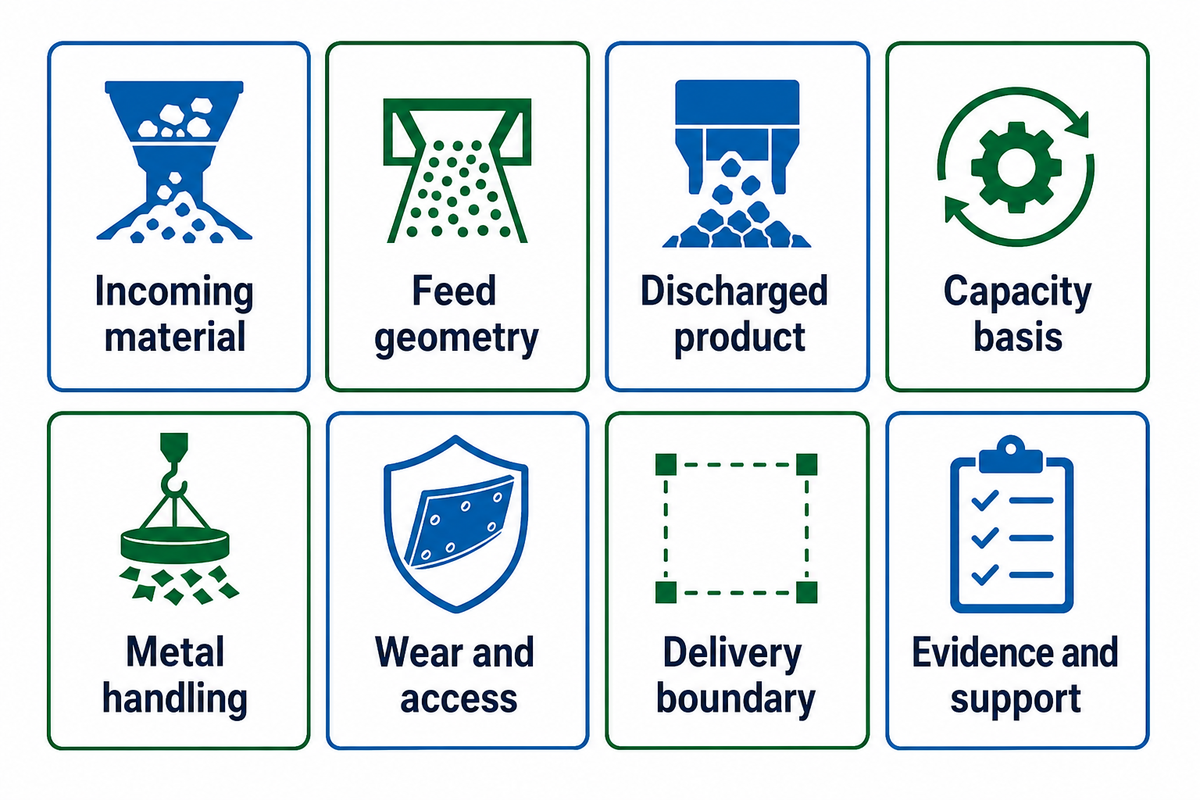
Choose a manufacturer by working backwards from the discharged product through the machines needed to make it. A useful proposal names the incoming pallet condition, the loading method, the sizing stage and the metal-removal arrangement. With that information, the purchasing and production folks can compare equivalent equipment duties rather than unmatched price offers.
What is the difference between a pallet pre-crusher, shredder and grinder?
A pallet pre-crusher reduces large pallets to an intermediate feed, while a shredder breaks them further by means of its cutting system. A grinder, with a specific rotor and sizing system, is used to size a wood fraction. System names tend to overlap between manufacturers. Understand the actual feed opening, the tools, the screen and the discharge path to understand what each proposed machine accomplishes.
WEIMA’s screw pre-crusher and Vecoplan’s twin-rotor VPC make the first distinction easy to see: both sit ahead of another sizing machine. Cresswood shows why the grinder label alone doesn’t establish high-speed operation. Rotochopper shows why grinding and hammer milling can remain separate stages. A diagram naming those stages is more useful than a catalogue heading that simply calls everything a wood shredder.
Determine the next destination for the shredded material. Fuel preparation, mulch production and finer biomass feed involve different acceptance criteria. A screen opening is only one of these. Long splinters, oversize material and recirculation can also affect the usable fraction. Rather than asking for a small chip, describe the actual product your next machine or customer will receive.
Machine design should follow that destination. A shredder for wooden pallets needs a receiving arrangement which is suited to bulky wood waste, while the discharged pieces should be usable for the following operation. Reducing pallets to manageable pieces can resolve a handling problem without completing the product making process.
A double shaft shredder and a single-shaft shredder can also have different feed and size arrangements. Compare the actual shredder design, and don’t assume the shaft count decides the purchase. Likewise, a wood chipper selected for clean feed should not be substituted for a nailed-pallet machine merely because both reduce wood.
Can a pallet shredder handle nails and feed a pellet line?
A correct pallet shredder can handle nailed wood if the manufacturer specifies that duty. However, nail tolerance doesn’t mean the output is metal-free or ready for a pellet press. The line also needs adequate separation, further particle-size reduction and moisture conditioning. Each unit of the line should be evaluated based on the material that it receives and sends out.
First, fasteners and other contamination should be differentiated. Nails and screws are part of a normal pallet stream for a number of machines listed in this document. Large metal attachments, unrelated refuse and plastic parts alter that stream. Sorting the incoming load helps to keep a defined wood processing duty separate from general solid waste handling. A wood-only proposal shouldn’t be transformed into a mixed industrial waste project.
Then, the separation point should be identified. A cutter that tolerates pallet nails protects the reduction operation’s ability to process that material; downstream separation addresses what remains in the wood. The acceptance discussion should include the discharged product after separation, rather than stopping at whether the rotor can survive a nailed pallet. Metal detection and magnetic separation serve different functions in a line.
For pellet production, connect the primary crusher’s output with the requirements of fine grinding and pressing. TCPEL’s pallet crusher for biomass preparation describes the front-end equipment, while our pellet production line comparison helps frame the larger equipment scope. The crusher’s centimetre-scale discharge shouldn’t be relabelled as a finished pellet-mill feed specification.
What should a complete pallet crusher quotation include?
A complete quotation should define the proposed machine and tools, receiving arrangement, screen or output specification, metal handling, discharge equipment, controls, installation responsibilities and initial wear parts. It should also define the feedstock and operating conditions under which any capacity claim is made. These determine whether competing proposals cover the same processing job.
Ask the supplier where its responsibility ends. For example, a grinder manufacturer may supply a machine, while a dealer or integrator designs the receiving and conveying system. Both can be acceptable arrangements, but a machine quotation doesn’t mean a turnkey quotation for a plant. The purchasing team must determine who owns layout coordination, controls interfaces and commissioning of connected equipment.
Electrical and mobile alternatives must be compared. A site electric machine brings site power, fixed foundations and material route into consideration. A mobile diesel machine brings relocation and loading arrangements into it. Neither arrangement has a universal operating-cost advantage, and without knowing the site energy costs, working pattern and required output, the proposal should explain its rationale rather than relying on a generic savings percentage.
Stationary processing
- Plan a repeatable receiving and discharge route.
- Match site power and the connected conveyors.
- Provide access for tools, screens and maintenance.
Mobile processing
- Plan relocation between the actual material stockpiles.
- Match loading equipment and discharge collection.
- Provide access for refuelling and maintenance.
Compare machine specifications across a common duty
Shredder manufacturers and suppliers must answer the same application description. A supplier who offers a shredder machine for a fixed yard may be addressing the application correctly. However, its material-handling boundary may be different from a supplier who offers a mobile machine. See how each proposal will shred wood and move the resulting fraction through the site.
In recycling plants, the purchasing function goes beyond waste reduction at the intake. Handling wood after the cutting stage is part of the routine work. A proposal should describe the discharged material route and cutting arrangement.
Some chipper shredders may be listed along with metal shredders and tire shredders, but a broad list isn’t the basis for evaluating this wood stream. A proposed machine for a clean feed has a different application boundary from a machine that receives nails. Keep the selected tools and accepted feed beside the quoted model.
For recycling operations, the useful measure is whether recyclable materials reach the intended outlet in a usable condition. A machine can reduce waste volume without generating the correct wood fraction. Explain that distinction when the objective is to reduce waste handling as well as supply a downstream process.
When comparing top shredder manufacturers, ask what their shredding technology changes in this particular line. Loading and access and product collection remain part of processing and recycling, even if the cutting system receives most of the attention. The proposal should connect the dots, instead of making many unconnected assumptions.
Compare these eight purchasing checks
- Incoming material: describe whole pallets, dismantled boards, blocks and mixed waste wood separately. Include the fasteners and other contamination the machine will actually encounter.
- Feed geometry: compare maximum piece dimensions with the hopper or conveyor arrangement. An opening that accepts a board doesn’t establish how the machine receives stacked pallets.
- Discharged product: specify the required fraction and its next use. Identify whether screening, recirculation or another reduction stage is included.
- Capacity basis: retain the proposed screen, feed condition and loading pattern beside every production figure. A full-range catalogue maximum can’t stand in for the selected model.
- Metal handling: distinguish nail-tolerant tooling from separation and detection equipment. State the product requirements after those operations.
- Wear and access: compare how tools and screens are changed, which wear parts are supplied initially and how routine service fits the site layout.
- Delivery boundary: name the party responsible for the machine, transfer equipment, electrical work, installation and commissioning. Avoid gaps between separate quotations.
- Evidence and support: request an application test using representative material, relevant customer references and documents for the quoted equipment. Check certificate holder, scope and validity rather than treating a regional company certificate as a machine approval.
A heavy duty machine is useful only when its construction and cutting arrangement match the work. High torque can assist in primary reduction, but it doesn’t set the saleable product specification. High throughput is equally incomplete without the feed and discharge conditions. For an assertion to be meaningful, a manufacturer has to give technical specifications for support.
Keep the final supplier discussion tied to the business outlet. Mulch, boiler fuel and animal bedding don’t have interchangeable material requirements. If the plant plans to make pellets, compare the pressing stage separately through the wood pellet machine manufacturer guide. Buying the correct front-end crusher is the beginning of that process, not a substitute for selecting the rest of it.
Frequently Asked Questions
Which pallet crusher manufacturers are best for stationary recycling?
UNTHA, Cresswood and Franklin Miller are useful stationary candidates for different feeding arrangements.
UNTHA’s PS1300 offers a compact dedicated pallet-shredding starting point. Cresswood’s XR700 suits a hopper-fed low-speed grinding discussion, while Franklin Miller’s TASKMASTER XL begins with an individual-pallet hopper. Compare how your operators collect and load the wood, then align the proposed discharge with the next machine. SSI is another relevant single-shaft candidate when its proposed configuration fits that same material flow.
Which manufacturers are best for two-stage pallet processing?
WEIMA and Vecoplan are clear candidates for pallet pre-crushing followed by secondary shredding.
WEIMA’s Woodwolf uses a screw to break whole pallets before a following machine reduces them further. Vecoplan presents its VPC with a matched VHZ secondary-shredder option. HAAS also belongs in a coarse primary-reduction discussion for broader wood-waste duties. Compare the combined line, including the transfer and sizing stage, instead of judging the first machine’s output as the final product.
Can one pallet crusher produce finished pellet-mill feed?
A primary pallet crusher should be specified as one preparation stage in a pellet-production line.
Whole-pallet reduction doesn’t automatically establish the particle size, moisture condition or metal content needed by a pellet press. Rotochopper’s grinder-to-RMT arrangement illustrates why further milling can be a separate operation. TCPEL likewise presents its crusher within a broader biomass route. Match each discharge to the next machine, with the final feed requirement set by the proposed pellet process.
Is a wooden-pallet shredder the same as a plastic-pallet shredder?
Wood and plastic pallets require separate application checks, even when a supplier offers both.
The feed material changes the tooling, sizing and product-handling discussion. A wood-pallet application doesn’t establish suitability for every polymer pallet, and a plastic-recycling machine isn’t automatically configured for nailed wood. Describe the actual material stream in the enquiry.
How should buyers compare pallet crusher prices?
Compare quotations for the same feedstock, output and supply boundary before comparing their totals.
Separate the machine price from conveyors, magnets, screens, controls, installation and the next reduction stage. Include initial wear parts and the responsibilities for commissioning. A basic primary crusher and a complete screened processing line are different purchases, so a shared price range would hide more than it explains. For a fair comparison, issue the same material description and discharged-product requirement to every shortlisted manufacturer, and ask each to identify exclusions. That creates a usable commercial comparison without inventing a universal market price.
Who is the largest pallet crusher manufacturer?
This shortlist groups relevant manufacturers by process fit rather than company size.
For pre-crushing, start with WEIMA and Vecoplan; for stationary pallet shredding, compare UNTHA and the other dedicated candidates; for grinding, examine Rotochopper, Schutte, Williams and WSM. Select the equipment category that matches your product before comparing individual suppliers.
For smaller pressing projects, the flat-die pellet mill comparison covers a separate equipment choice after material preparation.
Choose the Output Before the Supplier
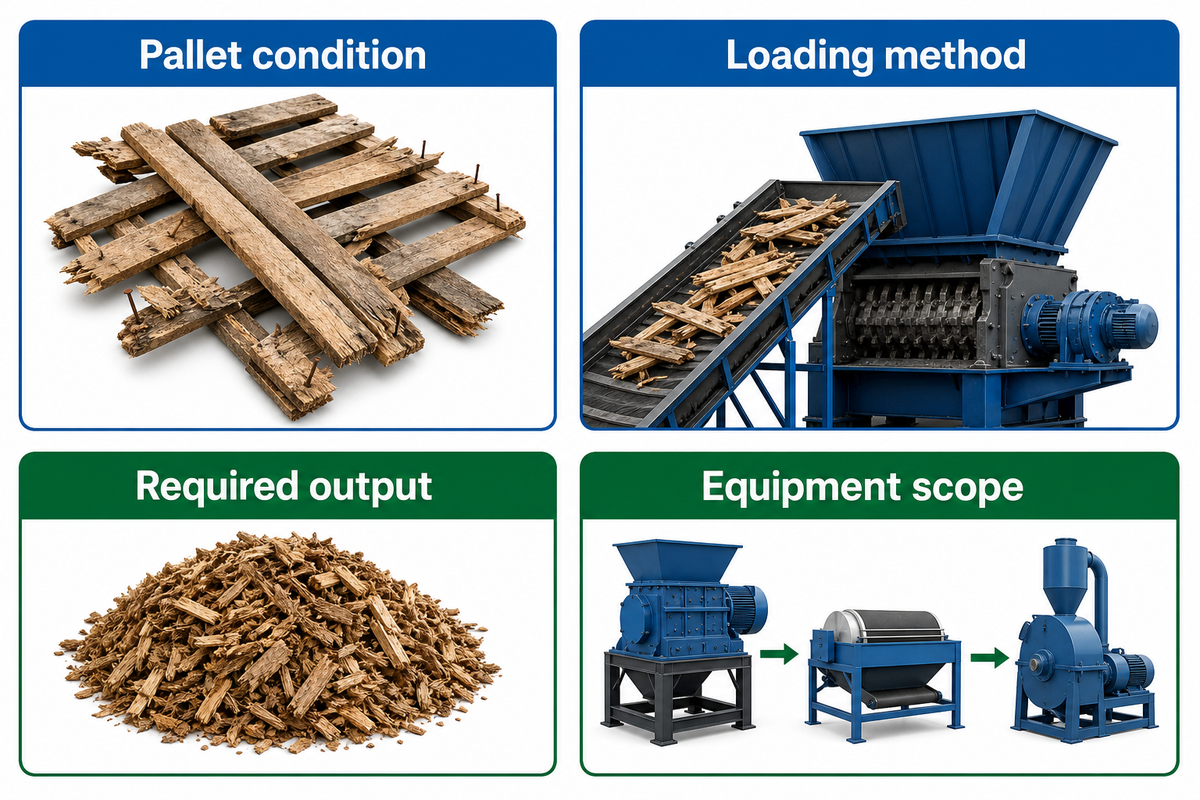
At TCPEL, we can discuss pallet crushing as part of biomass preparation, including the connection to the following processing stages described in our pallet-processing equipment overview. Send the pallet condition, loading method and required output with your enquiry. Those details help us propose the equipment scope rather than quote a machine around an undefined capacity target.
Key takeaway
Choose the required wood product first. Then compare the pallet crusher, separation equipment and secondary processing needed to make that product.
Discuss your pallet-processing requirements
Tell us what enters the line and what needs to leave it. We’ll use that material description to discuss a suitable preparation route.
References & Sources
Company histories, product specifications and application descriptions come from the manufacturers’ official pages, checked in October 2026. The official website is shown in each profile. Model highlights are manufacturer statements; the dated Lindner case and regional UNTHA UK quality statement retain their stated scope.