Get in Touch with TCPEL

Last updated: October 2026 · By: GW
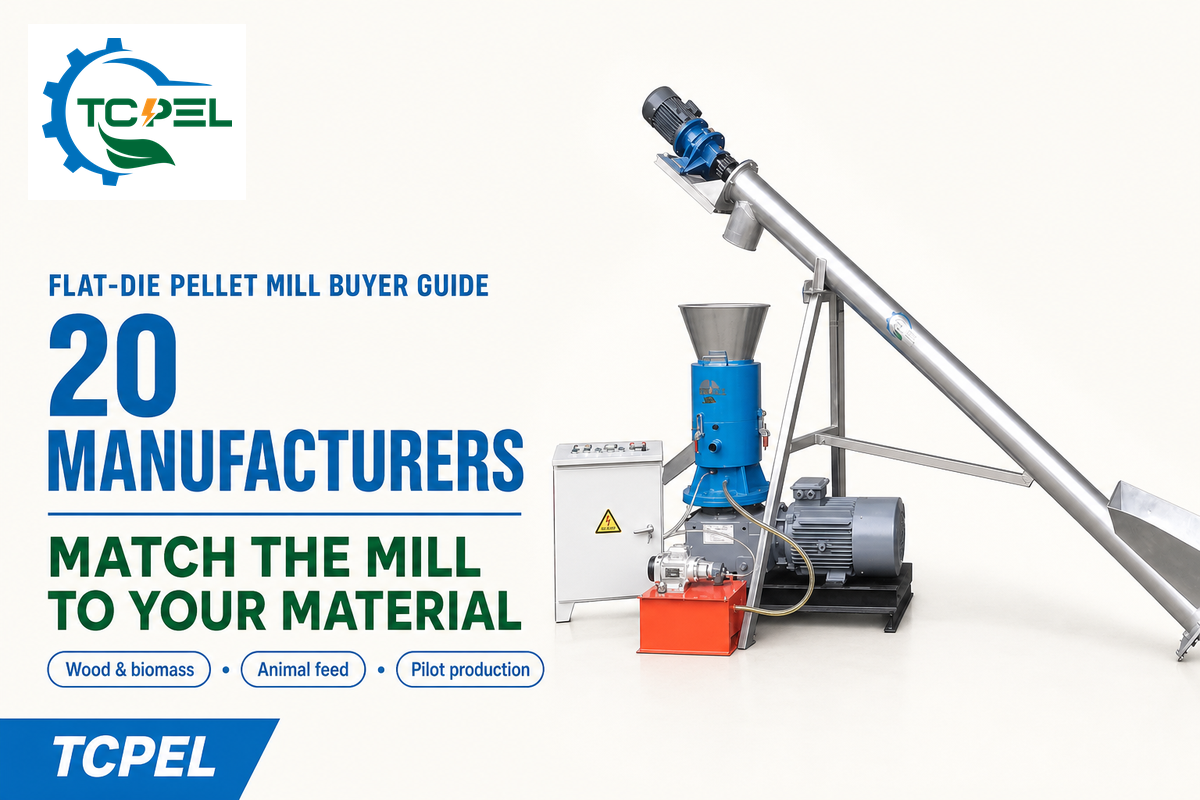
Top flat die pellet mill manufacturers include AMANDUS KAHL for industrial plants, Buskirk for modular US biomass systems, CME for non-wood pilot production, and GEMCO for small mills with several drive choices. TCPEL offers packaged sawdust-pelleting equipment, while European and Chinese specialists provide further choices for farm feed and compact wood-pellet production.
A flat die pellet mill can be a small farm press or a component of an industrial biomass plant. The best place to start a comparison is with the material: a fast feed-pellet rating isn’t a wood-pellet rating, and the largest machine in a manufacturer’s catalog may use a different die design. Start with the shortlist for your application, then compare specific models and equipment packages. The range of pellet mills below covers farm feed, renewable energy feedstocks and pilot work. Each application requires a specific model choice.
Quick Picks
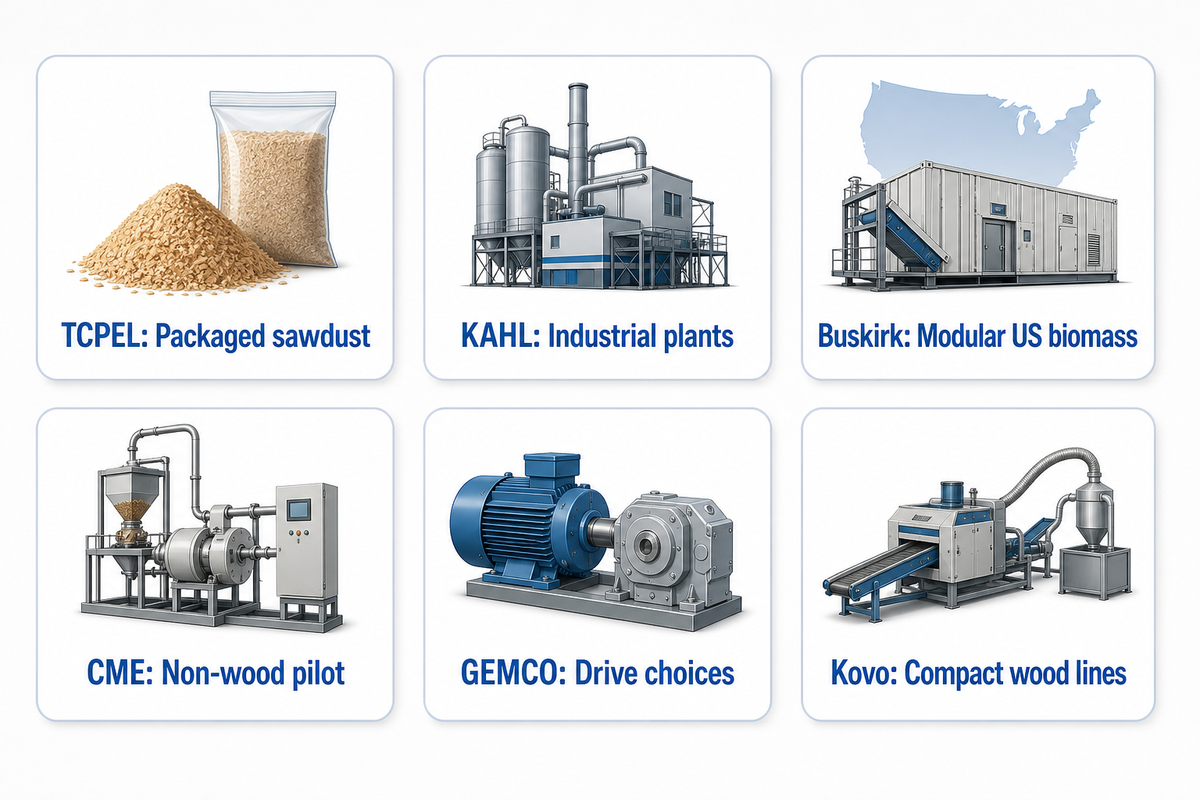
- Best for packaged small-commercial sawdust production: TCPEL, with TCZL mills and a published feeder, controls and lubrication package.
- Best for industrial flat-die plant engineering: AMANDUS KAHL, with a broad machine family and complete process systems.
- Best for modular US biomass production: Buskirk Engineering, with geared PM1850 mills and expandable arrangements.
- Best for non-wood pilot production in the USA: Colorado Mill Equipment, with the compact MILL-10.
- Best for comparing small-mill drive options: GEMCO, with electric, diesel, PTO and gasoline choices.
- Best for compact European wood-pellet lines: Kovo Novák, with MGL presses, feeding and mixing equipment.
Disclosure: This guide is published by TCPEL. We list ourselves first because this is our website, not because we claim to be the market leader. The other 19 manufacturers are grouped by what they’re best for, in no particular order within each group.
How We Selected These Manufacturers
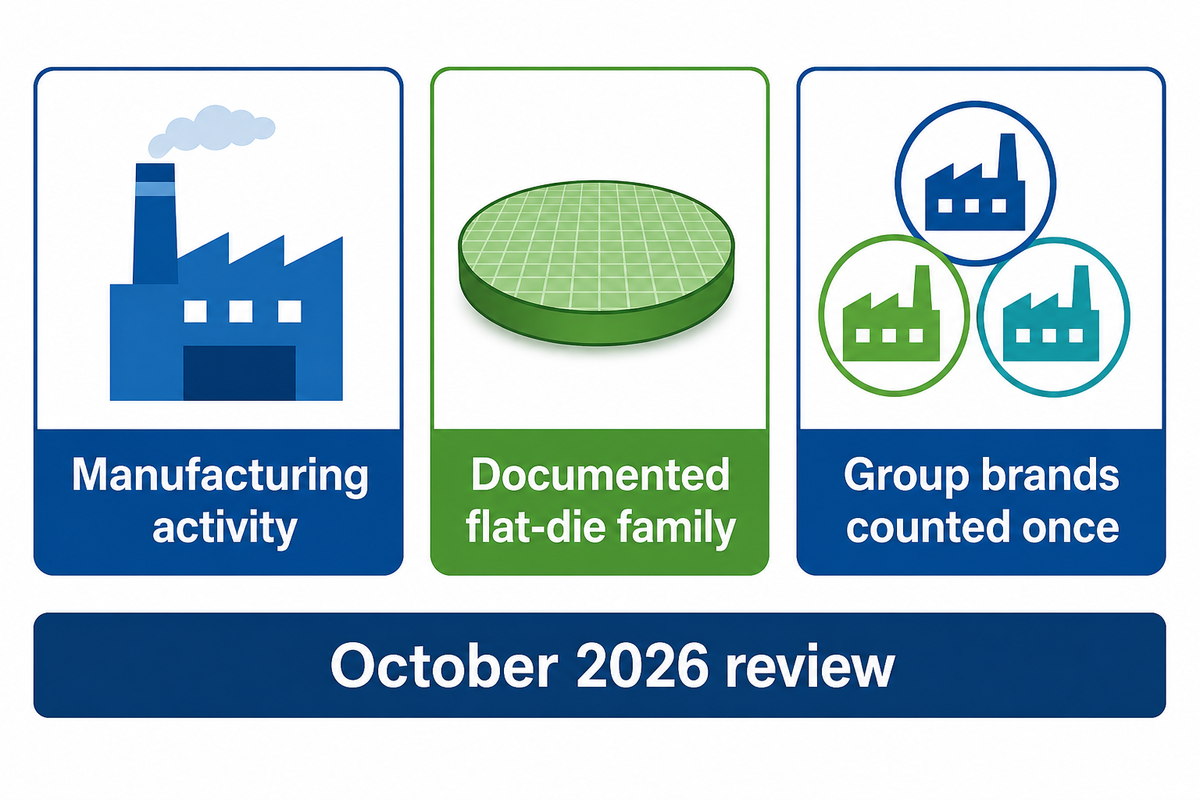
We selected companies with identifiable manufacturing activity and a documented family of flat-die machines for wood, biomass, feed or pilot production. Company data was confirmed against official company websites and public sources in October 2026, while product and corporate data were checked separately. Trading-only companies were excluded, as well as distributors, sourcing platforms, directories, media websites, used equipment dealers; a manufacturer that also exports or sells complete lines remains eligible. Brands within the same group are counted as one. Numbers are for navigation and not a performance league table or an exhaustive industry census.
Flat Die Pellet Mill Manufacturers Compared
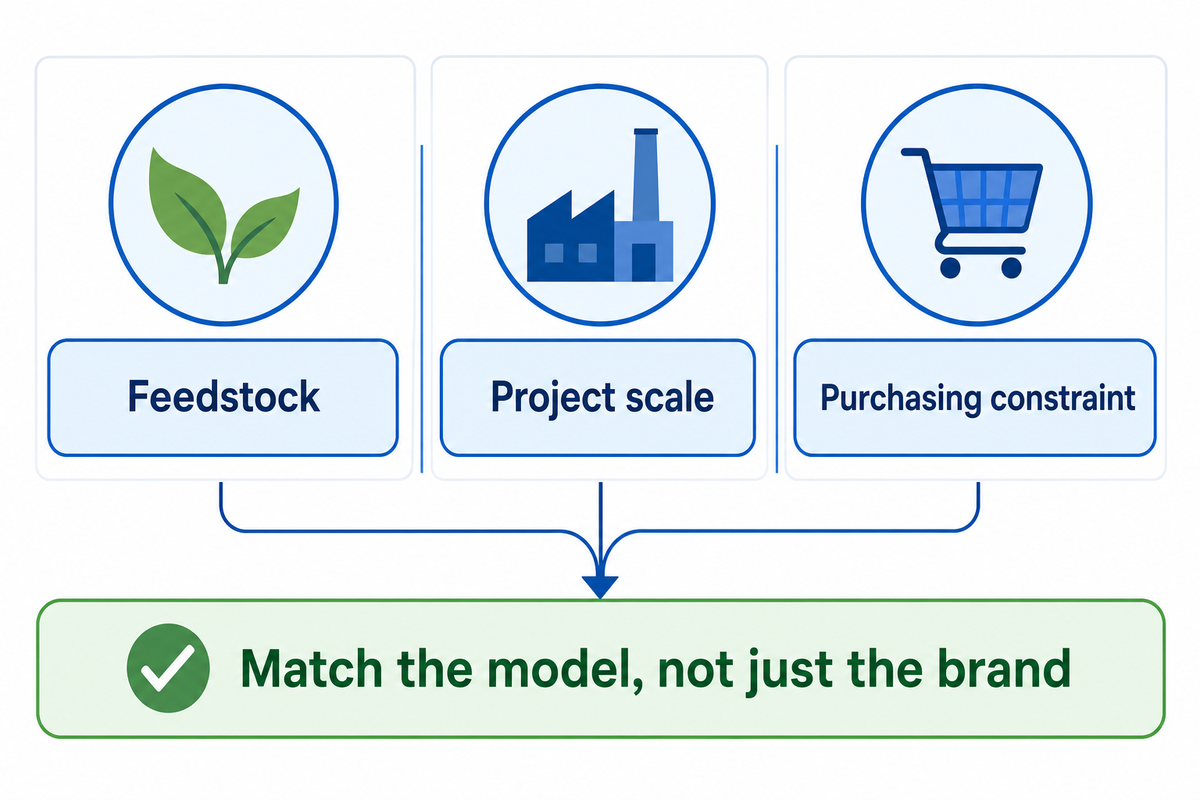
Flat-Die Manufacturer and Material-Fit Map
The Flat-Die Manufacturer and Material-Fit Map provides a match of a documented flat-die machine family to a feedstock, project scale and purchasing constraint.
Use the comparison to reduce the candidate suppliers before undertaking individual quotes. Capacities in the profiles are published examples for the stated material by the manufacturer and aren’t the result of a direct comparison test. Founded years are the years of the company or operating history as published; in cases where the current legal entity is newer, the profile describes the difference. Scroll to the right to view all columns in the comparison.
| No. | Company Name | Headquarters | Founded Year | Best For | Brief Introduction | Flat-Die Product Family | Key Advantages | Potential Disadvantages | Official Website |
|---|---|---|---|---|---|---|---|---|---|
| 1 | TCPEL | Jinan, Shandong, China | 2020 | wood pellet projects needing packaged equipment | Packaged sawdust equipment | TCZL biomass presses | Feeder and controls in listed package | Softwood and moisture basis | https://tcpel.net/ |
| 2 | AMANDUS KAHL | Reinbek, Germany | 1876 | industrial flat-die plants and diverse materials | Industrial process engineering | Flat-die industrial family | Broad drive and die range | Plant engineering required | https://www.akahl.com/ |
| 3 | Buskirk Engineering | Ossian, Indiana, USA | Not publicly disclosed | modular US biomass pelleting | US modular manufacturing | PM1850; Tri-Mill | Gearmotor and modular expansion | Three-phase supply | https://buskirkeng.com/ |
| 4 | Nawrocki / miniPelleter | Żnin, Poland | 2001 (manufacturing) | compact European biomass systems with matched dies | Polish compact pellet systems | miniPelleter | Material-matched dies; local parts | Prepared dry feedstock | https://www.minipelleter.com/ |
| 5 | Kovo Novák | Citonice, Czech Republic | 1990 (registered) | compact Czech pellet lines with metered feeding | Czech mills and compact lines | BONSAI; MGL | Metered hopper and mixing chamber | Specified wood preparation | https://www.kovonovak.com/ |
| 6 | GEMCO / ABC Machinery | Anyang, China | 1997 (GEMCO) | buyers comparing electric, diesel, PTO and gasoline drives | ABC biomass equipment division | D-type; R-type | Four drive choices | Application-specific configuration | https://www.gemco-energy.com/ |
| 7 | Yulong | Jinan, Shandong, China | 2007 | separate feed and fibrous-material mill selection | Feed and biomass machinery | SKJ2 | Separate feed and fiber ratings | Lower fiber throughput | https://www.yulong.cc/ |
| 8 | Fanda | Zhengzhou, China | 2009 | compact electric wood-pellet production | Compact electric wood equipment | KL electric series | Wood-specific capacity table | Compact range ceiling | https://www.fandapelletmill.com/ |
| 9 | TechnoMaszBud | Słupno, Poland | 2013 (operations) | compact biomass production with variable-speed feeding | Polish pellet equipment business | PRIME; PELLETNIK | Converter and gearbox warranty | Power cable extra | https://technomaszbud.pl/ |
| 10 | Leabon | Zhengzhou, China | 2011 | tractor-driven small wood-pellet equipment | Manufacturer and exporter | PM PTO series | Tractor-driven configurations | Tractor required | https://www.zzleabon.com/ |
| 11 | MIKIM | Anyang, Henan, China; registered in Tianjin | 2014 | small mills with separately stated wood and feed ratings | Small pellet equipment maker | 120–400 flat-die family | Distinct wood and feed ratings | Feed figures exceed wood | https://www.woodpellets-machine.com/ |
| 12 | Azeus | Zhengzhou, China | 2012 (Goodada) | entry-level electric wood-pellet trials | Wood mills and line integration | AZSPLM electric | Small single-phase entry model | Larger models three-phase | https://www.azeuspelletmill.com/ |
| 13 | Sunwit | Zhengzhou, China | Not publicly disclosed | farms comparing feed and wood duties | Farm feed and biomass equipment | SWSP | Side-by-side material capacities | 380 V, 50 Hz stock | https://www.feed-pelletmachines.com/ |
| 14 | Colorado Mill Equipment | Cañon City, Colorado, USA | 2008 | US pilot-scale non-wood pelleting | US pilot and production equipment | MILL-10 | Compact formulation trials | Not for wood | https://coloradomillequipment.com/ |
| 15 | Fusmar | Zhengzhou, China | 2017 | small poultry farms making their own feed | Farm feed machinery | Fus-PLM | Electric and diesel selection | Feed-based output rating | https://www.feedpelletmills.com/ |
| 16 | Lima | Zhengzhou, China | 2006 | small complete animal-feed lines | Integrated farm feed equipment | Flat-die farm line | Grinding through cooling scope | Larger lines use ring die | https://www.limafeedmachines.com/ |
| 17 | TONY | Jinan, Shandong, China | 2013 | small feed presses with wider ancillary equipment | Pellet mills and auxiliary machines | SKJ105–250 | Small motor and output steps | Compact feed range only | https://en.tonyjixie.com/ |
| 18 | Artmash | Zhmerynka, Ukraine | 2005 (operations) | custom farm-feed lines and hardened wearing parts | Closed-cycle farm machinery maker | Fixed-die granulators | Hardened dies and rollers | Made-to-order lead time | https://www.artmashagro.com/ |
| 19 | Shuliy | Zhengzhou, China | 2011 | compact farm-feed presses with electric or diesel drives | Agricultural processing machinery | SL-F feed series | Electric and diesel drives | Three-phase electric example | https://www.shuliy.com/ |
| 20 | Victor | Xingyang, Zhengzhou, China | 2012 (operations) | livestock farms needing a choice of power source | Livestock feed equipment maker | VTKLP | Four power-source choices | Drive-specific specifications | https://www.pelletizermill.com/ |
Industrial Flat Die Mills and Engineered Pellet Lines
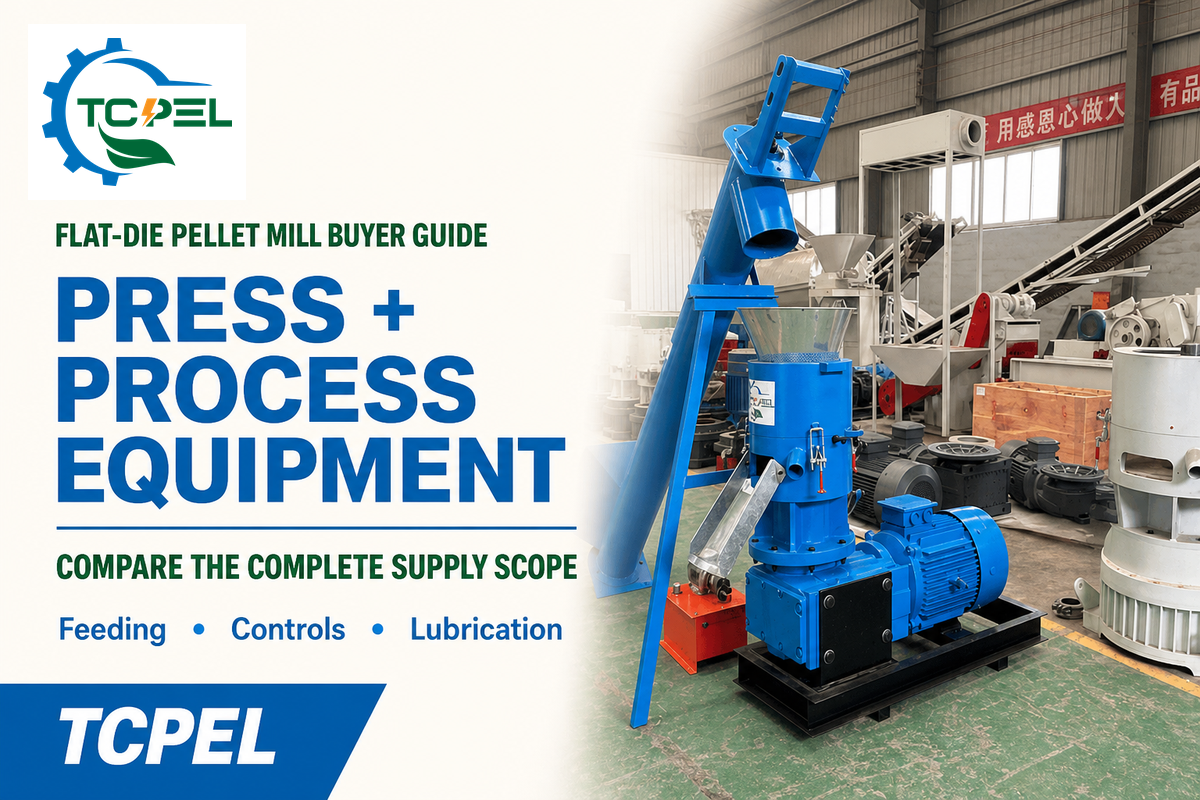
Industrial and integrated suppliers offer more than a compact press. KAHL covers a broad process-equipment family, while Buskirk, Nawrocki and Kovo connect flat-die pelleting with material handling or line design. TCPEL’s packaged TCZL offering fits smaller commercial sawdust projects. The right shortlist follows the size of the project and the preparation equipment already on site.
1. TCPEL: Best for wood pellet projects needing packaged equipment
Headquarters: Jinan, Shandong, China · Founded: 2020 · Type: Biomass machinery manufacturer operating under ALLWIN INTERNATIONAL CO., LTD.
Official website: https://tcpel.net/
Main products: TCZL flat-die pellet mills and biomass processing equipment.
Published specifications: TCZL350: 30 kW, 300–400 kg/h; TCZL400: 37 kW, 400–500 kg/h, on specified softwood sawdust.
Quality / certification: NOWD sample-based Verification of Compliance NTS2307072S names ALLWIN as manufacturer and TCPEL as trademark; includes TCZL200–550 models.
TCPEL combines a flat-die press with the equipment around it, which is useful when a sawmill needs more than a stand-alone pellet machine sitting beside a pile of residue. The TCZL350 and TCZL400 occupy a practical small-commercial wood-pellet range, while the larger listed TCZL models extend the same family without turning a feed capacity into a sawdust claim. A feeder, control cabinet, lubrication equipment and tools are included in the published package, so the starting scope is clearer than a bare-press offer. The sample-based NOWD document names ALLWIN INTERNATIONAL as manufacturer and TCPEL as trademark; it applies to the specified pellet-machine models.
Buying limitation: TCZL output figures use softwood sawdust at about 12% moisture; wetter or different feedstock changes output.
2. AMANDUS KAHL: Best for industrial flat-die plants and diverse materials
Headquarters: Reinbek, Germany · Founded: 1876 · Type: Process machinery manufacturer and plant builder.
Official website: https://www.akahl.com/
Main products: Flat-die pellet mills and complete pelleting plants.
Published specifications: Family spans 3–630 kW drives and 175–1,500 mm dies.
Quality / certification: Central production facility certified to DIN EN ISO 9001:2015, according to KAHL.
KAHL belongs on an industrial shortlist because flat-die processing is part of its core equipment range, with complete plant engineering alongside the press. Its published drive and die dimensions cover a family of machines for compound feed, wood and other biomass, so a large project can be discussed within one manufacturer’s process offering. Adjustable roller gaps and an automatic lubrication system address operating control and maintenance rather than simply adding a larger motor. The Reinbek production facility’s stated ISO 9001:2015 certification concerns its quality system, while the appropriate mill size still follows the intended material and production duty.
Buying limitation: This is an engineered industrial equipment choice; the 3–630 kW range describes a family, not one universally configurable machine.
3. Buskirk Engineering: Best for modular US biomass pelleting
Headquarters: Ossian, Indiana, USA · Founded: Not publicly disclosed · Type: US flat-die equipment manufacturer.
Official website: https://buskirkeng.com/
Main products: PM1850 and modular Tri-Mill pelleting systems.
Published specifications: PM1850 has an 18-inch die and 50 HP gearmotor; up to 900 lb/h woody material with proper preparation.
Notable capability: Three 6-inch rollers work over the 18-inch die; stainless steel upper housing.
Buskirk’s PM1850 uses a geared drive and a substantial die-and-roller assembly for biomass processing, with three 6-inch rollers working over the die. The manufacturer publishes different maximum outputs for prepared woody material, hops and crop residue, which gives a buyer a better starting point than a single capacity applied to every feedstock. Modular Tri-Mill arrangements also suit a producer planning to add presses as demand grows rather than replace the whole pelleting stage. For a US operation, the company’s Indiana location and domestic manufacturing offer a direct route to discussing equipment support and material trials.
Buying limitation: PM1850 requires three-phase power, so a single-phase farm supply doesn’t match the standard machine.
4. Nawrocki / miniPelleter: Best for compact European biomass systems with matched dies
Headquarters: Żnin, Poland · Founded: Manufacturing since 2001; miniPelleter concept introduced in 2014 · Type: Pellet machinery manufacturer.
Official website: https://www.minipelleter.com/
Main products: miniPelleter compact flat-die pellet mills.
Published specifications: Biomass output up to 350 kg/h, with material-matched die geometry.
Notable capability: Parts made in Poland and 24-month structural warranty.
Nawrocki developed the miniPelleter concept after years of making industrial pellet equipment, and the compact range focuses on matching die geometry to the material. That matters for a small biomass business processing a specific local residue rather than a changing mix of unknown raw materials. The company says its parts are made in Poland and offers a 24-month structural warranty, a narrower promise than a blanket warranty on wearing parts or every purchased component. With biomass output stated up to 350 kg/h, miniPelleter fits compact production where preparation and repeatability matter more than the highest catalog throughput.
Buying limitation: Published material preparation calls for 10–15% moisture, so wet residues need drying before pelleting.
5. Kovo Novák: Best for compact Czech pellet lines with metered feeding
Headquarters: Citonice, Czech Republic · Founded: Registered in 1990 · Type: Czech pellet machinery manufacturer.
Official website: https://www.kovonovak.com/
Main products: BONSAI and MGL biomass pellet mills.
Published specifications: English MGL400 product page: 19 kW; actual pellet production 80–250 kg/h.
Quality / certification: Czech Product mark certificate 316 dated 2005, displayed by the manufacturer.
Kovo Novák offers individual presses and compact pellet lines, with feeding and mixing equipment integrated around the MGL series. Its English MGL400 product page lists actual pellet production of 80–250 kg/h separately from press throughput of up to 600 kg/h. The Czech catalog lists 120–380 kg/h production for MGL400, so the quoted machine’s specification needs confirmation. An auger-fed hopper and mixing chamber help explain its fit for a small producer seeking controlled feeding instead of manual loading alone. The catalog’s Czech Product mark certificate is an origin-related distinction; the more practical sizing information is the specified wood preparation and the finished-pellet output.
Buying limitation: Wood output ratings use prepared spruce sawdust at up to 12% moisture, with limits on hardwood fraction and particle size.
Compact Wood Pellet Mills and Farm Systems
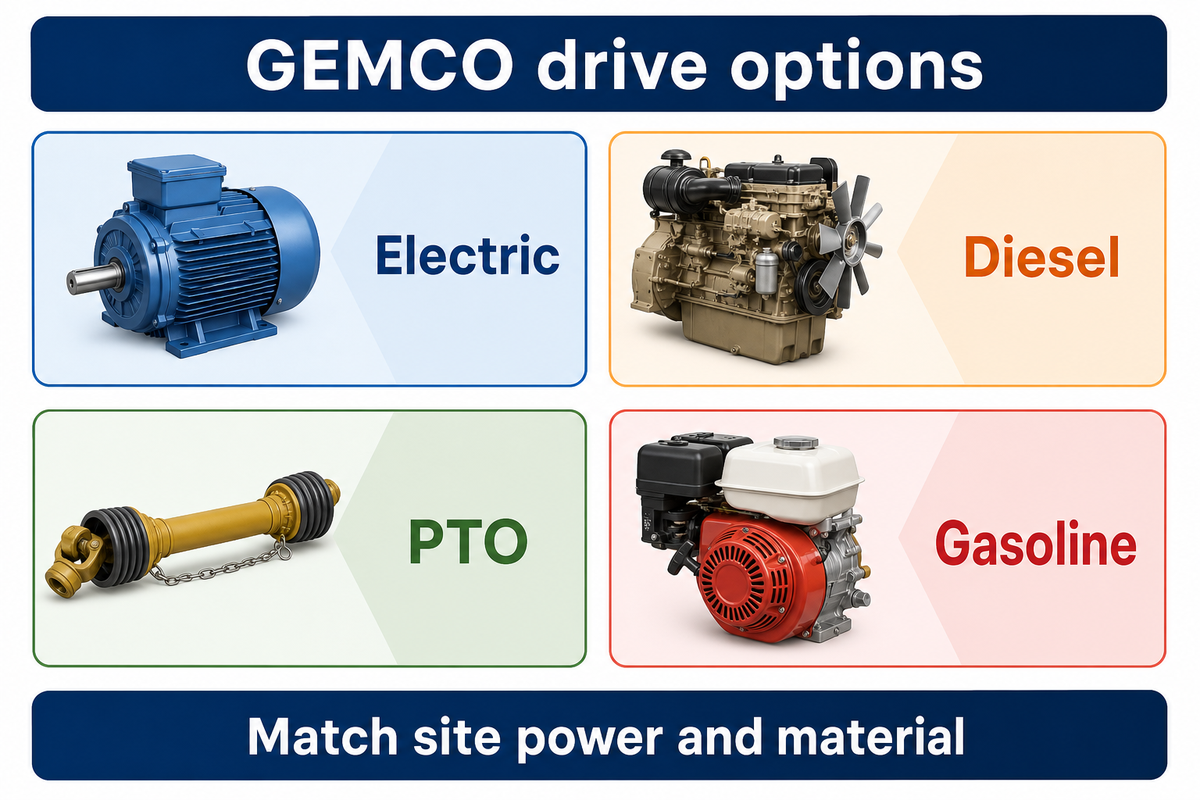
Compact wood pellet mills suit smaller biofuel businesses and farms, but the available drive and material rating require attention. Some electric pellet mills use three-phase power with modest output. A diesel or PTO drive version of the machine may be a better fit and different rates may be published for wood and animal feed by the same manufacturer.
6. GEMCO / ABC Machinery: Best for buyers comparing electric, diesel, PTO and gasoline drives
Headquarters: Anyang, China · Founded: GEMCO founded 1997 · Type: ABC Machinery biomass equipment manufacturing division.
Official website: https://www.gemco-energy.com/
Main products: Die-turning and roller-turning flat-die pellet mills.
Published specifications: Electric, diesel, PTO and gasoline versions, with material testing.
Quality / certification: Website describes GEMCO as ISO9000 and CE certified; enterprise-level wording.
GEMCO provides both die-turning and roller-turning layouts, with electric, diesel, PTO and gasoline drives across its small-mill range. This makes the brand relevant to farms and workshops whose power supply is as important as their desired pellet output. ABC Machinery identifies GEMCO as its biomass equipment division and KMEC as another group brand. Material testing is part of GEMCO’s published offer, which supports choosing a die and drive arrangement around the intended wood or feed application.
Buying limitation: Wood and feed applications need the appropriate die and mill configuration; one generic output figure can’t cover both.
7. Yulong: Best for separate feed and fibrous-material mill selection
Headquarters: Jinan, Shandong, China · Founded: 2007 · Type: Pellet and biomass machinery manufacturer.
Official website: https://www.yulong.cc/
Main products: SKJ2 flat-die mills and larger pelleting systems.
Published specifications: SKJ2-300: 30 kW; feed 600–1,000 kg/h, fiber 300–500 kg/h.
Quality / certification: ISO9001 and CE listed on company profile.
Yulong’s SKJ2 table gives feed and fiber capacities separately, a useful distinction for anyone comparing a livestock-feed press with a biomass pellet mill. The 30 kW SKJ2-300 is listed at 600–1,000 kg/h for feed but 300–500 kg/h for fiber, and that second category shouldn’t be silently relabeled as guaranteed wood output. Gearbox construction and a quick-release die clamp support routine access to wearing parts. Yulong also manufactures larger pelleting equipment, but the small flat-die family remains a distinct choice within that wider product range.
Buying limitation: SKJ2 fiber output is substantially lower than the corresponding feed rating.
8. Fanda: Best for compact electric wood-pellet production
Headquarters: Zhengzhou, China · Founded: 2009 · Type: Biomass and feed machinery manufacturer.
Official website: https://www.fandapelletmill.com/
Main products: KL electric flat-die mills.
Published specifications: KL200: 7.5 kW and 100–150 kg/h wood; KL400: 30 kW and 400–500 kg/h wood.
Quality / certification: Company states its machines meet CE and ISO standards without naming an ISO version.
Fanda’s KL series supplies a relatively straightforward electric flat die wood pellet mill for a workshop, farm or small biomass-fuel operation. Its model table gives wood-specific capacities, including 100–150 kg/h for KL200, rather than using a faster animal-feed figure to describe the same press. The company describes material testing, English manuals and remote assistance alongside a two-year complete-machine warranty. Buyers moving up the KL range can compare motor power and die diameter within one family, while keeping the published wood output ceiling in view.
Buying limitation: The listed KL electric flat-die wood range tops out at 400–500 kg/h on KL400.
9. TechnoMaszBud: Best for compact biomass production with variable-speed feeding
Headquarters: Słupno, Poland · Founded: Manufacturing since 2013; current Polish company registered 2021 · Type: Pellet machinery designer and manufacturer.
Official website: https://technomaszbud.pl/
Main products: PRIME and PELLETNIK flat-die equipment.
Published specifications: PRIME200 PRO: 15 kW, 216 mm die, up to 220 kg/h.
Notable capability: Frequency converter included; gearbox warranty is five years.
TechnoMaszBud’s PRIME200 PRO combines a 15 kW drive with a 216 mm die and 148 mm rotating rollers, with a frequency converter included. That combination suits compact biomass pellet production where feed adjustment is part of daily operation, rather than an optional item discovered after purchase. The manufacturer’s catalog traces equipment activity to 2013; its current Polish company was registered in 2021, so the operating history and legal-entity date describe different events. A five-year gearbox warranty is a notable feature of this model, although it’s separate from the general machine warranty and the installation items supplied.
Buying limitation: PRIME200 PRO is supplied without a power cable; electrical installation must be budgeted separately.
10. Leabon: Best for tractor-driven small wood-pellet equipment
Headquarters: Zhengzhou, China · Founded: 2011 · Type: Manufacturer and exporter of feed and wood-pellet equipment.
Official website: https://www.zzleabon.com/
Main products: PM-series PTO flat-die mills and pelleting lines.
Published specifications: PM350T: 350 mm die, 350–400 kg/h published wood output.
Quality / certification: CE claimed in PTO product listing.
Leabon’s PM-series PTO mills suit an owner who already has tractor power available and wants to use it for small wood-pellet production. Published examples span several die diameters, including the PM350T with a 350 mm die and a 350–400 kg/h wood rating. Leabon also describes manufacturing and installation of wood and feed lines, so the PTO mill sits within a wider equipment business rather than being its only offer. A tractor-driven press can suit an agricultural site, but its purchasing scope must include the tractor connection and the available drive arrangement.
Buying limitation: PTO models need a compatible tractor as their power source; the pelletizer isn’t a self-powered machine.
11. MIKIM: Best for small mills with separately stated wood and feed ratings
Headquarters: Anyang, Henan, China; registered in Tianjin · Founded: 2014 · Type: Tianjin Mikim Technique manufacturing and export business.
Official website: https://www.woodpellets-machine.com/
Main products: Small flat-die pellet mills with electric and engine-driven options.
Published specifications: 200B electric: 7.5 kW, wood 110–140 kg/h, feed 200–300 kg/h.
Quality / certification: Company website lists CE, ISO9001 and SGS credentials.
MIKIM’s detailed flat-die table separates output for wood pellets from output for feed, which is more useful than the broad capacity in a product headline. The 200B electric model, for example, combines a 7.5 kW motor with a wood rating of 110–140 kg/h and a feed rating of 200–300 kg/h. Tianjin Mikim Technique identifies Anyang as its headquarters and Tianjin as its registered location, while its range includes electric and engine-driven small equipment.
Buying limitation: The electric 400C is listed at 400–550 kg/h for wood versus 900–1,100 kg/h for feed; the feed number isn’t wood output.
12. Azeus: Best for entry-level electric wood-pellet trials
Headquarters: Zhengzhou, China · Founded: 2012, as listed by Goodada · Type: Pellet machinery manufacturer and line integrator.
Official website: https://www.azeuspelletmill.com/
Main products: AZSPLM electric flat-die wood-pellet mills.
Published specifications: AZSPLM120: 2.2 kW and 40–60 kg/h wood; AZSPLM200: 7.5 kW and 110–140 kg/h.
Notable capability: Stationary die with rotating roller and replaceable dies.
Azeus lists a genuinely small starting point in the AZSPLM120, with a 2.2 kW motor and 40–60 kg/h wood capacity. Its stationary die and rotating roller arrangement can suit an early wood-pellet trial where the business needs modest output before investing in a larger line. The same product table extends to larger models, while the company describes design, installation and commissioning of pellet systems. Replaceable dies provide a choice of pellet sizes, but the electrical distinction between the small 120 model and the larger three-phase machines matters when choosing a workshop unit.
Buying limitation: Most larger AZSPLM models specify 380 V, 50 Hz three-phase power; the small 120 model is the listed single-phase option.
13. Sunwit: Best for farms comparing feed and wood duties
Headquarters: Zhengzhou, China · Founded: Not publicly disclosed · Type: Feed and biomass machinery manufacturer.
Official website: https://www.feed-pelletmachines.com/
Main products: SWSP flat-die feed and wood mills.
Published specifications: SWSP260B: 15 kW, feed 400–600 kg/h and wood 200–300 kg/h.
Notable capability: Material-specific capacities appear side by side in the SWSP table.
Sunwit’s SWSP family covers small feed and wood duties with separate ratings in the same specification table. For the 15 kW SWSP260B, the company lists 400–600 kg/h for feed and 200–300 kg/h for wood, which makes the material effect visible before a buyer compares offers. Its wider range includes feed grinding, mixing and cooling equipment for a farm production setup. The useful reason to shortlist Sunwit is that clear split between two duties, especially when a farm is deciding whether to focus on animal feed or biomass fuel.
Buying limitation: The published SWSP electric table specifies 380 V, 50 Hz; this stock configuration needs a matching power supply.
Feed Pellet Mills and Pilot Production
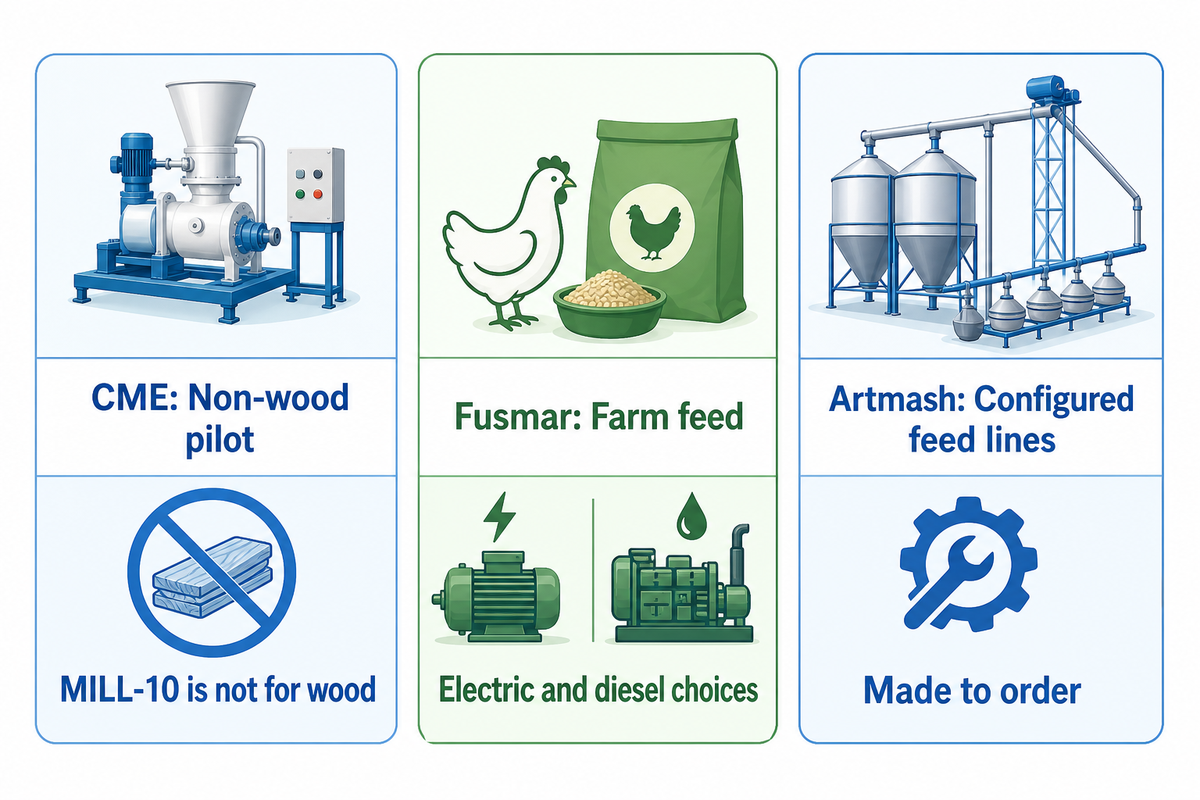
Feed and pilot machines address a different buying task from a dedicated wood-pellet plant. A farm may need a complete grinding-and-mixing line, while a laboratory needs manageable batches and straightforward formulation changes. The manufacturers below offer those choices, with CME’s MILL-10 carrying an explicit non-wood restriction and several farm mills offering alternative drives.
14. Colorado Mill Equipment: Best for US pilot-scale non-wood pelleting
Headquarters: Cañon City, Colorado, USA · Founded: 2008 · Type: US pellet machinery manufacturer.
Official website: https://coloradomillequipment.com/
Main products: MILL-10 flat-die pilot pellet mill.
Published specifications: 10 HP three-phase motor, 8-inch die, 80–600 lb/h depending on material.
Notable capability: Designed for R&D, formulation testing and small production runs.
CME builds its machines in Cañon City, Colorado, and positions MILL-10 for research, formulation trials and small production runs. The flat-die machine uses a 10 HP three-phase motor with an 8-inch die; the published 80–600 lb/h range changes with the material being processed. This makes it a useful US option for pilot work that needs a compact production machine rather than a large continuous pellet plant. CME’s wider catalog also includes ring-die mills, but those machines should be evaluated separately from MILL-10 and its explicit material restriction.
Buying limitation: CME explicitly states that MILL-10 isn’t intended for wood processing.
15. Fusmar: Best for small poultry farms making their own feed
Headquarters: Zhengzhou, China · Founded: 2017 · Type: Feed and biomass machinery manufacturer.
Official website: https://www.feedpelletmills.com/
Main products: Fus-PLM flat-die feed mills.
Published specifications: Fus-PLM260B feed output 400–600 kg/h; electric and diesel options.
Notable capability: Farm-size feed range uses interchangeable pellet sizes of 2–10 mm.
Fusmar’s farm-use range targets poultry owners who want to turn prepared feed ingredients into pellets without installing a large feed factory. The Fus-PLM260B is listed at 400–600 kg/h for feed, with electric and diesel options across the small-mill offering and pellet diameters of 2–10 mm. That range gives a farm room to match pellet size to its animals and its chosen feed formulation. Fusmar also describes line layout, installation guidance and training, which can help connect the press with the grinding and mixing stages needed for repeatable feed production.
Buying limitation: Published Fus-PLM260B output is a feed rating and varies with pellet diameter; it isn’t a wood-pellet capacity.
16. Lima: Best for small complete animal-feed lines
Headquarters: Zhengzhou, China · Founded: 2006 · Type: Feed machinery manufacturer.
Official website: https://www.limafeedmachines.com/
Main products: Electric and diesel flat-die mills plus farm feed lines.
Published specifications: Electric flat-die range 60–1,000 kg/h; diesel range 60–400 kg/h.
Quality / certification: Website lists ISO9001 and CE among its credentials.
Lima offers the surrounding process as well as the press: its farm feed line links a crusher, conveyors and mixer with a flat-die mill and cooler. The published 200–1,000 kg/h line class is suited to farms and small commercial feed businesses that want an integrated route from ingredients to cooled pellets. Electric and diesel mills cover different output ranges, so a power-source change is also a model-selection decision. Lima’s larger commercial systems use a different ring-die route, making it important to compare the quoted line’s actual equipment rather than the company’s largest advertised plant.
Buying limitation: Lima’s larger commercial feed lines use ring-die equipment; the flat-die line described here’s the 200–1,000 kg/h farm class.
17. TONY: Best for small feed presses with wider ancillary equipment
Headquarters: Jinan, Shandong, China · Founded: 2013 · Type: Pellet machinery manufacturer and line supplier.
Official website: https://en.tonyjixie.com/
Main products: SKJ105–250 flat-die feed mills.
Published specifications: SKJ200: 7.5 kW and 150–200 kg/h; SKJ250: 15 kW and 200–300 kg/h.
Quality / certification: Product-page technical image states CE certification for the displayed flat-die models.
TONY’s small SKJ series uses a fixed die and pressure roller, with the SKJ105 starting at 1.5 kW and a stated 50–80 kg/h feed output. The SKJ200 and SKJ250 provide larger steps within the same compact family, which suits a small farm choosing between limited daily batches and a more regular feed-making schedule. TONY also manufactures drying, crushing, cooling and packing equipment, so auxiliary machines can be discussed within the same supplier relationship. Its product-page specification image states CE certification for the displayed flat-die models; the relevant capacities remain those of the SKJ family.
Buying limitation: The SKJ105–250 flat-die series is a 50–300 kg/h feed range, distinct from TONY’s much larger ring-die machines.
18. Artmash: Best for custom farm-feed lines and hardened wearing parts
Headquarters: Zhmerynka, Ukraine · Founded: Operating since 2005 · Type: Closed-cycle equipment manufacturer.
Official website: https://www.artmashagro.com/
Main products: Fixed flat-die granulators and automated feed lines.
Published specifications: Feed kits span 200–1,600 kg/h; MIDLE line lists 500–800 kg/h.
Notable capability: Dies and rollers use tool alloy steel hardened to 55–60 HRC.
Artmash manufactures granulators and feed-line equipment through a closed production cycle, and its published wear-part detail is more specific than a general claim of durability. Dies and rollers use tool alloy steel hardened to 55–60 HRC, with CNC drilling and countersinking described for die manufacture. Fixed flat-die granulators form part of automated and semi-automated feed kits, including the MIDLE line listed at 500–800 kg/h. That combination suits a farm seeking a configured line and replaceable wear components, provided its purchasing schedule allows for the company’s made-to-order production window.
Buying limitation: Equipment is made to order; the company lists a typical manufacturing window of two to five weeks.
19. Shuliy: Best for compact farm-feed presses with electric or diesel drives
Headquarters: Zhengzhou, China · Founded: 2011 · Type: Agricultural and processing machinery manufacturer.
Official website: https://www.shuliy.com/
Main products: SL-F flat-die animal-feed pellet machines.
Published specifications: SL-F-210: 7.5 kW, 300–450 kg/h, with 2–4 roller options.
Quality / certification: Shuliy states ISO9001 company certification and CE for most products, not every model.
Shuliy’s SL-F feed range combines a roller-and-pressure-plate layout with electric and diesel drive choices. The SL-F-210 electric model is listed at 7.5 kW and 300–450 kg/h, with two-, three- and four-roller configurations described across the offering. A compact arrangement with a movable base can be convenient for a farm feed area where equipment positioning matters alongside output. Shuliy’s broader wood-processing catalog also contains ring-die machines, so this entry focuses on the small flat-die feed family rather than importing capacities from its larger biomass equipment.
Buying limitation: SL-F-210’s listed electric configuration uses three-phase power; smaller pellet diameters reduce throughput.
20. Victor: Best for livestock farms needing a choice of power source
Headquarters: Xingyang, Zhengzhou, China · Founded: Manufacturing since 2012 · Type: Flat-die feed machinery manufacturer.
Official website: https://www.pelletizermill.com/
Main products: VTKLP animal-feed flat-die pellet machines.
Published specifications: VTKLP260 electric: 15 kW, 260 mm die, 500–600 kg/h feed.
Quality / certification: Company homepage states CE certification.
Victor concentrates on flat-die feed machinery and offers several drive choices for livestock farms with different site utilities. Its VTKLP260 electric model uses a 260 mm die and a 15 kW motor, with 500–600 kg/h listed for feed; the diesel version has its own specification rather than an interchangeable power label. The company describes incoming-material checks, assembly inspection and tests before shipment. Electric, diesel, gasoline and PTO options make it a useful comparison point when a farm’s production needs are clear but the preferred power source is still being decided.
Buying limitation: VTKLP260’s 15 kW electric version requires three-phase power; engine-driven versions have separate specifications.
How to Choose a Flat Die Pellet Mill Manufacturer
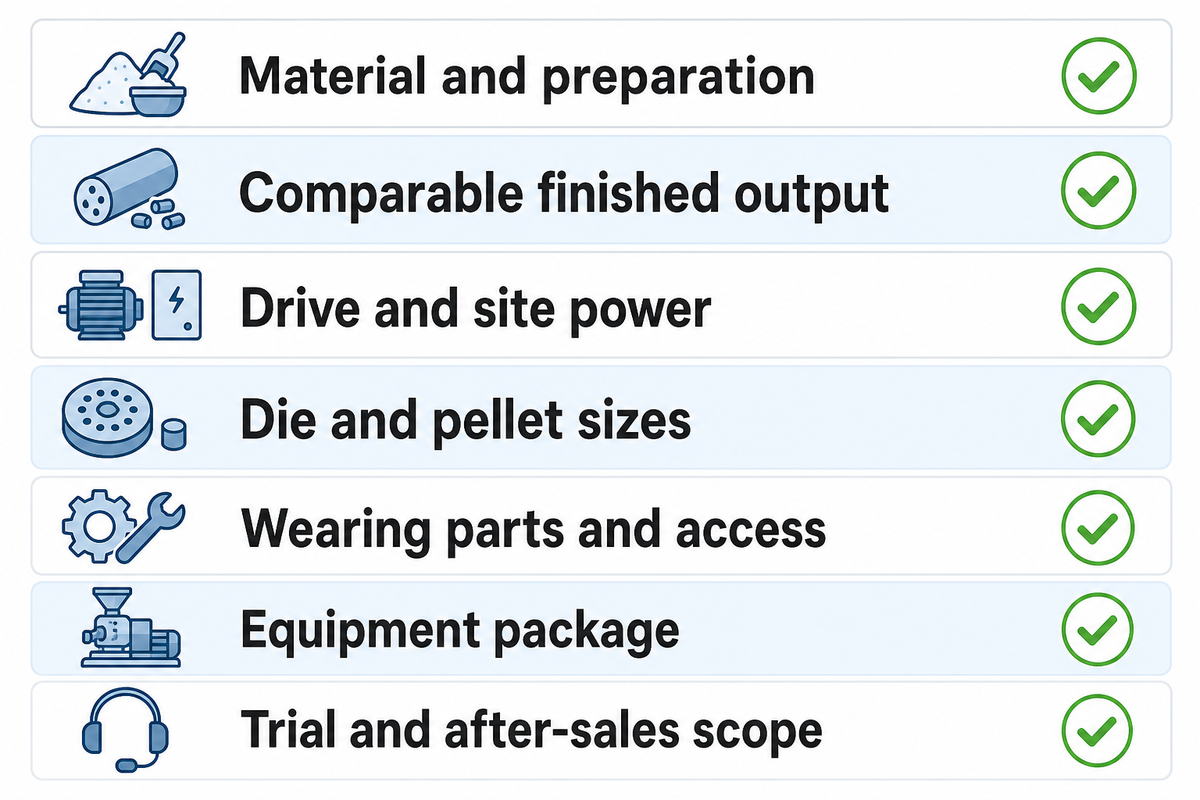
Feedstock, finished-pellet output and available power are the key factors that determine the selection of the manufacturer. Not all companies with the right small press may be the best fit for a complete pellet manufacturing line. A manufacturer of large plants may offer more engineering than is needed on the farm. Wood-rated wood pellet machine models may be a better first option than the higher feed rated models. These seven checks help turn a long list of candidates into a useful comparison of equipment.
- Define the material and its preparation. State whether you’ll use sawdust, wood shavings, crop residue or a prepared feed mixture. Include moisture and particle size with the sample description. Kovo’s wood specifications and Nawrocki’s moisture range show why preparation belongs in the machine discussion. Large wood chips first need size reduction; a biomass hammer mill for feed preparation addresses a different stage from pelleting itself.
- Compare finished output on the same basis. Separate wood, fiber and feed rates, and distinguish maximum throughput from sustained production capacity. Kovo’s MGL400 separates press throughput from actual pellet output; Sunwit and MIKIM separate wood from feed. A high output number is useful only when the material and operating conditions match your production needs. Define what high-quality pellets mean for your buyer, including size, durability and fines. Crumbling pellets create rework even if the press discharges material quickly; ask to see uniform pellets after cooling and handling.
- Match the drive to the site. Check voltage, phase and frequency, plus the starting arrangement for the motor. Three-phase equipment such as Buskirk’s PM1850 and CME’s MILL-10 requires an appropriate supply. A diesel engine or tractor PTO changes fuel, maintenance and installation needs rather than simply removing the electrical line item. For a small workshop, the single-phase Azeus AZSPLM120 is a different proposition from its larger three-phase models.
- Determine the die and pellet sizes. Overall, die size isn’t pellet-size; the outer diameter of the disc determines the size of the disc, and the holes in the die determine the pellets. A pellet mill die also needs the correct compression geometry for the material. Agree on diameter and allowable durability for pellet production based on actual feedstock.
Manufacturers offering various die options should identify the die for pellet production in the quoted machine. - Plan wearing parts and maintenance access. Discuss the die, roller shell and bearings as replaceable parts, including their part numbers and supply route. A description such as high-quality alloy steel doesn’t establish wear resistance or guarantee a longer service life. Ask for the grade, heat treatment and expected wear under your duty. Artmash’s stated 55–60 HRC wear-part hardness is a concrete example of the detail available. Include lubrication and maintenance requirements in the comparison, and check whether parts remain available throughout the machine’s operational life. For easy handling during a die change, ask about component weights and the lifting arrangement.
- Compare the same package. Identify whether the offer includes a feeder, electrical cabinet, cooling equipment, spares and commissioning. TCPEL lists several of these items in its standard package; TechnoMaszBud excludes a power cable from PRIME200 PRO. A complete wood pellet production line also includes stages beyond the press. Wet biomass can need a rotary drying stage, and hot pellets can need a pellet cooler before storage or packing.
- Agree on the trial and after-sales scope. Ask for a trial using a representative batch and record its moisture, feed rate and finished pellet quality. Test the full variety of raw materials you intend to use, with each recipe processed separately. Record incoming material quality as well as output: one successful batch does not establish consistent performance across changing feedstock. Confirm the legal manufacturer on the quotation, the applicable model documents, the warranty exclusions and the route for replacement parts. Keep a company quality-system certificate separate from a model conformity document. TCPEL’s NOWD sample verification and KAHL’s stated ISO 9001:2015 system certification illustrate why the document’s subject matters.
Can this pellet machine be used for both feed and fuel pellet production?
Some flat-die machines can produce pellets from both feed and fuel materials, but the model, die and preparation must suit each duty. Sunwit and MIKIM publish separate ratings for wood and feed on small mills, while CME expressly excludes wood from MILL-10. Softer materials and prepared feed mixtures shouldn’t be used to predict output from a woody feedstock.
“not intended for wood processing”
Keep animal-feed preparation separate from fuel-material handling. Pellets made from biomass waste for heating aren’t a feed formulation, and a manufacturer’s list of possible materials doesn’t make the same setup suitable for every product. Include cleaning and die-change downtime when budgeting for a machine that will alternate between materials. Ask the manufacturer how each intended feedstock affects die lifespan. For poultry feed, the feed grinding stage and ingredient mixing need their own process requirements before the pelletizing process begins.
How do industrial flat die and ring die pellet mills compare?
Both designs are used in production, and flat-die equipment isn’t limited to hobby machines. KAHL’s published flat-die range reaches 630 kW, while many small farm presses sit at the other end of the scale. A ring die pellet mill uses a cylindrical die; a flat-die press uses a disc-shaped horizontal die, with either the die or rollers rotating according to the design.
A vertical ring die machine is therefore not interchangeable with a flat-die model simply because both have a vertical layout. Compare the chosen machine’s feeding arrangement, duty, heat dissipation and service access within the intended application. For output measured in tons per hour, evaluate the complete system and material tests rather than assuming one die geometry always wins. KAHL and CME’s different product families show why brand name alone doesn’t settle that choice.
Material preparation also affects pellet production efficiency. A 2022 study on pine and switchgrass pelleting reported that the moisture and the die compression ratio affected pellet durability and density. The ring-die trial conditions aren’t operating settings for every machine in this list. A useful lesson in buying is to hold pellet quality and feedstock constant for a comparison of trial runs.
Frequently Asked Questions
Which flat die pellet mill manufacturers are best for wood pellets?
KAHL, Buskirk, TCPEL and Kovo Novák are useful wood-focused starting points for different project sizes.
KAHL fits industrial process engineering, Buskirk offers modular US biomass equipment, and TCPEL publishes packaged sawdust systems. Kovo Novák combines compact presses with feeding and mixing equipment. For smaller electric machines, Fanda and Azeus provide named wood-rated models. Match the shortlisted model to prepared wood and its stated moisture condition; CME MILL-10 belongs in a non-wood pilot shortlist instead.
Who manufactures flat die pellet mills in the USA?
Buskirk Engineering and Colorado Mill Equipment manufacture flat-die equipment in the USA.
Buskirk is based in Ossian, Indiana, and offers the geared PM1850 for biomass applications, including properly prepared woody material. CME designs and builds equipment at its Cañon City, Colorado facility; its MILL-10 targets research and small production runs. The material difference is decisive: MILL-10 isn’t intended for wood processing, whereas Buskirk publishes a woody-material rating.
Which Chinese flat die pellet mill manufacturers should I compare?
Compare TCPEL, GEMCO, Yulong and Fanda for wood-related projects, with Fusmar, Lima and Victor among the feed-focused options.
Leabon adds tractor-driven equipment, while MIKIM and Sunwit publish separate wood and feed capacities for small machines. TONY and Shuliy also offer compact feed presses within broader machinery ranges. These companies differ in package scope and drive choice, so shortlist a product family before discussing price. GEMCO, ABC Machinery and KMEC count as one group in this comparison.
Which European manufacturers make flat die pellet equipment?
KAHL, Kovo Novák, Nawrocki, TechnoMaszBud and Artmash provide European options.
KAHL operates from Germany, Kovo Novák from the Czech Republic, Nawrocki and TechnoMaszBud from Poland, and Artmash from Ukraine. Their offerings span industrial plants, compact wood-pellet systems and farm-feed lines. Location is one selection factor; the named machine family and your material remain the main technical filters.
How much should I budget for a flat die pellet mill?
Published October 2026 examples include TCPEL’s USD 4,000–12,200 FOB Qingdao list and CME MILL-10 starting at USD 9,400.
TCPEL’s listed range covers different TCZL models and a specified equipment package; CME’s starting figure covers a different pilot-mill offer with selectable options. These are separate supplier examples, not a universal market-price range. Freight, import charges, site electrical work and any missing preparation equipment belong in the project budget. Prices and inclusions can change, so the final comparison should use current quotations for the same material and delivered equipment scope.
What is the difference between a pellet mill manufacturer and a supplier?
A manufacturer makes the equipment; a supplier may manufacture, resell or integrate it.
A manufacturer can also export machines or provide a complete production line containing purchased components. The real difference is who manufactures the press, holds the drawings and provides wearing parts compatible with the press.
Discuss Your Pellet Project with TCPEL
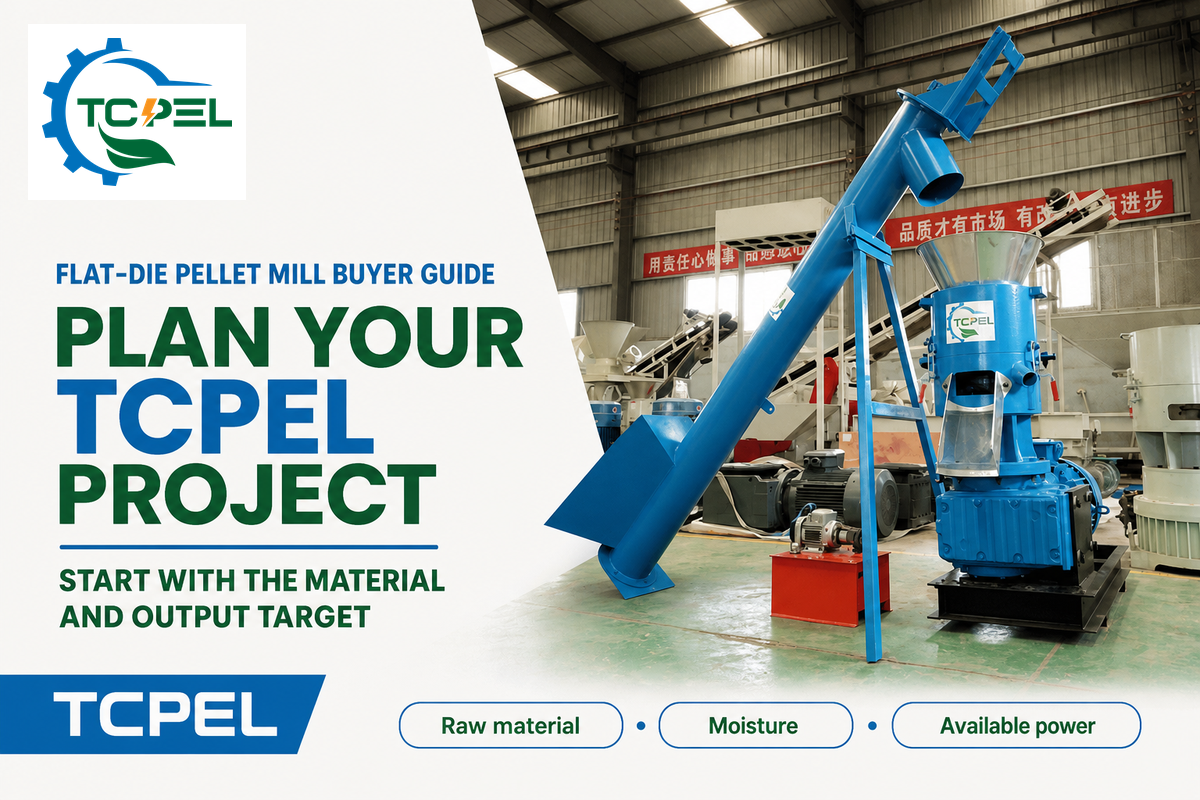
TCPEL supplies TCZL flat-die machines with a published package covering the press, feeder, control cabinet and lubrication equipment. For a small-commercial sawdust project, the TCPEL flat die pellet mill range provides a starting model comparison with wood-specific output conditions.
Send your raw material, moisture level, target hourly output and available power, along with the equipment you already have. We can use those details to discuss the press and the surrounding process, from preparation to cooling. A buyer planning a wider biomass pellet production system should describe the whole production route so that the proposed package covers the required stages.
Discuss Your Pellet Project Contact the TCPEL team
Sources and comparison notes
Company profiles use the manufacturers’ official company and product pages identified by the website lines above, with public corporate profiles supplementing selected founding years. Ratings, warranty terms and certification descriptions are attributed to those sources. This comparison was prepared from published information; it doesn’t report factory visits or independent performance tests.
References & Sources
- Research on high-moisture pelleting of southern yellow pine and switchgrass blends Frontiers in Energy Research, 2022. Used for the discussion of material preparation and pellet properties.