Get in Touch with TCPEL

Updated July 2026 · Reviewed by the TCPEL technical team.
A feed grinding hammer mill is the machine that sets your feed’s particle size — the one job that quietly decides your feed cost and your animals’ performance. Get the grind right and you spend less on grain per kilo of gain; get it wrong and you either waste energy grinding too fine or leave feed value on the table grinding too coarse.
This guide covers how the mill actually reduces particle size, how to pick a screen for a target micron, what drives your energy per ton, and where a hammer mill beat a roller mill – using published animal-science data rather than vendor claims.
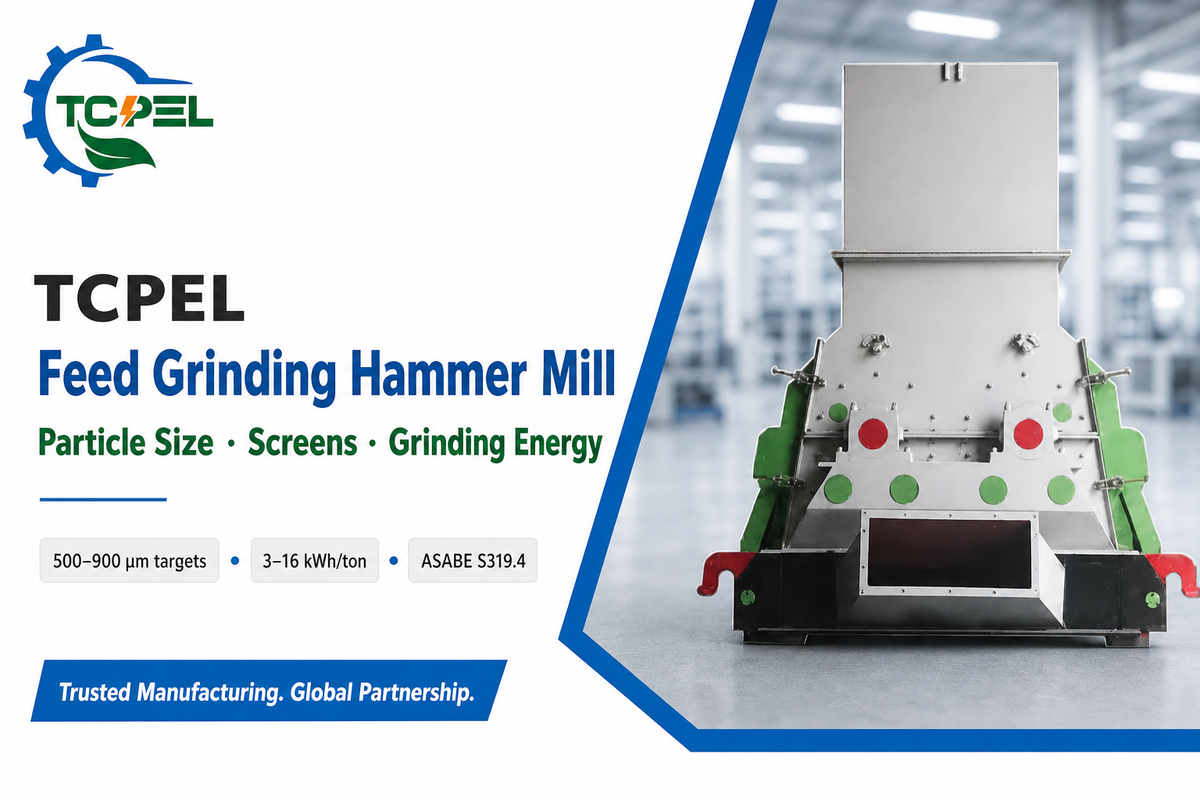
Short answer: A feed grinding hammer mill reduces grain by high-speed impact – swing hammers on a rotor strike material until it passes through a perforated screen, and airflow pulls the sized particles out.
Screen aperture and hammer tip speed together set the mean particle size, which for most livestock lands between 500 and 900 microns.
Key takeaways
- Finer is not always better: below ~500 µm, swine gastric-ulcer risk rises and grinding energy more than doubles for a shrinking return.
- Every 100 µm reduction in swine diet particle size is worth roughly 1-1.2% in feed efficiency – up to a species-specific floor.
- Screen hole size is your primary fineness control; tip speed is the fine-tune.
- Grinding can be a third of a feed mill’s electricity bill, so screen and hammer condition are cost levers, not just maintenance items.
Quick Specs: Typical Feed Grinding Hammer Mill Envelope
| Hammer tip speed | 16,000–23,000 ft/min (~81–117 m/s) |
| Screen aperture (feed) | ~1.5–10 mm (1/16″ to 3/8″) |
| Typical output particle size | 500–1,000 µm (species-dependent) |
| Grinding energy | ~3–16 kWh/ton (rises steeply as micron falls) |
| Feed moisture before grinding | ≤15% (higher may need drying) |
| Drive | Electric motor or PTO |
Ranges compiled from Kansas State University feed-processing extension data and field practice; your values vary by material, screen, and mill.
How a Feed Grinding Hammer Mill Works
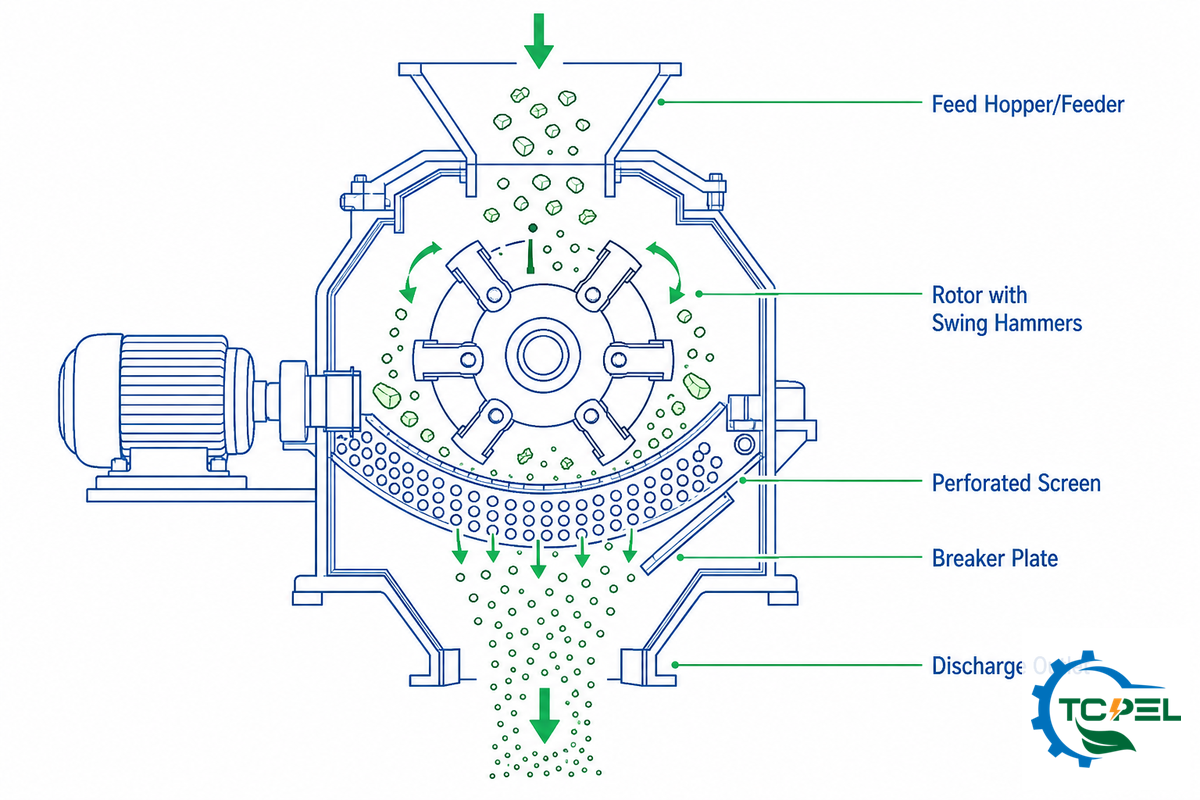
A feed grinding hammer mill reduces grain and feed ingredients by high-speed impact. Free-swinging or fixed hammers mounted on a rotor spin at speed and strike incoming material; the fragments stay in the grinding chamber until they’re small enough to pass through a perforated screen, and airflow (natural or from an aspiration fan) pulls the sized particles out.
Two settings do most of the work: the screen aperture sets the ceiling on particle size, and the hammer tip speed controls how hard and how often particles are hit before they escape.
How does an industrial hammer mill work step by step?
Feed enters the front through a feeder or hopper into a grinding chamber, where fast-spinning hammers strike it against breaker plates and a screen. Particles small enough pass through the screen’s holes; larger pieces take more hits until they do. Output is a range of sizes, described as a geometric mean diameter (GMD, or dgw) plus a spread rather than one number.
Both GMD and the geometric standard deviation (Sgw) are measured with a 13-sieve stack using method ANSI/ASAE S319.4. One caveat before trusting any micron value, your own or a supplier’s: only compare sizes measured by the same method, since sieve count, agitation time, and dispersion agents all shift the number. Whatever you adjust later, the screen and the tip speed move the whole distribution up or down.
Mechanically, a feed grinder is built around a rotor of hardened-steel or stainless-steel hammers, a perforated screen, a feeder or hopper at the intake, and a discharge auger or belt conveyor that moves ground material toward storage. Drive is by electric motor (usually belt-driven) or PTO, and many models add a hydraulic door for quick screen changes. Portable and stationary formats exist, from small farm units to heavy-duty industrial machines, and established manufacturers publish capacity by model.
💡 Key takeaway
The screen limits the biggest particles, the tip speed sets the finest. Everything else – energy, consistency, animal performance – falls into place based on these two controls.
Particle Size Is the Real Product: Grind Size vs Feed Conversion Ratio
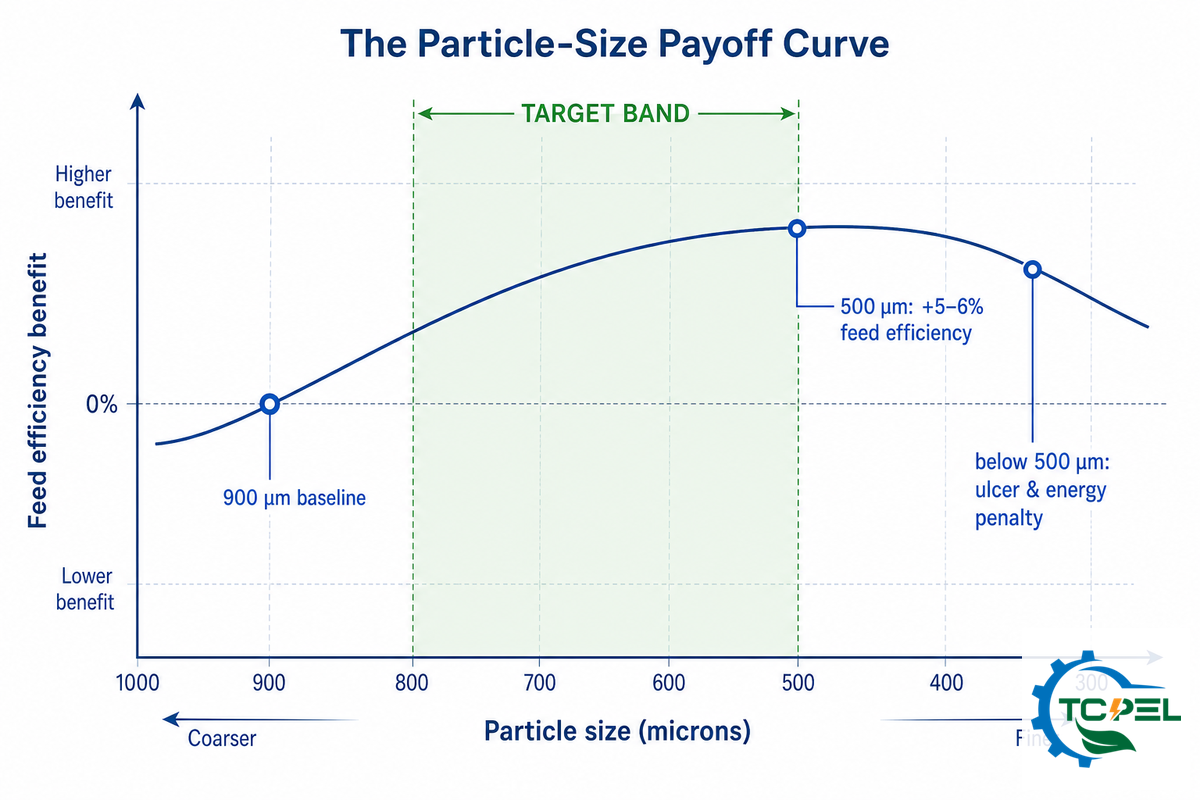
The particle-size (dgw, in microns) you get out has a direct effect on feed cost. Grind finer and you increase the surface area for better digestibility and feed-conversion ratio (FCR), but there’s a limit, specific to species, below which your energy use and feed mill costs shoot up, your feed becomes unmanageable in bins and your animals’ gut health goes South. This trade-off is the single most important principle in feed grinding.
This relationship between size and performance has been well studied. In well-documented Kansas State University grow-finish trials, reducing particle size from roughly 900 microns down to about 500 microns improved FCR by around 5-6%. That’s about a 1-1.2% improvement in efficiency for every 100-micron reduction. Although these KSU studies were conducted decades ago, they’re still the gold standard in the industry and are periodically confirmed in newer extension work. However, a KSU particle-size fact sheet shows why you don’t just “grind finer, finer, finer.” It says the risk of gastric ulcers and esophageal keratinization increase when diets are ground below 500 microns, and feed becomes bridged in bins, generating dust. FCR may continue to improve below 500 microns, with Iowa State noting finishing pig efficiency could continue to increase while ulcer susceptibility is variable depending on genetics and overall health, but the risk of ulcers and increased feed-mill costs exceed the gain. For this reason, approximately 500 microns has been accepted as a reasonable floor for grind size, rather than a ceiling for efficiency.
The Particle-Size Payoff Curve
When you graph FCR against particle size, the line go up – meaning improved efficiency – as you grind finer, until it goes down again. This “particle-size payoff curve” reflects the balance between improved digestibility and efficiency, and rising energy costs, poor feed flow, dust and gut health issues. Your goal isn’t to grind as finely as possible, it’s to reach your species’ target size and stop.
Poultry provides the clearest example. One might intuitively think that birds require a fine feed, but extension work from Auburn University has demonstrated that even in crumbled and pelleted broiler feeds, the inclusion of coarse particles works best, and laying hens gain nothing if feed is finer than approximately 800 µm. Coarse fractions assist the development of the gizzard. So the “finer is better” axiom is factually wrong for several of the real feeding programs currently in use.
| Species / class | Target dgw (µm) | If too fine | If too coarse |
|---|---|---|---|
| Swine, nursery/starter | 500–700 | Ulcers, dust, bridging | Lower feed efficiency |
| Swine, grow-finish (corn) | ~700 (600–800) | Ulcers rise <500 | ~1%/100µm FE lost |
| Swine, wheat-based diets | 800–900 | Pasty/floury, cuts intake | Reduced digestibility |
| Broiler, meal diets | 600–900 | Dust, poor flow | Uneven intake |
| Broiler, crumbled/pelleted | coarser tolerated | Loses gizzard benefit | Usually fine if pelleted |
| Laying hens | ≥800 | No gain, wastes energy | Selective feeding |
| Beef / dairy (ground grain) | coarser; keep fiber | Low rumen pH, acidosis | Lower starch digestibility |
| Sow / gestation | ~600–700 | Ulcer risk | Efficiency loss |
| Single-feed compromise | 550–650 | — | — |
Sources: KSU Applied Swine Nutrition particle-size fact sheet, Iowa State IPIC, Mississippi State and Auburn extension. The 550–650 µm single feed recommendation is based on general, widely cited feed science guidelines.
“Reducing particle size increases the surface area of the grain, improving digestibility and feed efficiency, but grinding too finely increases energy costs and the risk of gastric ulcers.”
Choosing the Right Screen: From Hole Size to Target Micron
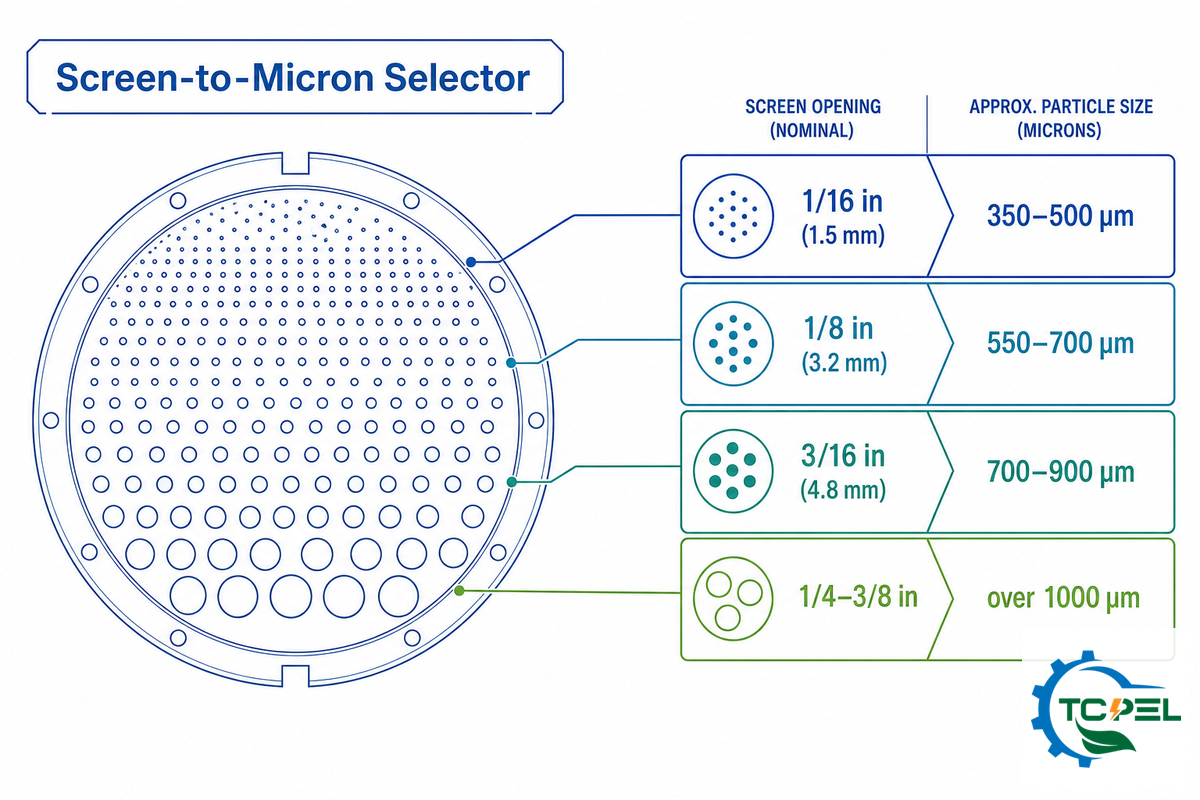
Your screen serves as the main device to control the particle size of the grind. Smaller screen holes keep particles in the mill longer’s chamber, resulting in more impacts and a finer grind; the larger the holes, the faster particles pass through, producing a coarser grind. Because the relationship between hole size and the resulting micron size isn’t constant, changing with such factors as moisture content, the condition of the hammer tips, the rotational speed of the rotor, and the type of grain being ground, treat the directional bands that follow as approximate guides and always verify with a sieve test.
How does the screen size affect the final product?
Screen hole diameter dictates the coarsest end of the particle-size distribution; as a rule of thumb based on typical farm hammer mill results, a 1/8-inch (~3.2mm) screen produces corn particles of about 600 µm, while larger 3/16- or 1/4-inch screens yield particles well in excess of 800 µm.
Because output also shifts with tip speed and hammer wear, pick a screen to bracket your target rather than treat it as a fixed reference, then confirm the result with a sieve test on the actual grind.
| Screen hole | ~Output GMD (corn) | Best-fit use |
|---|---|---|
| 1/16″ (~1.5 mm) | ~350–500 µm | Fine mash, pre-pellet, young stock |
| 1/8″ (~3.2 mm) | ~550–700 µm | Grow-finish swine, general mash |
| 3/16″ (~4.8 mm) | ~700–900 µm | Broiler meal, layer feed |
| 1/4″–3/8″ (6.4–9.5 mm) | >1,000 µm | Coarse/ruminant, roughage blends |
The directional bands represent real-world practices in farms and KSU studies regarding screens and tip speeds. Precise output varies with factors such as the moisture of the feed, the level of wear on the mill components, and its rotational speed. It’s always recommended to confirm results with a sieve test.
📐 Engineering Note
In addition to the size of the holes in your screen, the total amount of open area is a key factor. A screen with a greater percentage of open area will pass particles more rapidly, even at a finer grind size, thus reducing the energy requirements and heat generated during grinding. However, screens with very high percentages of open area and low gauge may wear and distort more quickly; be sure to match the gauge of the screen to the abrasiveness of the material you’ll be grinding.
Tip Speed, Hammer Pattern & Rotor Setup
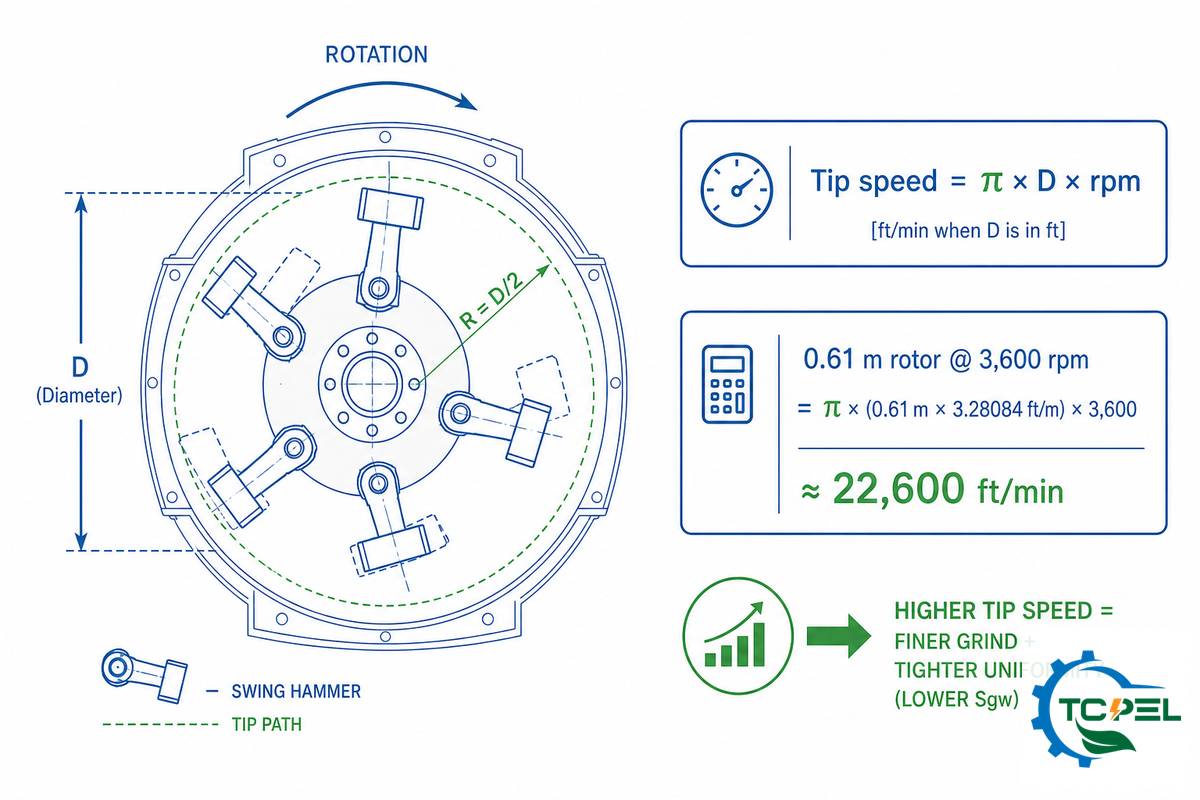
While your screen controls the maximum coarseness of your grind, tip speed and the way hammers are configured enable you to fine-tune where within that range your grind falls. Tip speed, or the speed of the hammer tips at their extreme edge, is generally in the 16,000-23,000 ft/min range for feed grinding; any speed higher than this will necessitate a sturdy, carefully engineered mechanical design for the mill.
How are the hammers configured?
Hammers are mounted in a pattern around the rotor so that the entire screen surface is used efficiently, and with more hammers and higher tip speeds come more impacts per second, leading to a finer and more consistent grind, but also higher energy consumption and increased heat.
Kansas State University researchers have well-documented the effects of tip speed: in one study by KSU, an increase in tip speed from 10,250 to 20,500 ft/min resulted in a reduction in corn geometric mean diameter of between 233 and 305 µm, depending on the screen, and – perhaps more significantly – a reduction in grind uniformity of 0.13 to 0.31 in geometric standard deviation. Uniformity, an important dimension often overlooked by buyers’ guides, has a significant impact on both the quality of the final pellet and the uniformity of feed mixtures.
A common and costly mistake is to blame a coarsening grind on the screen when the real culprit is worn hammers running at a reduced effective tip speed — swapping screens then wastes downtime without fixing the drift. Consider a swine mill that ran the same 3/16″ screen for months as its grow-finish grind crept from 720 up to about 900 µm; the operator kept ordering finer screens until a sieve check plus an ammeter reading showed the hammers had rounded off. Rotating to a fresh hammer edge restored the target at the original screen, recovering both feed efficiency and throughput. Tip speed and hammer condition, not the screen alone, decide where inside the ceiling your grind actually lands.
📐 Engineering Note — tip speed worked example
Tip speed = π × rotor diameter × rpm. 24″ (0.61 m) diameter rotor at 3,600 rpm gives π × 0.61 × 3,600 ≈ 6,900 m/min ≈ 22,600 ft/min, a good fit within the ideal range. Lower it to 3,000 rpm and you’re at ~18,800 ft/min – a less refined, less energetic grind. Use this as a test: Will the machine’s stated rpm really give you the screen fineness you need?
Grinding Energy: What Drives Your kWh per Ton
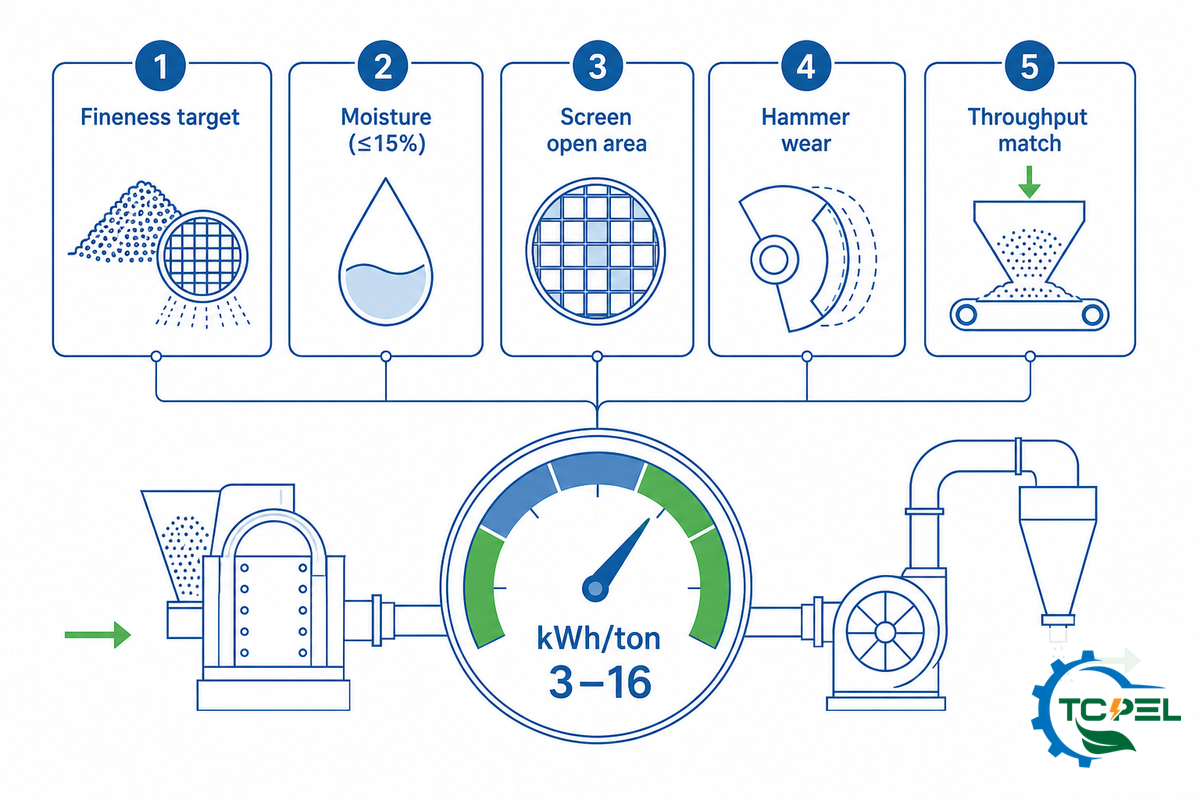
Grinding isn’t a minor cost center. A peer-reviewed 2025 study in the journal Processes reported that grinding was responsible for 34% of total energy costs in feed mills, and process adjustments achieved as much as 18% energy savings in grinding. So grinding settings aren’t just about output; they’re a direct input into your operating expenses.
By far the dominant driver is fineness. KSU’s classic corn-grinding research (Wondra et al.) shows specific energy climbing from about 3.1 to 8.1 kWh/ton as grind gets finer, while production rate falls, dropping roughly 43% going from 700 to 500 µm. In other words, the last 200 microns of fineness can cost you nearly half your throughput and double your energy, and the 2025 mill-level data below shows that trade-off still dominates energy bills today. Practitioner benchmarks put routine feed grinding around 10–16 kWh/ton, rising toward 25 on hard materials. Fineness is the biggest lever within a given grain, but grain type can override it: Mississippi State reports sorghum ground to 500 µm used less milling energy (~3.4 kWh/ton) than corn ground coarser to 900 µm (~4.8 kWh/ton). So compare energy within one feedstock, not across them.
The 5 Levers of Grinding Energy
- Fineness target – largest lever; avoid finer than required by the species.
- Moisture – grains above ~15% require more energy and heat to grind. Ensure dryness or blend.
- Screen open area – provides faster material movement for the same fineness.
- Hammer wear – dull hammers tend to pound instead of shear, increasing energy consumption and heat generation.
- Throughput match – efficiency improves when a motor operate close to its rated capacity.
A new feed mill project we designed in Southeast Asia to support pellet production taught us this the hard way: grinding to a seemingly safe 500 µm for a grow-finish diet drastically reduced mill throughput, requiring a second shift. Revising the target to 650 µm brought the capacity back online with no impact on gain. That takeaway is simple: chasing a higher performance standard often carries a direct cost, evident on the electricity meter.
Hammer Mill vs Roller Mill, Choosing by Feed Quality
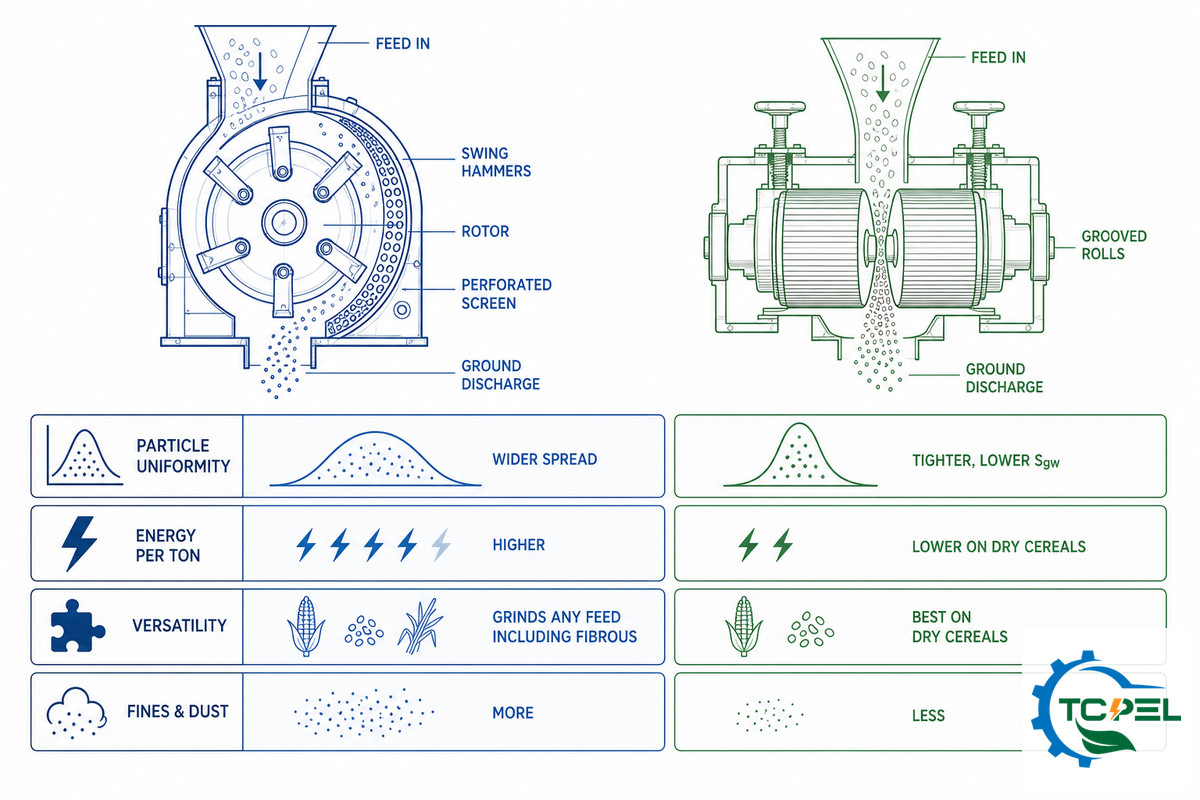
The choice here should be based on feed quality and your operational needs, not on a specific product sale. While hammer mills excel at processing nearly any ingredient and achieving fine grinds with wide particle distribution, roller mills operate more efficiently and deliver more uniform grinds for dry cereals but struggle with high-moisture and fibrous materials. Choose based on your desired uniformity and versatility; then consider our TCPEL feed grinding hammer mill for a solid commercial solution.
✓ Hammer mill strengths
- Grinds nearly any ingredient, incl. fibrous
- Reaches fine targets easily
- Lower capital cost, simple screens
- Better digestibility in some studies at 700 µm corn
⚠ Where a roller mill wins
- Tighter uniformity (lower Sgw), fewer fines
- Less energy per ton on dry cereals
- Less dust and heat
- Weaker on fibrous / high-moisture feeds
Here’s the reference that K-State compares: roller mills give more consistent particle size and consume less power per ton of material processed, while hammer mills are more versatile. A PorkGateway test study found the difference is largest at around 800 microns, diminishing around 400 microns. If your ingredient formulation has significant amounts of fiber, by-products or moisture variation, the hammer mill’s flexibility generally wins.
Keeping Particle Size Consistent: Hammer & Screen Wear
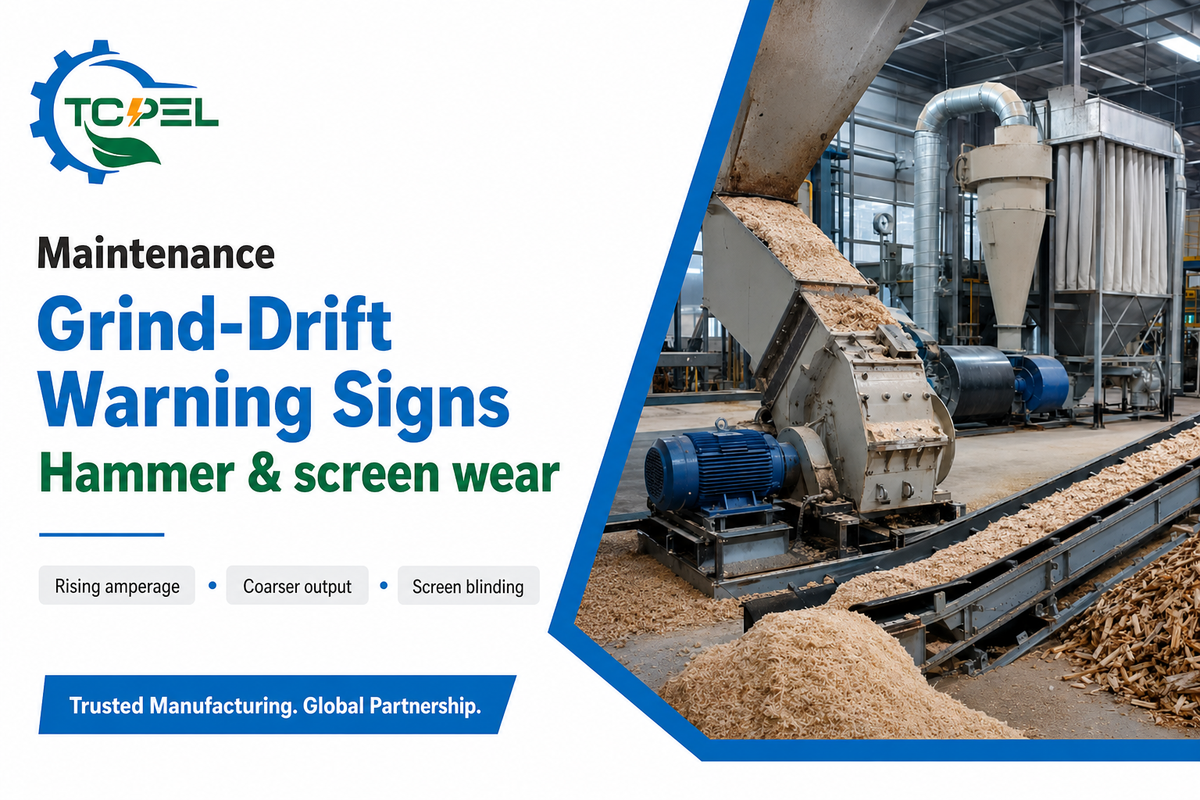
The grind you set in month one isn’t the grind you get in month three. As the hammers become rounded and the screen holes elongate and get smoother with time, your throughput increases, often resulting in coarser material with an increased percentage of fines, and always with increased power draw. Identifying and responding to this drift as soon as it begins helps ensure consistent feed and cost stability.
When and how should hammers be changed?
Hammers typically are turned or flipped to a fresh surface periodically on a schedule tied to the tonnage processed and are replaced in sets to maintain rotor balance – mixing and running hammers of varying weights creates vibration and reduces bearing life. You’re more likely to be alerted to this drift through your ammeter and particle size measurements than through your calendar.
Kansas State University feed-science guidance recommends that hammer-mill operators use a weekly short-stack sieve test to assess particle size, supplemented by a monthly full, 13-sieve test.
Grind-Drift Warning Signs
- Motor amperage creeping up while the feed rate holds steady
- Output getting coarser on the weekly sieve
- More fines / dust than usual
- Throughput dropping (tons/hour) at set draw
- Screen blinding or visible hole enlargement
- Higher discharge temperature
Matching Setup to Feedstock: Corn, Small Grains, Fibrous & Oilseeds
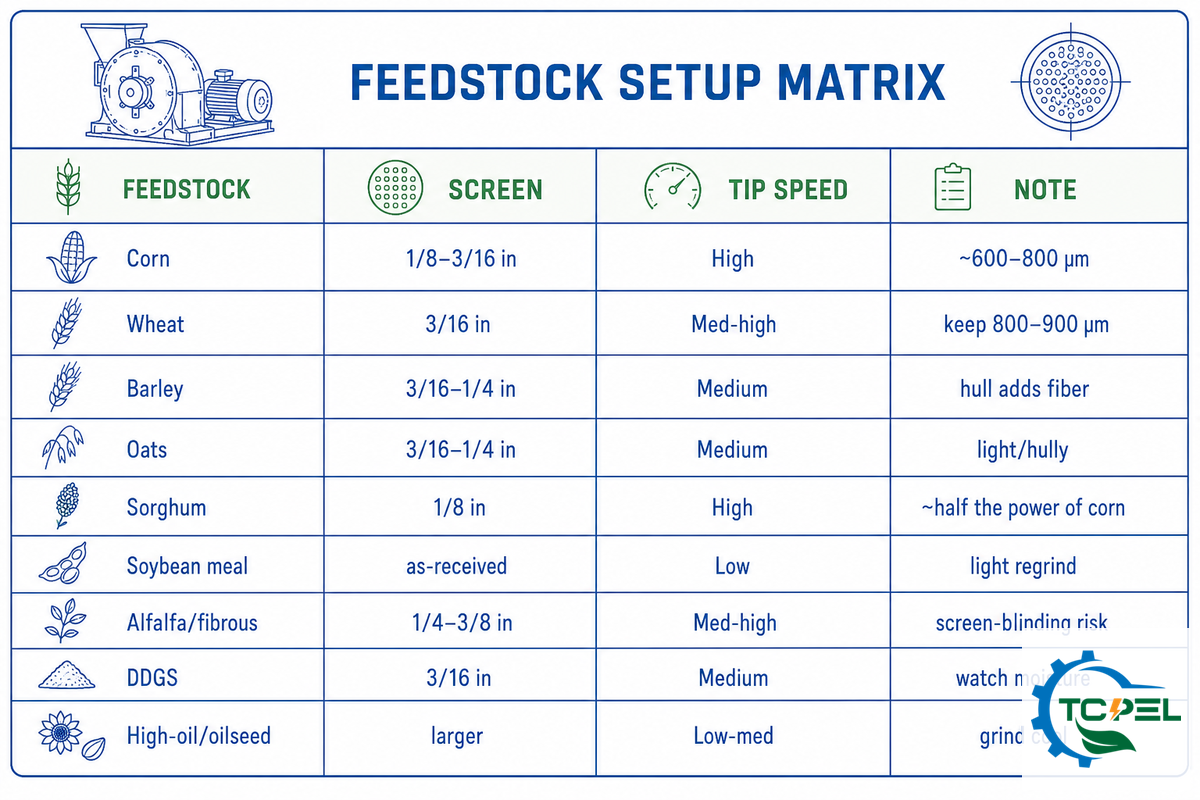
There’s no one screen size or speed setting that will produce ideal results for all ingredients. Hardness, oil content, moisture level, and fiber content will all influence grinding efficiency and ideal particle size for a specific ingredient. Wheat, for example, should stay coarser at 800–900 µm to avoid a pasty grind that cuts intake, per university extension guidance. This matrix provides a framework to start with and should be confirmed by sieving any new ingredient prior to its use.
Across feed production, the same grinding operation supplies livestock feed, poultry, aquafeed, and pet food lines, so one mill often covers both coarse and fine grinding applications. On smaller farms a combined grinder mixer performs grinding and mixing in one automatic pass, while larger plants run continuous, rotary-fed hammer mills sized by model. Whatever the format, holding the target particle size is what keeps ground feed consistent from batch to batch.
| Feedstock | Screen band | Tip speed | Note |
|---|---|---|---|
| Corn / maize | 1/8″–3/16″ | High | Baseline; ~600–800 µm common |
| Wheat | 3/16″ | Med-high | Keep 800–900 µm; too fine = pasty |
| Barley | 3/16″–1/4″ | Medium | Hull adds fiber; avoid over-fine |
| Oats | 3/16″–1/4″ | Medium | Light, hully; screens easily |
| Sorghum / milo | 1/8″ | High | Grinds with ~half the power of corn |
| Soybean meal | as-received | Low | Often already sized; light regrind only |
| Alfalfa / fibrous | 1/4″–3/8″ | Med-high | Screen blinding risk; keep open area |
| DDGS | 3/16″ | Medium | Watch moisture & heat |
| High-oil / expeller | larger | Low-med | Oil smears screens; grind cool |
Matrix framework based on feed processing experience; an average 15% moisture content (prior to grinding) is a general guide line across all feedstocks.
Industry Outlook: Feed Grinding Through 2026
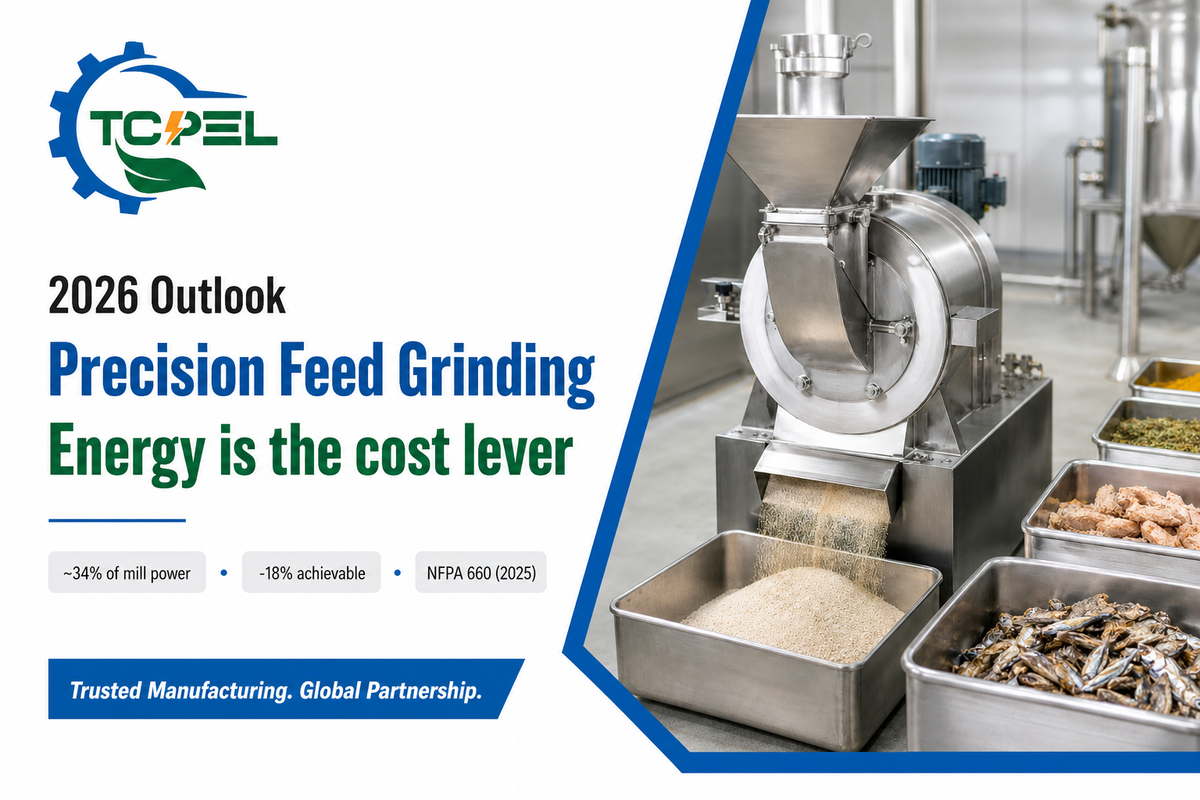
Cost, not technological novelty, will likely be the main driver of feed grinding decisions through 2026. Because grinding accounts for approximately one-third of the energy used in a feed mill and today’s fluctuating feed and energy costs are placing immense pressure on profit margins, precisely controlling particle size has become a direct mechanism for managing feed costs. A 2025 optimization initiative, which documented an 18% reduction in energy consumption, exemplifies the efficiency gains feed mills are seeking through adoption of variable-frequency drives, real-time specific energy monitoring and predictive maintenance schedules for hammer replacement.
Regarding compliance, combustible dust is a present concern, not a future one; the existing OSHA standard for handling grain dust (29 CFR 1910.272) is already in force in feed mills today. By 2026, all combustible dust codes will be consolidated into a single NFPA standard (NFPA 660), which will integrate existing standards NFPA 61, 652, and 654. Feed mill operators need to stay abreast of these developments in addition to the existing OSHA requirement. Growing market interest in energy-efficient, high-precision grinding systems is largely considered anecdotal market information and shouldn’t influence decisions on a major equipment purchase unless it directly correlates to projected improvements in your feed costs and operational efficiency. For any new projects planned for 2026, make certain to specify systems that measure and control specific energy (kWh/ton) and have easy access for screen changes rather than relying solely on nameplate capacity.
Frequently Asked Questions
What is the ideal particle size for animal feed?
View Answer
The ideal particle size is species-specific; there is no universal optimum. For example, grow-finish pigs thrive on around 700 microns (with optimum efficiency at 500 microns, but with a higher incidence of ulcers), while 500-700 microns works well for nursery pigs and 600-900 microns for broiler rations; no benefit has been demonstrated for feed for laying hens below about 800 microns. Ruminants require coarser grinds to ensure the effectiveness of their diet’s fiber. Many mills that have to use a single grind setting compromise at 550-650 microns.
What factors influence a hammer mill’s grinding capacity?
View Answer
Capacity varies based on your target fineness (finer output significantly decreases throughput-a reduction of roughly 43% when going from a 700-micron output down to 500 micron on corn), screen open area, motor horsepower and how well loaded the motor is, hammer condition, feedstock hardness and moisture content, and the airflow through the mill. Due to their interplay, the same mill can put out anywhere from two to ten times as many tons per hour depending on the grind you need it to make.
What happens if hammers of different weights are used in a mill?
View Answer
Using mixed-weight hammers creates an unbalanced rotor that causes vibration, accelerated wear on bearings and screens, and can eventually lead to mill damage. Always replace hammers in full, matched sets and arrange them on the rotor in a balanced pattern to distribute wear on the screen and ensure smooth running.
How does airflow affect hammer mill performance?
View Answer
Airflow pulls sized particles through the screen and carries away heat and moisture. Good aspiration raises throughput and keeps the grind cooler; weak airflow lets fines recirculate and overheat the material.
How often should hammer mill screens be replaced?
View Answer
Replace your screens when your weekly sieve analysis indicates that the output size has become too coarse, when you notice an increase in amperage draw for the same feed rate, or when you see visible enlargement of the holes in the screen. There is no universal lifespan on screens-hard, abrasive feeds will cause much faster wear than soft grain.
Can one feed grinding hammer mill handle both mash and pellet-line grinding?
View Answer
Yes-a hammer mill positioned upstream of a pelleting line is extremely common since pelleting requires a carefully controlled, reasonably fine particle size to achieve durable pellets. Changing the screen on the hammer mill is typically the way you transition between a coarser mash grind and the finer, pre-pellet grind size. Our feed grinding hammer mill page and animal feed pelletizer page discuss how to properly pair our mill with a pellet line.
Get expert help sizing your feed grinding hammer mill
If you tell us your animal species, your desired particle size, and your expected production rate (tons/hour), our engineers will recommend the correct hammer mill and screen set for your operation.
Why We Wrote This Guide
TCPEL (ALLWIN INTERNATIONAL CO., LTD) has built biomass and feed pelleting machinery since 2020 and shipped to more than 60 countries, and a hammer mill sits at the front of nearly every feed pellet line we deliver. We wrote this guide because most “feed grinding hammer mill” articles quote particle-size and energy numbers with no source; here every figure is tied to Kansas State University and other published feed-science research so you can check it yourself.
References & Sources
- Particle Size and Its Effect on Swine PerformanceKansas State University, Applied Swine Nutrition
- Feed Particle Size for SwineIowa State University Extension (IPIC)
- Particle Size Important for Swine DietsMississippi State University Extension
- Effects of Diet Particle Size on Poultry PerformanceAuburn University (Alabama Extension)
- Effects of Hammermill Tip Speed on Particle SizeKansas State University Research Reports
- Hammermills and Roller Mills (MF2048)Kansas State University
- Effects of Hammermills and Roller Mills on Finishing PigsPorkGateway (US Pork Center of Excellence)
- Energy Optimization in Feed Milling (Processes, 2025)MDPI, peer-reviewed
- Particle Size Reduction, Quality Assurance GuidelinesKansas State University Grain Science
- ANSI/ASAE S319.4 Method of Determining Fineness of Feed MaterialsASABE
- Combustible Dust and NFPA 660National Fire Protection Association