Get in Touch with TCPEL

Updated July 2026. Reviewed by the ALLWIN INTERNATIONAL CO., LTD (TCPEL) technical team.
A biomass hammer mill is the impact grinder that turns bulky raw material — wood chips, sawdust, straw, rice husk, bagasse, corn stalks, cotton stalks and other crop residues, into the fine, uniform particles a feed pellet plant or biofuel line needs. What most buyers miss: “biomass” is not one material. One mill that grinds clean pine sawdust cheaply can burn through hammers and screens on rice husk, because the two feedstocks behave nothing alike inside the grinding chamber. This guide is organised around that fact, how different feedstocks grind, wear parts, and cost to process, rather than around one machine.
Quick Specs, Biomass Hammer Mill (typical ranges)
| Output particle size | 1–10 mm; ≤3.35 mm for wood-pellet dies |
| Screen aperture | 2–12 mm perforations |
| Rotor tip speed | ~60–100 m/s (≈3000 r/min class) |
| Feed moisture | below ~14–15% to avoid screen blinding |
| Specific grinding energy | ~11 kWh/dry ton (dry wood chips) up to ~26 kWh/dry ton (corn stover); feedstock- and screen-dependent |
| Dominant wear driver | ash / silica content of the feedstock, not material hardness |
Ranges are for educational planning use, derived from published DOE/INL and peer-reviewed data; your actual quantities will vary depending on feedstock, moisture and target particle size.
What a Biomass Hammer Mill Does, and Where It Sits in the Line
Mechanically, a biomass hammer mill is pretty straightforward: a high-speed rotor rotates, swinging free or fixed hammers that crush and pulverize raw material against breaker plates until the pieces are small enough to fall through a perforated screen. The screen defines the maximum particle size; whatever doesn’t pass through is recirculated until it does.
(Suppliers may list the same machine as a hammer mill for biomass, a biomass grinding machine, a crushing machine or pulverizer, or a biomass wood crusher; some catalogues shorten it to a hammermill.) (For a diagram and all core parts, see our wood hammer mill working principle article – we won’t repeat it here.)
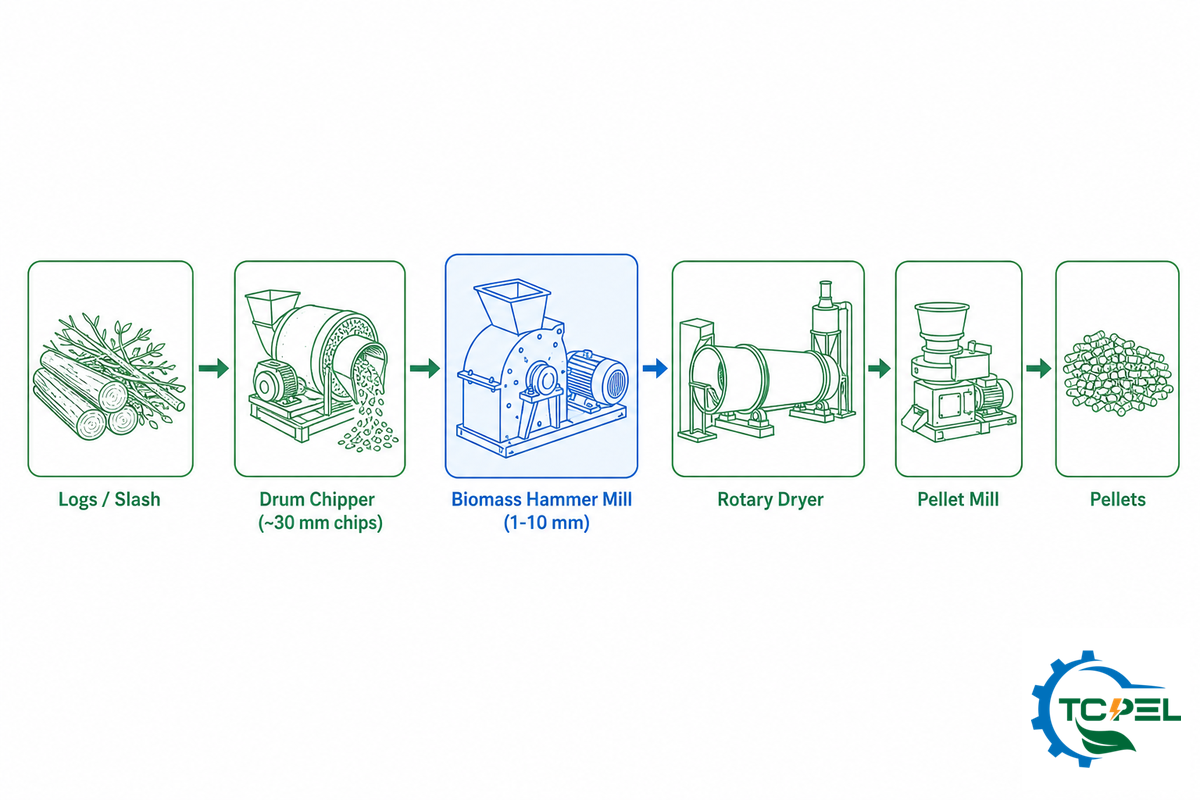
What’s relevant for planning is how far the mill is placed. A pellet or briquette plant typically has a two-stage reduction chain: a drum wood chipper reduces logs/slash to ~30 mm chips, then the hammer mill reduces those chips (plus sawdust, wood shavings and agricultural waste) to the mm level. The ground material is then (if needed) dried in a biomass rotary dryer, and pressed in a biomass pellet machine. See the complete wood pellet production line layout for all stages.
The Biomass Feedstock Spectrum: How Materials Grind Differently
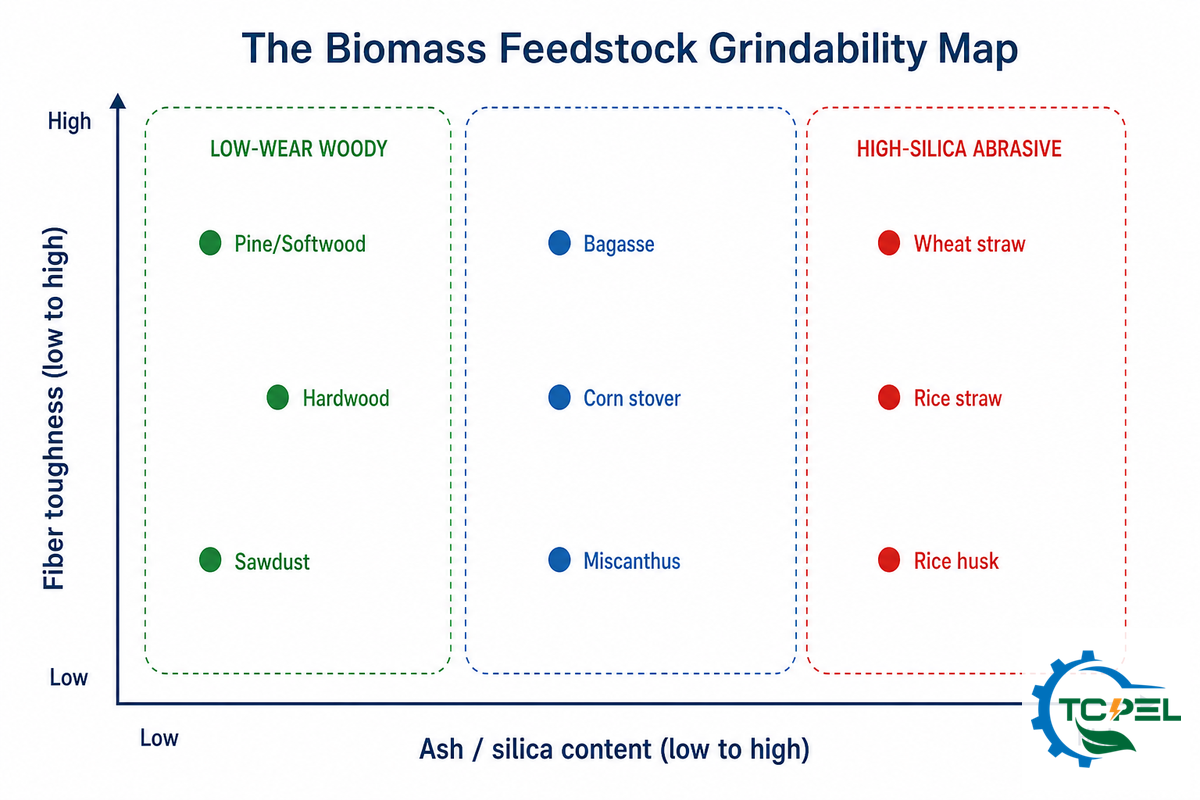
The most common planning failure is considering “biomass” as a single grinding requirement. Ash content varies from under 1% for clean wood to about 15-20% for rice husk and straw, and most of that ash is silica – a very abrasive mineral. Screening life, grinding energy requirements and hammer wear are all determined by actual feedstock, not a typical number. Whether it is a wood chip hammer mill, a sawdust hammer mill, or a straw grinder, the feedstock, not the label on the machine, drives the setup for these biomass materials.
The 9-Feedstock Grindability Matrix
| Feedstock | Feedstock Class | Ash / silica | Fiber character | Relative grinding energy | Dominant wear driver |
|---|---|---|---|---|---|
| Softwood chips (pine) | Woody | <1% ash | Friable when dry | Low (~11 kWh/dry ton) | Low — mostly impact fatigue |
| Hardwood chips | Woody | <1–2% ash | Denser, tougher | Low–medium | Low |
| Sawdust / shavings | Woody | <1% ash | Already fine | Very low | Low |
| Wheat / rice straw | Herbaceous residue | ~15–17% ash (73% silica) | Tubular, fibrous, low density | Medium–high | High — silica abrasion |
| Rice husk | Agri residue (shell) | ~15–20% ash (up to 95% silica) | Abrasive, low bulk density | Medium | Very high — silica abrasion |
| Corn stover / stalks | Herbaceous residue | 6–11% ash (soil-dependent) | Fibrous + pithy | High (~26 kWh/dry ton) | High — silica + soil |
| Sugarcane bagasse | Agri residue (fibre) | Ash ~92% silica | Stringy, wet as-received | Medium–high | High — silica + wrapping |
| Palm EFB | Agri residue (fibre) | High ash + moisture | Very tough, stringy | High | High — fibre wrap + abrasion |
| Bamboo | Woody-grass | ~1.4% ash | Hard, low ash | Medium | Low–medium |
| Miscanthus (energy grass) | Energy crop | Moderate ash | Fibrous stalk | Medium (14–18 kWh/t) | Medium |
Ash and silica figures are from peer-reviewed characterisation of rice husk, rice straw and bagasse ashes; grinding energy figures from DOE/INL and peer-reviewed hammer-mill studies (see References). Ash figures are for as-received material, soil dependent.
Use the matrix as a routing tool: the lower the number on the sheet, the cleaner the wood; the closer to rice husk or straw, the more the process varies from “fibre cut” to “abrasive mineral.” For a primary comparison of how bamboo compares to rice straw – 1.4% ash compared to 16% – use the NC State BioResources comparison as a primary source.
Silica, Ash and Abrasion: Why Herbaceous Biomass Wears Hammers Faster Than Wood
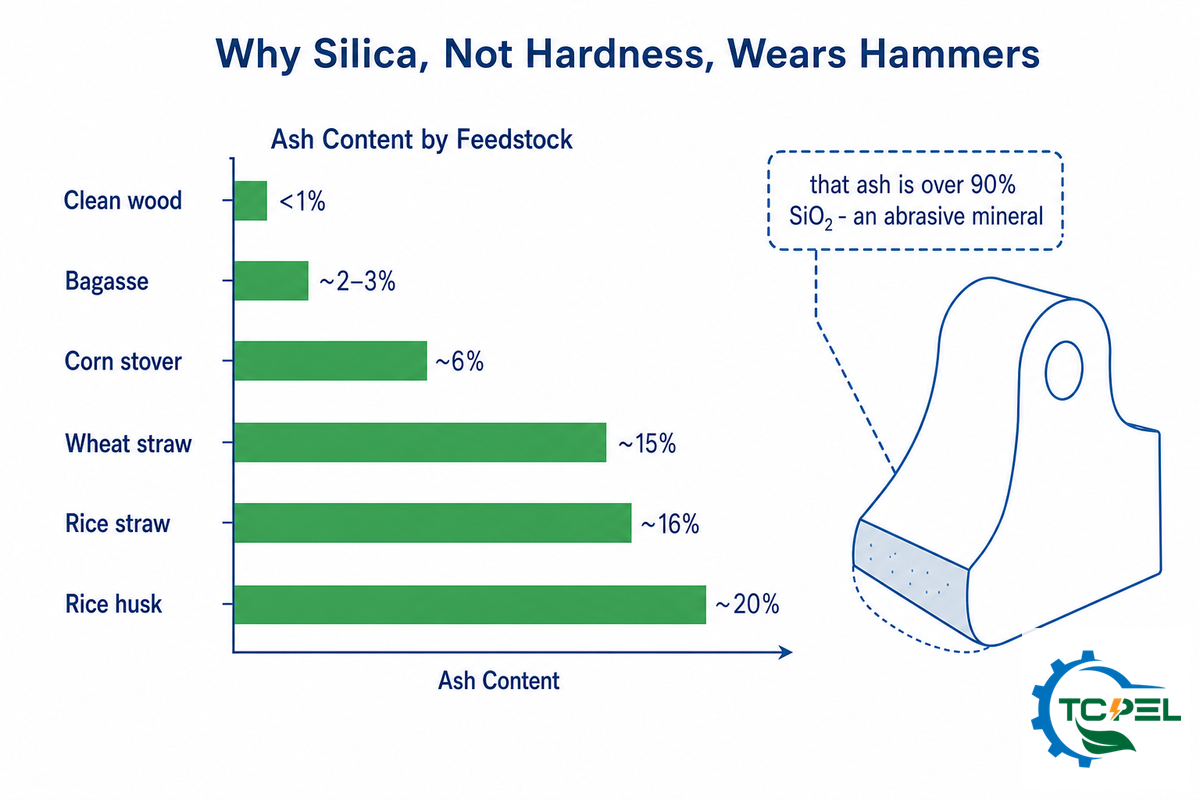
Here’s the piece most equipment specifications omit: hammer wear on biomass isn’t determined by how “hard” the material is, but by silica content. Rice husk ash runs up to roughly 94.79% SiO₂, rice straw ash about 73.26% SiO₂, and sugarcane bagasse ash roughly 92.5% silica. Silica, trapped in the fibre, is fine grit, and abrades steel like sandpaper – regardless of Janka hardness.
Both lab and field evidence concur. According to a study on the wear and tear of hammer-mill blades in the U.S. Dept of Energy by DOE PAGES, the use of carbide overlay hammer-mill blades, because they came into contact repeatedly with the inorganic material in shredded biomass (wear driven by minerals, not fiber), eroded them and even led to the fracture of blades. The way that technical forum engineers express this is more direct and is as follows: most of the time, biomass can contain more silica, i.e. “sand”, than coal, and as a result it can lead to accelerated wear of the grinding surfaces.
“A major misconception is that operators see hammer-mill screen size as the end-all-be-all solution. If controlling fines is the goal, changing the screen size is not the best option, high tip speed and heavy hammers make fines no matter what size of screen you run.”
Engineer, CPM Industrial Solutions, writing in Feed & Additive Magazine
📐 Engineering Note, The Silica-Wear Multiplier
Instead, think about wear in terms of ash/silica instead of merely tonnage. If one is pelletizing clean wood, it’s possible for hammers to last for hundreds of hours. On the other hand, with a high silica residue such as rice husk, wear can reduce that lifespan significantly and cause screens to be changed within weeks instead of months. there are two means of mitigating that impact: 1. Materials: wear-face the impact surface or install tungsten-carbide tips. 2. Raw Material Cleaning: removal of stones and the use of air classification to remove the mineral load prior to grinding can be effective (in this method, the U.S. DOE/INL reduced three-pass corn stover ash from 11.20% to 6.00%). Wear is determined not solely by plant species but partially by what you’re able to control.
Screen Aperture and Particle Size, Matched to Feedstock
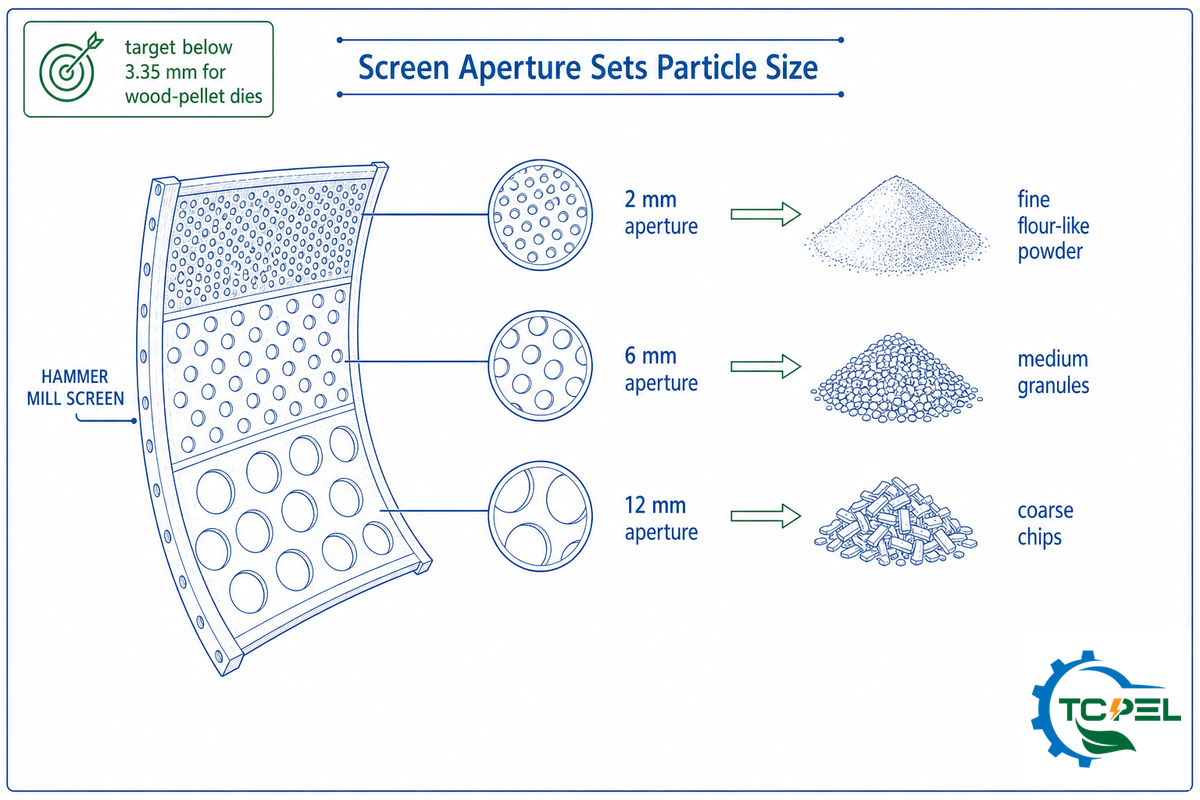
While the screen is responsible for controlling the size of the particle, the optimal aperture will vary depending on the feedstock and the end product. Typically, wood-pellet dies are able to withstand processing when feedstock size is at or below 3.35mm in order to extrude efficiently. In this case, a 2 to 4mm screen is usually a reasonable beginning for pelletization. Both combustion and gasification are tolerant of a coarser grind. In the case of fibrous straw, a larger screen opening is required in order to facilitate the removal of larger particles, and to prevent bridging or blinding. Friable husk, conversely, passes through a smaller screen opening with greater ease, releasing fine particles cleanly.
A common wood-pellet specification cited, ISO 17225-2 (which also formed the basis for ENplus), is only for wood pellets. If you are processing straw, husk or other non-wood biomass into pellets, the corresponding size specification will be ISO 17225-6 for graded non-wood pellets, which includes herbaceous, fruit and mixed biomass. For example, with the 2021-2024 update to ENplus, criteria such as “coarse fines” and “proportion of pellets below 10mm” were added, thereby more directly linking the grind consistency with pellet grade.
💡 Worked example, picking a starting aperture
The goal: wood pellets, with feed 3.35 mm. Start with a 3mm screen. Should the pellet mill produce a large proportion of fines or display low durability, try a 2.5mm screen but anticipate increased grinding energy and monitor the die for straight-through passage of fines. If you intend to process straw to achieve a similar particle size, it’s generally better to use a coarser screen one level coarser, typically a 3-4mm opening with more screen area, as Bridging will be more of an issue than a lack of fineness. Roughly 3.35mm = 6 mesh, 2mm = 10 mesh, and 1mm = 18 mesh.
Grinding Energy and Moisture: The Two Levers Behind Cost per Ton
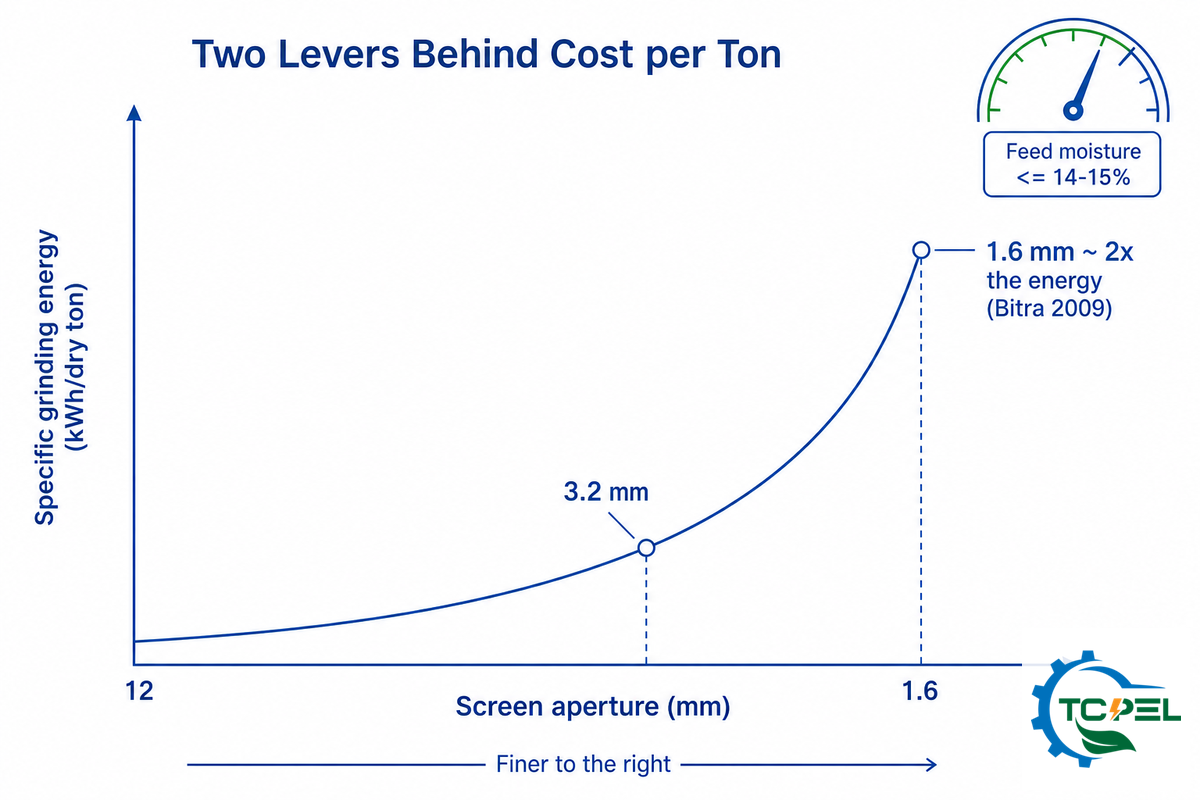
Specific grinding energy, kilowatt-hours per ton, is where feedstock and screen choice hit the electricity bill. Published figures, drawn from different studies and measurement bases (grinding-stage versus whole-process, dry ton versus ton), so read them as indicative magnitudes rather than a like-for-like ranking, span a wide band: roughly 11 kWh/dry ton for dry wood chips (a low energy consumption case), 14–18 kWh/t for Miscanthus energy grass, and about 26 kWh/dry ton for corn stover through a hammer mill. Peer-reviewed work reports ~27.6 kWh/Mg for switchgrass at a 3.2 mm screen.
📐 Engineering Note, The Screen-Halving Energy Penalty
As the screens shrink down for fine grinding, you pay for energy: the screen with a 1.6 mm aperture used on wheat straw has nearly double the total specific grinding energy compared to a 3.2 mm screen according to Bitra et al. study (Powder Technology, 2009) – a single-feedstock lab test, not a fundamental truth. Note the boundary condition: Screen aperture is only one option with tip speed, hammer pattern and feed rate; also consider how tip speed and angle shift with feed. Don’t try for a finer grind than your pellet die and throughput demand.
Those micrometers cost money.
Moisture is the second lever. Feeding above ~14-15% moisture content will blind the screen, smear material, choke throughput, and ramp up energy (which is why drying often precedes or goes along with grinding). Wet, fibrous material is a primary area where a hammer mill begins to falter. (We’ll get to that in a moment).
Hammer Mill vs Roller Mill, Crusher, Chipper and Shredder for Biomass
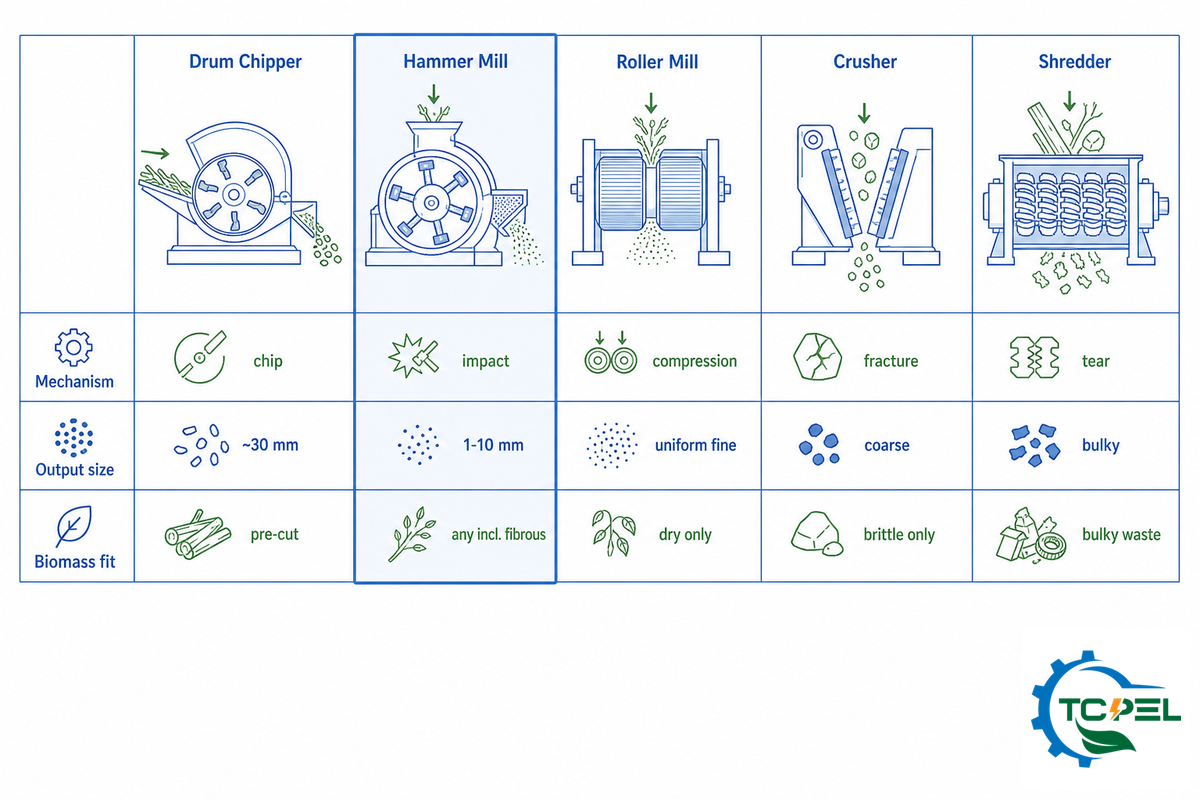
How is a biomass hammer mill different from a wood chipper or crusher?
Biomass hammer mill vs wood chipper. A wood chipper and a biomass hammer mill perform distinct and complementary tasks. The wood chipper (or crusher) does the first and coarse chipping – turning logs and slash into around 30 mm wood chips. Then, the hammer mill grinds down these wood chips, plus sawdust and other agri residue, to the millimeter level required by a pellet or briquette press.
Most operators mill to 2-4 mm, then feed the pelletizer directly.
✔ Where a hammer mill wins
- Fine, uniform particles (1–10 mm) for pelletizing
- Handles mixed, dry feedstock and screen changes easily
- High capacity per dollar of capital
⚠ Where it struggles
- Wet feedstock (>15%) blinds the screen
- High-silica residue accelerates hammer/screen wear
- Fine dust raises a combustible-dust risk
| Machine | Output size | Best for | Weak point |
|---|---|---|---|
| Chipper | ~10–50 mm chips | Logs, branches (first cut) | Not fine enough for pellets |
| Hammer mill | 1–10 mm | Dry chips, sawdust, straw, husk | Wet feed, high-silica wear, dust |
| Roller mill | Consistent flakes | Dry, free-flowing grain | Poor on fibrous biomass |
| Rotary shear | Coarse–medium | Wet, fibrous herbaceous feedstock | Not as fine as a hammer mill |
| Shredder / crusher | Coarse | Bulky waste wood, pallets | Pre-stage only |
Truth be told, hammer mill: isn’t always the best choice: In a DOE/INL herbaceous feedstock project in the US, they removed a second stage hammer mill and replaced it with a rotary shear that was less moisture-sensitive, operated at a higher throughput, and consumed less power on wet/fibrous material. If your feedstock will be routinely wet straw or grass, consider a rotary shear instead of a hammer mill before purchasing. For a related look at coarse pre-stage machines, see our wood crusher vs shredder guide.
Types and Configurations for Biomass Duty
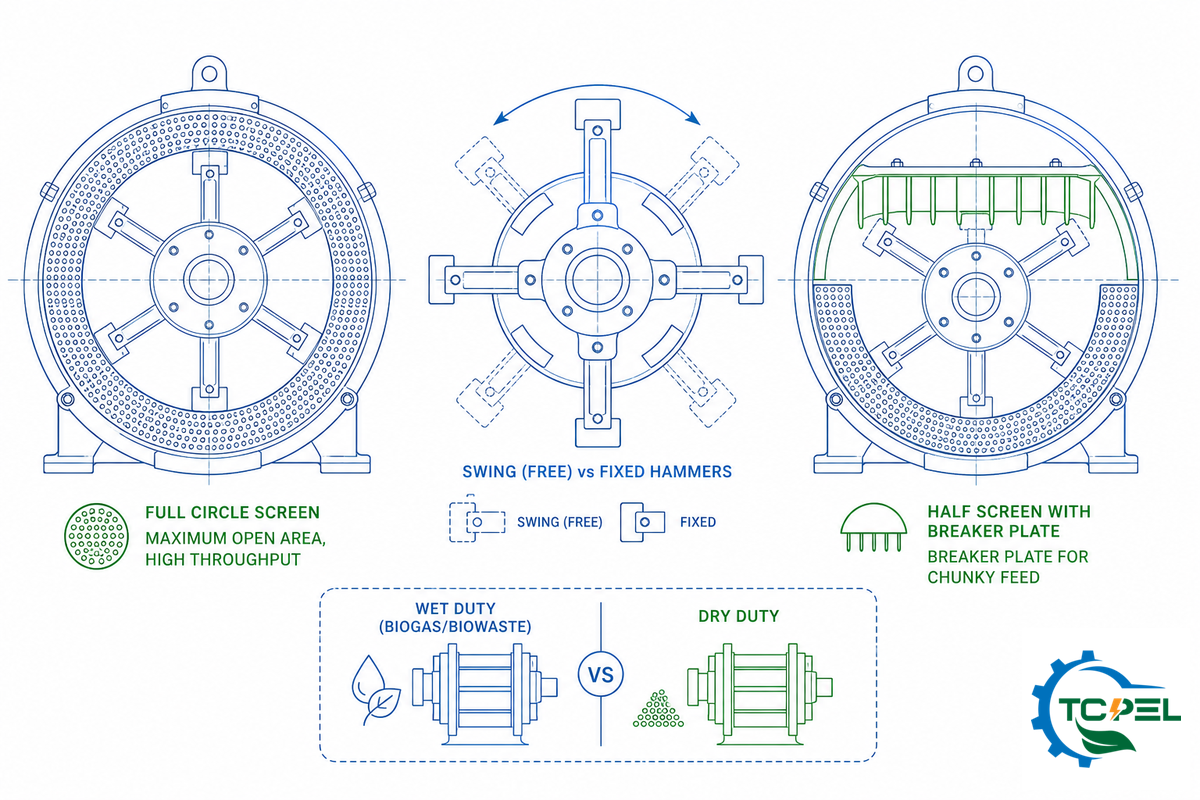
In practice, matching the wrong discharge to a light feedstock such as sawdust is a costly mistake — pneumatic recirculation can cut throughput by 20–30% and overheat the grinding chamber.
Biomass hammer mills range from a small hammer mill for wood, sized for home use and small scale sites, up to plant-scale units. After the feedstock has directed you to one, the setup you use to operate it will dictate the hammer mill’s working efficiency and performance for your material:
- Full circle screen / half screen – Full circle screens ensure maximum open area to give high-capacity throughput whilst the half screens have a breaker plate for dealing with larger, chunkier feedstock; some designs stage the rotor concentrically, as in multistage hammer mill patent WO2018053600A1.
- Horizontal or vertical? the horizontal version is most widely used but vertical designs are great for either very light or sticky products
- Gravity vs pneumatic discharge – built-in fan and cyclone convey the finished product, fine and light bulk solids, into storage; draw fine biomass through screen; handy for husk and sawdust; heavier chip material may fall via gravity
- Wet vs dry operation: Some hammer mills are specifically for wet waste like biogas or biowaste. In a pelleting mill most operations would expect the feed material to be dried first, using a managed hopper and a controlled feeder for stable operation.
Sizing a Biomass Hammer Mill: Capacity, Power and Screen Together
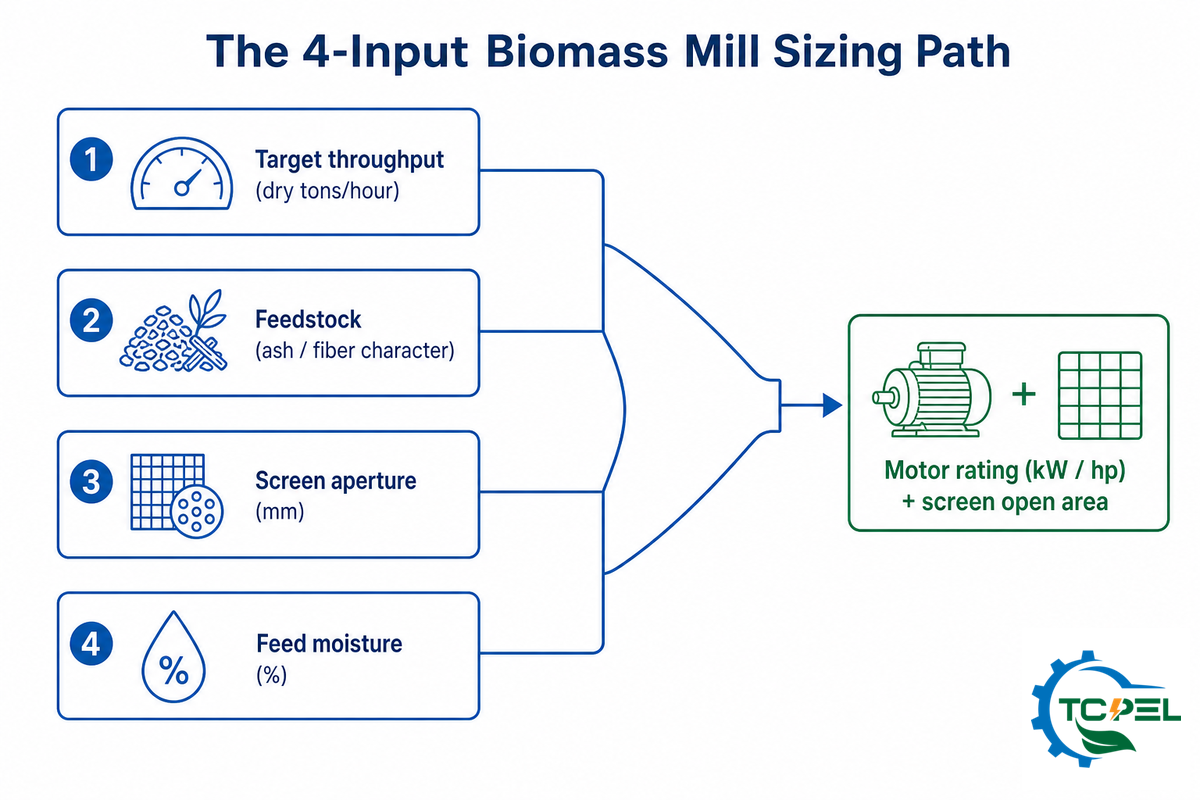
Sizing isn’t “pick a capacity”. Capacity, motor power, screen aperture, tip speed, it’s all one integrated choice. A logical process:
The 4-Input Biomass Mill Sizing Path
- Feedstock – determine class and ash/silica (from the matrix above); high-silica feedstock derates throughput and shortens wear-part life.
- Target particle – set by end use (≤3.35 mm for pellets); this sets the screen band.
- Throughput – your target number of dry tons per hour reduced to account for hard-to-handle feedstock.
- Power + tip speed – Size the motor — its rating in kilowatts or horsepower — from specific energy (kWh/t) multiplied by throughput, with headroom. Aim tip speed to fineness needed, without creating excessive fines.
A worked cut: to grind 3 dry tons/hour of corn stover (~26 kWh/dry ton) to pellet feed, budget on the order of ~78 kW of grinding energy plus drive and headroom – then confirm against the vendor’s tested curve for your material. DOE/INL depot modelling puts first-stage grind capacities at 2, 5 and 8 dry tons/hour as natural tiers to size against.
Common Biomass Hammer Mill Problems: Blockage, Blinding, Fines and Fire Risk
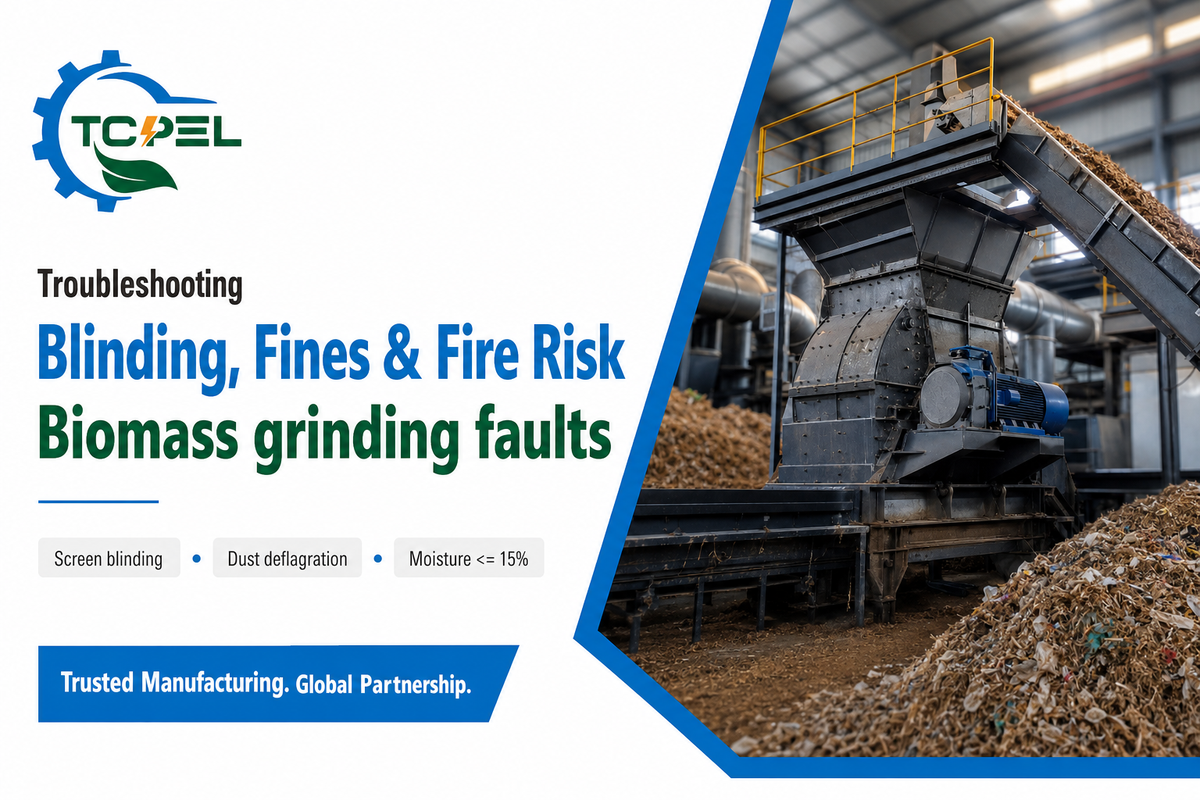
What is the problem with hammer mills?
Most hammer mill problems fall into four recurring failure modes. Screen blinding and plugging – the #1 culprit – usually starts when feed moisture climbs above 14-15%, which cuts capacity and spikes amps. Abrasive silica wear, tramp metal or stone, and combustible dust round out the set. Each failure mode below carries a definite fix.
- Screen blinding (wet/sticky feed): dry down to <15% , or increase aperture, or air to remove fines.
- Abrasive screen/hammer wear: on high-silica residue, plan replacement within a few weeks, use hardfaced or carbide tipped hammers and pre-clean the feedstock.
- Tramping Metal & Stone: Agriculture carries lots of earth and dirt on crop residue – install a magnet & stone trap before the rotor.
- Combustible dust: fine biomass dust is a real deflagration hazard (see below).
⚠️ Important, dust deflagration risk
Your US OSHA Technical Manual notes that as particle size decreases and as moisture decreases – precisely what a hammer mill accomplishes – combustible dust hazard increases. It refers to NFPA 61 and NFPA 654 for design principles. Since explosibility (Kst, minimum ignition energy) is material- and condition-dependent, test your actual feed material’s dust characteristics as part of engineering.
Dust deflagrations occurring in processing and collection equipment can develop into explosions.
What Drives Biomass Hammer Mill Cost, and a Pre-Purchase Checklist

Open-market supplier prices differ so much it’s hard to cite effectively, but public techno-economic modeling from DOE/INL offers a plausible range. US DOE/INL biomass depot modeling (10 dry ton/hr) suggested hammer mill capital costs between roughly US$103,200 and US$515,200 depending on configuration, and a total processing cost from US$27.91 to US$69.77 per dry ton.
Treat these as order-of-magnitude estimates, not purchase prices – your actual costs depend on electricity, hardware robustness, replacement-parts system and feedstock. Whether you are pricing a biomass hammer mill for sale, weighing a small biomass hammer mill for a farm, or vetting manufacturers, cost turns on power, build quality and the wear-part system more than the sticker.
Cost drivers to consider: installed motor power (energy per ton is a lifetime cost), heavy-duty build & bearings, wear-part system (how quickly and cheaply can you change hammers and screens on abrasive feed-stock), the feeder/discharge arrangement, and certification (CE/ ISO 9001).
- Request an actual throughput curve on your feedstock instead of just a published value.
- Confirm hammer & screen metallurgy and quoted wear life for high-silica material.
- Check screen-change design (how many minutes, how many bolts).
- ✔Verify magnet/stone-trap, dust management and CE/ISO documentation.
💡 Not ready for a quote?
Send us your feedstock, moisture and target particle size and our engineers will suggest a screen-size starting point and model band – a low-commitment way to sanity-check your sizing before you shortlist suppliers.
Biomass Size-Reduction Outlook 2026: Feedstock Diversification and What It Means for Buyers
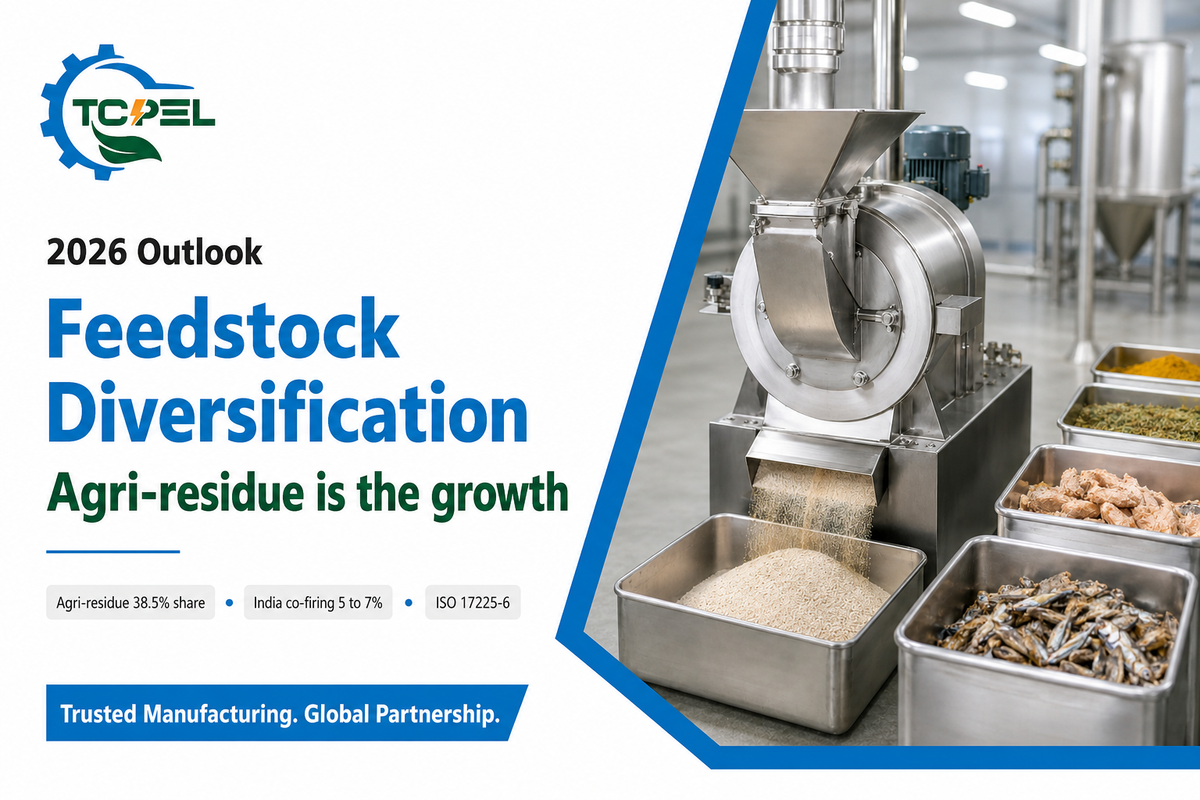
The important shift isn’t the market’s size – it’s what’s being ground.
Clean wood feedstock is tightening: the USDA 2025 EU wood-pellet report notes EU production is expanding but not keeping up with demand because sustainable wood supply is limited. Meanwhile, market analyses put agricultural residue as a large and rising share of global biomass pellet production, and national policy is pulling more of it in, India, for one, steps its biomass co-firing mandate for thermal power from 5% to 7% across 2024–2026.
For a buyer, the implication is concrete: the size-reduction machinery you specify today is more likely to see straw, husk and stover tomorrow, not just clean sawdust. Spec for feedstock flexibility and an abrasion budget now – carbide-ready hammers, easy screen changes, a magnet and stone trap – rather than buying for clean wood and being surprised. (For context, the biomass-pellet market is projected to grow at roughly 7% CAGR through the mid-2030s; treat that as background, not the reason to buy.)
Biomass Hammer Mill FAQ
Q: What raw materials can a biomass hammer mill handle?
View Answer
A biomass hammer mill grinds many feedstocks: wood chips, sawdust and shavings, plus agricultural residue such as wheat and rice straw, rice husk, corn stalks, sugarcane bagasse, palm EFB, bamboo and energy grasses like Miscanthus. The machine copes with all of them, but grinding energy, screen life and hammer wear differ sharply, clean wood is easy, while high-silica husk and straw are abrasive and shorten wear-part life. Match the screen, hammer metallurgy and moisture control to the specific material rather than assuming one setup fits every feedstock.
Q: How is a biomass hammer mill different from a wood chipper or crusher?
View Answer
They do different jobs in sequence rather than competing. A chipper or crusher makes the coarse first cut, reducing logs and slash to roughly 10–50 mm chips. A hammer mill then grinds those chips, along with sawdust and crop residue, down to the 1–10 mm range that a pellet die or briquette press needs. Crushers fracture brittle material; a chipper slices wood into chips; a hammer mill pulverises by impact and screens the output to a controlled size. Most pellet plants run a chipper and a hammer mill together, not one instead of the other.
Q: What is the problem with hammer mills?
View Answer
The three recurring problems are screen blinding, abrasive wear and dust. Feedstock above about 14–15% moisture smears and blinds the screen, which chokes throughput and raises energy use. High-silica residue such as rice husk abrades hammers and screens quickly, forcing frequent replacement. And the fine, dry dust a hammer mill produces is a combustible-dust hazard that must be managed to NFPA guidance. All three are manageable with drying, the right metallurgy and dust control, but they are the reasons a hammer mill can disappoint on the wrong feedstock.
Q: What are the disadvantages of a hammer mill versus a roller mill?
View Answer
A hammer mill uses more power and generates more heat and dust than a roller mill, and its screens can clog on wet feed. Roller mills give more uniform particles on dry, free-flowing grain with lower energy, but it performs poorly on fibrous biomass like straw and wood. For biomass pelletizing the hammer mill usually wins on fibre handling and fineness; the roller mill’s advantages mostly apply to grain feed.
Q: What particle size does a biomass hammer mill produce for pelletizing?
View Answer
For wood pellets, feed is typically ground at or below 3.35 mm, using a screen around 2–4 mm depending on feedstock and die.
Q: Does grinding rice husk or straw wear hammers faster than wood?
View Answer
Yes, substantially. Rice husk and straw carry roughly 15–20% ash that is largely silica, up to about 95% SiO₂ in husk ash, and silica abrades steel like fine sand, independent of how “hard” the plant is. That is why high-silica residue can shorten hammer and screen life to a fraction of what clean wood allows, and why carbide-tipped hammers and feedstock pre-cleaning pay off on these materials.
Why We Wrote This Guide
Most hammer-mill pages describe one machine. We built this around biomass feedstock diversity because that is where buyers get burned, a mill sized for clean sawdust can fail on rice husk. The figures here are compiled from public DOE/INL techno-economic data, peer-reviewed comminution and ash-characterisation studies, and OSHA/ISO standards, cross-checked against field practice. Reviewed by the ALLWIN INTERNATIONAL CO., LTD (TCPEL) technical team, which has supplied biomass size-reduction and pellet-line equipment to customers in more than 60 countries.
Sizing a mill for your feedstock?
TCPEL’s GXP biomass hammer mill series is built for mixed and abrasive feedstock, with carbide-ready hammers and quick screen changes.
References & Sources
- Corn Stover Anatomical Fractionation & Hammer-Mill Grinding Energy — US Department of Energy (FCIC)
- Pilot-Scale Pelleting: Feedstock Grinding & Specific Energy — Idaho National Laboratory
- Rice Husk & Rice Straw Ash Silica Characterisation — NC State BioResources
- Bitra et al., Hammer-Mill Energy & Particle Size of Biomass — via US EPA HERO
- Biomass Hammer-Mill Blade Wear Mechanisms — US DOE PAGES (ORNL/INL)
- Combustible Dust — Technical Manual (NFPA 61 / 654) — US OSHA
- ISO 17225-6:2021 — Graded Non-Woody Pellets — ISO
- EU Wood Pellets Annual 2025 — USDA Foreign Agricultural Service
Related Articles
- Wood Hammer Mill Guide — working principle, screens & anatomy
- Wood Crusher vs Shredder — choosing the coarse pre-stage
- Rotary Dryer — drying biomass below 15% before grinding
- Biomass Pellet Machine — the densification step downstream
- Wood Pellet Production Line — how the six stages connect
- Pellet Cooler Guide — finishing the pellet