Get in Touch with TCPEL

Updated June 2026 · Reviewed by the TCPEL technical team.
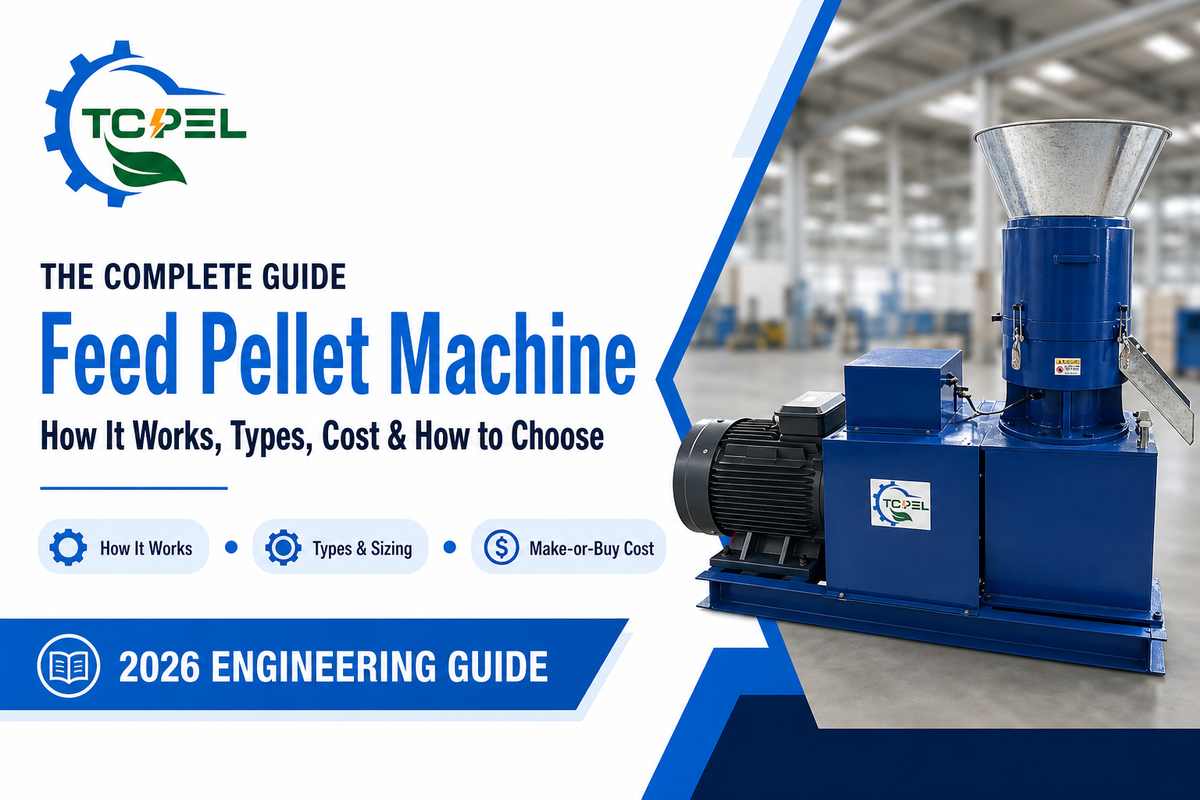
A feed pellet machine is a machine that presses ground feed mash through a steel die so that roller pressure and friction heat bind it into dense, uniform pellets. That single sentence hides most of the decisions a buyer actually faces: which die architecture, what size, which feed materials, and whether running your own machine beats buying bagged feed at all. This guide answers those questions with sourced data, not sales copy, so you can size, choose, and run the right machine for your operation.
In one paragraph: A feed pellet machine compresses ground feed mash through a perforated die, where roller pressure plus steam-conditioning heat (roughly 65–90 °C) gelatinize starch and bind the mix into pellets, typically at 60–6,000 kg/h depending on motor power. The pellet form mainly lifts animal intake and cuts feed waste — but only when pellet quality stays high, and only when the economics of your scale work out.
Quick Specs, Typical Feed Pellet Machine Envelope
| Capacity range | 60–6,000 kg/h (farm to industrial line) |
| Motor power | 3–132 kW (electric, diesel, or PTO) |
| Die hole sizes | 2–12 mm (matched to species) |
| Conditioning temp | 65–90 °C (steam) |
| Mash moisture window | 12–18% (material-dependent) |
| Pellet durability target | 92–95% PDI; under 10% fines |
What Is a Feed Pellet Machine, and How Does It Turn Mash Into Pellets?
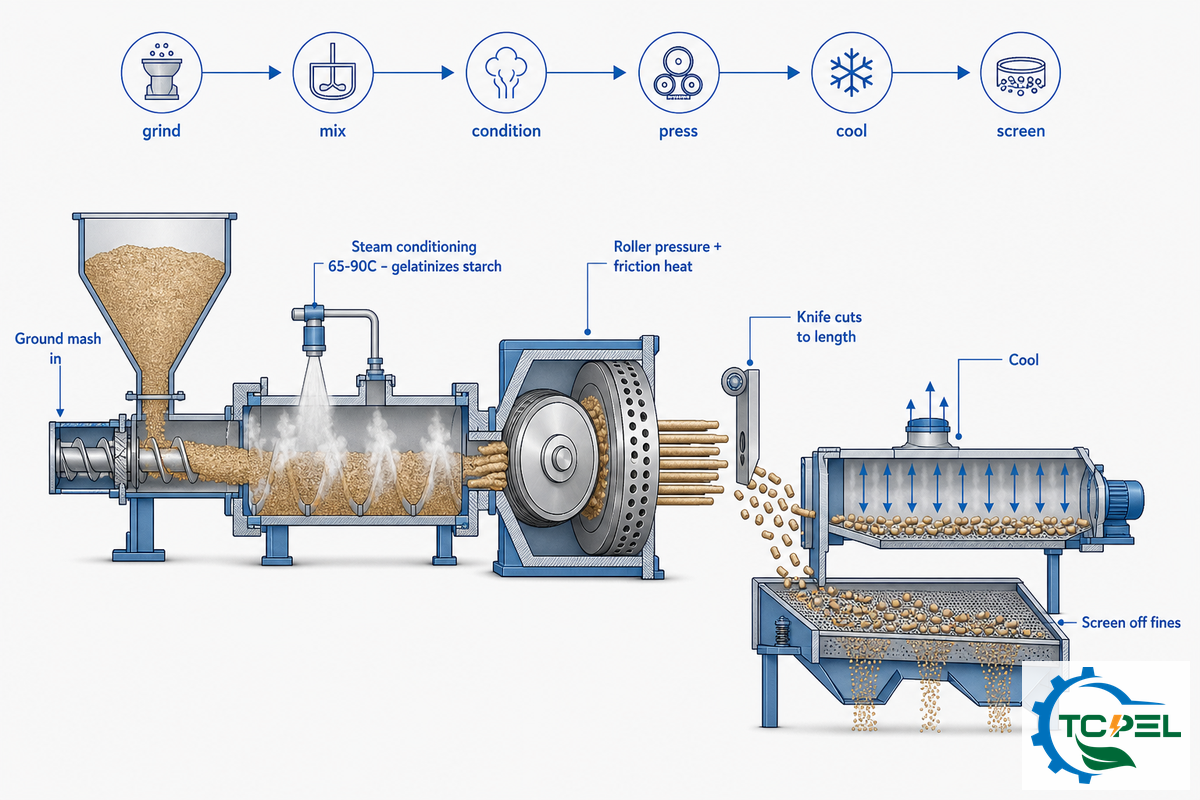
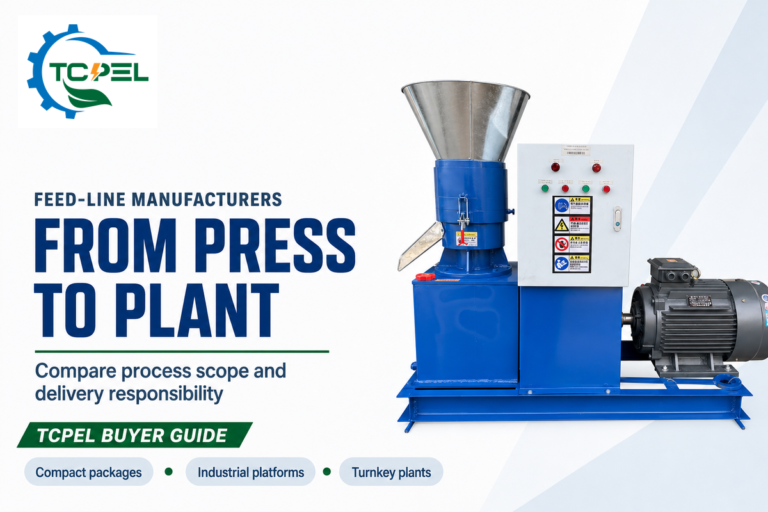
A feed pellet machine, also called a feed pellet mill, pellet press, pellet making machine, or pelletizer, is a machine that forces conditioned feed mash through the holes of a hardened steel die, where rotating rollers compress it into cylindrical pellets that a knife cut to length.
A pellet mill sit at the center of a short line: a grinder, hammer mill, crusher, or pulverizer cuts ingredients down first, then you mix, condition, press them through the die’s disc of holes, cool, and screen off fines.
Here’s what physically happens, and why it matters. Steam is injected into the mash before the die [WHAT]. The moisture and heat soften the feed and begin to gelatinize starch, Penn State Extension notes that conditioning plus die pressure triggers “chemical and irreversible reactions,” so part of pelleting is genuinely cooking, not just shaping [WHY], per Penn State Extension. That’s why a cold, poorly conditioned home pellet misses much of the digestibility benefit even when it looks like a proper pellet [SO WHAT].
The granted patent CA2769985C documents a practical detail most buyers miss: where you add moisture matters. Water blended in cold at the mixer becomes bound during gelatinization and is retained better than water added at the conditioner, raising pellet durability while cutting pellet-mill energy by 14–19% per ton across three commercial mills.
💡 Key takeaway
Pelleting is conditioning + compression + cooking. Skip the steam, the cooler, or the fines screen and you are not really making feed pellets — you are making fragile lumps that break back into mash.
Why Pellet Your Feed? The Measurable Case Over Mash and Bagged Feed
Pelleting pays off mainly by lifting feed intake and cutting waste, not, as is often claimed, by magically improving digestion. In a trial of 2,800 Ross 308 broilers, the best crumble-pellet diet returned a feed conversion ratio of 1.31 versus 1.49 for mash, with body-weight gain of 951 g versus 757 g, per a study in Veterinary Medicine International (PMC). Birds simply eat more of a pellet, intake can run up to 10% higher than on mash.
But that advantage has a hard precondition. Penn State Extension reports that at least 40% intact pellets must reach the feed pan before any body-weight or feed-conversion benefit appears, and each 10-percentage-point rise in intact pellets buys about 0.4 points of feed conversion. A machine that run hot and fast but spits out mostly fines delivers no gain over mash, research summarized by industry agronomists found that poor-quality pellets performed the same as cheaper meal.
Biosecurity: Real, But Not Sterilization
Conditioning heat does reduce pathogens. The U.S. USDA-FSIS NACMCF report states pelleting has been reported to cut Salmonella by 50–93%, mainly through steam during conditioning. Yet the kill is temperature-dependent: a thermal death-time curve compiled by the American Feed Industry Association and hosted by UC Davis Food Safety shows Salmonella reduction climbing from roughly 90% near 58 °C to near-total only as the product approaches ~75 °C, and warns that feed pelleted at a relatively low temperature is unlikely to be fully decontaminated. Europe’s feed federation FEFAC is blunt about the limit: “the usual time/temperature combinations used in the commercial pelleting process don’t effectively kill bacteria but may reduce their presence.” Treat pelleting as a meaningful reduction step, not a license to feed contaminated grain.
✔ What pelleting genuinely buys you
- Higher intake and faster gain (up to ~10% more intake)
- Less feed waste and ingredient segregation
- Denser feed, cheaper storage and freight
- A real, if partial, pathogen-reduction step
⚠ What it will not do
- Improve results below 40% intact pellets
- Sterilize feed at typical commercial temperatures
- Fix a nutritionally unbalanced ration
- Always beat mash, some studies show no difference, and mash can mean lower death loss
Types of Feed Pellet Machines: Flat-Die, Ring-Die, and Extruders Compared
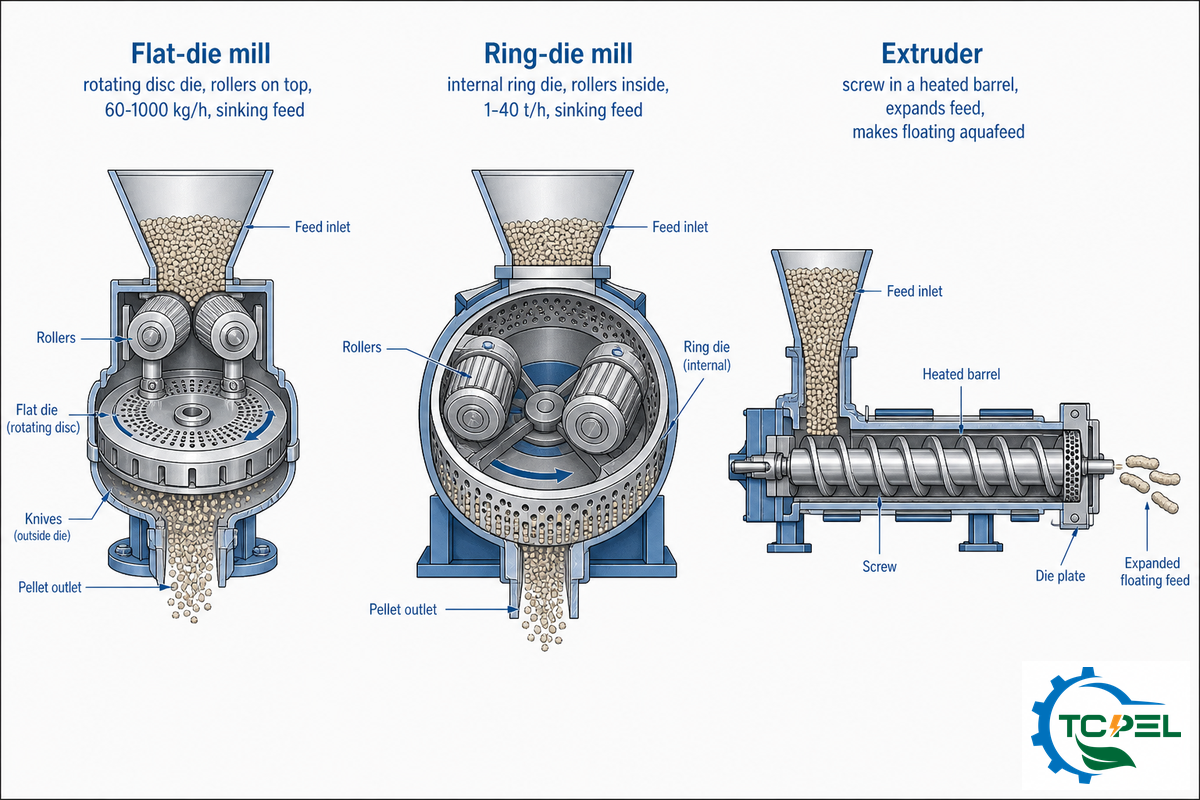
Three machine architectures cover almost every feed job: the flat-die pellet mill, the ring-die pellet mill, and the extruder. A biomass pellet machine and a flat die pellet mill share these frames but are tuned for sawdust versus feed. They aren’t interchangeable, and the right pick depend more on your scale and whether you need sinking or floating feed than on price alone.
| Dimension | Flat-die pellet mill | Ring-die pellet mill | Extruder |
|---|---|---|---|
| Typical capacity | 60–1,000 kg/h | 1–40 t/h | 0.2–10 t/h |
| Best fit | Farm / small mill, mixed materials | Continuous commercial feed mill | Floating aquafeed, petfood, full-fat soy |
| Feed it makes | Sinking | Sinking | Floating or sinking |
| Energy / throughput | Higher energy per ton, flexible | More efficient at scale | Highest energy; preconditioning >18% moisture |
| Capital cost | Lowest | Mid–high | Highest |
| Repair access | Easiest (open chamber) | More involved | Specialist |
Synthesis of the Feed Pelleting Reference Guide and peer-reviewed mill evaluations (see References).
Press or Extrude? A 3-Branch Routing Tree for Machine Type
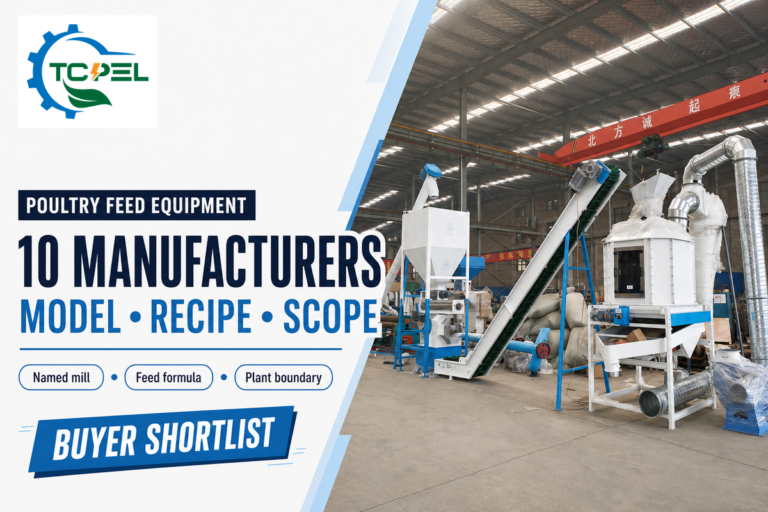
Here’s the decision in three branches, we call it the Press-or-Extrude Routing Tree. If you need floating fish feed, you need an extruder; the Feed Pelleting Reference Guide notes extrusion is the route for feeds a conventional pellet mill can’t make, including floating aquatic feeds, petfood, and full-fat soy. If you make sinking feed at farm or small-mill scale on varied materials, choose a flat-die mill. If you run continuous commercial tonnage above roughly 1 t/h, a ring-die mill is more efficient. One more field reality: feed-spec flat-die mills (where the die rotate) and wood-spec mills (where the rollers rotate) are different builds, practitioners warn that cheap import mills sold for “any material” are rarely rated for hardwood. At plant scale, the pellet mill is just one feed machine inside a full pellet production line of processing equipment — grinder, mixer, conditioner, cooler, and packer — and across animal feed processing the trend is toward integrated feed production with inline controls.
What Is the Difference Between a Pellet Mill and an Extruder?
A pellet mill presses conditioned mash through a die under roller pressure to make dense, sinking pellets. An extruder adds high shear, heat, and moisture in a barrel, then forces the cooked dough through a die so it expands and traps air, producing pellets that can float. Pellet mills are cheaper to buy and run and handle most livestock and poultry feed; extruders are the only practical route for floating fish feed and certain heat-processed or full-fat formulas.
What Can You Pellet? Feed Materials and Formulation by Animal
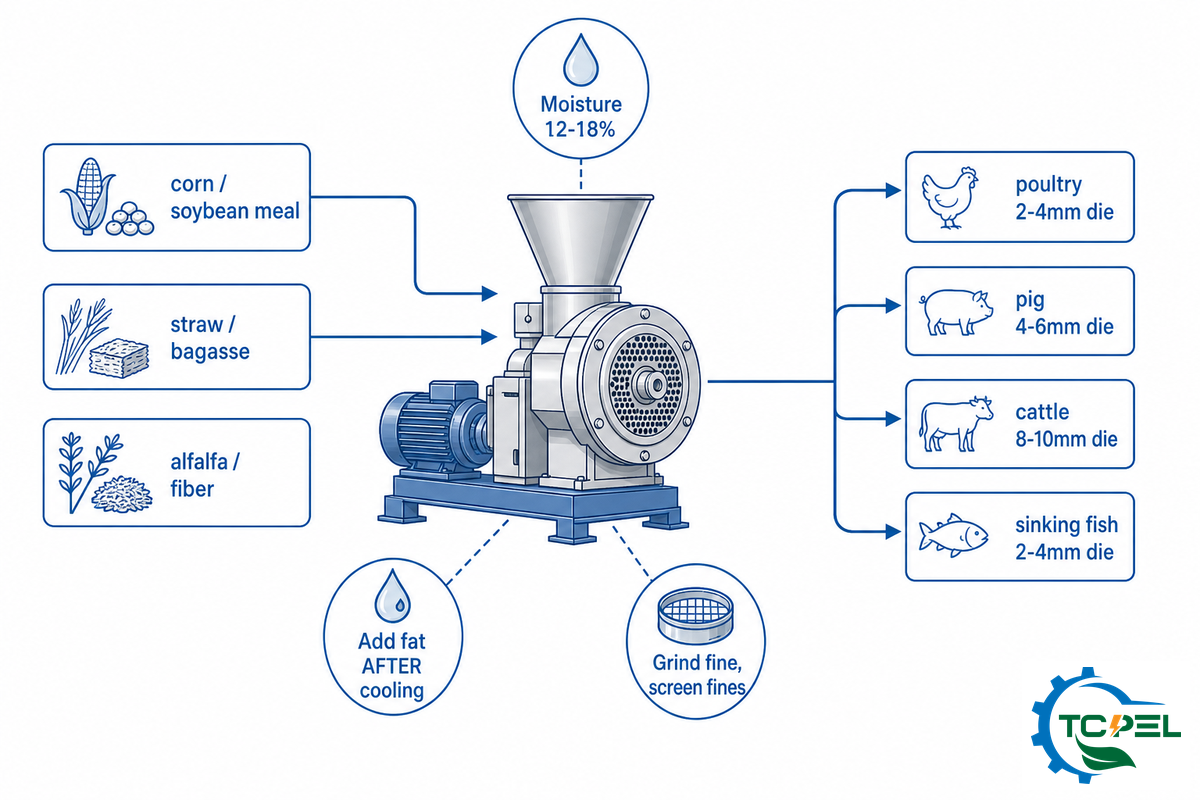
A feed pellet machine will press almost any ground, balanced ration — grain, soybean meal, straw, sugarcane bagasse, even ground nut shells — but pelletability and nutrient value are two different questions. That same die turns out an animal feed pellet or a poultry feed pellet once the formula fits the species.
Get the moisture, fiber, and fat right and the pellets hold together; get the formula right and the animal thrives. The table below maps typical materials and the formulation levers that matter, by animal.
| Animal / stage | Typical base ingredients | Formulation / pellet note |
|---|---|---|
| Broiler (grower–finisher) | Corn, soybean meal, fat, premix | ~21–23% crude protein; corn-soy resists steam, so chase pellet quality with binder/grind, not heat |
| Layer hen | Corn, SBM, limestone, premix | Often kept on mash; if pelleted, keep particle size up for gizzard health |
| Pullet / starter | Corn, SBM, fine premix | Usually crumbled (broken pellet) for small beaks |
| Beef cattle (finishing) | Grain, byproducts, roughage, molasses | High fiber/molasses; ruminants gain less from starch gelatinization than monogastrics |
| Dairy cattle | Grain mix, protein meal, minerals | Pelleted concentrate fed alongside forage; watch heat-labile additives |
| Pig (grower–finisher) | Corn, SBM, wheat, fat, premix | Pelleting lifts energy digestibility, but avoid over-fine grinding (ulcer risk) |
| Sinking fish (tilapia, catfish) | Fishmeal/SBM, grain, binder | Pellet mill OK for sinking feed; floating feed needs an extruder |
| Rabbit | Alfalfa, grain, fiber sources | High forage fiber binds well; firm pellet preferred |
| Goat / sheep | Grain, byproducts, roughage | Ruminant; moderate hardness, avoid excessive fines |
| Pet food (dog/cat) | Meat meal, grain, fat | High-fat / specialty formulas usually need an extruder, not a pellet mill |
Two formulation levers move pellet quality more than the machine does. Industry research attributes roughly 40% of pellet quality to the recipe and ingredient choice, and adding fat at the mixer before the die is “the worst thing for pellet quality” — apply fat after cooling instead. Moisture is the other lever: too dry and pellets crumble into fines, too wet and they soften and jam, with the workable window usually 12–18% and material-dependent.
Heat has a hidden cost in the formula too. Studies in Animals and the journal hosted on PMC show pelleting and extrusion above ~100 °C significantly degrade added vitamins (E, B-complex), so on-farm pelleting without heat-stable premixes can quietly make feed less nutritious than the mash it replaced.
⚠️ Ingredient safety is separate from pelletability
A machine can physically pellet a moldy grain, but that does not make it feedable. The U.S. FDA sets aflatoxin action levels as low as 20 ppb for dairy and immature animals (with higher tiers for finishing beef), per FDA Sec. 683.100. Test inbound ingredients for contaminants before they ever reach the die — pelleting will not remove a mycotoxin.
How to Choose and Size a Feed Pellet Machine
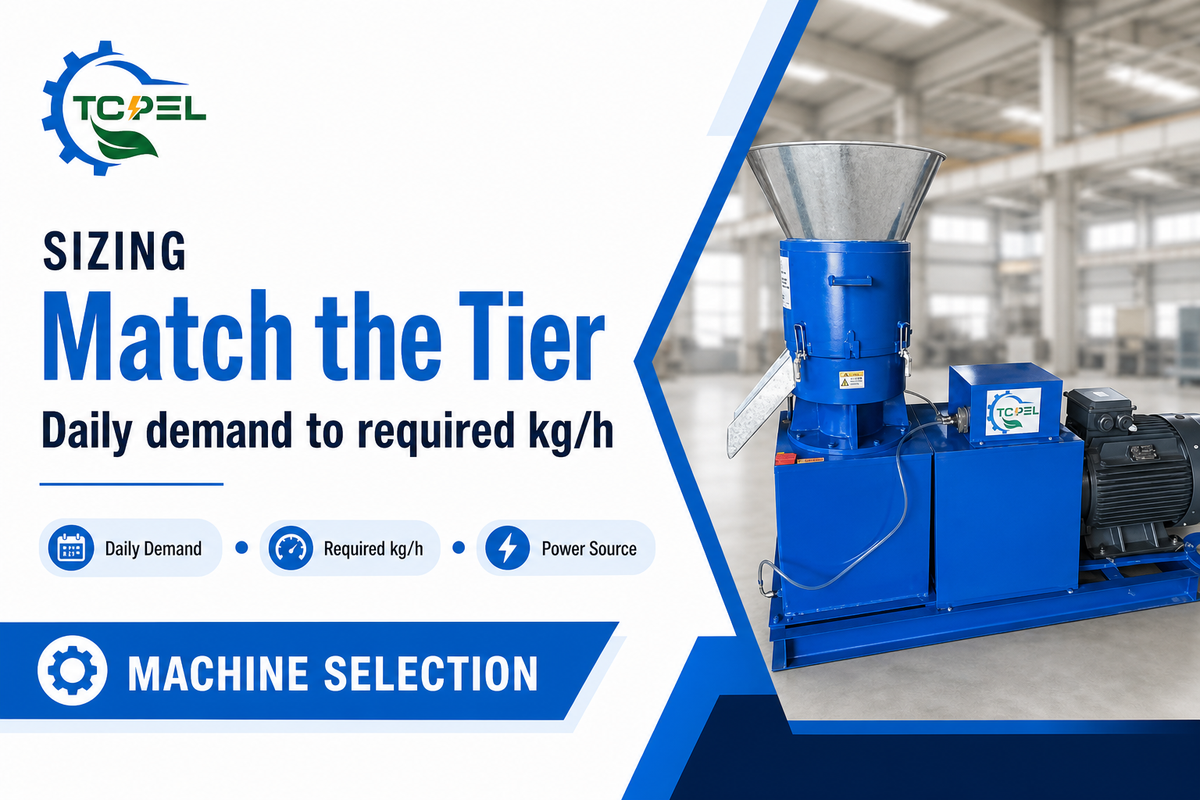
Sizing a feed pellet machine starts from your animals, not from a catalog. Work out your daily feed demand, divide by the hours you’ll actually run, add a utilization margin, and the required kg/h falls out. Then match power source to your site.
Feed Demand Throughput Calculator: Size It in 3 Steps
The Feed Demand Throughput Calculator
- Daily demand = head count × daily intake per head.
- Required kg/h = daily demand ÷ daily run hours ÷ 0.8 (utilization margin).
- Match a class to that kg/h, then add headroom for growth.
Worked example. 500 laying hens × 0.12 kg/day = 60 kg/day. Running a 2-hour batch: 60 ÷ 2 ÷ 0.8 ≈ 38 kg/h, an entry-tier farm machine, not an industrial line. Field data behind our capacity sizing tool shows an entry-tier press sustains roughly 50–150 cattle or 125–400 birds, which lines up with that math.
Power source is the other half of the decision. On reliable three-phase grid power, an electric machine is simplest and cheapest to run; a 220V single-phase unit suits home use and small farm use. Where rural supply is unstable, a diesel engine or PTO drive — or a dual electric-plus-diesel prime mover — keeps a large-capacity line going through outages. When you compare machines, weigh the build too: stainless steel contact parts resist corrosion, and a low noise, low maintenance design with an adjustable die gap cuts running cost for the small and medium-sized operations that buy most units; a peer-reviewed evaluation of an on-farm roll-type mill confirms that small machines on a 2 hp motor can still hit a 95.77% pellet durability index, often higher than big commercial units because lower heat preserves pellet integrity, per documented large-die / low-horsepower designs (patent US7785379B2) and field tests. One practitioner tip from rural installers: fit a voltage stabilizer, because what looks like a “broken motor” is often just supply voltage sag tripping the drive.
Can I Make Animal Feed With a Pellet Machine at Home?
Yes, a small feed pellet machine — usually a flat-die unit on single- or three-phase power — will pellet a balanced home ration for poultry, rabbits, or cattle at roughly 50–400 kg/h. The catch is that you still need the full short line: grind to under 3mm, mix and condition to the right moisture, then press through a 4mm, 6mm, or 8mm die, cool, and screen. Skipping conditioning or cooling is the usual reason home pellets crumble.
Below a few hundred kg per day, weigh whether the time and wear are worth it against simply buying bagged feed.
The Economics: Is Making Your Own Pelleted Feed Worth It?
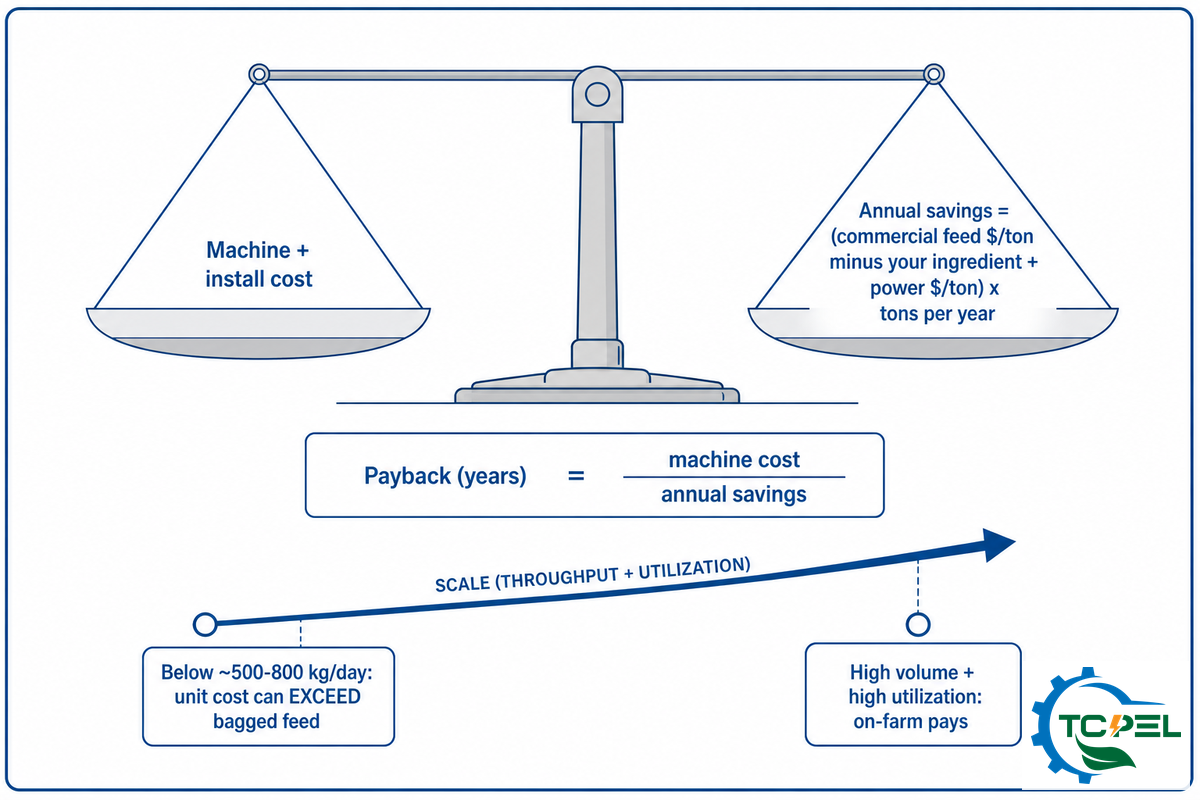
Making your own pelleted feed isn’t automatically cheaper — and at small scale it’s often more expensive. Vendors dodge this, so here’s the honest version. Feed is the dominant cost in animal production, about 70% of total pork production cost, per the University of Illinois review hosted at Illinois (Lancheros et al., 2020), which is exactly why the make-vs-buy math deserves real numbers.
Make-or-Buy Break-Even Calculator
The Make-or-Buy Break-Even Calculator
- Annual savings = (commercial feed $/ton − your ingredient + power $/ton) × tons/year.
- Payback (years) = machine + install cost ÷ annual savings.
The trap. Plug in real small-scale numbers and the spread often collapses. Home mixing typically saves only single-digit percentages per batch, and below roughly 500–800 kg/day of output, with start-stops, manual labor, or unstable raw-material supply, your unit cost can exceed commercial feed. One backyard keeper documented spending about $111 to make 100 lb of feed versus $35 for a commercial bag. Ingredient prices are a range, not an average, so budget at the high end.
Why does scale dominate? Because the binding constraint is purchasing power, not the machine. As one long-time keeper put it after running the numbers repeatedly, feed companies buy grain by the trainload and vitamins and amino acids by the ton, while a small operator buy 50-lb bags by the pound, and some single-grain bags cost more than a bag of complete feed. Machine cost is real too: dies and rollers are consumables, replaced every 500–1,000 operating hours, which industry estimates put at 12–15% of operating cost. None of this means on-farm pelleting never pays, at sufficient volume and machine utilization it clearly can, but the break-even tonnage sit higher than the brochures imply.
⚠️ Compliance status can change the math
Scale does not only change cost — it can change your regulatory category. Under the U.S. FDA FSMA Preventive Controls for Animal Food rule (21 CFR 507), an on-farm operation feeding its own animals may be exempt, while a facility manufacturing animal food for others must run current Good Manufacturing Practices and a written food-safety plan. Crossing from “feeding my herd” into “selling feed” adds compliance cost that belongs in your break-even, not just throughput and grain price.
Operating and Maintaining a Feed Pellet Machine
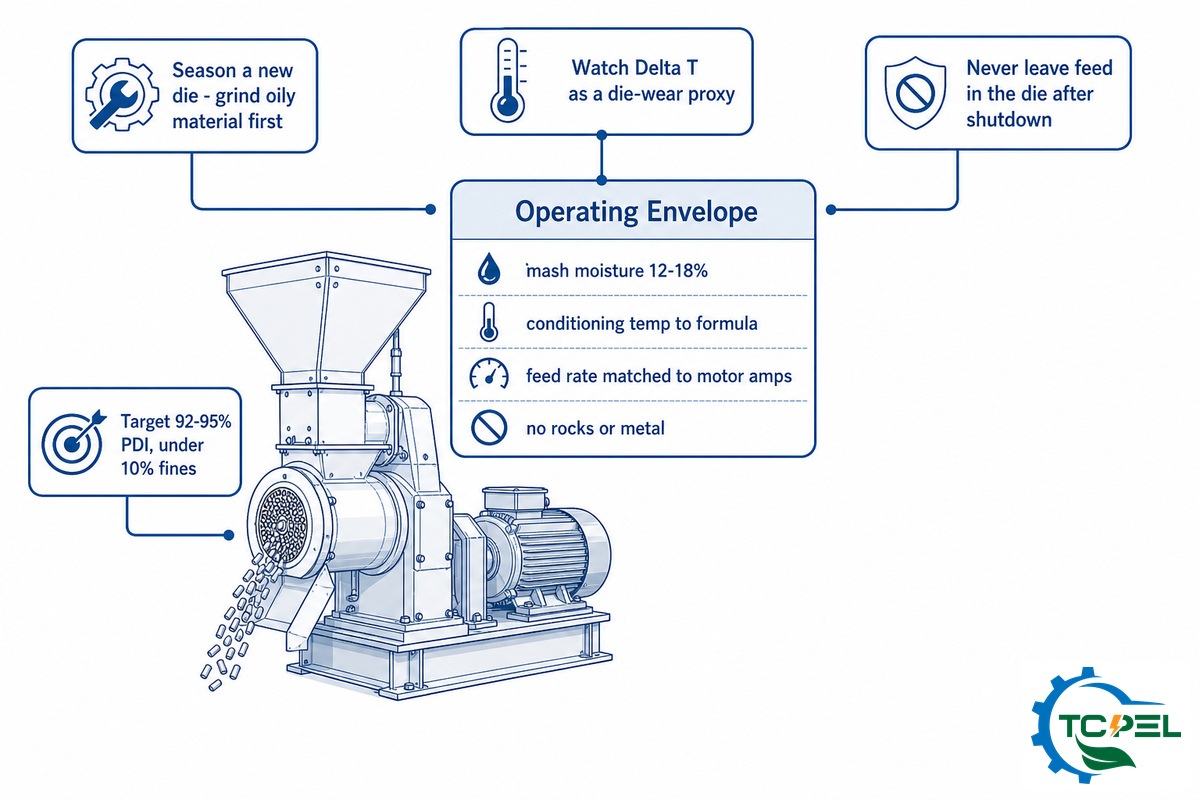
A feed pellet machine rewards process discipline and punishes neglect. The single most useful number to manage is the Pellet Durability Index (PDI): the percentage of pellets that survive a standard tumble test, measured per ASAE S269.5, with high-quality feed targeting 92–95% and fines kept under 10%, per the Kansas State University pellet-quality guide. A 2,691-observation model from a commercial mill found PDI is driven mostly by conditioning temperature, fat, fiber, and humidity, not by the die alone.
Feed Pellet Machine Operating Envelope
Stay inside what we call the Feed Pellet Machine Operating Envelope and most problems disappear: mash moisture 12–18%, conditioning to the right temperature for your formula, feed rate matched to motor amperage, and absolutely no rocks or metal entering the die. Two operator habits matter most. First, break in a new die, its bores are rough from the factory, so season it by grinding an oily material through before real production, or it will jam and extrude powder. Second, never leave feed sitting in the die after shutdown; it sets and clogs the holes.
📐 Engineering Note
Watch “Delta T” — the temperature difference between conditioned mash and the pellets leaving the die, as a die-wear proxy. Granted patent CA2769985C ties a 38–54% reduction in Delta T directly to “die and roll savings.” For biosecurity, don’t trust the dial: place calibrated thermocouples in the product flow so you measure actual material temperature against the ~75 °C threshold needed to reliably reduce Salmonella, and remember the cooler is a top re-contamination point, per the UK Code of Practice for Salmonella in animal feed.
“You have to inject steam or moisture before the die to make pellets form, then run them through a cooler because the compression makes heat, then across a shaker screen to strip fines. In 34 years and hundreds of dies I never broke one making feed, but I watched wood-pellet mills get scrapped with broken dies.”
Safety: Combustible Dust and Moving Parts
Treat a feed pellet line as the dust-and-machinery hazard it’s. U.S. OSHA classifies feed mills and dust pelletizing plants as grain-handling facilities with life-threatening risks: fires and explosions from combustible grain dust, plus crushing and amputation hazards at augers, rollers, and conveyors. Control dust with collection and housekeeping, lock out moving parts before clearing a jam, and never reach into a running die or roller chamber. These aren’t edge cases, they’re the reason grinding, conveying, and pelleting are regulated work.
Feed Pelleting in 2026: What’s Driving Buyer Decisions

Three forces are shaping how operators buy and run feed pellet machines this year, and none of them is a market-size headline. First comes biosecurity tightening: regulators keep sharpening feed-safety rules, with the UK refreshing its Code of Practice for Salmonella in animal feed in June 2026 under EU feed-hygiene regulation 183/2005. Because commercial pelleting reduces rather than sterilizes pathogens, buyers are paying more attention to verified conditioning temperature and cooler hygiene than to raw throughput.
Second comes a feed-cost reset. Despite the common assumption that feed cost only rise, the USDA Economic Research Service forecasts U.S. farm spending on feed to fall about 6.8% in 2026. Lower ingredient prices change the make-vs-buy break-even, and the action item is concrete: if you’re weighing an on-farm machine for 2026, rerun your break-even at current grain prices, not last year’s.
Third, automation is creeping down-market: inline die-temperature and pellet-quality sensors and automatic roller adjustment, once industrial-only, are reaching smaller mills. As context only, and these figures vary widely by scope, market researchers peg the broader feed-processing-machinery market around USD 30 billion in 2026. Treat that as directional background, not a buying reason.
Frequently Asked Questions
How much does a feed pellet machine cost?
View Answer
Cost scales with capacity and build, so think in tiers rather than a single number. Small flat-die farm machines sit at the low end, continuous farm-to-small-mill lines in the middle, and semi-automatic ring-die commercial systems much higher; a complete industrial pelletizing plant runs into six figures. Bigger cost drivers buyers underestimate are consumables and energy — dies and rollers are replaced every 500–1,000 hours — so compare landed price plus spare-part and power cost, not just the headline figure on any feed pellet machine for sale. For current model pricing, see the published spec table on our feed pellet machine product page.
Can I make animal feed with a pellet machine?
View Answer
Yes, provided you start from a nutritionally balanced ration and run the full short line. Grind ingredients under 3 mm, mix and condition to the right moisture, press through a die sized for your animal, then cool and screen off fines. A small pellet mill machine handles poultry, rabbit, pig, and cattle feed well. What a pellet machine will not do is fix an unbalanced formula or remove contaminants — pelletability and feeding safety are separate questions, so balance the diet and test ingredients first.
How does a feed pellet machine work?
View Answer
Ground feed mash is steam-conditioned to soften it and begin gelatinizing starch, then forced through the holes of a steel die by rotating rollers. Pressure and friction heat then bind the mix into firm pellets, which a knife cuts to length. Because the pellets leave the die hot, they pass through a cooler, then a screen removes broken fines. That conditioning-and-cooking step is why a properly made pellet holds together and digests differently from cold mash.
Is it cheaper to make your own feed?
View Answer
Not always — and not at small scale. Because feed companies buy ingredients in bulk you cannot match, home mixing often saves only single-digit percentages, and below a few hundred kilograms per day your unit cost can exceed commercial feed once labor and die wear are counted. Run the Make-or-Buy Break-Even Calculator above with your real tonnage and current grain prices before you commit.
Pellet mill vs extruder, what is the difference?
View Answer
A pellet mill presses conditioned mash through a die to make dense, sinking pellets and is cheaper to buy and run. An extruder cooks the feed under higher heat and shear so it expands and can float, which is essential for floating fish feed and some petfood. For most livestock and poultry feed, a pellet mill is the right and more economical choice.
Can a feed pellet machine make floating fish feed?
View Answer
No — a conventional pellet mill makes sinking pellets. Floating aquafeed requires an extruder, which expands the feed so it stays on the water surface.
What pellet size do different animals need?
View Answer
Broadly, poultry take small pellets or crumbles, pigs and rabbits intermediate sizes, and cattle larger pellets — matched at the die. See the species-by-species die and pellet-size matrix on our product page for exact recommendations.
Ready to match a machine to your animals and tonnage?
About This Guide
This guide draws on peer-reviewed feed-science research, USDA and FDA materials, and the day-to-day questions buyers in 60-plus countries bring to our engineering team when sizing a feed pellet machine. Where the data is mixed, as with pellet-vs-mash performance and on-farm economics, we have reported the honest range rather than the marketing version. Reviewed by the TCPEL technical team.
References & Sources
- Feeding Pellets for Broiler Performance Improvements – Penn State Extension
- Crumble-Pellet and Mash Diets, Broiler Performance – Veterinary Medicine International (PMC)
- NACMCF Response on Salmonella Controls – USDA-FSIS
- Salmonella Control Guidelines (AFIA) – UC Davis Food Safety
- Feed Hygienisation (Feed Safety) – FEFAC
- Particle Size, Pelleting and Extrusion in Pig Diets (Lancheros et al., 2020) – University of Illinois
- Evaluating Pellet Quality (MF3228) – Kansas State University Research & Extension
- Prediction of Pellet Durability Index in a Commercial Feed Mill – Journal of Animal Science (PMC)
- Code of Practice for the Control of Salmonella in Animal Feed – UK Government (Defra/APHA/FSA)
- Farm Sector Income Forecast (2026) – USDA Economic Research Service
- FSMA Final Rule: Preventive Controls for Animal Food (21 CFR 507) – U.S. FDA
- Action Levels for Aflatoxins in Animal Food (Sec. 683.100) – U.S. FDA
- Grain Handling, Hazards & Standards – U.S. OSHA
- Improved Method for Conditioning Animal Feed (CA2769985C) – Google Patents
- Pelleting: Key Ingredient Effects – WATTPoultry
- Feed Pelleting Reference Guide: Extrusion – Feed Strategy
Related Articles
- Animal Feed Pelletizer Guide – the pelleting line and durability in depth
- Wood Pellet Machine Guide – how biomass pelleting differs from feed
- Flat Die Pellet Mill: Buyer & Operator Guide
- Wood Hammer Mill Guide – the grinding step before the die