Get in Touch with TCPEL


Updated June 2026 · Reviewed by the ALLWIN INTERNATIONAL (TCPEL) technical team.
A hammer mill is a size-reduction machine that grinds material by striking it with high-speed swinging hammers and forcing the fragments through a perforated screen sized to the target particle.
Quick Specs
| Rotor speed | 1,500–3,600 RPM (coarse to fine) |
| Screen aperture | 0.8–50 mm (1/64 in to 2 in) |
| Typical output | ~300 µm to 10 mm, set by the screen |
| Specific energy | ~8–30 kWh per tonne, varies with screen & material |
| Drive power | 7.5–250 kW (3-phase; small units run on household current) |
| Core wear parts | Swinging hammers & perforated screen |
A hammer mill is a machine for industrial size reduction, and choosing one well starts with understanding how it actually grinds. This guide explains how a hammer mill works, the main types, how the screen sets particle size, how to estimate power and tip speed, how it compares with other mills, and the dust-safety standards that now apply, written as a vendor-neutral engineering reference rather than a sales page.
In short: A hammer mill reduces material by striking it with high-speed swinging hammers on a rotating shaft and forcing the fragments through a perforated screen sized to the target particle. The screen is the primary control of output size, though tip speed, moisture, hammer wear and feed rate all shift the result. Also called a pulverizer, it grinds biomass, wood, grain, feed, minerals, food and chemicals.
Key takeaways
- The perforated screen, not the hammers, is the main lever on particle size, but it isn’t the only one.
- Hammer mills give the widest material range and highest capacity per size; roller mills give tighter, lower-energy grinds on dry friable grain.
- Finer isn’t automatically better: over-grinding wastes energy and creates dust and handling problems.
- Fine grinding of grain and biomass is combustible-dust work governed by OSHA rules and the 2024–2025 NFPA 660 standard.
What Is a Hammer Mill?
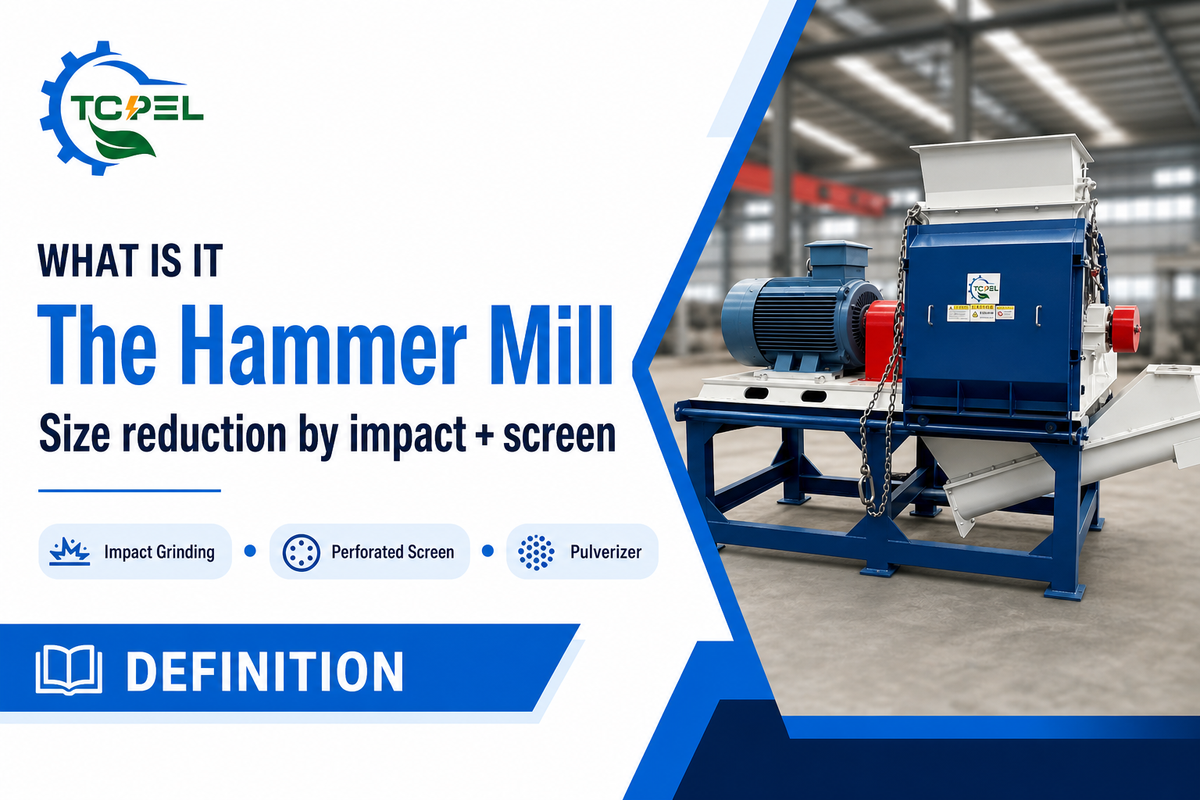
A hammer mill is a size reduction machine that grinds bulk material by repeated, high-speed blows of small hammers, then passes the result through a perforated screen. Hammers swing freely from a rotor on a rotating shaft inside a grinding chamber, and material is shattered into smaller pieces on impact and held in the chamber until it’s fine enough to perforate the screen and discharge.
Because the same machine can shred or crush everything from sawdust to limestone simply by changing the screen and hammer pattern, the hammer mill is one of the most widely used pieces of grinding equipment in industry.
In practice hammermill is used interchangeably with pulverizer and, loosely, with crusher, though a true crusher works coarser material with rigid blow bars and usually no screen. In a processing line, the hammer mill sits after primary chipping or cleaning and before pelleting, drying, mixing or packaging. TCPEL builds a full industrial hammer mill range for exactly these duties.
How a Hammer Mill Works: Impact, Attrition & Shear
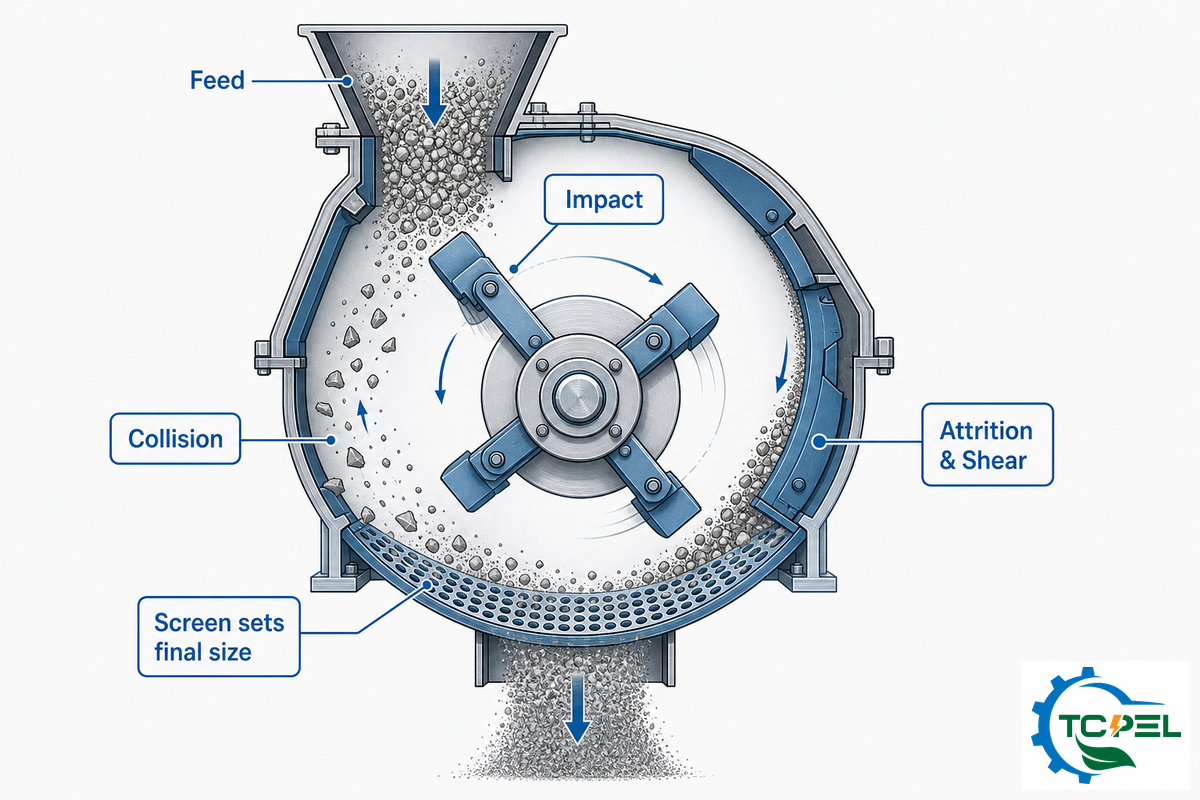
A hammer mill works by three forces acting at once inside the grinding chamber. First is impact: the rotor spins the swinging hammers at high speed (commonly 1,500–3,600 RPM) so they strike incoming feed and shatter it. Second is attrition and shear: particles are dragged and rubbed against the breaker plate and screen, and cut by the edge of the hammers. Third is particle-on-particle collision as fragments rebound inside the chamber.
Material recirculates under these repeated blows of small hammers until it’s small enough to pass the screen, so the screen, not the hammers, sets the final particle size.
This is why a hammer mill can hold a desired particle size across very different feeds: the rotating shaft and hammer geometry supply energy, while the perforated screen acts as the gatekeeper. That split, energy in from the rotor, size control at the screen, is the foundation for every particle size reduction decision later in this guide. As the comminution literature shows, reducing particle size to a smaller material size raises specific energy sharply, because finer grinding means more passes before particles perforate the screen. It can shred or crush aggregate as readily as grain.
“It is difficult to relate a screen size to specific microns due to the variations of equipment such as tip speed, wear, moisture content of the grain, etc.”
Hammer Mill Components: Rotor, Hammers, Screens & Breaker Plate
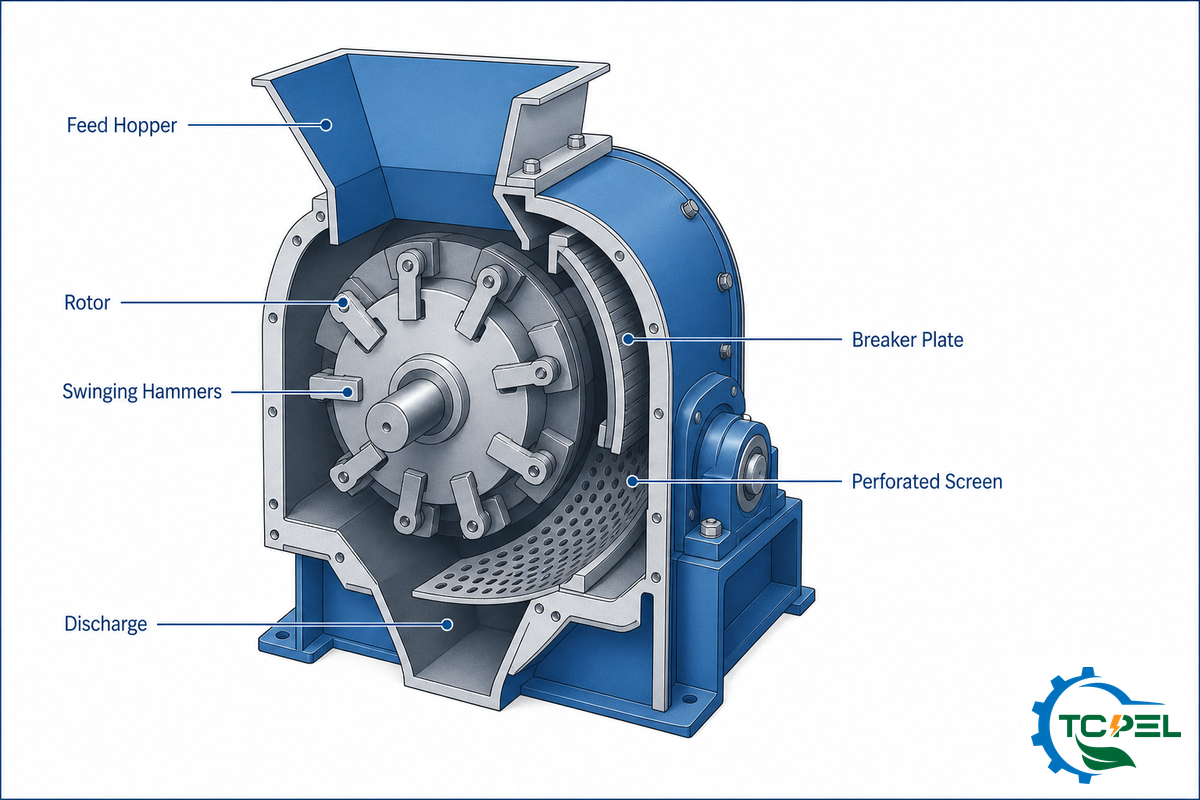
Every hammer mill is built from the same core parts, and knowing which wear out tells you where the running cost lives:
- ✔Rotor and shaftthe rotating shaft, mounted vertical or horizontal, carries the swinging hammers; balance here governs vibration and bearing life.
- ✔Hammersfree-swinging (or fixed) wear parts, typically 12 to 60 per rotor; four-way reversible designs roughly double wear life.
- ✔Perforated screenthe interchangeable gatekeeper that sets output size; a consumable that’s swapped to change grind.
- ✔Breaker platethe hardened surface where shear and attrition occur at the hammer arc.
- ✔Feed hopper and grinding chamberthe steel drum that contains the work; one-piece welded chambers resist dust build-up.
- ✔Drive and dischargeelectric motors (often direct-coupled) and either a gravity or air-swept discharge.
📐 Engineering Note
For food and pharmaceutical duty, contact parts are built in 304 stainless steel; for abrasive minerals and biochar, hammers and liners use abrasion-resistant (AR) or hardfaced steel. Match the hammer hardness to the feed, hardfacing that’s too brittle chips on tramp metal, while soft hammers round over and lose grinding efficiency.
Types of Hammer Mills
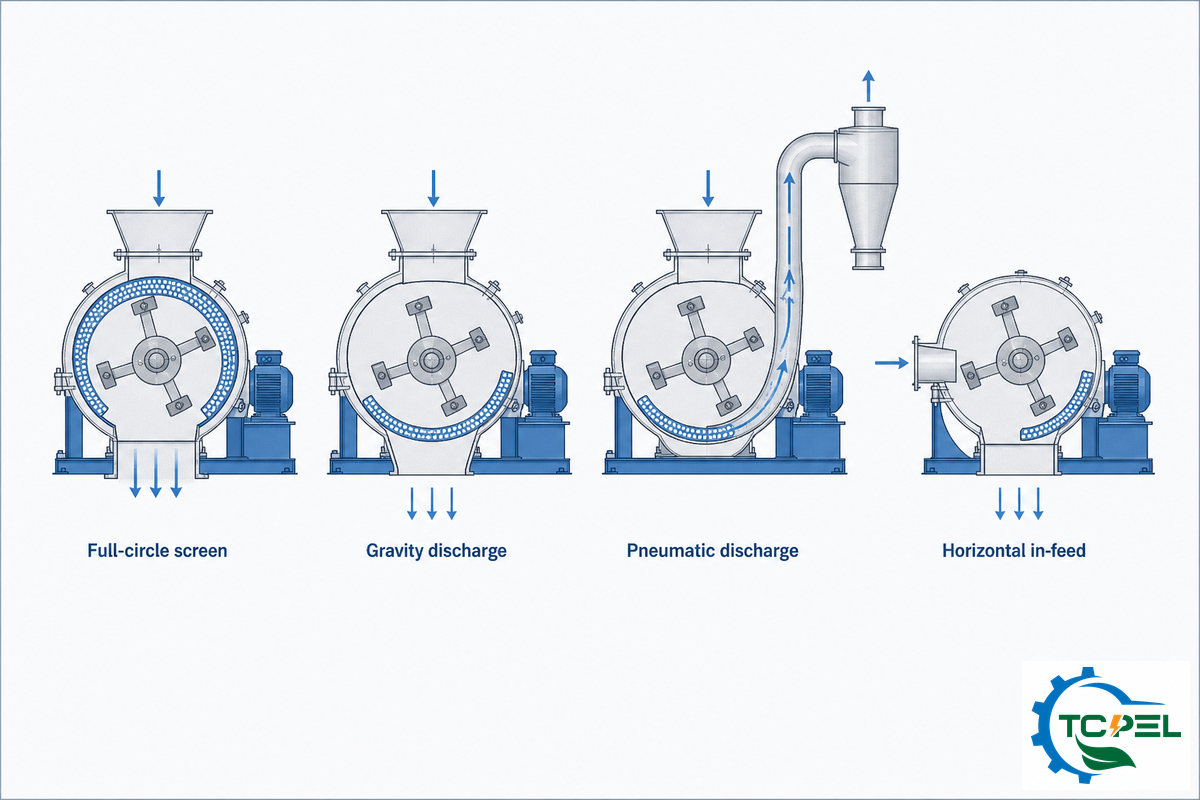
What are the types of hammer mills?
Hammer mills are classified mainly by how they discharge material, how the screen wraps the rotor, and how the hammers are mounted. Each discharge hammer moves ground product out by gravity or by air flow to separate fines: gravity discharge hammer designs (bottom discharge) drop product downward, while pneumatic discharge hammer mills, also called discharge hammer mills, pull it through on an air stream. Configurations below map each one to where it fits.
| Type of hammer mill | Defining feature | Best for |
|---|---|---|
| Gravity (bottom) discharge | Ground material falls out by gravity | Dense, free-flowing feed: coal, glass, ceramics, dry chemicals |
| Pneumatic (air-swept) discharge | Air flow draws product through and out | Light, fluffy feed: biomass, paper, wood chips, bone meal |
| Full-circle screen | Screen wraps the full rotor for fast evacuation | Light non-sticky feed: grass, grain, sawdust, spices |
| Half-screen | Screen covers the lower arc only | General-purpose grinding with easier screen access |
| Horizontal in-feed | Material enters from the side, not the top | Heavy, aggressive duty: pallet scrap, trim scrap |
| Vertical-shaft | Hammers rotate on a vertical rotating shaft | Fine grinding and tight footprints |
| Reversible-rotor | Rotor runs both directions to even out hammer wear | Continuous, abrasive duty needing long hammer life |
| Screenless | Air classification replaces a perforated screen | Sticky or heat-sensitive material that blinds screens |
| Lump breaker | Fixed comb, not swinging hammers | De-lumping paste or powder, not true size reduction |
Configurations compiled from industry milling practice. The right type depends on feed density, stickiness and target fineness.
Screen Selection & Particle Size Control
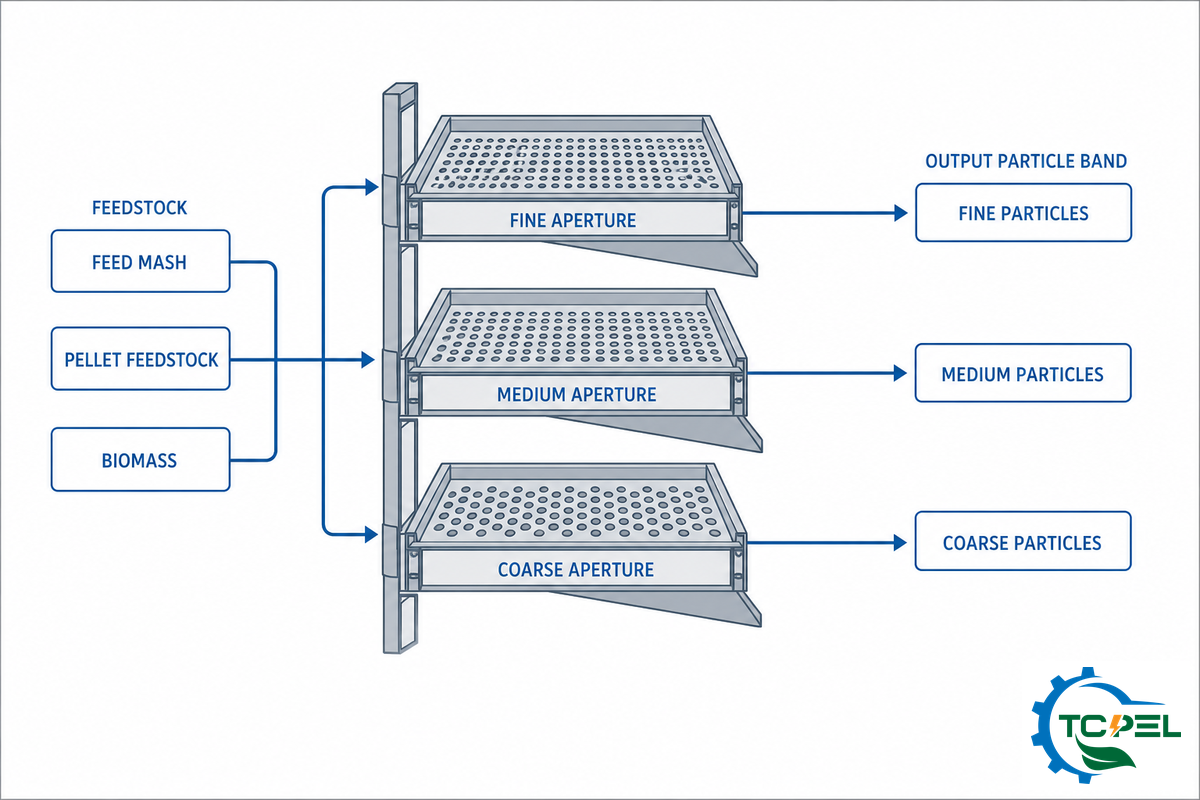
Screen selection is the single most-used control on a hammer mill, yet it’s a starting point, not a precise dial. Smaller perforated screens yield a finer particle size at lower throughput and higher specific energy; larger screens do the opposite, and as feedstock changes, so does the screen. Effective particle size reduction means matching the screen to the target material size, then trimming by trial, reducing particle size always costs more energy.
Material-to-Screen Routing Tree
Read this routing tree as indicative aperture ranges by feedstock, where to begin, not a guarantee.
| Feedstock | Indicative screen | Typical output | Downstream use |
|---|---|---|---|
| Sawdust / fine biomass | 1–3 mm | <1–3 mm | Pre-pellet feedstock |
| Wood chips / shavings | 3–6 mm | 2–6 mm | Wood pellet / briquette |
| Straw / EFB / palm waste | 4–8 mm | 3–8 mm | Biomass fuel pellet |
| Corn (livestock feed) | 3/16–1/4 in (~5–6 mm) | ~600–800 µm | Mash / pellet feed |
| Wheat / sorghum | 1/4–3/8 in (~6–9 mm) | ~800–900 µm | Feed (shatters to more fines) |
| Soybean / oilseed cake | 2–4 mm | ~500–800 µm | Protein meal |
| Poultry mash | 1–1.5 mm fine | <1 mm | Mash feed |
| Limestone / mineral | 1–3 mm | fine powder | Aggregate / filler |
| Spices / food / pharma | 0.8–1.5 mm | fine, uniform | Powder / capsule grade |
Indicative ranges compiled from university feed-grinding guidance and biomass milling practice; screen choice interacts with tip speed, moisture and hammer condition.
Three corrections to the “smaller screen = better” instinct. First, capacity falls with aperture, engineers on agricultural forums note that smaller screen holes directly reduce throughput. Second, the screen isn’t the only variable: Mississippi State University Extension stresses that reducing the rotor RPM lowers the share of fines (at the cost of grinding time), that the number and condition of the hammers shift fineness, and that low-moisture grain shatters and produces more fines than grain at a normal 10–12% moisture. Third, open area matters, a common rule of thumb sizes air assist at about 1.25–1.5 CFM per square inch of screen area to keep the screen clear. Above roughly 15% moisture, dry the feed first or screens blind and product size drifts.
Tip Speed, Rotor Power & Sizing the Mill
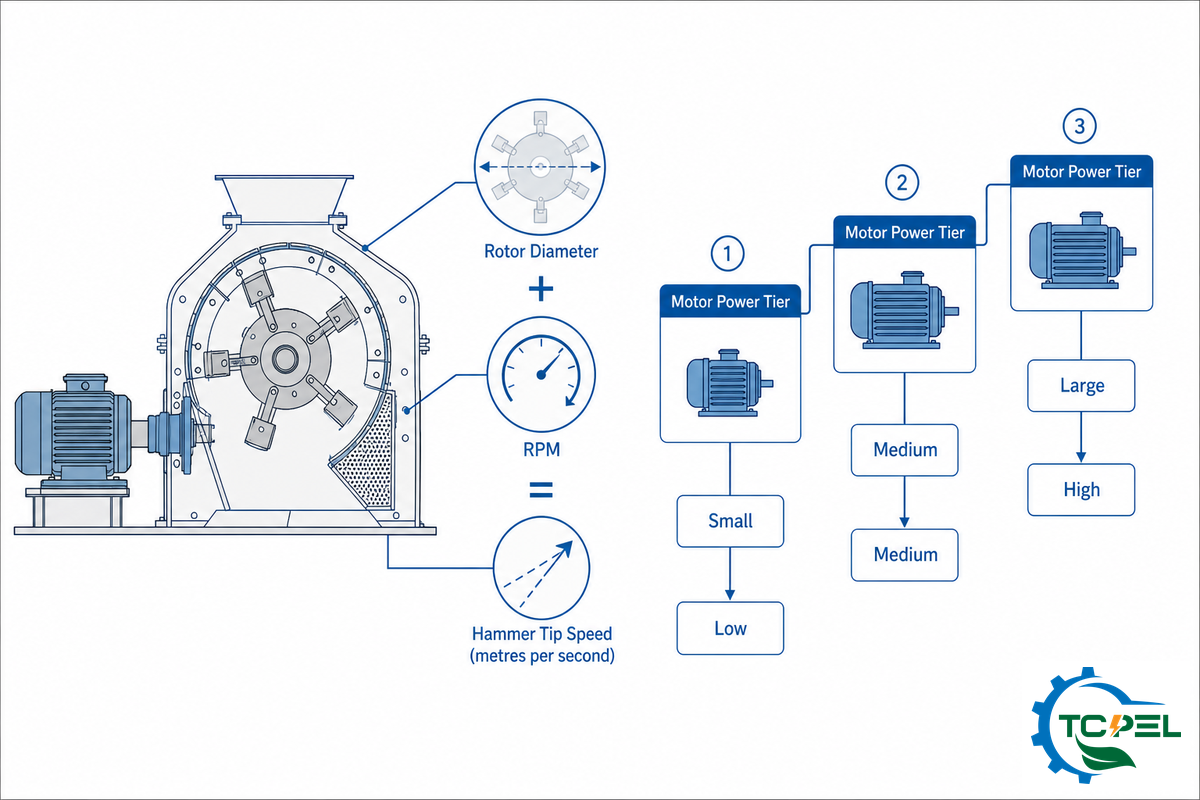
What size hammer mill do I need for X tonnes per hour?
Sizing a hammer mill means matching three things: tip speed to the fineness you want, screen to the particle size, and motor power to throughput. Tip speedthe speed of the hammer tips, not the RPM, is what governs how hard each blow lands. It follows a simple formula that defines a workable operating envelope by material.
Tip-Speed Operating Envelope
📐 Worked example — tip speed
Tip speed v = π × D × n ÷ 60, where D is rotor diameter (m) and n is RPM. A 0.6 m rotor at 3,000 RPM gives v = π × 0.6 × 3,000 ÷ 60 ≈ 94 m/s. Coarse biomass grinds well at roughly 60–90 m/s; fine feed and food powders want the upper end, ~90–115 m/s. If your mill is slower, a larger rotor diameter restores tip speed without a variable-frequency drive.
For power, work from specific energy. One 2025 study in the journal Processes found this grinding machine consumes 8 to 30 kWh per tonne, depending on mill design and screen size; in that work, corn drew more energy than soy. Coarser screens and a lower shaft speed give a more energy efficient grind; finer output costs more. As a planning figure: grinding 2 t/h of softwood to a 4 mm screen at about 15 kWh/t needs roughly 30 kW at the rotor, and the same wood to a 1 mm screen can nearly double that. Indicative ranges below support first-pass power budgeting, not guarantees.
9-Material Specific Energy Benchmark
| Material | Target size | Indicative kWh / tonne | Note |
|---|---|---|---|
| Corn (feed) | ~900 µm | ~5 | Rises steeply as size falls |
| Sorghum | ~500 µm | ~3.4 | Shatters more than corn |
| Wheat | ~700 µm | ~5–8 | More fines than corn |
| Soybean meal | ~600 µm | ~6–10 | Oil content affects flow |
| Softwood / sawdust | 3–4 mm | ~10–18 | Fibrous, moisture-sensitive |
| Hardwood | 3–4 mm | ~15–25 | 25–30% above softwood |
| Straw / EFB | 4–8 mm | ~8–15 | Light, low bulk density |
| Sub-6 mm biomass | <6 mm | ~18–30 | Fine pelleting feedstock |
| Limestone / mineral | fine | ~12–25 | Abrasive; hardens hammers’ duty |
Indicative figures synthesized from peer-reviewed comminution studies and university feed data; verify against a test grind of your own material.
For purchase-ready sizing across capacity tiers and motor ratings, the TCPEL hammer mill range publishes power and throughput by tier, this guide deliberately keeps the focus on the underlying engineering so you can sanity-check any quote.
Hammer Mill vs Roller, Pin, Impact Crusher & Other Mills
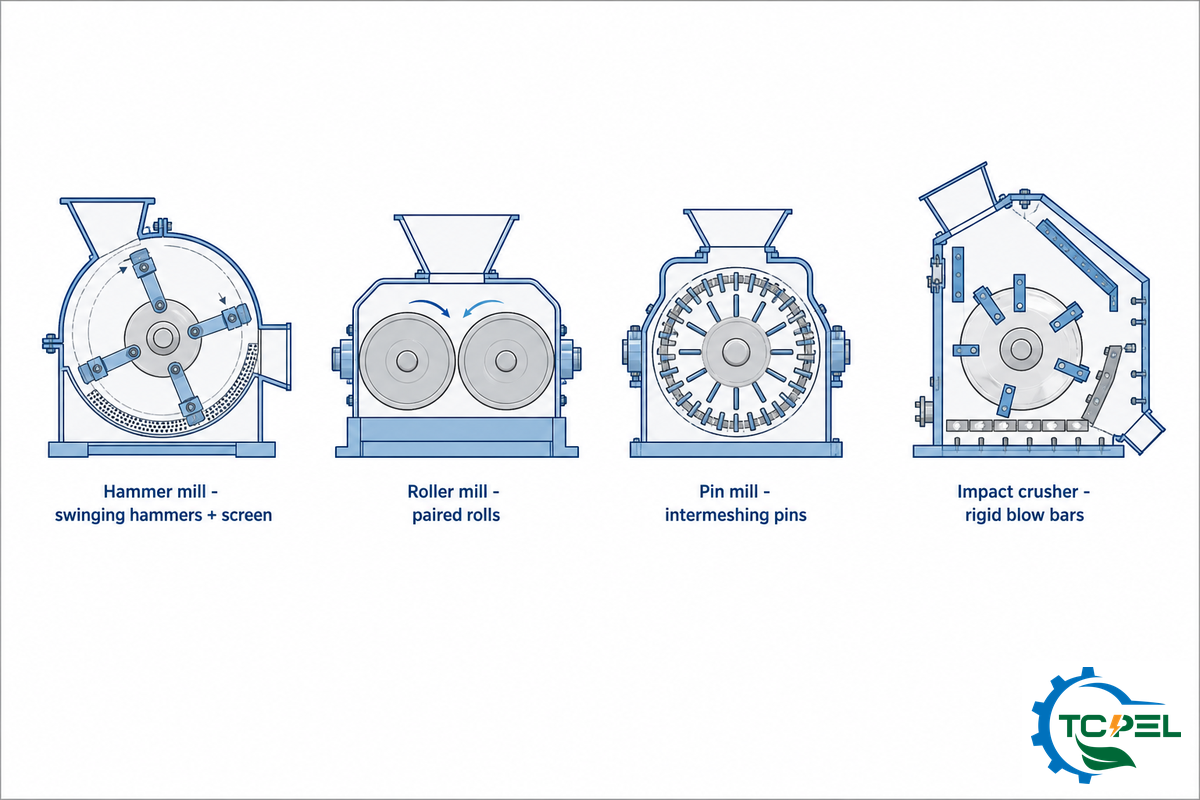
What is the difference between a pin mill and a hammer mill, or a grinder and a hammer mill?
A hammer mill is one of several size-reduction machines, and the honest answer to “which is best” is that it depends on material and objective. A pin mill uses intermeshing pins at higher tip speed for finer, shear-driven grinding; a roller mill compresses material between rolls for a tighter, lower-energy grind on dry friable grain; an impact crusher uses heavy rigid blow bars for coarse aggregate.
“Grinder” is a generic term, a hammer mill grinder is one kind of grinder. Real trade-offs are set out below.
Size-Reduction Machine Selection Crosswalk
| Machine | Particle control | Energy | Best fit |
|---|---|---|---|
| Hammer mill | Wide range, more fines; set by screen | Higher (~8–30 kWh/t) | Widest material range, highest capacity per size |
| Roller mill | Tight, uniform, fewer fines | Lower (up to ~half on grain) | Dry friable grain; flour, malt, feed |
| Pin mill | Very fine, shear-driven | High | Fine, non-abrasive powders |
| Impact crusher | Coarse, graded by gravity | Moderate | Aggregate, ore, construction |
| Ball mill | Ultra-fine, slow | High | Fine mineral / ceramic powder |
| Disc / burr mill | Uniform, adjustable gap | Moderate | Wet milling, specialty grain |
Energy and uniformity figures reflect dry-grain comparisons; on fibrous or mixed feed the hammer mill’s flexibility often outweighs the roller mill’s efficiency edge.
✔ Where the hammer mill wins
- Handles almost any material, including fibrous and mixed feeds
- Highest capacity per machine size; lower purchase cost
- Easier maintenance and low maintenance cost
- Particle size changed by swapping the screen
⚠ Where it gives ground
- Uses more energy than a roller mill on dry grain
- Wider particle spread and more fines
- Noisier and dustier; needs dust control
- Changing screens means stopping the mill
University extension data is blunt about the energy gap: a roller mill can grind grain with roughly half the energy of a hammer mill at equal particle size. But the same sources note hammer mills offer easier maintenance, a low maintenance cost, a wider variety of materials and greater capacity per size, and peer-reviewed feed research finds hammer mills deliver a higher reduction ratio and greater grinding capacity than roller mills, and that “coarse grinding doesn’t always permit an optimal” result. This decision is material-and-objective specific, not a verdict.
Applications by Feedstock: Biomass, Wood, Feed, Grain, Food & Pharma

Because output is reset by the screen and hammer pattern, hammer mills are used across many industries, one base machine grinds many types of materials. Hammer mill uses span far beyond one sector: the same hammer mill working principle that drives a hammer mill for wood also grinds feed grain, and swapping the hammer mill hammers or the screen retunes it. In biomass and wood, hammer mills size sawdust, wood chips, straw, EFB and palm waste into pre-pellet feedstock; dry hammer mills further reduce pre-dried woody particles ahead of pelleting. See our dedicated wood hammer mill grinding guide and the biomass hammer mill line for feedstock-specific detail.
In animal feed and grain, hammer mills grind corn, wheat, sorghum and oilseed cakes for mash and pellet feed; the feed grinding hammer mill pairs with a downstream pellet line. Beyond fuel and feed, hammer mills can be used to grind groundnuts, soya and beans, and a hammer mill with low hammer blows can remove hard nutshells. In the chemical industries and pharmaceutical industries they crush ingredients to an intermediate grade of powder and a precise grain size for quick dissolution and fast formulation, and size medicinal grains into a precise quantity for capsules. On the farm the same machine works as a grain mill, and a used hammer mill is often rebuilt with fresh screens; such hammermills slot into a wider processing equipment line, from a horizontal in-feed hammer for scrap to fine feed grinders. Recycling lines use them to shred paper and crush light scrap.
A field scenario. A 2 t/h wood pellet line in Eastern Europe specified a hammer mill on a 6 mm screen to feed a pellet press. When winter feedstock arrived at 22% moisture, throughput collapsed and the screen blinded within an hour. Adding a rotary dryer ahead of the mill to bring moisture under 12% restored rated capacity, a reminder that the mill is only as good as the feed prep around it.
Correct particle size is an outcome target, not “as fine as possible.” Mississippi State University Extension warns that extremely fine grinding has been linked to increased ulcers in swine, dusty feed that reduces intake and bridges in bins, respiratory problems, and higher processing costs, which is why recommended swine corn lands around 700–800 microns rather than the finest the mill can reach.
Dust-Explosion Safety: NFPA 660 & ATEX for Fine Grinding

Fine grinding of grain, wood and biomass generates combustible dust, and that makes hammer-mill safety a regulated obligation, not an optional extra. Investigators at the U.S. Chemical Safety Board found that combustible-dust explosions at the Didion Milling dry-corn mill in Cambria, Wisconsin killed five workers in 2017, a reminder that grinding and conveying grain generate the same combustible dust a hammer mill produces. According to OSHA, a dust explosion needs five elements: fuel, oxygen, an ignition source, dispersion of the dust cloud, and confinement, and a hammer mill, its ducting and dust collector supply exactly that confinement.
Regulatory exposure has three distinct layers, and it helps to keep them separate:
- ⚠OSHA (United States law). There’s no single combustible-dust rule; several mandatory standards apply, including 29 CFR 1910.272 for grain handling and 1910.307 for hazardous locations. Where no specific standard fits, OSHA cites the General Duty Clause, Section 5(a)(1).
- ⚠NFPA 660 (consensus standard). Effective December 6, 2024, NFPA 660 consolidates six older dust standards, NFPA 61 (agricultural and food), 484, 652, 654, 655 and 664, into one document that OSHA references and inspectors lean on.
- ⚠ATEX (European Union). In the EU, equipment in explosive dust atmospheres must meet the ATEX directives, a separate, region-specific framework from the U.S. system.
📐 Engineering Note
Practical controls for a hammer-mill dust system: a cyclone plus bag filter sized for the air-assist flow, explosion venting or suppression on the collector, bonding and grounding to remove static ignition, magnets or pneumatic separators ahead of the mill to catch tramp metal, and a housekeeping schedule that keeps dust layers below the depth that can propagate a secondary explosion.
Maintenance & Troubleshooting
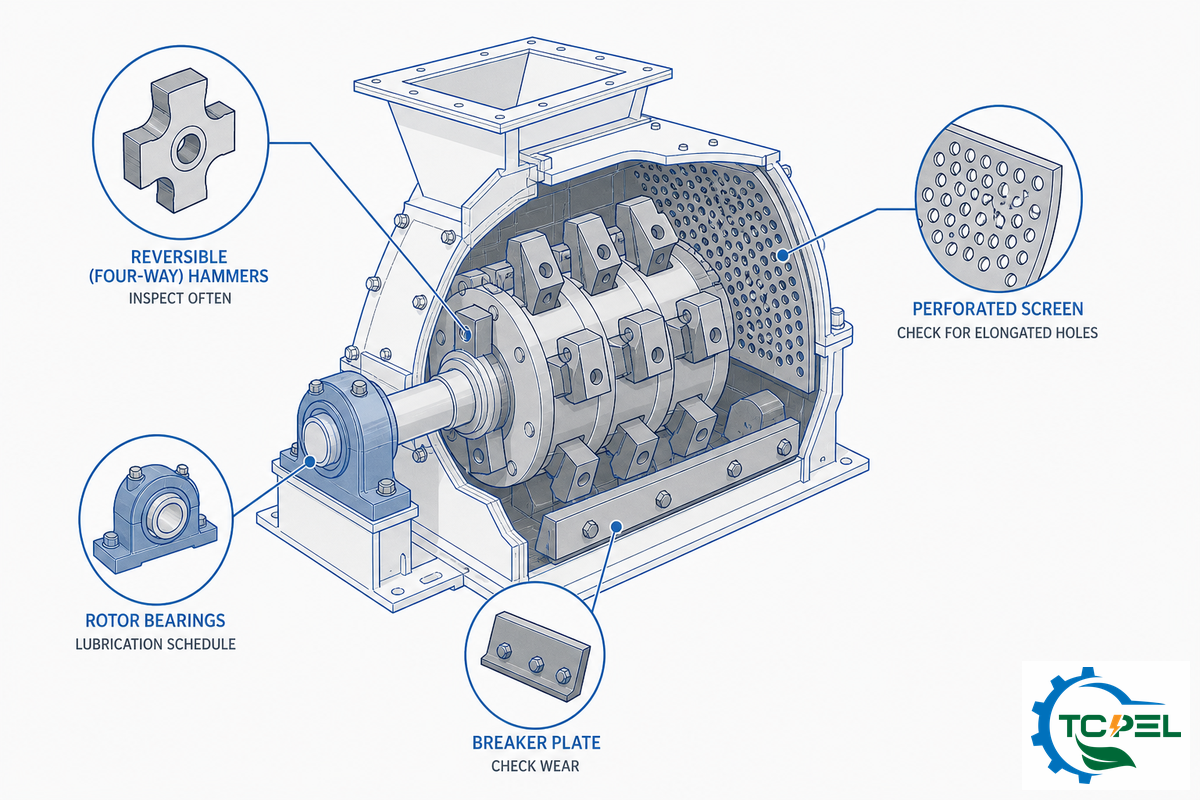
What are the disadvantages of a hammer mill?
A hammer mill’s honest limitations are energy use on dry grain, more fines, noise and dust, all manageable with the right setup. Most running cost lives in two wear parts: hammers and screens. Inspect them weekly, or more often on abrasive feed; replace hammers before edge rounding unbalances the rotor, and screens before holes elongate.
Reversible (four-way) hammers and hardfaced or AR-steel parts extend wear life on abrasive duty, and keeping bearings on a lubrication schedule prevents the most common unplanned downtime. Proper maintenance of rotor balance is what keeps a high-speed machine smooth.
Four faults cover most service calls:
| Symptom | Likely cause | Fix |
|---|---|---|
| Capacity dropping | Worn hammers or blinded screen | Rotate/replace hammers; clean or replace screen |
| Vibration | Uneven hammer wear, rotor imbalance | Replace hammers in matched sets; check balance |
| Clogging / blinding | High-moisture feed (>15%) | Dry feed; add air assist; open screen |
| Overheating | Overfeeding, dull hammers, poor airflow | Meter feed; sharpen/replace; check discharge |
Industry Outlook: What’s Changing for Buyers (2026)

Two forces, not headline market growth, should shape a hammer-mill purchase in 2026. The first is regulatory: NFPA 660 took effect on December 6, 2024, folding the agricultural and food dust standard (NFPA 61) and five others into a single combustible-dust standard. Any plant fine-grinding grain or biomass should re-baseline its dust controls against NFPA 660 now, because inspectors and insurers are already aligning to it after incidents like Didion.
The second is demand-driven fineness. The USDA Foreign Agricultural Service reports EU wood-pellet production expanding in 2025 yet not keeping up with demand, while U.S. mills produced over 11 million tonnes of pellets in 2025. Heating-season and renewable-energy demand pushes pellet producers toward finer, more uniform pre-pellet grinding, which raises the specific-energy load on the hammer mill and makes energy per tonne a real procurement metric. If you’re planning a 2026 line, specify the dust-control package and the energy budget up front rather than bolting them on later; market-size forecasts (variously 2–6% CAGR) are background, but the dust standard and the fineness trend are concrete.
Frequently Asked Questions
What is a hammer mill used for?
View Answer
Hammer mills grind many materials by impact and attrition: biomass and wood into pre-pellet feedstock, grain and oilseeds into animal feed, minerals into powder, and food, spice and pharmaceutical ingredients into a precise grain size. One machine serves many industries because the perforated screen and hammer pattern reset the output for each material.
How fine can a hammer mill grind?
View Answer
With a fine screen and high tip speed, a hammer mill commonly reaches a few hundred microns — fine enough for feed, biomass and many food powders. Below roughly 100–200 microns, a pin mill, roller mill or air-classifying mill usually controls particle size more uniformly and with fewer fines. The practical floor depends on material, moisture and how much fines and energy you can accept.
Can a hammer mill grind wet or high-moisture material?
View Answer
A hammer mill handles some moisture, but above about 15% the screen blinds, throughput falls and particle size drifts. For wetter feed, dry it first, choose a coarser screen, or use a wet-milling design. Normal grain moisture of 10–12% grinds cleanly; very dry grain below that range shatters and makes excess fines that the screen then has to clear.
What is the difference between a grinder and a hammer mill?
View Answer
“Grinder” is a general term for any size-reduction machine; a hammer mill is one type of grinder that uses swinging hammers and a screen.
How long do hammer mill hammers and screens last, and what drives wear?
View Answer
Wear life depends almost entirely on feed abrasiveness. On clean grain, hammers can run for many months; on abrasive biomass, biochar or mineral, screens may need attention monthly and hammers far sooner. Four-way reversible hammers roughly double life by exposing fresh edges, and hardfaced or AR-steel parts help on abrasive duty. The biggest avoidable wear comes from tramp metal — magnets and separators ahead of the mill pay for themselves. Replace hammers in matched sets to keep the rotor balanced.
Can a hammer mill grind hay or straw?
View Answer
Yes — with an air-swept (pneumatic) discharge and an open screen, hammer mills handle hay, straw and other light fibrous feed, which is why they are common in both feed and biomass plants.
About This Guide
This hammer mill guide was compiled by the technical team at ALLWIN INTERNATIONAL (TCPEL), a manufacturer of biomass and feed pellet machinery, hammer mills and rotary dryers shipping to 60+ countries. We wrote it as a neutral engineering reference: the screen-aperture, specific-energy and dust-safety figures are drawn from university extension data, peer-reviewed comminution research and the current NFPA 660 standard, not from our own catalogue. Where our field experience adds something, we’ve said so, for example, that direct-coupled drives remove the 2–4% transmission loss of belt-driven mills across our installed base.
References & Sources
- Mathematical Model to Improve Energy Efficiency in Hammer Mills (Processes, 2025)MDPI, peer-reviewed
- Direct mechanical energy measures of hammer mill comminution (Bitra et al., Powder Technology)University of Tennessee
- Is particle size important for swine diets?Mississippi State University Extension Service
- The Effects of Diet Particle Size on Animal PerformanceKansas State University
- Combustible Dust: OSHA StandardsU.S. Occupational Safety and Health Administration
- Didion Milling Company Explosion and FireU.S. Chemical Safety Board
- NFPA 660, Standard for Combustible Dusts and Particulate SolidsNational Fire Protection Association
- EU Wood Pellets Annual 2025USDA Foreign Agricultural Service
- Particle size distribution and energy of grain grinding (Animal Feed Science and Technology)peer-reviewed