Contacter TCPEL


Mis à jour en juin 2026 · Relu par l’équipe technique de TCPEL.
Une presse à granuler les aliments pour animaux comprime un mélange alimentaire broyé à travers une filière en acier afin que la pression des galets et la chaleur de friction l’agglomèrent en granulés denses et uniformes. Cette seule phrase masque la plupart des décisions auxquelles l’acheteur est réellement confronté : quelle architecture de filière choisir, quelles dimensions, quelles matières premières utiliser et s’il est vraiment plus avantageux d’exploiter sa propre machine que d’acheter des aliments en sacs. Ce guide répond à ces questions à partir de données sourcées, et non d’arguments commerciaux, afin de vous aider à dimensionner, choisir et exploiter la machine adaptée à votre activité.
En un paragraphe : une presse à granuler les aliments pour animaux comprime un mélange alimentaire broyé à travers une filière perforée, où la pression des galets et la chaleur du conditionnement à la vapeur (environ 65–90 °C) gélatinisent l’amidon et agglomèrent le mélange en granulés, généralement à un débit de 60–6 000 kg/h selon la puissance du moteur. La présentation sous forme de granulés augmente principalement la consommation des animaux et réduit le gaspillage d’aliments, mais uniquement si la qualité des granulés reste élevée et si l’économie d’échelle est favorable.
Caractéristiques rapides et plage de fonctionnement type d’une presse à granuler les aliments
| Plage de capacité de production | 60–6 000 kg/h (de l’exploitation agricole à la ligne industrielle) |
| Puissance du moteur | 3–132 kW (électricité, diesel ou PTO) |
| Diamètres des trous de la filière | 2–12 mm (adaptés à l’espèce) |
| Température de conditionnement | 65–90 °C (vapeur) |
| Plage optimale de teneur en humidité du mélange | 12–18 % (selon la matière) |
| Objectif de durabilité mécanique des granulés | PDI de 92–95 % ; moins de 10 % de fines |
Qu’est-ce qu’une presse à granuler les aliments et comment transforme-t-elle un mélange en granulés ?
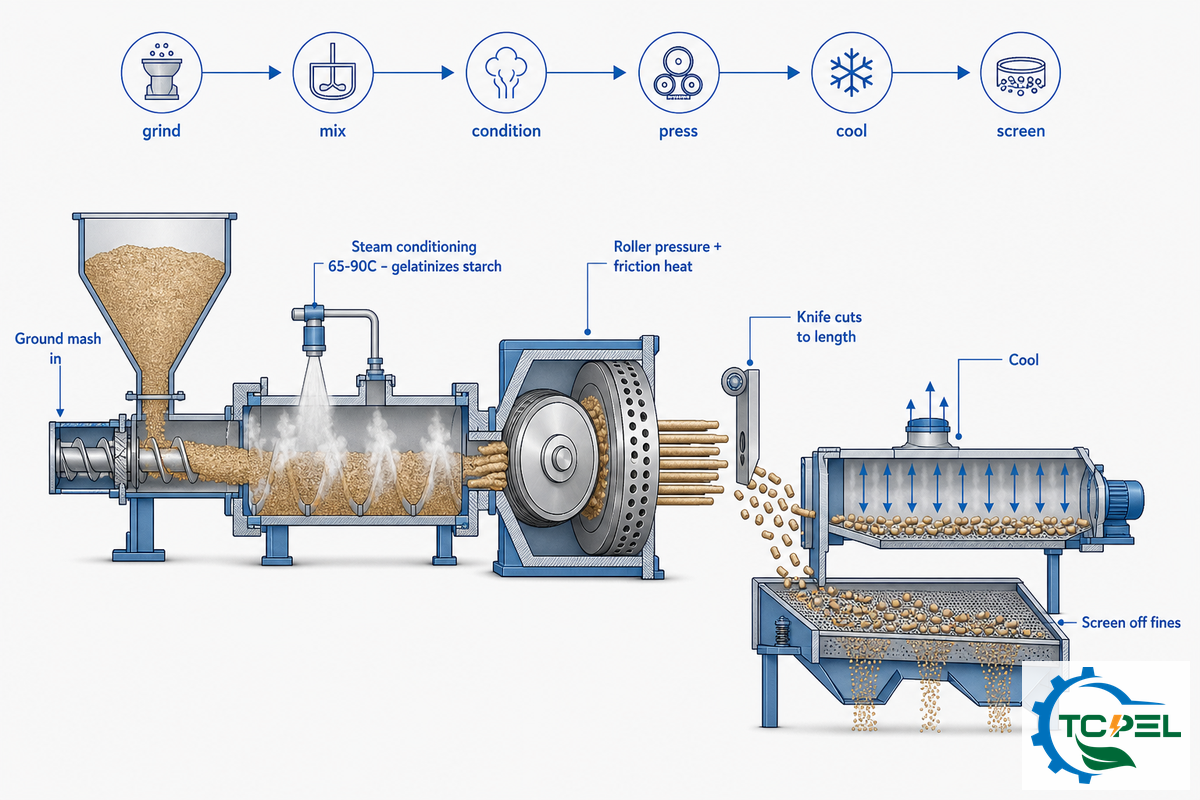
Une presse à granuler les aliments pour animaux, également appelée presse à granulés d’aliments, presse à pellets, machine de fabrication de granulés ou granulateur, force un mélange alimentaire conditionné à travers les trous d’une filière en acier trempé, où des galets rotatifs le compriment en granulés cylindriques qu’un couteau coupe à la longueur voulue.
Une presse à granuler occupe le centre d’une ligne courte : un broyeur, un broyeur à marteaux, un prébroyeur ou un pulvérisateur réduit d’abord les ingrédients, puis ceux-ci sont mélangés, conditionnés, comprimés à travers le disque perforé de la filière, refroidis et enfin criblés pour retirer les fines.
Voici ce qui se produit physiquement et pourquoi cela compte. De la vapeur est injectée dans le mélange avant son passage dans la filière [QUOI]. La teneur en humidité et la chaleur assouplissent l’aliment et commencent à gélatiniser l’amidon ; Penn State Extension précise que le conditionnement associé à la pression de la filière déclenche des « réactions chimiques irréversibles », de sorte que la granulation constitue véritablement une cuisson et pas seulement une mise en forme [POURQUOI], selon Penn State Extension. C’est pourquoi un granulé fabriqué à froid et mal conditionné à la ferme perd une grande partie des bénéfices de digestibilité, même s’il ressemble à un véritable granulé [CONSÉQUENCE].
Le brevet délivré CA2769985C documente un détail pratique que la plupart des acheteurs négligent : l’endroit où l’humidité est ajoutée a son importance. L’eau incorporée à froid dans le mélangeur se lie pendant la gélatinisation et se conserve mieux que l’eau ajoutée dans le conditionneur, ce qui accroît la durabilité mécanique des granulés tout en réduisant de 14–19 % par tonne la consommation énergétique de la presse dans trois usines commerciales.
💡 À retenir
La granulation associe conditionnement, compression et cuisson. Sans vapeur, refroidisseur de granulés ou grille de séparation des fines, vous ne fabriquez pas réellement des granulés d’aliment pour animaux, mais des amas fragiles qui se désagrègent à nouveau en mélange farineux.
Pourquoi granuler vos aliments ? Les avantages mesurables par rapport à la farine et aux aliments en sacs
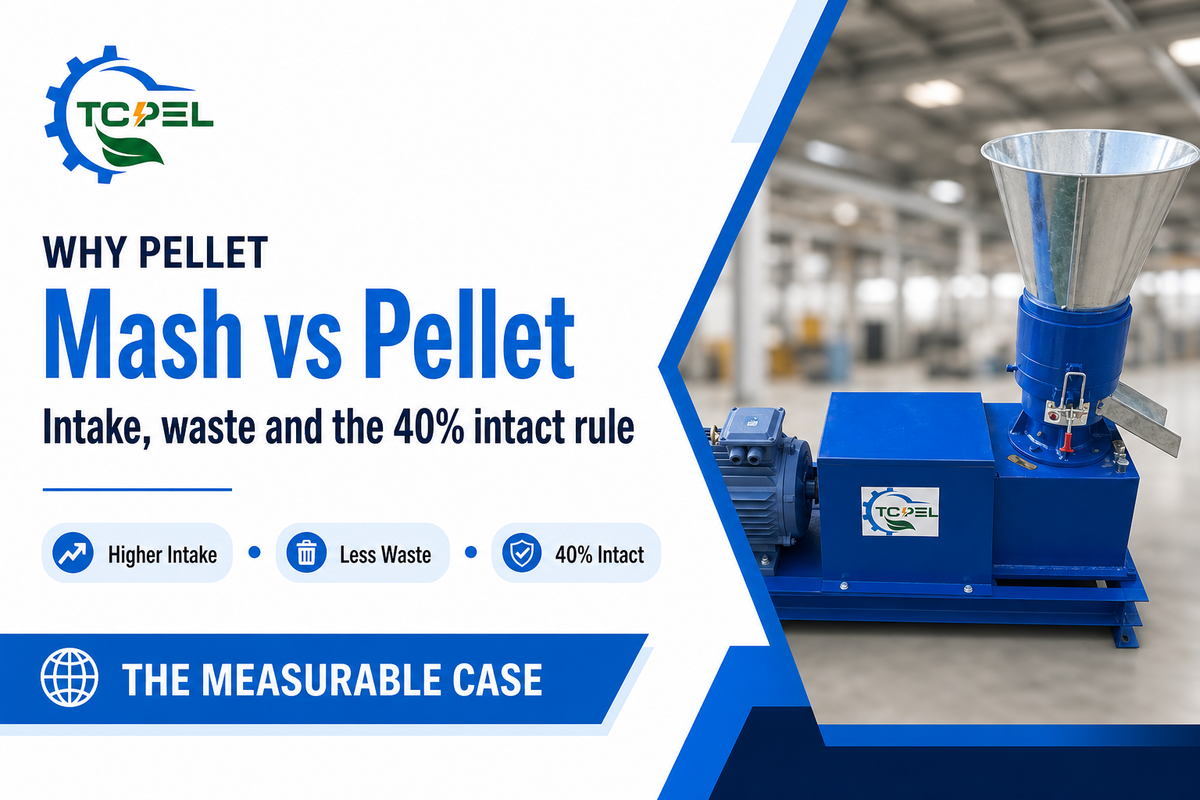
La granulation est principalement rentable parce qu’elle augmente la consommation d’aliments et réduit le gaspillage, et non parce qu’elle améliore miraculeusement la digestion, contrairement à une affirmation fréquente. Lors d’un essai portant sur 2 800 poulets de chair Ross 308, le meilleur régime composé de miettes et de granulés a produit un indice de consommation de 1,31 contre 1,49 pour la farine, avec un gain de poids corporel de 951 g contre 757 g, selon une étude publiée dans Veterinary Medicine International (PMC). Les oiseaux consomment tout simplement davantage d’aliments en granulés, avec une ingestion pouvant être jusqu’à 10 % supérieure à celle d’un aliment en farine.
Cet avantage est toutefois soumis à une condition stricte. Penn State Extension indique qu’au moins 40 % de granulés intacts doivent atteindre la mangeoire avant qu’un bénéfice sur le poids corporel ou l’indice de consommation n’apparaisse, et que chaque hausse de 10 points de pourcentage de la proportion de granulés intacts améliore l’indice de consommation d’environ 0,4 point. Une machine qui fonctionne à haute température et à grande vitesse, mais produit surtout des fines, n’apporte aucun gain par rapport à la farine ; des travaux synthétisés par des agronomes du secteur ont conclu que les granulés de mauvaise qualité donnaient les mêmes résultats qu’une farine moins chère.
Biosécurité : une réalité, mais pas une stérilisation
La chaleur du conditionnement réduit effectivement les agents pathogènes. Le rapport américain USDA-FSIS NACMCF indique que la granulation réduirait Salmonella de 50–93 %, principalement grâce à la vapeur utilisée pendant le conditionnement. Cette destruction dépend toutefois de la température : une courbe de durée de destruction thermique compilée par l’American Feed Industry Association et publiée par UC Davis Food Safety montre que la réduction de Salmonella passe d’environ 90 % près de 58 °C à une élimination presque totale uniquement lorsque le produit approche ~75 °C, et avertit qu’un aliment granulé à une température relativement basse a peu de chances d’être entièrement décontaminé. La fédération européenne de l’alimentation animale FEFAC expose clairement cette limite : « les combinaisons habituelles de durée et de température utilisées dans le procédé commercial de granulation ne détruisent pas efficacement les bactéries, mais peuvent réduire leur présence ». Considérez la granulation comme une étape importante de réduction des agents pathogènes, et non comme une autorisation d’utiliser des céréales contaminées.
✔ Ce que la granulation vous apporte réellement
- Une consommation accrue et une croissance plus rapide (jusqu’à ~10 % de consommation supplémentaire)
- Moins de gaspillage d’aliments et de ségrégation des ingrédients
- Des aliments plus denses, avec un stockage et un transport moins coûteux
- Une véritable étape de réduction des agents pathogènes, bien que partielle
⚠ Ce que la granulation ne permet pas
- Améliorer les résultats avec moins de 40 % de granulés intacts
- Stériliser les aliments aux températures commerciales habituelles
- Corriger une ration déséquilibrée sur le plan nutritionnel
- Toujours surpasser la farine : certaines études ne relèvent aucune différence, et la farine peut réduire la mortalité
Types de presses à granuler les aliments : comparaison des filières plates, des matrices annulaires et des extrudeuses
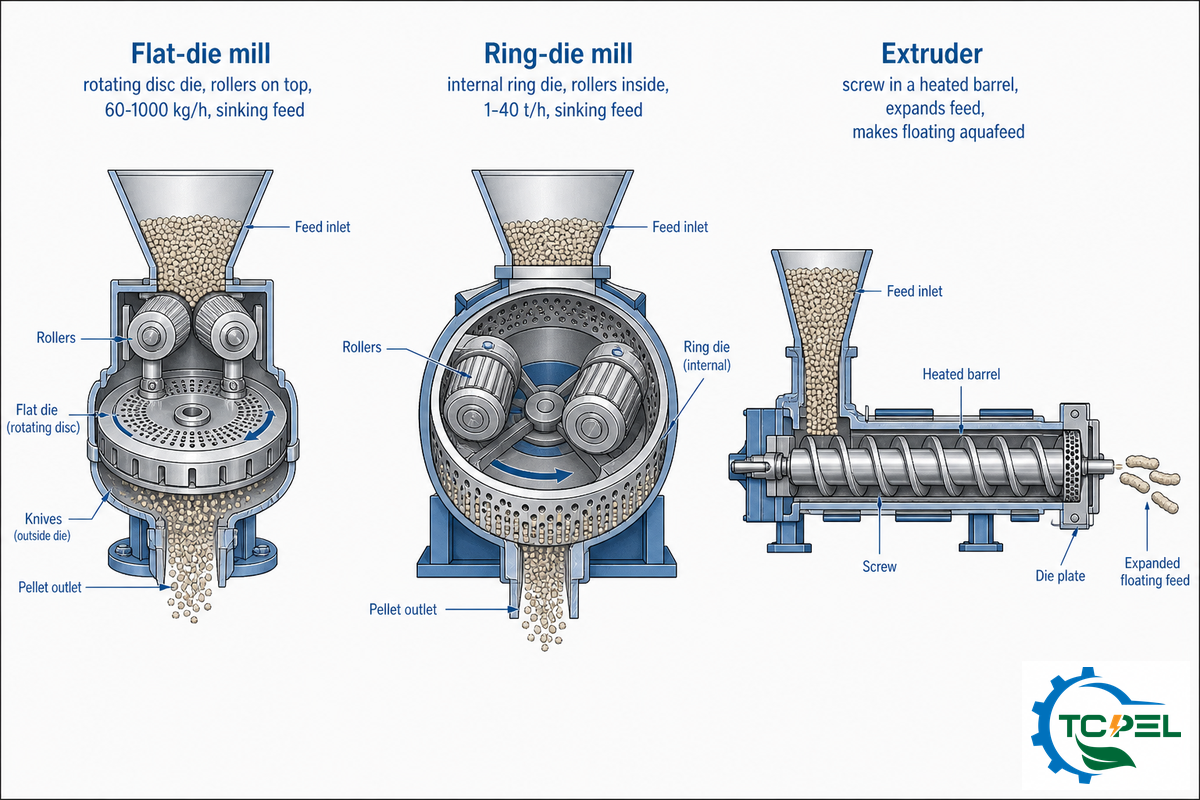
Trois architectures de machines couvrent presque tous les besoins de production d’aliments : la presse à granuler à filière plate, la presse à matrice annulaire et l’extrudeuse. Une presse à granulés de biomasse et une presse à granuler à filière plate utilisent des bâtis similaires, mais sont réglées respectivement pour la sciure de bois et les aliments pour animaux. Elles ne sont pas interchangeables, et le bon choix dépend davantage de votre échelle de production et de votre besoin de fabriquer des aliments coulants ou flottants que du seul prix.
| Critère | Presse à granuler à filière plate | Presse à granuler à matrice annulaire | Extrudeuse |
|---|---|---|---|
| Capacité de production type | 60–1 000 kg/h | 1–40 t/h | 0,2–10 t/h |
| Utilisation idéale | Exploitation agricole ou petite unité, matières variées | Fabrique commerciale d’aliments en fonctionnement continu | Aliments aquacoles flottants, aliments pour animaux de compagnie, soja entier riche en matières grasses |
| Type d’aliment produit | Coulant | Coulant | Flottant ou coulant |
| Énergie / débit | Consommation énergétique par tonne plus élevée, mais grande flexibilité | Plus efficace à grande échelle | Consommation énergétique la plus élevée ; préconditionnement à une teneur en humidité >18 % |
| Coût d’investissement | Le plus faible | Moyen à élevé | Le plus élevé |
| Accès pour les réparations | Le plus facile (chambre ouverte) | Plus complexe | Spécialiste requis |
Synthèse du Feed Pelleting Reference Guide et d’évaluations de presses publiées dans des revues à comité de lecture (voir Références).
Presser ou extruder ? Un arbre d’orientation à 3 branches pour choisir le type de machine
La décision se répartit en trois branches, selon ce que nous appelons l’arbre d’orientation « Presser ou extruder ». Si vous devez produire des aliments flottants pour poissons, il vous faut une extrudeuse ; le Feed Pelleting Reference Guide précise que l’extrusion convient aux aliments qu’une presse à granuler classique ne peut pas fabriquer, notamment les aliments aquacoles flottants, les aliments pour animaux de compagnie et le soja entier riche en matières grasses. Si vous produisez des aliments coulants à l’échelle d’une exploitation agricole ou d’une petite unité à partir de matières variées, choisissez une presse à filière plate. Si vous exploitez en continu une unité commerciale d’un débit supérieur à environ 1 t/h, une presse à matrice annulaire est plus efficace. Autre réalité de terrain : les presses à filière plate destinées aux aliments, dont la filière tourne, et les presses destinées au bois, dont les galets tournent, sont de conception différente ; les professionnels avertissent que les machines importées bon marché et vendues comme adaptées à « toutes les matières » sont rarement conçues pour les bois durs. À l’échelle d’une usine, la presse à granuler n’est qu’une machine au sein d’une ligne complète de production de granulés comprenant des équipements de transformation — broyeur, mélangeur, conditionneur, refroidisseur de granulés et ensacheuse — et l’ensemble du secteur de la transformation des aliments pour animaux évolue vers une production intégrée avec des contrôles en ligne.
Quelle est la différence entre une presse à granuler et une extrudeuse ?
Une presse à granuler comprime un mélange conditionné à travers une filière sous la pression de galets pour produire des granulés denses et coulants. Une extrudeuse ajoute un cisaillement, une chaleur et une teneur en humidité élevés dans un fourreau, puis force la pâte cuite à travers une filière afin qu’elle se détende et emprisonne de l’air, produisant ainsi des granulés capables de flotter. Les presses à granuler sont moins chères à l’achat et à l’exploitation et conviennent à la plupart des aliments pour le bétail et les volailles ; les extrudeuses constituent la seule solution pratique pour les aliments flottants destinés aux poissons et certaines formules soumises à un traitement thermique ou riches en matières grasses.
Que peut-on granuler ? Matières premières et formulation selon l’animal
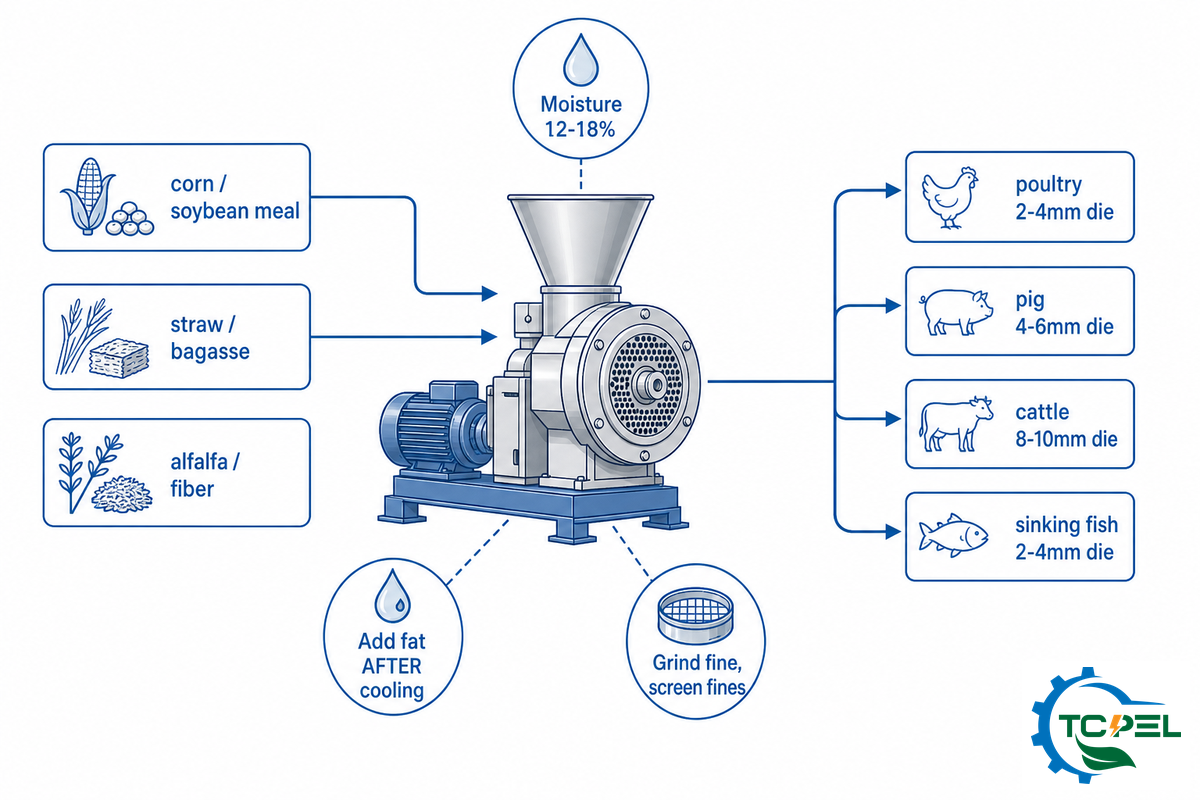
Une presse à granuler les aliments peut comprimer presque toute ration broyée et dimensionnée de manière cohérente — céréales, tourteau de soja, paille, bagasse de canne à sucre et même coquilles de fruits à coque broyées — mais l’aptitude à la granulation et la valeur nutritionnelle sont deux questions distinctes. Cette même filière produit un granulé d’aliment pour animaux ou un granulé pour volailles dès lors que la formule est adaptée à l’espèce.
Si la teneur en humidité, les fibres et les matières grasses sont correctes, les granulés restent cohésifs ; si la formule est correcte, l’animal se développe bien. Le tableau ci-dessous présente, par animal, les matières courantes et les paramètres de formulation importants.
| Animal / étape du procédé | Ingrédients de base courants | Remarque sur la formulation / les granulés |
|---|---|---|
| Poulet de chair (croissance–finition) | Maïs, tourteau de soja, matières grasses, prémélange | ~21–23 % de protéines brutes ; le mélange maïs-soja résiste à la vapeur, il faut donc améliorer la qualité des granulés avec un liant et un broyage adapté, et non avec davantage de chaleur |
| Poule pondeuse | Maïs, SBM, calcaire, prémélange | Souvent nourrie avec un aliment en farine ; en cas de granulation, conserver une granulométrie suffisante pour préserver la santé du gésier |
| Poulette / démarrage | Maïs, SBM, prémélange fin | Généralement servi sous forme de miettes (granulés brisés) pour les petits becs |
| Bovins de boucherie (finition) | Céréales, coproduits, fourrages grossiers, mélasse | Forte teneur en fibres et en mélasse ; les ruminants bénéficient moins de la gélatinisation de l’amidon que les monogastriques |
| Bovins laitiers | Mélange de céréales, tourteaux protéiques, minéraux | Concentré granulé distribué avec du fourrage ; surveiller les additifs thermosensibles |
| Porc (croissance–finition) | Maïs, SBM, blé, matières grasses, prémélange | La granulation améliore la digestibilité énergétique, mais il faut éviter un broyage trop fin (risque d’ulcère) |
| Poissons consommant des aliments coulants (tilapia, poisson-chat) | Farine de poisson/SBM, céréales, liant | Une presse à granuler convient aux aliments coulants ; les aliments flottants nécessitent une extrudeuse |
| Lapin | Luzerne, céréales, sources de fibres | La forte teneur en fibres fourragères assure une bonne cohésion ; un granulé ferme est préférable |
| Chèvre / mouton | Céréales, coproduits, fourrages grossiers | Ruminant ; dureté modérée, éviter l’excès de fines |
| Aliments pour animaux de compagnie (chien/chat) | Farine de viande, céréales, matières grasses | Les formules riches en matières grasses ou spécialisées nécessitent généralement une extrudeuse, et non une presse à granuler |
Deux paramètres de formulation influencent davantage la qualité des granulés que la machine elle-même. Des recherches du secteur attribuent environ 40 % de la qualité des granulés à la recette et au choix des ingrédients, et l’ajout de matières grasses dans le mélangeur avant la filière est « la pire chose à faire pour la qualité des granulés » — appliquez-les plutôt après le refroidissement. La teneur en humidité est l’autre paramètre : si le mélange est trop sec, les granulés se désagrègent en fines ; s’il est trop humide, ils ramollissent et provoquent des bourrages, la plage optimale étant généralement de 12–18 % selon la matière.
La chaleur présente également un coût caché dans la formule. Des études publiées dans Animals et dans la revue hébergée sur PMC montrent que la granulation et l’extrusion au-dessus de ~100 °C dégradent considérablement les vitamines ajoutées (E, complexe B) ; sans prémélanges thermostables, la granulation à la ferme peut donc rendre discrètement l’aliment moins nutritif que la farine qu’il remplace.
⚠️ La sécurité des ingrédients est distincte de leur aptitude à la granulation
Une machine peut physiquement granuler des céréales moisies, mais cela ne les rend pas propres à l’alimentation animale. La FDA américaine fixe des seuils d’intervention pour les aflatoxines pouvant descendre jusqu’à 20 ppb pour les animaux laitiers et immatures (avec des seuils supérieurs pour les bovins en finition), selon FDA Sec. 683.100. Analysez les ingrédients entrants pour détecter les contaminants avant même qu’ils n’atteignent la filière — la granulation n’élimine pas les mycotoxines.
Comment choisir et dimensionner une presse à granuler les aliments
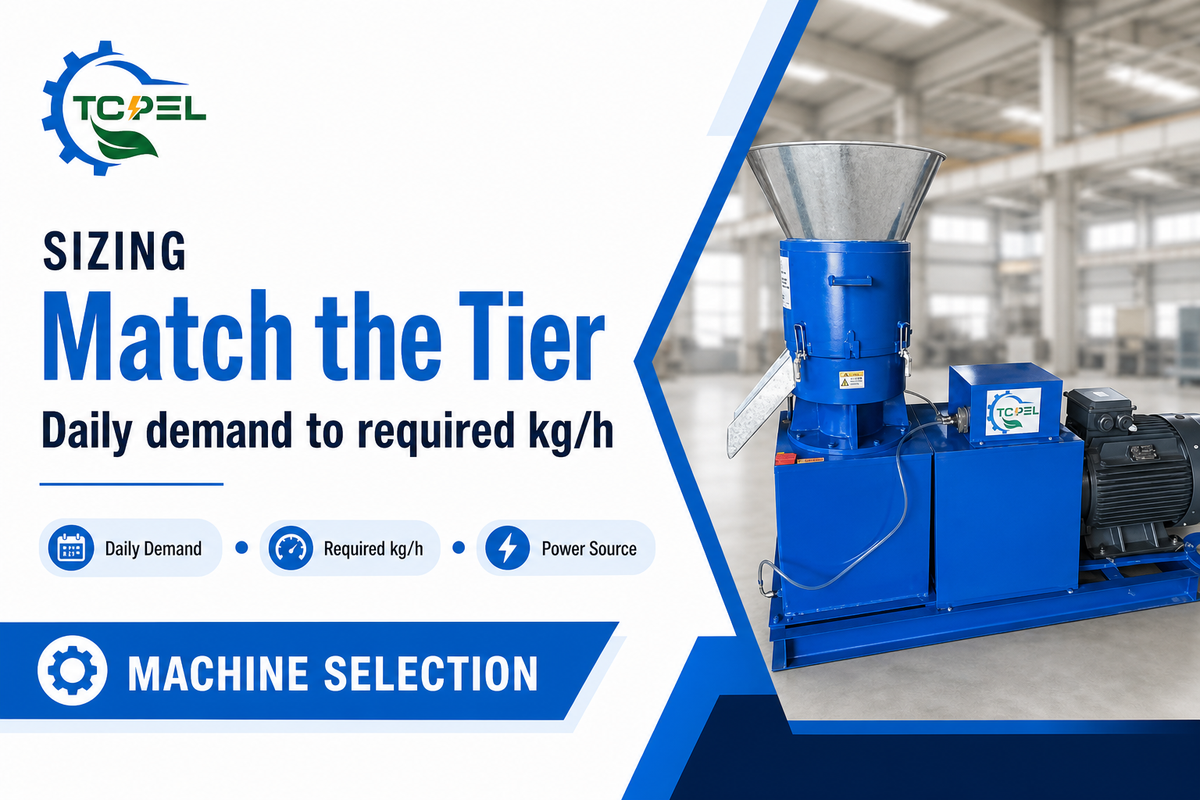
Le dimensionnement d’une presse à granuler les aliments commence par vos animaux, et non par un catalogue. Calculez vos besoins alimentaires quotidiens, divisez-les par le nombre d’heures de fonctionnement réel, ajoutez une marge d’utilisation et vous obtenez le débit requis en kg/h. Adaptez ensuite la source d’énergie à votre site.
Calculateur de débit selon les besoins alimentaires : dimensionnement en 3 étapes
Le calculateur de débit selon les besoins alimentaires
- Besoin quotidien = nombre d’animaux × consommation quotidienne par animal.
- Débit requis en kg/h = besoin quotidien ÷ heures de fonctionnement quotidiennes ÷ 0,8 (marge d’utilisation).
- Choisissez une catégorie correspondant à ce débit en kg/h, puis prévoyez une réserve de capacité pour la croissance.
Exemple de calcul. 500 poules pondeuses × 0,12 kg/jour = 60 kg/jour. Pour un lot traité en 2 heures : 60 ÷ 2 ÷ 0,8 ≈ 38 kg/h, ce qui correspond à une machine agricole d’entrée de gamme, et non à une ligne industrielle. Les données de terrain qui étayent notre outil de dimensionnement de capacité montrent qu’une presse d’entrée de gamme peut alimenter environ 50–150 bovins ou 125–400 oiseaux, ce qui concorde avec ce calcul.
La source d’énergie constitue l’autre moitié de la décision. Avec une alimentation triphasée fiable, une machine électrique est la solution la plus simple et la moins coûteuse à exploiter ; un modèle monophasé 220V convient à un usage domestique ou dans une petite exploitation. Lorsque l’alimentation électrique rurale est instable, un moteur diesel ou un entraînement PTO — voire une motorisation double électrique et diesel — permet à une ligne de grande capacité de continuer à fonctionner pendant les coupures. Lorsque vous comparez les machines, examinez également leur construction : les pièces en acier inoxydable en contact avec le produit résistent à la corrosion, tandis qu’une conception silencieuse, nécessitant peu d’entretien et dotée d’un écartement de filière réglable réduit les coûts d’exploitation des petites et moyennes structures qui achètent la majorité des unités ; une évaluation publiée dans une revue à comité de lecture portant sur une presse à galets utilisée à la ferme confirme que de petites machines équipées d’un moteur de 2 hp peuvent tout de même atteindre un indice de durabilité mécanique des granulés de 95,77 %, souvent supérieur à celui des grandes unités commerciales, car une chaleur moindre préserve l’intégrité des granulés, selon des conceptions documentées à grande filière et faible puissance (brevet US7785379B2) et des essais de terrain. Un conseil pratique donné par des installateurs ruraux consiste à poser un stabilisateur de tension, car ce qui ressemble à un « moteur en panne » n’est souvent qu’une chute de la tension d’alimentation qui déclenche la protection de l’entraînement.
Puis-je fabriquer des aliments pour animaux chez moi avec une presse à granuler ?
Oui, une petite presse à granuler les aliments — généralement un modèle à filière plate alimenté en monophasé ou en triphasé — peut transformer en granulés une ration maison dimensionnée de manière cohérente pour les volailles, les lapins ou les bovins, à un débit d’environ 50–400 kg/h. Il faut toutefois disposer de toute la ligne courte : broyer à moins de 3 mm, mélanger et conditionner jusqu’à la bonne teneur en humidité, puis comprimer à travers une filière de 4 mm, 6 mm ou 8 mm, refroidir et cribler. L’absence de conditionnement ou de refroidissement est la cause habituelle de l’effritement des granulés fabriqués à la ferme.
En dessous de quelques centaines de kg par jour, vérifiez si le temps consacré et l’usure engendrée en valent la peine par rapport au simple achat d’aliments en sacs.
Rentabilité : fabriquer ses propres aliments granulés en vaut-il la peine ?
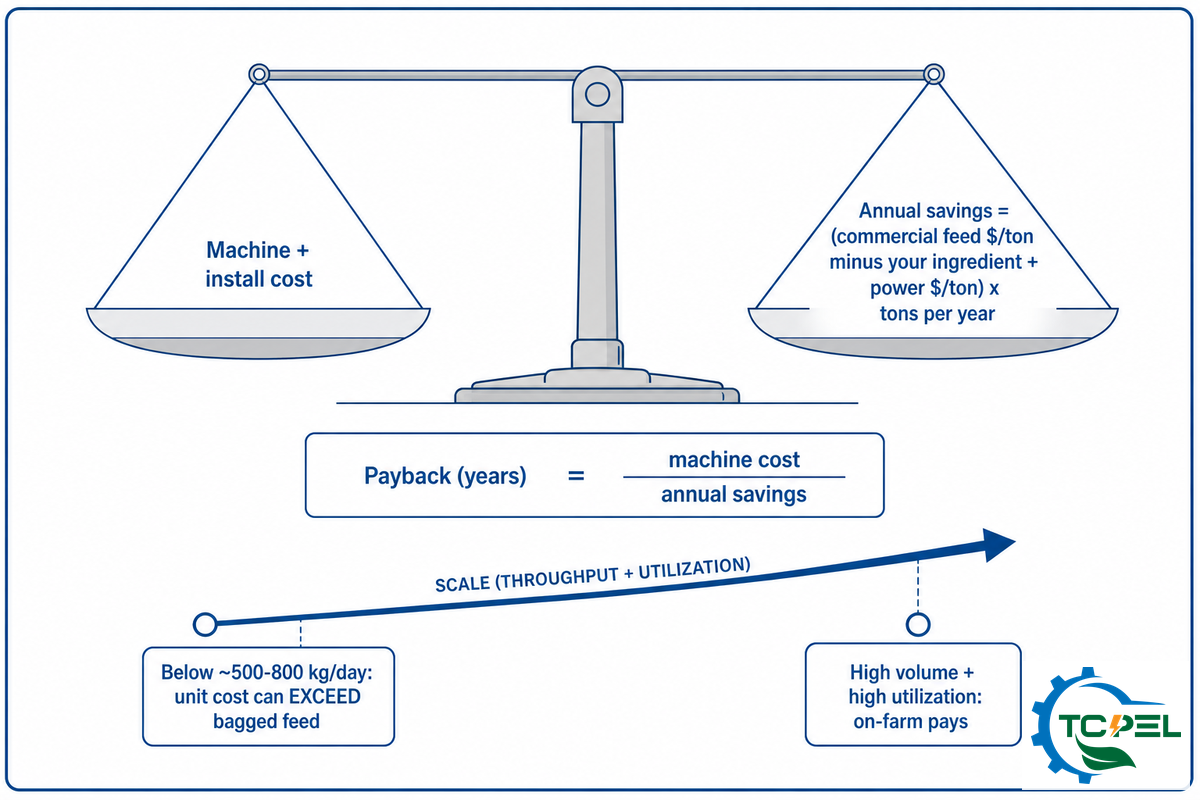
Fabriquer vos propres aliments granulés n’est pas automatiquement moins cher — et, à petite échelle, cela revient souvent plus cher. Les fournisseurs évitent ce sujet ; voici donc la réalité. Les aliments constituent le principal coût de la production animale, soit environ 70 % du coût total de production porcine, selon l’étude de l’University of Illinois publiée sur Illinois (Lancheros et al., 2020), ce qui explique précisément pourquoi la comparaison entre fabrication et achat doit reposer sur des chiffres réels.
Calculateur du seuil de rentabilité entre fabrication et achat
Le calculateur du seuil de rentabilité entre fabrication et achat
- Économies annuelles = (aliment du commerce en $/tonne − vos ingrédients + électricité en $/tonne) × tonnes/an.
- Temps de retour sur investissement (années) = coût de la machine + installation ÷ économies annuelles.
Le piège. Lorsque l’on saisit des chiffres réels à petite échelle, l’écart s’effondre souvent. Le mélange à la ferme n’économise généralement qu’un pourcentage à un chiffre par lot et, en dessous d’un débit d’environ 500–800 kg/jour, avec des démarrages et arrêts, du travail manuel ou un approvisionnement instable en matières premières, votre coût unitaire peut dépasser celui des aliments du commerce. Un petit éleveur a indiqué avoir dépensé environ $111 pour fabriquer 100 lb d’aliments, contre $35 pour un sac du commerce. Le prix des ingrédients forme une fourchette et non une moyenne ; établissez donc votre budget sur la valeur haute.
Pourquoi l’échelle de production est-elle déterminante ? Parce que la principale contrainte est le pouvoir d’achat, et non la machine. Comme l’a résumé un éleveur expérimenté après avoir refait plusieurs fois les calculs, les fabricants d’aliments achètent les céréales par trains entiers et les vitamines et acides aminés à la tonne, tandis qu’un petit opérateur achète des sacs de 50 lb au prix à la livre, et certains sacs d’une seule céréale coûtent plus cher qu’un sac d’aliment complet. Le coût de la machine est également réel : les filières et les galets sont des consommables remplacés toutes les 500–1 000 heures de fonctionnement et représentent, selon les estimations du secteur, 12–15 % des coûts d’exploitation. Cela ne signifie pas que la granulation à la ferme n’est jamais rentable ; elle peut clairement l’être avec un volume et un taux d’utilisation de la machine suffisants, mais le tonnage nécessaire pour atteindre le seuil de rentabilité est plus élevé que ne le laissent entendre les brochures.
⚠️ Le statut réglementaire peut modifier le calcul
L’échelle ne modifie pas seulement les coûts — elle peut également changer votre catégorie réglementaire. Selon la règle américaine FDA FSMA Preventive Controls for Animal Food (21 CFR 507), une exploitation agricole qui nourrit ses propres animaux peut être exemptée, tandis qu’un établissement fabriquant des aliments pour les animaux de tiers doit appliquer les bonnes pratiques de fabrication actuelles et disposer d’un plan écrit de sécurité des aliments. Le passage de « nourrir mon troupeau » à « vendre des aliments » ajoute des coûts de conformité qui doivent figurer dans votre calcul du seuil de rentabilité, au même titre que le débit et le prix des céréales.
Exploitation et entretien d’une presse à granuler les aliments
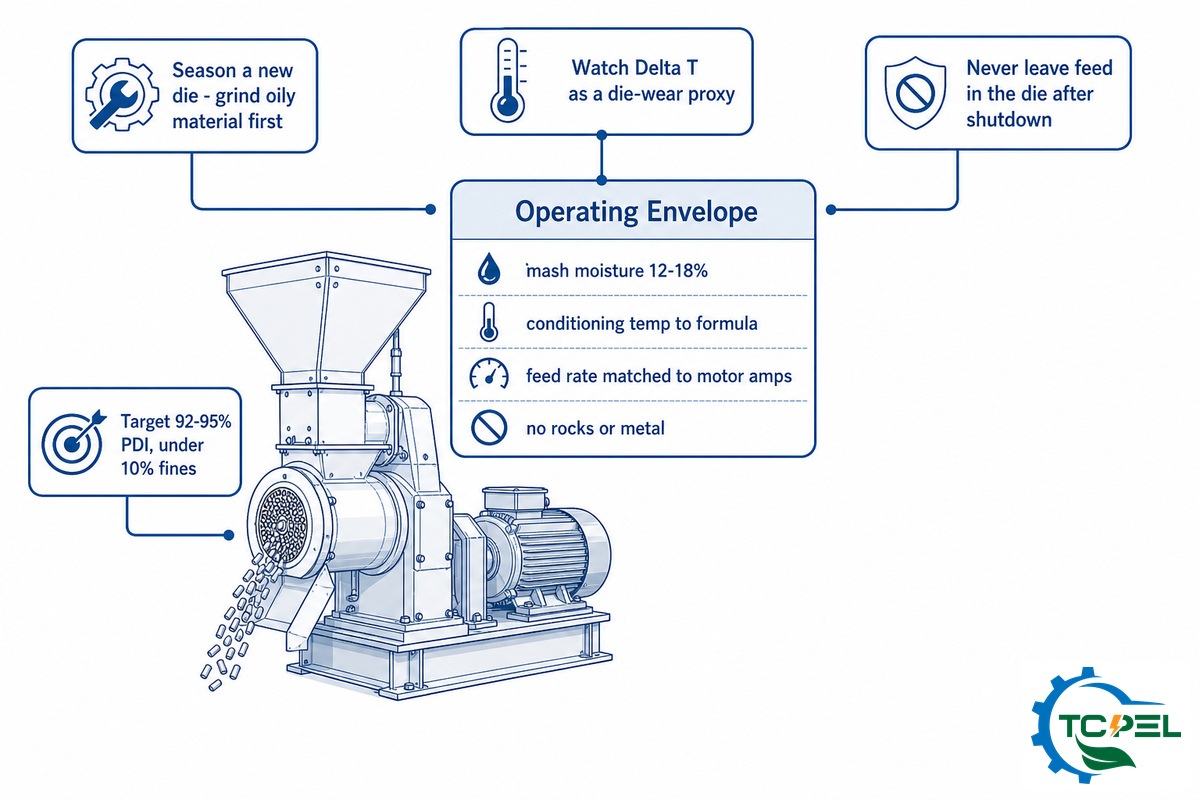
Une presse à granuler les aliments récompense la rigueur du procédé et sanctionne la négligence. Le paramètre le plus utile à suivre est l’indice de durabilité des granulés (PDI) : il correspond au pourcentage de granulés qui résistent à un essai normalisé de culbutage, mesuré conformément à ASAE S269.5, avec un objectif de 92–95 % pour un aliment de haute qualité et moins de 10 % de fines, selon le guide de Kansas State University sur la qualité des granulés. Un modèle fondé sur 2 691 observations provenant d’une usine commerciale a établi que le PDI dépend principalement de la température de conditionnement, des matières grasses, des fibres et de l’humidité ambiante, et non de la seule filière.
Plage de fonctionnement d’une presse à granuler les aliments
Restez dans ce que nous appelons la plage de fonctionnement de la presse à granuler et la plupart des problèmes disparaîtront : teneur en humidité du mélange farineux de 12–18 %, conditionnement à la température adaptée à votre formule, débit d’alimentation ajusté à l’intensité du moteur et absence absolue de pierres ou de métal dans la filière. Deux habitudes de l’opérateur sont particulièrement importantes. Premièrement, rodez toute filière neuve, car ses alésages sont encore rugueux à la sortie d’usine : faites-y passer une matière huileuse préalablement broyée avant la production réelle, sans quoi elle se bloquera et extrudera de la poudre. Deuxièmement, ne laissez jamais d’aliment dans la filière après l’arrêt, car il durcit et obstrue les trous.
📐 Note d’ingénierie
Surveillez le « Delta T » — l’écart de température entre le mélange farineux conditionné et les granulés sortant de la filière — comme indicateur indirect de l’usure de la filière. Le brevet délivré CA2769985C établit un lien direct entre une réduction de 38–54 % du Delta T et des « économies sur la filière et les galets ». Pour la biosécurité, ne vous fiez pas au cadran : placez des thermocouples étalonnés dans le flux de produit afin de mesurer la température réelle de la matière par rapport au seuil d’environ 75 °C nécessaire pour réduire de manière fiable Salmonella, et n’oubliez pas que le refroidisseur constitue un point majeur de recontamination, conformément au Code de bonnes pratiques britannique pour la maîtrise de Salmonella dans les aliments pour animaux.
« Il faut injecter de la vapeur ou de l’humidité avant la filière pour former les granulés, puis les faire passer dans un refroidisseur, car la compression produit de la chaleur, et enfin sur un crible vibrant afin d’éliminer les fines. En 34 ans et avec des centaines de filières, je n’en ai jamais cassé une en fabriquant des aliments pour animaux, mais j’ai vu des presses à granulés de bois mises au rebut à cause de filières cassées. »
Sécurité : poussières combustibles et pièces mobiles
Traitez une ligne de granulation d’aliments pour animaux en tenant compte des risques liés aux poussières et aux machines qu’elle présente. Aux États-Unis, l’OSHA classe les usines d’aliments pour animaux et les installations de granulation de poussières parmi les établissements de manutention des grains, où les risques mortels comprennent les incendies et les explosions provoqués par les poussières de céréales combustibles, ainsi que les risques d’écrasement et d’amputation au niveau des vis sans fin, des galets et des convoyeurs. Maîtrisez les poussières par aspiration et nettoyage, consignez les pièces mobiles avant de débloquer un bourrage et ne mettez jamais la main dans la chambre d’une filière ou de galets en fonctionnement. Ces risques ne sont pas marginaux : c’est précisément pour les prévenir que le broyage, le convoyage et la granulation sont des activités réglementées.
Granulation des aliments pour animaux en 2026 : les critères qui orientent les décisions d’achat

Cette année, trois facteurs déterminent la manière dont les exploitants achètent et utilisent les presses à granuler les aliments pour animaux, et aucun ne se résume à la taille du marché. Le premier est le renforcement de la biosécurité : les autorités durcissent continuellement les règles de sécurité des aliments pour animaux, le Royaume-Uni ayant actualisé son Code de bonnes pratiques pour la maîtrise de Salmonella dans les aliments pour animaux en juin 2026 dans le cadre du règlement européen 183/2005 relatif à l’hygiène des aliments pour animaux. Comme la granulation commerciale réduit les agents pathogènes sans les éliminer totalement, les acheteurs accordent davantage d’importance à la vérification de la température de conditionnement et à l’hygiène du refroidisseur qu’au seul débit brut.
Le deuxième facteur est la réévaluation du coût des aliments pour animaux. Malgré l’idée répandue selon laquelle ce coût ne peut qu’augmenter, l’USDA Economic Research Service prévoit une baisse d’environ 6,8 % des dépenses des exploitations agricoles américaines consacrées aux aliments pour animaux en 2026. La baisse du prix des ingrédients modifie le seuil de rentabilité entre fabriquer et acheter, d’où une mesure concrète : si vous envisagez une machine à la ferme pour 2026, recalculez votre seuil de rentabilité avec les prix actuels des céréales, et non ceux de l’année dernière.
Troisièmement, l’automatisation gagne progressivement les équipements d’entrée de gamme : les capteurs en ligne mesurant la température de la filière et la qualité des granulés, ainsi que le réglage automatique des galets, autrefois réservés aux installations industrielles, deviennent accessibles aux petites unités. À titre purement indicatif, sachant que ces chiffres varient fortement selon le périmètre retenu, les cabinets d’études évaluent le marché global des machines de transformation des aliments pour animaux à environ USD 30 milliards en 2026. Considérez cette donnée comme une tendance générale, et non comme un motif d’achat.
Questions fréquentes
Combien coûte une presse à granuler les aliments pour animaux ?
Voir la réponse
Le coût augmente avec la capacité de production et la qualité de fabrication : raisonnez donc par catégories plutôt qu’à partir d’un chiffre unique. Les petites presses agricoles à filière plate se situent dans le bas de la fourchette, les lignes continues destinées aux exploitations et aux petites usines dans la catégorie intermédiaire, et les systèmes commerciaux semi-automatiques à matrice annulaire bien plus haut ; une usine industrielle complète de granulation atteint un montant à six chiffres. Les principaux postes de coût sous-estimés par les acheteurs sont les consommables et l’énergie — les filières et les galets doivent être remplacés toutes les 500–1 000 heures — : comparez donc le prix rendu, le coût des pièces détachées et celui de l’énergie, et pas seulement le prix mis en avant pour une presse à granuler les aliments pour animaux à vendre. Pour connaître les tarifs actuels de chaque modèle, consultez le tableau des caractéristiques publié sur notre page produit consacrée aux presses à granuler les aliments pour animaux.
Puis-je fabriquer des aliments pour animaux avec une presse à granuler ?
Voir la réponse
Oui, à condition de partir d’une ration équilibrée sur le plan nutritionnel et d’utiliser toute la ligne courte. Broyez les ingrédients à une granulométrie inférieure à 3 mm, mélangez-les et conditionnez-les à la teneur en humidité appropriée, comprimez-les à travers une filière adaptée à vos animaux, puis refroidissez et éliminez les fines par criblage. Une petite presse à granuler convient bien aux aliments pour volailles, lapins, porcs et bovins. En revanche, une presse à granuler ne corrigera pas une formule déséquilibrée et n’éliminera pas les contaminants — l’aptitude à la granulation et la sécurité alimentaire sont deux questions distinctes : équilibrez donc la ration et analysez d’abord les ingrédients.
Comment fonctionne une presse à granuler les aliments pour animaux ?
Voir la réponse
Le mélange farineux broyé est conditionné à la vapeur pour l’assouplir et amorcer la gélatinisation de l’amidon, puis des galets rotatifs le forcent à travers les trous d’une filière en acier. La chaleur produite par la pression et le frottement agglomère ensuite le mélange en granulés fermes, qu’un couteau coupe à la longueur voulue. Comme les granulés sortent chauds de la filière, ils traversent un refroidisseur, puis une grille élimine les fines provenant des granulés cassés. Cette étape de conditionnement et de cuisson explique pourquoi un granulé correctement fabriqué reste cohésif et se digère différemment d’un mélange farineux froid.
Est-il moins cher de fabriquer vos propres aliments pour animaux ?
Voir la réponse
Pas toujours — et surtout pas à petite échelle. Comme les fabricants d’aliments pour animaux achètent les ingrédients en volumes que vous ne pouvez pas égaler, la fabrication à la ferme ne permet souvent d’économiser qu’un pourcentage à un seul chiffre et, en dessous de quelques centaines de kilogrammes par jour, votre coût unitaire peut dépasser celui des aliments du commerce après prise en compte de la main-d’œuvre et de l’usure de la filière. Avant de vous engager, utilisez le calculateur de seuil de rentabilité entre fabrication et achat ci-dessus avec votre tonnage réel et les prix actuels des céréales.
Presse à granuler ou extrudeuse : quelle est la différence ?
Voir la réponse
Une presse à granuler comprime un mélange farineux conditionné à travers une filière pour produire des granulés denses et coulants, tout en étant moins coûteuse à l’achat et à l’utilisation. Une extrudeuse cuit l’aliment à une température et sous un cisaillement plus élevés afin de le faire expanser et éventuellement flotter, ce qui est indispensable pour les aliments flottants destinés aux poissons et certains aliments pour animaux de compagnie. Pour la plupart des aliments destinés aux animaux d’élevage et aux volailles, une presse à granuler constitue le choix approprié et le plus économique.
Une presse à granuler les aliments pour animaux peut-elle produire des aliments flottants pour poissons ?
Voir la réponse
Non — une presse à granuler classique produit des granulés coulants. Les aliments aquacoles flottants nécessitent une extrudeuse, qui fait expanser l’aliment afin qu’il reste à la surface de l’eau.
Quelles dimensions de granulés faut-il selon les animaux ?
Voir la réponse
De manière générale, les volailles consomment de petits granulés ou des miettes, les porcs et les lapins des calibres intermédiaires, et les bovins des granulés plus gros — le diamètre étant déterminé par la filière. Consultez sur notre page produit la matrice des filières et des dimensions de granulés par espèce pour obtenir des recommandations précises.
Prêt à choisir une machine adaptée à vos animaux et à votre tonnage ?
Découvrez la gamme de presses à granuler les aliments pour animaux TCF →À propos de ce guide
Ce guide s’appuie sur des recherches évaluées par les pairs en sciences de l’alimentation animale, sur des documents de l’USDA et de la FDA, ainsi que sur les questions pratiques que les acheteurs de plus de 60 pays posent à notre équipe d’ingénierie lors du dimensionnement d’une presse à granuler les aliments pour animaux. Lorsque les données sont contradictoires, notamment concernant les performances comparées des granulés et du mélange farineux ainsi que la rentabilité à la ferme, nous avons présenté honnêtement la fourchette des résultats plutôt que la version commerciale. Guide vérifié par l’équipe technique de TCPEL.
Références et sources
- Utilisation de granulés pour améliorer les performances des poulets de chair – Penn State Extension
- Régimes sous forme de miettes, de granulés et de mélange farineux : performances des poulets de chair – Veterinary Medicine International (PMC)
- Réponse du NACMCF sur les mesures de maîtrise de Salmonella – USDA-FSIS
- Directives de maîtrise de Salmonella (AFIA) – UC Davis Food Safety
- Hygiénisation des aliments pour animaux (sécurité des aliments pour animaux) – FEFAC
- Granulométrie, granulation et extrusion dans les rations porcines (Lancheros et al., 2020) – University of Illinois
- Évaluation de la qualité des granulés (MF3228) – Kansas State University Research & Extension
- Prédiction de l’indice de durabilité mécanique des granulés dans une usine commerciale d’aliments pour animaux – Journal of Animal Science (PMC)
- Code de bonnes pratiques pour la maîtrise de Salmonella dans les aliments pour animaux – UK Government (Defra/APHA/FSA)
- Prévisions de revenus du secteur agricole (2026) – USDA Economic Research Service
- Règle définitive de la FSMA : contrôles préventifs applicables aux aliments pour animaux (21 CFR 507) – U.S. FDA
- Seuils d’intervention pour les aflatoxines dans les aliments pour animaux (Sec. 683.100) – U.S. FDA
- Manutention des grains, risques et normes – U.S. OSHA
- Méthode améliorée de conditionnement des aliments pour animaux (CA2769985C) – Google Patents
- Granulation : effets des principaux ingrédients – WATTPoultry
- Guide de référence sur la granulation des aliments pour animaux : extrusion – Feed Strategy
Articles connexes
- Guide des presses à granuler pour aliments pour animaux – analyse approfondie de la ligne de granulation et de la durabilité mécanique
- Guide des presses à granulés de bois – les différences entre la granulation de biomasse et celle des aliments pour animaux
- Presse à granulés à filière plate : guide de l’acheteur et de l’opérateur
- Guide des broyeurs à marteaux pour bois – l’étape de broyage avant la filière