Get in Touch with TCPEL

Updated July 2026. Reviewed by the ALLWIN INTERNATIONAL CO., LTD (TCPEL) technical team.
A wood pellet business is a manufacturing operation that crushes, dries, and compresses sawdust, wood waste, or agricultural residue into graded fuel pellets sold for home heating, BBQ fuel, or industrial boiler fuel. Starting a wood pellet business, whether you are building a wood pellet maker line from scratch or buying an existing one, involves clearing seven gates before the first ton ships: market fit, raw material supply, scale, equipment, capital, permits, and distribution. A feasibility review against these seven gates up front, before signing for a wood pellet plant lease or a single machine, is what separates a real business plan from a spreadsheet exercise. Miss any one of the gates and a well-built plant can still stall in commissioning or bleed cash on the wrong sales channel. This guide walks through each gate in order, using real project data, government trade figures, and one operator’s disclosed margins – not the “20% ROI guaranteed” language common on machinery-trading sites.
Quick Specs: Wood Pellet Business at a Glance
| Capacity range | 50 kg/h (home/small-batch) to 20 t/h (industrial turnkey line) |
| Startup capital (order of magnitude) | roughly $80,000 for a 0.5 t/h small plant up to $2.5M+ for a 10 t/h industrial line |
| Gross margin (real vs. marketed) | one disclosed producer reported 17% after improvement; machinery-site marketing commonly claims 20-30% |
| Quality target | ISO 17225-2:2021 graded wood pellets |
| Process | 6 stages: crush → dry → grind → pelletize → cool → pack |
The 7-Gate Wood Pellet Business Readiness Checklist:
- Market & product focus
- Raw material supply
- Scale decision
- Equipment list
- Startup capital
- Site & permits
- Operations & distribution
Is a Wood Pellet Business Feasible? The 7 Gates You Need to Clear
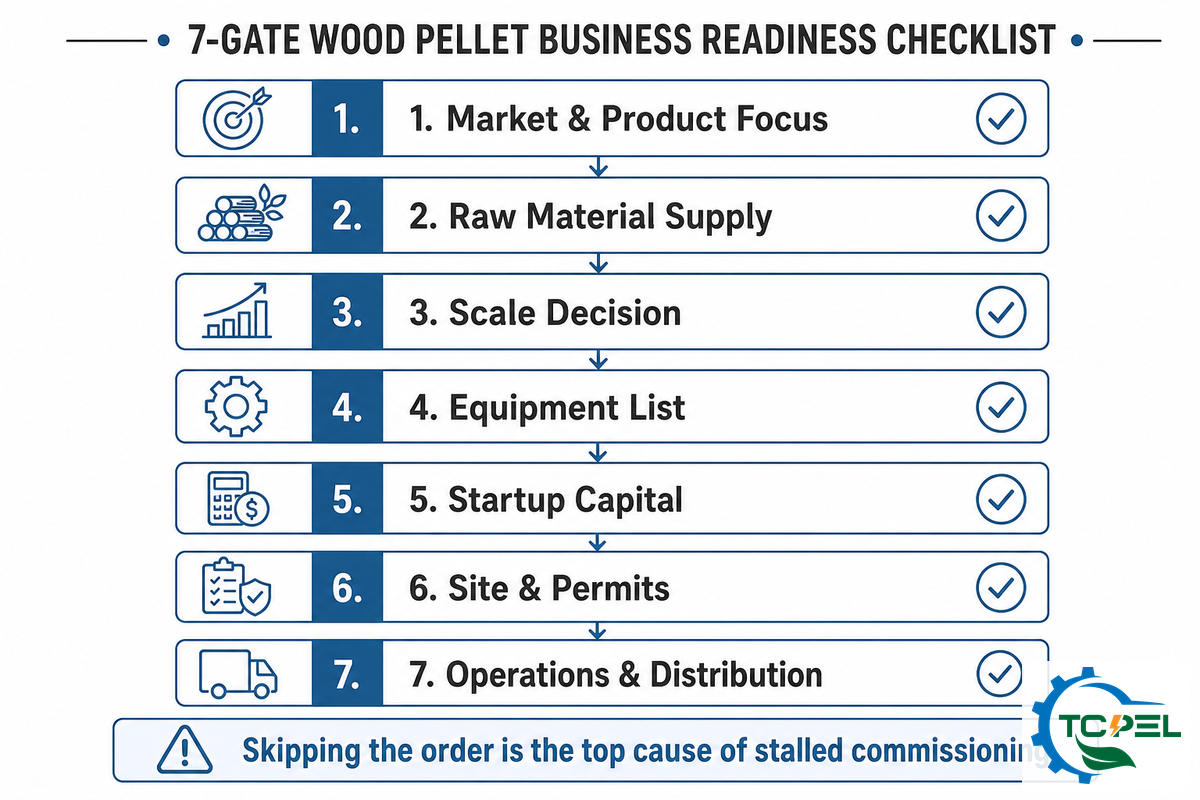
A wood pellet business clears seven gates before it turns a profit: market fit, raw material, scale, equipment, capital, permits, and distribution. Skipping the order matters more than most first-time operators expect – buying equipment before securing a feedstock contract, or picking a scale before confirming local demand, is the single most common reason new plants spend a year or more stuck in commissioning instead of shipping product.
“The apparent simplicity of making wood pellets has and continues to cause many project developers to fail to incorporate the knowledge, skills and wisdom gained from experience into the plant designs and operations protocols … those who know all the wrong ways of doing things are more likely to have far fewer headaches.”
John Swaan, Senior Associate, FutureMetrics Inc., writing in Biomass Magazine
Three-quarters of the guides sold by machinery manufacturers on this topic follow the same six-step skeleton – market research, financing, site and equipment, permits, supply chain, marketing – because several of the highest-ranking pages for this exact question are published by the same corporate group under different domain names, with no independent data behind the numbers. That structure is a reasonable checklist. The numbers behind it need a second, independent source before you budget against them, which is what the rest of this guide provides.
Step 1: Write Your Business Plan: Market Research and Product Focus
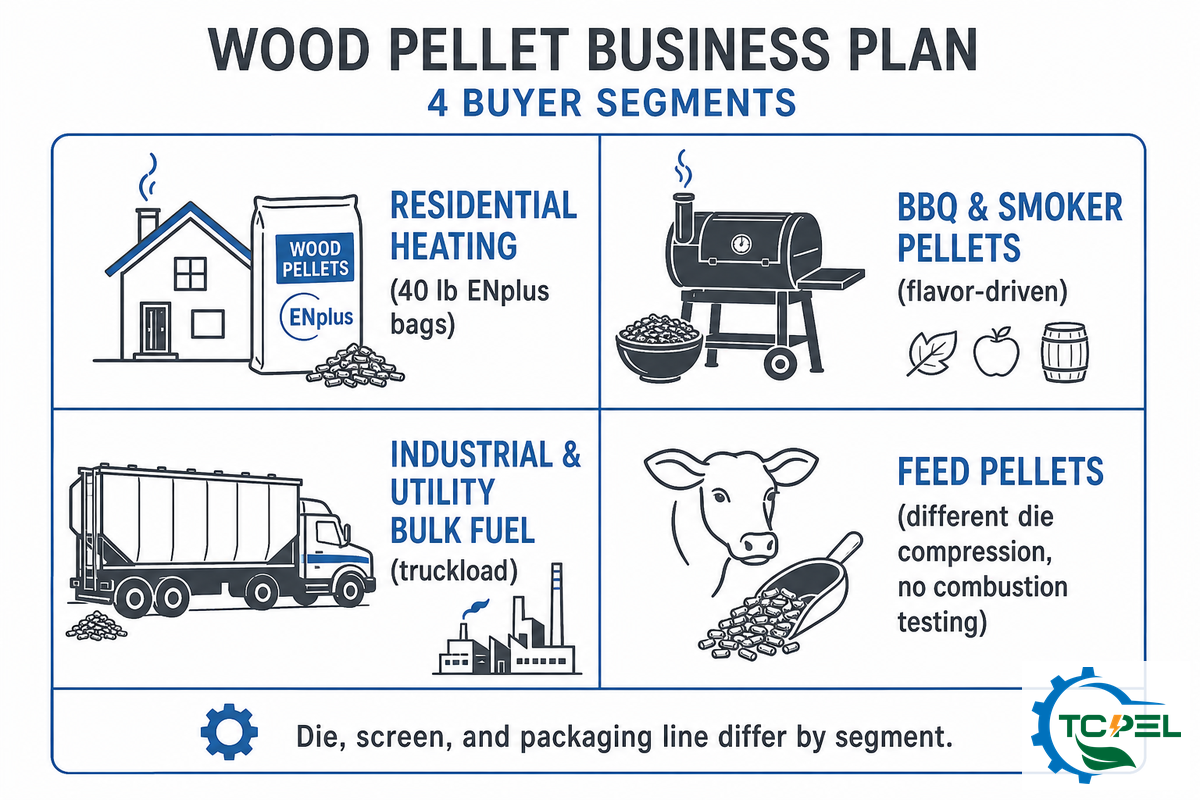
Your wood pellet business plan starts with one decision: which of four buyer segments you’re building for, because the die, screen, and packaging line differ by segment. Residential pellet heating bags (40 lb, ENplus-graded) serve homeowners with pellet stoves and account for the largest slice of pellet fuel demand. BBQ and smoker pellets serve a flavor-driven consumer niche with different bulk-density requirements. Industrial and utility bulk fuel serves power plants and boiler operators buying by the truckload with looser bagging requirements. Feed pellets are a distinct product line entirely – same wood pellet processing backbone, different die compression and no combustion-quality testing. Deciding this early prevents a wood pellet manufacturing business from building a line that fits none of the four segments well.
Why start a wood pellet business?
The obvious environmental angle aside, there’s a growing and specific one for 2026: data centers are looking at low-carbon fuel sources for their backup and ancillary power, and wood pellets are one of the options utilities are evaluating alongside natural gas and battery storage, according to industry coverage in Biomass Magazine. That’s a narrower and more concrete driver than “clean energy is growing,” and largely missing from the machinery-vendor guides that dominate this search.
U.S. exported some 10 million metric tons of wood pellets in 2024 at about $1.7 billion in value, according to data cited in a USDA Forest Service analysis of EU market restructuring – a scale figure worth keeping in mind before you assume your local market is thin.
Step 2: Secure Raw Material Supply Before You Buy Equipment
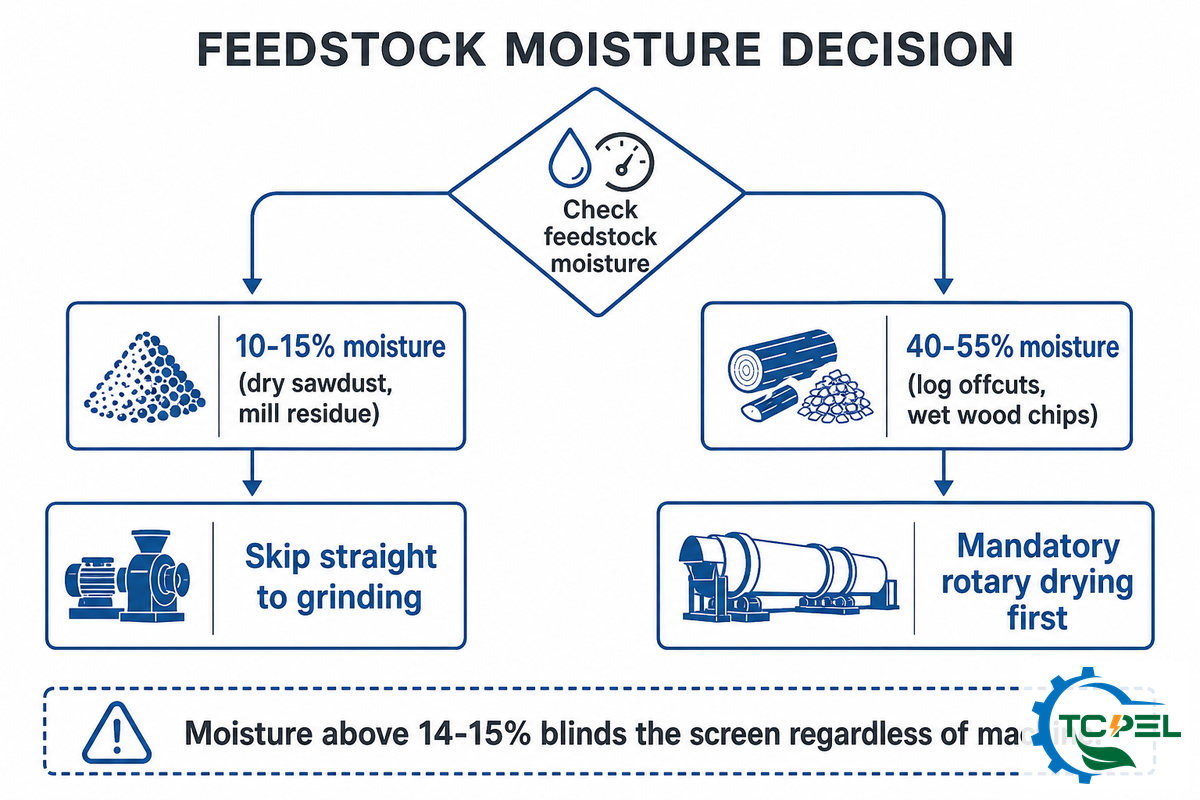
Confirm a raw material contract before you sign for equipment, because a pellet mill sized for 2 tons an hour is worthless without 2 tons an hour of feedstock arriving reliably. Many raw materials for pellets exist beyond wood: sawdust, wood shavings and wood chip offcuts, wood waste and waste wood from furniture factories, and agricultural residue (straw, rice husk, corn stalks, bagasse, palm EFB) all pelletize, but each behaves differently in the die, and moisture content above about 14-15% will blind the screen and choke throughput, regardless of which machine you buy. Wood chip pellet lines and straw or agri-residue lines aren’t interchangeable without retuning the screen and hammer pattern; a peer-reviewed pellet quality assessment found feedstock consistency, more than any single machine setting, drives finished-pellet quality variance.
| Requirement | Why it matters |
|---|---|
| 24/7 volume security | supplier interruptions, seasonal harvest gaps, and bad roads all stop a line that has no buffer stock |
| Site within ~50 miles of the fiber source | transport cost erodes margin fastest of any single line item on the P&L |
| Clean, low-contamination feedstock | dirt, stones, and foreign debris degrade pellet durability and accelerate wear on hammers and dies |
| Consistent species/moisture mix | switching feedstock types mid-batch without recalibrating the line is a common source of off-spec pellets |
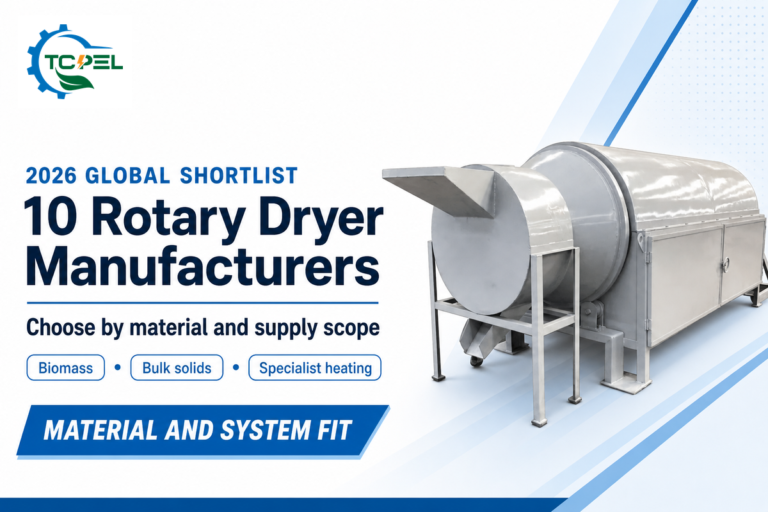
Not all feedstocks require a drying process up front-a common assumption to test rather than assume. Material already near the 10-15% moisture window (dry wood and sawdust, for instance, from a furniture factory) can skip straight to grinding. Wet log residue and fresh wood chips will almost always need a rotary dryer stage first. Confirm your feedstock moisture before budgeting for an unnecessary dryer, or neglecting a necessary one.
| Feedstock type | As-received moisture | Pre-processing needed | Pellet quality note |
|---|---|---|---|
| Softwood sawdust | low (dry mill residue) | minimal or none | clean, high-durability, low ash |
| Hardwood shavings | low-moderate | minimal drying | denser pellet, slightly more grinding energy |
| Log offcuts / wet wood chips | 40-55% | mandatory rotary drying | screen blinds without drying first |
| Wheat / rice straw | variable, fibrous | coarser screen, hardened wear parts | higher ash (10-20%), lower durability than wood |
| Rice husk | low, abrasive | carbide-tipped hammers recommended | high silica ash accelerates wear |
| Corn stalks / stover | moderate-high | drying + coarse screen | ash content varies with soil residue |
| Sugarcane bagasse | wet, stringy fiber | drying + heavy-duty conveying | fiber wrap can jam standard conveyors |
| Palm EFB (empty fruit bunch) | very high | drying + heavy-duty crushing | common Southeast Asia export feedstock |
| Bamboo | low-moderate | standard equipment | low ash, good pellet quality |
Step 3: Choose Your Scale: Low-Cost Small-Batch vs Industrial Line
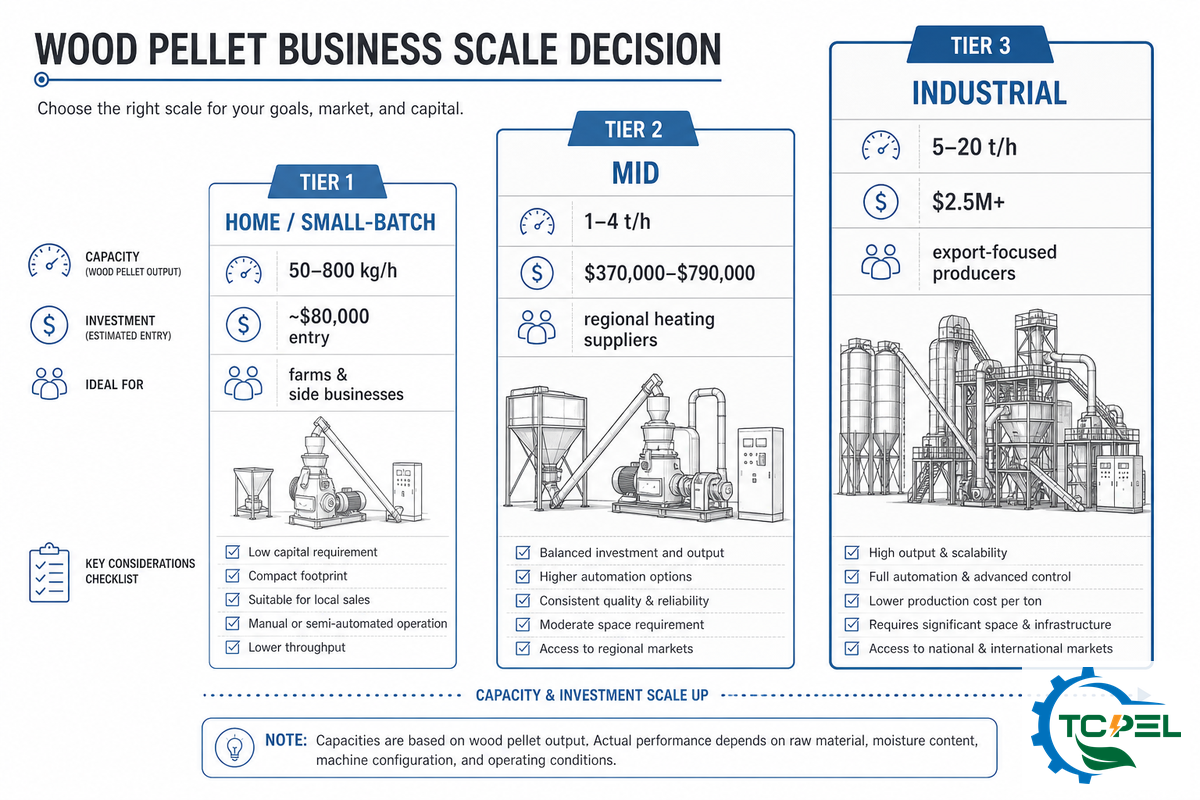
Match your line to your confirmed raw material volume and market, not the largest press your budget can afford; a large-scale pellet ring die, fed with inconsistent, low-volume feedstock, can make worse pellets than a smaller, correctly sized small wood pellet machine. An oversize wood pellet mill, bought before feedstock contracts are confirmed, is the single most expensive error on this list. ISO 17225-2:2021 quality standards apply equally to both ends of the scale, with small flat-die operations achieving the same graded-pellet specifications as large ring-die wood pellet plants with properly managed feedstocks and process controls.
| Scale tier | Typical buyer | Order-of-magnitude capital | Limitations / not suitable for |
|---|---|---|---|
| Home / small-batch, 50-800 kg/h (flat die) | farms, small workshops, side businesses | low-cost entry tier, smallest reported project figure around $80,000 | not suitable for utility-scale or export-contract volume |
| Mid, 1-4 t/h (ring die) | regional heating-fuel suppliers | reported project figures in the $370,000-$790,000 band for comparable capacity, per one manufacturer’s disclosed case studies | figures are single-source manufacturer claims, not independently audited — treat as a planning range, not a quote |
| Industrial, 5-20 t/h (turnkey line) | export-focused producers, utility supply contracts | can exceed $2.5M for equipment alone at the top of the range | not suitable without a confirmed multi-year feedstock and offtake contract |
Step 4: Build Your Equipment List (the 6-Stage Line)
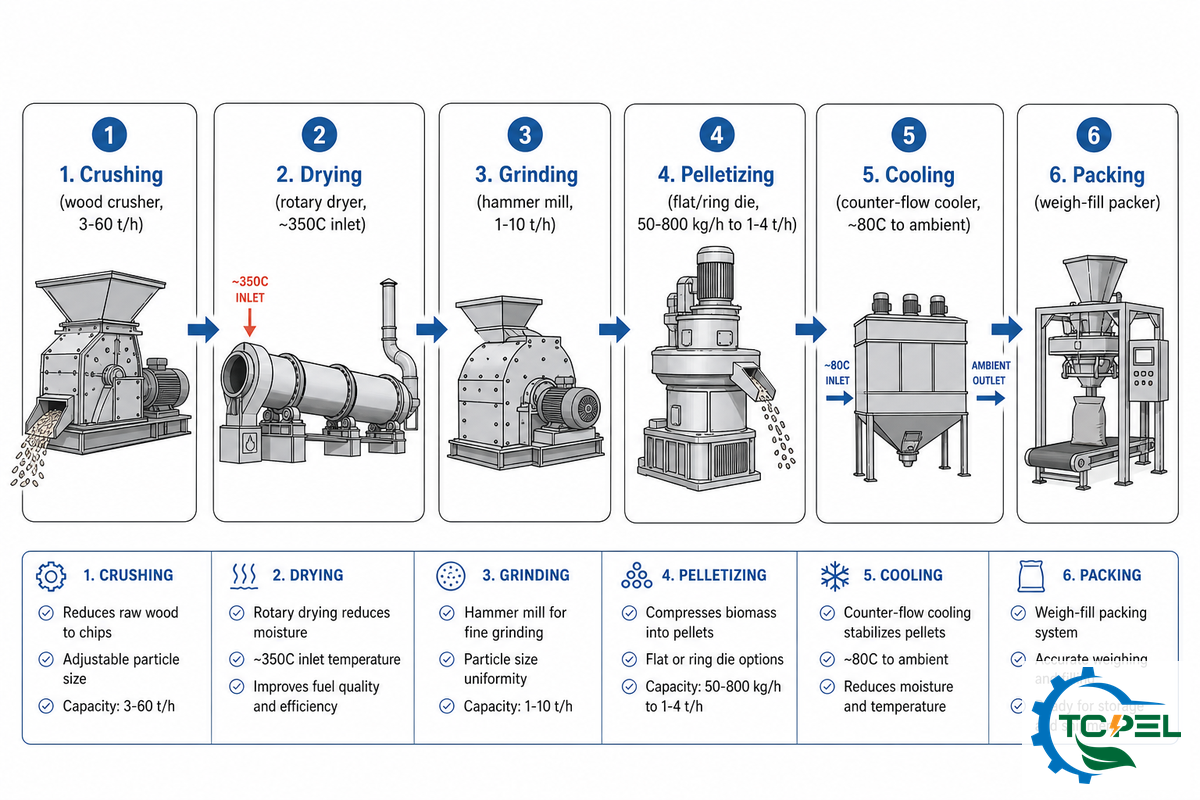
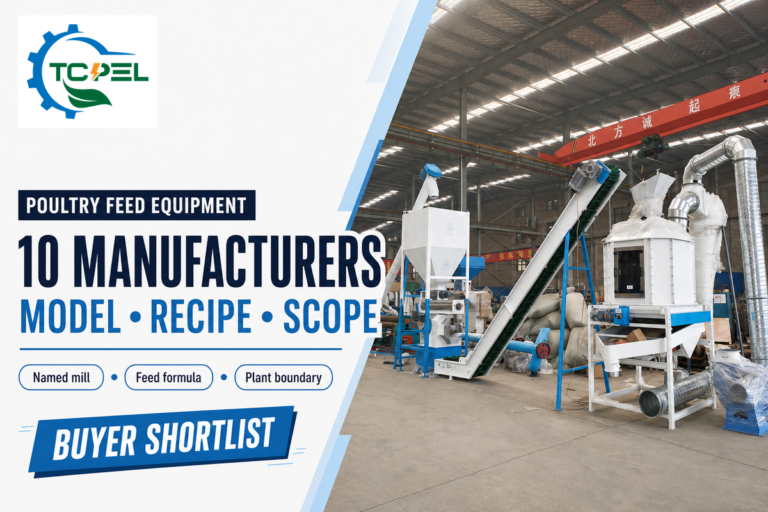
The full six-machine wood pellet production line system should be balanced; you can’t fix an undersized crusher or dryer by simply buying a single “pellet machine”. Pellet manufacturing and wood pellet manufacturing both give a simple overview of a similar production flow: inputs of raw material are outputted as graded fuel pellets after a series of six connected operations. This description also matches the equipment scope in the TCPEL equipment portfolio, our real-world range of seven different equipment categories covering 21 product lines that we offer as a guide line for wood pelletizing at any scale:
| Stage | Equipment | Typical spec |
|---|---|---|
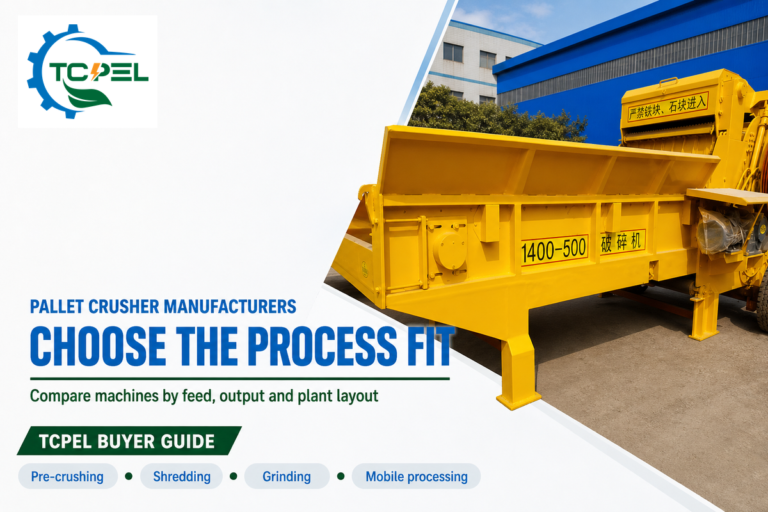
| 1. Crushing | wood crusher / drum chipper | 3-60 t/h, reduces logs/pallets to chip size |
| 2. Drying | rotary dryer | ~350°C inlet, brings moisture to the 10-15% pelletizing window |
| 3. Grinding | hammer mill | 1-10 t/h, 37-250 kW, sizes material below 5 mm |
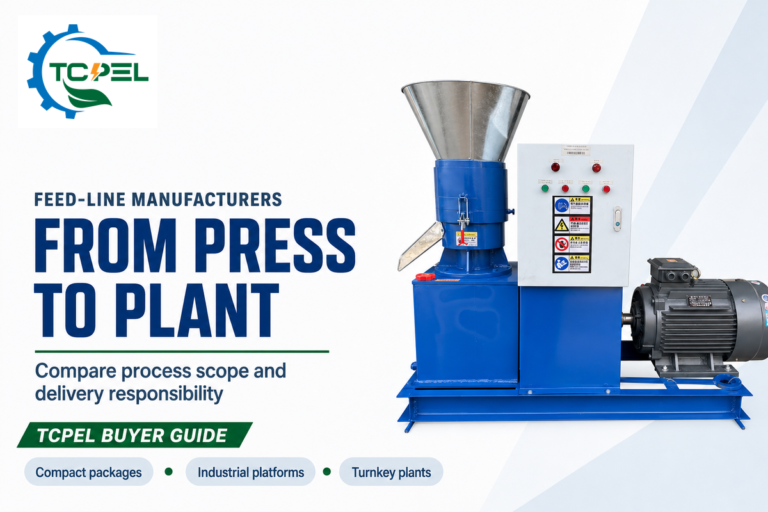
| 4. Pelletizing | flat die or ring die pellet machine | flat die 50-800 kg/h; ring die 1-4 t/h |
| 5. Cooling | counter-flow pellet cooler | drops pellets from ~80°C toward ambient so they harden instead of crumbling |
| 6. Packing | automatic weigh-fill packing machine | bags finished pellets without re-absorbing moisture |
Running a pellet line well and properly operating a pellet mill depend on selecting die/rotor speeds matched to your specific feed stock-a fact that many first-time buyers ignore when reviewing specs in favor of testing report findings. Getting the pellet making process right, not just making pellets at any rate, is what separates a line that runs at spec from one that doesn’t. Here’s a bit of unexpected advice before shopping: higher die speeds or rotor speed don’t inherently create a better-quality pellet. A faster hammer mill tip speed and a faster die rotation rate will generate more fines and will consume more power but may not make the pellets any stronger; the critical variables here are your die compression ratio and the control of feedstock moisture content, the same die-and-press-roller engineering variables that decades of pellet mill press design patents have continued to refine. Request that every equipment supplier provide test-run results using your actual feedstock.
Still working on the feasibility and aren’t quite ready for a quote? You may find it helpful to use a pellet line configurator tool that can guide you through a stage-by-stage listing of the necessary equipment based on your particular feedstock and desired production rate prior to consulting any vendors.
Step 5: Budget the Startup Capital and Financing
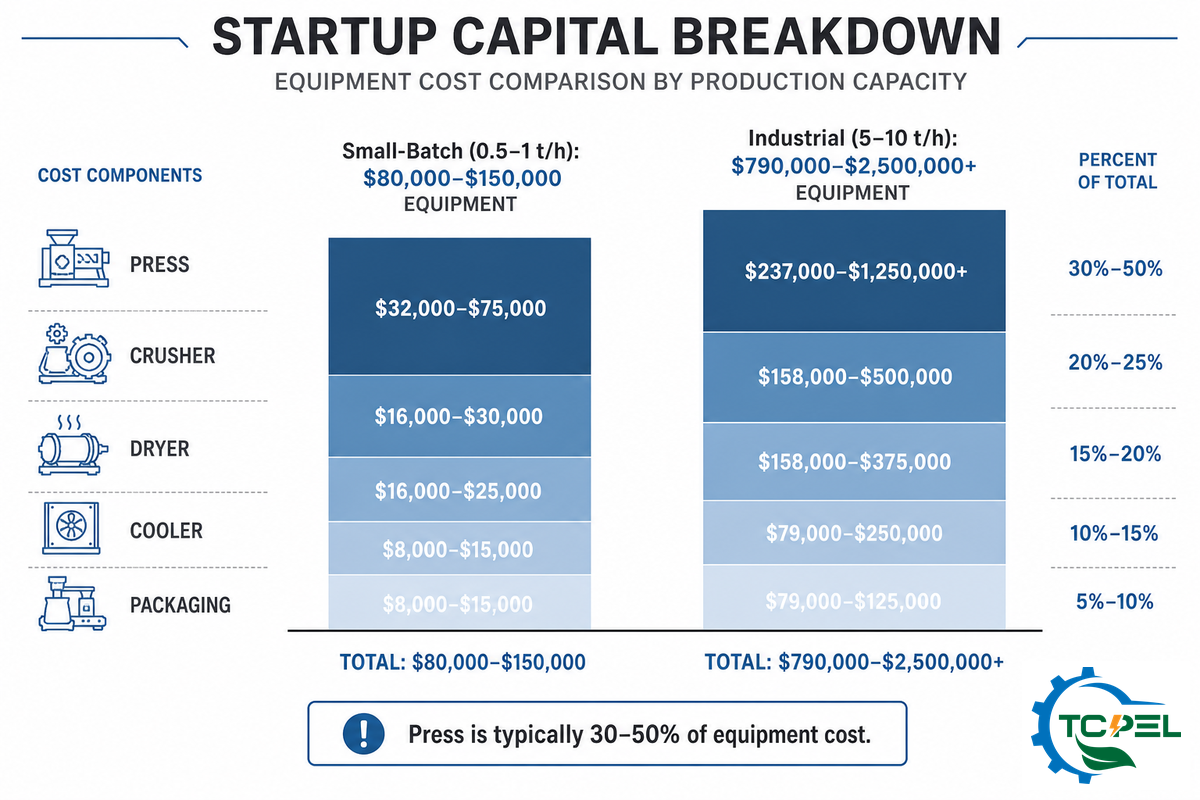
Plan the full six-machine production line from the start-not only the press, which often constitutes 30%-50% of the equipment costs, with the balance consisting of the crusher, dryer, cooler, and packaging machinery. Published project costs are extremely variable due to the differences in scale and location, a pattern a peer-reviewed wood pellet supply-chain cost review confirms across plant sizes; consider the cost data presented in such materials as ranges for estimation rather than definite quotes. Project finance, which may consist of bank loans, co-investment, and self-funding, typically represents the greatest obstacle to business success in this industry; investing in wood pellet equipment prior to having a solid financial plan in place is a common pitfall among business projects that causes them to stall during construction.
5-year total cost of ownership — small-batch vs industrial tier (order-of-magnitude planning figures):
| Cost item | Small-batch (0.5-1 t/h) | Industrial (5-10 t/h) |
|---|---|---|
| Equipment purchase | ~$80,000-$150,000 | ~$790,000-$2,500,000+ |
| Installation & commissioning | lower, often owner-operator installed | higher, needs contracted installation crew |
| Energy (5-yr) | lower absolute cost, higher cost-per-ton at partial load | lower cost-per-ton at full utilization |
| Maintenance & spares (5-yr) | lower absolute cost | higher absolute cost, needs a spares inventory plan |
| Downtime risk (5-yr) | single line = total stoppage on any failure | often has redundancy or faster service response justifying the spend |
Payback example: TCPEL’s own procurement guidance is explicit that a realistic commercial pellet-plant payback runs roughly 2-4 years, not the 3-6 month figures some equipment sellers advertise — a figure that lines up with a real disclosed operator’s experience rather than a marketing claim.
Step 6: Secure Your Site, Permits, and Utilities
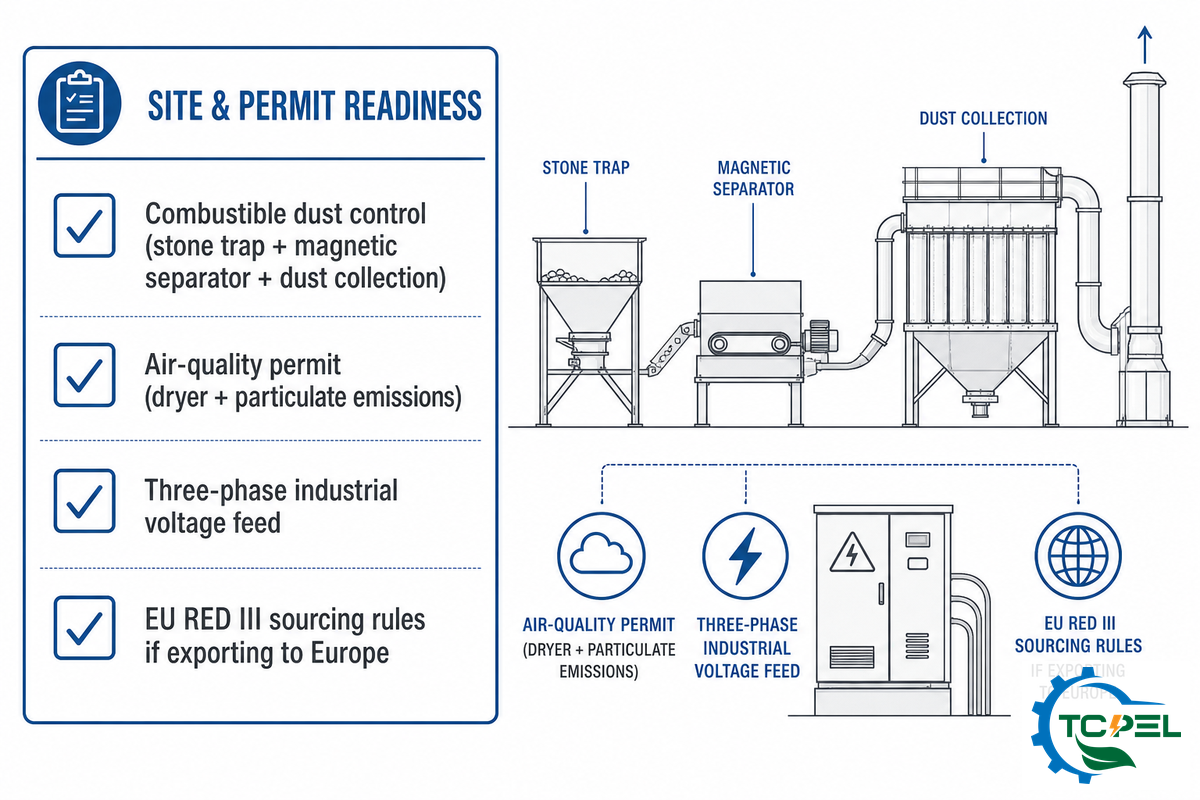
In addition to these financial considerations, most “how-to” guides often neglect the importance of addressing combustible dust and emissions. These factors, particularly the issues of combustible dust during the grinding and drying stages and emissions produced by your dryer, can be more important than most operators initially believe. Finely divided, dry wood dust generated during the grinding and screening processes is a combustible material and, under OSHA combustible-dust guidance, a known safety hazard. NFPA 660, an updated standard set to take effect in December 2024 that consolidated six separate dust regulations (including NFPA 61 for food and agricultural operations), serves as a reference standard that many inspectors and insurers now use. Essential elements for addressing these issues include a stone trap and a magnetic separation system before the grinder, properly sized dust collection equipment that complements the air assist flow, and anti-static grounding and bonding measures.
Regarding air quality, the EPA AP-42 emission-factor guidelines for wood products clearly identify both the dryer and the handling of wood particles as sources of particulate matter (PM, PM-10, PM-2.5), as well as CO, VOCs, and NOx. These findings mean that your dryer selection, along with any related air pollution control devices you incorporate, can be a significant component of your environmental permit application. Be sure to check with local regulatory agencies regarding air-quality permits before selecting a location; the size and sophistication of your dryer and any control technologies you use will significantly influence the nature of what you’re permitted to produce.
If you’re planning to put in a plant in the European Union, here’s one more constraint: the RED III update to the EU’s biomass sustainability rules cracked down on biomass sustainability, broadened no-go zones for sourcing, and stripped eligibility for new subsidies on forest-biomass power generation used solely for electricity – a nuance which affects the Economics of a project based in EU differently than a non-EU project selling fuel direct to home market.
On the utility end, running a hammer mill requires a three-phase industrial voltage feed; make sure you’re prepared to service the total connected load of the crusher, the dryer fan, the hammer mill, the pellet press and the packaging line prior to committing to a lease on your facility.
Step 7: Set Up Operations, Quality Control, and Distribution
Don’t count on even the best planned plant coming on line trouble free; breakdowns during commissioning are industry-normal, not a symptom of poor design; do plan to bring along both a cash runway and the appropriate patience during your “valley of death” commissioning phase. Ship only pellets tested against ISO 17225-2:2021 quality classes, screened before any bag is closed out and shipped.
Where to Sell: Distribution Channels
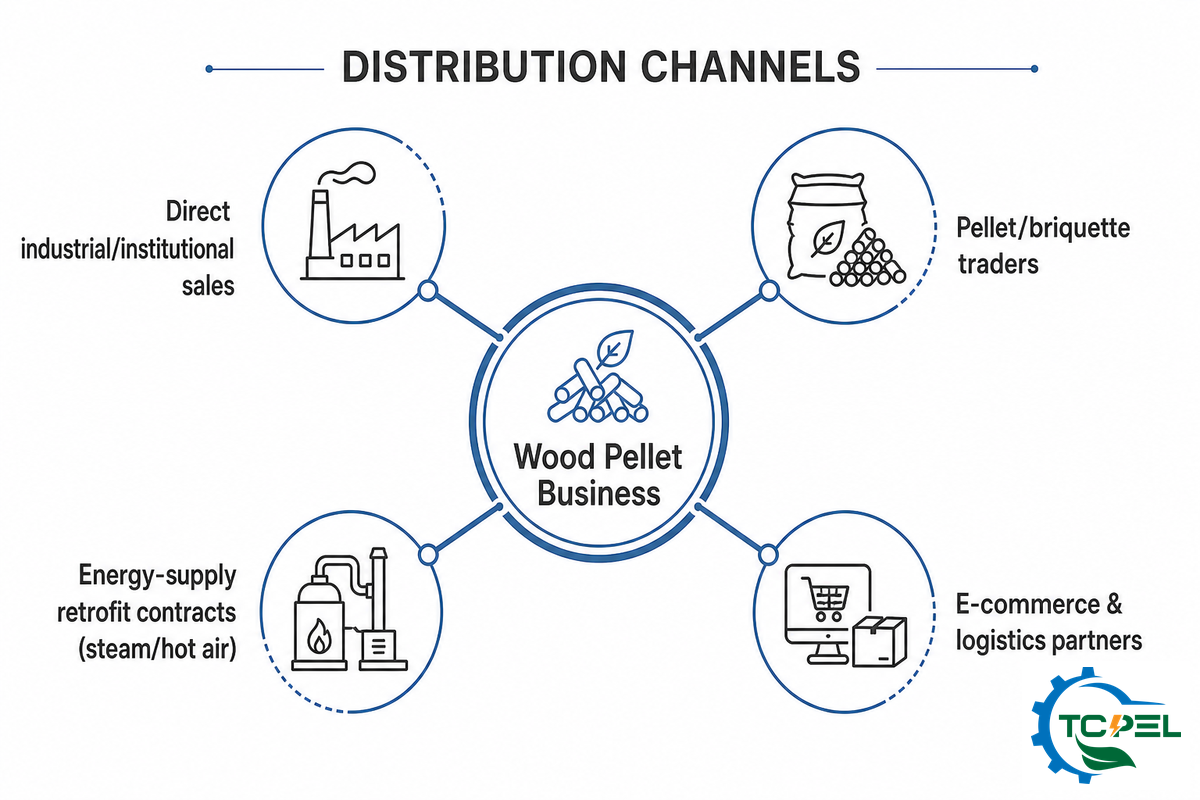
For sales channels, the paths used by established operators include direct sales to biomass-burning industrial or institutional users, sales through pellet or briquette traders, energy-supply contracts where you retrofit a factory’s boiler and sell them steam or hot air, and e-commerce or logistics-partner channels for smaller-volume buyers. Diversifying beyond one channel early reduces how much pricing power any single buyer holds over you.
Buy an Existing Pellet Business vs. Build From Scratch
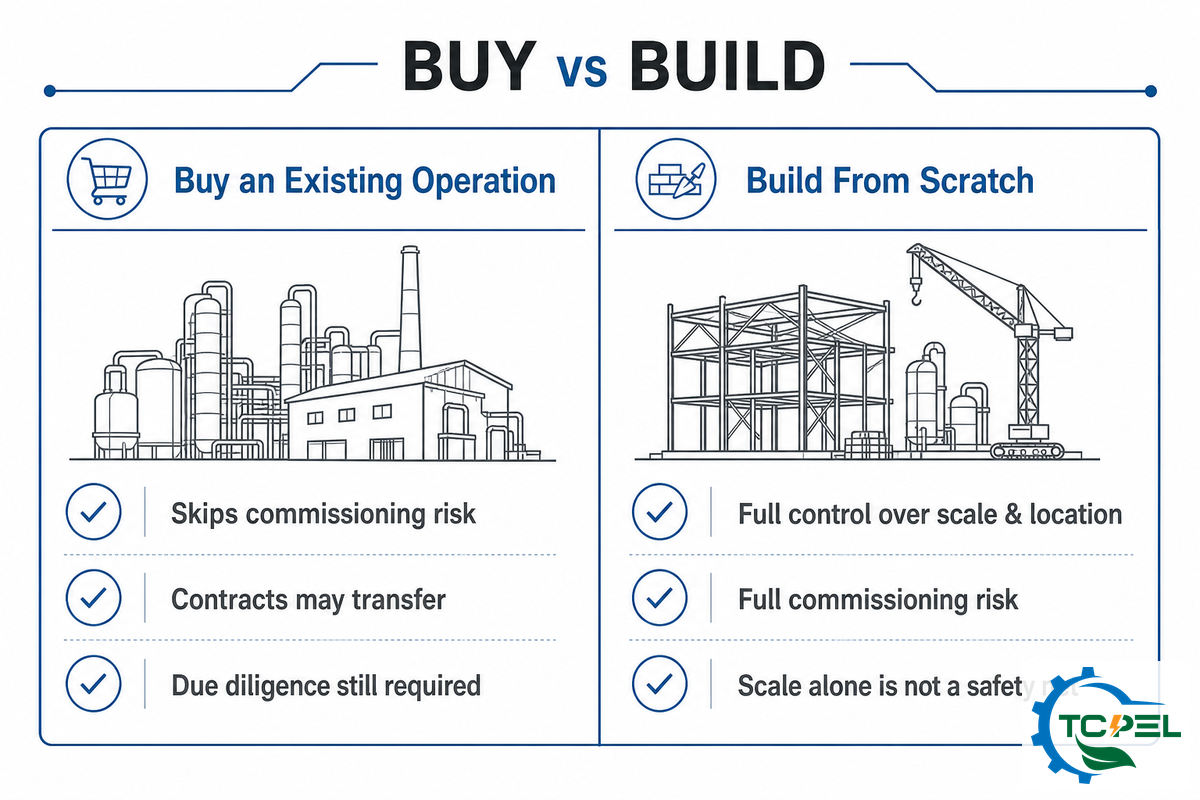
✓ Buying an existing operation
- Skips commissioning risk and existing customer contracts may transfer
- Industry consolidation is real and active, Lignetics acquired New England Wood Pellet in a 2026-relevant deal, confirming this is a normal path, not a fallback
- Due diligence on equipment condition and feedstock contracts still required, use EIA’s 72-manufacturer, 13.11 million tons/year U.S. industry baseline to sanity-check a target’s claimed capacity and utilization
- Search listings for a wood pellet business for sale or a wood pellet manufacturer for sale before assuming you have to start from a bare site
⚠ Building from scratch
- Full control over scale, location, and equipment fit to your feedstock
- Full commissioning risk and time cost
- Scale alone isn’t a safety net, Enviva, the largest global industrial wood pellet supplier, filed for Chapter 11 bankruptcy protection in 2024 with debts exceeding $2.6 billion per its own SEC filing, a reminder that contract concentration and debt load matter more than size
Neither path is automatically the safe one on demand grounds either: a USDA FAS market report on the UK, the largest importer of U.S. wood pellets, notes that government funding support there is shifting toward wind and solar and that large-scale biomass subsidies are scheduled to decline starting 2027, which weakens any assumption that buying into an existing export-focused operation locks in secure demand for the life of the equipment. One other related structural phenomenon to keep in mind: a peer-reviewed analysis of the Russian wood pellet industry highlighted the lack of truly large, integrated, vertically controlled players even as the industry was growing very rapidly; fragmented operations that skipped integrating all 6 process stages failed more often than raw market growth alone would predict. Irrespective of whether you acquire an existing wood pellet factory, go through the work of starting a wood pellet plant operation from scratch, or are looking at building an add-on wood pellet manufacturing plant onto an existing sawmill, the integration of the 6 process stages (rather than simply capacity alone) seems to be a predictor of those businesses that function in the wood pellet industry rather than stall.
A wood pellet manufacturing business, a wood pellet production business and a wood pellet processing business describe the same underlying operation; what makes the difference in this context is vertical integration; it’s one problem to produce pellets, it’s another problem to build a profitable wood pellet making plant, and a third problem entirely to keep feeding pellets into a wood pellet processing plant; many first-time wood pellet manufacturing business owners confuse these.
How Profitable Is a Wood Pellet Business? Margins & Market Outlook (2026)
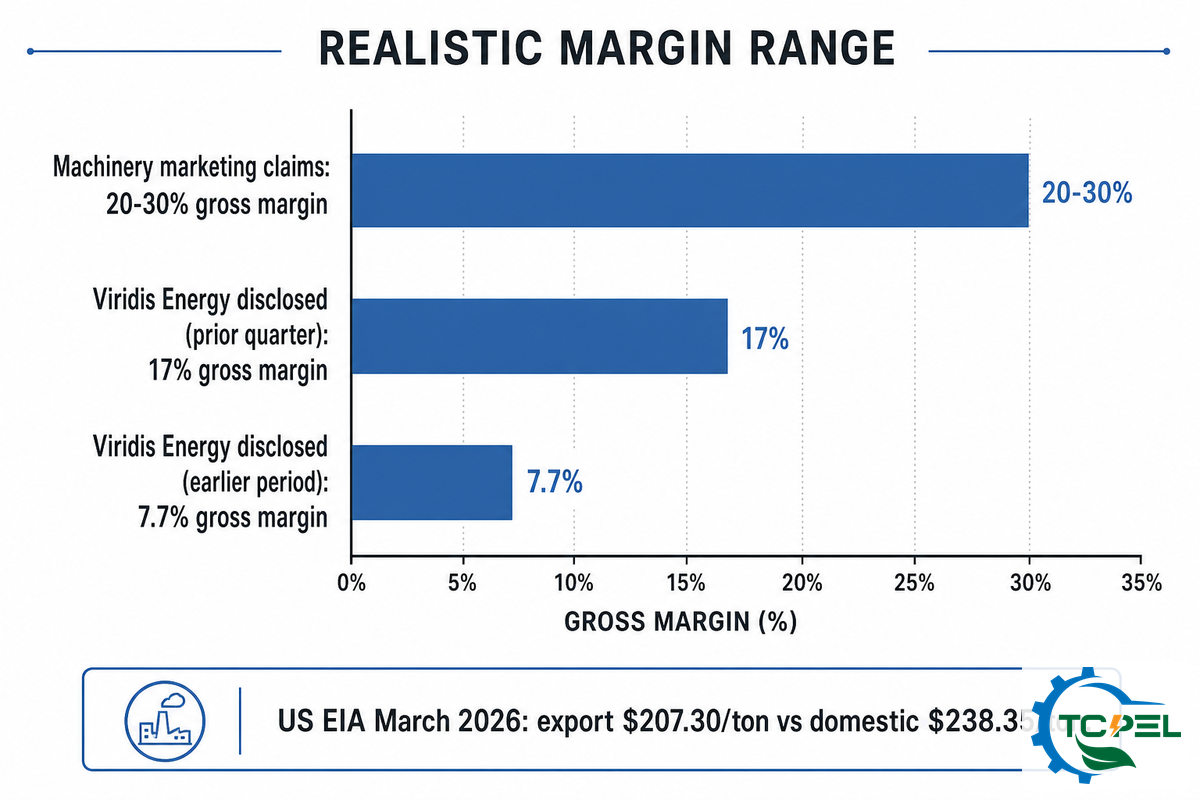
Actual reported operator margins will generally be less than the “20-30% gross margin” range listed on machinery marketing sites. Viridis Energy (Canadian pellet maker) listed a 17% gross margin in one prior quarter with coverage from the industry press – a notable jump from a prior period of 7.7% gross margin – which gives a more realistic price range than an unsourced marketing claim.
Channel mix further impacts actual realized pricing; US EIA March 2026 data show average export price of $207.30/ton versus $238.35/ton in domestic sales; an export-focused customer will therefore be able to realize lower margin for a given ton.
At a higher frequency, however, the concrete driver for the next year-and-a-half to watch in 2026 is less the headline market size (global wood pellet market is estimated at anywhere from $10-20 billion value, and growing mid-single-digit to high-single-digit percent on a CAGR depending on the analyst, but keep these at arm’s length), and more a second headline: industry trade press reports say data centers are assessing low-carbon fuel sources (like wood pellets) as backup or supplementary fuel sources, representing another growth outlet in addition to residential heating and utility co-firing. There’s also evidence of Torrefied (“black”) pellet growing more rapidly than white pellets in select market analyses, driven by coal substitute fuel demand in existing coal power plants.
Whether it’s your own wood pellet business operation churning out good quality pellets domestically, or setting up a stand-alone wood pellet export business, the basic math remains the same: production process discipline that lets you turn out spec-grade pellets at the end of the line has greater potential for your margin than any specific piece of machinery. That holds whether you build the pelletizing operation around biomass wood or agricultural-residue supply, as long as the crush-dry-grind-pelletize-cool-pack workflow stays a balanced operation end-to-end. Some people start wood pellet business plans as a side project built around a single feedstock; others go straight into starting a wood pellet manufacturing operation at full industrial scale. Either way, that process balance, more than the scale you start your own wood pellet venture at, is what determines whether you start your wood pellet business on solid footing.
Starting a Feed Pellet Business Instead?
A feed pellet business follows the same 7-gate frame as a fuel pellet business; the difference is only the die compression profile and no need for combustion quality tests. (For feed-related specific equipment & sizing please refer to feed pellet machine line and cattle feed pellet machine guide.)
Frequently Asked Questions
Q: How do I start a biomass pellet or wood pellet business?
Confirm raw material supply and a target buyer segment first, then size your equipment line, budget the full startup capital, and secure permits before committing to a site.
The order matters more than the checklist itself: raw material and market fit come before equipment selection, because a press sized for volume you cannot feed or sell is the most common reason new pellet businesses stall during commissioning. After confirming feedstock and buyer, size your scale (small-batch vs industrial), build a six-stage equipment list, budget the full capital range rather than just the press cost, and secure combustible-dust and air-permit approvals before finalizing your site, since dryer and grinding equipment both affect what a local permit will allow.
Q: What is the profit margin on pellet plants?
Marketed figures cite 20-30% gross margin, but at least one disclosed public operator reported 17% after improvement — treat 20-30% as an optimistic ceiling, not a guarantee.
17% gross margin from Viridis Energy, a Canadian pellet maker, was quoted in a previous quarter’s disclosure (from 7.7% prior to that)-a real, disclosed number, even if not a current-year one that’s below the 20-30% usually stated on machinery marketing material with no sourcing. That realizable number is also a function of channel mix: US EIA export sales were on average priced lower than domestic sales as of March 2026, so an export-heavy customer base will bring down your margin from whichever number you started with; build your financial model on the conservative end of the range and call everything above that gravy.
Q: What is the cost to start a complete wood pellet production plant?
Reported figures span roughly $80,000 for a small 0.5 t/h plant to $2.5M or more for a 10 t/h industrial line — the range is wide because scale, automation level, and feedstock condition all move the number.
The spread in published estimates is orders of magnitude, which is information in and of itself: a small plant for a home or small business (roughly 0.5 t/h) has been costed around $80,000 in recent industry guidance, whereas a full-size industrial plant running at 5-10 t/h has been priced from about $370,000 to more than $2.5 million, based on several disclosed project cases and cost guides. Factors like the feedstock condition, flat-vs-ring dies, level of automation, and the destination’s compliance requirements all contribute to the cost; look for an itemized quote breaking out these components, rather than a single price.
Q: Can I make my own wood pellets at small scale before going industrial?
Yes — small flat-die pellet mills in the 50-800 kg/h range let you test a business model on a real budget before committing to industrial-scale capital.
A small, flat-die production line is a practical way to confirm feedstock supply, assess market fit, and develop your operational skills before committing to larger, industrial ring-die equipment. All of the same ISO 17225-2:2021 quality specifications are applicable at a smaller scale, so a properly run plant can achieve pellet grading, just with lower throughputs and generally higher energy costs per ton than a fully utilized industrial plant.
Q: Where can I sell my quality wood pellets?
Direct sales to industrial or institutional biomass-fuel users, pellet/briquette traders, energy-supply retrofit contracts, and e-commerce or logistics-partner channels are the main sales paths established operators use.
Established sales channels can include direct sales to existing biomass fuel consumers (industrial and institutional users including power, chemical, smelter and heating applications); marketing through pellet and briquette distributors; energy supply agreements where you retro-fit a factory boiler and then sell its heat output (steam or hot air); or selling into the e-commerce/logistics ecosystem for smaller buyers. Building out more than one channel simultaneously will limit any single buyer’s pricing power over you.
Q: Is there a demand for wood pellets?
Yes — the U.S. alone exported roughly 10 million metric tons in 2024, and data-center backup power is emerging as a new demand channel beyond traditional heating and cofiring.
The US exported roughly 10 million metric tons of wood pellets worth approximately $1.7 billion in 2024, according to figures cited in a USDA Forest Service analysis; data centers evaluating the need for low-carbon backup power represent a growing, niche segment in addition to the existing markets for residential heat and utility co-firing.
Q: Why start a wood pellet business?
Wood pellets turn low-cost waste material into a graded, exportable fuel with a global buyer base — but treat the 2-4 year realistic payback window as the honest planning figure, not the 3-6 month claims some sellers advertise.
Cheap, reliable feedstock beats a cheap machine every time.
Why We Wrote This Guide
Most wood-pellet business guides are provided by machinery marketers who claim 20-30% ROI with no source. This article is based on trade data from the USDA and US EIA, ISO quality standards, real margins disclosed by an operator in the public domain, and named reports in the industry press on both a large acquisition (Lignetics) and a large bankruptcy (Enviva) – as both are realistic outcomes in this industry.
Reviewed by the ALLWIN INTERNATIONAL CO., LTD technical team, which has run a 20,000 sqm manufacturing facility in Zhangqiu, Shandong with 100+ staff since 2020, supplying wood, biomass and feed pellet machinery and turnkey lines to clients in more than 60 countries.
References & Sources
- Wood Pellet Market Restructuring Under the European Union — USDA Forest Service
- Manufacturing Fuel Pellets from Biomass — Penn State Extension
- Quality Assessment of Biomass Pellets Available on the Market — PMC / National Institutes of Health
- ISO 17225-2:2021, Solid Biofuels, Fuel Specifications for Graded Wood Pellets — International Organization for Standardization
- NFPA 660, Standard for Combustible Dusts and Particulate Solids — National Fire Protection Association
- Monthly Densified Biomass Fuel Report — U.S. Energy Information Administration
- Preventing Pellet Plant Failures — Biomass Magazine (John Swaan, FutureMetrics Inc.)
- Canadian Pellet Producer Reports Improved Margins — Biomass Magazine
- Lignetics Acquires New England Wood Pellet — Biomass Magazine
- Enviva Inc. Form 8-K, Chapter 11 Bankruptcy Filing — U.S. Securities and Exchange Commission (EDGAR)
- EU Bioenergy and Biomass Sustainability Rules (RED III) — European Commission
- The Wood Pellet Business in Russia — ScienceDirect (peer-reviewed)
- Wood Pellet Supply Chain Costs — A Review and Cost Optimization Analysis — ScienceDirect (peer-reviewed)
- AP-42: Compilation of Air Emissions Factors from Stationary Sources — U.S. Environmental Protection Agency
- Combustible Dusts (Publication 3371) — U.S. Occupational Safety and Health Administration
- Pellet Mill (US4770621A) — U.S. Patent, Google Patents
Related Articles
- Hammer Mill: A Complete Engineering Guide — the grinding stage explained in depth
- Wood Pellet Machine: Complete Guide to Types & Cost — how the pelletizing stage works and how to choose
- Pellet Production Line: The 6 Stages of Wood Pellet Making — the full process in detail
- Rotary Dryer: How It Works, Types & Common Problems — sizing the drying stage
- Wood Pellet Production Line: Equipment & Process Guide — equipment-by-equipment walkthrough