Get in Touch with TCPEL

Updated June 2026 · Reviewed by the TCPEL technical team.
A pallet crusher is an industrial machine that reduces whole wooden pallets to small, reusable wood pieces by shredding, grinding, or chipping. It turns the slow-motion problem in the corner of every warehouse yard, a growing stack of broken wooden pallets, into either a recurring disposal bill or a recovered material stream. Here’s the catch: buyers rarely struggle with whether to reduce pallets; they struggle with which machine to buy, what the shredded output is actually worth, and how fast it pays back. Vendors compound the confusion by using “crusher,” “shredder,” “grinder,” and “chipper” interchangeably, even though those machines behave very differently on a nail-laden pallet. Whatever you call the machine, the job is the same: shred pallets and other waste wood down to a shredded wood fraction you can reuse, sell, or move on at a fraction of the original volume. This guide separates the terms, walks through how the machines work, and, the part almost no product page covers, maps what a crushed wood pallet becomes, from landscaping mulch to clean biomass fuel.
Quick Specs: Pallet Crushing & Shredding
| Machine classes | Single-shaft shredder, dual-shaft shredder, grinder (hammer/impact), chipper |
| Throughput | ~5–30 t/h industrial range (model-dependent) |
| Output particle size | ~20–60 mm (coarse shred) down to 2–20 mm (fine grind) |
| Drive power | ~15–330 kW depending on size and feed rate |
| Nail handling | Metal-tolerant rotor + overband magnet for steel recovery |
| Volume reduction | ~60–80% (hauling-cost driver) |
| Price band | ~$500 (small) to $100,000+ (industrial line) |
| Typical outputs | Volume reduction, mulch, animal bedding, clean biomass fuel |
Pallet Crusher vs Shredder vs Grinder vs Chipper: What’s the Difference?
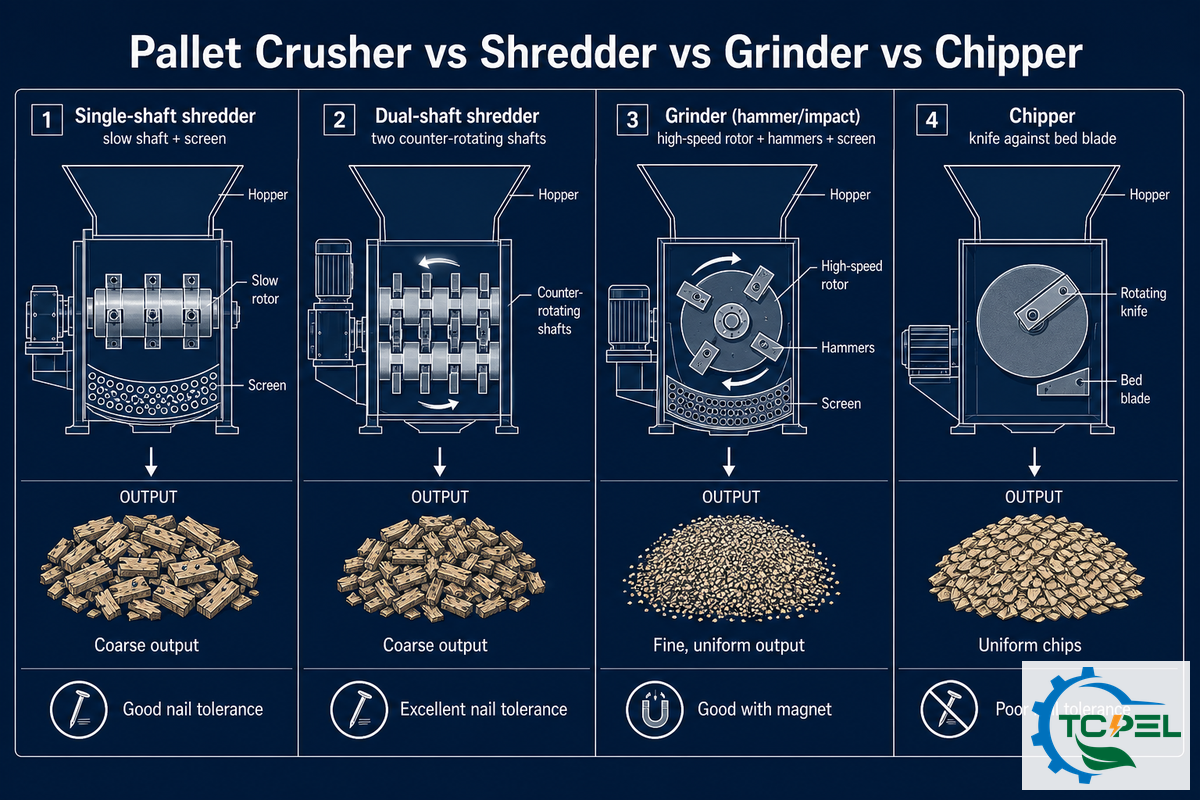
Crusher, shredder, grinder, and chipper name four different reduction mechanisms, not interchangeable machines. A shredder tears pallets apart with slow, high-torque shafts; a grinder smashes them against a screen for finer, uniform output; and a chipper slices clean wood but cannot survive nails. “Pallet crusher” is simply the umbrella term buyers use for any of them.
In mechanical terms, a pallet shredder uses one or two slow-turning shafts (roughly 50–120 rpm) loaded with hooked cutters that tear the pallet apart at high torque. A grinder (often a hammer mill or impact crusher) spins a rotor at high speed so hammers smash the wood against a screen until the pieces pass through, which is what gives it uniform, finer output. A pallet chipper sits at the clean-wood end of this shredding equipment family, while a heavy-duty industrial shredder anchors the volume-reduction end, all of them built to break down pallets made of wood (and sometimes plastic). In practice, a wood pallet shredder or a grinder is what most buyers actually need.
The 4-Machine Pallet Reduction Decision Tree
| Machine | Mechanism | Output | Nail tolerance | Best when your goal is |
|---|---|---|---|---|
| Single-shaft shredder | Slow-speed shaft + screen | Coarse, fairly uniform | Good | Controlled chip size for downstream reuse |
| Dual-shaft shredder | Two counter-rotating shafts, high torque | Coarse, irregular | Excellent | Pure volume reduction of mixed, nail-heavy pallets |
| Grinder (hammer/impact) | High-speed rotor + hammers + screen | Fine, uniform | Good (with magnet) | Mulch / animal bedding / biomass feedstock |
| Chipper | Knife against bed blade | Uniform chips | Poor | Clean, de-nailed wood only |
Machine-behavior characteristics compiled from industrial wood-processing equipment literature.
If you remember one rule, make it this: shredders are chosen for pallets because they tolerate metal; grinders are chosen when the output has to be uniform. A high-speed chipper will produce beautiful chips and then destroy its knives the first time it meets a clutch of nails. For most facilities the honest first question is whether you need raw volume reduction or a saleable, sized product, and that single answer collapses the four-way choice down to one. The differences between an industrial pallet crusher and a hammer-style grinder become much clearer once you know which output you’re selling.
✔ On-site crushing
- ~60–80% volume reduction before hauling
- Output can become mulch, bedding, or fuel revenue
- Removes unsightly, fire-risk pallet piles
⚠ Outsourced removal
- No capital outlay, but a permanent per-pull fee
- Zero byproduct value captured
- Cost scales with volume, every year
Inside the Cutting Chamber: How a Pallet Crusher Works
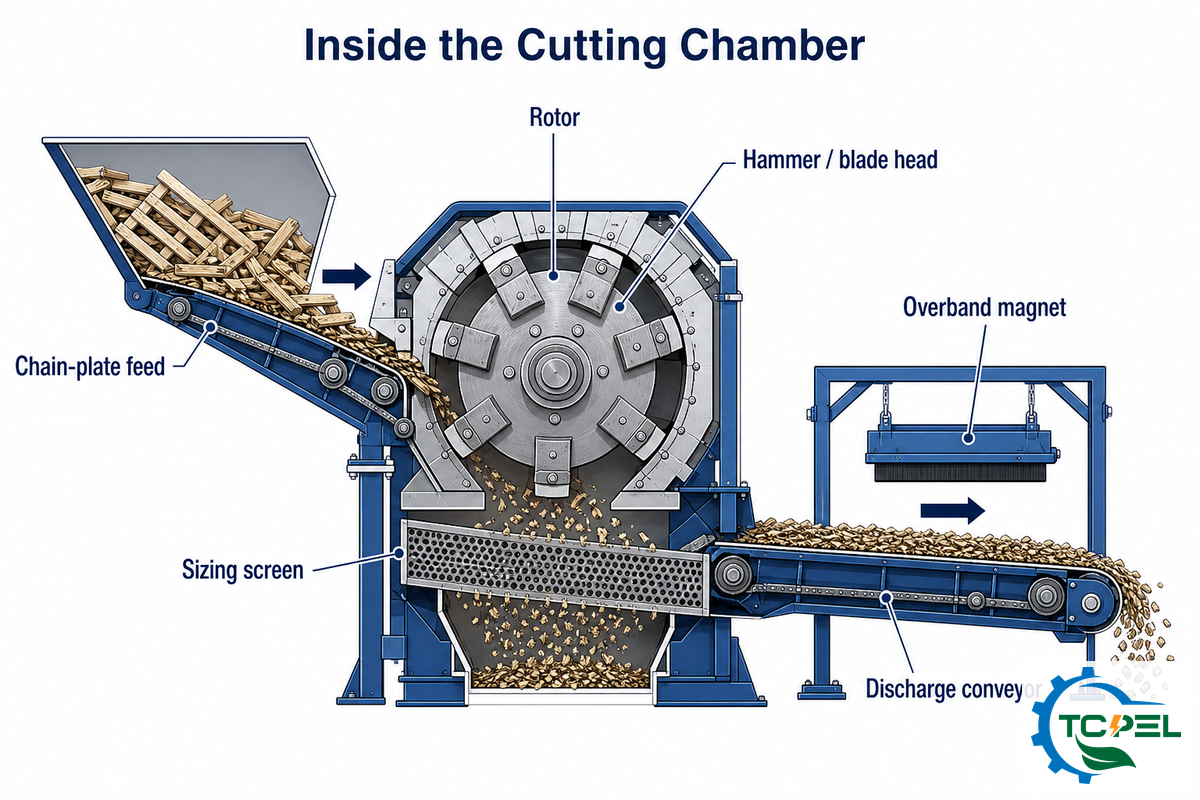
Strip away the brand names and a pallet crusher is four things: a feed hopper or chain conveyor that handles the bulky wooden boards, a cutting chamber holding the rotor or shafts with their rotating blades, a sizing screen, and a discharge conveyor belt, sometimes an auger, that often run under an overband magnet. On a low-speed shredder, the pallet drop onto counter-rotating shafts whose cutters grab and tear the boards; torque, not speed, does the work, which is exactly why nails and screws pass through with only gradual cutter wear. On a hammer-style grinder, a high-speed rotor flings hammers at the wood, and only fragments smaller than the screen openings escape, everything larger keeps circulating in a kind of multi-stage grinding until it’s sized down. Fed pre-shredded material from an upstream shredder, that same grinder run faster and wears less. A granted U.S. patent for a wood reduction chamber (US10507469B2) describes this same geometry: a fixed bed blade providing constant cutting action against the moving cutters.
📐 Engineering Note
Low-speed, high-torque shredders typically run their shafts at roughly 50–120 rpm with heavy heat-treated alloy shafting and oversized bearings. The design trade-off is direct: lower speed and higher torque buy nail tolerance and a coarser chip; if you need a fine, uniform particle for mulch or fuel pellets, you accept a higher-speed grinder and a magnetic separator ahead of any downstream equipment. Match the rpm/torque class to the output you intend to sell, not to the headline throughput number on the spec sheet.
The Nail Problem: Crushing Pallets That Are Full of Metal
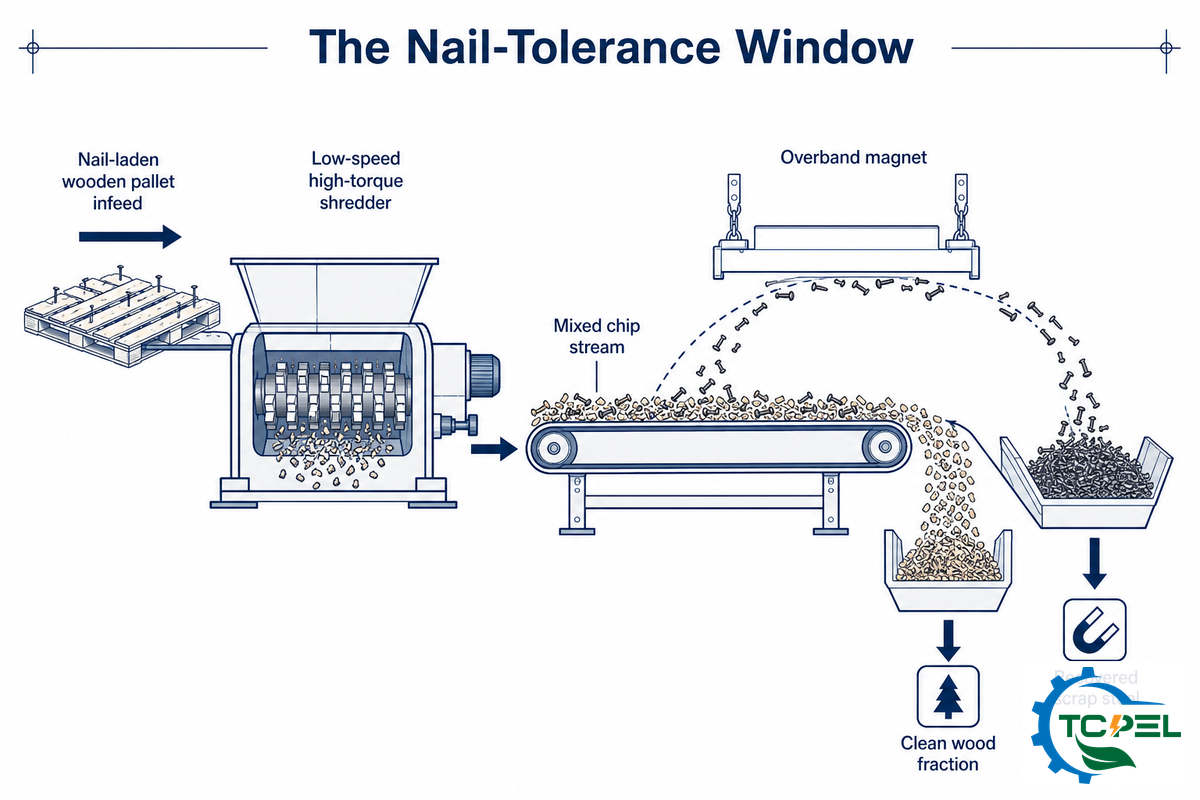
This is the question that sinks the wrong purchase. A standard wooden pallet carries dozens of nails or screws, and the machine that ignores them fails fast, wood shredding and metal aren’t a friendly mix unless the machine is built for it. Answering it reliably is mechanical, not optional: choose a low-speed, high-torque shredder or a reinforced grinder, then put an overband or drum magnet, a simple separation device, on the discharge conveyor to pull the loosened steel out of the chip stream. A pallet shredder with magnet turns that recovered metal into a scrap-revenue line instead of a contaminant, and a flimsy DIY pallet crusher is exactly what cannot do this. Feeding pallets with nails this way turn what was contaminated pallet scrap into a clean wood fraction plus a sellable steel fraction.
| Machine class | Nail tolerance | Metal separation | Wear impact |
|---|---|---|---|
| Low-speed dual-shaft shredder | Excellent | Overband magnet downstream | Gradual, controlled cutter wear |
| Single-shaft shredder | Good | Magnet + screen | Moderate; periodic knife/screen service |
| Hammer/impact grinder | Good (hardened hammers) | Magnet essential before reuse | Hammer/screen wear; rebuildable |
| High-speed chipper | Poor | Not designed for it | Severe — knife damage on first nail strike |
Can a pallet crusher handle nails and metal parts?
Yes, provided you pick the right class. Low-speed shredders and reinforced grinders are built to chew through pallets “with nails and all,” because their high torque and heavy shafting absorb the impact that would chip a high-speed chipper’s knives. The nails aren’t destroyed; they’re loosened from the wood and then pulled out by a magnetic separator on the discharge belt, leaving a clean wood fraction and a sellable scrap-steel fraction.
What you should not do is feed nail-laden pallets to a machine designed for clean wood and hope for the best.
Scenario. A mid-sized furniture maker started reducing its scrap pallets with a fast disc chipper it already owned for offcuts. Within weeks the knives were chipped and the maintenance log filled with unplanned blade changes, the nails the crew never fully removed were doing the damage. Switching the pallet stream to a low-speed shredder with a discharge magnet ended the knife failures, recovered a bin of scrap steel each week, and turned an erratic repair cost into a predictable wear-part schedule. The lesson practitioners repeat is blunt: the cheapest machine you already own is the most expensive one if it was never meant to eat metal.
Sizing a Pallet Crusher to Your Volume
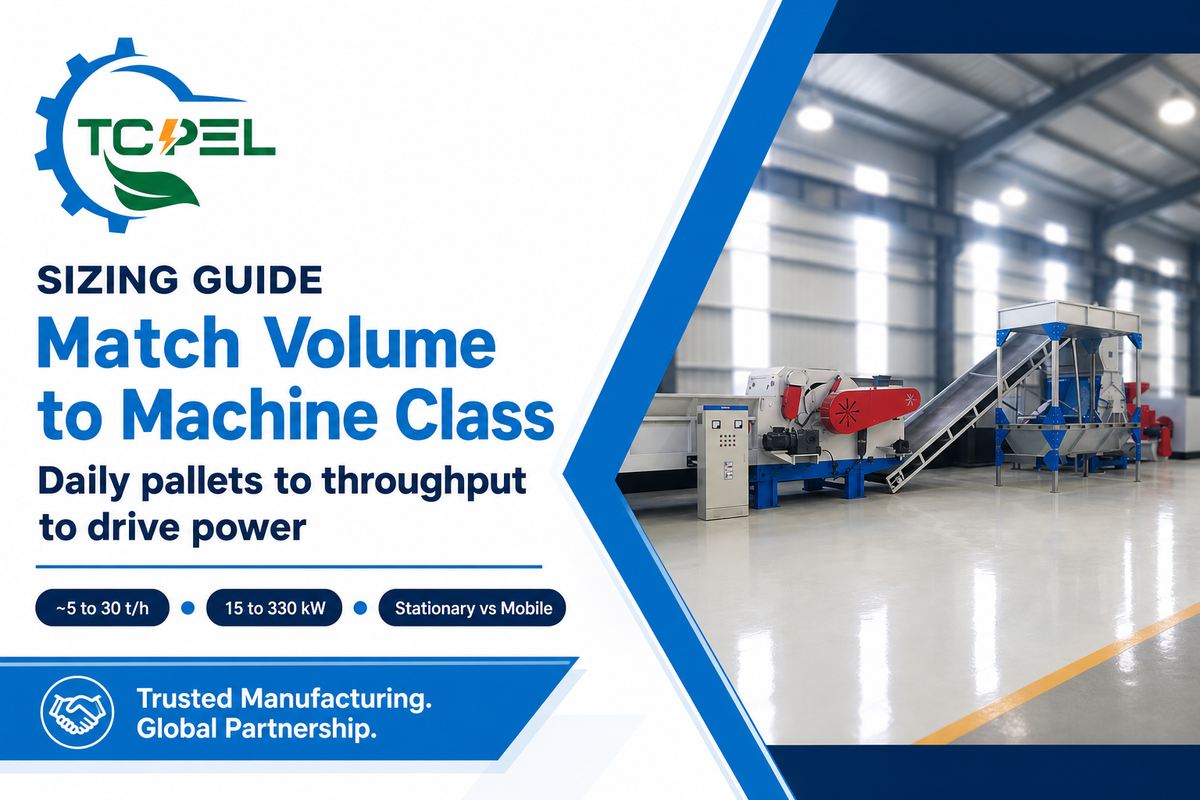
Whether the vendor calls it a wood pallet crusher, a pallet crushing machine, or pallet grinding equipment, sizing starts with a number most buyers can estimate in five minutes: pallets per day. Industrial wood shredders and grinders typically process roughly 5 to 30 tons per hour, with the actual figure swinging on pallet condition, nail content, and how fine you want the output. Because an average wooden pallet weighs roughly 30–65 lb (about 14–30 kg), you can convert your daily pallet count into an hourly tonnage and read off the machine class you need.
💡 Worked example: from pallets to motor size
Say you scrap 300 pallets per day at ~20 kg each. That’s 300 × 20 kg = 6,000 kg ≈ 6 t/day. Over one 8-hour shift, 6 ÷ 8 = 0.75 t/h, but real feeding is uneven, so size for the peak, not the average. Apply a ~2× peak factor and you’re designing around ~1.5 t/h. That points to a compact single-shaft shredder in the lower power band (roughly 30–55 kW), not a 300 kW line built for a regional recycler. Buying for the average is the classic costly mistake, undersize and the machine run flat-out and overheats; oversize and you pay for capacity that idles.
| Daily pallets | Approx. throughput | Machine class | Drive power | Typical best output |
|---|---|---|---|---|
| Under 50 | <0.4 t/h | Small single-shaft shredder | ~15–30 kW | Volume reduction |
| 50–150 | 0.4–1 t/h | Compact single-shaft shredder | ~30–45 kW | Mulch / bedding |
| 150–300 | 1–1.5 t/h | Single-shaft shredder | ~45–75 kW | Mulch / bedding |
| 300–600 | 1.5–3 t/h | Dual-shaft shredder | ~75–110 kW | Mixed / nail-heavy reduction |
| 600–1,000 | 3–6 t/h | Dual-shaft shredder + grinder | ~110–160 kW | Bedding / biomass feed |
| 1,000–2,000 | 6–12 t/h | Grinder line | ~160–250 kW | Biomass feedstock |
| Over 2,000 | 12–30 t/h | Heavy-duty grinder line | ~250–330 kW | Recycler-scale feedstock |
| Multi-site / service | Varies | Mobile shredder (engine-driven) | Diesel / PTO | On-site reduction as a service |
| Contaminated / mixed stream | Varies | Dual-shaft + overband magnet | Per volume | Volume reduction only |
Ranges synthesized from published industrial throughput (5–30 t/h) and drive-power data; treat as a starting point, not a substitute for a vendor capacity rating.
Are mobile pallet crushers worth the cost?
A mobile pallet shredder (trailer- or skid-mounted) earns its premium only in two situations: when you process pallets across more than one site, or when you sell on-site reduction as a service. For a single fixed warehouse, a stationary shredder machine almost always wins on price per ton because you aren’t paying for the chassis, engine, and road-readiness you’ll never use.
Whichever you pick, plan the material handling, how full pallets reach the infeed and how the output leave, before you pick the industrial pallet shredder model itself. Your deciding question isn’t “is mobile better” but “does my material move, or do I move to it?” If the pallets pile up in one yard, buy stationary and put the savings into a better magnet and conveyor.
From Mulch to Biomass Fuel: What Crushed Pallets Become
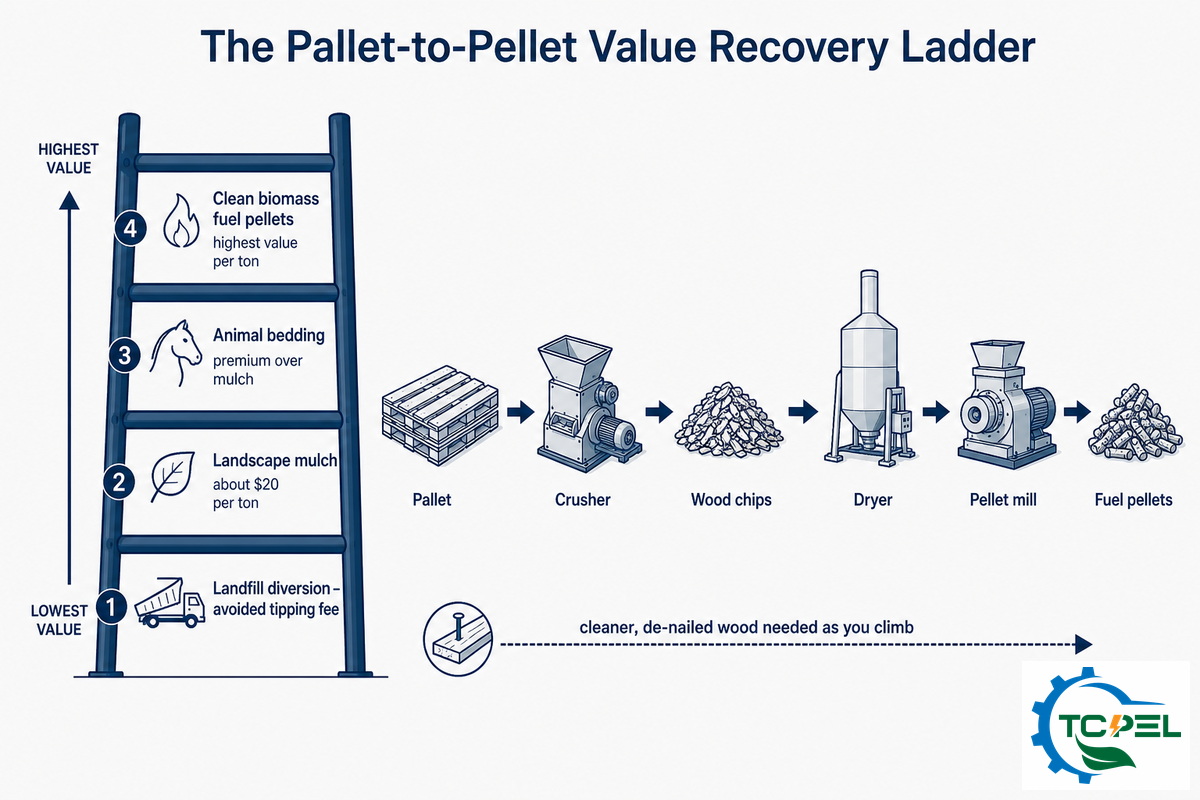
This is where most product pages stop and the real economics begin. Crushed pallet wood isn’t one product; it climbs a ladder of value, and each rung asks for cleaner wood and a little more processing. The U.S. Department of Energy notes that municipal and packaging wood is “both a disposal challenge and a potential resource for feedstock production,” and Virginia Tech’s unit-load researchers found that clean shredded pallet particles are low in moisture and ash with a relatively high net heating value, in their words, “an excellent industrial fuel.” An honest caveat, confirmed by the U.S. Energy Information Administration, is that the commercial wood-pellet industry runs mostly on sawmill residues, not recovered pallets, so pallet wood is a viable on-site fuel and a secondary feedstock, not the backbone of the pellet market.
The Pallet-to-Pellet Value Recovery Ladder
- Landfill diversion onlycoarse shred, ~60–80% volume reduction. Value = avoided tipping fees, nothing more. Requires the least clean wood.
- Landscape mulchuniform grind of clean, untreated wood. A state forestry program reports wood waste sold for roughly $20 per ton as mulch or bedding.
- Animal beddingfine, low-dust grind; commands a premium over mulch where livestock markets are nearby.
- Clean biomass fueldried, sized particles or pellets from de-nailed, untreated wood. Highest value per ton, but the cleanliness bar is also highest.
That ladder is the whole strategy: a basic pallet crusher captures the bottom rung on day one, and you climb only as far as your wood cleanliness and your local markets allow. To reach the top rung, the crushed chip usually pass through a dryer and a pellet press, the same equipment chain TCPEL builds for biomass producers, from hammer-mill fine grinding through a flat-die pellet mill or a higher-capacity ring-die pellet mill. The point isn’t that every yard should make pellets; it’s that knowing the full ladder tell you exactly how much machine to buy now and what to add later.
Scenario. A third-party logistics warehouse generates about 200 pallets a week. Outsourced removal was a flat weekly fee with zero return. After installing a single-shaft shredder with a magnet, the operation kept the bottom two rungs: it diverted the volume from the dumpster and sold clean grindings to a nearby stable as bedding. The scrap steel from the magnet covered part of the wear-parts budget. The team deliberately skipped the fuel rung, their pallet stream included too many heat-stamped export boards of unknown coating to guarantee a clean fuel product, so they sold what they could verify was clean and landfill-diverted the rest.
The Economics: Disposal Savings and Payback
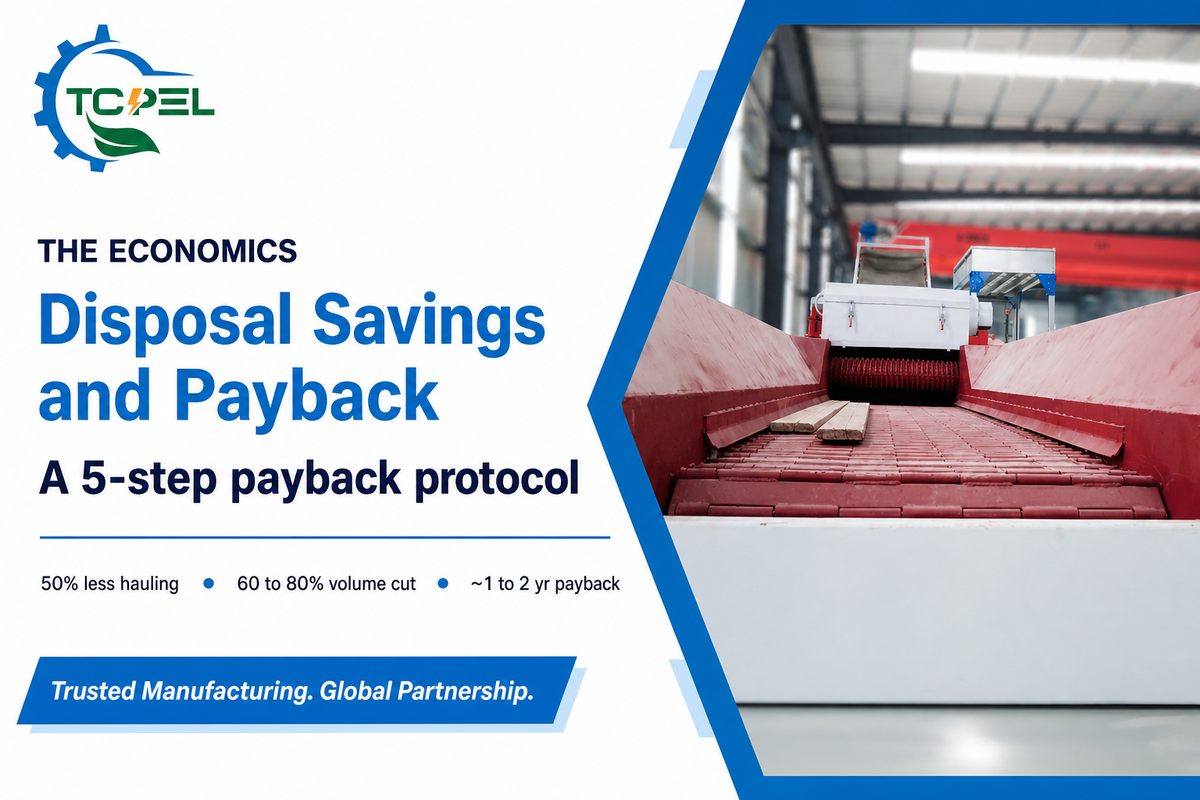
A pallet crusher pays for itself by erasing a recurring waste-disposal cost, then adding a small revenue stream on top, the return on investment most buyers underestimate because they only count the machine, not the hauling it eliminate. Independent equipment guidance puts on-site reduction at roughly a 50% cut in hauling frequency and 60–80% less loose volume, with facilities reporting annual savings “in the tens of thousands of dollars.” Larger programs go further: one managed pallet-recycling program documented combined disposal-and-purchasing savings exceeding $2 million a year. You don’t need to model that scale to make the decision, you need five lines.
The 5-Step Disposal-Cost Payback Protocol
- Current disposal cost / yearpulls or hauls per month × fee, plus any landfill tipping.
- Capital + installmachine, magnet, conveyor, electrical.
- Operating cost / yearpower, wear parts, and labor to feed it.
- Recovered value / yearavoided hauling + byproduct sales (mulch/bedding/fuel) + scrap steel.
- Payback (months) = Capital ÷ ((Step 1 + Step 4 recovered) − Step 3 operating) ÷ 12.
💡 Worked payback
Suppose a plant pays for two dumpster pulls a week at $250 each, about $26,000/year (Step 1). A compact shredder line installs for ~$45,000 (Step 2). Power, wear, and part-shift labor run ~$9,000/year (Step 3). It diverts the volume and sells clean grindings plus scrap steel for ~$6,000/year (Step 4). Payback = $45,000 ÷ (($26,000 + $6,000) − $9,000) = $45,000 ÷ $23,000 ≈ 1.95 years. Swap in your own pull fees and the same five lines give you a defensible number to take to procurement.
How do pallet crushers reduce disposal costs?
Three ways, stacked. First, volume: shredding removes 60–80% of the bulk, so the same dumpster holds far more wood and you pay for fewer pulls. Second, diversion: reduced wood can be sold or reused instead of landfilled, cutting tipping fees that, as the Department of Energy notes, keep rising as landfill capacity shrinks.
Third, recovery: the magnet turns the nails that used to be a contaminant into a small scrap-steel revenue line. The biggest single lever is almost always hauling frequency, that’s the cost that compounds every week you do nothing.
Operating and Maintaining a Pallet Crusher
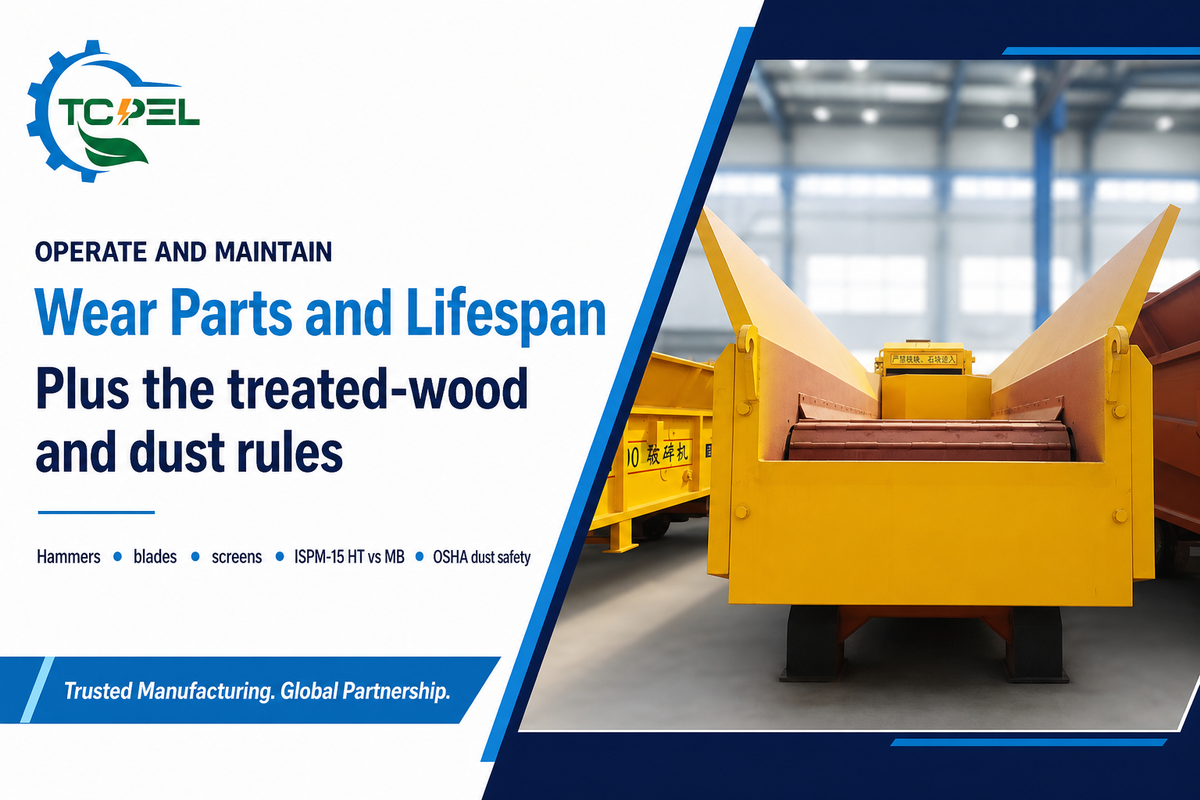
A well-matched pallet crusher is a long-lived asset; the variables that shorten its life are nails on the high end and contamination on the chemical end. Routine maintenance centers on the wear parts, cutters or hammers, screens, and bearings, inspected on a schedule and rebuilt rather than replaced wholesale. But one rule protect both your machine and your output markets, and it’s about which pallets you feed it.
⚠️ Treated and contaminated pallets: the hard limit
Not every pallet can become mulch or fuel. Older pallets may be treated with chromated arsenicals (CCA); the U.S. EPA states that CCA-treated wood “should not be reused in products such as mulch” and shouldn’t be burned because of toxic chemicals in the smoke and ash. For businesses, the EPA notes that treated-wood waste may require a hazardous-waste determination under RCRA. Export pallets carry an ISPM-15 markbut that stamp certifies only heat treatment (HT) for pests at a 56 °C core for at least 30 minutes; it’s a phytosanitary measure, not a guarantee that the board is free of paint, coatings, or contamination. Screen for paint, chemical staining, and unknown stamps before any pallet enters a mulch or fuel stream.
📐 Engineering Note — guarding and combustible dust
Pallet reduction creates two EHS exposures worth designing for from day one. Rotating shafts, hammers, and nip points need machine guarding at the point of operation. And fine wood dust is a documented explosion hazard: U.S. OSHA classifies combustible dust as “fine particles that present an explosion hazard when suspended in air,” and wood processing is among the most affected industries. Specify dust collection, bonding/grounding, and housekeeping alongside the crusher, not after the first incident.
How often does a pallet crusher need maintenance, and how long does it last?
Treat it like any high-torque industrial machine: daily visual checks, scheduled lubrication, and wear-part inspection at intervals set by your throughput and pallet condition. Cutters, hammers, and screens are consumables sized to be rebuilt; bearings and shafting on a properly matched, heavy-built machine last for many years of service.
The fastest way to shorten that life is to run a machine flat-out because it was undersized for the volume, which loops straight back to sizing it correctly in the first place.
Industry Outlook: Why On-Site Pallet Crushing Is Growing
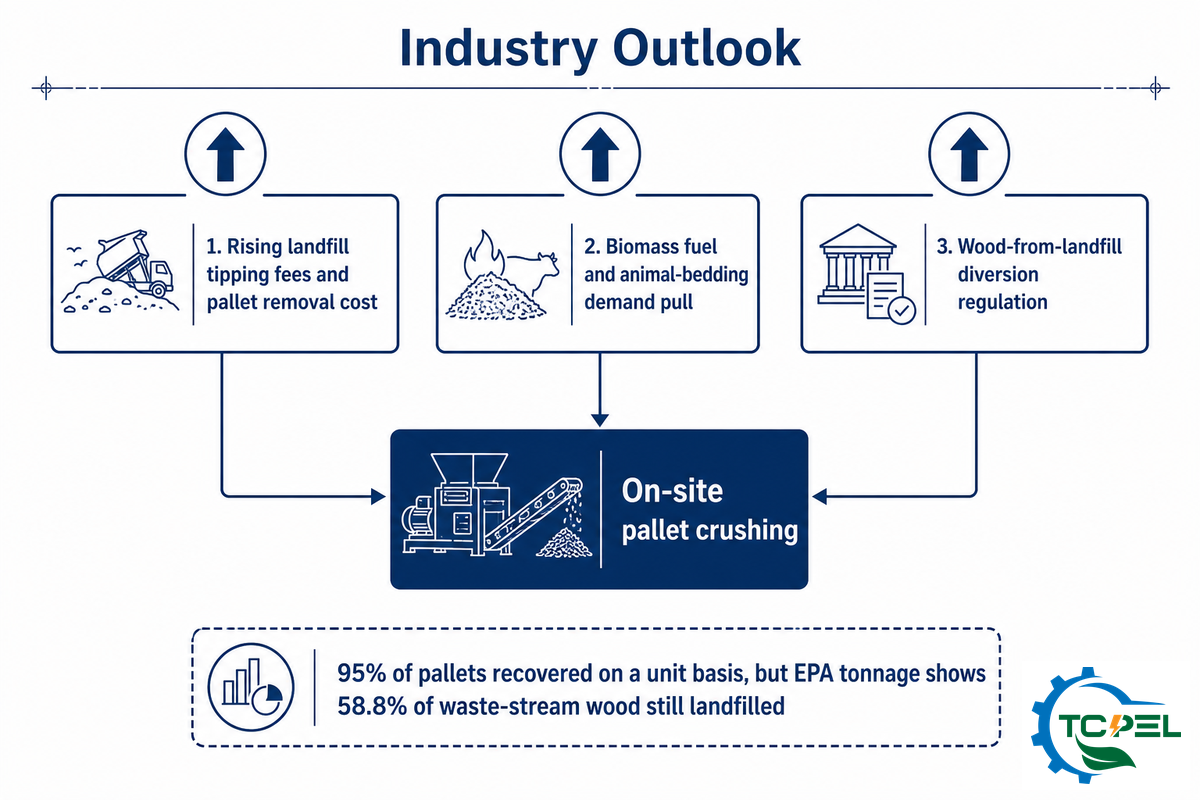
What drives on-site pallet crushing isn’t a market-size headline, it’s cost and compliance pressure that rises every year. The U.S. Department of Energy points to “reduced landfill capacity, increasing tipping fees” as a structural squeeze on anyone hauling waste, and that squeeze is what improves a crusher’s payback math regardless of how many people search for the machine. At the same time, demand for clean wood feedstock, for bedding, mulch, and biomass fuel, pulls recovered pallet wood up the value ladder rather than into the ground. That’s why heavy-duty shredders and recycling shredders keep showing up not just at dedicated recyclers but inside the warehouses and plants generating the waste wooden pallets and crates in the first place.
Research with the National Wooden Pallet & Container Association and the USDA Forest Service found that roughly 95% of wooden pallets are recovered into usable materials rather than landfilled, the question for most operations is no longer whether to divert pallets, but which tier of value to capture.
Summarizing the landfill-avoidance study led by Laszlo Horvath, PhD, Center for Packaging and Unit Load Design, Virginia Tech
That 95% figure deserves a careful reading, because the U.S. EPA’s material-flow data tell a complementary story. Counting pallet units, recovery is very high, most pallets are repaired and put back into service and never reach the waste stream. But counting tonnage of the wood packaging that does reach municipal solid waste, EPA estimated that in 2018 about 11.5 million tons were generated, roughly 3.1 million tons were recycled (chiefly chipped into mulch or bedding), and about 58.8% was still landfilled. Both numbers are right; they answer different questions. The practical takeaway for a buyer is that the landfilled tonnage, not the recovered units, is the on-site value you haven’t captured yet. A regulatory tailwind is forming too: in 2026 the wooden-pallet industry secured an exclusion for wooden pallets from California’s new extended-producer-responsibility rules, a sign that policy increasingly treats pallets as a recovered material rather than single-use waste. If your pallet pile is growing and your hauling invoice is rising, the timing argument is simply that the cost gap widens every quarter you wait.
Frequently Asked Questions
Q: How much does a pallet crusher cost?
View Answer
Prices span a very wide band — from around $500 for a small unit to well over $100,000 for a full industrial line with feed and discharge conveyors and magnetic separation. The figure is driven by throughput, drive power, build quality, and whether you add downstream equipment such as a magnet or a screen. The more useful number is not the sticker price but the payback: a compact line that erases recurring hauling fees often pays back in roughly one to two years, which matters far more than the headline cost.
Q: What’s the difference between a pallet crusher and a pallet shredder?
View Answer
“Pallet crusher” is the umbrella search term; “shredder” is one specific mechanism under it. A shredder uses slow, high-torque shafts to tear pallets apart and tolerates nails well, while a grinder uses a high-speed rotor and screen to make finer, more uniform output for mulch or fuel. When a vendor says “crusher,” ask which mechanism they mean and what output size it produces — that answer, not the label, tells you whether the machine fits your job.
Q: What is the lifespan of a pallet crusher?
View Answer
A correctly sized, heavy-built machine lasts many years, because its frame, shafting, and bearings are designed for continuous industrial duty. The consumables — cutters or hammers, screens, and seals — are meant to be inspected on a schedule and rebuilt, not run to failure. The single biggest life-shortener is chronic undersizing: a machine forced to run flat-out overheats, jams, and wears far faster than one matched to the daily volume.
Q: Can you actually make money recycling pallets with a crusher?
View Answer
The first and most reliable “money” is money you stop spending: a crusher cuts hauling frequency and tipping fees, which for many facilities is tens of thousands of dollars a year. On top of that, the output can be sold — clean grindings as landscape mulch (a state forestry program cites around $20 per ton) or animal bedding, and the nails recovered by the magnet as scrap steel. Reaching the highest-value rung, clean biomass fuel, takes drier, de-nailed, untreated wood and usually a pellet press, so most operations capture the avoided-cost and mulch/bedding tiers first and add fuel later only if their wood stream is verifiably clean. The honest answer is that the savings are nearly guaranteed and the revenue is real but volume- and market-dependent.
Q: What industries use pallet crushers most?
View Answer
Any operation that receives goods on pallets and accumulates broken ones: warehouses and distribution centers, manufacturing plants, recycling facilities, sawmills, and landscaping or agricultural suppliers that can use the output. For these recycling processes, on-site reduction is simply better waste management than hauling loose pallets away.
Q: Can a pallet crusher process plastic pallets too?
View Answer
Many low-speed shredders handle both wood and plastic pallets, but the output streams should be kept separate because they have different downstream markets — wood becomes mulch, bedding, or fuel, while plastic regrind is recycled as polymer. If you run mixed pallets, confirm the machine is rated for plastic and plan for sorting; do not assume one chip pile can serve both markets.
Q: Do I have to remove nails before crushing?
View Answer
No — if you choose a machine built for it. Low-speed shredders and reinforced grinders process pallets nails-and-all, then a magnet pulls the metal from the output. A high-speed chipper, by contrast, needs clean wood.
Why We Wrote This
TCPEL builds the full wood-to-pellet equipment chain, crushers, hammer mills, dryers, and pellet mills, so we see pallet reduction not as a disposal task but as the first stage of a value-recovery line. This guide reflects that vantage point: the goal is to help you buy the right amount of machine for the value tier you can actually reach today. Reviewed by the TCPEL technical team.
Related Articles
References & Sources
- Containers and Packaging: Product-Specific DataU.S. Environmental Protection Agency (2018 wood packaging generation, recycling, landfill data)
- Chromated Arsenicals (CCA)U.S. Environmental Protection Agency (treated-wood reuse and disposal)
- ISPM-15 Wood Packaging MaterialUSDA Animal and Plant Health Inspection Service
- Municipal Solid Waste Feedstock ReportU.S. Department of Energy, Bioenergy Technologies Office
- Combustible Dusts (OSHA 3371)U.S. Occupational Safety and Health Administration
- Biomass ExplainedU.S. Energy Information Administration
- Properties of Shredded Wooden PalletsCenter for Packaging and Unit Load Design, Virginia Tech
- Woody Biomass FeedstockIndiana Department of Natural Resources, Division of Forestry