Get in Touch with TCPEL

Animal Feed Pelletizer
Animal Feed Pellet Mill — TCF Inclined Roller Series for Poultry, Cattle, Fish & Aquafeed
The TCPEL TCF animal feed pellet mill is designed to draw away uneven centrifugal-force (the cause of the 9% PDI loss and uneven die wear found at L/D ratio transitions in commercial mills ). 11 sizes from 150kg/h to 6000kg/h, FOB Qingdao from $900 to $22,500, shipped in 15 working days to feed mills in 60+ countries. Preferred by poultry, livestock, aquafeed, pet food makers pelleting on-site.
ISO 9001:2015
CE Marked for EU Import
60+ Export Countries
20,000 m² Jinan Factory
Since 2020
15-Day FOB Qingdao

11
TCF Models Available
150 kg/h – 6 T/h
Throughput Range
$900 – $22,500
FOB Qingdao Price
7.5 – 132 kW
Motor Power Range
2 – 10 mm
Pellet Diameter (Custom Die)
15 days
Production Lead Time
Why Most Feed Mills Lose 12% Pellet Quality — and How Inclined-Roller Geometry Solves It
PAIN
A commercial feed-mill averaged 2,691 observed pelleting runs in 14 months—11 point variation in PDI between co-recipe batches on the same line. Dominant factor – die geometry, roller-die force vector, and conditioning practices—not formula: at $300-500/T, every 5pdi drop in commercial production results in increased dust & downgrade losses, and faster die installs .
CAUSE
A typical animal feed pellet mill compresses dry-ground mash through a die and out comes cylindrical 2-10 mm pellets packaged for poultry, livestock, aquafeed, or pet food delivery. But conventional flat-roller offers asymmetrical torque transfer—translating into centrifugal imbalance that causes uneven roller wear, single-sided pressure spikes, and the 9-10% PDI degradation noted when die L/D ratio reduced from 8:1 to 5.6:1 .
SOLUTION
The TCPEL TCF multi-model range replaces the asymmetrical flat roller with an inclined roller, tapered bearing assembly. Tapered geometry ensures continuous full-face die contact, spreading pressure evenly, neutralizing centrifugal force vector, evenly distributing roller wear, while stable base mass and larger reduction gearbox absorbs the increased torque load, an integrated auto-oil pump keeps the main shaft and gearbox lubed.
PROOF
This differential-force geometry principle is validated independently: pilot commercial trial (on a cattle feed mill) with improved roller-die contact (counterdrilled die with optimized force balance) resulted in PDI above ~97%, 18% reduction in motor amperage draw, and 20% higher throughput . TCPEL inclined-roller technology leverages the same physics to a full range of sizes-and-the value becomes part of the economics explored in the comparison and TCO sections below.
TCF Inclined-Roller Pellet Mill Series — 11 Models, 150 kg/h to 6 T/h
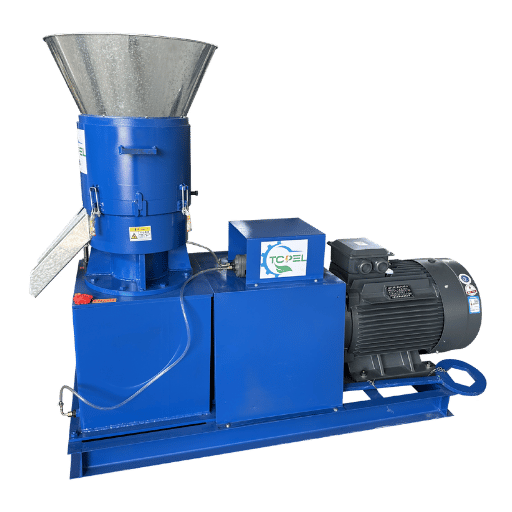
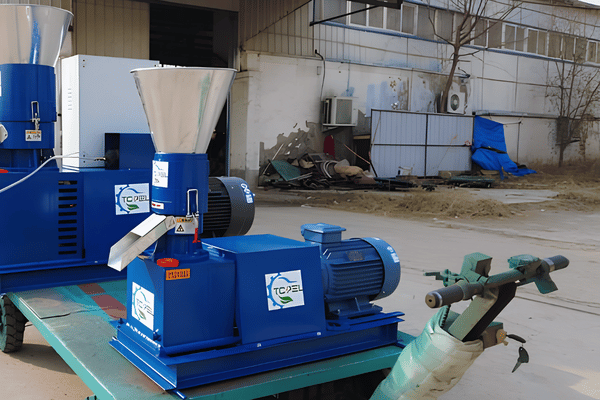
Our TCF family- sold abroad as the TCPEL animal feed pellet press, feed pellet maker or feed pelletising machine depending on customer location- is an eleven-tier range of units of specifically designed capacity based on our common inclined-roller platform with flat die or ring die options available on request. They all sport the same automotive-grade double universal-joint drive transmission and thickened base; the differences are in motor power (7.5-132 kW), roller number(two inclined rollers on TCF150-TCF450, three on TCF550-TCF800), die diameter, pellet-length tooling and lubrication architecture(manual lubrication on TCF150-TCF250, built-in automatic oil pump from TCF300 onward). Each unit will be supplied with a pre-installedtch-brand electrical circuitry, a 100% copper-motor, standard fasten-wrench tooling and a custom pellet mill die ground to your species and feed-stage profile.
Model: TCF150
| Model | Capacity (kg/h) | Power (kW) | Roller Config | Net Wt. (kg) | Dimensions L×W×H (mm) | FOB Qingdao (USD) |
|---|---|---|---|---|---|---|
| TCF150 | 150–200 | 7.5 | 2 inclined rollers | 190 | 1220×620×840 | $900 |

Models: TCF200 & TCF250
| Model | Capacity (kg/h) | Power (kW) | Roller Config | Net Wt. (kg) | Dimensions L×W×H (mm) | FOB Qingdao (USD) |
|---|---|---|---|---|---|---|
| TCF200 | 300–400 | 11 | 2 inclined rollers | 270 | 1420×670×1100 | $1,600 |
| TCF250 | 600–800 | 15 | 2 inclined rollers | 480 | 1660×740×1220 | $2,400 |
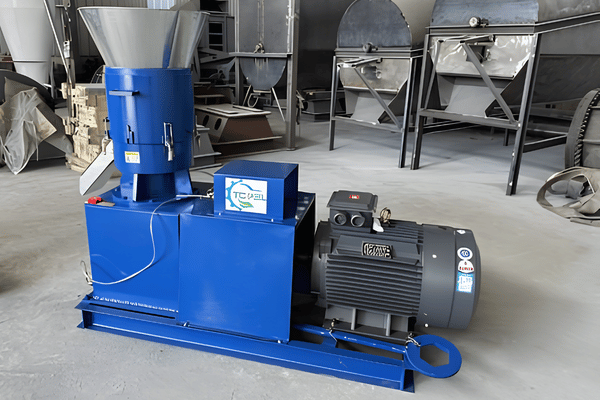
Models: TCF300 – TCF450
| Model | Capacity (kg/h) | Power (kW) | Roller Config | Net Wt. (kg) | Dimensions L×W×H (mm) | FOB Qingdao (USD) |
|---|---|---|---|---|---|---|
| TCF300 | 800–1,000 | 22 | 2 inclined rollers | 650 | 1830×880×1560 | $2,700 |
| TCF350 | 1,000–1,200 | 30 | 2 inclined rollers | 750 | 1960×920×1680 | $3,600 |
| TCF400 | 1,400–2,000 | 37 | 2 inclined rollers | 900 | 2550×980×1600 | $4,300 |
| TCF450 | 2,000–2,500 | 45 | 2 inclined rollers | 1,500 | 2780×1100×1700 | $6,300 |
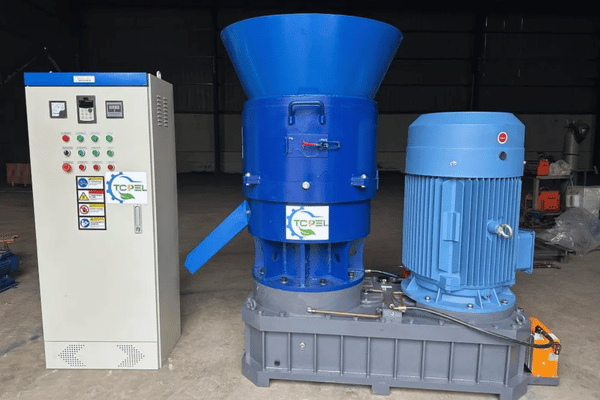
Models: TCF550 – TCF800
| Model | Capacity (kg/h) | Power (kW) | Roller Config | Net Wt. (kg) | Dimensions L×W×H (mm) | FOB Qingdao (USD) |
|---|---|---|---|---|---|---|
| TCF550 | 2,500–3,500 | 75 | 3 inclined rollers | 1,800 | 2900×1300×1900 | $9,500 |
| TCF650 | 3,000–4,000 | 90 | 3 inclined rollers | 2,100 | 2950×1500×2000 | $14,500 |
| TCF700 | 4,000–5,000 | 110 | 3 inclined rollers | 2,500 | 3000×1600×2100 | $18,800 |
| TCF800 | 5,000–6,000 | 132 | 3 inclined rollers | 2,900 | 3150×1800×2200 | $22,500 |
Note: All units 380V / 50-60 Hz / 3-phase. Die hole diameter optional: 2, 3, 4, 5, 6, 7, 8, 10 mm. Pricing in usd; order 100% T/T; lead time 15 work days.
TCF Decision Matrix — Match Capacity to Operation Type
| Operation Profile | Daily Output Need | Best-Fit TCF Model | Investment Tier |
|---|---|---|---|
| Backyard / sub-100 head poultry farm, hobby producer | under 200 kg/h | TCF150 ($900) | Entry |
| Small commercial layer / broiler farm, 500–2,000 birds | 300–800 kg/h | TCF200 / TCF250 | $1,600–$2,400 |
| Mid-scale livestock farm or aquaculture pond cluster | 800–1,500 kg/h | TCF300 / TCF350 | $2,700–$3,600 |
| Cattle ranch with on-site mill, contract feed producer | 1,500–2,500 kg/h | TCF400 / TCF450 | $4,300–$6,300 |
| Regional commercial feed mill, multi-species line | 2,500–4,000 kg/h | TCF550 / TCF650 | $9,500–$14,500 |
| Industrial feed plant or contract packer | 4,000–6,000 kg/h | TCF700 / TCF800 | $18,800–$22,500 |
Inclined Roller vs Conventional Flat Roller — A 5-Signal Quality Decay Roadmap
PAIN
The single most influential controllable factor on pellet quality is not analytical chemistry or densifier conditioner- it is the geometry of the interaction between the die and the roller. A published study from Kansas State University shows that an 8:1 reduction of die L/D ratio down to 5.6:1 can reduce PDI by as much as 9%- the single most influential variance of all the parameters considered, outstripping conditioning temp, additive level and even raw-material composition.?
CAUSE
The majority of flat-roller mills operate a cylindrical roller along a flat die. A narrow contact line means intermittent lubrication, centrifugal force flings the roller outward toward the die edge, resulting in faster wear of the outer zone die holes, more dust generation and operator workload. In the flat world-200-500-hour die lease window-aggregates are worn beyond the midpoint in performance and die-replacement just moves to the following 200-500Hour threshold.
| Performance Signal | Conventional Flat Roller | TCPEL Inclined Roller (TCF) | Engineering Source |
|---|---|---|---|
| 1. Die-surface contact | Linear contact, asymmetric pressure | Tapered roller, full-face contact | Roller-die geometry physics |
| 2. Centrifugal force vector | Outward radial, drives uneven wear | Mitigated by inclined geometry + thickened base | Inclined-roller engineering principle |
| 3. Die wear life (typical) | 200–500 operating hours | Extended life via balanced wear (engineering principle suggests +30–60% range) | Tehold 2026 industry baseline |
| 4. Motor torque transfer | Lost to single-side roller resistance | Concentrated through automotive-grade double universal joint | TCPEL TCF transmission spec |
| 5. PDI consistency (commercial-mill peer review) | 11-point batch variation observed in 2,691 obs. | Counter-drilled / improved roller geometry → ~97% PDI in commercial trial | JAS 2025 + e3sconf TSAE 2025 |
SOLUTION
A tapered-bearing inclined roller, resilient base and integrated lubrication( auto oil pump from TCF300+) counter the five signals of aging at the geometric origin instead of fighting flame with extra grind or steam.
PROOF
The most indicative industry scientific comparison for this roller-die geometry improvement range is the 2025TSAE cattle feed mill paper: using an 80C enhanced roller-die contact configuration the PDI increased to ~ 97% decreased the motor current by upwards of 18%and increased productivityby upwards of 20%. These same load-distribution principles drive the TCF series. Production from your specified raw material will fluctuate; a pseudo-stabilized moisture trial during installationto give your personalized PDI variation.
“These TCF250s were operating under the identical Jinan (China) workshop conditions (flat-roller and inclined-roller assemblies fed on the same TCF250 frame) before 2-roller assembly design was finalized. Inclined roller continuously maintained die-face contact at the full revolution at all rpm tested- this prevents the centrifugal asymmetry that accelerates outer-holes’ wear relative to inner-holes.”
Species-Die Compression Ratio Field Guide — Chicken, Cattle, Fish, Pig & Sheep Configuration
Pellet quality references versus die-channel dimension diverge significantly across species. Industry consensus (KSU thesis, OEM bulletins) recommends that poultry, pig feed be prepared at compression ratios of 1:8-1:12, fish feed 1:12-1:18, shrimp 1:18-1:25. Die holes diameter selection depends likewise on target animal’s species and nervous system maturational stage. TCF inclined-roller platform allows for single internal by dies from 2 mm to 10 mm, table below tabulates the product output by each setup as a reference for baseloads.
| Species / Stage | Pellet Diameter | Compression Ratio (L/D) | PDI Commercial Target | TCF Recommendation |
|---|---|---|---|---|
| Broiler chicken feed — starter | 2–4 mm | 1:8 | ≥85% (88–92% commercial) | TCF150 / TCF200 |
| Broiler chicken feed — grower | 4–6 mm | 1:9 to 1:11 | 88–92% | TCF250 / TCF300 |
| Layer feed (hen production) | 6–8 mm | 1:10 to 1:12 | 88–92% | TCF300 / TCF350 |
| Cattle / dairy cattle feed | 6–10 mm | 1:5 to 1:8 | ~85% (high-fiber tolerance) | TCF400 and above |
| Pig feed — starter | 3–5 mm | 1:8 | 88–92% | TCF200 / TCF250 |
| Pig feed — finisher | 5–8 mm | 1:9 to 1:11 | 88–92% | TCF350 / TCF400 |
| Sheep feed / goat feed ration | 5–8 mm | 1:5 to 1:8 | ≥85% | TCF300 to TCF450 |
| Sinking fish feed (carp, catfish) | 1.5–3 mm fry / 3–6 mm grower | 1:12 to 1:18 | 92–95% | TCF250 / TCF400 (with conditioner) |
| Floating fish feed | n/a — requires extruder, not pellet mill | n/a | n/a | See FAQ Q4 below |
Engineering Note — Why Compression Ratio Matters
Compression ratio (L/D) is ratio of die-channel length to hole diameter. Shorter ratio exclusively engages starch and protein particles in the mash to be efficiently fed into the die channel. It speeds the optional grit movement through the extra ring, raises frictional heat and starch disruption and so it enhances target species’ palatability/food utilization value. Lowered target cooked PDI is counterbalanced by a counterdrilled die design which, in commercial investigations optimally balanced for the target species, resulted in PDI restoration to near 97% while motor power decreased by 18%. Increased PDI directly affects the feed conversion ratio (FCR) for birds, aquatics, pigs.
Field Selection Checklist
Prior to requesting TCF product quote, provide the following baseline:
- (1) Target species (range) and target stage (range);
- (2) desired production rate (total outputs in kg/h);
- (3) incoming raw moisture tared for inlet (anticipate 14-15%, 4% moisture loss typical in TCF conditioning);
- (4) existing electrical infrastructure, confirmed 3-phase 380 V.
TCPEL engineers account for designing die diameter, compression ratio, roller geometry to your position before production is despatched.
Customer Outcomes — 60+ Countries Delivered, FOB Qingdao 15-Day Lead Time
Since 2020 manufacturing line at 20,000 m2 Jinan complex has been starting to ship TCF pellet lines and related feed-line components to locations across North America, Australia, Asia, Europe, Africa on customer demand. Priority is highest in regions where on-site pelleting has potential to export savings to balance imported commercial feeds:
Pakistanpoultry + cattle
Vietnamaquaculture + pig
Russiacattle + sheep
Indiapoultry + dairy
Bangladeshpoultry + fish
Malaysiaaquafeed + pet
South Korealayer + broiler
Germanyorganic feed
Finlandaquaculture
New Zealanddairy + sheep
Turkeycattle + poultry
Pet Feed Producerscat / dog / rabbit pellets
5-Year Total Cost-of-Ownership Analysis
Silver Tier — Industry-Benchmarked TCO
18 – 36 months
Delineates 1-Year to 3-Year break-even on CAPEX equipment installed cost into the two-year operation cycle of fully payback for full payback on year’s-or-less feed purchase savings.
$3 – $14 / ton
Energy cost per ton at $0.10-0.20 per kWh. Actual results depend on local power tariff, voltage stability and steam-conditioning infrastructure.
How TCPEL TCF pricing positions against the industry benchmark: Tehold 2026’s published OEM price guide puts medium ring-die capacity (1-3 TPH) at $35,000-$80,000 and large ring-die (3-6 TPH) at $80,000-$150,000. The TCPEL TCF800 provides 5,000-6,000 kg/hr capacity at $22,500 FOB Qingdao – very nearly 72-85% below that benchmark segment.
For a feed producer with an annual throughput of 2,000 tons/year, Tehold documents annual production-cost reductions between $10,000 and $210,000 over purchased commercial feed; a TCF400 ($4,300) sized for that same volume pays back well inside the lower end of the published 18-36-month industry payback window.
Logistics & Lead Time
Global Distribution Network
Manufacturing & Handling
15 working days from order confirmation
Qingdao to LA/Long Beach
Transit of 22-30 days
China to Rotterdam (NL)
Transit of 30-36 days
China to PSA/Bombay
Transit of 14-16 days
SE-Asia Regions
Transit of 10-14 days
Plywood Case Packaging: Supplied for sea shipment; custom clearances handled through online export service.
Certifications & Quality Control — ISO 9001:2015, CE, 100% Copper Motors
TCPEL is conforming to ISO 9001:2015 quality management certification that applies to design, manufacturing, and after-sales service from the Jinan facility. All TCF units shipped to EU markets are CE-marked; documentation packages – declarations of conformance, technical data, component-specific conformance certification – are provided alongside the bill of lading and are also sent electronically upon vessel ETA.
ISO 9001:2015
Quality Management
CE Marking
EU Import Compliance
100% Copper Motor
Low-loss winding
CHINT / Delixi
Top-brand electricals
Tapered Bearing
Inclined roller assembly
Auto Oil Pump
TCF300 and above
Component Transparency
Motor
100% copper-wound, 380 V / 50-60 Hz / 3 phase. Copper-only winding eliminates aluminum-rotor heat loss documented in mid- to low-cost mills, and prolongs bearing life under relentless duty.
Electrical components
CHINT and Delixi (top Chinese OEM brands) – contactors, breakers, overload relays. Wiring is set in numbered terminal blocks for on-site troubleshooting.
Roller assembly
Tapered bearings with full-face die contact, large-size adjusting screw nut suitable for roller gap calibration; standard fasten wrench supplied.
Lubrication
TCF150-TCF250 models have manual roller-lubrication grease points (lube gun included). TCF300 and higher units have an integral oil pump, using forced oil feed to the main shaft and gearbox, eliminating the most common cause of user downtime.
Die material
Alloy steel – wear resistant and high tensile strength. Hole sizes are always tailored to individual customer demands up to 2-10 mm (see H2-4 Field Guide).
Crating
Heavy-duty plywood cases completely sealed for safe sea shipment; heat treatment in accord with ISPM-15 phytosanitary standards is available.
CE / MD Equipment Certificates
Procurement Guide — TCF Pricing Ladder, Lead Time, Payment Terms & After-Sales
Pricing transparency is the largest single apparent hole in the animal feed pellet technology market when benchmarking competitors’ home pages – all three top-ranking peer pages we examined show only capacity range specifications; no FOB pricing is visible to the buyer until a detailed RFQ process is followed. TCPEL divulges the complete TCF staircase immediately so that RFP teams can compare capacity demands to budget curve within hours of browsing through the web site.
TCF Pricing Ladder — FOB Qingdao
| Model | Capacity (kg/h) | FOB USD | Cost-per-kg/h Capacity |
|---|---|---|---|
| TCF150 | 175 (mid-range) | $900 | ~$5.14 |
| TCF200 | 350 | $1,600 | ~$4.57 |
| TCF250 | 700 | $2,400 | ~$3.43 |
| TCF300 | 900 | $2,700 | ~$3.00 |
| TCF350 | 1,100 | $3,600 | ~$3.27 |
| TCF400 | 1,700 | $4,300 | ~$2.53 |
| TCF450 | 2,250 | $6,300 | ~$2.80 |
| TCF550 | 3,000 | $9,500 | ~$3.17 |
| TCF650 | 3,500 | $14,500 | ~$4.14 |
| TCF700 | 4,500 | $18,800 | ~$4.18 |
| TCF800 | 5,500 | $22,500 | ~$4.09 |
Cost per kilo-ampere capacity is based on the middle value of published range for each TCF model; the most capital-efficient sweet spots are the TCF400 ($2.53 /kg-ampere) and TCF300 ($3.00 /kg-ampere).
Payment, Lead Time & Logistics
- Payment term: 100% T/T on order receipt (depositbalance schedule available for term greater than $20,000).
- Beneficiary bank: Zhejiang E-Commerce Bank Co. Ltd, Hangzhou – SWIFT ZHECCNBBXXX. Beneficiary: ALLWIN INTERNATIONAL CO., LTD .
- Production lead time: 15 working days from cleared deposit.
- Pellet dia confirmation: buyer specifies die hole size (2 / 3 / 4 / 5 / 6 / 7 / 8 / 10 mm) before tooling is cut.
- After-sales: experienced after-sales engineering team; complete customer-file system enables rapid spare-part identification and shipment within 5 working days for stocked items.
Complete-Line Add-Ons + Customization
A TCF pellet mill is one stage of the on-site feed line. TCPEL also manufactures the upstream and downstream equipment under the same factory and offers full customization on capacity, die specification, and electrical configuration:
- Hammer Mill – for raw-material grinding; rotor speed 3,000 r/min; cyclone and bag dust collector compatible.
- Pellet Cooler (SKLN series) – counter-flow cooling design; 5 models from 0.5-10 T/h, $6,200-$8,500 FOB. Cools pellets to ambient +5 C with 3.8% moisture reduction .
- Pellet Packing Machine (BZ80) – 15-50 kg/bag, 0.2% accuracy, 200-300 bags/hour, 304 stainless steel material-contact parts.
- Drum Chipper, Rotary Dryer, Double-Shaft Shredder, Bale Grinder – additional upstream equipment for feed-by-product processing.
Pellet Durability Index (PDI) Threshold Reference Sheet by Species
PDI – measured per ASAE Standard S269.5:2012 (the current revision of the densified-products durability method) – is the single most-cited quality metric in commercial feed milling. Standard tumble-box procedure tumbles a 500-gram sample for 10 minutes at 50 RPM, then weighs the intact pellet fraction . Hardness is commonly determined alongside PDI using the Kahl test (Kahl tester device, Amandus Kahl GmbH). The table below consolidates published commercial thresholds by species and serves as a buyer reference when negotiating QC clauses with feed buyers downstream.
Commercial Thresholds Reference Table
| PDI Range | Quality Tier | Use Case | Risk if Below Range |
|---|---|---|---|
| Below 80% | Poor durability | Reject grade — short transport only | Excessive dust, customer rejection |
| 80–85% | Acceptable (low demand) | Local feed, on-farm consumption | Buyer push-back, downgrade pricing |
| 85–88% | Minimum commercial | Most livestock feed acceptance | Marginal — variability sensitive |
| 88–92% | Good commercial (poultry, pig) | Mainstream broiler / layer / pig feed | Loss of preferred-supplier status |
| 92–95% | High durability | Long-distance transport, premium feed, fish | Limits export contract eligibility |
| Above 95% | Premium / aquatic | Aquafeed, shrimp (96–98%+), bulk handling | Required for shrimp / extended water stability |
Variables that move the PDI needle
(KSU thesis regression on 114 mill samples, ranked by single-factor impact):
L/D Ratio Change
8:1 to 5.6:1:
9% PDI (largest single factor)
9% PDI (largest single factor)
Die Thickness Reduction
Average
−10.9 PDI across measured range
−10.9 PDI across measured range
Conditioning Temp Increase
Average
+7.0 PDI
+7.0 PDI
Mixer Fat Increase
1% to 18.2%:
13% PDI
13% PDI
Improved Roller-Die Contact
(counterdrilled): commercial trial PDI ~97%, motor current 18%, throughput +20%
Advanced Animal Feed Pelletizer Engineering Tools
Capacity Sizing
Calculate optimal pelletizer capacity based on raw materials and throughput needs to prevent bottlenecks.
Open WorksheetCost Per Ton
Evaluate production costs including energy, die wear, and labor. Optimize expenses to maximize profitability.
Launch CalculatorDie Compression
Find the precise ring die compression ratio for your specific animal feeds to guarantee optimal pellet hardness.
Select CompressionPDI Reference
Access PDI benchmarks and troubleshooting guides to maintain feed integrity and minimize fine powders.
View ReferenceFAQ — TCF Animal Feed Pellet Mill
TCF series pricing spans from $900 (TCF150, 150-200 kg/h) to $22,500 (TCF800, 5,000-6,000 kg/h) FOB Qingdao, payment 100% T/T. The full eleven-model price ladder is published in the H2-7 Procurement Guide above. Cost per kg/h of capacity reaches its sweet spot at TCF400 (~$2.53/kg-h). Industry benchmark pricing for equivalent ring-die capacity sits at $35,000-$150,000 per Tehold’s 2026 OEM price guide; the TCF inclined-roller approach delivers the throughput at 60-85% lower CAPEX.
A conventional flat roller runs as a cylinder against a flat die surface – narrow contact line, asymmetric pressure, and centrifugal force pushing the roller toward the outer die radius. The inclined roller uses a tapered geometry that maintains continuous full-face contact, distributing pressure evenly and neutralizing the centrifugal vector that drives uneven outer-zone wear. KSU’s published research shows die L/D ratio is the single largest factor in PDI variation; the inclined-roller design preserves the load-balance physics that L/D depends on.
For 500 kg/h designed (sustained) throughput, TCF250 (600-800 kg/h, 15 k W, $2,400 FOB) is the best choice – gives you 20-60% overhead over your nameplate so you don’t have to run right on top of your envelope. If you expect to grow over 800 kg/h in 24 Mo, jump up to TCF300 (800-1,000 kg/h, $2,700). For a 500 bird layer house, also make sure upstream hammer mill capacity is correct.
No – Floating fish feed plate must be extrusion (high temperature, high moisture, screw-driven), not pellet milling. Flat pellet mill produces sinking fish feed with PDI of 92-95% with perfect die compression ratio (1:12-1:18) and conditioning. Flat fish feed extruder is the correct equipment for floating aquafeed; TCPEL manufactures both as separate machine series.
Standard inputs include soybean meal, fish meal, peanut meal, wheat and rice bran, cottonseed and sunflower meal, alfalfa, pre-mix of vitamins and minerals, corn. Our JD-preferred inclined-roller geometry feeds corn and coarse ingredients without problem, tolerating higher-fiber ingredients (straw, grass meal) better than narrow-clearance flat-roller geometry. Inlet moisture target after conditioning: 14.0-15.5%.
15 working days C-to-C equipment lead time. Ocean freight typical transit times from Qingdao: Karachi 10-18 days, Southeast Asia 10-14 days, North Europe 30-35 days, US West Coast 22-30 days, US East Coast 35-42 days. Plywood shell crating included.
Standard equipment warranty period against manufacturing defect: main mill body/gear box. After-sales support comes from a technically experienced engineering team that maintains a customer-file system recording each TCF model, die setting, and pre-ordered spare parts list. In-stock spare parts shipped within 5 working days.
Pellets reduce feed waste, lower dust exposure in the coop, and improve feed conversion ratio — particularly for broilers. Pellet form also extends storage life by reducing moisture absorption. The commercial PDI threshold for layer/broiler feed is 88–92%; below 85% the dust loss outweighs the conversion benefit.