Get in Touch with TCPEL

Last updated: October 2026
The top feed pellet production line manufacturers to compare include TCPEL and ABC Machinery for compact packages; Bühler, ANDRITZ and Van Aarsen for industrial plant integration; KAHL for flat-die processing; and IMAS/Viteral for feed projects with building scope. The best fit follows the required feed process, matched equipment and delivery responsibility.
There are a number of things a complete feed mill has to get right before it can produce pellets consistently. Ingredients need to end up in the right place, batches need to be mixed correctly, and the cooler and packing system need to be able to handle what the presses produce. A supplier’s role across those stages is more useful than a long list of pellet machine manufacturers with unrelated headline capacities.
Comparison scope
- 20 distinct supplier groups with published feed equipment and integrated line or plant offers.
- Compact equipment packages, industrial process platforms and regional turnkey plant builders.
- Company and project figures retain their original machine, line or factory boundary.
Quick Picks
- Best for compact livestock and poultry packages: TCPEL.
- Best for a small packaged plant comparison: ABC Machinery / GEMCO.
- Best for integrated process control: Bühler Group.
- Best for a defined modular industrial concept: ANDRITZ Feed & Biofuel.
- Best for flat-die formulation development: AMANDUS KAHL.
- Best for a documented feed mill with building delivery: IMAS / Viteral.
Disclosure: This guide is published by TCPEL. We list ourselves first because this is our website, not because we claim to be the market leader. The other 19 manufacturers are grouped by what they’re best for, in no particular order within each group.
How We Selected These Feed Pellet Production Line Manufacturers
The companies included in this report manufacture feed processing machinery and offer integrated systems, complete feed mills or engineering services related to their own process machinery. We excluded trading companies, sourcing platforms, directories, wood only equipment companies and duplicate group brands. We verified company information against official websites and public project sources in October 2026. The selection covers different plant sizes and engineering roles rather than assigning a market-share or performance rank.
ABC Machinery and GEMCO count once, as do CPM and IDAH, Rosal and Mabrik, and Ottevanger’s related equipment brands. A company’s group history is identified separately where it differs from a division or regional business. Our TCPEL company background identifies the publisher’s legal entity and factory base. Supplier specifications below are attributed company figures; named plant references describe those particular installations.
What Counts as a Complete Feed Pellet Production Line?
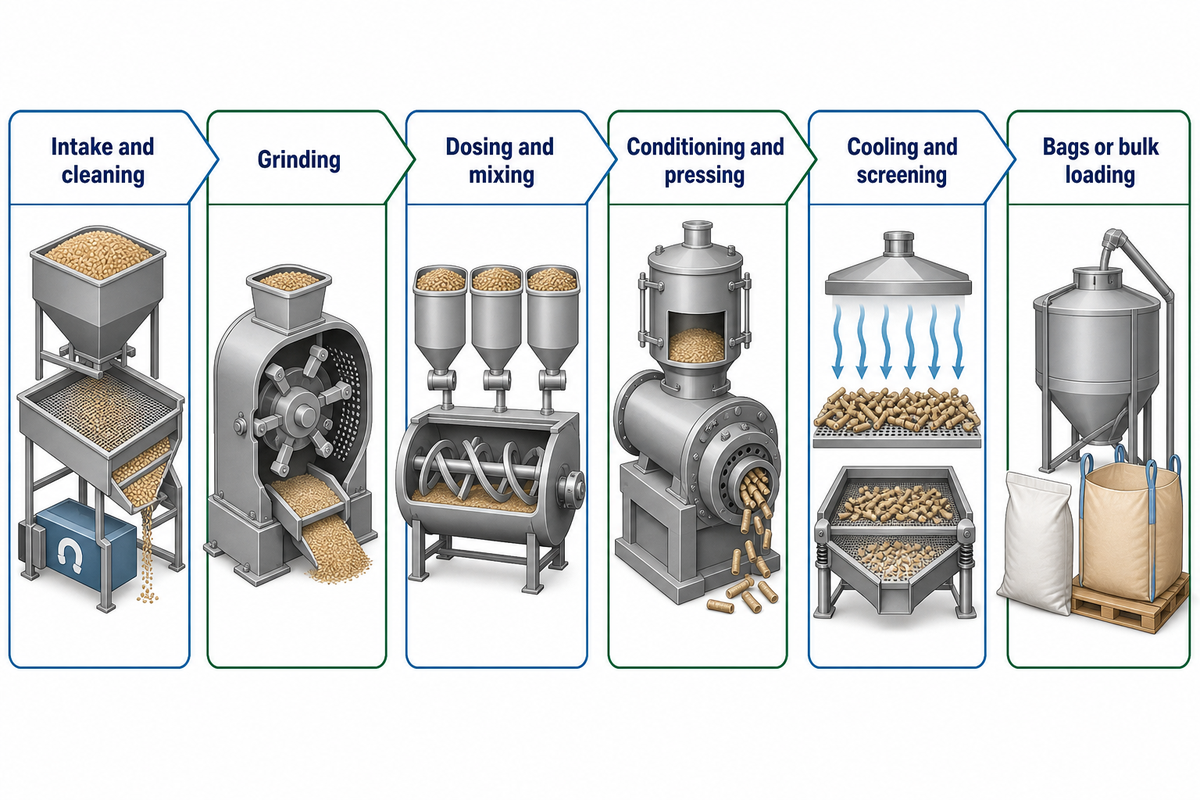
A complete feed pellet production line connects ingredient preparation, batching and mixing with conditioning, pressing, cooling, screening and dispatch. Its supplier must coordinate the flow between machines and the operating controls. A feed pellet mill machine covers the pressing stage; the remaining equipment and site work define the wider purchase.
Animal feed production begins before the pellet mill. Intake equipment moves the raw material into storage; cleaning and magnets remove unwanted material; grinding prepares particle size; and dosing brings the recipe into the mixer. The feeder and conditioner prepare a mash which is then pressed. Downstream equipment cools the feed pellets, separates fines and sends finished product to bags or bulk loading.
The Food and Agriculture Organization’s feed-processing guidance lists those operations as a connected sequence and distinguishes pelleting checks from extrusion checks. In an extrusion process, bulk density and floating or sinking behavior, in addition to shape and particle size, become product specifications. Therefore, a floating fish feed system, for example, requires a different process arrangement than a livestock press.
Compressed feed pellets
- Conditioning followed by a pellet press.
- Cooling, screening and optional crumbling.
- Recipe and die selection matched to the feed.
Extruded aquafeed
- Conditioning and an extrusion process.
- Drying and cooling matched to the product.
- Density and water behaviour included in the brief.
A small animal feed pellet mill can be a sensible replacement in an existing working plant. A greenfield buyer also needs storage, conveyors, utilities and a defined installation plan. The TCPEL feed pellet production line page provides one example of a connected equipment sequence. Diesel engine or PTO-driven standalone presses belong to another procurement route; their drive choice doesn’t provide a complete automated mill.
20-Company Feed-Line Fit Map
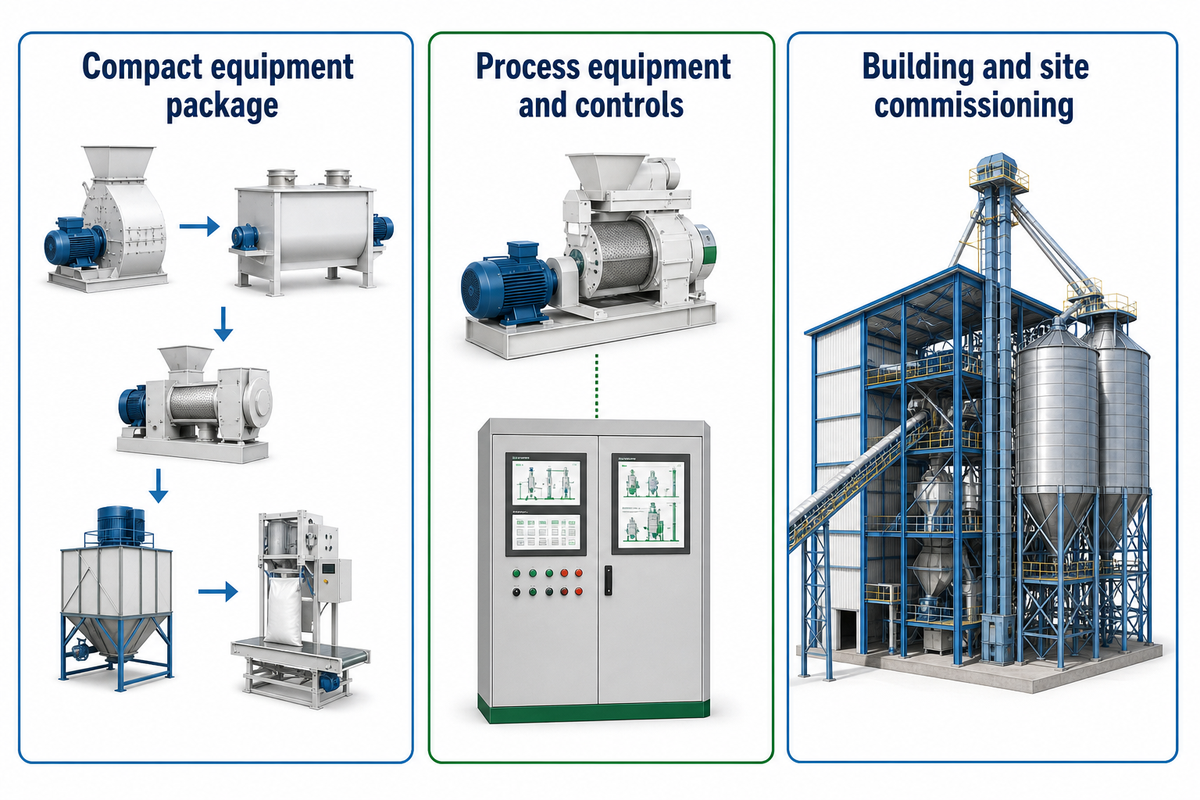
The 20-Company Feed-Line Fit Map links equipment manufacturers to plant scope, production, and one practical buying constraint.
Read the plant-scope column first. A containerised mill, a process-equipment platform and a building-inclusive project put different work on the owner’s team. The numbers in the profiles should aid the first conversation; the table keeps the advantages and limitations short enough to compare different suppliers without turning them into a numerical league table.
| No. | Company Name | Headquarters / operating base | Founded Year | Best For | Brief Introduction | Plant Scope | Key Advantages | Potential Disadvantages | Official Website |
|---|---|---|---|---|---|---|---|---|---|
| 1 | TCPEL | Jinan, Shandong, China | 2020 | compact livestock and poultry feed projects needing a modular equipment package | pellet machinery manufacturer under ALLWIN INTERNATIONAL CO., LTD | Compact equipment package | Connected preparation and finishing equipment | Largest listed TCF press: 6 t/h nominal | https://tcpel.net/ |
| 2 | ABC Machinery / GEMCO | Anyang, Henan, China | 2014 ABC joint venture; GEMCO is an older brand | compact packaged feed mills with a visible model layout | machinery manufacturer and turnkey plant supplier | Compact and medium feed plants | 600–1,000 kg/h compact configurations | Compact STLP differs from industrial ring-die scope | https://www.abcmach.com/ |
| 3 | Alvan Blanch | Chelworth, Malmesbury, United Kingdom | 1952 | on-farm and commercial feed mills alongside crop-processing equipment | British machinery manufacturer and integrated system builder | Integrated on-farm/commercial systems | Farm and commercial system options | ABP800: 10-12 tph | https://www.alvanblanchgroup.com/ |
| 4 | SKIOLD | Sæby, Denmark | 1877 | farm-to-commercial feed milling with integrated grain handling | feed machinery manufacturer and complete-plant supplier | Farm and commercial feed mills | Grain handling plus feed production | Cooler emptying adds recipe-change time | https://skiold.com/ |
| 5 | Bühler Group | Uzwil, Switzerland | 1860 | feed plants integrating process control and manufacturing execution | industrial process-equipment manufacturer and plant engineering group | Industrial process and control platform | Kubex 5 with process and MES controls | MES introduces another integration layer | https://www.buhlergroup.com/ |
| 6 | ANDRITZ Feed & Biofuel | Esbjerg, Denmark (division headquarters) | 1852 ANDRITZ group roots; not a division incorporation date | complete industrial feed plants and a defined modular alternative | feed-process machinery manufacturer and turnkey plant division | Modular and turnkey plants | 10 TPH modular feed-plant option | Extrusion needs a different process train | https://www.andritz.com/feed-and-biofuel-en |
| 7 | CPM | Blaine, Minnesota, USA (listed corporate location) | 1883 CPM roots; first successful commercial pellet mill in 1931 | integrated grinding, pelleting and lifecycle equipment platforms | pellet mill and process-equipment manufacturing group | Industrial equipment/process platform | Grinding-to-cooling equipment platform | Site and civil delivery scope separately defined | https://onecpm.com/ |
| 8 | FAMSUN | Yangzhou, Jiangsu, China | Not publicly disclosed | multi-species plants requiring separate pelleting and extrusion routes | feed and food equipment manufacturer and engineering provider | Multi-species equipment and engineering | Separate species and process families | Species families require separate configuration | https://en.famsun.com/ |
| 9 | Zhengchang | Liyang, Jiangsu, China | 1918 group roots | large integrated feed plants with storage and controls | feed machinery manufacturer and whole-plant engineering group | Whole-plant design and commissioning | Whole-plant engineering and SZLH equipment | 10 SZLH858 and 3 SZLH558 production lines | https://en.zhengchang.com/ |
| 10 | Van Aarsen | Panheel, Netherlands | 1949 | custom turnkey feed mills with coordinated process engineering | feed machinery manufacturer and turnkey plant engineer | Custom turnkey feed mills | Custom plant layout through commissioning | Custom project needs a wider engineering brief | https://vanaarsen.com/ |
| 11 | Ottevanger | Moerkapelle, Netherlands | 1909 | containerised and high-output feed mills under one process partner | feed equipment manufacturer and plant integrator | Containerised and industrial mills | C10-10 modular and large plant references | C10-10 containerised feed mill: 10 t/h | https://www.ottevanger.com/ |
| 12 | AMANDUS KAHL | Reinbek, Germany | 1876 Hamburg roots; Reinbek move in 1965 | flat-die feed plants and formulation trials before scale-up | process machinery manufacturer and turnkey plant supplier | Flat-die process plants | Pilot trials and flat-die architecture | Different tooling from ring-die plants | https://www.akahl.com/ |
| 13 | Fragola S.p.A. | Assisi, Perugia, Italy | 1961 | feed mills combining pelleted feed and premix production | feed machinery manufacturer and turnkey plant builder | Turnkey feed and premix plants | Feed and premix projects separated | 15 ton/h meal; 10/12 ton/h pellet | https://www.fragolaspa.com/en/ |
| 14 | Alapala Feed Tech | İstanbul, Türkiye (head office); Çorum factory | 1954 | grain processors adding feed and bran-pelleting plants | machinery manufacturer and turnkey feed-plant engineer | Grain-linked feed and bran plants | 2–60 TPH plants with buildings and silos | Bran package starts at the bran silo | https://www.alapala.com/ |
| 15 | Rosal-Mabrik | Santa Perpetua de Mogoda, Barcelona, Spain | 1956 Talleres Rosal roots; Mabrik formed in 1973 | turnkey plants with group-made pelleting sections | feed plant engineering and machinery manufacturing group | Turnkey plants and pelleting sections | Group-made process and pelleting machinery | Responsibilities split across group companies | https://rosal-feedmills.com/en/ |
| 16 | Yemmak | Bandırma, Türkiye | 1965 | large poultry-feed plants and multi-process turnkey projects | feed machinery manufacturer and turnkey process engineer | Turnkey process engineering | 240 t/h Şenpiliç plant reference | ~30,000 m² Area | https://www.yemmak.com/ |
| 17 | Yemtar | Bandırma, Türkiye | 1980 | turnkey feed mills combining pelleting, intake and storage | feed machinery manufacturer and turnkey factory builder | Containerised and turnkey feed factories | Smart-Mill container and full-factory offers | Changes cannot be made to the containers | https://www.yemtar.com/en/ |
| 18 | STOLZ (Desmet) | Wailly Beaucamp, France | 1952 | feed mills with coordinated bulk handling and process equipment | feed-process machinery manufacturer within Desmet | Bulk handling through feed processing | ABMS feeder and SAGA screen changes | SAGA: adapted to Stolz RMP hammermills | https://www.desmet.com/en/about-us/about-stolz |
| 19 | IMAS / Viteral | Konya, Türkiye | 1989 | feed-plant projects including steel buildings and central automation | machinery manufacturer and turnkey feed-plant engineer | Turnkey plant plus steel building | Nurym 20 t/h building-inclusive project | Building-inclusive tender exceeds equipment-only scope | https://www.viteral.com.tr/ |
| 20 | RICHI Machinery | Wuzhi, Jiaozuo, Henan, China (factory); Zhengzhou trade office | 1995 | export feed plants with on-site commissioning and a defined packaging endpoint | pellet machinery manufacturer and turnkey plant supplier | Export turnkey feed plants | Packaging endpoint and overseas commissioning | Overseas start-up needs a site service plan | https://www.richimachinery.com/ |
Compact and Modular Feed-Line Projects
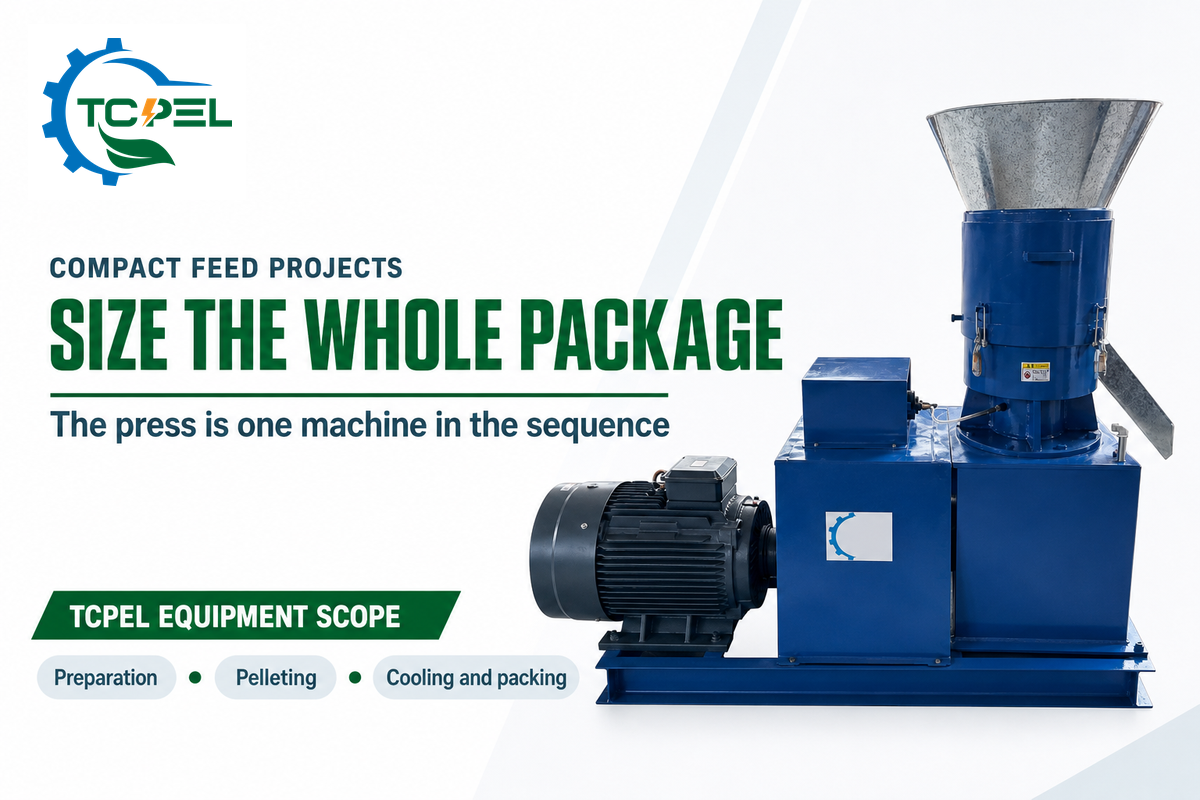
The compact feeding system should be integrated with equipment for preparation, mixing and finishing at the intended feed output. The four companies in this example provide integrated systems for smaller and/or modular projects. Their published press and equipment lists help buyers define the layout, while the complete equipment list and specs define the purchase.
1. TCPEL: Best for compact livestock and poultry feed projects needing a modular equipment package
Headquarters / operating base: Jinan, Shandong, China · Founded: 2020 · Type: pellet machinery manufacturer under ALLWIN INTERNATIONAL CO., LTD
Official website: https://tcpel.net/
Main products: hammer mill, mixer, conveyors, pellet mill, cooler, optional crumbler, sieve and bagger.
Capabilities: TCPEL’s published TCF machine capacity range starts at 150 kg/h and reaches 6 t/h. The page lists 11 TCF models.
Quality / qualifications: According to TCPEL’s website, MD-NTS2307072S is listed for the pellet machine, alongside separate ancillary-machine documents.
TCPEL suits a buyer who needs a compact equipment package rather than a factory-scale master plan. The company’s feed-line sequence puts a hammer mill and mixer ahead of pelleting, then adds cooling, screening and bagging, so the conversation can start with connected machines instead of an isolated pellet maker. Eleven published TCF steps give smaller projects a model ladder, while the optional crumbler changes the downstream arrangement for smaller feed particles. The largest listed TCF machine is rated at 6 t/h, which limits a single-press purchase above that nominal duty.
2. ABC Machinery / GEMCO: Best for compact packaged feed mills with a visible model layout
Headquarters / operating base: Anyang, Henan, China · Founded: 2014 ABC joint venture; GEMCO is an older brand · Type: machinery manufacturer and turnkey plant supplier
Official website: https://www.abcmach.com/
Main products: STLP300/STLP400 compact plants, ZLSP mills, ring-die feed systems.
Capabilities: 600–1,000 kg/h small plants and 1–10 TPH medium lines on its feed business site.
Quality / qualifications: Its feed-business website lists CE and ISO9001 claims for its equipment and quality system.
ABC Machinery is a useful compact-plant comparison because its feed business separates small packaged systems from medium projects. According to that website, a small feed pellet plant covers 600–1,000 kg/h, while medium lines span 1–10 TPH; the GEMCO catalog also identifies the STLP300 and STLP400 configurations. Those packages connect feed preparation with a mill and cooler, which helps a small-scale buyer compare actual equipment sequences. STLP compact packages are a different configuration from industrial ring-die projects, so the same brand name shouldn’t flatten the two offers into one specification.
3. Alvan Blanch: Best for on-farm and commercial feed mills alongside crop-processing equipment
Headquarters / operating base: Chelworth, Malmesbury, United Kingdom · Founded: 1952 · Type: British machinery manufacturer and integrated system builder
Official website: https://www.alvanblanchgroup.com/
Main products: ABP pellet presses, grinders, inclined mixers, coolers, bagging and conveying systems.
Capabilities: ABP350 lists 1–2.5 t/h; ABP800 lists 10–12 t/h, as press model ratings.
Quality / qualifications: The company’s 2026 history lists Made in Britain manufacturer recognition.
Alvan Blanch connects feed processing with the crop-handling work around it. Its pelleting offer covers both commercial and on-farm systems, and the ABP350’s listed 1–2.5 t/h press range sits below the ABP800’s 10–12 t/h range. A farm expanding beyond mash can therefore compare grinding, mixing and downstream handling within the same manufacturer’s portfolio, while another customer can combine feed work with wider agricultural processing machinery. ABP press ratings must be matched to the complete plant; one press capacity doesn’t define mixer or cooler output. The listed ABP800 press covers 10–12 t/h; a duty above that range needs a different single-press configuration.
4. SKIOLD: Best for farm-to-commercial feed milling with integrated grain handling
Headquarters / operating base: Sæby, Denmark · Founded: 1877 · Type: feed machinery manufacturer and complete-plant supplier
Official website: https://skiold.com/
Main products: feed mills, pellet presses, conditioners, coolers, crumblers and sifters.
Capabilities: Pelleting section lists 2–40 t/h, with fines return and downstream screening.
Notable work, according to the company’s website: The official feed portfolio combines pelleting with grinding and proportioning for pigs, cattle and poultry.
SKIOLD is worth comparing when feed production is part of a farm’s grain-to-livestock operation. The company connects grain storage and handling with proportioning and grinding for pigs, cattle and poultry, while its pelleting page lists a 2–40 t/h range with conditioning, cooling, crumbling and sifting. An animal husbandry business making feed on site can compare those operations within one feed mill plant. Its counterflow cooler requires complete emptying when changing recipes, which adds a changeover duty for a plant making several products.
Industrial Feed Plant Engineering Platforms
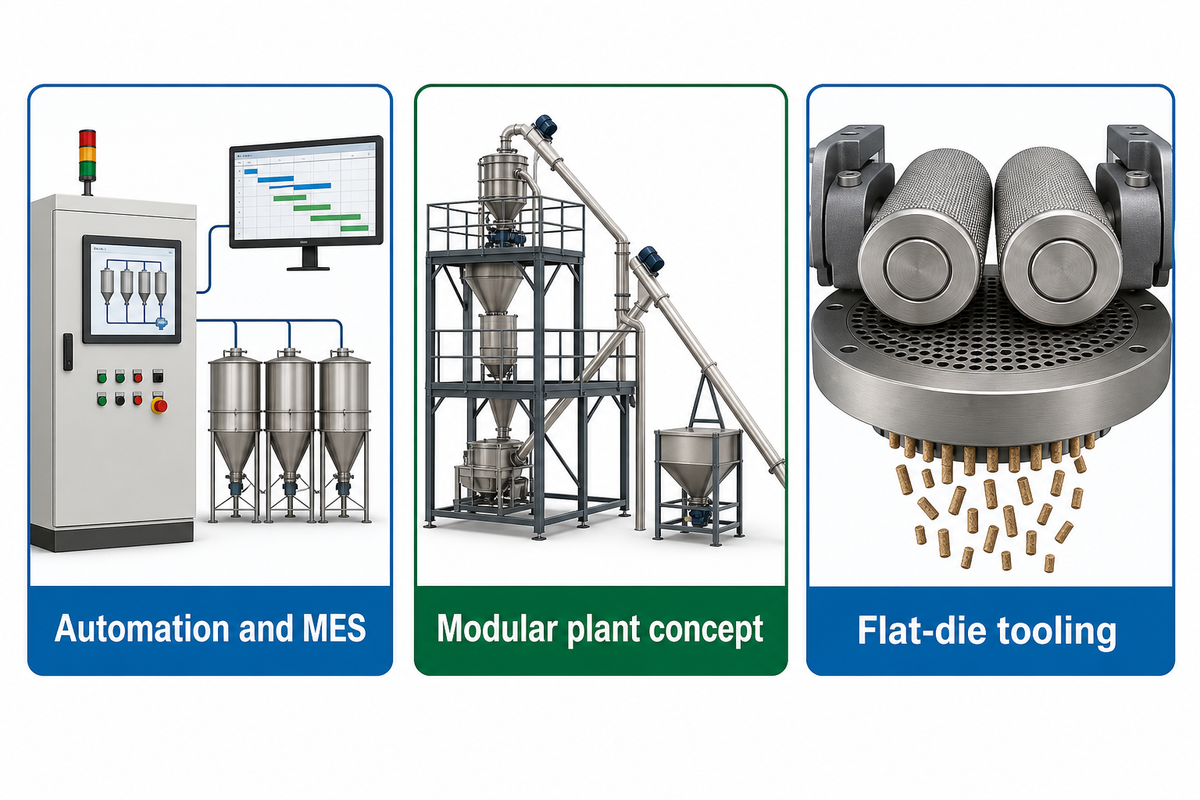
Large scale animal feed production needs a process partner that assists in connecting equipment choices to controls and plant operation. Eight other groups showcase integrated process and/or equipment platforms. Their project roles differ, and the comparison should be the scope of engineering and operating support around the pellet mill.
5. Bühler Group: Best for feed plants integrating process control and manufacturing execution
Headquarters / operating base: Uzwil, Switzerland · Founded: 1860 · Type: industrial process-equipment manufacturer and plant engineering group
Official website: https://www.buhlergroup.com/
Main products: Kubex 5 Series pellet mills, Granulex 5 Series hammer mills, PelletingPro and Mercury MES.
Capabilities: Animal-feed process equipment with plant automation, training and lifecycle support.
Quality / qualifications: ISO 9001:2015 certificate CH14/1241.00, Issue 12, identifies Bühler AG and listed sites; valid through 16 November 2026.
Bühler offers a route for connecting the process floor to factory-wide control. Kubex 5 pelleting and Granulex 5 grinding sit alongside PelletingPro and Mercury MES, so equipment selection can be coordinated with production information, operator routines and maintenance support. That’s useful for an established feed manufacturing plant comparing process upgrades with a new integrated line, particularly where the plant wants one operating platform across departments. Mercury MES and pelleting controls are distinct system choices that add an integration layer to a basic equipment order.
6. ANDRITZ Feed & Biofuel: Best for complete industrial feed plants and a defined modular alternative
Headquarters / operating base: Esbjerg, Denmark (division headquarters) · Founded: 1852 ANDRITZ group roots; not a division incorporation date · Type: feed-process machinery manufacturer and turnkey plant division
Official website: https://www.andritz.com/feed-and-biofuel-en
Main products: hammer mills, OptiMix mixers, conditioners, expanders, pellet mills, coolers and automation.
Capabilities: Advertises a 10 TPH modular feed plant as well as custom complete feed-pelleting plants.
Quality / qualifications: According to its Esbjerg page, the division lists ISO9001 certification for that location.
ANDRITZ explicitly offers both the key process machines and complete feed-pelleting plants. Its 10 TPH modular feed plant provides a concrete alternative to a fully customised mill, while the wider portfolio includes OptiMix mixing, conditioning, expansion and downstream cooling. A buyer can therefore compare a defined modular concept with a site-specific industrial project through the same feed-and-biofuel division. Feed pelleting and extrusion require different process trains; the modular feed offer isn’t a universal aquafeed configuration.
7. CPM: Best for integrated grinding, pelleting and lifecycle equipment platforms
Headquarters / operating base: Blaine, Minnesota, USA (listed corporate location) · Founded: 1883 CPM roots; first successful commercial pellet mill in 1931 · Type: pellet mill and process-equipment manufacturing group
Official website: https://onecpm.com/
Main products: 1100, 3000, 7700 and 7900 Series mills, hammermills, conditioners, crumblers and coolers.
Capabilities: Equipment spans particle-size reduction, temperature and moisture control, pelleting and downstream handling.
Notable work, according to the company’s website: IDAH was acquired in 2023 and is counted within CPM rather than as another independent group.
CPM’s strength for this shortlist is the breadth of connected process equipment and long-term parts support. An animal feed pellet mill can be paired with size reduction, temperature and moisture control, crumbling and cooling, with the 1100, 3000, 7700 and 7900 families providing several equipment platforms. The corporate history also records IDAH’s acquisition in 2023, which makes it part of this group comparison rather than an additional independent manufacturer. The animal-feed portfolio coordinates process equipment; civil works and a complete site-delivery package remain a separate engineering scope.
8. FAMSUN: Best for multi-species plants requiring separate pelleting and extrusion routes
Headquarters / operating base: Yangzhou, Jiangsu, China · Founded: Not publicly disclosed · Type: feed and food equipment manufacturer and engineering provider
Official website: https://en.famsun.com/
Main products: K, KN, KX and MUZL pelleting families; grinding, mixing, extrusion and coating systems.
Capabilities: Integrated equipment and engineering for aqua, pig-and-poultry, ruminant, premix, fermented and pet feeds.
Notable work, according to the company’s website: The current site identifies its ISO feed-machinery technical-committee secretariat role in hosting and drafting industry standards.
FAMSUN organises its feed business around different production programs rather than a single generic machine. The K, KN, KX and MUZL families sit within a wider offer spanning pig and poultry feed, ruminant feed, aquafeed, premixes and pet food, supported by grinding, mixing, extrusion and coating. A company producing several types of animal feed can use that structure to compare process routes within one engineering organisation. Pig-and-poultry, ruminant and aquafeed product families require separate selection rather than one common press specification.
9. Zhengchang: Best for large integrated feed plants with storage and controls
Headquarters / operating base: Liyang, Jiangsu, China · Founded: 1918 group roots · Type: feed machinery manufacturer and whole-plant engineering group
Official website: https://en.zhengchang.com/
Main products: SZLH pellet mills, grinding, batching, mixing, storage and electrical-control systems.
Capabilities: Layout, process design, equipment manufacture, installation, commissioning and operator training.
Quality / qualifications: Its About page lists ISO 9001 quality-management certification and CE / CU-TR product claims.
Zhengchang combines feed machinery with the storage, electrical control and project delivery surrounding it. Its feed offer covers plant layout and process design through equipment manufacture, installation and commissioning, and operator training; a published Shuanghui reference names SZLH858 and SZLH558 equipment. That scope makes the company relevant to large scale feed pellet plants where raw-material movement and plant management matter alongside the press itself. Annual plant output and individual SZLH press rates describe different design boundaries. The multi-factory Shuanghui reference includes 10 SZLH858 and 3 SZLH558 production lines; its large-model arrangement calls for a different site layout from a compact single-line package.
10. Van Aarsen: Best for custom turnkey feed mills with coordinated process engineering
Headquarters / operating base: Panheel, Netherlands · Founded: 1949 · Type: feed machinery manufacturer and turnkey plant engineer
Official website: https://vanaarsen.com/
Main products: hammer mills, mixers, conditioners, pellet mills, coolers, dosing and bulk-loading systems.
Capabilities: Concept-to-commissioning feed mills, project management, layout integration and aftercare.
Notable work, according to the company’s website: Its history identifies the Kalmar Lantmän feed factory in Sweden and the TITAN CU1200 launch in 2021.
Van Aarsen’s turnkey offer follows a feed project from concept through commissioning and aftercare. A customized feed pellet project can draw on its history, which includes the Kalmar Lantmän factory in Sweden and the TITAN CU1200 launch, while the current plant portfolio connects dosing, grinding, mixing, pelleting and downstream handling. Those two sides of the business, process machinery and coordinated plant engineering, suit an owner developing a new commercial mill or a substantial extension. A custom plant project needs a wider design brief and engineering effort than a standard replacement press.
11. Ottevanger: Best for containerised and high-output feed mills under one process partner
Headquarters / operating base: Moerkapelle, Netherlands · Founded: 1909 · Type: feed equipment manufacturer and plant integrator
Official website: https://www.ottevanger.com/
Main products: Progress MonoRoll, grinding, dosing, mixing, conditioning, pelleting and automation.
Capabilities: Afrosiyob C10-10 containerised plant: 10 t/h; Fakieh plant: 120 t/h with dedicated 30 t/h structured-feed line.
Notable work, according to the company’s website: The official portfolio spans modular containerised mills and the Fakieh industrial project.
Ottevanger gives buyers examples at distinctly different project scales. The Afrosiyob C10-10 containerised plant is listed at 10 t/h, while the Fakieh reference describes a 120 t/h poultry-feed mill with a dedicated 30 t/h structured-feed line. Its equipment and services extend from intake to packaging, with automation and maintenance within the same broader offer. Large multi-line references must be separated from the capacity of a single pelleting train when a purchaser sizes the next production line. The cited 10 t/h C10-10 package needs a different configuration for a higher-output duty.
12. AMANDUS KAHL: Best for flat-die feed plants and formulation trials before scale-up
Headquarters / operating base: Reinbek, Germany · Founded: 1876 Hamburg roots; Reinbek move in 1965 · Type: process machinery manufacturer and turnkey plant supplier
Official website: https://www.akahl.com/
Main products: flat-die pellet mills, expanders, extruders, dryers, coolers and crushing roller mills.
Capabilities: Own pilot plant tests raw materials, formulations and process settings for project development.
Quality / qualifications: The Kahl Holding ISO 9001:2015 certificate names Amandus Kahl feed-machinery and plant production in its appendix; valid from April 2026 through April 2029.
AMANDUS KAHL offers a different mechanical route through its flat-die pellet mills and related process equipment. The company’s own pilot plant tests raw materials, formulations and process settings, which gives an unusual recipe a development path before an industrial line is fixed. Expanders, extruders, drying and cooling equipment widen that process choice beyond a conventional feed pellet mill. A flat-die plant uses a different die-and-roller architecture from a ring-die line and needs its own tooling and operating plan.
Regional Turnkey Feed-Plant Specialists
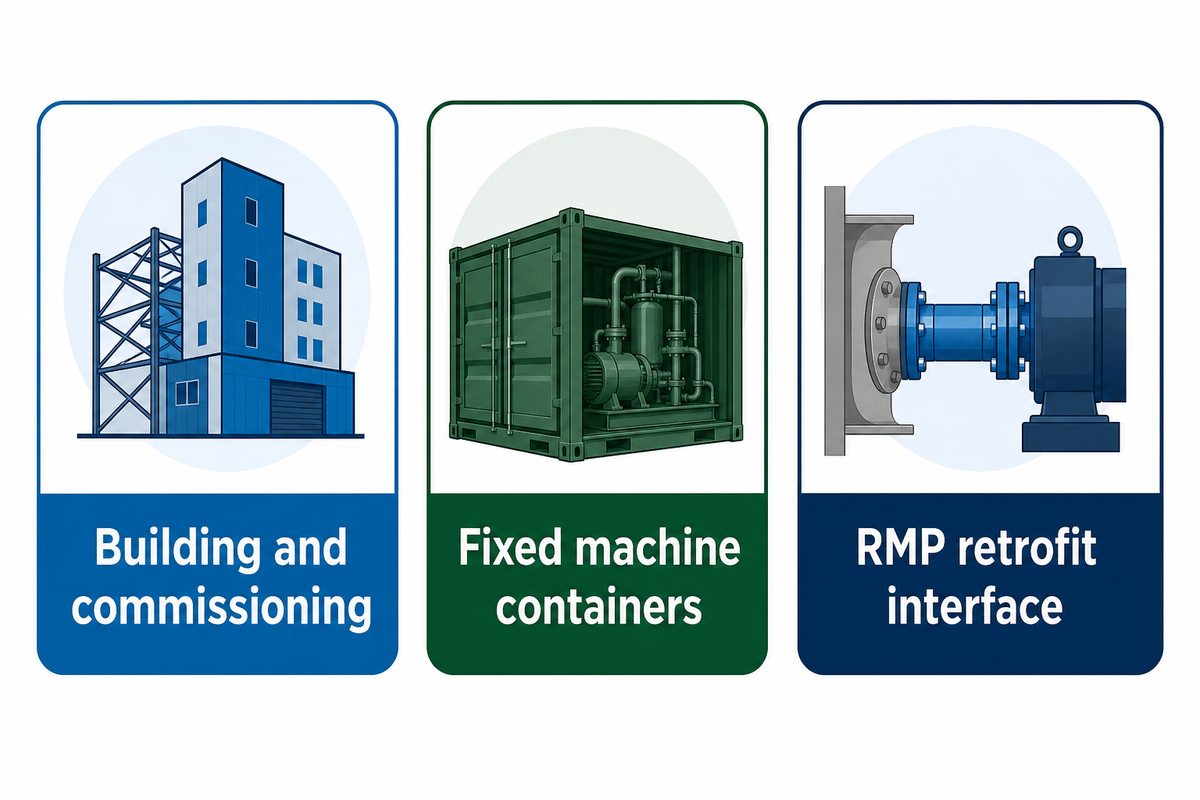
Beyond a pellet press, specialty regional plant builders and engineers can provide other integrated solutions. Their process families and named installations help narrow the shortlist when the project centres on premix integration, grain processing or a particular delivery boundary.
13. Fragola S.p.A.: Best for feed mills combining pelleted feed and premix production
Headquarters / operating base: Assisi, Perugia, Italy · Founded: 1961 · Type: feed machinery manufacturer and turnkey plant builder
Official website: https://www.fragolaspa.com/en/
Main products: reception, storage, micro-dosing, hammer mills, mixers, conditioning, pelleting, cooling and coating.
Capabilities: Public references include 40 t/h feed plus 10 t/h premix, and 15 t/h meal with 10–12 t/h pellets.
Quality / qualifications: According to its website: ISO 9001, ISO 14001, ISO 45001:2018, ISO 50001 and UNI EN 1090, with separate management and manufacturing scopes.
Fragola’s public projects show why a feed plant should be described stage by stage. One reference combines 40 t/h feed production with 10 t/h premix production, while another distinguishes 15 t/h meal from 10–12 t/h pellets. The company also makes the equipment between reception, micro-ingredient dosing and coating, so the comparison can cover the complete feed stream alongside premix handling. Meal, pelleting and premix capacities in one project must be sized separately rather than summed into press output. For the cited 15 t/h meal mill, pelleting is listed at 10–12 t/h; a buyer needing 15 t/h of pellets needs a larger pelleting section.
14. Alapala Feed Tech: Best for grain processors adding feed and bran-pelleting plants
Headquarters / operating base: İstanbul, Türkiye (head office); Çorum factory · Founded: 1954 · Type: machinery manufacturer and turnkey feed-plant engineer
Official website: https://www.alapala.com/
Main products: KPPM pellet mills, TCDA hammer mills, YYKA mixers, YKPS coolers, crumblers and dosing equipment.
Capabilities: Official turnkey feed mills list 2 TPH to 60 TPH, including steel buildings and silos.
Notable work, according to the company’s website: DESMÜD announced the Agro Universal feed facility opening in Gori, Georgia, on 15 October 2026.
Alapala Feed Tech is a practical candidate for a grain processor moving into feed or adding a bran-pelleting business. Its official offer covers 2 TPH to 60 TPH turnkey feed mills with steel buildings and silos, and a signed technical article describes 2–15 t/h bran plants using KPPM pellet mills with MCC and automation. DESMÜD’s October 2026 announcement of Agro Universal’s Gori facility supplies a current feed-project example. Its 2–15 t/h bran-pelleting package starts at bran silos; a complete compound-feed mill requires the wider intake and batching scope.
15. Rosal-Mabrik: Best for turnkey plants with group-made pelleting sections
Headquarters / operating base: Santa Perpetua de Mogoda, Barcelona, Spain · Founded: 1956 Talleres Rosal roots; Mabrik formed in 1973 · Type: feed plant engineering and machinery manufacturing group
Official website: https://rosal-feedmills.com/en/
Main products: Mabrik pellet mills, hammer mills, mixers, hygienisers, coolers, coaters and crumblers.
Capabilities: Feed-plant engineering, manufacture, assembly and after-sales service; portfolio quotes projects from 10–400 t/h.
Rosal-Mabrik combines plant engineering with a dedicated pellet-equipment company. Rosal handles turnkey feed plants, Mabrik supplies pelletising machinery, and 7RM carries out assembly and maintenance, so the group’s offer can connect the press section with a wider factory project. Its equipment portfolio includes conditioners, hygienisers, coolers and coaters as well as mills, which suits a plant considering changes downstream of the mixer. Plant engineering, pellet-press manufacture and local assembly sit with different group companies.
16. Yemmak: Best for large poultry-feed plants and multi-process turnkey projects
Headquarters / operating base: Bandırma, Türkiye · Founded: 1965 · Type: feed machinery manufacturer and turnkey process engineer
Official website: https://www.yemmak.com/
Main products: pellet mills, grinders, mixers, extrusion, coating, cooling and flaking equipment.
Capabilities: Machine manufacture, process engineering, automation, modernisation and plant assembly.
Quality / qualifications: Its quality policy names ISO 9001:2015 and links quality-certificate images.
Yemmak connects machinery manufacture with process engineering, automation and turnkey plant assembly. The Şenpiliç reference on its company page describes a 240 t/h feed mill, and its wider offer spans poultry, ruminant and aquatic feeds alongside other processing industries. That combination is relevant to medium and large scale projects where the owner wants engineering solutions across several production duties and an established plant-delivery organisation. The 240 t/h Şenpiliç reference is a factory project, not a single pellet mill capacity. The Şenpiliç reference occupies about 30,000 m², a different site commitment from a compact packaged line.
17. Yemtar: Best for turnkey feed mills combining pelleting, intake and storage
Headquarters / operating base: Bandırma, Türkiye · Founded: 1980 · Type: feed machinery manufacturer and turnkey factory builder
Official website: https://www.yemtar.com/en/
Main products: Smart-Mill container plant, UPH, Pelpeak, belt/gear pellet mills, mixers, silos and coolers.
Capabilities: Feed factories plus cleaning, grinding, mixing, pelletising, bagging and bulk-loading systems.
Notable work, according to the company’s website: The current catalog names both the Smart-Mill container plant and distinct belt/gear pelleting systems.
Yemtar publishes both complete factories and named process equipment, including the Smart-Mill container plant, UPH and Pelpeak systems. Its current range extends through raw-material intake, cleaning, grinding, mixing, pelletising, cooling and bagging, with storage and bulk loading alongside those stages. This gives an integrated project buyer a wider comparison than a press-only offer, while the container concept provides a separate layout option. Belt-driven and gear-driven presses are separate equipment choices; neither alone defines the Smart-Mill container package. Yemtar states that Smart-Mill machine containers cannot be changed to accommodate other machines.
18. STOLZ (Desmet): Best for feed mills with coordinated bulk handling and process equipment
Headquarters / operating base: Wailly Beaucamp, France · Founded: 1952 · Type: feed-process machinery manufacturer within Desmet
Official website: https://www.desmet.com/en/about-us/about-stolz
Main products: hammer mills, ABMS feeder, SAGA screen exchange, mixers, pellet mills, conditioners and filters.
Capabilities: Design and manufacture from individual process equipment to complete feed mills.
Notable work, according to the company’s website: SAGA automates hammer-mill screen exchange; ABMS distributes feed and removes waste ahead of grinding.
STOLZ links the movement of bulk ingredients to the equipment that processes them. Its portfolio includes the ABMS feeder and SAGA automatic hammer-mill screen exchange as well as mixing, conditioning, pelletising and dust extraction, with engineering and automation services around the machines. A mill handling several ingredients can compare those upstream interfaces alongside the pressing section instead of treating conveying as an afterthought. Bulk-conveying throughput is a different duty from pellet-production capacity. SAGA is adapted to STOLZ RMP hammermills, making the RMP interface a specific constraint for a retrofit.
19. IMAS / Viteral: Best for feed-plant projects including steel buildings and central automation
Headquarters / operating base: Konya, Türkiye · Founded: 1989 · Type: machinery manufacturer and turnkey feed-plant engineer
Official website: https://www.viteral.com.tr/
Main products: VPP pellet presses, VMX paddle mixers, VHM hammer mills and complete Viteral feed plants.
Capabilities: Nurym Group project: 20 t/h feed mill, process equipment, building, installation and commissioning.
Notable work, according to the company’s website and World Grain: World Grain reports a 20 t/h Nurym Group turnkey feed mill in Kazakhstan with intake-to-25 kg-bag scope.
IMAS supplies feed plants through its Viteral brand and has a named project covering the building as well as the production process. World Grain’s June 2025 Nurym Group report describes a 20 t/h Kazakhstan mill with VPP, VMX and VHM equipment, central automation and an intake-to-25 kg-bag process. The same report identifies design, manufacture, installation, commissioning and training, which makes this a concrete whole-project reference. The Nurym reference includes the steel building and site commissioning, a wider purchase scope than an equipment-only package.
20. RICHI Machinery: Best for export feed plants with on-site commissioning and a defined packaging endpoint
Headquarters / operating base: Wuzhi, Jiaozuo, Henan, China (factory); Zhengzhou trade office · Founded: 1995 · Type: pellet machinery manufacturer and turnkey plant supplier
Official website: https://www.richimachinery.com/
Main products: feed pellet mills, hammer mills, mixers, conditioners, coolers, extrusion and packaging systems.
Capabilities: Process design, equipment fabrication, integration, on-site commissioning and finished-product packaging.
Quality / qualifications: Its historical timeline lists ISO, CE, BV, SGS and CCPIT claims under 2010.
RICHI’s current company offer defines a project endpoint at finished-product packaging and includes process design, equipment fabrication and system integration. Its historical project list records a 15tph feed line in Uzbekistan in 2020, while the service description includes overseas installation guidance, commissioning and operator training. That combination suits an export buyer comparing a feed pellet plant with a coordinated delivery and start-up service rather than buying disconnected animal feed processing machines. Overseas installation guidance and commissioning require a site-specific service plan.
8 Feed-Line Purchase Checks
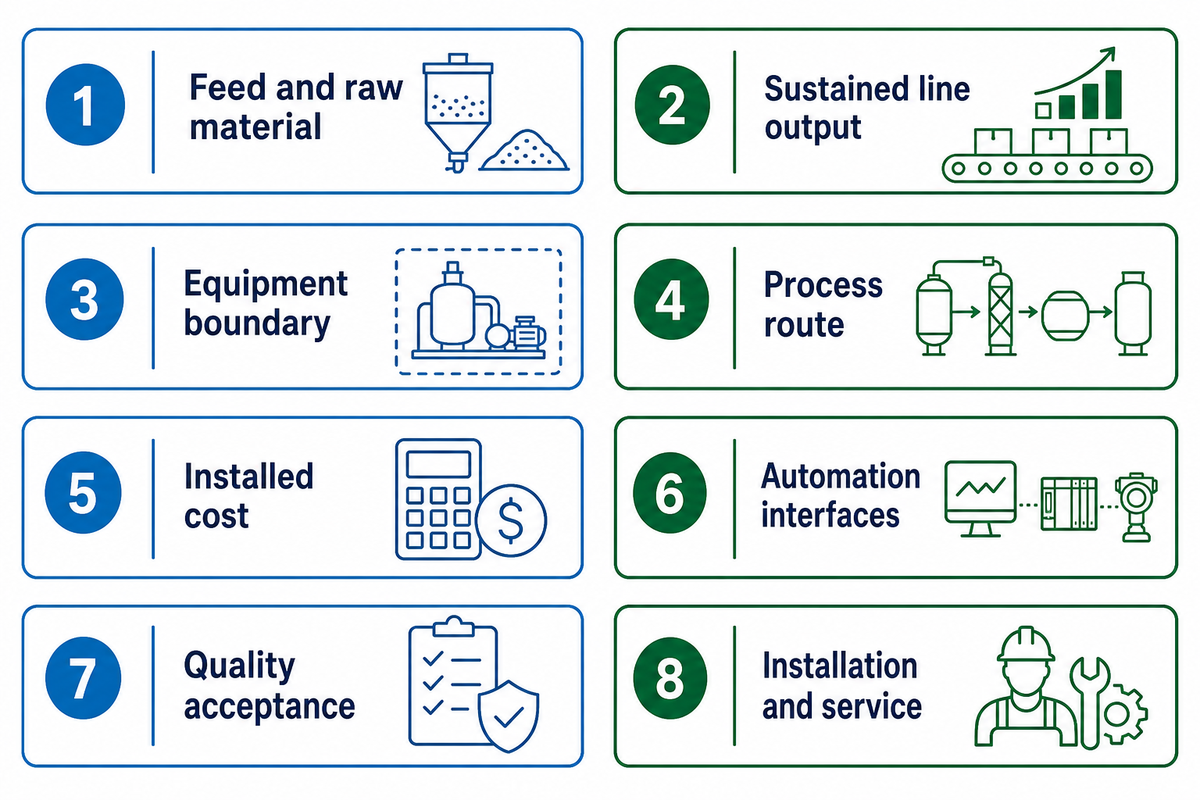
Let’s consider complete feed plant solutions with the same production brief and boundary of supply. About eight aspects can convert the supplier list into a purchase decision: the feed recipe, sustained output, equipment, the process route and its integrations, utilities, automation, quality and service. Any or all of these aspects can remove a source of mismatch between a quotation and an operating mill.
Define the feed and the raw material
Let’s begin with the raw materials and finished product. A poultry feed pellet recipe may require different grinding and conditioning as compared to a cattle pellet feed recipe. Determine your required pellet quality, and say whether your plant makes one recipe or several types of animal feed. State your expected pellet size and any crumbles. A supplier designing animal feed pellet making equipment needs that brief before selecting the press, mixer and downstream machines.
Compare sustained line output on the same basis
Ask for the production rate of acceptable finished feed after the agreed cooler and screen. Keep startup material and returned fines separate from packed output. Fragola’s published meal-versus-pellet figures and Ottevanger’s multi-line references show why a factory capacity and a press rating answer different questions. To make feed pellets efficiently, the upstream batch cycle and downstream handling must keep pace with the pressing section; a larger motor alone doesn’t balance the process.
Write down the equipment boundary
Mention receiving, storage, grinding, dosing, mixing and conditioning equipment, presses, cooling, screening and dispatch equipment. Mark optional crumbling or coating separately. A feed making machine is one item in that sequence, while a complete feed mill requires the connections and control logic between items. The difference matters especially when a small feed pellet operation grows into industrial production: conveyors, buffers and finished-product handling can change with the production needs.
Select the process before selecting the brand
Pick compressed pellets for defined livestock duties or opt for an extrusion route when the aquafeed requirements call for control on density and behavior with water. The Food and Agriculture Organization separates pellet durability checks from extrusion shape and density checks in its processing guidance. A biomass pellet or wood pellet system can share a manufacturer with feed machinery, but feed-contact arrangements and recipe handling need their own configuration. “Pellet production” is a broad machinery category and not one process that’s interchangeable.
Separate equipment price from installed cost
Compare freight, duties, foundations, buildings, electrical distribution and utilities with the equipment price. Identify the steam system, compressed air and extraction work that falls to the owner or a local contractor. IMAS’s Nurym reference includes the building, while a compact package can describe a much smaller delivery boundary. An animal feed pellet production project needs both process equipment and a functioning site; an FOB machinery price covers only its stated supply scope.
Define the automation and integration work
Ask who connects the controls and what level of automation is provided. Machine control, batch management and manufacturing execution perform different jobs: a touch panel on one press does not provide factory-wide recipe management. Advanced automation is useful only if its interfaces match the plant’s operating routine. A brownfield feed mill may keep the existing dosing or packing equipment; therefore, the responsibility for interlocks, operator displays, signaling and alarm systems must be evident in the proposal and commissioning plan.
Match quality acceptance and certificates to the purchase
Use a written acceptance plan covering formula, particle size, conditioning conditions, pellet durability and sampling position. Kansas State University’s quality-feed resources provide pelleting records, mixer-uniformity and scale-verification forms that help structure those measurements. Check the named entity, site, scope and validity of any certificate. ISO 9001 describes a management system; a component document applies to its stated equipment. Define product quality and performance separately from corporate qualifications.
Plan installation, wear parts and service
First confirm the site team and operator training schedule and after-sales route before committing to delivery dates. Wear-part durability and performance belong in the maintenance discussion. The discussion includes dies, rollers, critical spares, practical route for remote or on-site service and support. A high-performance press still needs a maintainable line around it. Ask how recipe changeovers and cleanout affect the daily schedule, and who owns the final installation and commissioning work when different suppliers provide parts of the plant.
These checks also separate a feed pellet machine manufacturer from the organisation responsible for the complete project. A single animal feed recipe may fit a standard package; several recipes and product forms can require a more coordinated control and handling design. Small to large projects benefit from the same first decision: define what must leave the packing point, then match the process and delivery scope to that job.
Frequently Asked Questions
Which manufacturers are best for a complete industrial feed plant?
ANDRITZ, Van Aarsen and Ottevanger suit different complete-plant briefs.
ANDRITZ is a useful comparison for key equipment plus turnkey engineering and its 10 TPH modular concept. Van Aarsen suits a custom feed-mill layout with coordinated process engineering, while Ottevanger covers containerised and larger industrial projects. IMAS/Viteral adds a documented building-inclusive route. The best shortlist follows the feed process and delivery scope; corporate size alone doesn’t choose the right system for a particular plant.
Can one feed pellet machine make both cattle and poultry feed?
Yes, with a machine and configuration suited to both recipes.
Feed pellet machines can cover more than one livestock application, but the formulation and finished feed quality still guide the setup. Grinding, die selection and conditioning may change between cattle and poultry duties. Cooling and crumbling also affect the final product. A multi-recipe plant needs a changeover and cleanout plan alongside the press selection, so a poultry catalog rating shouldn’t become an automatic cattle-output promise.
How much does a complete feed pellet production line cost?
TCPEL lists indicative equipment packages from US$11,200 to US$185,000 FOB Qingdao.
That October 2026 public range belongs to TCPEL’s listed Mini through Large equipment packages, rather than every supplier or a fully installed factory. Its page lists Mini at US$11,200–15,500 and Large at US$95,000–185,000. Freight and site work belong in a separate installed-cost comparison. Custom industrial mills need a project-specific equipment and engineering scope before their prices can be compared with those packages.
Is the largest animal feed producer also a feed-line manufacturer?
Feed production and feed-equipment manufacturing are different business roles.
A feed producer makes the finished product sold to livestock customers. A machinery manufacturer supplies the processing machines or plant. For a factory purchase, shortlist the company with the equipment and engineering offer, then identify its responsibility for the delivered system.
Can a livestock pellet line produce floating fish feed?
A conventional press line needs a different extrusion configuration for floating aquafeed.
Floating fish feed calls for an extrusion route designed around density and water behaviour, with drying and cooling matched to that product. The Food and Agriculture Organization distinguishes extrusion checks from ordinary pelleting checks, and TCPEL’s feed-line page describes separate floating and sinking architectures. Some preparation equipment can be shared in a planned facility, but the press section can’t simply acquire an extruder’s job by changing the die. Suppliers such as ANDRITZ and FAMSUN publish both process families, which lets a buyer compare the appropriate configuration within a wider equipment portfolio. The product brief should specify the required floating or sinking behaviour.
Should I buy a complete line or replace only the pellet mill?
Buy a line for a new process; replace a mill inside a balanced existing plant.
Choose a complete package when preparation, mixing and downstream handling also need to be built or redesigned. Replace the animal feed pellet making machine when the surrounding equipment can already support the required output and product. A replacement still needs compatible connections and control interfaces.
Conclusion
The best supplier for a feed project is the one whose machinery and engineering match its process and delivery boundary. A compact package from TCPEL or ABC Machinery serves a different purchase from a custom industrial mill, while Alapala and IMAS/Viteral add documented grain-linked or building-inclusive options. The comparison becomes useful when the same feed recipe, finished-output target and equipment scope reach every bidder.
Key takeaway
Compare complete animal feed pellet production lines by matched process stages and delivery responsibility. Keep a press rating, a pelleting-train rating and a multi-line factory capacity in their own scopes.
TCPEL supplies compact-line equipment for preparation, mixing and finishing through cooling and packing. Explore our feed pellet plant configurations, then send the feed recipe, intended output and site conditions for a TCPEL project quotation.
Related Articles
References & Sources
- Feed ingredient processing — Food and Agriculture Organization of the United Nations.
- Quality Assurance Guidelines and Resources — Kansas State University.
- Nurym Group feed-mill project report, June 2025 — World Grain.
- Agro Universal Georgia feed-facility opening, October 2026 — Association of Mill and Sector Machinery Manufacturers.
- Alapala Feed Tech’s bran-pelleting scope — signed technical contribution by Ali Cem Dağlı in Feed Planet, July 2023.