Get in Touch with TCPEL

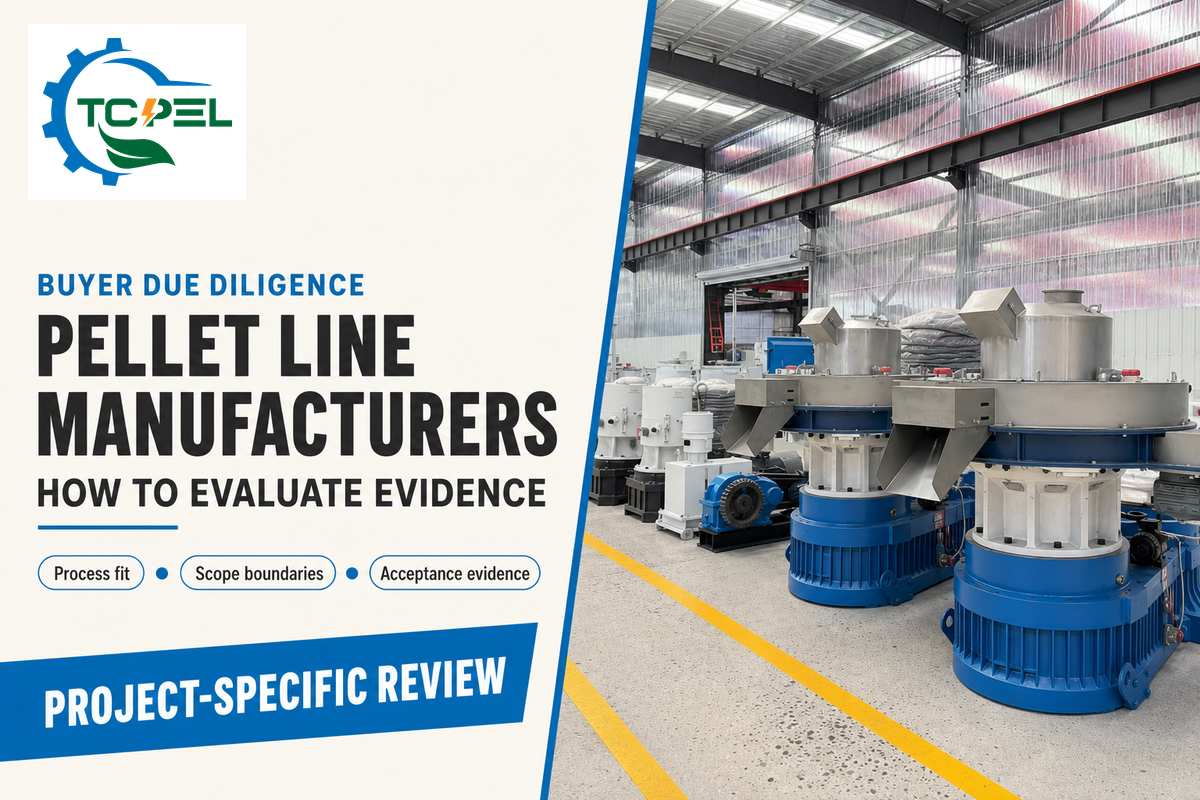
Procurement guide for wood and biomass fuel-pellet projects
A feasible way to appraise scope, feedstock evidence, safety responsibilities, throughput tests, commissioning support, and commercial risk, without depending on a universal supplier ranking.
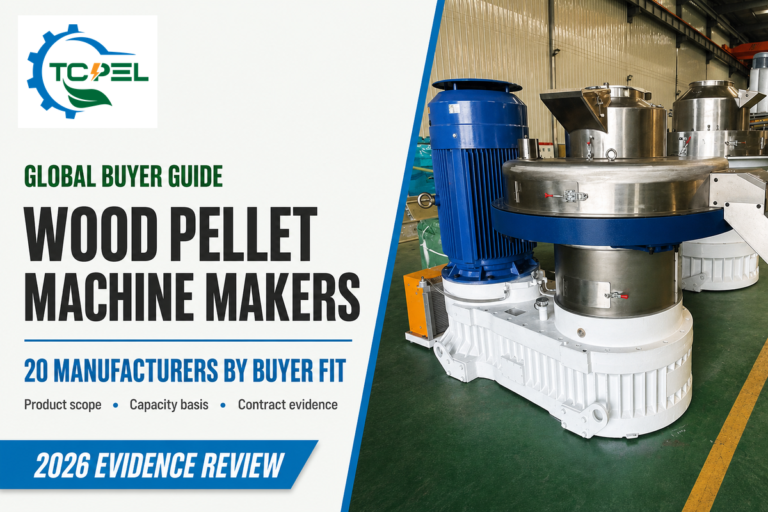
How to evaluate pellet production line manufacturers is a procurement method that tests project fit, scope, evidence, safety, acceptance, and lifecycle support against one frozen project basis. Logos and promotional factory videos won’t do. The best candidate will demonstrate how their line will address your actual feedstock, product specs, operating scenario, safety responsibilities, acceptance tests, and how they’ll provide lifecycle support.
This document covers wood and biomass fuel-pellet lines. It doesn’t cover animal-feed, aquaculture, fertilizer and plastics pelleting, where conditioning, hygiene, product quality and regulation can be materially different. Searches for starting a wood pellet business, pellet mills for sale, or a small pellet making machine belong to a different decision path from evaluating a complete industrial wood pellet production line. It’s assumed your team has performed an initial pelletization go/no-go review. Feedstock supply, the consuming system, utilities, labor, financing, land, permitting, and site economics can make a project unviable even when the equipment supplier is competent.
An evidence pack is best described as uneven. It contains, for example, calculations, drawings, test results, exclusions, and unresolved assumptions. It should allow the prospective client to trace each major commitment to the relevant owner, document, measurement, and remedy. For a wood pellet production project, that means connecting raw biomass preparation to pellet quality, production capacity, energy efficiency, combustion requirements, after-sales service, and maintenance costs. If the proposed biomass pellet mill is only one part of the system, the prime contractor must still show how the complete pellet line will behave at every interface.
1. Confirm the Project Should Reach Supplier Selection
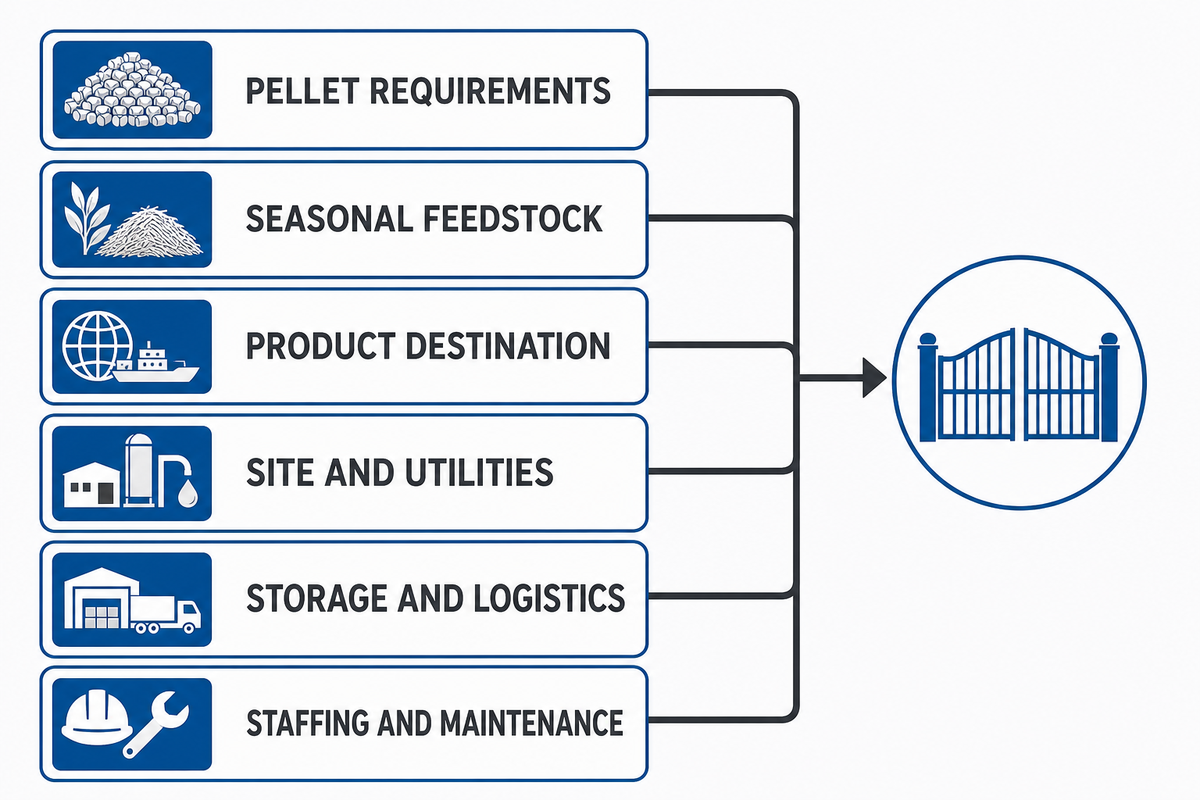
Comparing vendors isn’t the first step in making an investment decision. Before a request for proposal (RFP) is issued, the customer should determine the requirements for pellets, the seasonal availability of feedstock, where the product is to be consumed and sold, whether the site can support drying, the electric and thermal loads, storage, and truck movements, dust, staffing and maintenance, etc. A renewable energy label doesn’t replace the project-specific feasibility work to be performed.
This work is important because an operational, technically sound line can still be the wrong project. Adding pellet production to biomass processing increases preparation, energy use, wear-part replacement, labor, dust-control duties, and product-quality risk. An early feasibility assessment should review the impacts of added pelletization on the system, including the trade-offs of handling and market benefits against increased costs. This assessment should determine operational and permitting limitations outside the normal scope of equipment quotation. In the United States, for example, the Environmental Protection Agency’s New Source Review overview shows that permitting can be a pre-construction constraint for qualifying stationary sources.
Write go/no-go assumptions on one page. If the supplier must create the business case while quoting machinery, proposals will be hard to compare and commercial optimism may influence the technical basis.
Buyer rule: Freeze the project basis before comparing manufacturers; otherwise a low quote may simply reflect missing scope.
2. Start with a Project Performance Envelope
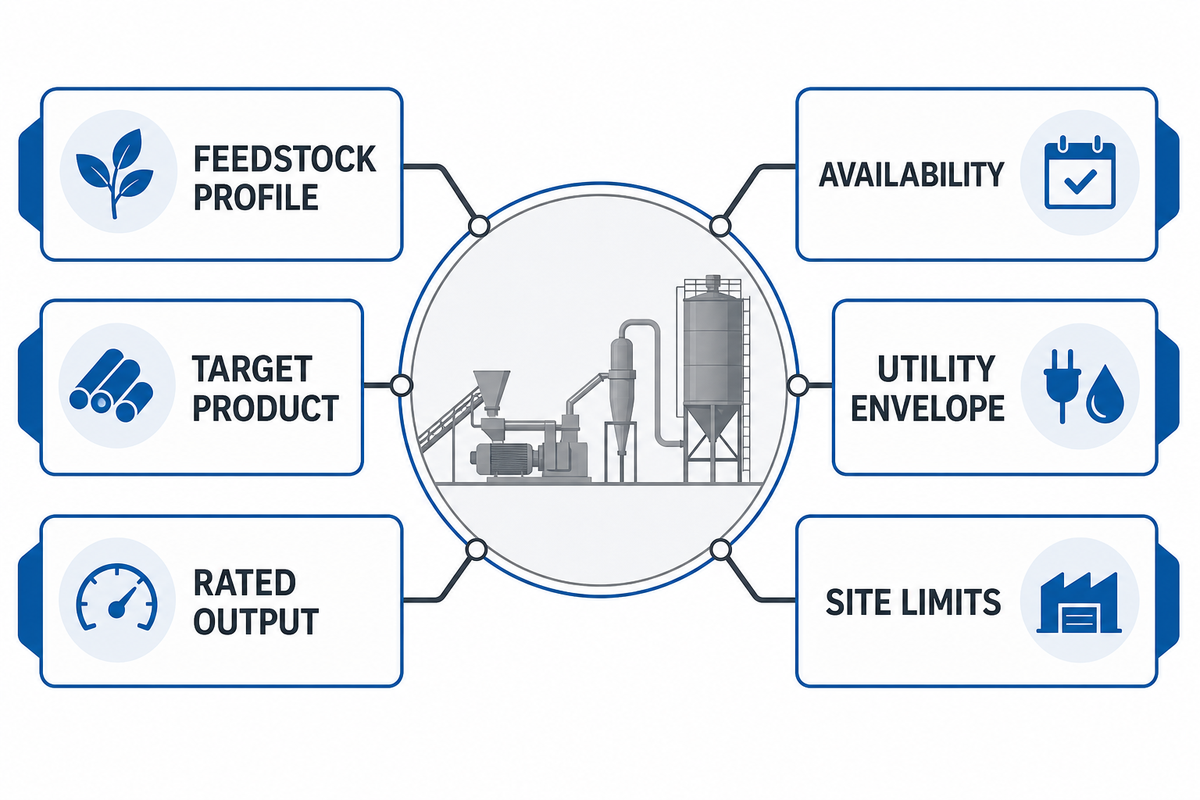
A request for proposal should begin with the conditions under which the bidder must deliver performance. A bid for “a 5 t/h line” provides no information to evaluate the strength of the offer. Don’t ask only for “a 5 t/h line.” State the material, incoming moisture range, particle-size distribution, contamination limits, bulk density where relevant, target pellet diameter, quality class, required operating hours, planned shifts, utility conditions, and the point at which saleable output will be measured.
Independent research confirms this caution. A study conducted by the U.S. Department of Agriculture on high-moisture pelleting found differences in density, durability, and energy results based on the level of moisture in the material, the size of the hammer mill screens, and other factors. Treating a bare machine rating as a whole-line assurance isn’t defensible. The pellet line may be limited by other process equipment such as drying, grinding, conveying, cooling, screening, packing and storage.
Identify the intended class and test methods if the finished product is to be graded as a wood pellet. ISO 17225-2:2021 addresses graded wood pellets, but citing that standard does not certify a manufacturer or cover every biomass application. Specify the class, edition, sampling method, and acceptance criteria in project documentation.
For fuel projects, define whether the output is pellet fuel or wood pellet fuel for a pellet stove, a biomass boiler, or a larger biomass power system. The buyer should specify ash content, pellet durability, pellet density, and any renewable energy or renewable energy source eligibility criteria required by the intended pellet market. These requirements connect production efficiency to the end-use duty.
| Envelope field | Buyer input | Supplier response |
|---|---|---|
| Feedstock | Species, residues, blend limits, contamination | Accepted range and preparation route |
| Moisture | Normal, minimum, maximum, sampling basis | Drying duty, bypass logic, performance effect |
| Product | Diameter, fines, durability, bulk density, class | Guaranteed limits and test methods |
| Output | Saleable tonnes per hour and annual target | Measurement point, availability and exclusions |
| Utilities | Voltage, frequency, fuel, steam, water, air | Connected load, expected demand and quality limits |
3. Make Every Manufacturer Quote the Same Scope Boundary
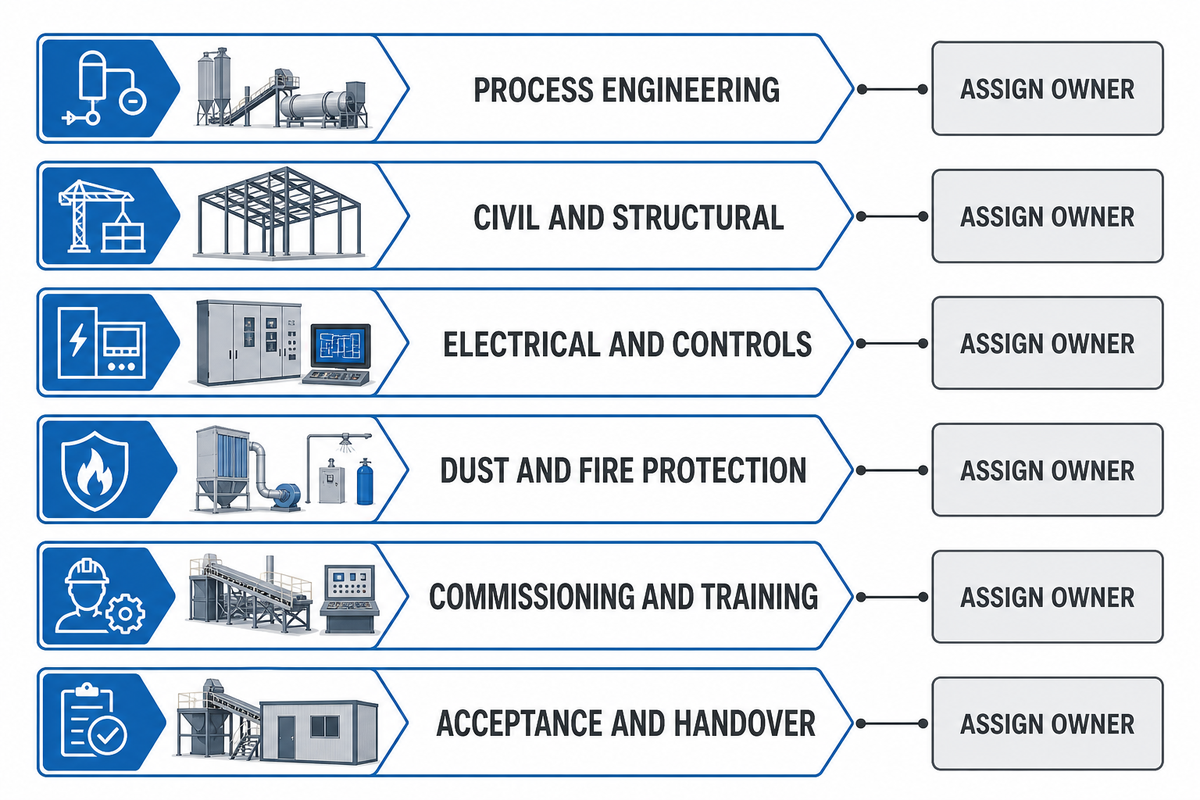
The word turnkey doesn’t standardize a battery limit. One supplier may include receiving, drying, grinding, pelleting, cooling, screening, controls, packing, installation and commissioning. Another may include only the process machines, and leave foundations, buildings, electrical distribution, ducts, fire protection, dust collection, utilities, cranes, permits and field labor to the buyer.
Create a responsibility matrix prior to requesting a price. Include machines, interfaces, services and documents as rows. Include supplier, buyer, local contractor and third party as columns. For each item, mark included, excluded, optional, or by others. This identifies hidden scope before it becomes a change order.
The matrix should address process design, general arrangement, foundations, structural steel, platforms, electrical panels, field wiring, instruments, control logic, historian, remote access, dust collection, fire and explosion protection, erection supervision, commissioning consumables, performance testing, training, manuals, spare parts, freight, unloading, taxes and local approvals. The NIST Manufacturing Extension Partnership blog guide recommends defining capability, schedule, line-item costs, pricing protections, and references. This is useful government-hosted guidance, not primary pellet-industry research. Its fields are useful when a pellet-line package crosses several contractors.
Keep detailed product configurations and request-for-quotation inputs on the dedicated pellet production line page. For an overview of the main stages of the process, use the existing pellet production line guide. This article owns the due-diligence decision, not those broader product and process topics.
Check what “complete pellet line” means in this proposal
A complete pellet production line is a coordinated process, not a synonym for one pellet machine. Depending on the different raw materials, the scope may begin with a debarker or wood chipper for logs and wood chips, or it may begin with receiving and screening for prepared sawdust. Size reduction, drying, magnetic separation, conditioning, the pellet mill, a pellet cooler, fines screening, recycle, storage, and packing must be balanced around the same production capacity.
The press choice also belongs inside the process basis. A ring die pellet machine and a flat die pellet machine are product labels, not evidence that either option suits industrial pellet production; require representative-material evidence for the proposed task. These labels don’t determine the project on their own. Die geometry, compression ratio, feed distribution, conditioning, motor duty, gearbox design, service life, and machine stability under representative material all need evidence. A biomass pellet machine offered for fuel should not inherit assumptions from an animal feed pellet mill or feed pellet machine simply because both use densification.
Terminology check: A pellet mill machine or pellet press is only the densification stage in the pellet production process. When comparing a pellet mill manufacturer with a full-line integrator, separate pellet machine manufacturing from complete pellet manufacturing. This helps the buyer choose the right supplier, define the right pellet line, and compare the cost of investment on the same scope.
The machine manufacturer should be asked to identify the bottleneck for normal, dry, wet, and contaminated cases. The answer should name the governing equipment and explain whether automation reduces the line rate, diverts material, or stops production when moisture, motor load, temperature, or downstream capacity crosses a limit. This is more beneficial than statements about production rate improvement found in brochures.
4. Verify Feedstock Trials and Process Design
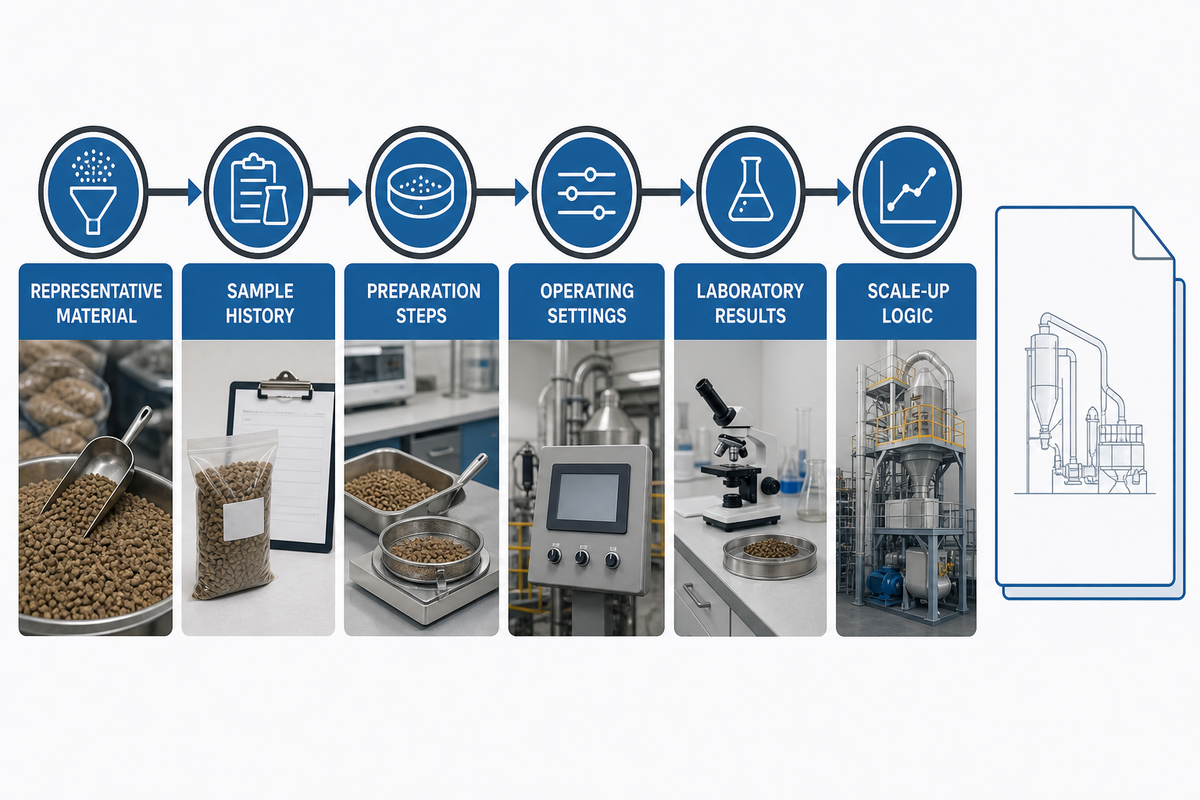
A trial is valuable only if it resembles the future plant. Sending a clean, dry sample, while the commercial feedstock arrives wet, variable, bark-heavy, sandy or mixed, can produce reassuring but irrelevant results. Record sample origin, storage history, moisture distribution, particle size, ash, contaminants, additives, and preparation steps. Also record die specification, operating settings, run duration, observations, and laboratory results.
Raw materials such as wood residues or rice husk can require different preparation and pelletizing parameters. Feedstock names alone do not establish what die settings are required, how the stability of machine operation will be affected, whether a compression ratio must change, or how production efficiency, die life, quality, and cost will respond. Because untested assumptions can increase the cost, a buyer selecting the right pellet manufacturer should require a representative-material test before accepting claims about those outcomes.
How does the supplier convert trial data to the proposed flowsheet? Which data determine the size of the dryer, hammer mill, conditioner, press, cooler, screen, recycle loop, and dust system? What’s the biggest uncertainty in the assumption? What happens if feedstock moves out of the normal range? Suppliers should explain the expected consequence of each control action for output, energy use, wear, and pellet quality.
In this case, a small pilot trial wouldn’t automatically be safer evidence than a commercial reference. The BioResources review on pellet cost and quality optimization states that trials should correlate with full-scale production. Obtain the scale-up rationale in writing. Acceptance tests should use representative material, not the sample that makes the press easiest to run.
5. Check Manufacturing Depth and Document Control
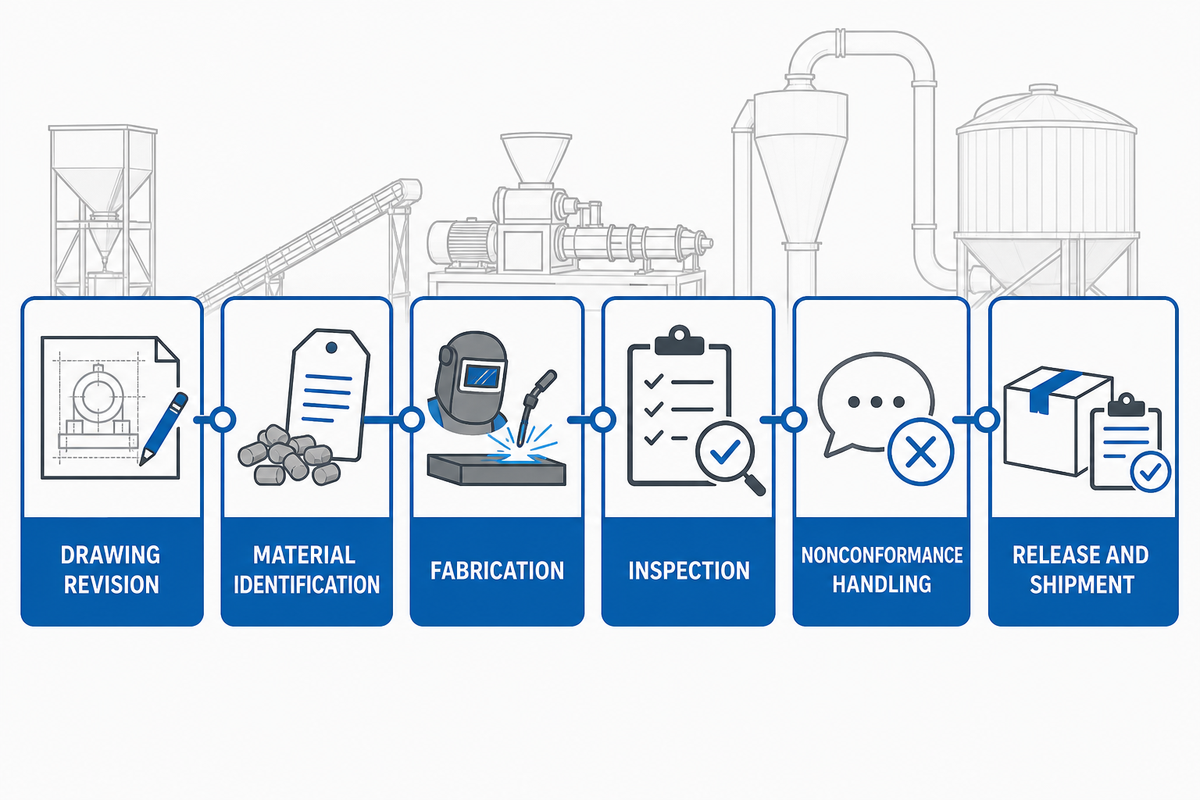
A factory visit shouldn’t just produce photographs, but respond to questions. Select a small number of traceable items and follow them from drawing revision through material identification, fabrication, inspection, nonconformance handling, release, packing, and shipment. Check the consistency of tag numbers for BOM, control panel drawings, instrument list, software backups, manuals, and spare parts list.
Do not assume maximum in-house production is preferred or best. For controlled outsourcing, evaluate whether the prime supplier documents approved providers, frozen specifications, incoming verification, performance monitoring, and clear warranty ownership. The bigger problem is an interface with no accountable owner. Which critical components does the service provider design and manufacture, which does it assemble, code, and test, which are sourced, and who closes a defect after delivery?
Review welding, machining, balancing, electrical assembly, inspection, and software records pertinent to the proposed line. If remote support is included, describe account ownership, buyer approval, access logging, backups, the horizon of supported software, the boundary of the network, and offboarding. Remote access that suits the vendor but remains opaque to the operator creates a lifecycle liability.
| Audit trail | Evidence to sample | Risk exposed |
|---|---|---|
| Design control | Approved drawing and revision history | Shop builds from an obsolete design |
| Material traceability | Certificate linked to a selected critical part | Unverified material substitution |
| Fabrication | Qualified procedure, operator record, inspection result | Inconsistent weld or assembly quality |
| Rotating equipment | Runout, balance, bearing, lubrication and test record | Vibration, heat and shortened service life |
| Electrical panel | Device list, wiring check, protection settings | Wrong rating or incomplete field interface |
| Control software | Version, backup, alarm list and access roles | Unrecoverable or unsupported automation |
| Purchased items | Approved supplier, specification and incoming check | Outsourced interface without control |
| Nonconformance | One closed report with concession authority | Defect hidden instead of resolved |
| Packing and shipment | Preservation, marks, lifting points and packing list | Damage, lost parts or unsafe unloading |
| Final data book | As-built drawings, certificates, tests and manuals | Plant cannot be maintained or modified safely |
6. Assign Safety and Compliance Responsibility
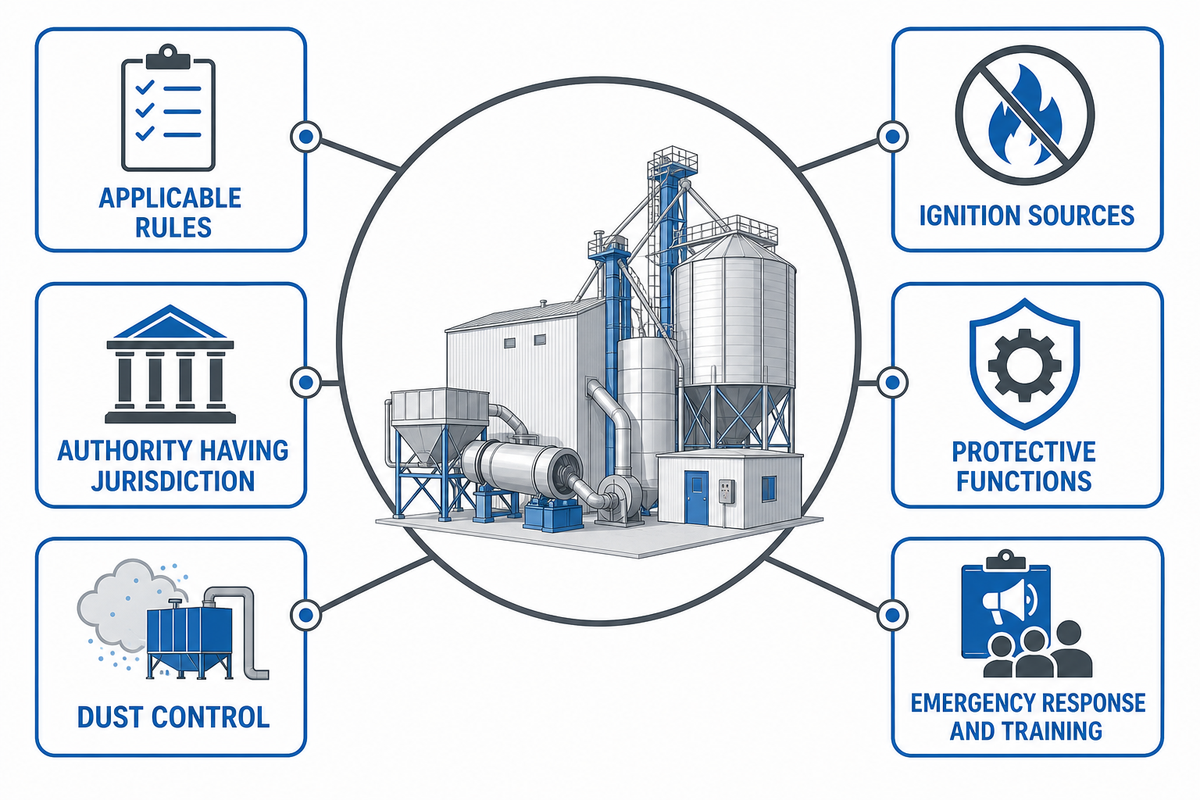
Wood dust can create fire and explosion hazards in grinding, drying, conveying, collecting, cooling, screening, and storage. OSHA’s combustible-dust guidance explains that fine particles suspended in air can present an explosion hazard and that hazard evaluation must consider explosibility. The agency’s 2024 Hazard Communication Standard final rule, effective July 19, 2024, added a definition of combustible dust and updated hazard-statement options. OSHA’s technical material also warns that moisture isn’t always an effective safeguard because settled material can dry.
Don’t ask for a generic compliance statement; ask for a project-specific hazard review. Identify the codes, regulations, standards, and other rules that apply. Identify the authority having jurisdiction. Identify the dust control and ignition sources and the means of isolation, venting, or suppression. Are interlocks provided? What’s the housekeeping procedure? What’s the plan for emergency response and training of personnel? During commissioning, require tests that establish whether protective functions operate as intended.
Contract terms may allocate deliverables, but they don’t eliminate the site-specific obligations of the employer. An OSHA machinery-guarding interpretation illustrates the point above. Conformity with another standard doesn’t by itself assure compliance with the Occupational Safety and Health Act. Hire qualified local safety and permitting professionals. A machine vendor declaration doesn’t constitute site approval.
7. Turn Throughput into an Acceptance Test
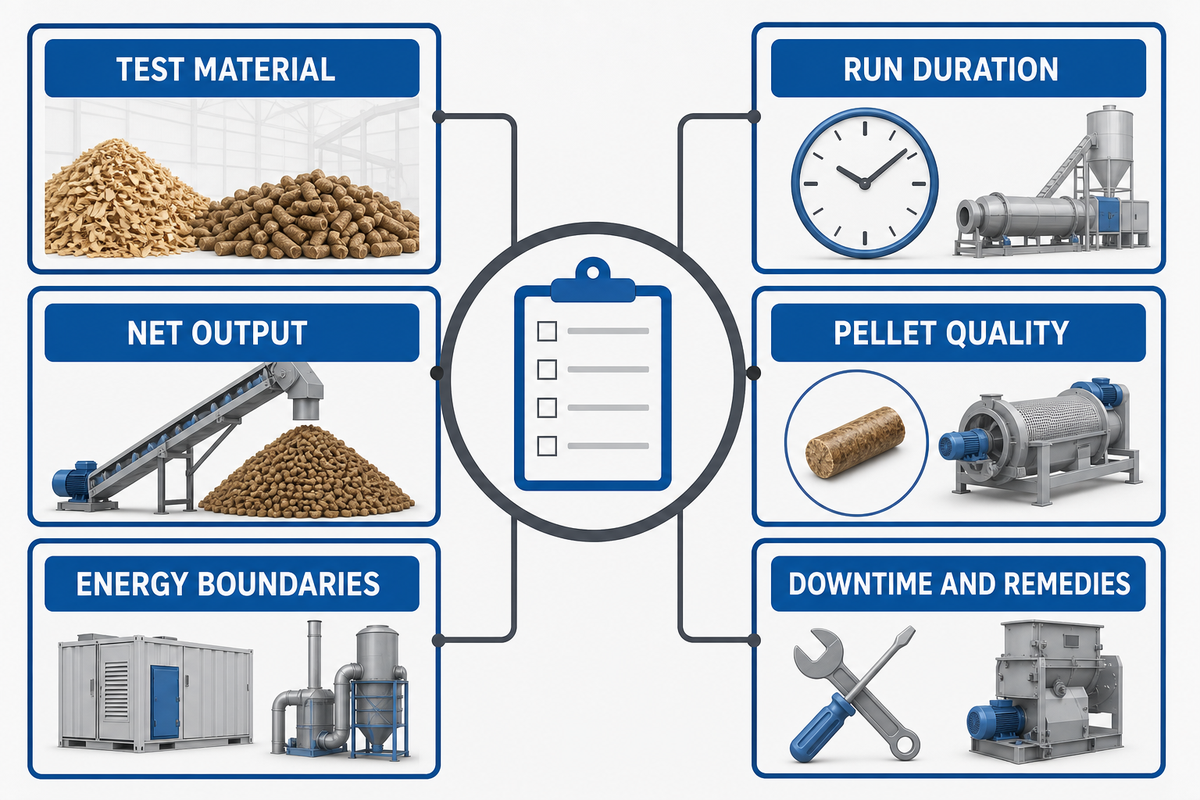
A guarantee is useful only when two independent teams can apply the same procedure and reach the same result. Define the test material and allowable variation, measurement instruments, calibration, and operator roles. Have samples been pre-conditioned? What’s the steady-state period? How long is the test? What’s planned and unplanned downtime? What’s the utility condition? How often are samples taken? What tests are done on product? How is recycle treated? When does saleable product leave the facility?
Separate three numbers: Instantaneous press output, sustained line output during the test, and annualized production at the agreed-upon availability. Do not multiply a short best-case rate by 8,760 hours and call it annual capacity. State how startup, die changes, cleaning, blockages, scheduled maintenance, downstream stops, and off-spec material affect the calculation.
Minimum acceptance-test record
- What’s the identity of the material? What’s the distribution of moisture? What’s the particle size? What’s the level of contamination? Who’s in custody of the sample?
- Line configuration, active equipment, software version, setpoints, die, and consumables
- Start and Stop Times, Operating Window, Interruptions
- Calibrated mass-flow, energy, temperature, pressure, and moisture measurements
- Saleable output plus fines, rejects, recycle, and product-quality results
- Acceptance rule, retest rule, correction deadline, and commercial remedy
Patent pages raise questions without performance validation. The pellet-mill roll-temperature sensing patent publication, for example, asks why monitoring may be important, but doesn’t prove that a bidder supplies, owns, or verifies the feature. Verify the installed functionality, test it and include it in the control sequence.
8. Compare Commissioning, Training, and Spares
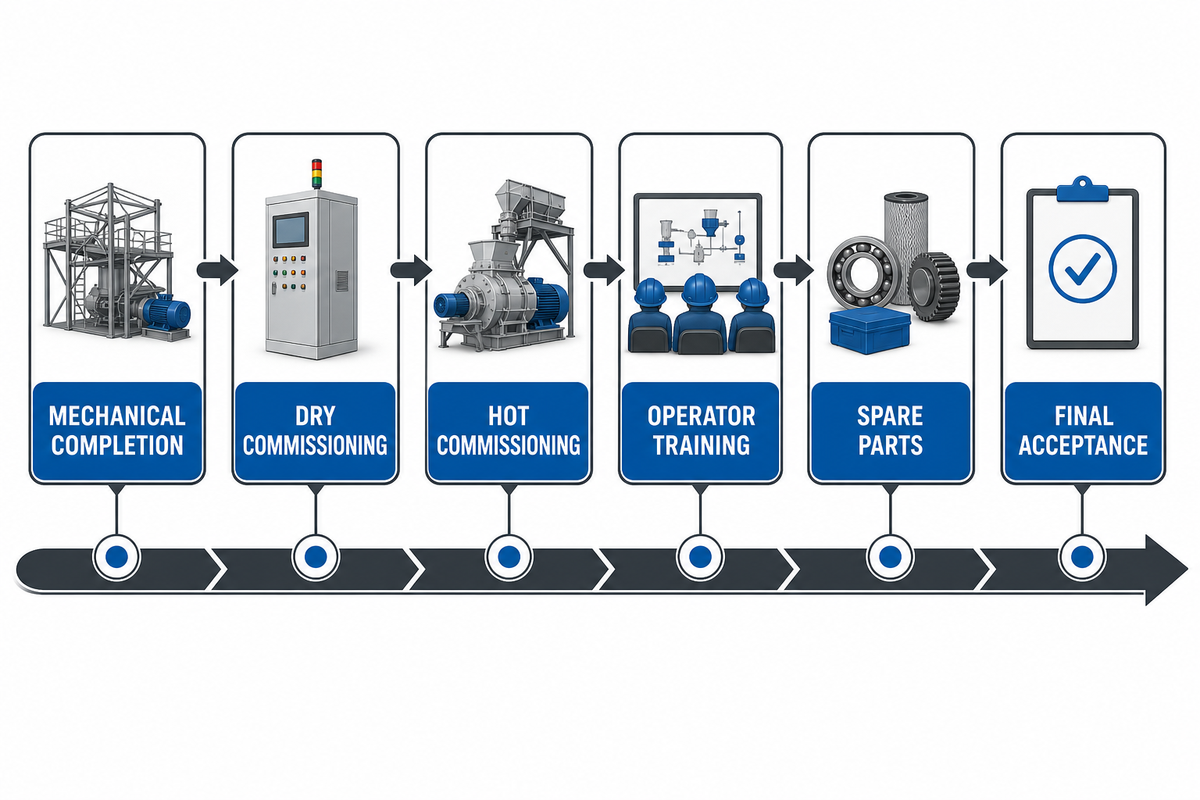
Equipment delivery is a milestone, not a running plant. Define mechanical completion, electrical checks, dry commissioning, hot commissioning, feedstock ramp up, performance testing, closing of the punch list, provisional acceptance, final acceptance, and handover. For each of these, identify who provides the labor, instruments, utilities, raw material, consumables, accommodation, lifting equipment, and translations.
According to a signed Biomass Magazine article on preventing pellet plant failures, commissioning is the meeting point of the assumptions made during design and construction with the realities of operation. That’s why operator training should cover abnormal conditions, as well as maintenance tasks. Will the supplier train operators on every shift to handle abnormal conditions and maintenance tasks? Will their competence be verified? Will editable checklists be left behind?
Spare parts should be provided based on lead time and consequence, rather than a general kit. Separate commissioning spares, two-year operating spares, wear parts, insurance spares, and ordinary consumables. Record part numbers, recommended quantities, shelf life, storage conditions, interchangeability, supply lead time, and the drawings needed for local manufacture where contractually permitted.
9. Normalize Price, Terms, and Exclusions
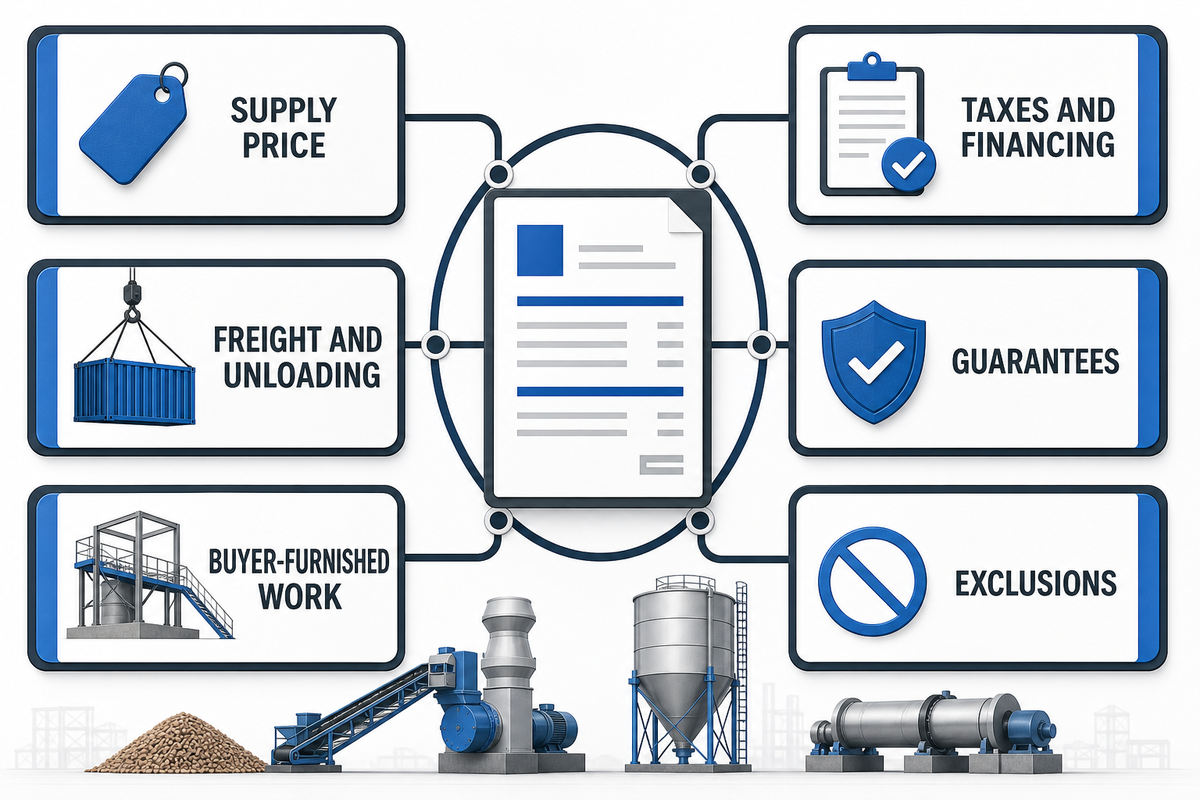
Compare complete, commissionable, test-ready scopes against equipment lists. Convert every bid to the same currency date, delivery basis, named place, freight assumption, insurance, taxes, unloading, installation labor, travel, utilities, civil works, controls, safety systems, commissioning, training, spares, documentation, warranty, and performance-test obligations.
The U.S. International Trade Administration’s pro forma invoice guidance shows some fields that are useful in specifying an offer, such as unit prices, dimensions, discounts, delivery point, terms of payment, estimated shipping date and validity.
Then you need to make two decisions, not one. The first decision is to determine whether the prices quoted are comparable. Second, decide whether the technical and execution risk is acceptable. Even the lowest normalized bid can be the wrong selection if it has weak process evidence, unclear interfaces, fragile controls, unverified safety deliverables, poor references, or no credible commissioning plan.
No reviewed source supports a universal pellet-line price or delivery lead time. Both depend on scope, material, output, destination, supply chain, local work, and the timing of the contract award. Energy consumption and maintenance costs also depend on the feed stock, drying duty, pelletizing process, line balance, operating schedule, and local energy price. Regard public price and delivery schedule examples as discovery prompts, not as commitments.
10. Use the 7-Rung Pellet Line Decision Framework
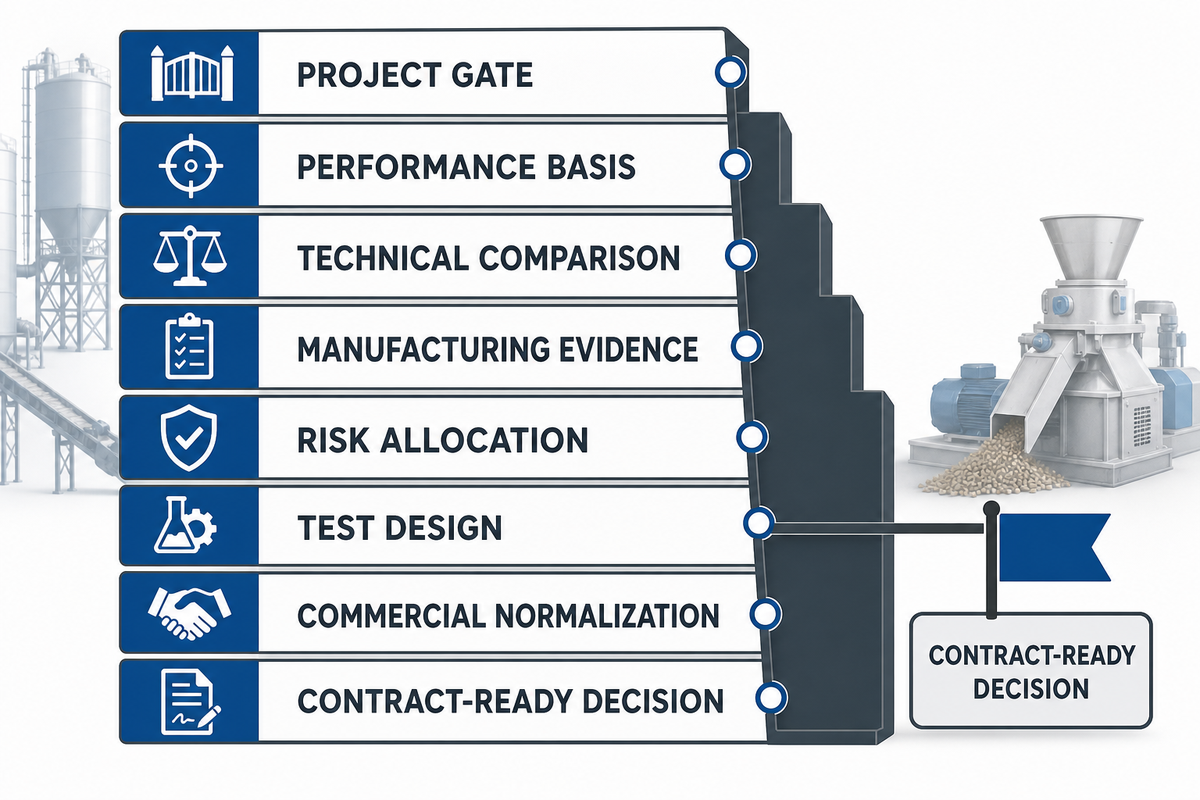
The 7-Rung Pellet Line Decision Framework, also called the Pellet Line Due-Diligence Ladder, keeps the team from jumping from a brochure to a purchase order. Suppliers advance only when the evidence at the current rung is complete.
- Project gate: confirm application, feedstock supply, market or consuming system, utilities, site economics, permits, financing, and owner capability.
- Comparable brief: issue one performance envelope and one battery-limit matrix to every candidate.
- Evidence screen: review relevant references, process calculations, feedstock trials, manufacturing controls, and key subcontractors.
- Risk allocation: assign safety, permitting interfaces, controls access, installation, commissioning, training, documentation, warranty, and spares.
- Test design: representative material, instruments, duration, product criteria, downtime treatment, retests, and remedies.
- Commercial normalization: align price basis, delivery terms, exclusions, payments, schedule, guarantees, and total buyer-supplied work.
- Contract-ready decision: select on demonstrated fit and manageable residual risk, not on web visibility or headline price.
The ladder doesn’t guarantee a universal winner. It gives a defensible decision for one project. It is a defensible decision framework for this type of capital-equipment purchase.
Frequently Asked Questions
What documents should I request from a pellet production line manufacturer?
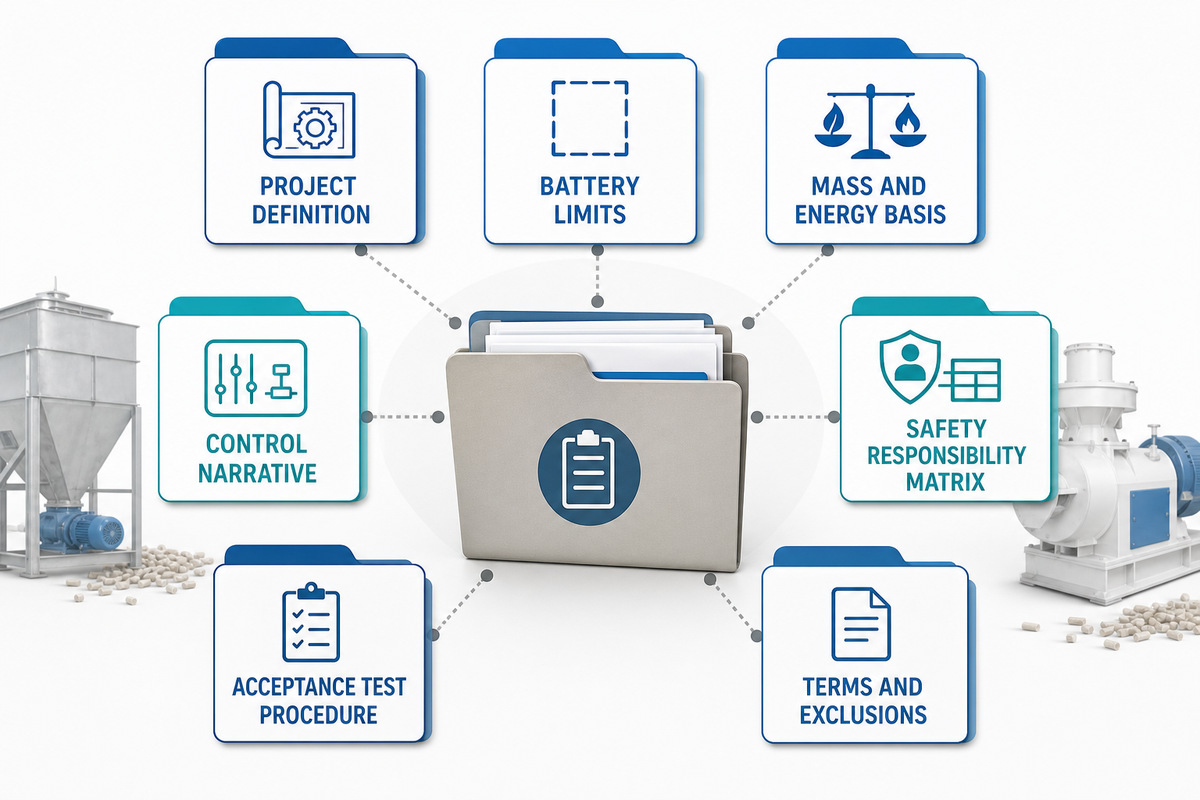
Request a revision-controlled process flow diagram, equipment and utility lists, layout, battery-limit matrix, control narrative, safety responsibility matrix, feedstock trial report, inspection plan, acceptance-test procedure, commissioning plan, manuals, spares list, warranty, exclusions, and commercial milestones. Each document should identify its revision, owner, approval status, and relationship to the exact quotation.
Look for a process flow diagram, equipment list, mass and energy basis, utility schedule, layout, battery-limit matrix, control narrative, instrument list, safety responsibility matrix, feedstock trial report, reference projects, quality and inspection plan, commissioning procedure, acceptance test procedure, training plan, manuals, spares, warranty, terms, exclusions, and commercial milestones. Request revision-controlled documents tied to the exact quotation. Include a compliance index to show who prepares, approves, and hands over each document. For controls, request the software version, backup procedure, access roles, alarm list, and network boundary. For performance, require assumptions and test methods beside each guarantee rather than as general statements. For guarantees, state requirements and test duration. Treat capacity claims for feedstocks without clear assumptions as screening figures rather than guarantees.
How can I compare capacity claims from different suppliers?
Every claim is assessed against the same standards. Ask for the bottleneck and the measurement point behind every quoted rate. Those standards may include feedstock identity, incoming moisture and particle size, target pellet quality, active process modules, utility conditions, test duration, downtime treatment, measurement location and saleable output. Separate press capacity from sustained line capacity and annual production. If a supplier can’t state the assumptions behind a tonnes-per-hour figure, treat it as a screening number rather than a firm guarantee.
Should I choose the manufacturer with the lowest price?
Normalize bids first. Include buyer-furnished equipment, civil work, electrical distribution, dust and fire protection, freight, unloading, installation, commissioning, training, spares, taxes, financing exposure, and exclusions. Technical fit and execution risk should then be assessed separately. The lowest comparable price may still have unacceptable risks for feedstock, safety, controls, schedule, service and acceptance test.
Is a feedstock test enough to guarantee plant output?
No. A test supports only the recorded material, preparation, equipment, settings, duration and measurement method. The supplier should explain how results scale to the proposed commercial line and how seasonal feedstock variations are to be addressed. Final performance requires an acceptance test at the contract site conditions.
Does an ISO pellet standard certify the equipment supplier?
No. A pellet standard defines product classes and test requirements. By itself it doesn’t certify the manufacturer, the production line, the installation, the site or a performance guarantee. Identify the exact standard edition and class, then write the relevant limits and test methods into the contract.
Prepare a Comparable Pellet Line Request
TCPEL publishes its complete-line configurations on the pellet production line page. Use the framework above to send a clear feedstock, product, capacity, site, utility, scope, safety, and acceptance basis. TCPEL’s engineering team can respond to that project brief; any capacity, schedule, price or performance commitment remains subject to the final written proposal and contract.
References & Sources
- USDA Agricultural Research Service: high-moisture pelleting at pilot and commercial scale
- ISO 17225-2:2021: graded wood pellets
- OSHA: Hazard Communication Guidance for Combustible Dusts
- OSHA: 2024 Hazard Communication Standard final rule
- OSHA Technical Manual: Combustible Dusts
- NIST Manufacturing Extension Partnership: how to write a request for proposal and vet suppliers
- U.S. International Trade Administration: Pro Forma Invoice
- BioResources: approaches to energy-pellet cost and quality optimization
- Biomass Magazine: preventing pellet plant failures
- U.S. Environmental Protection Agency: Clean Air Act permitting programs