Get in Touch with TCPEL

Last updated: October 2026
The top drum wood chipper manufacturers depend on the job: TCPEL, Bruks Siwertell, ANDRITZ and DIEFFENBACHER/MAIER cover different stationary plant needs; Bandit, Morbark and Vermeer offer named mobile whole-tree machines; Linddana’s TP 100 Mobile serves small access routes. The right wood chipper machine shortlist starts with a current drum model, then tests the wood and chip specification you actually need.
Quick Picks by Job
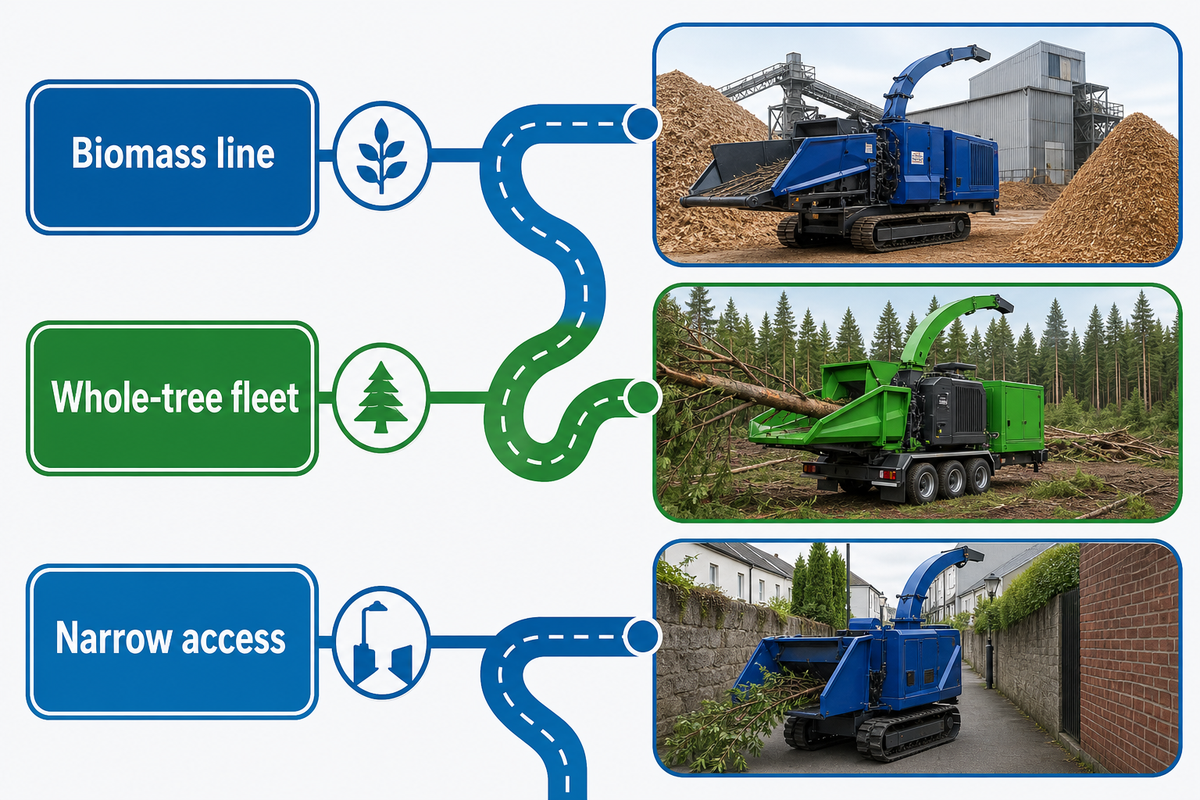
- For a published multi-model biomass line: TCPEL, with eight TC machine tiers.
- For industrial gravity-feed woodyards: Bruks Siwertell’s DG family.
- For integrated panel and biomass projects: DIEFFENBACHER/MAIER.
- For high-horsepower whole-tree fleets: Morbark’s 50/48X.
- For tractor-based field chipping: Eschlböck’s Biber 6.
- For narrow municipal access: Linddana’s TP 100 Mobile.
Disclosure: This guide is published by TCPEL. We list ourselves first because this is our website, not because we claim to be the market leader. The other 19 manufacturers are grouped by what they’re best for, in no particular order within each group.
This isn’t a capacity or market-share ranking; it’s a buying shortlist. A 600 hp tracked forestry chipper and a stationary electric mill chipper answer different requests. Heavy-duty is a useful duty label only when the seller also states the feed and operating basis. Use the table to identify a machine family and read the maker’s card before requesting a quote.
How We Selected These Drum Wood Chipper Manufacturers
Our selection criteria required an original manufacturer with a current maker-owned page naming a drum chipper model or a specific fixed-blade chipping drum configuration. The research checked product geometry, company identity, published specifications and the buyer application for each entry; trading companies, reseller-only listings, directories, disc-only machines and hammer shredders were excluded. Company data was verified against the official manufacturer websites and public company data in October 2026. Where a brand sits inside a group, the headquarters, age and certificate belong only to the entity named beside that fact. The twenty places emphasize industrial, forestry and practical contractor options rather than every maker in the market.
Specifications are shown in the units and limits set by the publishers. A flow rate given is the maker’s rating, not a site flow rate.
Comparison Table: 20 Makers and Their Buyer Fit
This table connects drum machines with the names you’re more familiar with. The short terms (advantage and limitation) are examples and starting filters. Full cards below give explanations.
| No. | Company Name | Headquarters | Founded Year | Best For | Brief Introduction | Documented Drum Model | Key Advantages | Potential Disadvantages | Official Website |
|---|---|---|---|---|---|---|---|---|---|
| 1 | TCPEL | Jinan, Shandong, China | 2020 | Biomass pellet lines needing a published eight-model stationary range | biomass machinery manufacturer | TC series | Eight documented TC models | Fixed installation | https://tcpel.net/ |
| 2 | Bruks Siwertell | Stockholm, Sweden | 2018 | Gravity-fed industrial residue chipping | industrial woodyard equipment group | DG gravity-feed drum chipper | Gravity-feed DG range | Industrial gravity feed | https://bruks-siwertell.com/ |
| 3 | ANDRITZ | Graz, Austria | 1852 | Large pulp-wood yards comparing horizontal and drop-feed options | pulp and wood-processing technology group | CDH/CDV drum chippers | CDH/CDV industrial line | Mill-scale integration | https://www.andritz.com/ |
| 4 | Valmet | Espoo, Finland | 2013 | Mixed wood grades in integrated pulp mill projects | pulp and wood-processing equipment group | Valmet Drum Chipper | Distinct mixed-wood drum model | Mill project scope | https://www.valmet.com/ |
| 5 | Rudnick & Enners | Alpenrod, Germany | 1977 | Stationary wood-processing lines that value quick knife changes | wood-processing machinery manufacturer | TH drum chippers | Quick-change TH knife system | Fixed line only | https://www.rudnick-enners.com/ |
| 6 | Pezzolato | Envie, Italy | 1976 | Electric chipping where a 45 or 55 kW motor fits the site | forestry and biomass machinery manufacturer | PTH 250 E | 45/55 kW PTH 250 E | Requires site power | https://chippers.pezzolato.it/ |
| 7 | Vecoplan | Bad Marienberg, Germany | 1969 | Modular stationary chipping and size reduction | industrial size-reduction machinery manufacturer | VTH 160/260 | Modular VTH line | Stationary plant equipment | https://vecoplan.com/ |
| 8 | DIEFFENBACHER / MAIER | Eppingen, Germany | 1873 (DIEFFENBACHER group predecessor) | Industrial panel, biomass and pulp lines needing a MAIER integrated drum chipper | Industrial plant and size-reduction equipment manufacturer | MAIER Drum Chipper | MAIER line integration | Large line focus | https://dieffenbacher.com/ |
| 9 | PALLMANN / Siempelkamp Size Reduction Solutions | Zweibrücken, Germany | 1903 (Pallmann predecessor) | Dry-basis capacity planning in integrated panel and biomass lines | industrial size-reduction equipment maker | PHT drum chipper | PHT dry-basis data | Small example: 3–6 bone-dry t/h | https://pallmann.eu/ |
| 10 | JENZ | Petershagen, Germany | 1921 | Custom stationary electric chipper installations | forestry and biomass equipment manufacturer | stationary drum chipper range | Electric site configurations | Power and conveyors needed | https://www.jenz.de/ |
| 11 | Bandit Industries | Remus, Michigan, United States | 1983 | Mobile whole-tree chipping | mobile forestry equipment manufacturer | 2090 drum whole-tree chipper | Named 2090 drum family | Component warranty scope | https://banditchippers.com/ |
| 12 | Morbark | Winn, Michigan, United States | 1957 | High-horsepower whole-tree forestry fleets | forestry equipment manufacturer | 50/48X whole-tree drum chipper | 10/20-knife Advantage 3 | Large horsepower class | https://www.morbark.com/ |
| 13 | Astec/Peterson | Chattanooga, Tennessee, United States (Astec parent) | 1972 (Astec parent) | Mobile forestry projects needing a specified chip-size window | forestry and wood-processing equipment maker | Peterson 4300B drum chipper | 4300B chip-size options | 4300B: 6–32 mm chip-size range | https://astecindustries.com/ |
| 14 | Precision Husky | Moody, Alabama, United States | 1964 | Large-drum forest product operations | wood-processing equipment manufacturer | DC-4042 drum chipper | 40-inch DC-4042 drum | Large machine footprint | https://precisionhusky.com/ |
| 15 | MusMax | Groß St. Florian, Austria | 1859 | Tractor-powered forestry and contract chipping | tractor-powered forestry machinery maker | Wood-Terminator tractor drum chippers | Tractor-powered drum range | Needs compatible tractor | https://www.mus-max.at/ |
| 16 | Eschlböck Maschinenfabrik | Prambachkirchen, Austria | 2002 incorporation of Eschlböck Maschinenfabrik GmbH; predecessor history is older | Tractor or diesel-driven field chipping with a documented 32 cm drum machine | Austrian forestry machinery manufacturer | Biber 6 drum wood chipper | Four-blade Biber 6 | 32 cm feed limit | https://www.eschlboeck.at/ |
| 17 | Heizohack / Heizomat | Gunzenhausen, Germany | 1982 | Hand-fed regional biomass and heating chip production | wood-chip heating and chipping machinery maker | HM 8-400 Green Series | HM 8-400 feed envelope | Hand-fed duty | https://www.heizomat.de/ |
| 18 | Vermeer | Pella, Iowa, U.S. | 1948 | Tracked whole-tree chipping on demanding jobsites | construction and forestry machinery manufacturer | WC2500TX optional microchip and macrochip drum designs | Tracked WC2500TX microchip/macrochip options | Optional microchip/macrochip drum designs | https://www.vermeer.com/ |
| 19 | TP Chipper / Linddana | Tørring, Denmark | 1980 | Small municipal and arborist access routes | Danish mobile wood chipper manufacturer | TP 100 mobile drum chipper | 74 cm TP 100 Mobile | 100 mm wood limit | https://www.tpchipper.com/ |
| 20 | Komptech | Frohnleiten, Austria | 1992 | Sites needing alternate shredding and fixed-blade chipping modes | environmental and biomass processing machinery maker | Axtor 4510/6210 chipper mode | Special fixed-blade Axtor drum | Mode changeover required | https://www.komptech.com/ |
Some founding dates identify a present corporation or a predecessor. In particular, the Astec date and Chattanooga location refer to Astec as the parent of Peterson; PALLMANN’s 1903 date describes its predecessor; Eschlböck’s 2002 date is an incorporation entry for the named GmbH. These distinctions matter when buyers use age as a supplier-risk proxy.
Stationary Drum Chipper Manufacturers for Biomass, Pulp and Panel Lines
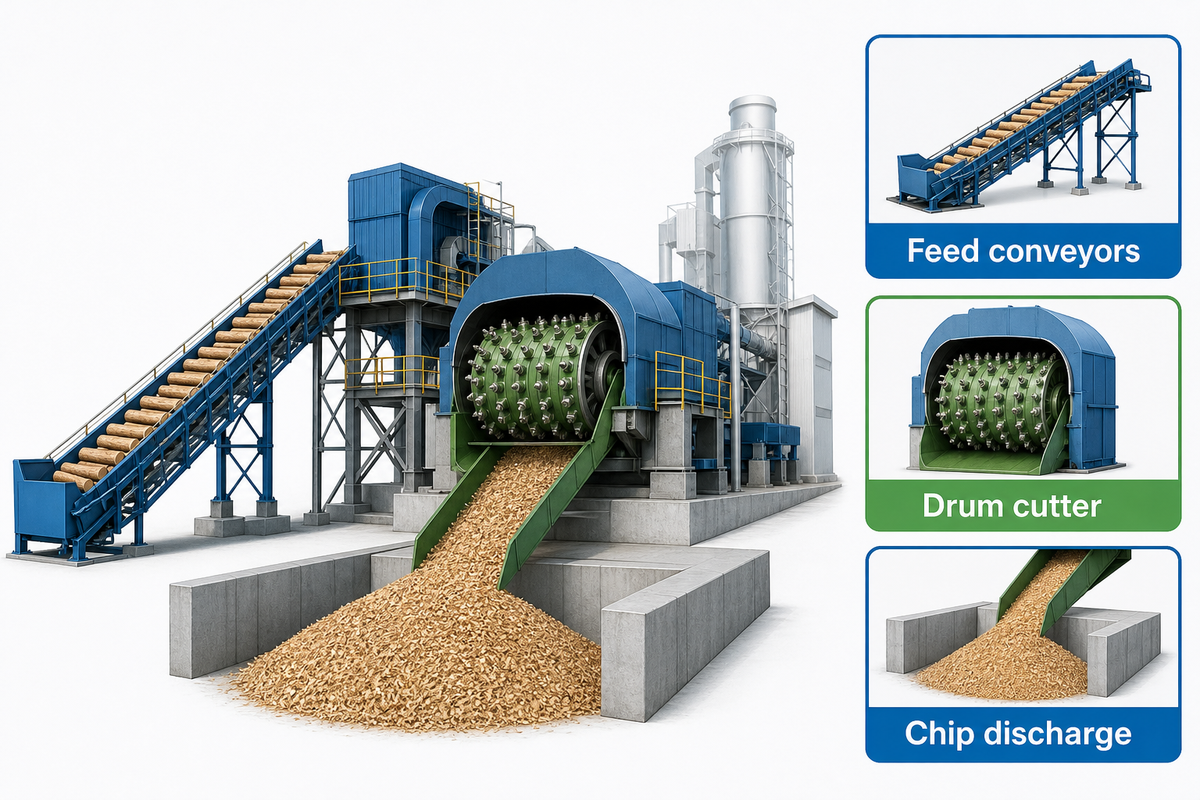
Stationary chipper bids include more than a cutter. Feed conveyors, motors, foundations, chip discharge, screens and control interfaces can dominate the installed scope. A wood waste line may need a contamination plan and a chip-quality target before a machine can be sized. The first ten makers publish drum products that could enter that discussion, including electric models for a fixed plant, but their capacity units and raw-material assumptions aren’t interchangeable. Compare their named machines against one feed and acceptance sheet; TCPEL’s pellet line overview shows where a chipper fits in a complete biomass project.
1. TCPEL: Best for biomass pellet lines needing a published eight-model stationary range
Headquarters: Jinan, Shandong, China · Founded: 2020 · Type: biomass machinery manufacturer
Official website: https://tcpel.net/
Main products: TC series
Documented capability: Eight models from TC216 through TC2116; maker-published 3–60 t/h, 55–710 kW and 30–50 mm chip output.
Certification / notable work: TCPEL publishes a Drum Chipper conformity verification document issued by NOWD, reference NTS2307074 (report NTS2307074S; listed-model scope) (as published for the stated product, site or legal entity).
Best for: Biomass pellet lines needing a published eight-model stationary range
Procurement limitation: The published TC range is stationary and needs line-level installation.
TCPEL’s TC range is built for a stationary wood-processing line where the chipper has to be matched to a dryer, hammer mill or board plant rather than moved between tree jobs. Its product page publishes eight models, starting with the TC216 and ending with the TC2116, and states motor and feed limits beside each model rather than one undifferentiated capacity claim. That makes it possible to ask for a specific machine and an acceptance run on your own logs. The 3–60 t/h span is a manufacturer rating across different models, so a quotation should identify the chosen unit, feedstock, chip screen and continuous-run basis.
2. Bruks Siwertell: Best for gravity-fed industrial residue chipping
Headquarters: Stockholm, Sweden · Founded: 2018 · Type: industrial woodyard equipment group
Official website: https://bruks-siwertell.com/
Main products: DG gravity-feed drum chipper
Documented capability: DG gravity-feed machines with 22–500 kW listed motor power.
Certification / notable work: DG gravity-feed machines with 22–500 kW listed motor power.
Best for: Gravity-fed industrial residue chipping
Procurement limitation: Drop-fed industrial equipment is unsuitable for towing between small jobs.
Bruks Siwertell is relevant when the feed arrives at a fixed woodyard as residues or logs and must be turned into chips within a larger handling system. The DG gravity-feed family is presented with a broad motor range, which makes the project layout and feed arrangement more useful selection criteria than the headline upper output figure. Its published cubic-metres-per-hour figure is a volume claim; it can’t be put on the same line as a tonnes-per-hour rating without measured bulk density and operating conditions.
3. ANDRITZ: Best for large pulp-wood yards comparing horizontal and drop-feed options
Headquarters: Graz, Austria · Founded: 1852 · Type: pulp and wood-processing technology group
Official website: https://www.andritz.com/
Main products: CDH/CDV drum chippers
Documented capability: CDH/CDV industrial drum chipper family; CDV product page states up to 150 m³/h.
Certification / notable work: ISO 9001 for ANDRITZ AG in Graz (named site scope) (as published for the stated product, site or legal entity).
Best for: Large pulp-wood yards comparing horizontal and drop-feed options
Procurement limitation: Industrial woodyard integration exceeds the scope of small mobile crews.
ANDRITZ offers drum chippers as part of woodyard and pulp-production equipment, including CDH and CDV configurations. The CDV page gives an upper capacity in cubic metres per hour, but the right comparison starts with how the machine accepts material and how the rest of the chip line screens and conveys it. Plants that already buy process equipment and life-cycle service from ANDRITZ may value a single engineering interface.
4. Valmet: Best for mixed wood grades in integrated pulp mill projects
Headquarters: Espoo, Finland · Founded: 2013 · Type: pulp and wood-processing equipment group
Official website: https://www.valmet.com/
Main products: Valmet Drum Chipper
Documented capability: Valmet Drum Chipper is designed for mixed wood qualities with horizontal feeding.
Certification / notable work: Valmet Drum Chipper is designed for mixed wood qualities with horizontal feeding.
Best for: Mixed wood grades in integrated pulp mill projects
Procurement limitation: The drum model is presented inside a mill-scale wood-handling portfolio.
Valmet’s Drum Chipper handles mixed wood qualities with horizontal feeding and low-maintenance construction. A pulp mill dealing with variable logs can ask Valmet to model the infeed, screen load and service interval within the wider wood-handling project, while keeping the drum configuration explicit in the request for quotation.
5. Rudnick & Enners: Best for stationary wood-processing lines that value quick knife changes
Headquarters: Alpenrod, Germany · Founded: 1977 · Type: wood-processing machinery manufacturer
Official website: https://www.rudnick-enners.com/
Main products: TH drum chippers
Documented capability: TH drum family with a documented quick-change knife system.
Certification / notable work: DIN EN ISO 9001:2015 (as published for the stated product, site or legal entity).
Best for: Stationary wood-processing lines that value quick knife changes
Procurement limitation: Stationary TH equipment needs a fixed installation and downstream handling.
Rudnick & Enners’ TH drum chipper is aimed at fixed wood-processing lines, where changeovers and knife access affect plant time. The maker describes a quick-change system and presents performance information against a stated average chip length of 30 mm. That detail matters: output at a different target chip size may not follow the same published figure. Buyers with sawmill offcuts or mixed residues should define the largest incoming piece, desired chip distribution and planned operating hours, then ask which TH geometry and feed conveyor suit those conditions.
6. Pezzolato: Best for electric chipping where a 45 or 55 kw motor fits the site
Headquarters: Envie, Italy · Founded: 1976 · Type: forestry and biomass machinery manufacturer
Official website: https://chippers.pezzolato.it/
Main products: PTH 250 E
Documented capability: PTH 250 E lists 45/55 kW motors, a 500 mm drum and 15–25 m³/h stated production.
Certification / notable work: PTH 250 E lists 45/55 kW motors, a 500 mm drum and 15–25 m³/h stated production.
Best for: Electric chipping where a 45 or 55 kW motor fits the site
Procurement limitation: The PTH 250 E requires suitable three-phase electrical infrastructure.
Pezzolato’s PTH 250 E is an electric drum chipper with a published 45 or 55 kW motor choice, a 500 mm drum and a 15–25 m³/h production range. This electric wood chipper is a tangible reference for a buyer with a fixed site and a modest to medium woodyard duty. The stated maximum material passage is also worth more than a generic claim of versatility because it sets a real infeed boundary. An electrical and material-handling plan belongs in the same quote as the machine; the catalogue figure alone doesn’t establish sustained accepted-chip output.
7. Vecoplan: Best for modular stationary chipping and size reduction
Headquarters: Bad Marienberg, Germany · Founded: 1969 · Type: industrial size-reduction machinery manufacturer
Official website: https://vecoplan.com/
Main products: VTH 160/260
Documented capability: VTH industrial drum line; VTH 260 range lists 55–160 kW.
Certification / notable work: VTH industrial drum line; VTH 260 range lists 55–160 kW.
Best for: Modular stationary chipping and size reduction
Procurement limitation: The VTH range is stationary industrial equipment, not a towable field chipper.
Vecoplan’s VTH drum family sits within a broader industrial shredding and chipping portfolio, so the named VTH model and cutting configuration belong on the purchase order. Its published power range reaches 160 kW for the larger line, and the modular design lets a plant specify the feed and discharge around the material stream. A recycling site should clarify contamination, chip target and knife-wear assumptions before treating the unit as equivalent to a clean-log chipper. A stationary VTH may fit a processing plant well, but it won’t substitute for a towable contractor machine.
8. DIEFFENBACHER / MAIER: Best for industrial panel, biomass and pulp lines needing a maier integrated drum chipper
Headquarters: Eppingen, Germany · Founded: 1873 (DIEFFENBACHER group predecessor) · Type: Industrial plant and size-reduction equipment manufacturer
Official website: https://dieffenbacher.com/
Main products: MAIER Drum Chipper
Documented capability: MAIER drum chipper uses a knife rotor and horizontal feed rollers for wood-based panel, biomass and pulp applications.
Certification / notable work: ISO 9001:2015 certificate for Dieffenbacher GmbH Maschinen- und Anlagenbau, valid to 2027-08-12 (as published for the stated product, site or legal entity).
Best for: Industrial panel, biomass and pulp lines needing a MAIER integrated drum chipper
Procurement limitation: MAIER is positioned for industrial processing lines, rather than small towable field work.
The MAIER Drum Chipper uses a knife rotor and horizontal feed rollers for panel, biomass and pulp-related material preparation. Its plant background is useful to a buyer procuring a complete wood-based panel line with shared controls and material handling. The company’s ISO 9001 certificate is for the named Dieffenbacher GmbH entity and listed sites.
9. PALLMANN / Siempelkamp Size Reduction Solutions: Best for dry-basis capacity planning in integrated panel and biomass lines
Headquarters: Zweibrücken, Germany · Founded: 1903 (Pallmann predecessor) · Type: industrial size-reduction equipment maker
Official website: https://pallmann.eu/
Main products: PHT drum chipper
Documented capability: PHT brochure lists 37–55 kW, 400 mm rotor and 3–6 bone-dry t/h under its stated basis.
Certification / notable work: PHT brochure lists 37–55 kW, 400 mm rotor and 3–6 bone-dry t/h under its stated basis.
Best for: Dry-basis capacity planning in integrated panel and biomass lines
Procurement limitation: The small PHT brochure example’s capacity is stated as bone-dry tonnes per hour under specified test conditions; higher-duty projects need a different model selection.
The PHT brochure makes PALLMANN unusually useful for a disciplined specification comparison because it states both a machine model and a dry-basis output assumption. Its small brochure example lists a 400 mm rotor, 37–55 kW main drive and 3–6 bone-dry tonnes per hour, with notes about the material and cutting conditions. PALLMANN is the historical maker name now presented through Siempelkamp Size Reduction Solutions in Zweibrücken; the 1903 date describes that predecessor history.
10. JENZ: Best for custom stationary electric chipper installations
Headquarters: Petershagen, Germany · Founded: 1921 · Type: forestry and biomass equipment manufacturer
Official website: https://www.jenz.de/
Main products: stationary drum chipper range
Documented capability: Custom stationary electric chipper models with examples from 160 to 315 kW.
Certification / notable work: Custom stationary electric chipper models with examples from 160 to 315 kW.
Best for: Custom stationary electric chipper installations
Procurement limitation: JENZ’s stationary electric range requires site power and integration.
JENZ describes its stationary chippers as electrically driven machines configured to an individual plant rather than one fixed road-going model. Published examples cover 160 to 315 kW, which places the offer in a different buying process from a compact arborist chipper. The advantage is the ability to specify feed integration, duty cycle and discharge as part of the site design. The trade-off is that power supply, civil works, conveyors and service access must be included in the project scope; a standalone machine price won’t describe the full installed system.
Mobile and Whole-Tree Drum Chipper Manufacturers
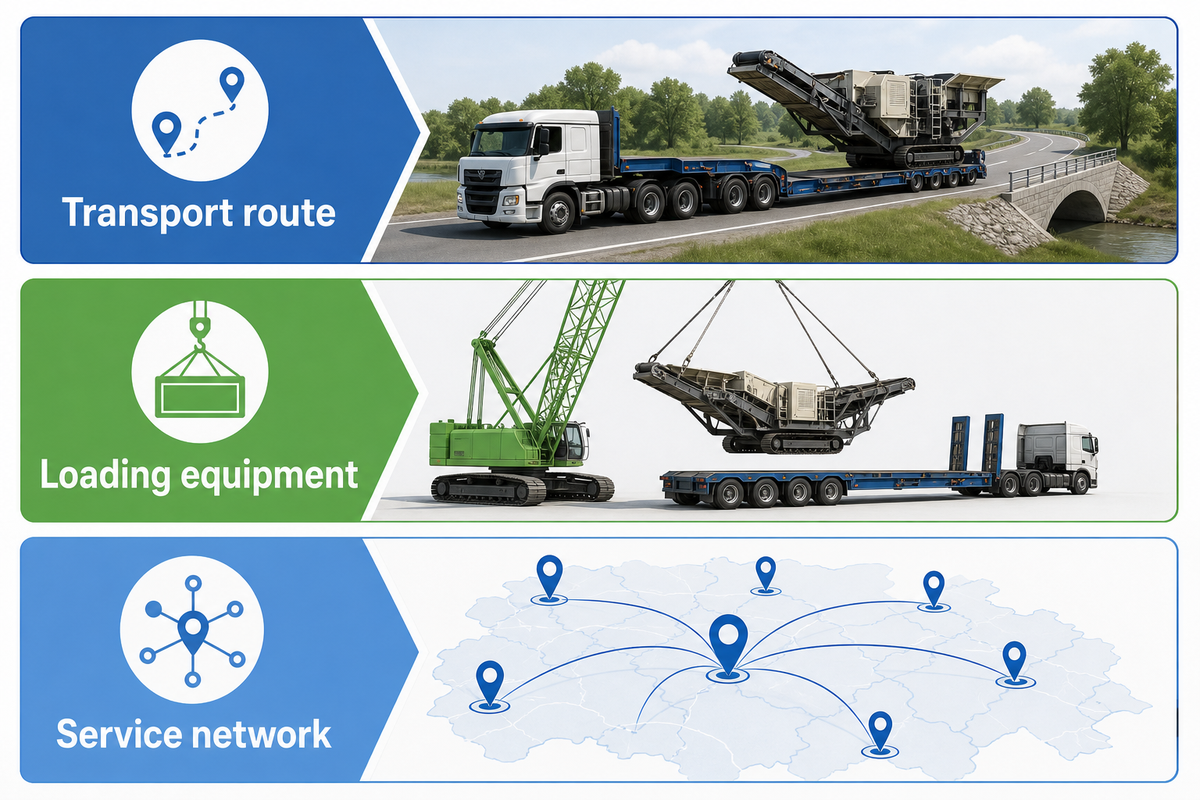
Mobile purchasers need to assess transport routes, loading equipment and the local service network. The chippers for forestry below range from tractor powered to tracked whole-tree platforms; the power source and feed method therefore deserve equal weight with a headline diameter. A landscape contractor should be equally clear in distinguishing a compact branch chipper from a whole-tree machine. A number of manufacturers make disc or wood chipper shredder machines, and the drum machine of interest in each card is the subject of the comparison.
11. Bandit Industries: Best for mobile whole-tree chipping
Headquarters: Remus, Michigan, United States · Founded: 1983 · Type: mobile forestry equipment manufacturer
Official website: https://banditchippers.com/
Main products: 2090 drum whole-tree chipper
Documented capability: Model 2090 named within a drum whole-tree line; maker publishes feed-system component warranty scope.
Certification / notable work: Model 2090 named within a drum whole-tree line; maker publishes feed-system component warranty scope.
Best for: Mobile whole-tree chipping
Procurement limitation: The 2090 is a mobile whole-tree machine, not a stationary electric plant unit.
Bandit names its 2090 as a drum-style whole-tree machine inside a range that also contains disc chippers. That product-level distinction lets a forestry fleet compare the correct rotor and feed arrangement instead of assuming every Bandit chipper works the same way. Its published GUTS warranty covers Bandit-manufactured feed-system and disc or drum components under stated limits.
12. Morbark: Best for high-horsepower whole-tree forestry fleets
Headquarters: Winn, Michigan, United States · Founded: 1957 · Type: forestry equipment manufacturer
Official website: https://www.morbark.com/
Main products: 50/48X whole-tree drum chipper
Documented capability: 50/48X supports a 10- or 20-knife Advantage 3 drum and 1,050–1,200 hp power class.
Certification / notable work: 50/48X supports a 10- or 20-knife Advantage 3 drum and 1,050–1,200 hp power class.
Best for: High-horsepower whole-tree forestry fleets
Procurement limitation: The 50/48X is a 1,050–1,200 hp class machine, excessive for small branch crews.
Morbark’s 50/48X is a high-horsepower whole-tree drum chipper with an Advantage 3 drum available in 10- or 20-knife arrangements. The company associates those choices with fuel-chip and smaller-chip tasks respectively, giving buyers a concrete reason to ask which drum is quoted. It also publishes a 1,050–1,200 hp class, a reminder that the 50/48X serves large operations rather than occasional branch clearing. Compare the transport envelope, loaders, knife replacement plan and accepted-chip sample before treating the model’s power class as evidence of net production at your site.
13. Astec/Peterson: Best for mobile forestry projects needing a specified chip-size window
Headquarters: Chattanooga, Tennessee, United States (Astec parent) · Founded: 1972 (Astec parent) · Type: forestry and wood-processing equipment maker
Official website: https://astecindustries.com/
Main products: Peterson 4300B drum chipper
Documented capability: 4300B drum model with maker-published chip-size range of 6–32 mm.
Certification / notable work: 4300B drum model with maker-published chip-size range of 6–32 mm.
Best for: Mobile forestry projects needing a specified chip-size window
Procurement limitation: The 4300B’s published chip-size range of 6–32 mm doesn’t cover requirements outside that window; those projects need a different agreed setup.
Astec lists the Peterson 4300B as a drum chipper within a forestry catalog that also contains disc machines. The named 4300B product page specifies a 6–32 mm chip-size range, useful for asking how the screen and knife setup will be configured for a particular downstream user. Company-level headquarters and the 1972 founding date in this guide refer to parent Astec, not a separately established Peterson legal entity.
14. Precision Husky: Best for large-drum forest product operations
Headquarters: Moody, Alabama, United States · Founded: 1964 · Type: wood-processing equipment manufacturer
Official website: https://precisionhusky.com/
Main products: DC-4042 drum chipper
Documented capability: DC-4042 line has a 40-inch drum and four 15-inch knives.
Certification / notable work: DC-4042 line has a 40-inch drum and four 15-inch knives.
Best for: Large-drum forest product operations
Procurement limitation: The DC-4042’s 40-inch drum belongs to a large industrial machine class.
Precision Husky’s DC-4042 is a large drum machine, with the company describing a 40-inch drum and a four-knife arrangement. That mechanical detail is more helpful to a wood yard than a broad promise of high production: it guides the initial questions about knife availability, feed opening and material handling around the chipper. A large drum alone doesn’t prove that large branches of every species will feed smoothly. The maker’s roots date to a 1964 Birmingham operation; its published contact address is now in Moody, Alabama. Specify whether the proposal includes conveyors, electrical systems and commissioning, as those line elements determine the delivered project scope.
15. MusMax: Best for tractor-powered forestry and contract chipping
Headquarters: Groß St. Florian, Austria · Founded: 1859 · Type: tractor-powered forestry machinery maker
Official website: https://www.mus-max.at/
Main products: Wood-Terminator tractor drum chippers
Documented capability: Wood-Terminator tractor chippers use drum cutting in a tractor-powered configuration.
Certification / notable work: Wood-Terminator tractor chippers use drum cutting in a tractor-powered configuration.
Best for: Tractor-powered forestry and contract chipping
Procurement limitation: Tractor-powered models need a compatible tractor and power take-off configuration.
MusMax’s Wood-Terminator range is designed around tractor-powered chipping, placing it between stationary plant equipment and engine-driven mobile whole-tree systems. The maker describes drum cutting and several tractor-matched configurations, so the tractor’s available power and shaft arrangement should drive the shortlist. A contractor with changing forest sites may prefer that layout if a suitable tractor is already in the fleet. Ask about chip size, loading method and transport setup for the specific model rather than transferring one range-wide claim to every Wood-Terminator variant.
16. Eschlböck Maschinenfabrik: Best for tractor or diesel-driven field chipping with a documented 32 cm drum machine
Headquarters: Prambachkirchen, Austria · Founded: 2002 incorporation of Eschlböck Maschinenfabrik GmbH; predecessor history is older · Type: Austrian forestry machinery manufacturer
Official website: https://www.eschlboeck.at/
Main products: Biber 6 drum wood chipper
Documented capability: Biber 6 has three drive variants, four quick-change blades and a 32 cm maximum stated wood diameter.
Certification / notable work: Biber 6 product page states GS safety label for the model (product scope) (as published for the stated product, site or legal entity).
Best for: Tractor or diesel-driven field chipping with a documented 32 cm drum machine
Procurement limitation: The Biber 6 has a 32 cm stated wood-diameter limit; larger whole-tree feed needs another model.
The Biber 6’s three drive variants share four quick-change blades and a stated 32 cm maximum wood diameter, while the tractor versions use power take-off and the engine version carries its own diesel. The maker also states a GS safety label for this model, a product-scope claim rather than a company-wide quality certificate. Forestry contractors should compare the drive, towing and service arrangement that matches their existing equipment.
17. Heizohack / Heizomat: Best for hand-fed regional biomass and heating chip production
Headquarters: Gunzenhausen, Germany · Founded: 1982 · Type: wood-chip heating and chipping machinery maker
Official website: https://www.heizomat.de/
Main products: HM 8-400 Green Series
Documented capability: HM 8-400 Green Series states feed height up to 40 cm.
Certification / notable work: HM 8-400 Green Series states feed height up to 40 cm.
Best for: Hand-fed regional biomass and heating chip production
Procurement limitation: The HM 8-400 hand-fed format is narrower than large whole-tree systems.
Heizohack is the chipper line within Heizomat’s machinery business, and the HM 8-400 Green Series is the named hand-fed drum entry here. The product page gives a feed height up to 40 cm, which helps a buyer understand the machine’s material envelope before discussing hourly output. It fits regional biomass operations that gather branches and shorter wood pieces for heating chips. The hand-fed format and feed limit separate it from grapple-loaded whole-tree machines; staffing, guarding and local support should be quoted as part of the installation and operating plan.
18. Vermeer: Best for tracked whole-tree chipping on demanding jobsites
Headquarters: Pella, Iowa, U.S. · Founded: 1948 · Type: construction and forestry machinery manufacturer
Official website: https://www.vermeer.com/
Main products: WC2500TX optional microchip and macrochip drum designs
Documented capability: WC2500TX offers optional microchip and macrochip drum designs and 600 hp maximum engine power.
Certification / notable work: WC2500TX offers optional microchip and macrochip drum designs and 600 hp maximum engine power.
Best for: Tracked whole-tree chipping on demanding jobsites
Procurement limitation: The WC2500TX is a 600 hp tracked platform, so access and transport needs matter.
Vermeer’s WC2500TX gives a North American whole-tree fleet a tracked platform with optional microchip and macrochip drum designs and a stated maximum engine power of 600 hp. The optional wording matters because the buyer must specify the drum arrangement rather than assume that every WC2500TX configuration makes the same product. Vermeer also describes SmartCrush down pressure for difficult material entering the cutting drum. Before ordering, compare the track machine’s transport, access route, loader pairing and local dealer support with the actual sites where it will work.
Smaller and Flexible Drum Chipper Manufacturers
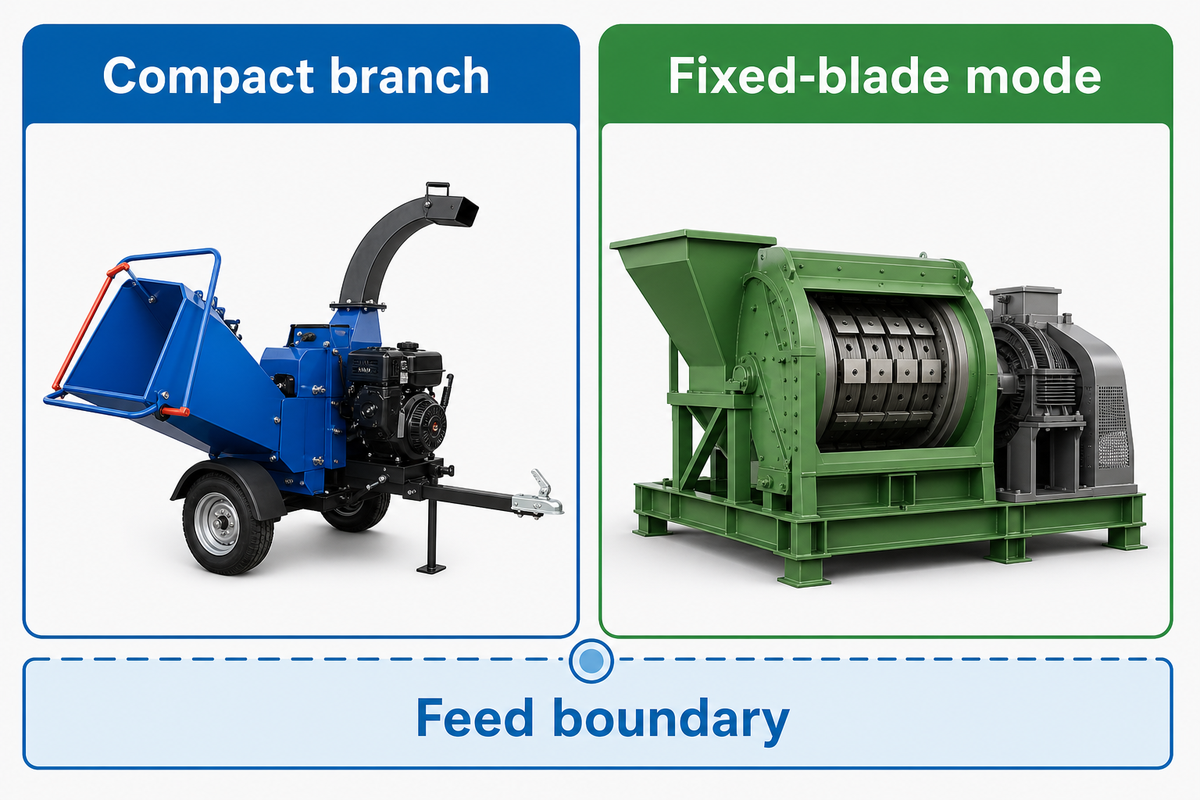
A compact chipper and a dual-mode industrial machine occupy opposite ends of this group. The reason for listing them is to give the potential buyer the ability to identify the exact drum cutting setup, as opposed to buying it under the broad label of chipper-shredder. Municipal yard waste may include soil and non-wood materials; the supplier needs to specify what material the chosen chute and cutting system can process. Read their feed and configuration boundaries.
19. TP Chipper / Linddana: Best for small municipal and arborist access routes
Headquarters: Tørring, Denmark · Founded: 1980 · Type: Danish mobile wood chipper manufacturer
Official website: https://www.tpchipper.com/
Main products: TP 100 mobile drum chipper
Documented capability: TP 100 Mobile uses a drum, two reversible blades, 100 mm wood diameter limit and 74 cm width.
Certification / notable work: TP 100 Mobile uses a drum, two reversible blades, 100 mm wood diameter limit and 74 cm width.
Best for: Small municipal and arborist access routes
Procurement limitation: The TP 100 Mobile accepts wood up to 100 mm, not large logs.
Linddana’s TP 100 Mobile is a compact drum chipper, not a scaled-down whole-tree machine. The current maker page lists two reversible blades, a maximum wood diameter of 100 mm and a width of 74 cm; its compact design directly describes where it can reach. That branch diameter limit also defines what it can accept. Municipal grounds teams and arborists working through narrow gates can use those limits to decide quickly whether a demonstration is worthwhile. A twig-rich load and a straight 100 mm limb are different feed tests; neither is evidence of quiet operation without a measured noise figure. The Danish manufacturer’s larger range includes different mechanisms, so the TP 100’s drum specification shouldn’t be assumed for every other TP model.
20. Komptech: Best for sites needing alternate shredding and fixed-blade chipping modes
Headquarters: Frohnleiten, Austria · Founded: 1992 · Type: environmental and biomass processing machinery maker
Official website: https://www.komptech.com/
Main products: Axtor 4510/6210 chipper mode
Documented capability: Axtor 4510/6210 can operate with a special fixed-blade chipping drum; a different setup shreds.
Certification / notable work: Axtor 4510/6210 can operate with a special fixed-blade chipping drum; a different setup shreds.
Best for: Sites needing alternate shredding and fixed-blade chipping modes
Procurement limitation: Axtor’s chipping result requires its specific chipping drum and fixed-blade setup.
Komptech’s Axtor has a special chipping drum with fixed blades; other configurations are intended for shredding, which can produce a different material stream. That flexibility may suit a biomass processor or waste management operator handling more than one input or output specification, but it also makes changeover time and tooling part of the purchase decision. Ask for a demonstration in the actual chipping mode, including the required chip fraction, and keep any shredder-mode throughput claim out of the chipper comparison.
Compare Published Capacity on a Common Test Basis
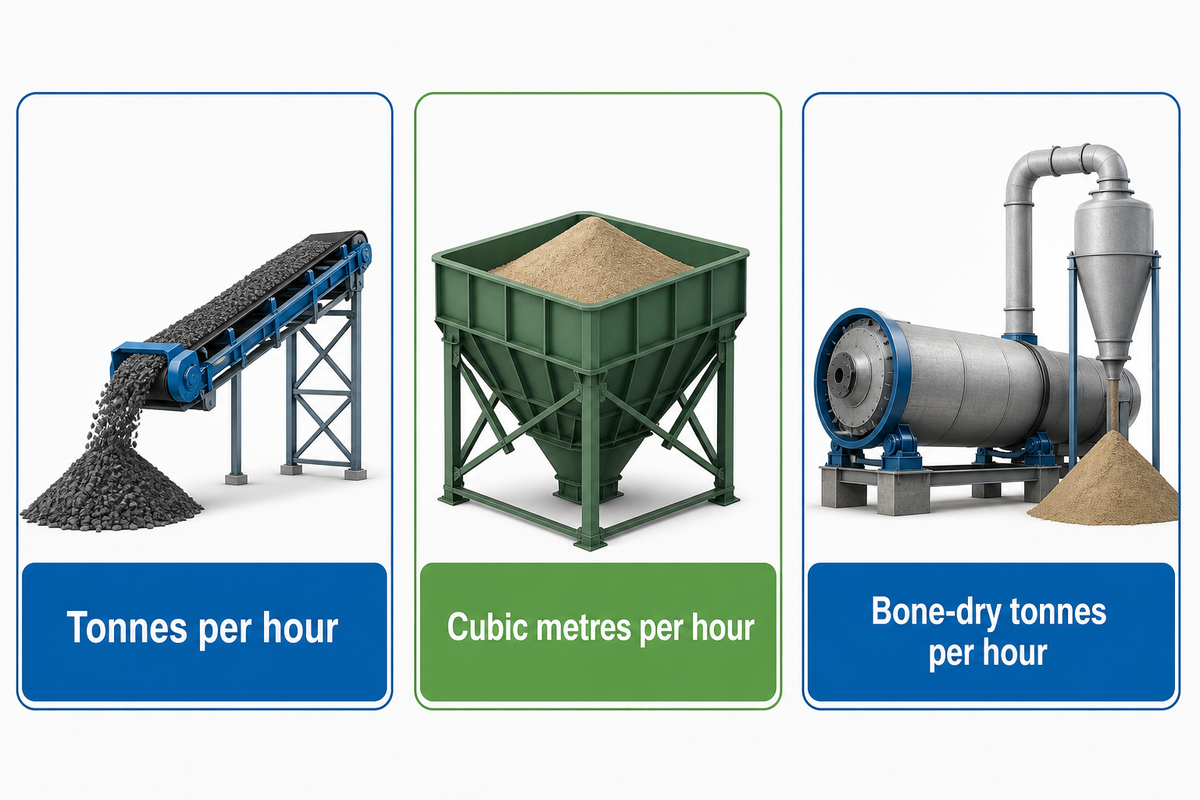
Published capacity figures describe different things. TCPEL’s range is in tonnes per hour across eight models; Bruks and Pezzolato give examples in cubic metres per hour; the PHT brochure gives bone-dry tonnes per hour under its own material assumptions. A volume isn’t a mass until you measure the actual chip bulk density, and wet feed isn’t bone-dry output. Power in kW or hp is a machine specification, not a direct output measurement. A shredder’s reduction ratio doesn’t establish a chipper’s accepted particle size or saleable output. For a fuller sizing discussion, use the drum chipper buyer’s guide beside this supplier list.
| Published figure | Ask the maker to define | Keep separate in your comparison |
|---|---|---|
| Tonnes per hour | Whether it is incoming feed, all discharged chips or accepted chips | Moisture, species, screen returns and scheduled time |
| Cubic metres per hour | Loose or solid volume and where it is measured | Bulk density measured on the supplied chip mix |
| Bone-dry tonnes per hour | Drying or moisture calculation and source material | Wet-feed mass and chip reject fraction |
| Engine or motor power | Installed versus available power at the stated duty | Fuel or electrical load during the trial |
Use one acceptance sheet for every supplier. Record incoming species, bark and contamination, moisture, minimum and maximum piece size, target chip size distribution, where accepted chips are weighed, how oversize and fines are counted, and the planned uninterrupted operating period. If the destination is papermaking, define the accepted fraction with the mill, rather than vaguely requesting uniform chips. Indicate if sawdust and other fines are reusable in the process or if they must be removed as a separate stream. Ask suppliers to quote on-spec output per scheduled hour, not only total chips leaving the drum. This request is for comparable evidence rather than a formula for converting a competitor’s brochure to a guaranteed plant result.
How to Choose a Drum Chipper Manufacturer and Specify the Request for Quotation
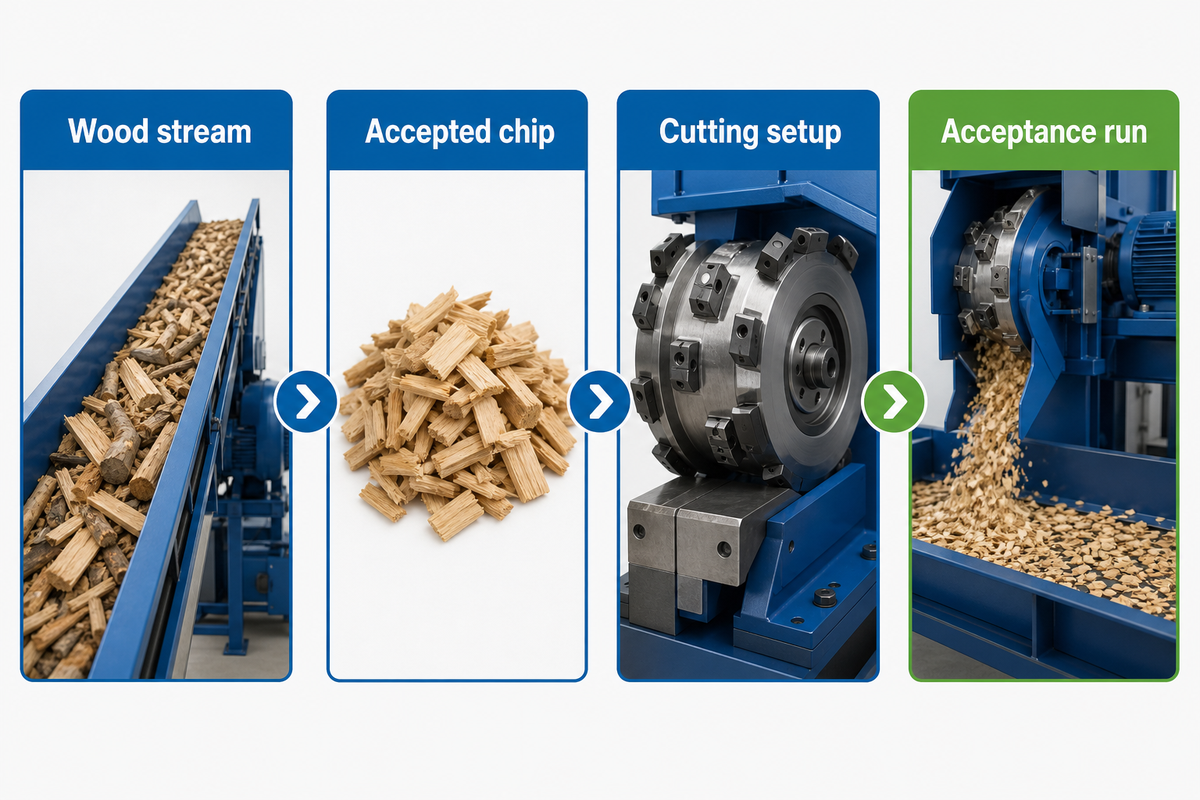
Start with the actual wood stream and the machine’s position in the process. These seven checks enable a quote that can be compared, commissioned and serviced; a company with the largest published number may still be the wrong fit for your yard.
- State the species, whether green or dry, bark share, dirt and metal risk, diameter distribution, maximum length, and if the material arrives as logs, slabs, brush or mixed residue. Say if this is commercial use in a repeatable process or cleanup (intermittent) process, because the duty cycle affects the trial plan. Name each material type and send a recorded batch description or representative sample. A drum that handles clean straight logs may need different feeding or knife protection for irregular, contaminated pieces.
- Define the accepted chip. Give the downstream user’s screen sizes, acceptable fraction, oversize limit and fines limit. A pellet line, pulping operation, boiler for energy production and mulch buyer can evaluate different particle distributions. Compost production may also impose other contaminations and size specifications, so state them separately. Ask where sample will be taken and how many samples will be retained during a trial. A single attractive photo of chip can’t describe distribution over a shift.
- Set the scope for measurements. Each supplier should say whether the quoted value is feed intake, gross chips, screened accepted chips or dry solids. Specify the clock: Scheduled hours, powered hours or time under load. In the request, state the desired reporting unit. Require the vendor to retain its native brochure unit along with any conversion.
- Once you’ve selected the equipment, you still have some site-specific issues to resolve for a stationary installation, such as the conveyors and motor voltage, foundation loads, dust and fire controls, access for knife changes, and the handoff from supplier packages. For a mobile job, you still need to think about transport width and weight, site grade, loader reach, towing or track mobility, and the availability of a compatible tractor when a power take-off model is proposed. Ask about diesel exhaust treatment and measured noise levels where local site rules apply.
- Ask for the exact cutting configuration. The knife count, drum type, screen, anvil, feed rollers and control settings can change both chip size and wear. Ask how the knife and anvil shear the wood and whether hydraulic feed pressure is adjustable for the sample material. Komptech’s Axtor needs the fixed-blade chipping drum to meet this article’s use case; Vermeer’s WC2500TX lists microchip and macrochip drum designs as options. A quote that names only the brand doesn’t settle the configuration. Ask which options are standard on standard models and which require a priced add-on.
- Price service with the machine. Ask for a critical spares list with part numbers. Find out the knife steel and regrind limits. When and where are the stocking locations? How long will it take to get the parts? Who will commission the machine? Will training and after-hours support be provided? Ask how exposed parts resist corrosion at the intended site and whether daily access supports ease of use for a trained crew. A machine described as a workhorse still requires a written maintenance and spare parts plan. Verify the warranty scope, exclusions and actual components. The dealer name is only useful if they can supply the machine and spares in your region.
- Agree on an acceptance run. The following should be recorded in the purchase order: wood to test, operating duration, staffing, sample points, accepted fraction and records. For professional use, include startup, knife change and shutdown steps in the observed trial. Decide in advance who will fuel or electrically power the plant, who will clear screen rejects, and what will happen if the feedstock falls outside the agreed range.
Request the relevant certificate or conformity document, ensuring the legal entity, model and site scope are shown; confirm the document is valid prior to accepting it as proof.
These checks also resolve the common certification question. A CE conformity statement for one wood chipper is a product claim; ISO 9001 at a named company or plant is a management-system claim. Neither alone proves your targeted chip yield. Put certification, representative material testing and after-sales terms in one request rather than repeating a generic warning under every manufacturer.
Frequently Asked Questions
Who makes the best wood chippers?
For a drum wood chipper, the useful answer depends on the installation and feedstock. TCPEL, Bruks, ANDRITZ and DIEFFENBACHER/MAIER document stationary options, while Bandit, Morbark and Vermeer document mobile whole-tree machines. Linddana offers a compact TP 100 Mobile for smaller wood. The best choice for a buyer is the named model that meets the feed opening, accepted-chip specification, service region and documented trial target. That method exposes differences a brand list can’t, especially where one bid includes conveyors or commissioning and another quotes only the cutter. This guide puts TCPEL first because it publishes the page, not because a comparable performance test ranked all twenty.
What are some popular brands of wood chippers?
Bandit, Morbark, Vermeer, Valmet, ANDRITZ and Bruks Siwertell are recognizable names in their respective chipper markets. Several sell both disc and drum equipment. In this guide, Bandit means the 2090 drum line, Morbark the 50/48X, Vermeer the WC2500TX microchip/macrochip drum designs and Valmet its separately identified Drum Chipper. Compare the named product and the regional service offer, not the umbrella brand.
Is a drum wood chipper better?
A drum chipper is often a practical option for continuous woodyard or whole-tree duty, but it isn’t automatically better than a disc chipper for every target chip. Feed shape, chip-size distribution, knife maintenance, energy use and plant layout can reverse the decision. A long, clean stem going to a pulp line presents a different question from variable forestry residues feeding a biomass boiler. The same manufacturer may offer both rotor types for different jobs, and a dealer may show multiple versions under one familiar brand. A lower headline power rating doesn’t settle the accepted-chip yield either. For the mechanical comparison, read TCPEL’s drum versus disc guide.
Which suppliers fit a 10–20 t/h stationary line?
Start with TCPEL’s individual TC models and ask ANDRITZ, Bruks and other stationary makers which named configuration fits the duty. A published 10–20 t/h target can’t be compared directly with cubic metres per hour or bone-dry tonnes per hour.
What should an overseas buyer ask about spare parts and service?
Ask who manufactures the quoted machine, who stocks its knives, anvils and feed components near the destination, and which technician will commission it. Outline part numbers, replenishment lead times, warranty exclusions and a written response route for downtime, and request local electrical and control documentation. Clarify who will be responsible for the interface if the offer includes a chipper and conveyors/screens of a third party. These details determine uptime more directly than a dealer count on a website.
Shortlist the Machine, Then Validate the Offer
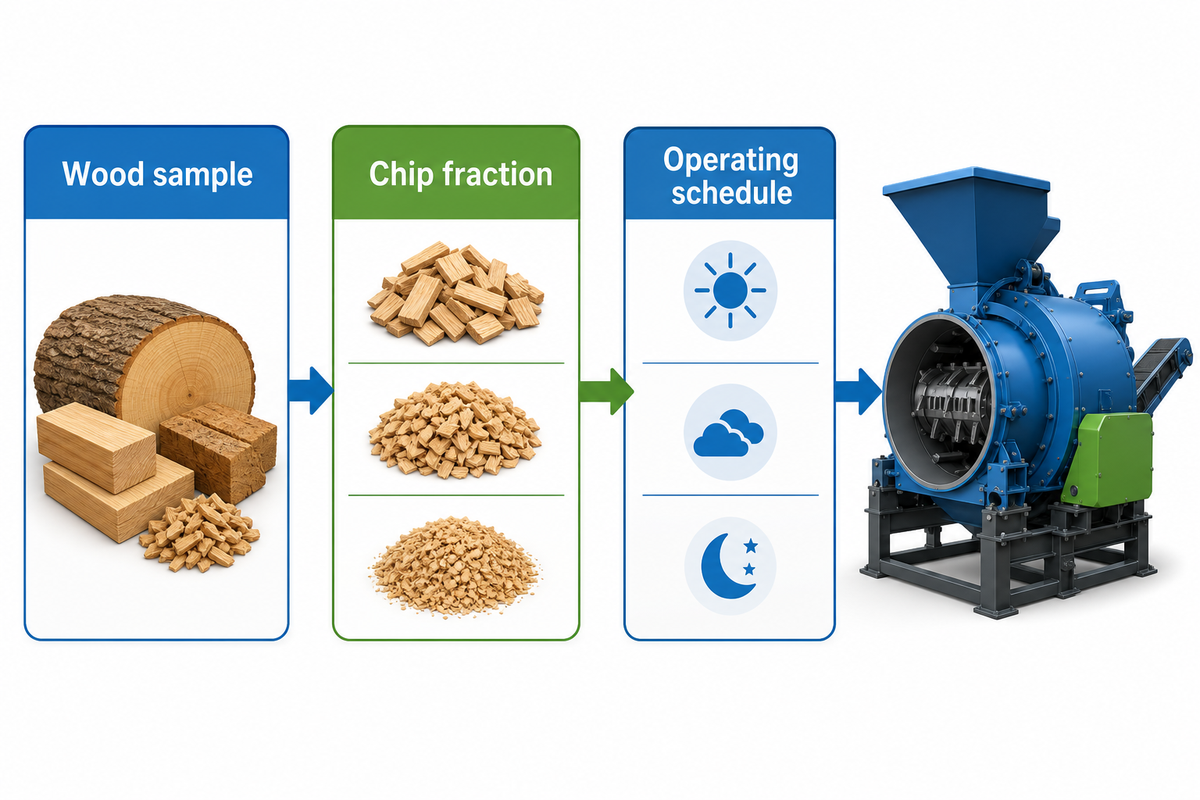
Leave all figures in their original units, until the suppliers agree to a common test boundary.
If a stationary biomass line is your project, review TCPEL’s eight-model drum wood chipper range and the company and factory information. You can request a model-specific quote with your wood sample, target chip fraction and expected operating schedule. This is an invitation to compare a specific offer, not a claim that TCPEL leads every application.
References & Sources
The maker’s company cards and comparison table provide the makers’ official websites. The product level sources, company history pages, public register evidence and certificate scope notes were reviewed in October 2026 and are retained with this research. The external machine links are shown as plain text so that the potential buyer can view the relevant manufacturer. The main text of this article synthesized the published machine and service descriptions into buying guidance. The ratings remain attributed to their publishers.