Get in Touch with TCPEL

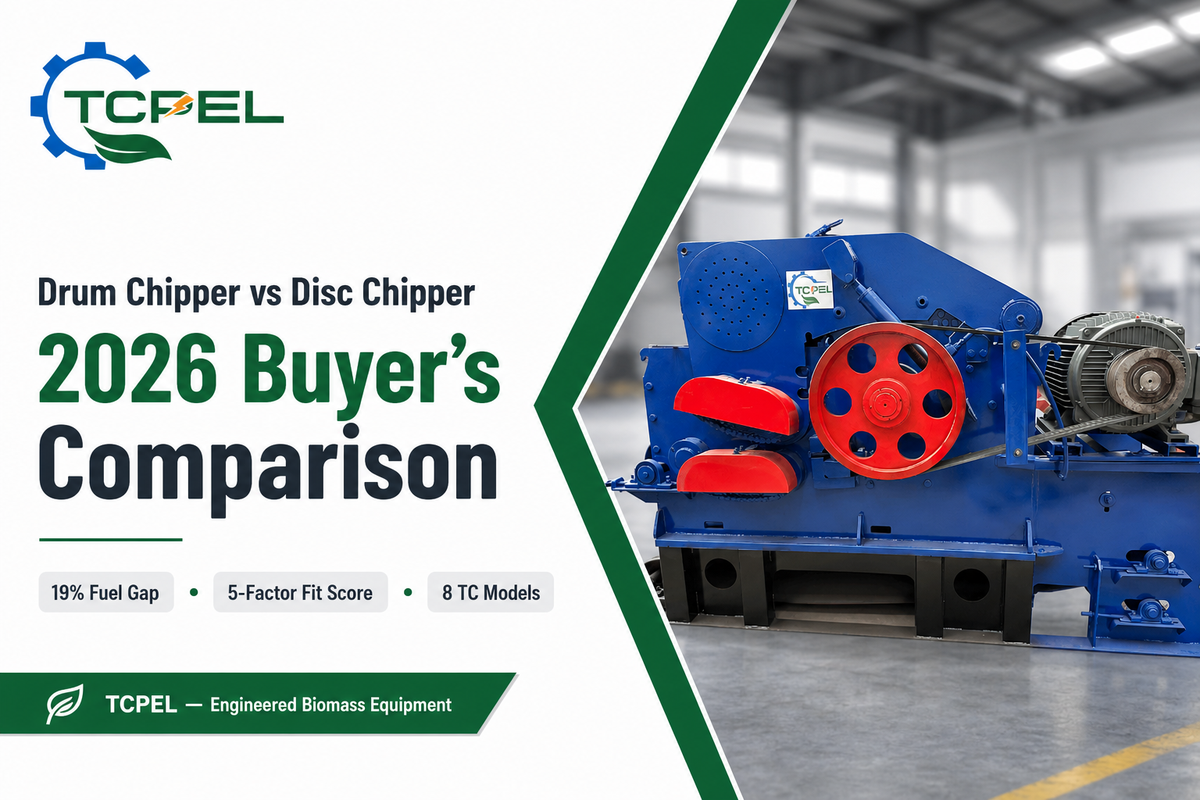
Drum chipper vs disc chipper is a choice most buyers simply frame as an upward progression-bigger, heavier, more expensive is better. This is a misconception. Each of these machine types operates on a different mechanical principle, and both chippers operate best in their specific environments, where the other falters — a disc wood chipper excels on clean, straight stemwood, and a drum chipper excels on dirty or oversized material. Make the wrong choice, and you either waste money on functionality you don’t require, or you end up with a machine that gums up on the first batch of brush from a downed tree.
On clean, homogeneous stemwood, disc chippers are faster and burn roughly 19% less fuel per ton. Drum chippers, by contrast, are better suited to tolerate the dirt, bark, and the larger or forked pieces of material that will bog down or blunt a disc machine. Neither type has an outright advantage over the other; your best choice depends on the type of feedstock you primarily process, not simply your budget.
Key Facts Before You Decide
- Compared to drum machines, disc chippers (also often marketed as disk chippers by sellers of used machinery) have a fuel advantage of 19% per ton on clean stemwood-a figure borne out by a controlled, 120-iteration peer-reviewed study that most buyers may assume would favor drum.
- That specific claim of “drum at 800-1,200 RPM and disc at 1,800-2,400 RPM” stems from a single manufacturer’s blog post and lacks confirmation from authoritative engineering literature.
- All machines, regardless of their make, are measured against the same chip standard, EN ISO 17225-4, and there are no separate standards of performance designated specifically for “drum grade” or “disc grade” machinery.
- Although generally purported to be 8% greater, the productivity lead drum machines hold over disc machines wasn’t found to be statistically significant in the same controlled experiment that demonstrated the fuel efficiency difference.
- Five key input factors, which are rated and then added together to determine the overall best fit, will take precedence over personal brand preference.
This guide provides a focused decision matrix for addressing the drum versus disc issue. To explore TCPEL’s drum chipper models, review their capacity table, and request a price quote, go to the TCPEL drum chipper TC series page. For an in-depth overview that includes sizing considerations, brand comparison, and overall costs of drum chipper machines in the broader drum category, consult our Drum Chipper Buyer’s Guide.
Quick Answer: Drum vs Disc at a Glance
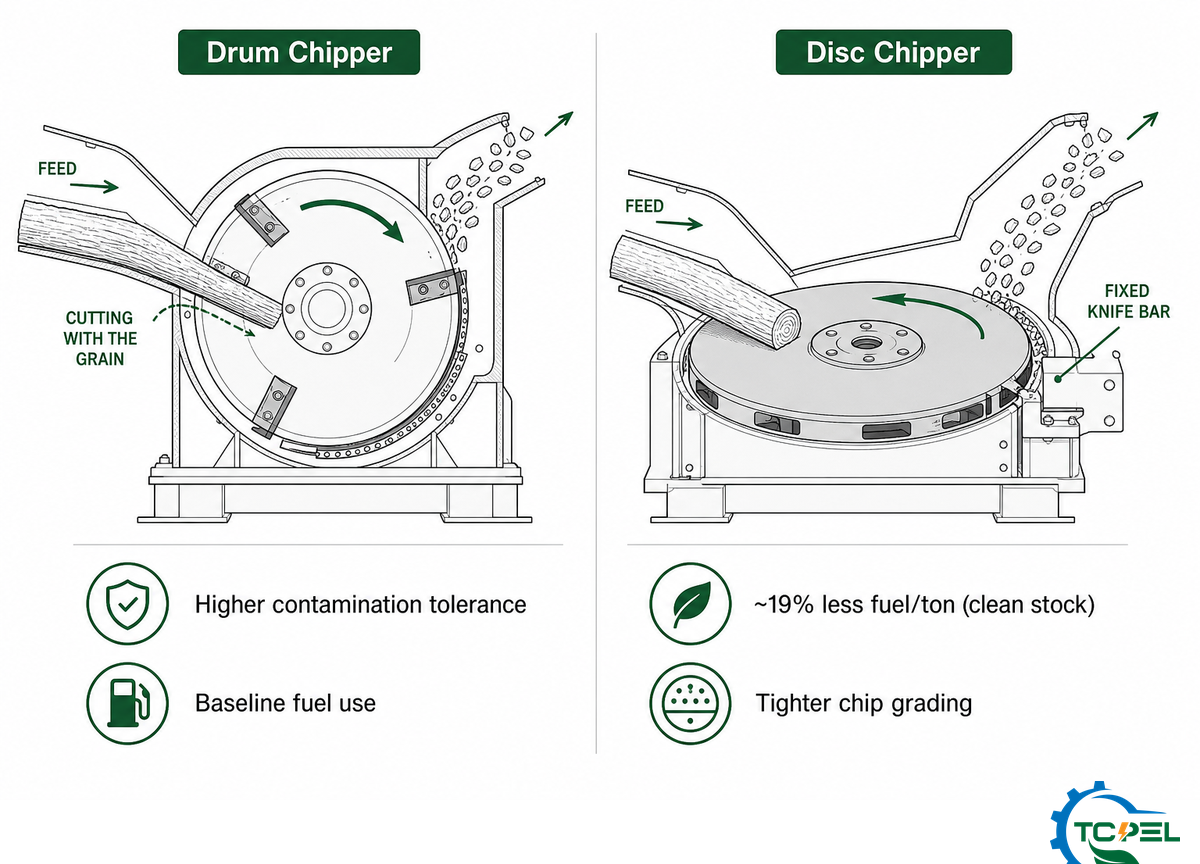
When disc chippers process wood, they shear against a fixed knife bar while a spinning disc moves across it, producing closely sized chips with improved fuel efficiency. However, they can easily clog, become dull, or stop if handling dirty, over-sized, or crooked material. Conversely, drum chippers pass wood into a rotary drum lined with cutting blades that sever fibers in the direction of the grain. This allows them to manage contamination and awkwardly shaped pieces that would otherwise stall a disc, albeit at the cost of approximately 19% higher fuel consumption per ton on identical clean feed material, per a controlled 120-repetition chipper fuel-consumption study.
| Category | Drum Chipper | Disc Chipper |
|---|---|---|
| Cutting mechanism | Knives on a rotating drum, cutting with the grain | Knives on a flat disc, cutting against a fixed shear bar |
| Chip consistency | Wider size spread, more fines | Tighter, more uniform grading |
| Contamination tolerance | High — bark, dirt, mixed debris | Low — grit dulls knives fast |
| Fuel use, clean stemwood | Baseline | ~19% less per ton |
| Knife wear pattern | Even (cuts with the grain) | Uneven — inner edge wears slower |
| Best feedstock | Whole trees, forked limbs, dirty land-clearing debris | Clean, straight stemwood; spec-grade fuel or pulp chips |
| Purchase price, equal capacity | Higher — heavier drum and frame | Lower — lighter, simpler build |
| Resharpening interval | Longer — tolerates moderate dulling | Shorter — needs a consistently sharp edge |
| Achievable chip grade | ISO 17225-4 A1 possible with sharp blades, right screen | ISO 17225-4 A1 possible with sharp blades, right screen |
How Drum and Disc Chippers Actually Cut Wood
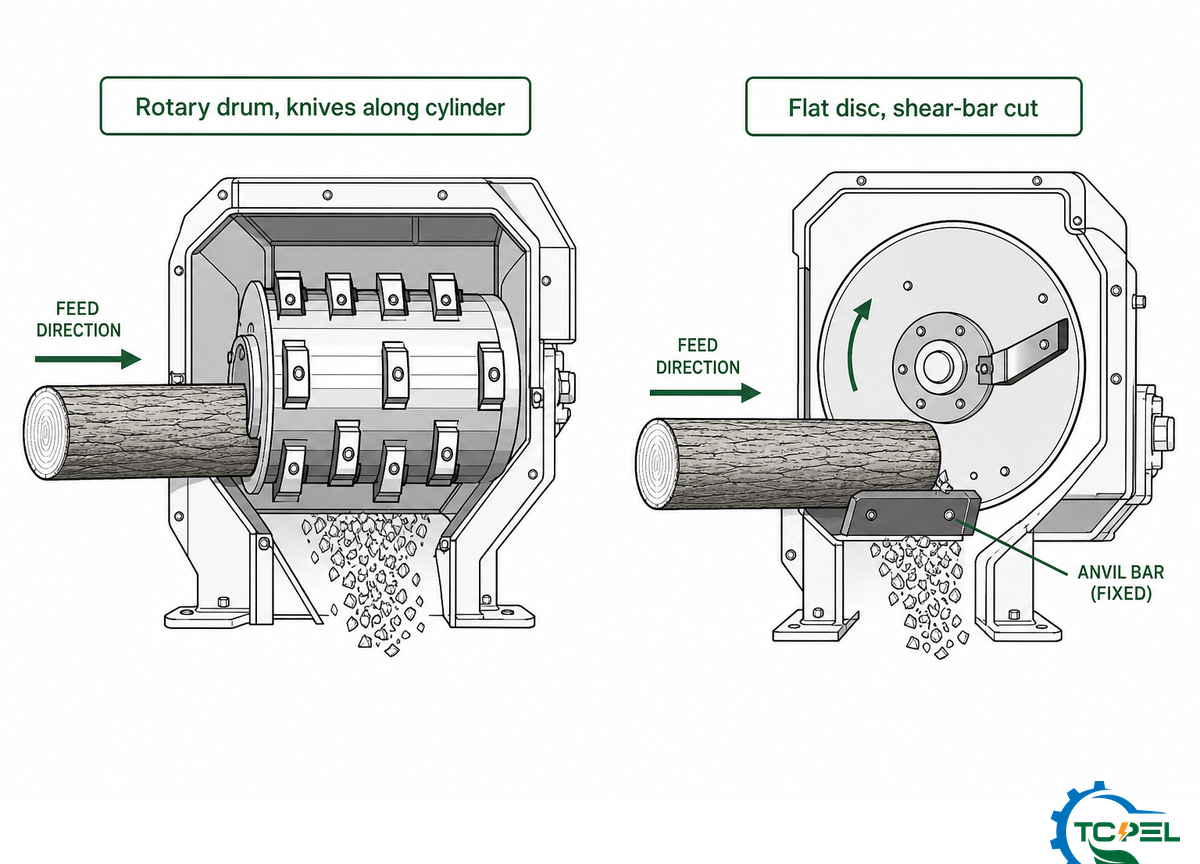
Disc chippers mount knives on a fast-spinning disc that shears against a fixed bar as logs feed in, producing a neat, consistent chip. By contrast, drum chippers mount knives around a spinning steel drum whose mass plows through knots and bark, cutting with the grain rather than slicing at a fixed angle.
That one change-wood vs. metal cutter-accounts for nearly all the other differences described in this guide: chip shape, fuel use, wear patterns on knives, even the tolerances for dirt. Put simply, a disc cuts across the grain while a drum cuts with it, which is why chippers are designed and marketed around such different feedstock claims even when both machines shred the same log.
Marketing is probably the primary culprit for the notion of discrete speed requirements for disc vs. drum chippers. You’ll see a wide spread (e.g., “drum” require 800-1200 rpm, disc needs 1800-2400 rpm), and it will be traced back to a single manufacturer blog. Independent sources-including one peer-reviewed paper in the journal Agriculture-suggest typical combined rotor speeds for both mechanisms between 1000 and 2000 rpm, noting discs that can run well at 1500 rpm. In practice, drum speeds have been reported from roughly 1500 to over 3200 rpm, depending on model and flywheel design. When you encounter such precise distinctions, understand they’re estimates derived from specific models, not general mechanical truths.
Feed system design matters as much as rotor speed for real-world throughput. Drum chippers often pair a forced infeed with the feed drum’s knives, which keeps torque steady even as piece diameter changes; some compact drum models built for tighter job sites use a shorter drum to deliver the same cutting action in less space. How many tons an hour a machine actually delivers depends more on feed system tuning and operator technique than on rotor speed alone-two chippers with identical RPM ratings can process material at very different rates.
Drum chipper
- Handles bark, dirt, and mixed debris without stalling
- Cuts with the grain — even knife wear over time
- Better on forked, curved, or oversized limbs
- More forgiving of moderately dull blades
- Uses roughly 19% more fuel per ton on clean wood
Disc chipper
- Tighter, more uniform chip grading
- Roughly 19% less fuel per ton on clean stemwood
- Lighter and generally easier to service
- Needs consistently sharp knives to perform well
- Struggles with contaminated, fibrous, or oversized stock
What is the difference between drum style and disc style chippers?
Drum machines feed material against revolving knives that cut with the grain, making them more tolerant of dirt, bark, and irregular shapes-though the chips run less consistent and burn about 19% more fuel on clean stock than a disc would. Disc chippers instead shear material against a fixed blade on a spinning disc, producing tighter, more uniform chips at lower fuel cost when the feedstock is clean.
The tradeoff runs the other way on messy material: disc chippers may clog or dull more easily if fed dirt, oversized chunks, or unusual material, while a drum tolerates the same conditions with less drama. Neither type of machine is inherently better; it just depends on the feedstock you’ll use.
Chip Quality and Consistency: Which Produces Better Chips
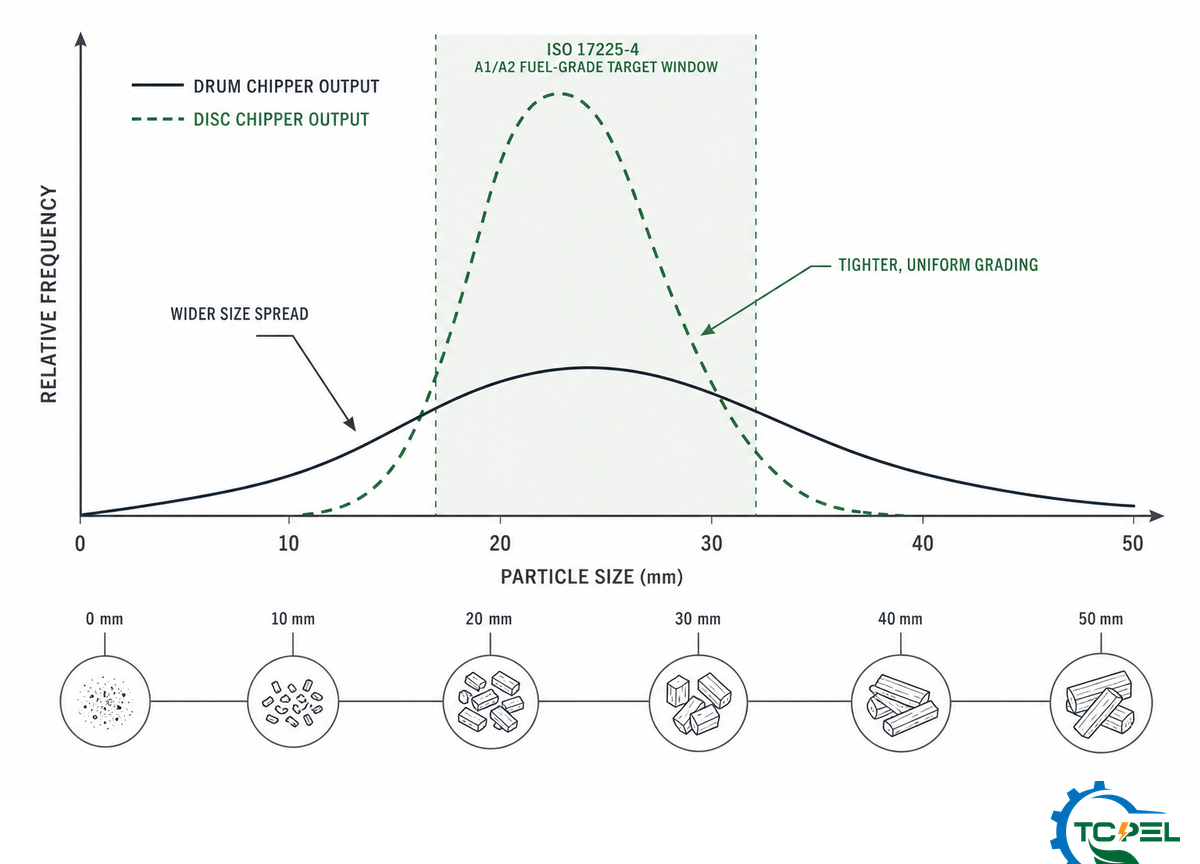
Both machines produce chips measured to the same standard-ISO 17225-4:2021. The standard delineates particle size, moisture content, and ash percentage for specific classes (A1, A2, B1, B2) of chip fuel. It does not have different grades for chips made by drum or disc machinery; you can make high-quality A1 fuel from either machine if the blades are sharp and the screen sizes are appropriate. The “loose chips” sometimes made by discs (also referred to as disk chippers by older machine builders) are simply less consistently sized, but can still meet grade standards.
Disc chippers, in practice, provide a narrower and more consistent chip-size distribution because the cut geometry is fixed by the shear-bar position on every pass. By contrast, drum chippers produce a broader size range with more fines as the knives dull, because the cutting path varies more with material orientation. For biomass fuel or as feedstock for a pellet-making plant – where a consistent size range of 5-25 mm is a must – the resulting spread is more significant than that from mulch or land-clearing debris, for which a wider size distribution will provide a more rapid ground coverage.
Capacity and Material Tolerance: Clean Stock vs Contaminated, Oversized Feedstock
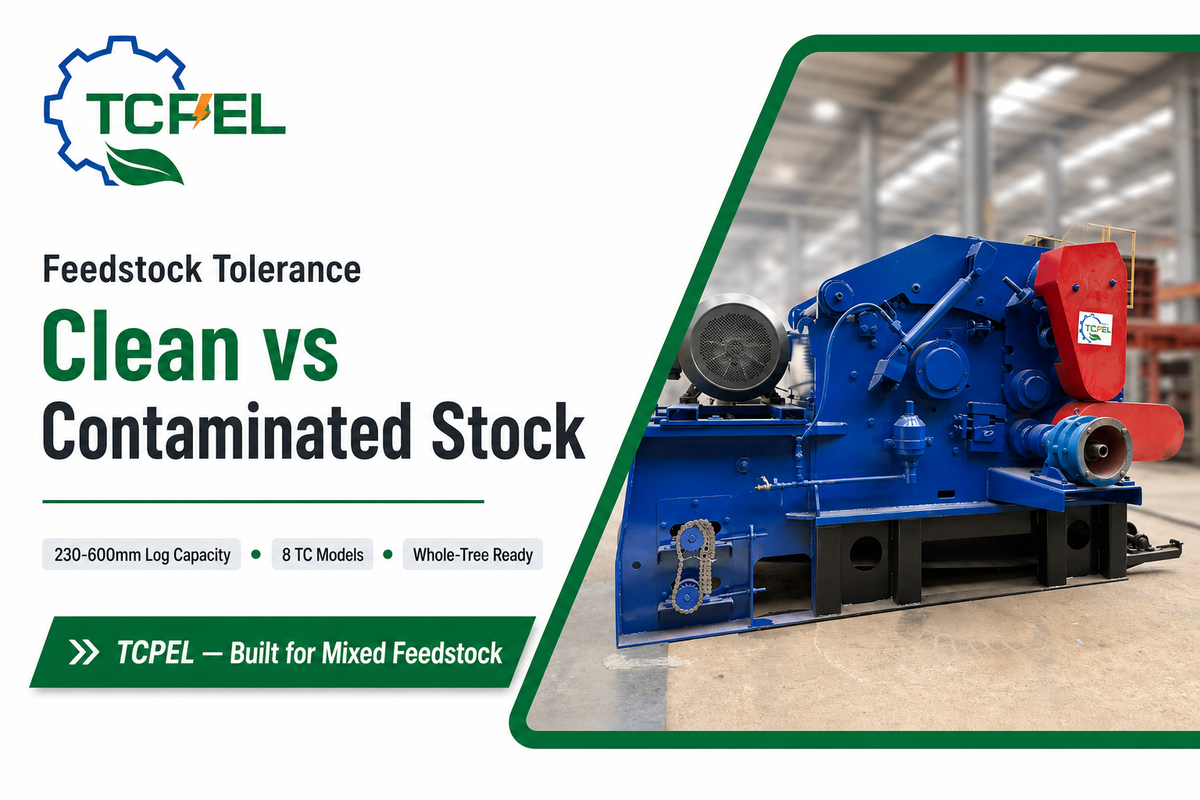
In fact, not raw horsepower but feedstock quality is the primary differentiator in a good versus a bad decision between a drum and a disc. A Florida tree service came very close to purchasing a disc chipper before the dealer pointed out that disc machines struggle with palm fronds, wrapping the shaft in stringy fiber and prematurely wearing the bearing seals faster than on a drum machine – an inability based not on size or hardness but on the specific characteristics of fibrous, non-woody material.
“Palm is very stringy. The fibers start wrapping around the shaft over time and eventually wear away the bearing seals. That’s more prevalent with disc chippers than hydraulic drum chippers-though plenty of hydraulic drum chippers choke on light material too.”
With dead, brittle hardwoods the roles are reversed: on a dead ash the owner found that sharp, brittle branches shattered under the feed rollers, causing them to get stuck sideways against the disc, thus slowing down operations; when switching to an 188hp drum chipper on similar tasks, there was considerably less debris left behind, and operation was more efficient.
Landscapers processing green waste or handling routine prune-and-clear tree work face a different calculus than a sawmill or land-clearing crew. A 6-inch infeed handles most yard debris and pruning cuts without trouble; a 12-inch or larger opening only earns its keep once you’re routinely clearing whole storm-damaged trees or C&D-style construction and demolition debris with embedded dirt. Smaller chippers built for occasional tree work rarely need a heavy-duty applications rating that a daily-use land-clearing operation requires-buying that capacity for green waste and pruning work alone wastes money on power you’ll never use. Peer-reviewed research backs up why this is a feedstock question first: a review of European wood-chip production literature found that chips repeatedly failed to meet ISO quality specifications because of contamination and moisture variability introduced during harvesting and handling, not because of the comminution machine itself (Moskalik & Gendek, 2019, Forests).
Which chipper type is better for larger branches?
Drum chippers generally handle larger, oversized, or forked branches better, because the drum’s inertia and continuous cutting action grab material forcefully without needing it presented straight. Disc chippers can match large-diameter capacity on paper, but they need a clean, straight piece to feed well.
If your feedstock regularly includes storm debris, root balls, or mixed species that aren’t yet de-barked, that material warrants a drum; a tighter chip grade is worth trading off for a disc chipper only when you’re dealing primarily with clean, straight stemwood.
📐 Engineering Note
Knife wear differs with the machine regardless of material: on a disc chipper wear is more uneven due to the smaller surface contact with material near the shaft than the outer diameter of the knives, while a drum chipper’s knives exhibit even wear across their length because they slice with the grain along the full length of the cutting edge. Uniform wear helps the drum knife have a longer operational life between resharpening; the uneven wear pattern on disc machines typically necessitates replacing the entire set of knives once the worn part of the knife dulled.
Power, Drive Type and Fuel Efficiency
On clean stemwood, a disc chipper uses 19% less fuel per oven-dry ton than a comparable drum chipper – and that number comes not from a slick brochure but from a peer-reviewed study. Spinelli, Cavallo, Eliasson, and Facello performed a 120-repetition study in 2013 and observed that a disc chipper outperformed a drum chipper on four feedstock types, from chestnut to poplar, with fuel savings between 12.8% and 21.1% depending on the material, for an overall average near 19%. Skogforsk’s separate, much larger 2024 Swedish dataset also supported this, reporting 2.16 liters per oven-dry ton for disc chippers vs. 2.47-2.64 for drum machines when chipping stemwood – roughly 14.4%-18.3% more for the drum, per that dataset. Even better, a separate Croatian Journal of Forest Engineering study of actual commercial (non-lab) operations revealed an even greater savings of 28%.
That same Silva Fennica dataset also flags a limit on how far to generalize the 19% figure: feedstock type had a strong effect on fuel consumption in its own right, one the researchers describe as potentially “stronger than the effect of chipper type.” Treat 19% as a clean-stemwood benchmark, not a guarantee that holds once moisture, species, or contamination shift.
~19%less fuel, disc vs drum on clean stemwood
8.3%drum productivity edge — not statistically significant
3independent studies confirming the fuel gap
That same study shed light on a fact most buying guides omit: the drum chipper’s about 8% productivity edge (the statistic used most to justify its higher fuel draw) over the disc, which wasn’t statistically significant (p=0.0535 at the 5% level). Researchers on that same study found no evidence supporting the popular belief that disc chippers produce a larger proportion of oversize material than drum chippers. In layman’s terms: The evidence for disc chippers being more fuel-efficient with clean stock is strong across three studies, while the evidence for the often-cited productivity gains offsetting the higher fuel draw is weaker than marketed.
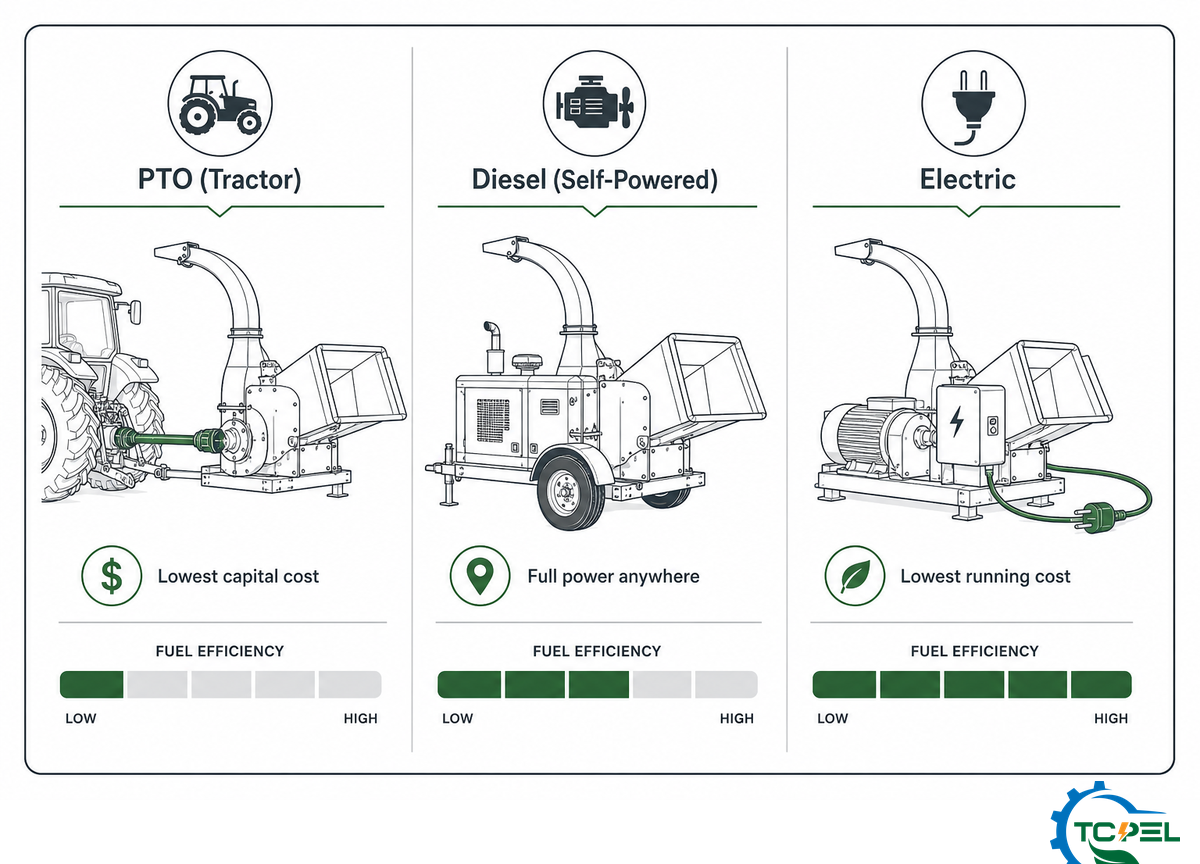
| Drive | Where it fits | Trade-off |
|---|---|---|
| PTO (tractor) | Farm, orchard, occasional use | Lowest capital cost; output capped by tractor horsepower |
| Diesel (self-powered) | Mobile, in-woods, remote sites | Full power anywhere; higher fuel and maintenance cost |
| Electric | Fixed plant, biomass and pellet lines | Lowest running cost and emissions; needs grid capacity on site |
Cost Comparison: Purchase Price and Total Fuel-Cost Economics
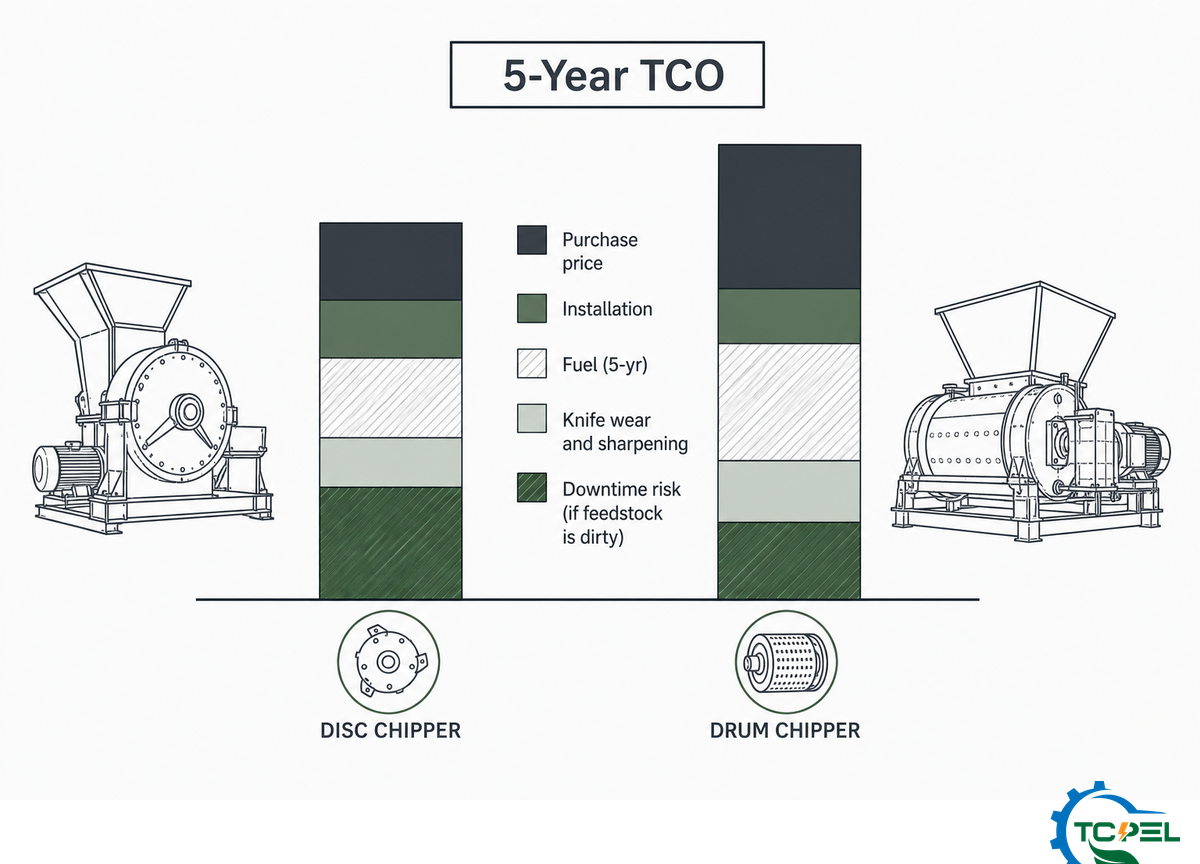
The initial purchase price for a disc chipper, with its disc-and-shear-bar combination, is generally lower than that for an equivalent-capacity drum because it’s a lighter machine and simpler to manufacture than the heavy-duty drum built to withstand repeated impact with knots and other hard debris. But over a multiyear period, that initial gap can disappear thanks to the disc chipper’s ~19% fuel savings every operating hour-assuming you can keep the feedstock clean enough that you’re not running knives at an unsustainable replacement pace. Independent, itemized purchase-price and downtime-cost benchmarks across manufacturers are thin in the published literature. Most of the verifiable numbers behind this comparison come from fuel-consumption research rather than dedicated total-cost-of-ownership studies, so treat the multiyear payback picture as directional rather than audited.
Dealer network coverage belongs in that cost math too: a machine with thin parts and service support nearby means longer downtime waiting on a knife shipment, which quietly erodes the disc chipper’s fuel-cost edge. Expected service life matters just as much-a well-maintained chipper of either mechanism type can run for decades, so buyers pricing out a new chipper purchase should weigh multi-decade service life against the upfront price gap rather than the sticker price alone. A lighter-in-weight disc chipper is also easier to tow between job sites, which matters more for a mobile tree crew than for a fixed biomass plant.
Shop for a drum chipper for sale or a disc chipper for sale online and most listings lead with price, not feedstock fit-exactly the trap this guide is meant to help you avoid. A compact PTO drum chipper aimed at farm use has a very different value proposition than a large diesel unit, and a drum style wood chipper isn’t automatically the safer buy just because it costs more. Comparison threads that surface under searches like “drum chipper vs disc chipper reddit” or “drum chipper vs disc chipper price” tend to converge on the same feedstock-first logic covered here, whether the debate is a Bandit disc chipper against a competing drum model or a drum vs flywheel chipper design question. Run your own numbers through the 5-Factor Fit Score above rather than trusting a single forum thread’s verdict.
5-year total cost of ownership, mid-capacity industrial unit (illustrative, clean stemwood feedstock):
| Cost item | Disc chipper | Drum chipper |
|---|---|---|
| Purchase price | Lower | Higher (heavier drum + frame) |
| Installation & commissioning | Comparable | Comparable |
| Fuel (5-yr, clean stock) | Baseline | ~19% higher |
| Knife wear & sharpening | More frequent — sharp edge required for output | Less frequent — tolerates moderate dulling longer |
| Downtime risk (5-yr) | Higher if feedstock isn’t kept clean | Lower on mixed/dirty material |
Payback logic: on a fixed diet of clean, debarked stemwood processing roughly 2,000 tons per year, a 19% fuel saving on a disc chipper compounds to a meaningful multi-year fuel-cost advantage over a drum machine of the same rated capacity. That advantage erodes — and can reverse — the moment feedstock includes enough bark, dirt, or oversized material to push knife-replacement frequency and downtime above what a drum machine would tolerate on the same load. That purchase-price gap is a one-time cost; the fuel and downtime gap repeats every operating year, which is why feedstock cleanliness, not sticker price, should drive the decision.
Maintenance Economics: Knife Wear and Sharpening
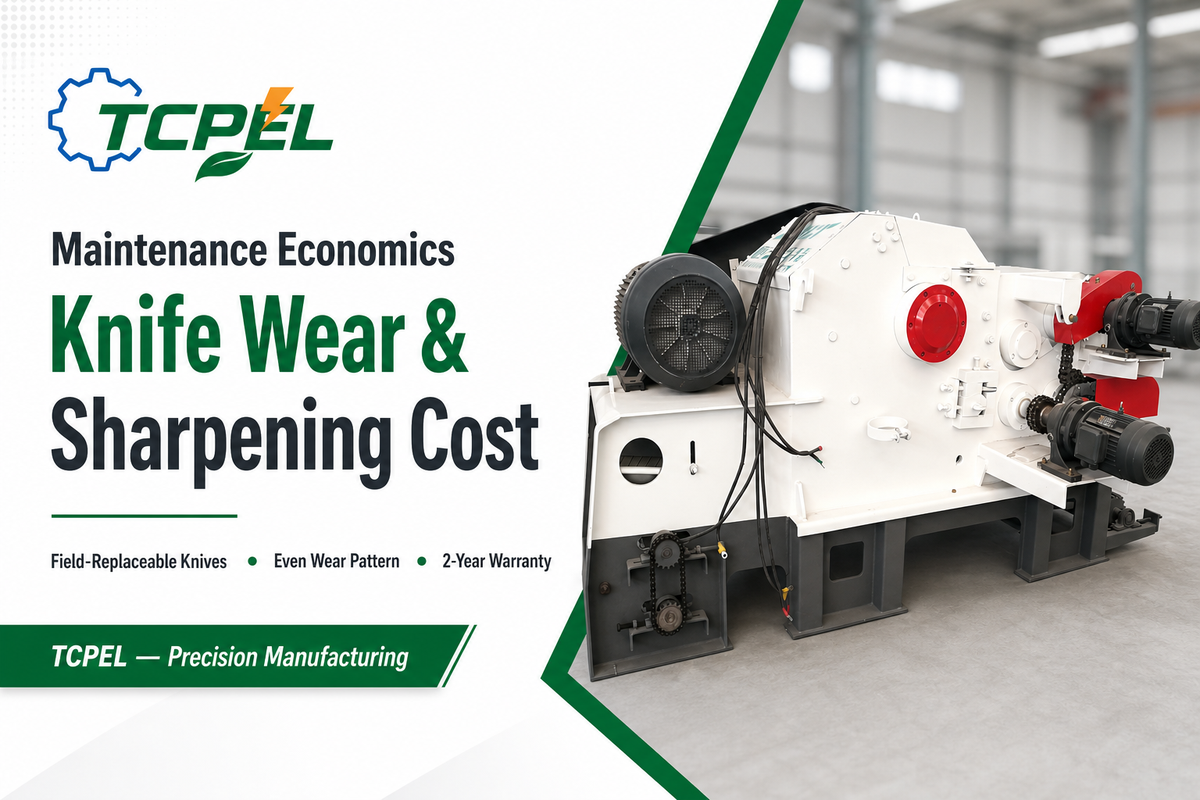
The way a machine’s knives wear down isn’t about raw operating hours, but about the fundamentally different wear pattern each machine’s knife assembly generates, and that’s what truly impacts your cost. Knife wear on disc chippers isn’t uniform: the inside edge of the knives closest to the disc shaft is constantly rubbing on more material than the outside edge. When that worn portion dulls, the whole set of knives becomes inefficient, even if parts of them are still usable. On the other hand, knives on a drum wear evenly along their entire length because the knife cut runs in the same direction as the grain, which also makes them tolerant of somewhat dull blades for a longer period.
How often do chipper blades get sharpened?
General practice is to re-sharpen a chipper’s edge every 6-8 hours, sooner on dense hardwood and much sooner when dirt and grit are present. One tree-service owner running a Vermeer disc chipper reported averaging about two hours, round trip, per knife change-out, not counting cutting time-an expense that adds up fast with an hourly crew.
A 2024 peer-reviewed field study puts numbers behind that drag on uptime: as knife wear accumulated across a chipping cycle, per-cycle chipping time rose from 25 to 38 minutes. Delays overall consumed 37% of total worksite time in that dataset, and knife management-dry sharpening or a full knife change-accounted for roughly 30% of that delay total. Dry sharpening itself took about 30% less time than a full knife change (Mihelič et al., 2024, Forests).
On either machine type, nothing matters more than keeping contamination out. A tree forum documented one provider whose knives, sharpened only a week earlier, were destroyed after concrete and rock debris from an old driveway got mixed into a brush pile and fed through the chipper, roasting the clutch and fracturing components. Other posters recognized the damage pattern as consistent with hard material, not wood.
Keeping blades sharp and properly gapped against the anvil is the single biggest lever on chip quality and engine load-a worn anvil edge or an oversized knife-to-anvil gap produces ragged chips and forces the machine to work harder regardless of mechanism type. Grease points on bearings and drive components need the same routine attention: skipping scheduled lubrication is a common way owners quietly shorten service life while telling themselves they’re cutting maintenance costs. Crews who keep their machine’s blades sharp also report less vibration during long shifts, since a dull edge tends to grab and shudder instead of shearing cleanly. Well-maintained chippers process material at their rated feed rate without bogging down or causing a blockage in the infeed chute-reducing downtime is as much about routine care as it’s about which mechanism you bought.
The 5-Factor Drum-Disc Fit Score, Which Should You Choose
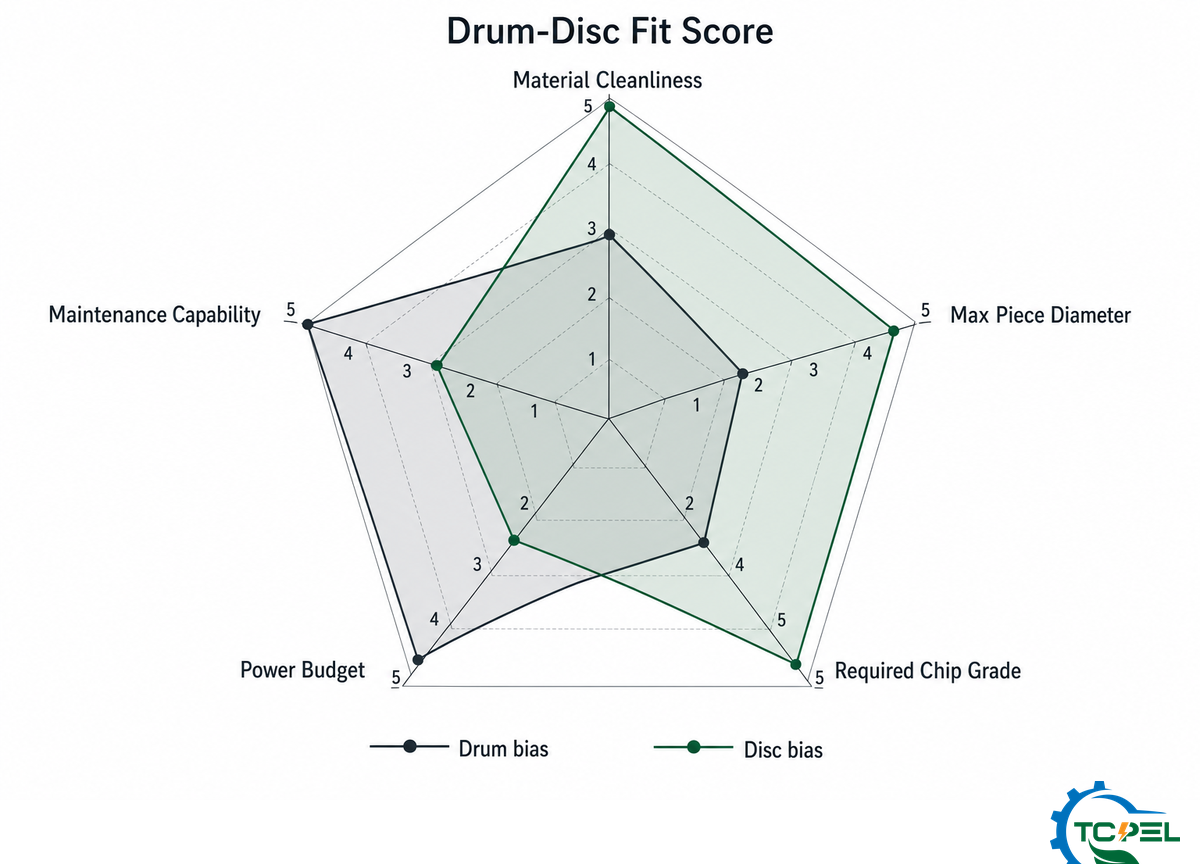
Generally, drum-vs-disc discussions get simplified into “just buy the big one” or “buy the cheap one” recommendations that fail to truly weigh your particular job. My suggested five factors-scored from 1 (heavy drum bias) to 5 (heavy disc bias)-are: cleanliness of the material, max piece diameter, desired chip grade, budget of available power and your ability to maintain equipment on-site.
The 5-Factor Drum-Disc Fit Score
- Material cleanliness – 1 (no bark, debarked material) to 5 (mixed dirt, bark, etc.)
- Max piece diameter – 1 (uniform small diameters) to 5 (very large diameter material, including full-tree, or forks)
- Required chip grade – 1 (fine-particle, tight-spread ISO 17225-4 for fuel or pulp) to 5 (wide-spread mulch grade)
- Power budget – 1 (limited, or only tractor-based PTO power) to 5 (dedicated, higher-power diesel or electric)
- Maintenance capability – 1 (you can readily re-sharpen knives and do light repair yourself) to 5 (you lack maintenance time/skills, so rely on the machine tolerating abuse better)
Let’s test: A sawmill processing offcuts with moderate bark contamination (3), with an average 14-inch diameter (3), yielding material for a fuel-grade mix (3), using only tractor PTO power (2) and with limited maintenance time available (4), gets a score of 3+3+3+2+4 = 15. Scores from 18-25 would strongly lean toward the drum design; from 6-12, lean strongly toward disc; 13-17 falls in a middle zone where both are suitable. In the middle zone, go with the cheaper option (usually disc), unless one category scores a 5 in its own right-then, that factor should be your overriding decision-maker.
Treat this score as a starting heuristic, not a verdict. Peer-reviewed forestry research on chip quality and knife wear shows that feedstock moisture, ash content, blade condition, and handling practice on site can outweigh the drum-vs-disc choice itself in determining real-world chip quality and cost. If your biggest uncertainty is how contaminated your feedstock actually runs, resolve that unknown before trusting the total.
Common Mistakes When Choosing Between Drum and Disc

The biggest errors in drum-vs-disc comparisons are rarely about machinery, but rather about the buyer’s process: I often read forum advice saying, “Buy what you can afford,” and, “Of course, there’s always some kind of issue.” The problem is, what looks like a great bargain in upfront purchase price for a disc chipper can quickly disappear when you start paying for damaged feed rollers, frequent knife replacement, and production losses because your particular waste material jams it frequently. That earlier story about palm tree trimmings highlights another classic blunder: owners investigate a general chipper, but don’t thoroughly consider whether their actual materials (wet bark, woody palm fronds, storm-blown dirt-covered brush) fit the machine they’re buying.
Choosing the right chipper starts with an honest read of your material, not an abstract debate over disc or drum. Forums are full of threads where owners compare drum and disc models, a Bandit disc chipper against a Morbark 2400 drum chipper, for instance, and reach opposite conclusions, not because one brand builds a better machine but because their feedstock differed. Chippers are typically marketed as all-purpose equipment, and a machine that excels on clean tree-work debris may struggle the moment C&D-style construction and demolition debris with embedded grit enters the feed. New chipper buyers who skip this step tend to repeat the same mistake described above: deciding on budget alone.
Do
- Score your actual feedstock against the 5-Factor Fit Score before comparing brands
- Ask what a bearing seal or knife-change repair costs on the specific model, not just the sticker price
- Confirm current safety compliance against ANSI Z133-2026, which replaced the 2017 edition in May 2026
- Budget for downtime, not just fuel, when your material includes bark or dirt
Don’t
- Assume the bigger or more expensive machine is automatically the safer buy
- Feed rock, concrete, or metal-contaminated brush piles through either machine type
- Trust a precise RPM spec from a single manufacturer source without independent confirmation
- Buy disc for consistently dirty or oversized feedstock to chase a lower sticker price
Safety Compliance needs to be one of the line items in the decision, not the end goal. OSHA’s own safety bulletin highlights 39 chipper related fatalities from 1996 to 2005 with 78% involving workers being caught inside of the machine rather than struck by ejected debris-the machine access-cover interlock and lockout regulations (29 CFR 1910.266(h)(4)) apply equally to both machines. In tree-care specific applications, a new safety standard has been recently published. The ANSI Z133-2026 developed by the International Society of Arboriculture was approved and published on May 27, 2026 and has superseded the 2017 edition. Most current machine operating procedures still reference the older ANSI Z133 standard, so it’s worthwhile to double check machine specifications prior to machine delivery-no matter the mechanism type.
Frequently Asked Questions
Q: Is a drum wood chipper better than a disc chipper?
Neither is universally better: a drum chipper wins on contaminated, oversized, or forked material, while a disc chipper wins on fuel economy and chip consistency with clean stock.
One of the few pieces of peer-reviewed research to date-a 120-repetition study-shows that disc chippers use approximately 19% less fuel per ton than drum chippers on clean stemwood, and that drum’s often-cited productivity edge over disc was not statistically significant. But this study did not include contaminated or larger-than-optimum materials – precisely the circumstances where the majority of user reports favor drum-style machines. We are aware of at least one case of a disc chipper getting plugged repeatedly on dead and brittle ash before switching to a heavier-duty drum-style machine resolved the problem. Match the machine to the material you’ll process-not to the perceived best “all-around” machine.
Q: How fast does a chipper drum spin?
Independent sources put chipper rotor speeds in a combined 1,000-2,000 RPM range for both drum and disc designs, with real-world drum reports running as wide as 1,500-3,200+ RPM depending on flywheel size and drive era.
A “800-1200 RPM for drum style” figure has circulated on many buyer guides but is attributable to a single manufacturer and not validated by any published, peer-reviewed research. One published paper found a combined 1,000 to 2,000 RPM for both mechanism types and references one actual disc-chipper example running at 1,500 RPM. Take any single precise RPM number you find referenced on the web with a grain of salt, and get the actual rated RPM for your intended machine from the manufacturer.
Q: What are the common problems with chipper machines?
Feed jams from oversized or brittle material, knife damage from rock or metal contamination, and uneven knife wear that forces early full-set replacement on disc machines are the most common problems.
Feedstock contamination is the most significant lever on either machine-one machine had knives completely destroyed after one week when contaminated with old driveway debris containing rocks and concrete. A secondary, and very common failure, mode is where a customer purchases an undersized machine that “will always have stuff that is too big for it.” This leads to excess hand trimming and undermines the primary benefit of using a chipper. Keeping debris such as rocks, concrete and metal out of the feedstock and performing a pre-shift inspection will prevent the majority of failures of either mechanism type.
Q: What is a drum chipper?
A drum chipper reduces wood by feeding it against a heavy rotating drum lined with knives around its circumference, cutting with the grain rather than slicing against a fixed blade like a disc machine does.
Its mass provides the momentum necessary to drive material with knots, forks, and bark without getting stuck in the way a lighter machine would. For processing larger diameter and contaminated feedstock, this is the reason why drum-style equipment has become the industry standard for land clearing, storm cleanup and mixed-species brush processing. This comes at the expense of the chip produced and fuel consumption; a drum-style machine tends to have a larger spread of chip sizes and more fines than a disc machine working the same clean stemwood, while using about 19% more fuel per ton doing it.
Q: Can a disc chipper handle contaminated or dirty feedstock?
Poorly, disc chippers need consistently sharp knives to perform, and dirt, bark, or grit dulls the edge fast, unlike a drum chipper’s more forgiving tolerance for moderately dull blades.
According to field practitioners, the presence of stringy, or fibrous material is specifically more abrasive on the disc chipper’s bearing seals than it is to a drum machine’s hydraulic seals. As cycles continue, the fibers can begin to wrap themselves around the shaft and slowly wear away at the seal-a form of wear failure dealers said they’d far more commonly see on their disc-type machines compared to their hydraulic drum feeders. On a disc chipper, a unique knife wear pattern causes additional problems; one spot that has dulled may force a complete changeout of the entire knife set when other parts of the cutting edge are still good, a far cry from the even wear of a drum chipper across its knife length. If your job typically involves barking, dirt, gravel from construction work or species such as palm fronds, then a drum chipper’s tolerability of non-ideal material is more economical in terms of downtime than what you might save up front on a disc chipper.
Q: Do drum chippers need less engine horsepower than disc chippers?
No, on a like-for-like capacity basis, drum chippers generally need more, not less, engine horsepower than disc chippers, because the drum’s added mass and roughly 19% higher fuel draw both point toward a larger power requirement.
One arborist with years of experience conducted a spec-sheet review of commercial models, finding that disc chippers often required less horsepower per capacity than equivalent models of drum machines-the exact opposite of the common presumption that a larger capacity unit requires more horsepower.
About This Analysis
Whether you call it a wood chipper or a woodchipper, drum machines generally handle large, oversized pieces with sharp blades better than disc machines do, and this comparison draws on peer-reviewed forestry engineering research (Silva Fennica, Skogforsk, Croatian Journal of Forest Engineering, and the MDPI journals Agriculture and Forests), OSHA and ISO regulatory documentation, and field-practitioner accounts from arborist and tree-care forums, cross-checked against three independent manufacturer buyer’s guides. Where a claim, such as a specific rotor-speed range, could not be independently confirmed, we say so rather than repeating an unverified single-source figure. TCPEL manufactures drum-style chippers as part of a complete biomass feedstock-preparation line; where our own product line is referenced, it is noted explicitly rather than folded into the comparison data above.
References & Sources
- Fuel Consumption and Productivity of Motor-Manual Bucking, Skidder and Chipper (Spinelli et al., 2013) Silva Fennica, Finnish Society of Forest Science
- ISO 17225-4:2021, Graded Wood Chips International Organization for Standardization
- 29 CFR 1910.266, Logging Operations U.S. Occupational Safety and Health Administration
- Safety and Health Information Bulletin, Hazards of Wood Chippers U.S. Department of Labor (OSHA)
- ANSI Z133-2026 Safety Standard International Society of Arboriculture
- Biomass Comminution Equipment Performance Study Agriculture (MDPI), peer-reviewed
- Forest Operations Equipment Catalog, Chippers USDA Forest Service
- Adjustable-Angle Disc Chipper Patent CN222904377U Northeast Forestry University
- The Effect of Knife Wear and Sharpening Mode on Chipper Productivity and Delays (Mihelič et al., 2024) Forests (MDPI), peer-reviewed
- Production of Chips from Logging Residues and Their Quality for Energy: A Review of European Literature (Moskalik & Gendek, 2019) Forests (MDPI), peer-reviewed
Related Articles
- Drum Chipper Buyer’s Guide full sizing, brand landscape, and cost breakdown for the drum category
- Wood Crusher vs Shredder pre-reduction options for contaminated feedstock before chipping
- Biomass Hammer Mill Guide secondary size reduction after chipping
- Pallet Crusher Guide dedicated equipment for pallet and dimensional-lumber waste
- How to Start a Wood Pellet Business where chipping fits in a full pellet production line