Get in Touch with TCPEL

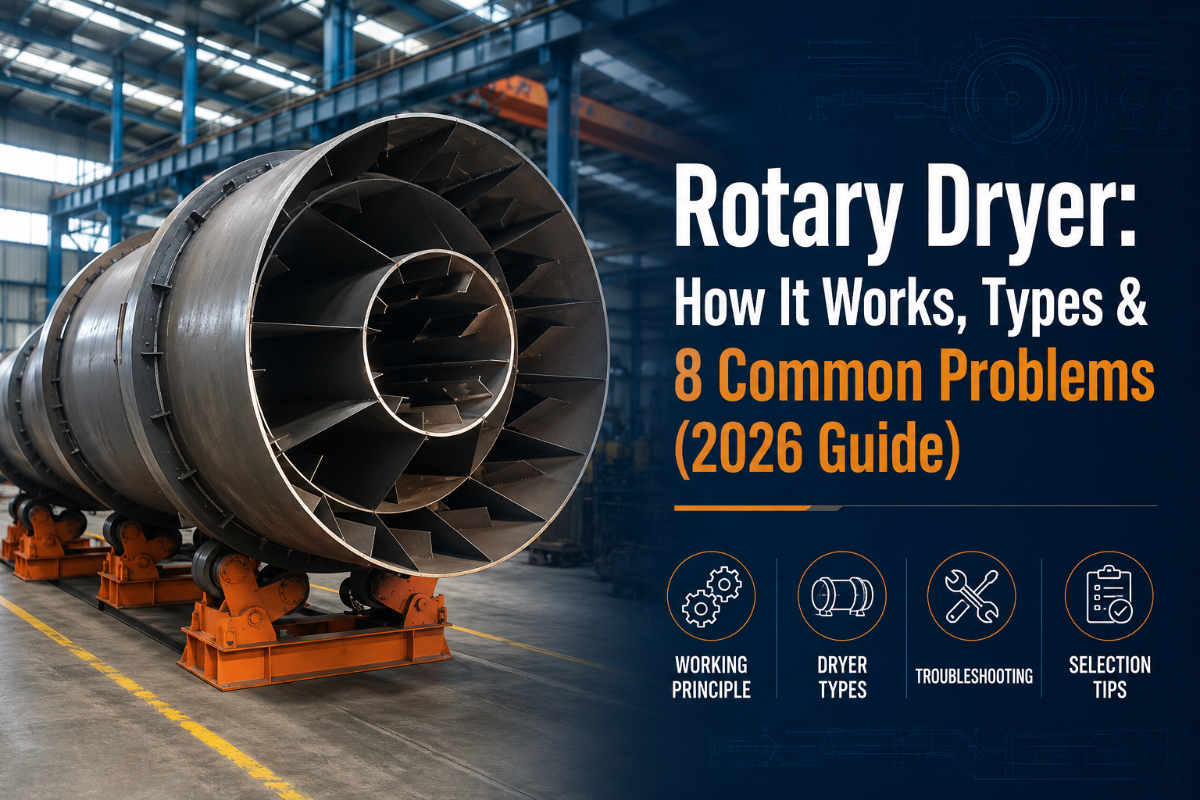
A rotary dryer is the workhorse that turns wet, freshly chipped wood, sawdust, sand, or mineral feed into a free-flowing solid your downstream line can actually use. If you run a pellet line, a foundry, or a mineral plant, the rotary dryer — also called a rotary drum dryer — sits at the point where moisture decides whether everything after it works. This guide explains how it works, the main types, what it costs to run, and the eight problems that most often take one offline.It is written as operating-and-troubleshooting background. When you are ready to compare models, capacities, and pricing, the industrial rotary dryer model and specification page covers selection in detail.
Quick Specs: Typical Rotary Dryer Operating Envelope
Indicative industry ranges for direct-fired bulk-solids units, not a single machine’s data sheet. Always size against your own material.
| Inlet gas temperature | ~93–1,200 °C (200–2,200 °F) full industry span; biomass commonly 350–600 °C |
| Moisture reduction (biomass) | e.g. ~50%+ wet feed down to 10–15% in a single pass |
| Residence time | 5–90 min (commonly 5–30 min), set by length, slope, speed |
| Drum slope / rotation | 1–5° slope; ~2–10 rpm |
| Heating method | Direct (co-current / counter-current) or indirect / steam-tube |
| Common materials | Biomass, sawdust, wood chips, sand, coal, minerals, fertilizer |
What Is a Rotary Dryer (and What Is It Used For)?
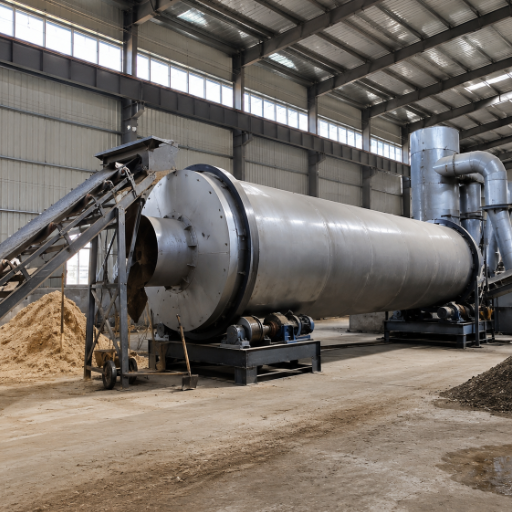
A rotary dryer is an industrial dryer built around a long steel cylinder that rotates slowly while wet solid material moves through it. Hot gas contacts the material and carries away moisture, dropping the moisture content to a target level. The University of Michigan’s chemical engineering reference describes the rotating shell as both a conveyor and a stirrer — it moves the solid along while mixing it into the gas .
That simple idea handles many different materials. Rotary dryers dry wood chips, sawdust, and biomass headed to a pellet line, plus sand, coal, fertilizer, and mineral ores. America’s National Renewable Energy Laboratory (US DOE) groups rotary dryers with flash and superheated-steam dryers as the main options for drying biomass fuel .
What makes the machine matter happens downstream. Wet feedstock at 45–55% moisture wastes burner fuel, jams pelletizers, and lowers product quality, because every point of excess moisture is energy the next stage cannot use. Drying first protects everything after it — which is why a dryer usually sits between size-reduction equipment like a drum chipper or hammer mill and a pellet machine.
How a Rotary Dryer Works: Components & the Three-Zone Drying Curve
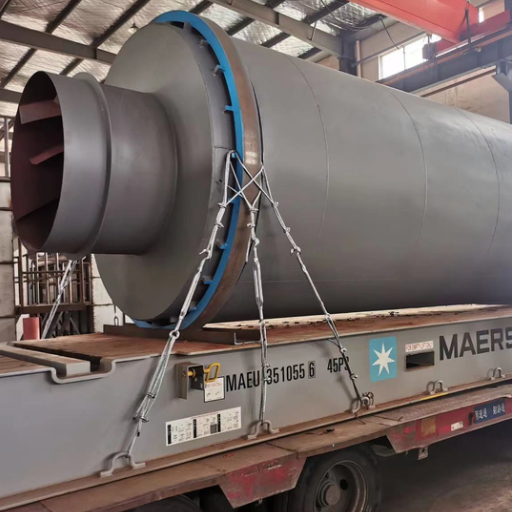
Strip away the brand names and every rotary drum dryer shares the same parts. A feed end takes in wet material. Inside the rotating drum, lifting flights (also called lifters or vanes) pick the solid up and shower it down through the gas — the cascading action that does most of the drying. A burner and combustion chamber supply heat, support rollers carry the drum’s weight, and an induced-draft fan with a cyclone pulls gas and fines out the discharge end.
What are the key components of a rotary dryer?
Only a handful of parts matter: feed chute, the rotating cylinder (the shell), lifting flights, the burner/combustion chamber, riding rings and support rollers, the drive (a girth gear or chain drive), and the discharge plus gas-cleaning train. Heat transfer is mostly convection — hot gas to tumbling particle. That coefficient rises with gas velocity (academic models put it on roughly the 0.8 power of gas mass velocity), which is why airflow, not just flame temperature, sets the drying rate .
One trap is treating the drum as one uniform box, when drying actually happens in stages. It helps to picture drying as The Three-Zone Drying Curve along the drum.
In the first zone, near the inlet, free surface moisture flashes off fast at a roughly constant rate, often removing the first 20–30 points of moisture in minutes. In the middle zone, the easy water is gone and the rate starts to fall as moisture has to migrate from inside each particle. In the final zone, near the discharge, the curve flattens — the last few points of moisture are the slowest and most fuel-hungry to remove.
Flight design controls how well those zones do their job. A patent for adjustable flights with internal dams (US 5,083,382, Gencor, 1990) describes the core problem plainly: flighting on the downhill side throws a thinner curtain than the uphill side, so hot gas slips past instead of contacting the material, and the drum overheats unevenly . Good lifters keep the curtain dense and even across the whole cross-section.
“On biomass lines we tune residence time and airflow to the target moisture first, then set burner temperature to match. Chasing a low moisture number with a hotter flame is how shops scorch product and start fires.”
Direct vs Indirect vs Steam-Tube: Rotary Dryer Types Explained
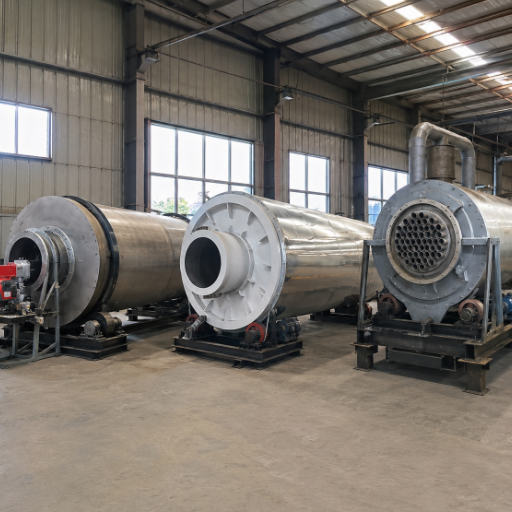
Choosing the wrong type is an expensive problem — an indirect unit bought for a duty a direct dryer handles can cost far more to run for no quality gain. Rotary dryers split first by how heat reaches the material.
In a direct dryer, combustion gases touch the solid — efficient and common for biomass, sand, and minerals that tolerate flue-gas contact. In an indirect dryer, the material is heated indirectly — heat passes through the drum shell or internal tubes, so the solid never meets the gas; this suits heat-sensitive, fine, or dust-prone feeds. Steam-tube dryers are an indirect variant that heat through internal steam tubes.
Direct dryers also split by gas direction. Co-current designs send gas and material the same way, so the wettest feed meets the hottest gas — gentle on the dried product. Counter-current designs run them opposite, pushing toward lower final moisture but exposing nearly dry material to the hottest gas. That choice is a real engineering trade-off, not a marketing label.
How is a rotary dryer different from a rotary kiln?
They look alike but do different jobs. Functionally, a rotary dryer removes moisture and leaves the material chemically unchanged, while a rotary kiln runs far hotter to drive a chemical reaction — calcining limestone, for example. Mixing them up is an expensive problem: a kiln-grade machine bought for a simple drying duty wastes both fuel and capital. People searching “rotary kiln dryer” usually want a dryer, not a calciner.
This section is a concept overview on purpose. To match a specific configuration to your feed and capacity — single-pass versus triple-pass, direct versus indirect — use the selection matrix on the industrial rotary dryer specification page.
Materials & Applications: The Material-Moisture Match
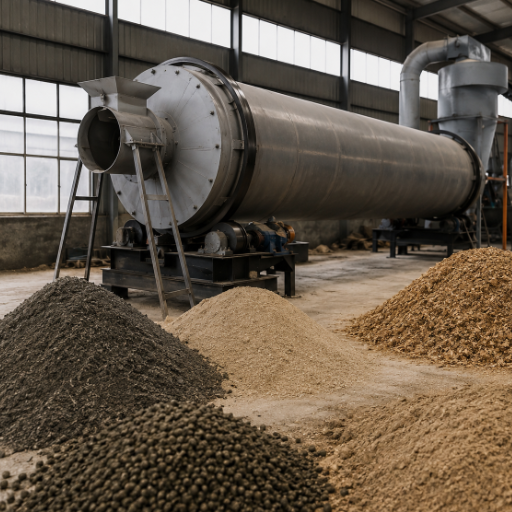
By far the most common sizing mistake is treating capacity as a fixed number. It is not. One unit rated for 5 tons per hour of sand may not move 5 tons per hour of wet sawdust, because sawdust mats and resists tumbling . Throughput is material-specific, and so is the right heating method.
Use The Material-Moisture Match below as a starting cue, then confirm against a real drying test on your sample. It maps a feedstock to a typical inlet-moisture band, a heating method, and the airflow direction that usually fits.
| Material | Typical inlet moisture | Heating method cue | Airflow cue |
|---|---|---|---|
| Sawdust / wood shavings | ~45–55% | Direct, watch fire risk | Co-current (gentle) |
| Wood chips | ~50%+ (can exceed 100% dry basis) | Direct | Co-current |
| Sand / aggregate | ~5–10% | Direct, high temp | Counter-current |
| Fine / heat-sensitive solids | varies | Indirect / steam-tube | n/a (no gas contact) |
Biomass also burns differently by species. Fibrous feeds ignite more easily than non-fibrous ones, and operators report that red cedar combusts in the drum more often than conventional spruce-pine-fir . That single fact changes how you set temperature for a cedar-heavy feed.
Here is why the match matters in practice. One small pellet shop in the US Pacific Northwest sized a drum for 4 tons per hour on dry planer shavings, then switched its feed to fresh sawmill sawdust at roughly 50% moisture. Throughput collapsed to barely 2 tons per hour, because the wet sawdust matted and resisted the cascade.
Its wettest feed simply would not throw a clean curtain through the gas. Their fix was not a bigger burner; it was pre-blending the wet sawdust with drier shavings to hold inlet moisture steady. Across TCPEL biomass dryer installations in 60+ countries, this material-first sizing is the most common correction the engineering team makes after the fact.
Operating Temperatures, Fuel Options & Throughput
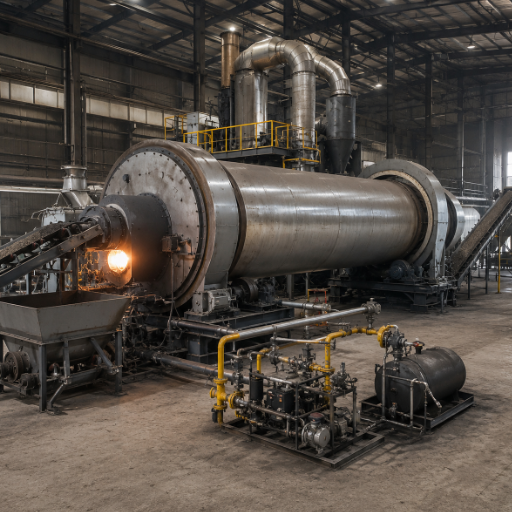
Temperature is where the most expensive mistakes happen, because the obvious lever — turn up the heat — is usually the wrong one. Inlet gas temperature spans a wide industry band — roughly 93–1,200 °C (200–2,200 °F) across all duties — but the figure that matters is your material’s ceiling, not the maximum the burner can reach. Biomass lines often run inlet gas in the 350–600 °C range, with outlet gas far lower once it has given up heat to the wet feed.
Fuel is flexible. Direct-fired units run on natural gas, LPG, diesel, biomass, or coal; many biomass plants close the loop by firing the dryer on the same wood waste they process. One DOE/NREL study notes that rotary drying with boiler exhaust gases can cut fuel use and make a boiler less sensitive to swings in fuel moisture .
📐 Engineering Note
Set throughput from residence time, not the nameplate. Residence time (5–90 min) is governed by drum length, a 1–5° slope, and ~2–10 rpm. Dropping slope or speed lengthens residence time; raising speed shortens it and can raise the drying rate, but too much speed damages fragile material. Size to hit your target moisture at a safe inlet temperature — not to push the highest tons-per-hour the drum can spin
Common Problems & Troubleshooting: The 8 Rotary Dryer Failure Modes
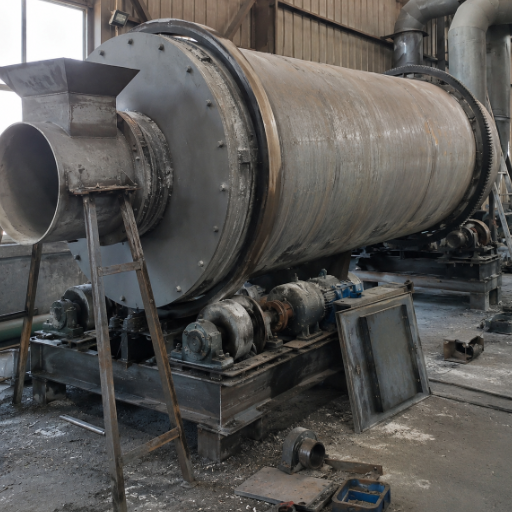
Most rotary dryer trouble is not exotic. Industry field reports converge on the same short list: failures trace to dust accumulation, misalignment, and weak preventive maintenance far more often than to any design flaw . Use The 8 Rotary Dryer Failure Modes below to move from symptom to root cause to a field fix.
| Symptom | Likely root cause | Field fix |
|---|---|---|
| 1. Incomplete / wet product | Buildup on walls insulating heat; clogged ducts; low residence time | Clean shell & ducts; slow drum / reduce slope; check burner |
| 2. Uneven moisture | Thin or worn flight curtain letting gas bypass | Inspect / adjust flights; restore even veiling |
| 3. Material build-up / “ringing” | Sticky feed at the inlet; aggressive lifters | Add knockers; use a bald section + softer inlet lifters |
| 4. Dryer fire | Dust + hot particles + over-temperature; fibrous feed | Lower inlet temp; clean ducting; spark detection; safe shutdown drill |
| 5. Excess dust / emissions | High gas velocity carrying fines; worn cyclone | Tune airflow; service cyclone + baghouse |
| 6. Noise / vibration | Worn or misaligned rollers; loose bolts; poor lubrication | Re-align; torque fasteners; lubricate on schedule |
| 7. Rising fuel use | Air leaks; lost insulation; buildup | Seal leaks; re-lag the shell; remove buildup |
| 8. Over-dried / scorched product | Inlet temp above the material’s limit; too-long residence | Cut inlet temp; raise speed slightly; trim burner |
What are the most common problems with rotary dryers?
If you only watch three things, watch buildup, alignment, and fire risk. Buildup on the shell and flights insulates heat, throws moisture off-spec, and can break loose in clumps that damage the flights and discharge. Misalignment shows up first as noise and vibration. And fire is the one that closes plants.
One field account captures the fire pattern well: dryer fires rarely come from a single dramatic mistake — they come from a pileup of small bad habits, like dirty ducting, poor temperature control, worn seals, and hot particles meeting dust . Patent and DOE sources note that wood-dust fire risk drops sharply once oxygen in the drum is held below about 8–10%, especially when feed moisture stays above 30% .
Picture the most common version of failure mode 1. A sawdust plant in northern Europe ran clean for two winters, then began shipping pellets that failed the durability test every afternoon. The root cause was not the dryer design — it was a 2 mm crust of buildup on the flights that had grown over months, throttling the curtain so the last drying zone never finished its job.
A weekend of cleaning plus a set of knockers on the shell restored output. The lesson TCPEL service engineers repeat is blunt: schedule the cleaning before the product fails, because by the time moisture drifts off-spec the buildup is already costing fuel.
⚠️ Important
Cranking the burner to dry faster usually backfires. Past a material’s limit, higher inlet temperature causes coking, color change, product degradation, and fire — not faster throughput. One trial of heat-sensitive product found quality dropped when temperature rose from 50 to 65 °C, with the best result at 55 °C . Tune residence time and airflow first; raise temperature last.
Drying Efficiency, Energy Use & Emissions Control
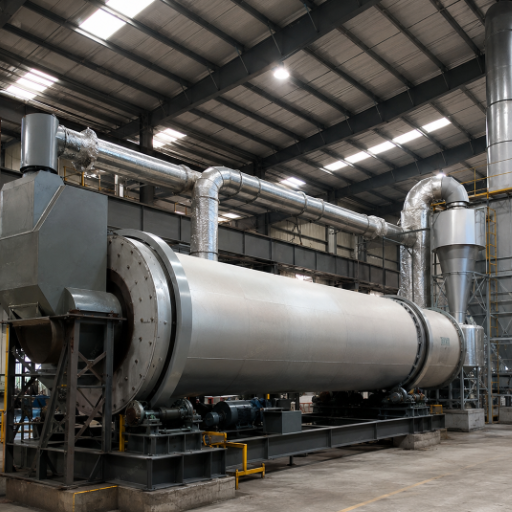
Energy is the running cost that matters, and almost all of it goes to evaporating water. Vaporizing water alone sets a theoretical floor of about 2,257 kJ per kg (roughly 970 BTU per lb). Real industrial dryers run higher once you add sensible heat and losses — published analysis puts direct dryers near 2,880–3,250 kJ/kg and indirect dryers near 2,700–3,060 kJ/kg of water evaporated.
For biomass specifically, peer-reviewed work reports indirect drying around 3.2–3.6 MJ per kg of evaporated water, and notes that rotary dryers tend to use 15–30% less specific energy than several alternative dryer types . Treat the biomass figure as a single-study range rather than a fixed constant.
Practical levers are unglamorous, and the reason they get ignored is that none of them feels urgent until the fuel bill climbs. Insulate the shell, seal air leaks, recover heat where you can, and keep buildup off the walls — each one lowers the fuel burned per ton of water removed. What makes a leaky, un-lagged drum costly is that it spends fuel heating ambient air instead of your feed. When TCPEL engineers audit an underperforming line, sealing leaks and re-lagging the shell is usually the first fix, because it pays back faster than any burner upgrade.
Emissions ride out with the exhaust, so a rotary dryer is only as clean as its gas-cleaning train. Particulate is typically caught by a cyclone followed by a fabric-filter baghouse; volatile organic compounds and odor are handled by wet scrubbers, venturi scrubbers, or activated carbon. US EPA guidance lists wet scrubbers as a recognized control technique for particulate from this kind of exhaust .
How to Source a Rotary Dryer (What to Specify)
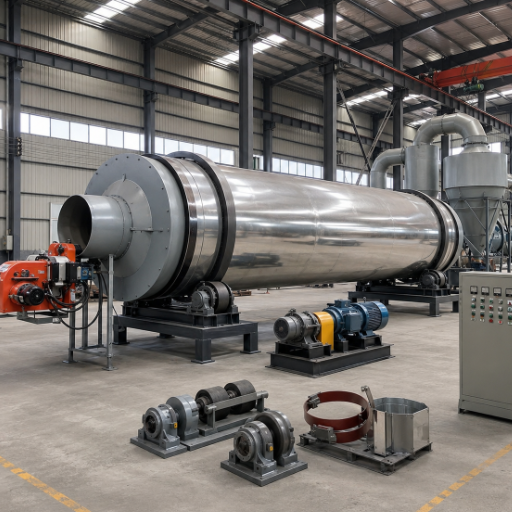
Every useful quote starts with a clear spec brief. Manufacturers cannot size a dryer from “I need a rotary dryer” — they need the numbers that drive the design. Give them these and the conversation moves fast.
- ✔ Material and bulk density (and whether it can touch flue gas)
- ✔ Inlet and target outlet moisture content
- ✔ Required throughput in tons per hour
- ✔ Available fuel and any material temperature limit
- ✔ Footprint, plant elevation, and emissions limits
With those in hand, ask each supplier to run a drying test on your actual sample rather than quoting from a chart. For TCPEL rotary dryer models, capacity bands, and pricing, start at the rotary dryer systems page, or see how the dryer fits a full biomass pellet production line with a pellet cooler and feed pellet machine.
Not sure which configuration fits your feedstock?
Industry Outlook: Where Biomass Drying Is Heading
Demand is the tailwind. Biomass pellet demand is projected to grow from about USD 14.99 billion in 2026 to USD 25.44 billion by 2034, a compound annual rate near 6.83%, with Europe holding the largest share . More pellets means more wet feedstock that has to be dried first.
Automation is the clearer technical shift, and the problem it solves is the single biggest source of scorched product and dryer fires: manual temperature control. New lines increasingly add variable-frequency drives and automated controls, and some plants now use computer-vision moisture sensing to adjust the process in real time — with reported energy savings in the 15–25% range. For a buyer in 2026, the practical takeaway is to ask whether a dryer can integrate PLC-based moisture control, because manual temperature control is exactly the habit that drives both over-drying and fires.
Frequently Asked Questions
Q: What is a rotary dryer used for?
View Answer
A rotary dryer reduces the moisture content of bulk solids by tumbling them through a heated rotating drum. It is used across biomass and wood-pellet production, sand and aggregate processing, fertilizer, coal, and mineral plants — anywhere wet feedstock needs to reach a stable, free-flowing moisture level before the next process step.
Q: What’s the difference between a direct and an indirect rotary dryer?
View Answer
In a direct rotary dryer, hot combustion gases contact the material — efficient and common for biomass, sand, and minerals. In an indirect dryer, heat passes through the drum shell or internal tubes and the material never touches the gas, which suits heat-sensitive, fine, or dust-prone feeds. Direct is cheaper to run; indirect protects product quality and limits contamination.
Q: What temperatures do rotary dryers typically operate at?
View Answer
Inlet gas temperature spans roughly 93–1,200 °C (200–2,200 °F) across all duties, but the working figure is set by the material, not the burner. Biomass lines commonly run inlet gas around 350–600 °C, while the outlet gas is far cooler after giving up heat to the wet feed. The right temperature is the highest one that stays safely below the material’s degradation or ignition point.
Q: What types of fuel can rotary dryers accept?
View Answer
Direct-fired rotary dryers run on natural gas, LPG, diesel, biomass, or coal. Many biomass plants fire the dryer on their own wood waste to close the loop.
Q: Are rotary dryers energy efficient, and how is efficiency measured?
View Answer
Efficiency is measured as energy used per unit of water evaporated. The theoretical floor to vaporize water is about 2,257 kJ/kg (≈970 BTU/lb); real industrial dryers run higher — direct units near 2,880–3,250 kJ/kg and indirect units near 2,700–3,060 kJ/kg — because of sensible heat and losses. Peer-reviewed biomass work reports indirect drying around 3.2–3.6 MJ/kg and finds rotary dryers using roughly 15–30% less specific energy than several alternatives. You improve it by insulating the shell, sealing air leaks, recovering heat, and keeping buildup off the walls.
Q: Can rotary dryers be automated?
View Answer
Yes. Modern units add variable-frequency drives, PLC control, and moisture sensing to hold outlet moisture steady and protect against over-drying. Automated moisture control is becoming a standard ask on new biomass lines in 2026.
Related Articles
- Industrial Rotary Dryer Models & Specifications — full selection and sizing matrix
- Rotary Dryer Systems — capacity bands and configurations
- Chicken Feed Pellet Machine Guide — downstream pelleting
- Cattle Feed Pellet Machine Guide — sizing a feed line
- Drum Chipper — size reduction before drying
References & Sources
- Report on Biomass Drying Technology (NREL/TP-570-25885) — National Renewable Energy Laboratory / US DOE
- Visual Encyclopedia of Chemical Engineering Equipment — Dryers — University of Michigan
- Rotary Drying of Wood Waste Fuels with Boiler Exhaust Gases — OSTI / US DOE
- Wet Scrubber for Particulate Matter — Control Technique — US Environmental Protection Agency
- Indirect Dryers for Biomass Drying (ChemEngineering, 4(1):18) — MDPI, peer-reviewed
- Information Sheet 12: Woody Biomass Fuel Drying — Bioenergy Association of New Zealand
About This Guide
This guide was written and reviewed by the TCPEL engineering team, which builds rotary dryers, drum chippers, and full biomass pellet lines and has exported drying and pelleting equipment to more than 60 countries since 2020. The operating ranges here reflect direct biomass-drying experience; the temperature, energy, and emissions figures are drawn from the public sources cited above, and material-specific behaviour should always be confirmed with a drying test on your own sample. TCPEL is CE and ISO 9001:2015 certified.