Get in Touch with TCPEL

Top 20 Wood Pellet Machine Manufacturers by Buyer Fit

Last updated: October 2026
The top wood pellet machine manufacturers are ANDRITZ, Bühler and CPM for large industrial systems, with other groups suited to different project scales and service needs. AMANDUS KAHL and SALMATEC are documented pellet mill manufacturers for European mill ranges. TCPEL, RICHI and Yulong are pellet mill manufacturers serving export projects. Buskirk manufactures smaller pelletizing systems for the North American market. The best option is dependent on the feedstock, sustained capacity, contract scope and location of the service.
Quick Picks by Wood Pellet Project Type
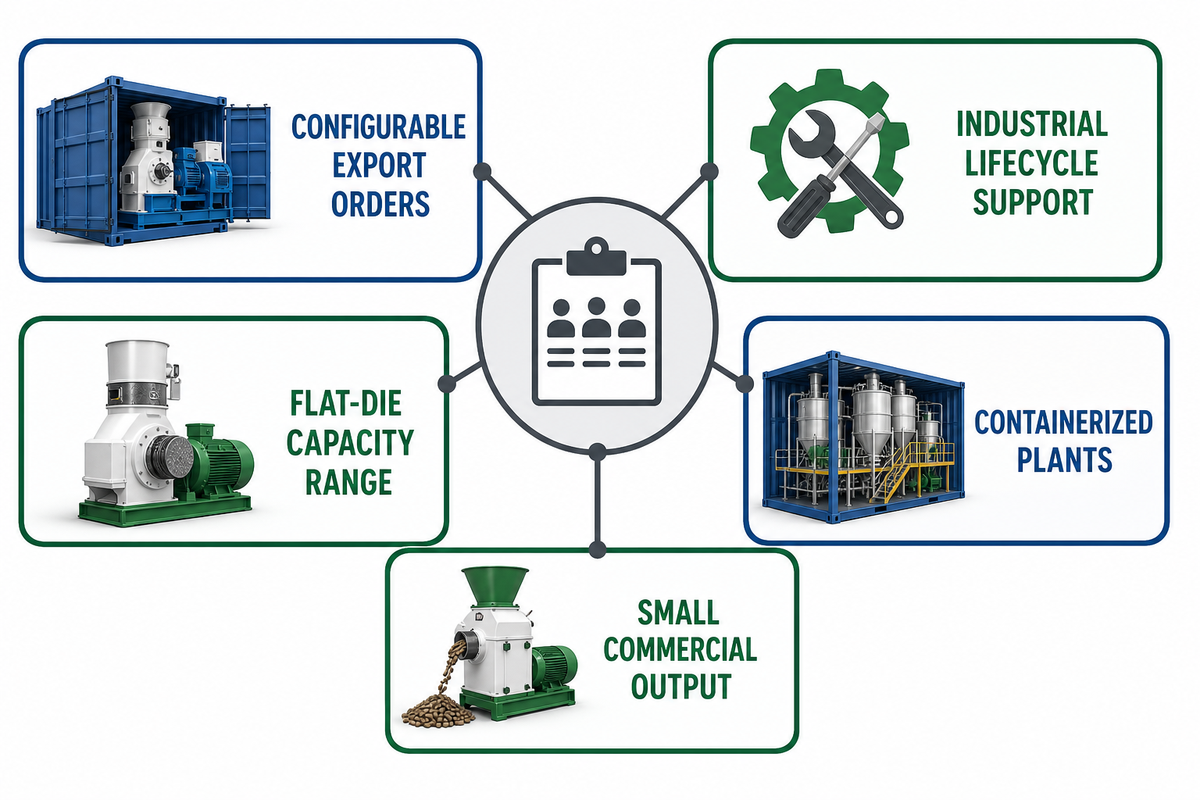
- Best for configurable export orders: TCPEL
- Best for large industrial lifecycle support: ANDRITZ
- Best for a documented flat-die capacity range: AMANDUS KAHL
- Best for containerized plants: PRODESA
- Best for small commercial North American production: Buskirk Engineering
These are starting points, not a ranking based on performance. A press that appears suitable on a catalog page can still not meet the target if the raw material moisture and particle size, utility limitations or downstream cooling differ from the circumstances for which the equipment was designed.
How We Selected These Manufacturers for 2026
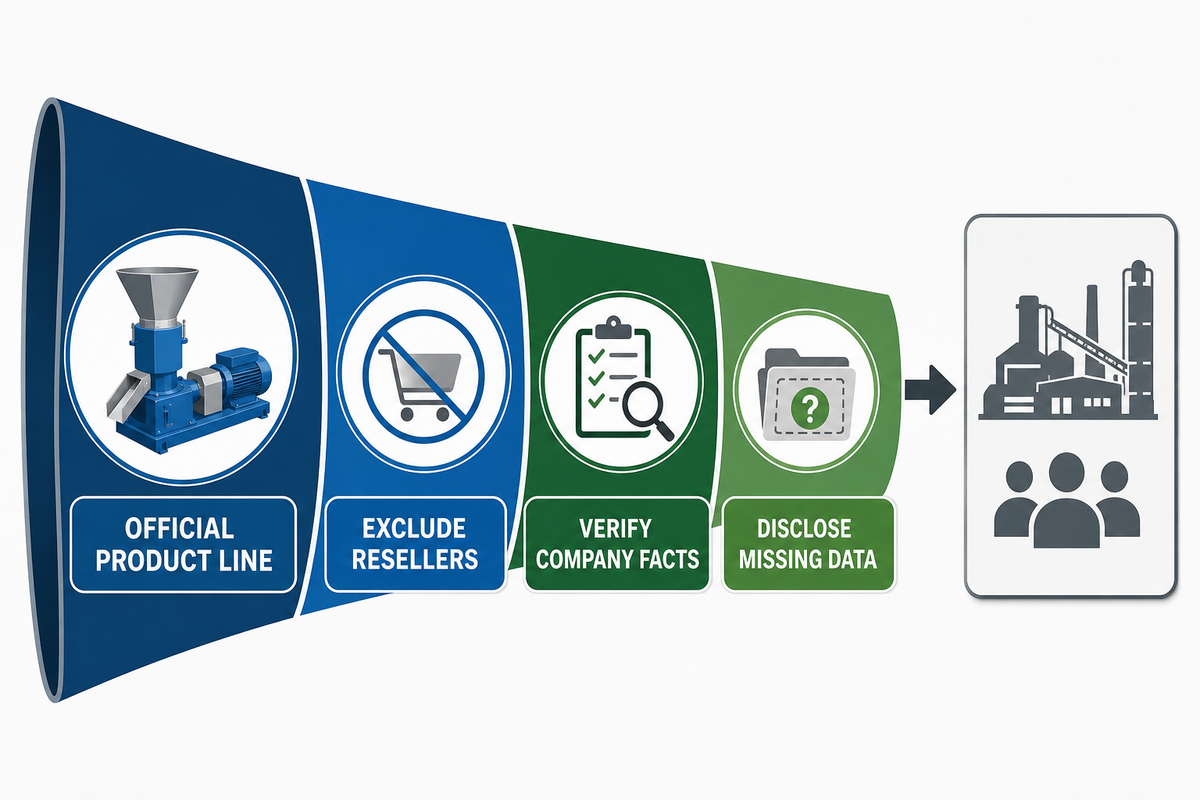
- Manufacturer evidence: each company had to present a current official page showing that it designs or manufactures wood or biomass fuel pellet mills, presses or complete pelleting plants.
- Scope control: we excluded marketplaces, directories, media publishers, used-equipment dealers, finished-pellet producers, pure distributors and companies limited to chippers, dryers, briquetters, dies or feed-only machinery.
- Source hierarchy: product scope and company facts came from official sites. Government, university and standards sources support process checks and safety checks. Google results helped find current pages but were not treated as proof by themselves.
- Verification rule: pages were checked on October 5, 2026. If information on the headquarters and founding year could not be verified from a public source, it was noted as “Not publicly disclosed” in the tables.
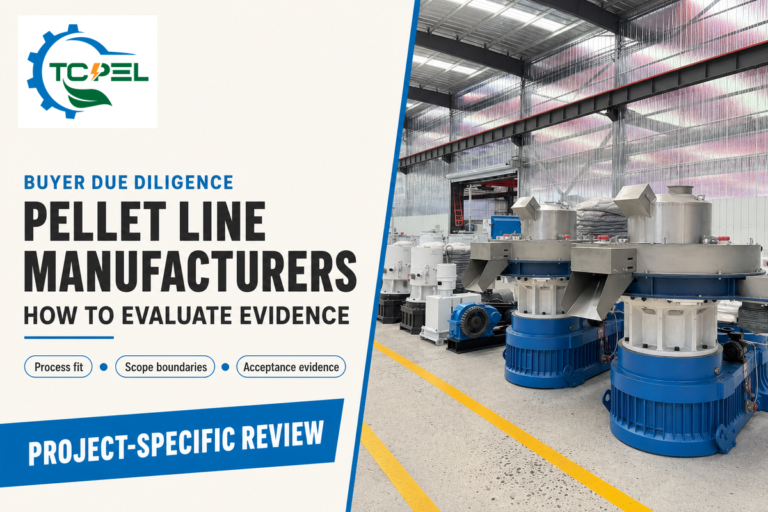
The term top follows buyer search language. This is a curated shortlist organized by buyer fit, not a ranking by market share, volume shipments, installed base or service performance. Headquarters describes sourcing geography; it doesn’t prove that a machine conforms to the buyer’s destination-market rules. For a full-line due diligence review, check our guide on performing a complete due diligence review on a pellet line supplier.
Searches for an industrial wood pellet machine, commercial wood pellet machine or small wood pellet machine often describe different capacity needs. We treat wood pellet machine price and wood pellet machine for sale queries as procurement intent, not as evidence that one configuration suits every buyer.
Comparison of 20 Wood Pellet Machine Manufacturers
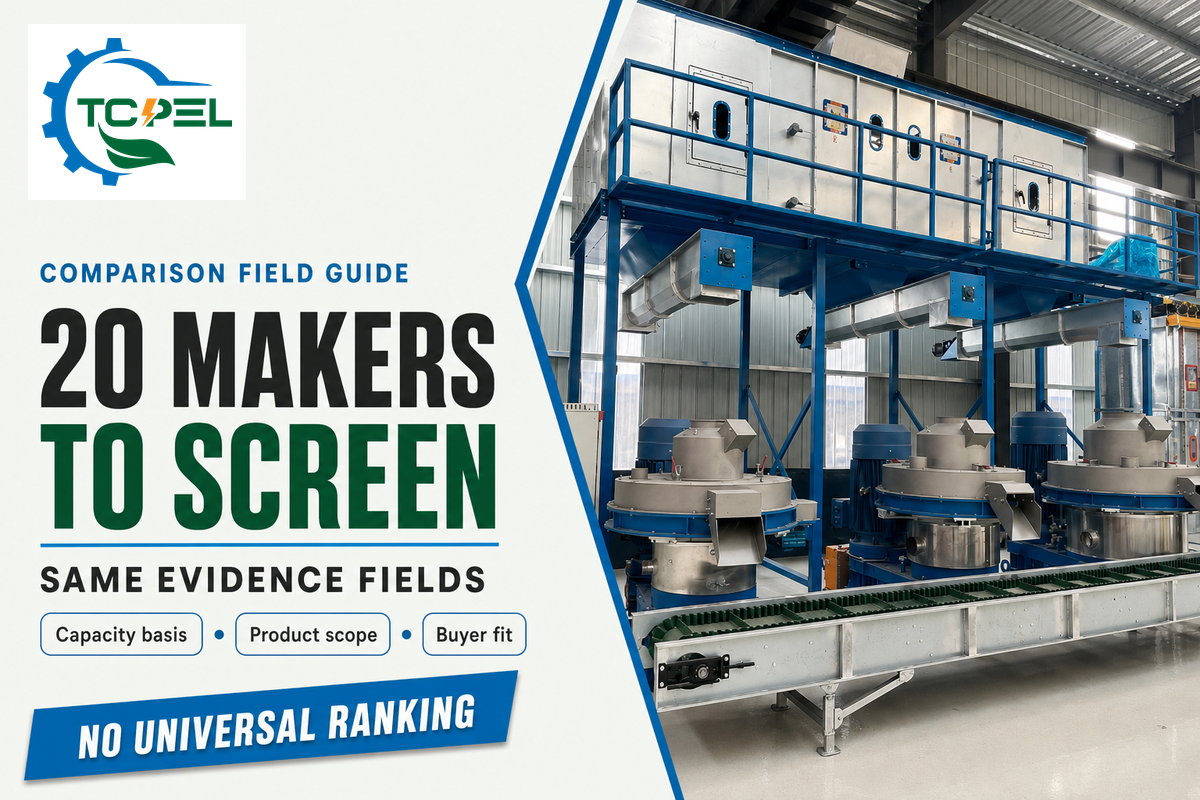
Use the table to build a short list, then ask every candidate to quote against the same feedstock and acceptance conditions. Published capacities use different bases: some describe one press, some a line, and one cited case reports annual plant output. They are not directly interchangeable.
| No. | Company Name | Headquarters | Founded Year | Best For | Brief Introduction | Main Products | Key Advantages | Potential Disadvantages | Official Website |
|---|---|---|---|---|---|---|---|---|---|
| 1 | TCPEL | Shandong, China | 2020 | Configurable export orders, 100 kg/h–4 t/h | Chinese maker with a published 17-model range. | Pellet machines, grinders, dryers, coolers, lines | Published capacity, power, price and service details | Young company; smaller disclosed service footprint | www.tcpel.net |
| 2 | ANDRITZ | Graz, Austria | 1852 | Large plants with lifecycle support | Industrial group covering mills and plant engineering. | Pellet mills, hammer mills, dies, systems | Global engineering and lifecycle service | No feedstock-bound throughput table on reviewed page | www.andritz.com |
| 3 | Bühler Group | Uzwil, Switzerland | 1860 | Integrated premium biomass lines | Process-equipment group offering RWPR mills and lines. | Pellet mills, feeders, conditioners, coolers | Integrated equipment and die refurbishment | Wood throughput not published on reviewed page | www.buhlergroup.com |
| 4 | CPM | Waterloo, Iowa, USA | 1883 | Multiple industrial platforms and aftermarket support | Manufacturer of biomass and wood pellet-mill platforms. | Pellet mills, dies, hammermills, coolers, controls | Broad platform and global parts network | Capacity depends on unnormalized feedstock preparation | www.onecpm.com |
| 5 | AMANDUS KAHL | Reinbek, Germany | 1876 | Broad flat-die capacity range | German flat-die mill and plant manufacturer. | Flat-die mills, turnkey wood plants | Published 1.5–12 t/h range and testing | Different wear-part standard from ring-die fleets | www.akahl.com |
| 6 | SALMATEC | Germany | 1972 | Compact modular 0.5–7 t/h systems | German specialist in pelletizers and compact plants. | Maxima pelletizers, compact units, turnkey plants | Model-level capacity and preassembled concepts | Public service-location detail is limited | www.salmatec.de |
| 7 | MÜNCH-Edelstahl | Hilden, Germany | 1981 | Custom ring-die and containerized systems | Ring-die maker with broad auxiliary-equipment scope. | RMP mills, dies, dryers, coolers, controls | Extensive equipment around the press | No public throughput or service-network table | www.muench-edelstahl-gmbh.de |
| 8 | PRODESA | Zaragoza, Spain | 1999 | Containerized plants up to 6 t/h | Engineering company focused on biomass plant delivery. | Containerized and turnkey biomass plants | Mobile, modular and full-plant engineering | Less emphasis on standalone mill catalog | www.prodesa.net |
| 9 | PROMILL | France | 1951 | High-output European projects | French supplier of drying, grinding and pelleting systems. | EVOLUTION mills, BNA hammer mills, systems | Project engineering, commissioning and after-sales | Published case output is plant-level | www.promill.fr |
| 10 | General Dies | Colognola ai Colli, Italy | 1960 | Custom plants with in-house wear parts | Italian plant builder and die manufacturer. | Pellet mills, dies, spares, complete plants | Engineering plus die and spare-part capability | Power range is not wood-only capacity | www.generaldies.com |
| 11 | Yemmak | Türkiye | 1965 | Published 0.5–5 t/h mill selection | Manufacturer with numeric WP Series specifications. | WP Series mills, complete pelleting systems | Capacity, die diameter and motor data | Local-service footprint not mapped publicly | www.yemmak.com |
| 12 | La Meccanica | Italy | 1961 | Mills paired with dies and spares | Italian maker of biomass machinery and lines. | Pellet mills, hammer mills, lines, parts | Machine manufacturing plus wear-part supply | No wood throughput by model publicly shown | www.lameccanica.it |
| 13 | RICHI Machinery | Zhengzhou, China | Not publicly disclosed | Broad turnkey export integration | Chinese maker of mills and complete processing lines. | Mills, dryers, grinders, packaging, lines | Wide process scope and international references | Official dates conflict; confirm the legal seller | www.pellet-richi.com |
| 14 | Shandong Yulong Machine | Shandong, China | 1998 | Higher-capacity Chinese lines | Manufacturer of pellet machines and complete plants. | Wood pellet machines, biomass equipment, plants | Design, manufacturing, installation and line cases | Public service locations need confirmation | www.pelletmachine.com |
| 15 | GEMCO / ABC Machinery | Anyang, China | Not publicly disclosed | Small-to-large export plant range | ABC Machinery’s biomass equipment division. | Small mills, ring-die mills, industrial plants | Compact equipment through 2–20 t/h projects | Official dates conflict; confirm the legal seller | www.gemco-energy.com |
| 16 | Shandong Kingoro Machinery | Jinan, Shandong, China | 1995 | Integrated biomass preparation and pelleting | Chinese maker with a full process-equipment range. | Pellet machines, chippers, grinders, dryers, packing | Broad preparation-to-packing equipment scope | No model-level wood capacity on reviewed page | www.kingoropelletmill.com |
| 17 | Buskirk Engineering | Ossian, Indiana, USA | Not publicly disclosed | Small commercial North American output | U.S. maker of flat-die mills and systems. | 8-inch, 18-inch, PM 1850, turnkey systems | Published woody output and U.S. manufacturing | Below industrial ring-die capacity ranges | www.buskirkeng.com |
| 18 | Colorado Mill Equipment | Cañon City, Colorado, USA | Not publicly disclosed | Assembly, testing, training and parts access | U.S. equipment assembler and service provider. | Hammermills, pellet mills, coolers, screens, bagging | Testing, refurbishment, training and spares | No public wood-throughput table | www.coloradomillequipment.com |
| 19 | Mabrik | Spain | Not publicly disclosed | Dedicated Spanish wood-mill sourcing | Spanish manufacturer with a wood-mill category. | Wood pellet mills | Clear first-party wood-pellet product scope | Limited public capacity and service detail | www.mabrik.com |
| 20 | Satyajit Machineries / Renewable Engineering | Jamnagar, Gujarat, India | Not publicly disclosed | Indian vertical-ring-die projects | Indian biomass machine and plant manufacturer. | Vertical ring-die machines, plants, process equipment | Domestic manufacturing and technical support | Confirm the legal seller before contracting | www.satyajitmachineries.com |
Global Industrial and Turnkey Coverage
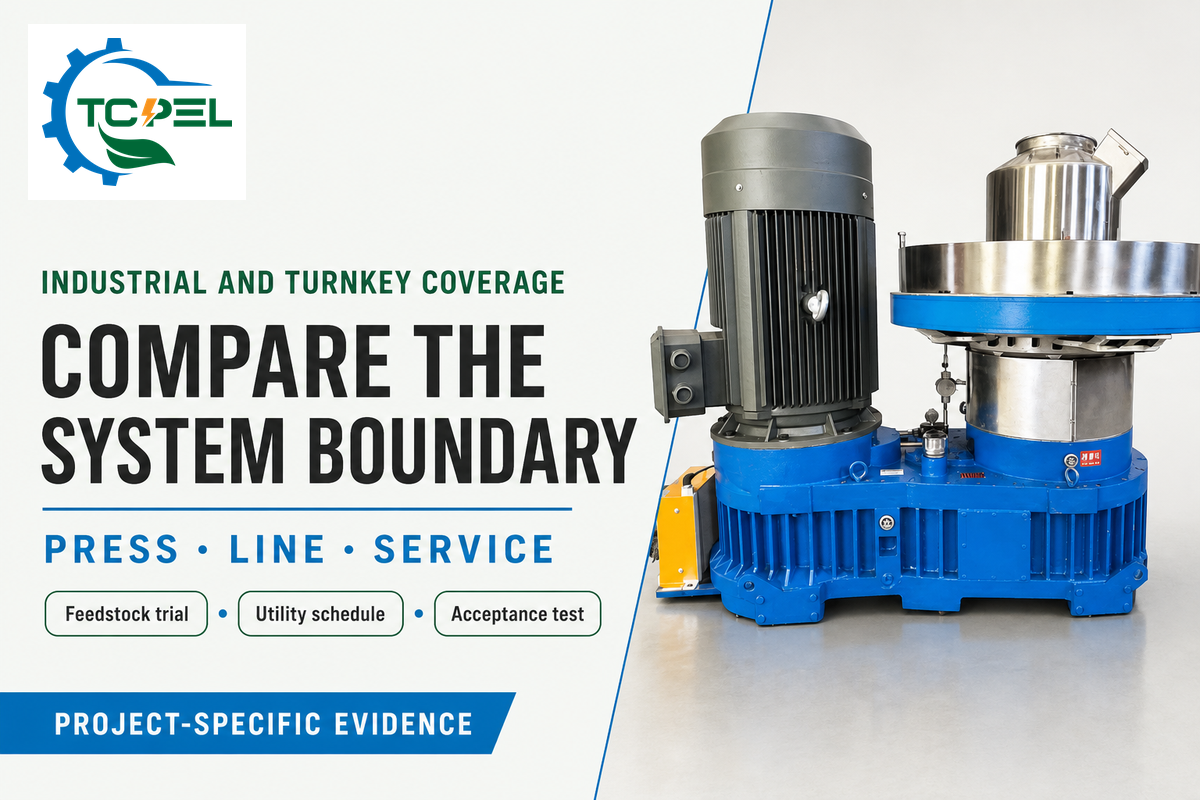
From a single machine to a complete process facility, this group covers different offers for buyers requiring multiple process stages and long-term support, but corporate size does not replace a feedstock trial or a project-specific performance guarantee.
1. TCPEL: Best for Configurable Export Orders From 100 kg/h to 4 t/h
Disclosure: This guide is published by TCPEL. We list ourselves first because this is our website, not because we claim to be the market leader. The other 19 manufacturers are grouped by what they are best for, in no particular order within each group.
TCPEL’s current ‘wood pellet machine models and specifications’ page has 17 configurations from 100 kg/h to 4 t/h with drive powers from 11 to 280 kW. The page currently publishes a two-year warranty on main components, a lead time of 15 working days after deposit confirmation, and a 24-hour response commitment by WhatsApp or email. Confirm all terms in the signed quotation and purchase contract. The company was founded in 2020, and its disclosed service footprint is smaller than those of long-established multinational groups. International clients should clarify commissioning, spare part stocking and response obligations prior to payment.
2. ANDRITZ: Best for Large Industrial Biomass Plants With Lifecycle Support
ANDRITZ presents pellet mills together with process design, installation, commissioning and lifecycle services for biomass plants. That combination suits projects where the press must be integrated with grinding, conditioning, cooling and controls under a wider engineering package. The webpage doesn’t associate a named wood feedstock to a guaranteed model throughput. So, users need a line-specific mass balance, utility schedule and acceptance test.
3. Bühler Group: Best for Integrated Premium Wood and Biomass Pelleting Lines
Bühler’s RWPR pellet mill is listed in complete solutions for pelleting of wood, straw and other biomass. Bühler has a process portfolio for upstream and downstream equipment as well as die refurbishing. So, the engineering ecosystem is convenient for users across several line stages. The webpage doesn’t publish a capacity table for wood. Output must therefore be agreed against the actual raw material.
4. CPM: Best for Multiple Industrial Platforms With Global Aftermarket Support
CPM’s line includes PM Series equipment for biomass and direct-drive pellet mills for biomass and wood applications. The company provides dies, hammermills, coolers, automation, and aftermarket parts. That equipment range can simplify lifecycle sourcing. CPM, IDAH, and Bliss are treated as one group in this study to avoid double-counting related brands. Model capacity is affected by process conditions that aren’t standardized in the product-line description under review.
5. AMANDUS KAHL: Best for Flat-Die Wood Pelleting Across a Broad Capacity Range
AMANDUS KAHL publishes 16 mill sizes, drive powers from 3 to 630 kW and output of about 1.5 to 12 t/h on its wood-pelleting page. They also offer pilot testing, engineering, and commissioning. A direct comparison of wear parts and operation with ring-die alternatives is warranted. Plants that are ring-die standardized should evaluate the effect of having a second die and roller standard.
6. SALMATEC: Best for Compact Modular Systems and 0.5–7 t/h Mill Selection
SALMATEC lists its compact units for Maxima arrangements from 0.5 to 1 t/h to 6 to 7 t/h for premium wood pellets. Preassembled concepts can help minimize on-site assembly, but transport, electrical and other sitework considerations still need to be addressed. Their public model-level capacities help in preliminary evaluations. The reviewed product material does not map a detailed public service-location network.
7. MÜNCH-Edelstahl: Best for Custom Ring-Die and Containerized Wood-Pelleting Systems
MÜNCH-Edelstahl provides RMP ring-die wood pellet mills plus dies, rollers, hammermills, dryers, coolers and controls. It also presents a containerized wood-pelleting system, giving buyers a modular alternative to a conventionally erected line. This supplier’s auxiliary equipment can support integrated equipment packages and systems. MÜNCH-Edelstahl doesn’t include a public throughput table or service-location map, so both are to be determined.
8. PRODESA: Best for Containerized Turnkey Plants up to 6 t/h
PRODESA describes residential and industrial containerized pellet plants with output up to 6 t/h. PRODESA gives more of an engineering-type solution versus a mill only. The offer fits projects where modularity, transportation and the single source integrator are of high importance. PRODESA maintains a less-catalogued public offer than standalone mill ranges.
A good separation of this group is contract scope. Published figures are from 100 kg/h (TCPEL) to 12 t/h (KAHL), with PRODESA plant limits at 6 t/h. Compare only figures with the same feedstock, boundary and test duration.
European Pellet-Mill Specialists
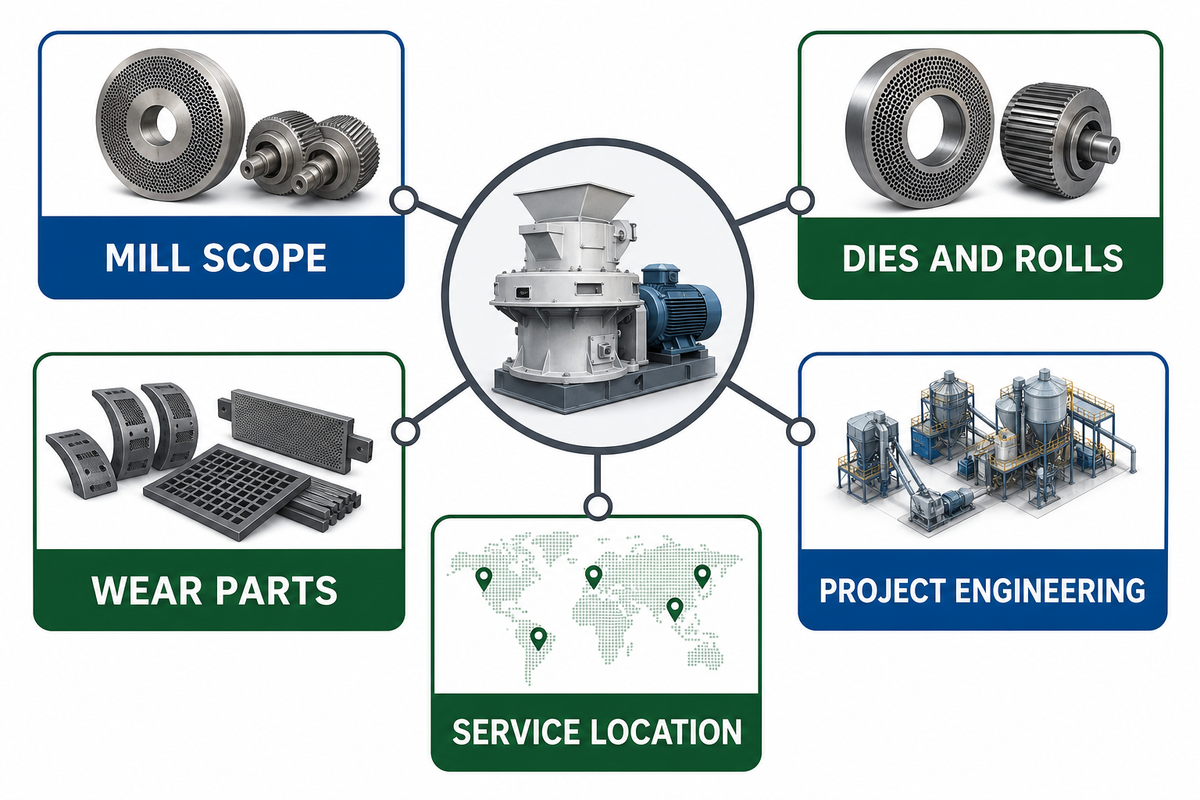
These companies manufacture pellet presses as well as dies, spares, grinding and drying equipment, and offer project engineering services. Their project experience and wear-part expertise can work well for customers in specific regions. Public data are sparse, so location should never replace a commitment for a response time.
9. PROMILL: Best for High-Output European Wood-Pellet Projects
PROMILL supplies EVOLUTION pellet mills, BNA hammer mills and equipment for drying and pelleting systems. An official case says four EVOLUTION mills in a French plant produce over 100,000 tonnes per year. That’s a good example of a high output project, not a per mill guarantee. A buyer should request the project’s operating hours, feedstock basis and net line rate before using it as a benchmark.
10. General Dies: Best for Custom European Plants With In-House Dies and Spares
General Dies offers complete wood and biomass pelleting plants along with pellet mills, dies and replacement parts. Its published mill power range spans 7.5 to 400 kW, although that is a general range rather than a wood-only capacity promise. In-house wear-part capability can reduce interface disputes between machine and die suppliers. Buyers should ask for a reference involving a wood-related application, and a die life reporting commitment.
11. Yemmak: Best for Published 0.5–5 t/h Wood-Mill Selection
Yemmak’s WP Series page publishes 500 to 5,000 kg/h, die diameters of 520, 660 and 900 mm, and motor power from 160 to 355 kW. Those numbers make early model screening more transparent than a page with no technical table. They still remain catalog data rather than delivered performance for every wood species. International buyers should confirm the nearest service team and stocked critical parts.
12. La Meccanica: Best for European Pellet Mills Paired With Dies, Rolls and Spares
According to La Meccanica, it creates and builds machinery and production lines for the manufacture of biomass pellets. The range comprises pellet and hammer mills, dies, rolls and wear parts. Wear components affect equipment availability and pellet quality. The website doesn’t disclose wood throughput for various models; representative-feedstock trials and written operating conditions are therefore critical.
Export-Focused Chinese Manufacturers
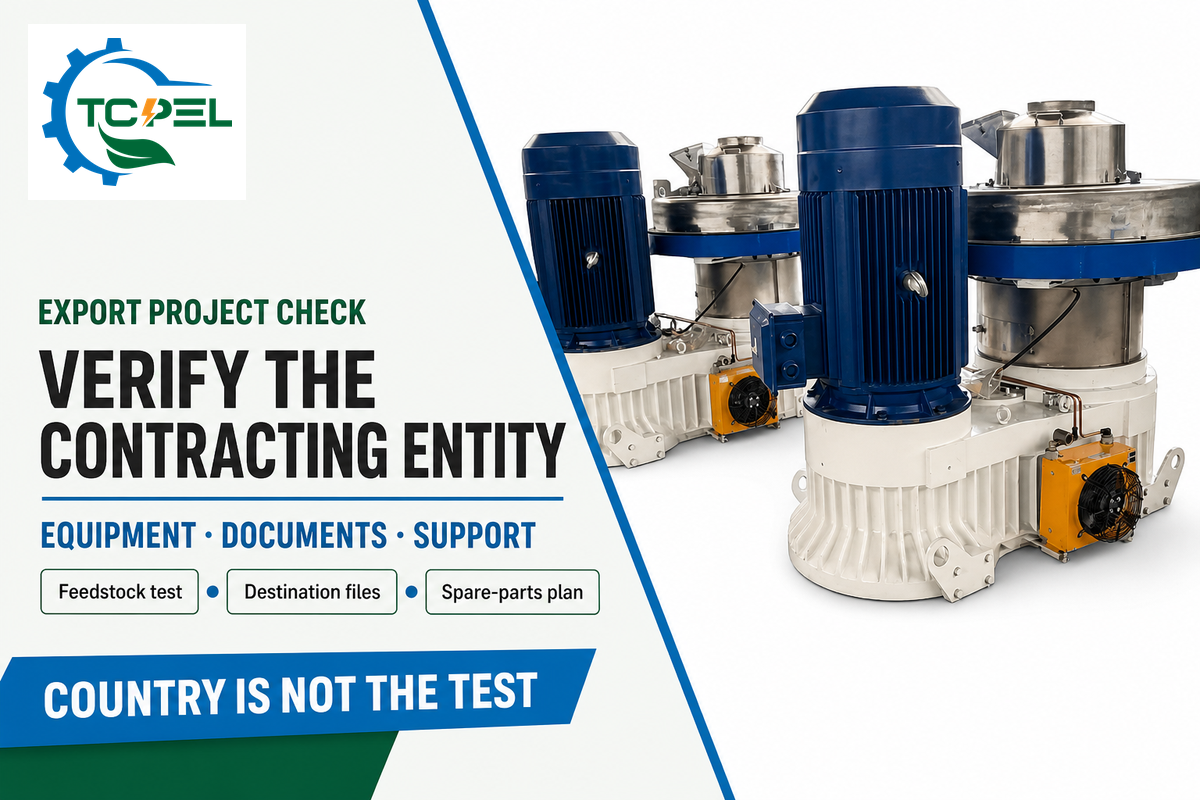
Many Chinese manufacturers can supply compact machines as part of a complete industrial line, including a broad range of auxiliary equipment; Penn State Extension’s fuel-pellet process overview illustrates why upstream and downstream stages must be scoped together. It isn’t necessary to assess potential equipment reliability by country of origin. The concern is the contracting entity, equipment included, destination documents, acceptance conditions and the written response action plan.
13. RICHI Machinery: Best for Turnkey Export Projects Requiring Broad Process Integration
RICHI’s official biomass mill page covers forestry waste and wood chips, while its company material reports projects across more than 140 countries and regions. Official RICHI pages conflict on a 1995 or 2013 founding year, so the table leaves the year undisclosed and buyers should confirm the contracting entity. The range of equipment covers processes from grinding and drying to pelleting and packing. It’s necessary to test the mill with respect to the buyer’s moisture, species and particle-size distribution.
14. Shandong Yulong Machine: Best for Higher-Capacity Chinese Wood-Pellet Lines
Yulong provides information on wood pellet machines, biomass equipment and complete plants, and has a 6-8 t/h wood pellet line case on its website. The company presents design, manufacturing and installation as part of its scope. The case gives line-level project experience and doesn’t guarantee the output of one mill. Prospective customers should review a company’s history, check the references in the region during the qualification process and request comparables in operation.
15. GEMCO / ABC Machinery: Best for Small-to-Large Export Plants From One Equipment Group
ABC Machinery identifies GEMCO as its biomass-equipment division, so the two names are consolidated in this list. Official web pages showcase small mills and mini plants, ring-die equipment, and projects from 2 to 20 t/h. ABC’s official brand page states 1997, while its milestones page states that Anyang Gemco Energy Machinery Co., Ltd. was established in 2007; the table therefore leaves the founding year undisclosed. The information is helpful for buyers seeking phased growth. Multiple related domains make it important to place the legal seller, warranty provider and receiving account on the same approved contract record.
16. Shandong Kingoro Machinery: Best for Integrated Chinese Biomass Preparation and Pelleting Equipment
Kingoro lists biomass pellet machines and complete wood-pellet lines alongside chippers, hammer mills, dryers and packing systems. The company website states its year of inception was 1995, and provides a patent portfolio. The wide process scope is useful when line balance matters more than one machine. The reviewed product page lacks a model-by-model wood capacity table, so output evidence must come from the project quotation and trial.
Do
- Confirm the exact legal seller and warranty provider.
- Price controls, dust handling, shipping, duties, commissioning and spares.
Don’t
- Treat a low machine quote as installed-line cost.
- Accept a catalog rate without feedstock-conditioned testing.
North American and Regional Specialists
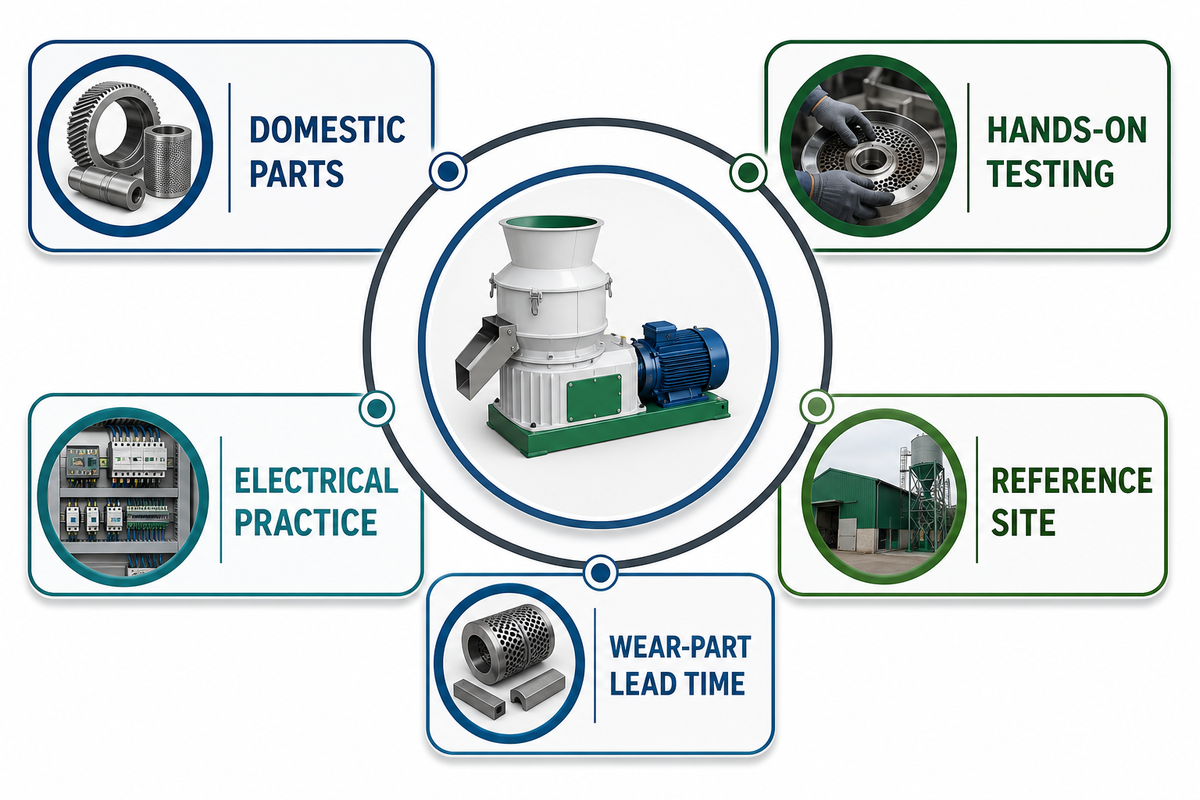
Regional specialists can be attractive when domestic parts, hands-on testing, and familiar electrical practice are more important than large scale production. Public output data in this group are sparse and not directly comparable, with Buskirk the only reviewed entry here publishing a wood-specific hourly figure; the right regional fit can still decrease friction for service and support.
17. Buskirk Engineering: Best for Small Commercial Flat-Die Production in North America
Located in Indiana, Buskirk manufactures flat-die pellet mills and turnkey systems. Buskirk’s 8-inch machine page shows woody-material outputs of up to 200 lb/h. This gives small commercial buyers a screening figure. That scale can fit pilot sales, farm operations or distributed production. It’s far less than the output of industrial ring-die lines, so expansion plans should be modeled prior to purchase.
18. Colorado Mill Equipment: Best for North American Assembly, Testing, Training and Parts Access
Colorado Mill Equipment lists R200 and R400 pellet mills with wood hammermills, coolers, screens and bagging equipment. Its public service scope includes assembly, testing, refurbishment, training and spare parts. These after-sales services can matter to U.S. operators that prioritize domestic access. Because the reviewed page doesn’t include a founding year or wood-throughput table, technical qualification depends on a written test.
19. Mabrik: Best for Spanish Buyers Seeking a Dedicated Wood-Pellet-Mill Supplier
Mabrik specifies an official product category for wood pellet mills and therefore satisfies the product line requirement for this report. Potential buyers may prefer to work with a wood pellet mill specialist rather than a large, diverse firm. Information in English is limited and capacity and service coverage are specifically lacking. Ask for the current model matrix, nearby references and wear-part lead times.
20. Satyajit Machineries / Renewable Engineering: Best for Indian Vertical-Ring-Die Biomass Projects
Satyajit Machineries presents vertical-ring-die biomass pellet machines and plant engineering from a site that publishes a Jamnagar, Gujarat address, describes 1972 as an engineering tradition and 2004 as entry into biomass, and names Satyajit Greentech Pvt Ltd in the footer; buyers should confirm the legal seller rather than infer a current company founding year. Its domestic manufacturing and support can suit Indian projects seeking regional access. A published figure of 120 MT describes the system input and isn’t a rating of a single pellet mill. The quote should give the rating of each machine, line net output and operating time.
How to Choose a Wood Pellet Machine Manufacturer
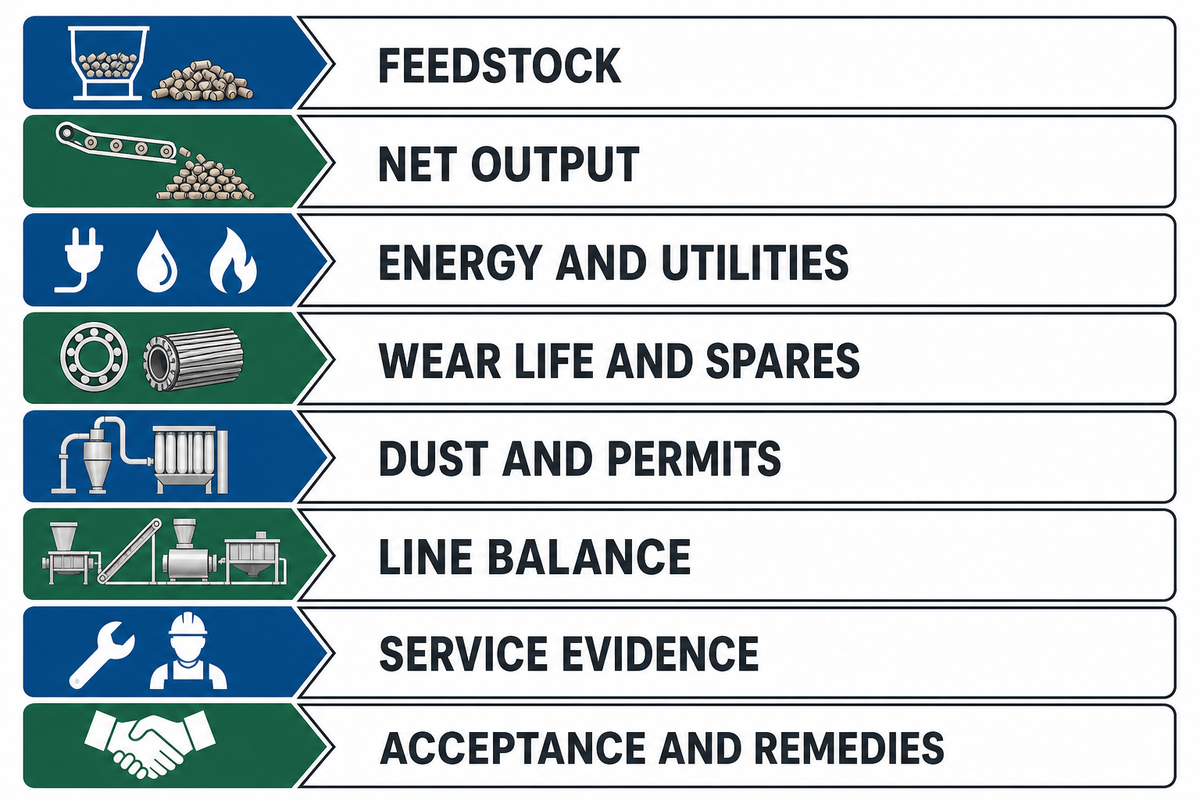
The 8-Point Pellet Mill Evidence Grid transforms disparate sales offerings to a compatible technical format. Use it to evaluate representations before comparing prices:
For a wood pellet manufacturing plant, confirm that the quoted pellet processing equipment matches the intended raw material and final fuel specification. Record the target pellet diameter, including 6mm or 8mm where applicable, and require the supplier to state the die specification, cooler and screening scope used for the guaranteed result. Treat labels such as energy-efficient and customizable as claims, not acceptance criteria: record measured kWh/t, representative feedstock, test duration and signed results. If the project processes sawdust or wood chips into renewable biomass fuel or pellets for heating, include feed preparation, the pelletizer, dryer, dust control, spare parts and downstream production and distribution in the same line boundary.
- Representative feedstock: provide species mix, contaminants, bulk density, as-received moisture and particle-size distribution. Request a witnessed test on representative feedstocks rather than a demonstration with sawdust.
- Sustained net output: define saleable pellet tonnes per hour after fines removal, not momentary press feed. Specify pellet diameter, durability or fines limit, test duration and permitted stoppages.
- Specific energy and utilities: record kWh/t metered for press and line, installed kW, voltage, frequency, compressed air, steam and water. Include the hammer mill sizing, and every auxiliary load.
- Wear life and spares: Request die and roller material, lead times, change procedure, expected operating hours and the first two years of critical spares. Separate wear exclusions from general warranties.
- Dust, emissions and permits: assign responsibility for dust collection, explosion protection, air emissions and site permits across dryers, burners, grinders, pelletizers, coolers and controls.
- Line balance: verify that dryer capacity and moisture control, grinding, conveying, cooling, screening and packing can sustain the press demand. For a packaged project, review the complete wood pellet production line boundary.
- Destination and service evidence: request declarations, marking, manuals, electrical documentation, traceability and importer-role allocation for the target market. Identify the commissioning team, response time for remote support and local spare stock.
- Acceptance and remedies: Attach factory and site acceptance procedures to the contract. Define instruments, calibration, sampling, and the method and criteria for calculation of output. Indicate re-test rights and remedies when the agreement is missed.
“Combustible dusts are fine particles that present an explosion hazard when suspended in air under certain conditions.”
Plants are responsible for a number of things, and dust protection is only one of them. Air permits applicable to jurisdiction may be required for dryers and burners as well as material handling. Electrical and machinery documentation is also destination dependent. Request the supplier to state inclusions and exclusions as you can’t make the assumption that the country of origin of a machine complies with requirements.
RFQ checklist — copy these into your quote request:
| Parameter | Recommended range | Why it matters | How to verify |
|---|---|---|---|
| Feedstock condition | Buyer-specified % moisture and mm particle size | Controls binding, energy and wear | Sample, calibrated meter and sieve report |
| Net saleable output | Contracted kg/h or t/h after fines removal | Prevents gross-feed capacity confusion | Timed mass-balance acceptance run |
| Specific energy | Contracted metered kWh/t at test condition | Exposes utility demand and operating cost | Calibrated meter over acceptance run |
| Pellet specification | Buyer-specified mm diameter and quality limits | Output without saleable quality has little value | Agreed sampling and laboratory method |
| Wear-part basis | Quoted operating hours and two-year spares list | Reveals maintenance exposure and lead time | Material certificate and contract schedule |
| Electrical and utilities | Site-specific V, Hz, kW, air, steam and water | Prevents interface and installation gaps | Approved utility schedule and drawings |
| Acceptance duration | Buyer-specified continuous hours | Separates stable output from a short peak | Signed factory and site protocol |
| Service response | Contracted remote and on-site response hours | Exposes post-installation support risk | Named team and service schedule |
For screening purposes, published capacity is useful. However, acceptance must be tied to the provided material and the complete system. Durable pellet formation may be hindered by a moisture mismatch. However, an undersized dryer, conveyor, or cooler may be the limiter to the net output, even if the pellet press is able to meet its feed rate.
Frequently Asked Questions
Which is the best wood pellet machine manufacturer for a large industrial plant?
Start with manufacturers that can prove full-plant engineering, feedstock-conditioned performance, lifecycle support and destination-market service; ANDRITZ, Bühler, CPM and PRODESA merit detailed project-specific evaluation.
For projects that include drying, grinding, pelleting, cooling, as well as process automation and commissioning, industrial groups such as ANDRITZ, Bühler, CPM, and PRODESA, among others, should be evaluated. When evaluating bids, feedstock-conditioned net output, utilities, dust, and emissions should be considered, as well as local service, references, and contractual acceptance evidence. Customize the request for quotation to your feedstock and specific needs. Also request two contactable plants using comparable raw material, plus a written local response-time commitment for the destination market. Verify who’s responsible for each process interface.
Which is the best wood pellet machine manufacturer for a small commercial line?
Match the manufacturer to required hourly output, feedstock preparation, included auxiliaries and local support; Buskirk, TCPEL and SALMATEC publish ranges that support an initial small-line shortlist.
Buskirk’s numbers are up to 200 lb/h for an 8-inch mill, while TCPEL states configurations from 100 kg/h and SALMATEC states compact units from 0.5-1 t/h. Different bases are used. Verify the feedstock, included auxiliaries, net saleable output, and expansion capacity before deciding. Also confirm the future motor and control capacity. For planned growth, confirm whether the electrical supply, controls, cooler and bagging equipment can accept a later press upgrade without replacement.
Who is the largest wood pellet machine manufacturer in the world?
No current public dataset supports one defensible global machinery winner; comparable figures for wood-specific shipments, installed presses, revenue and worldwide service coverage remain publicly unavailable.
Andritz, Bühler and CPM are international large industrial groups, but corporate scale isn’t the same as the market share for pellet machines. We didn’t identify any comparable public datasets for 2026 showing shipments, installed presses, wood specific revenues, or service coverage. Therefore, identifying one company as the largest would be speculative.
Are Chinese wood pellet machine manufacturers reliable?
Some are credible manufacturers, but project-level reliability must be established through legal-entity checks, representative-feedstock tests, destination documents, commissioning duties, warranty terms and written spare-parts support.
TCPEL, RICHI, Yulong, GEMCO/ABC and Kingoro each have an official wood/biomass pellet equipment line. Each buyer should check the legal entity of the seller, the test representation of the feedstock, the destination documents, warranty exclusions, commissioning and spare part plans. Country of origin alone proves neither reliability nor conformity.
How much does a wood pellet machine cost?
Machine price depends on output, die system, feedstock preparation, controls, delivery scope and acceptance terms; compare only quotations that state the same battery limits and inclusions.
As an example from October 2026, the product metadata for TCPEL shows prices for units from US$4,000 to US$42,200, FOB Qingdao. This isn’t a market-wide range for installed projects. Many other variables such as drying and grinding, conveying and cooling, screening, packing, dust protection, freight, duties, electrical works, commissioning, and spare parts can affect the total quotation.
What is the difference between a wood pellet machine manufacturer and a supplier?
A manufacturer designs or makes the equipment, while a supplier may only resell it; buyers should verify the factory role, legal contracting entity, warranty provider and service responsibility.
A supplier is allowed to provide local stock, installation, and service, but the buyer should know who owns the design, manufactures the press, provides the warranty and supplies the critical wear parts. Obtain the factory identity and name all legal entities that are responsible and include them in the contract.
What should be tested before a pellet machine is shipped?
Run a witnessed factory acceptance test with representative feedstock.
Measure sustained net output, feedstock moisture and size, pellet diameter, and agreed quality indicators, metered energy, fines, temperatures, alarms and safe shutdowns. Record calibrated instrument readings, test duration and stoppages. Preserve samples and signed results. Repeat the site acceptance test after installation.
Conclusion: Build a Verifiable Shortlist
Compare evidence when evaluating proposals to determine the best procurement result, rather than applying a universal ranking. Select three to six candidates whose published scope fits the project, issue one normalized request for quotation, and score their feedstock trial, net output, energy, wear parts, safety boundary, line balance, service plan and acceptance terms.
Key takeaway
A comparable quotation binds saleable output and energy use to the buyer’s actual feedstock, complete line boundary and witnessed acceptance test.
Ready to finalize your machine range? Review TCPEL’s wood pellet machine models and specifications and send us your requested materials, moisture, target output, pellet diameter, voltage and delivery location for configuration.
Related Articles
- Pellet Production Line Manufacturers, supplier due diligence for complete projects
- Wood Pellet Machine, published configurations, capacity and quotation inputs
- Pellet Production Line, process stages and system scope
- Hammer Mill, raw-material size reduction before pelleting
- Rotary Drum Dryer, moisture preparation for biomass feedstock
References & Sources
- U.S. Occupational Safety and Health Administration: Hazard Communication Guidance for Combustible Dusts
- National Fire Protection Association: 2025 combustible-dust standards update
- U.S. Department of Energy: biomass densification process material
- Penn State Extension: Manufacturing Fuel Pellets from Biomass
- Peer-reviewed open-access research on biomass pelletization variables
Transparency statement: TCPEL publishes this article and appears first under the disclosure above. Competing manufacturers were included when current official pages showed an applicable wood or biomass fuel pellet product line. Capacity, price, warranty and service statements are attributed to their publishers rather than independently verified. Missing public facts are labeled instead of inferred.
[DOC_01]
WHY WE WRITE THIS
TCPEL publishes engineering-led buying guides for biomass, wood, and feed pellet projects. We write for plant owners, procurement teams, project engineers, and distributors who need practical information before selecting pellet machines, dryers, hammer mills, coolers, or a complete production line. Our goal is to explain the real process variables behind pellet production, including raw material size, moisture content, target capacity, pellet diameter, line matching, spare-parts planning, and long-term operating stability.
[DOC_02]
ABOUT OUR BUSINESS
TCPEL is the pellet machinery brand of ALLWIN INTERNATIONAL CO., LTD., a manufacturer based in Zhangqiu District, Jinan, Shandong, China. Established in 2020, the company operates a 20,000-square-meter factory with in-house R&D, production, sales, and after-sales coordination. Its product range covers wood pellet machines, biomass pellet mills, feed pellet machines, drum chippers, wood crushers, hammer mills, rotary dryers, pellet coolers, packing machines, and complete pellet production lines. TCPEL states that it has supplied customers in more than 60 countries and regions.
[DOC_03]
OUR SERVICES
We support buyers from early project evaluation to post-shipment follow-up. This includes raw-material review, capacity matching, machine-list recommendation, complete line configuration, voltage and export-document customization, production and testing, shipping coordination, installation and commissioning assistance, and spare-parts support. Buyers can contact the team by email or WhatsApp and, according to the company’s contact page, typically receive a reply within 12 working hours.
BIOMASS PELLET
WOOD PELLET
FEED PELLET
TURNKEY LINE
CHINA FACTORY
EXPORT SUPPLIER
MANUFACTURER PROFILE // SPECIFICATIONS
NICHE
Biomass, Wood & Feed Pellet Machinery
ROLE
Pellet Machine Manufacturer / Turnkey Pellet Line Supplier
BRAND
TCPEL
COMPANY
ALLWIN INTERNATIONAL CO., LTD.
LOCATION
Zhangqiu District, Jinan, Shandong, China
ESTABLISHED
2020
FACTORY FOOTPRINT
20,000㎡
TEAM
100+ Workshop Staff
PRODUCT SCOPE
Wood Pellet Machines, Biomass Pellet Mills, Feed Pellet Machines, Drum Chippers, Wood Crushers, Hammer Mills, Rotary Dryers, Pellet Coolers, Packing Machines, Complete Pellet Production Lines
LINE CAPACITY RANGE
0.5-20 T/H Complete-Line Throughput Range
EXPORT REACH
60+ Countries and Regions
INQUIRY RESPONSE
Within 12 Working Hours
ADDRESS
East Side, Second Factory, Zhangjia Industrial Park, Mingshui Street, Zhangqiu District, Jinan City, Shandong Province, China 250203
—SYSTEM LOG//ACTION
Start Your Pellet Project
Contact TCPEL engineers for early project evaluation, capacity matching, complete line configuration, and quotation based on your raw materials.
Contact Us ->