Get in Touch with TCPEL


The 2026 Buyer’s Guide to Small Pellet Machines for Home Use: Types, Feedstock, DIY Realities & Costs
A small pellet machine for home use turns sawmill scrap, on-farm waste or workshop offcuts into densified wood pellets you can burn in a pellet stove or boiler. This 2026 buyer’s guide cuts through marketing fog with practical numbers: which power source fits your situation, how to size the mill to your actual heating demand, what you can and cannot feed it, whether DIY makes sense at your scale, and how to fix the seven problems that almost every home operator hits in year one. Every dollar figure, kilowatt-hour rate and standard reference below is sourced rather than rewritten from a brochure.
Quick Specs — Small Pellet Machine for Home Use
| Typical capacity range | 100 kg/h to 1,400 kg/h (single mill) |
| Motor sizing | 3 to 22 kW; single-phase 220V for workshop, three-phase 380V above ~7 kW |
| Power source options | Electric, diesel engine, or PTO (tractor) drive |
| Price range | DIY self-build $1,000–$2,000 | Entry FOB China $4,000–$6,000 | Workshop tier $6,000–$15,000 |
| Pellet output diameter | 4 mm, 6 mm or 8 mm (configurable die) |
| Typical die life | 800–1,200 hours on softwood sawdust; 600–900 hours on high-silica feedstock |
What Is a Small Pellet Machine for Home Use? Definition and Scope
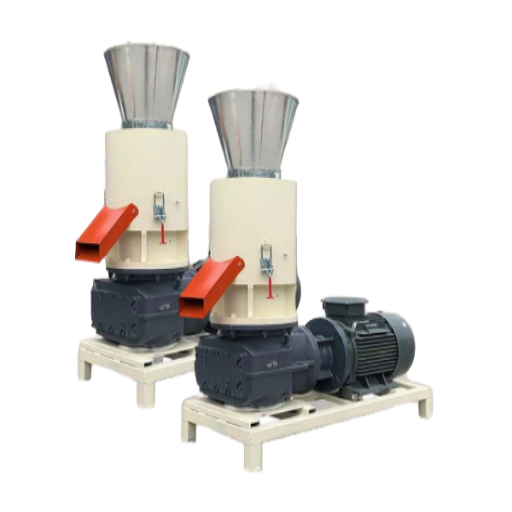
A small pellet machine for home use is a workshop-scale densification press, typically rated 100 to 900 kg/h of pellet output, that compresses ground biomass through a hardened steel die using a roller. “Home use” in the pellet industry covers three audiences: residential heat-pellet producers, on-farm feed pellet operators, and small sawmills monetising their own dust. That label rules out two extremes — the $80 hand-crank kits sold to hobbyists (no real output) and the 5-tonne-per-hour ring-die mills built for commercial pellet plants.
Three factors differentiate a real small pellet machine from a toy. 1) Motor power above about 3 kW (22 kW), as a 3 kW motor isn’t going to create the friction heat necessary to soften the lignin that will bind the pellets in the die. 2) A throughput rate of at least 100 kg/h on softwood sawdust, because at lower output rates you spend more on labour just standing and staring at the mill than the pellet is worth. 3) A hardened-steel flat die or vertical ring die (ALWAYS never ALUMINUM or GTD: lack of hardness will cause it to wear away inside of 100 hours of operation). Nearly every “homemade pellet maker” we saw on a North American marketplace list under $1,000 failed here.
Small Pellet Machine Types: Electric Flat-Die, Diesel Flat-Die, and PTO Variants
Three different kinds of power sources stand out in the small pellet machine field. The question is, which kind of power source suits you best?
This is determined by your grid access, whether you want to transport in your machine or not, and if you already paid for a tractor.
| Dimension | Electric Flat-Die | Diesel Flat-Die | PTO (Tractor) Drive |
|---|---|---|---|
| Typical capacity | 100–1,400 kg/h | 50–500 kg/h | 100–800 kg/h |
| Power requirement | 3–22 kW (220V or 380V) | 8–22 hp diesel engine | PTO 540 rpm, 15–40 hp tractor |
| Portability | Stationary (heavy frame + power line) | Trailer-mountable, off-grid capable | Hitch to tractor, fully mobile |
| Capital cost (FOB) | $4,000–$12,200 | $3,500–$8,000 | $4,500–$9,500 |
| Operating cost (per ton) | Lowest where grid power is cheap | Diesel cost dominates | Tractor fuel + wear share |
| Best fit | Workshop with reliable grid | Remote farms, off-grid rural | Working farms with existing tractor |
Electric flat-die is the default choice for North American and European home buyers, simply because labelled grid power is cheap relative to diesel and the unit can be left running unattended on a timer. Diesel units make sense for rural sites in developing markets or remote sawmill yards where grid stability is the constraint. PTO drive — the option most home buyers overlook — turns a tractor already on the property into a pellet mill engine for a few hundred dollars in coupling parts.
For TCPEL’s specific configured line-up of small flat-die units, see the TCZL flat-die small pellet machine series page.
Sizing Your Home Pellet Machine: Heating Tons, Throughput, and the kW Math
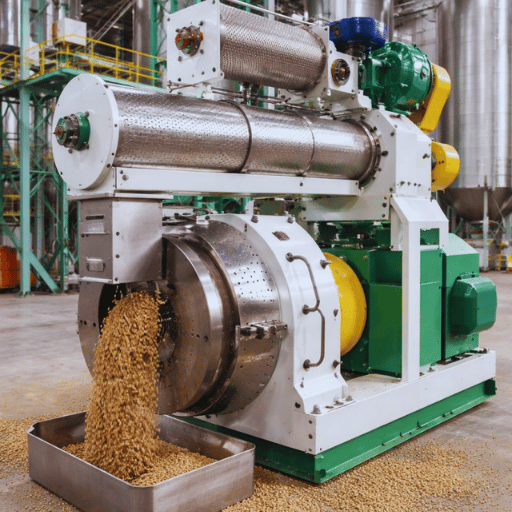
The majority of home buyers buy more than they need. They justify the purchase of a 900kg/h cap by stating, they times this figure by 8 hours per day and find it is what they need. The correct way to size is to inversely work back to the amount burnt per year.
Step 1 — Estimate Your Annual Pellet Demand
The Pellet Fuels Institute reports that the average homeowner uses 2-3 tons of wood pellets annually. Operator surveys report a range of something like 0.75-1.5 bags per day through the heating season for a home 1,400-2,000 square feet (a bag is 40 pounds or 18 kg). 1 tonne of wood pellets provides 4,800 kWh of useful heat at around 80% typical pellet-stove efficiency.
| Home size | Mild climate (4 mo heat) | Moderate (6 mo heat) | Cold (8 mo heat) |
|---|---|---|---|
| 1,000 sq ft | 1–1.5 tons/yr | 1.5–2 tons/yr | 2–3 tons/yr |
| 1,500 sq ft | 1.5–2.5 tons/yr | 2.5–3.5 tons/yr | 3.5–5 tons/yr |
| 2,500 sq ft | 2.5–3.5 tons/yr | 3.5–5 tons/yr | 5–7 tons/yr |
Step 2 — Convert Demand into Mill Throughput
Once you know the annual tonnes the size of the mill becomes easy to determine. A flat-die mill 200 kg/h running non-stop can produce a metric tonne in just 5 hours; a 500 kg/h machine does it in 2. For a 4-ton annual requirement even a modest 200 kg/h run-of-the-mill unit firing only 20 hours per year is enough to meet your demand at a 200 kg per hour throughput rating. That’s one weekend of operation, 360 days off.
📐 The Heating-Tons-to-Throughput Sizing Framework
- From the home size and climate profile from the table above select annual tons.
- Choose how many hours per year you feel comfortable using the mill. A slow, relaxing operator who fires up for 4 hours per week over 10 weekends would accept 40 hours total.
- Required throughput = (annual tons 1,000kg) acceptable hours. Spread a 4-ton demand evenly over 40 hours gives a target capacity of 100kg/hr.
- Add 50% headroom for break-in period, downtime, screening losses etc. Deign to buy one size higher units.
For the typical 150-300 square metre face of a 1,500-2,500 square foot moderate climate home, 150-300kg/hr flat-die mill is almost always the correct size. Oversizing to 500kg/hr incurs capital cost but doesn’t deliver additional usable output.
Feedstock Realities for Home Pellet Production: What to Feed and What to Avoid
The single largest predictor of pellet quality at home scale is the feed stock. Most home consumers have the misconception that any old wood waste will do, but in reality only a narrow range of feed stocks will produce durable, low-fines pellets with no pre-treatment that fit the budget.
| Feedstock | Verdict | Pre-treatment needed | Die wear risk |
|---|---|---|---|
| Softwood sawdust (pine, spruce, fir) | ✓ Best | Dry to 12–18% moisture | Low |
| Hardwood scrap (oak, beech, maple) | ✓ Good | Grind to ≤5 mm, dry to 12–15% | Low–medium |
| Wheat or corn straw | △ Workable | Chop, mix with 10–20% sawdust binder | Medium |
| Rice husk or high-silica residue | △ Workable but punishes die | Mix with softwood, accept short die life | High |
| Garden trimmings (leaves, grass) | ✗ Avoid | Too low in lignin, will not bind | Wasted batch |
| Pressure-treated or painted lumber | ✗✗ Never | Toxic fumes when burned | Hazard, not equipment wear |
| MDF, plywood, particle board | ✗✗ Never | Adhesives release formaldehyde when burned | Hazard |
What Is the Typical Die Life on a Small Pellet Machine?
At unimproved softwood sawdust within the 12-18% target moisture window a hardened steel flat die runs 800-1200 hours before flat spots become evident. Hardwood cuts this to 600-900 hours. Residues such as rice husk with high silica will cut that figure in half again. Vacuum hardened die alloys can extend the figures by 30-50% at a 20-30% die cost premium—but this only pays if you work mostly with abrasive material.
📐 Engineering Note — Moisture Window for Small Mills
Operators guides from companies such as GEMCO Energy suggest an 12-18% at the die – broader than the 10-15% window recommended by industrial ENplus A1 production. Small mills can tolerate the broader window because they don’t have a steam conditioning step to monitor temperature with, which most larger mills do have. Anything over 20% causes pellet crumbling at the die, below 8% nothing in either lignin or cellulose is found the soften and the pellets crumble post-ejection.
Is It Worth It to Make Your Own Wood Pellets? (Honest ROI Math)
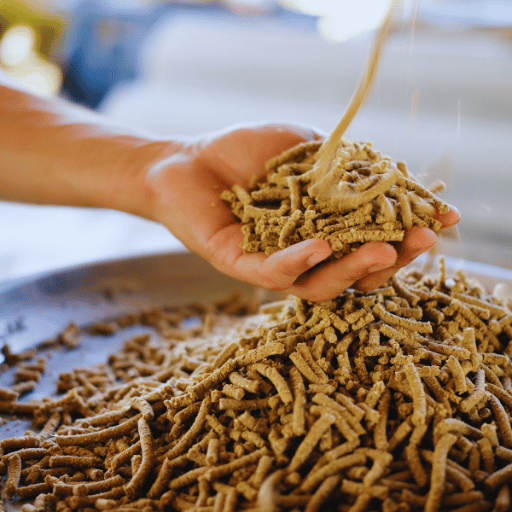
In truth, making your own pellets at home has the quickest payback when there is no feedstock cost—zero even—and the longest when you must pay market rates. It is very rare for the mill alone to make a difference between these two extreme scenarios: the truly decisive element is feedstock.
How Much Electricity Does a Small Pellet Machine Use per Ton?
Small flat-die mills use anywhere from 90-140 kWh/Ton pellet, sensitive to motor size and feedstock firmness. This translates to an electric direct cost of around $13-$20/Ton at the then current US residential industrial rate of about $0.14/KWh. Accounting for bag and screening loss as well as some performance premium maintenance, the all-in cost at the mill for a home-produced metric ton sits in the neighborhood of $25-$40(Ton) on free sawdust, as compared to the $280-$340(Ton) retail prices of the highest-of-grade ENplus pellets in the Northeast US market.
| Scenario | Annual demand | Annual saving vs retail (payback period horizon) | Payback on $5,000 mill |
|---|---|---|---|
| Free sawmill sawdust, 5 tons/yr | 5 t | $1,200–$1,500 | ~36–48 months |
| Buying wood chips at $30/ton, 5 tons/yr | 5 t | $1,000–$1,250 | ~48–60 months |
| Free sawdust, 10 tons/yr (large home or duplex) | 10 t | $2,400–$3,000 | ~20–24 months |
| No feedstock access, retail comparison only | — | Negative — do not buy a mill | N/A |
The 80/20 of home pellet ROI: home-milled pellets’ break even is due to purchase feed, not to purchase mill. Buy free sawdust and a $5,000 entry-level mill before you buy $1,000 homebuilt rig you won’t maintain.
DIY vs Buying a Small Pellet Mill: Realistic Cost-Quality-Effort Tradeoff
Online DIY pellet mill plans assume you can weld a pellet press from some $500 worth of scrap steel. That estimate neglects the items that count: a die set of precision-machine quality, hardened rollers, high-quality alignment bearings and a capable CPU. The more accurate DIY BUILDOFFMATERIALS exists some where between a Chinese FOB entry-level mill and the videos.
DIY Self-Build Cost Components
- Welded steel frame: $300–$500
- Used three-phase motor (7.5 kW): $200–$400
- Machined hardened die set: $800–$1,500
- Rollers and bearings: $250–$450
- Couplings, V-belts, electrical: $150–$300
- Build hours: 80–150 (your time)
Cash subtotal: $1,700–$3,150. Add labour at $25/hr and the project hits $3,700–$6,900 in real cost.
Entry-Level Chinese FOB Flat-Die
- 11 kW / 100 kg/h electric: $4,000 FOB Qingdao
- Pre-engineered alignment and bearings
- Hardened alloy steel die: 800–1,200 h life
- Manufacturer warranty (typically 12 months)
- Spare parts ecosystem already in place
- Assembled, tested, ready in 15 days
Including the Cash sub total: $4,000 plus freight?
The clock’s the time involved on recep. andenstallation?.
⚠ DIY Reality Check
DIY rollers and dies are very hard to align effectively without a machine shop. Small-mill forum field operators often report DIY mills using 30-50% shorter die life than commercial equivalents of similar throughput because the roller-die clearance moves under load. Build DIY only if you are single-use, farm, and you have a machine shop and welding bench in the building.
Common Problems with Small Pellet Machines and How to Fix Them
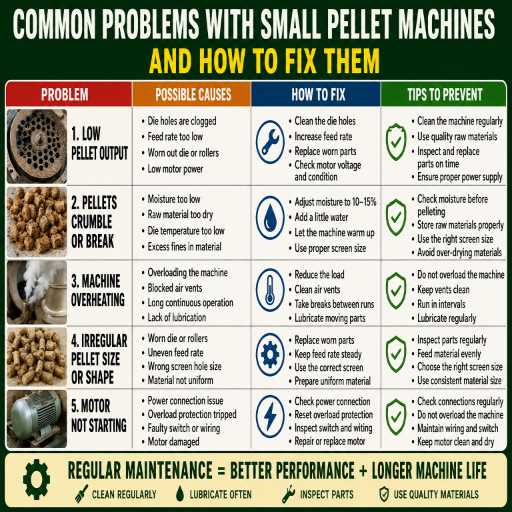
Anyway, all home operators run into the same handful of problems in the first year. Seven issues shown here have some manifestation on either operator forum or industry troubleshooting help sites like the old Hearth.com pellet mill talk or the Hayne Group 2025 ring die problems report.
| Problem | Most likely cause | First-line fix |
|---|---|---|
| Pellets crumbling or soft | Moisture outside 12–18% window, or compression ratio wrong for feedstock | Dry feedstock, then verify die compression ratio and die geometry against feedstock chart (or use the TCPEL feedstock-to-die quick check tool) |
| Low output rate | Cold die (cold start), feedstock particle too large, or roller clearance too wide | Allow 30–60 minute break-in run, regrind feed to ≤5 mm, adjust roller gap |
| Motor overheating | Undersized motor, blocked vents, or feedstock overload | Reduce feed rate, clear cooling vents, verify amp draw is below nameplate |
| Excessive noise or vibration | Roller bearing worn, loose anchor bolts, or unbalanced die | Stop mill, inspect bearings, retorque mounting bolts |
| Oil leakage at bearings | Worn seal or over-greased fitting | Replace seal kit, do not over-grease — one shot per service interval |
| Die clogging | Sap or oil from green wood, or moisture too high | Dry feedstock further, run a sand-and-oil purge through die |
| Premature die wear | High-silica feedstock, misaligned rollers, or under-spec die alloy | Switch to vacuum-hardened die, realign rollers, reduce silica feedstock fraction |
How Long Is the Break-In Period on a New Pellet Mill?
A new flat-die mill requires about 30 to 80 hours of operation through a break-in stage before reaching its rated throughput and pellet quality. During break-in the die channels work-harden and polish, friction-heat patterns stabilize, and the mill operator gain experience with the types and feedrates that call for its operating point “sweet spot.” The first dozen batches leave the die slightly crumbly. Pelletequipments.com recommends running the mill through a one hour feed of sawdust and oil mix for die seating; many operators use a sand-and-oil purge for the same.
Virtually every quality issue we see in the first month after delivery amounts to one of three things: feedstock moisture outside the 12-18% range, a die that is not completely broken-in, or a roller-clearance setting taken from an industrial spec table rather than small-mill. None of these are equipment faults and all three sorts out within the first two weeks if the operator blows through the recommended break-in checklist.
Small Pellet Machine Price Bands: From $1,500 DIY to $15,000 Commercial-Grade
Pricing for small pellet machines clusters — four bands. Each band varies capacity, durability and after-sales support, with the best option largely a function of annual tonnage goal, not budget headroom.
Four Price Bands for Small Pellet Machines
| DIY self-build ($1,000–$2,000) | Hand-built welded frame, sourced motor, machined die. Output ~50–150 kg/h. Best fit: single-purpose farm use where you have a machine shop already. |
| Entry FOB China ($4,000–$6,000) | 11 kW / 100–500 kg/h electric flat-die. Best fit: residential heat-pellet producer with 2–5 tons annual demand. |
| Mid-workshop ($6,000–$9,000) | 22–37 kW / 500–900 kg/h. Best fit: small sawmill monetising its own waste or on-farm operator with 8–15 tons annual demand. |
| Commercial-small ($9,000–$15,000) | 37–110 kW / 900–1,400 kg/h. Best fit: small commercial pellet line selling to neighbours or local heating customers. |
For one using a TCPEL-configured small pellet machine sized to your annual demand and feedstock, talk to a home pellet machine for small-scale production supplier with feedstock and capacity in hand.
From Small to Industrial: When to Upgrade Your Pellet Mill
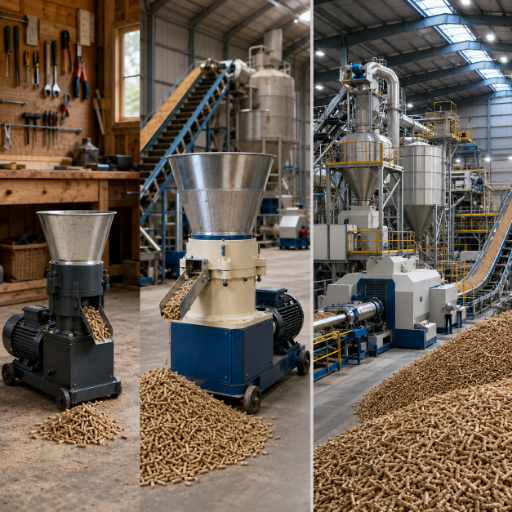
A small flat-die mill makes sense right up until one of four upgrade triggers occurs. First, when you operate the mill more than 1500 hours per year — at that point, it is the wear-economics break-even where a ring-die mill’s longer die life recuperates its extra capital cost. Second, when annual output passes about 50t – the labour share at small scale no longer looks sensible above this threshold. Third, when you decide to sell pellets to third parties within ENplus or DIN+ certification, which mandates steam conditioning and integrated cooling that small mills cannot provide. Fourth, when continuous unattended operation becomes necessary — as opposed to a periodic batch process that small mills were designed for.
For buyers approaching those triggers, the engineering trade-offs at industrial scale are covered in our companion guide to industrial biomass pellet machine sizing and feedstock chemistry.
Small-Scale Pellet Production Outlook 2026: Rising Heat Costs, Energy Transition, Off-Grid Demand
Three drivers will determine the small pellet machine market through 2026 and 2027, each with a different impact on whether to buy immediately or delay.
Residential heat cost pressure
The EIA Annual Energy Outlook 2026 forecasts further US biomass waste-to-energy capacity expansion (2.6 GW by end of 2025). North American residential heating fuel costs will presumably stay volatile for the foreseeable future, keeping demand high for self-sufficient pellet generation on farms and in homesteads.
Residential biomass policy
The Alliance for Green Heat follows DOE residential biomass schemes and export-credit market signals. residential-solid-biofuels-combustion-continuous-improvement-over-time/”>IEA Bioenergy has chronicled ongoing emission and efficiency enhancements in modern residential pellet stoves and boilers as far back as 2015.
Global pellet market growth
Market trackers place the world biomass pellets market around US $7.7 billion in 2025, trending up to around US $13 billion by 2035 (a 5-6% CAGR). Small producers drive the long tail of that market — rural off-grid, on-farm and tiny-home heating segments long ignored by industrial supply.
For a 2026 commissioning and feedstock cost in your region approaching zero, it is a good buying opportunity: ballpark flat-die FOB prices have been flat for two years, while North American retail pellet prices keep climbing. If feedstock must be bought at market price, wait for a feedstock supply contract before purchasing any mill.
Frequently Asked Questions

Q: How much electricity does a small pellet machine use per ton of pellets?
View Answer
Between 90 and 140kWh per tonne, depending on motor sizing and feedstock hardness. At a US home rate of under $0.14 per kWh, this is roughly $13 to $20 of direct power cost per tonne — insignificant next to the $280-$340 cost saving per tonne of not having to buy pellet.
Q: What is the typical die life on a home pellet mill?
View Answer
Die service life of 800 to 1200 hours can be expected on clean softwood sawdust in the 12-18% moisture window; hardwood yields 600-900 hours. High-silica feedstocks, such as rice husk, will reduce die life to less than 500 hours unless a vacuum-hardened die alloy has been specified.
Q: Can a small pellet machine produce ENplus-certified pellets?
View Answer
In operation, no. ENplus A1 certification requires moisture 10%, ash 0.7%, and mechanical durability 97.5% by test to ISO 17831-1. Achieving those in practice takes steam conditioning, controlled drying and counter-flow cooling three subsystems small flat-die mills lack.
Small mills routinely make serviceable heating pellets, just not certified ones.
Q: How long is the break-in period on a new pellet mill?
View Answer
Between 30 and 80 hours of running is proposed before the rated output and pellet quality are dependable. During break-in the die channels work-harden and polish; pellets from the first dozen or so batches are often a little crumbly. A sand-and-oil purge through the die for the first hour is common.
Q: Can I make pellets from straw or grass at home?
View Answer
Straw is OK if you add 10-20% softwood sawdust to provide a binder since straw in itself has a very low level of lignin and does not have enough to provide proper bonding under flat-die compression. This is not the case with garden grass or leaves. You just don’t have the lignin budget required to produce tolerable pellets in this size mill.
Q: How long will a 40-lb bag of wood pellets burn?
View Answer
For a typical 250,000 Btu per hour residential pellet stove at medium setting, a 40 lb (18kg) bag of biomass would run approximately 16 to 24 hours of steady operation. Operator surveys posted on Hearth.com indicated that winter use ranged from 0.75 to 1.5 bags per day in residences of 1,400-2,000 ft 2 (130-185 m 2). Total burn time varied with stove efficiency, feedstock moisture content, setting level, and pellet calorific value.
Q: What is the difference between a small pellet mill and a small pellet machine?
View Answer
Industry nomenclature is interchangeable. Some manufacturers may refer to the standalone press as a “pellet mill” while “pellet machine” or “pellet plant” refers to a buyed line with added hammer mill, dryer and cooling system. Inquire about capacity, motor size, die material and warranty – not the product name.
Ready to Size Your Small Pellet Machine for Home Use?
Give us the feedstock type, annual tonnage goal and port of destination – TCPEL’s engineering team will give back a configured TCZL flat-die quotation within 24 hours.
About This Buyer’s Guide
This guide has been authored by the TCPEL engineering team with operating data collected during shipment of the TCZL flat-die series since 2020, reaching over 60 countries from our 20,000 m2 Shandong plant. Much of our sizing math refers to data from the Pellet Fuels Institute, EIA Annual Energy Outlook 2026 and IEA Bioenergy residential biofuels reports, rather than re-telling the manufacturer marketing statements. When quoting small-mill data operating statistics, the source forum or industry blog is hyper-linked in-line.
References & Sources
- The Annual Energy Outlook 2026 – US Energy Information Administration
- DOE’s Impact with Residential Biomass – Alliance for Green Heat
- Combustion de biocombustibles solides à domiciledans le temps. Améliorations continueles. IEA bioénergie
- How Much Do I Need for My Home? -Energy Pellets of America / PFI sourcing
- Solutions to Common Problems Found in Small Pellet Mills – GEMCO Energy
- De top 5 Pellet Mill Ring Die problemen 2025 – Hayne groep.
- Pellet Mill Troubleshooting Questions – Mill Temps Too Low – Hearth.com
- EIA Forecasts for increased US Biomass Waste Production Capacity 2026-2027 – Biomass Mag.
- ENplus Quality Certification – Bioenergy Mag.
Related Articles
- Small pellet mill – house or small scale industrial use – the TCZL flat-die pellet mill series [diagram] – solutions page with a list of configured TCZL pellet mill models and estimates.
- Step-by-step introduction to biomass pellets making equipment – guide to compare equipment for larger heats. Occasional buyers guide.
- 5-Year Pellet Plant TCO Calculator – forward-looking cost modelling for when you grow out of a small mill.
- 5-Signal Feedstock-to-Die Rapid Calculation – preliminary estimate of feedstock amount and die-life.