Get in Touch with TCPEL

Top 20 Animal Feed Pelletizer Manufacturers: Who Fits Which Job?

Last updated: October 2026
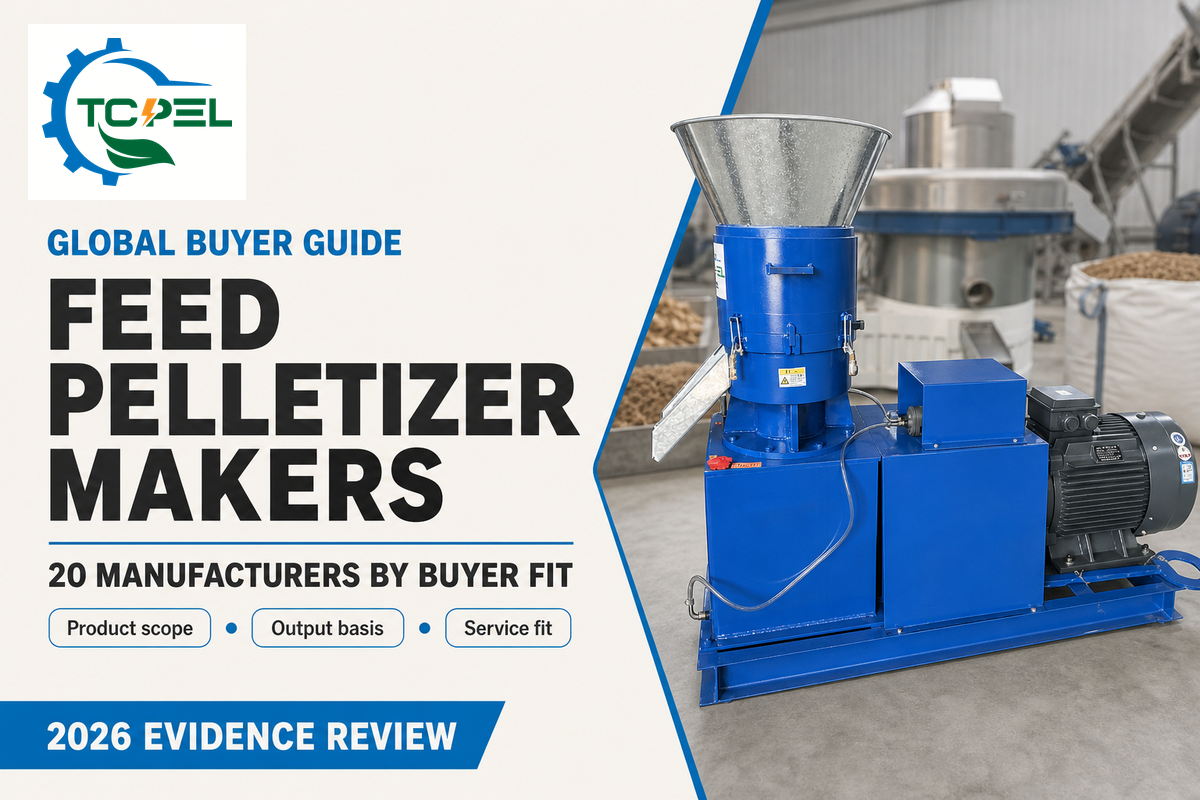
TCPEL lists animal feed pelletizer units for small- to mid-size systems without a market-leader claim. The top animal feed pelletizer manufacturers are best compared by buyer fit in 2026: TCPEL for published small-to-mid-capacity models; Bühler, ANDRITZ, CPM and Van Aarsen for integrated industrial programs; AMANDUS KAHL, Yemmak, Fragola and Henan Herm for specialized process ranges; and RICHI, GEMCO and Buskirk for export or smaller projects.
Quick Picks
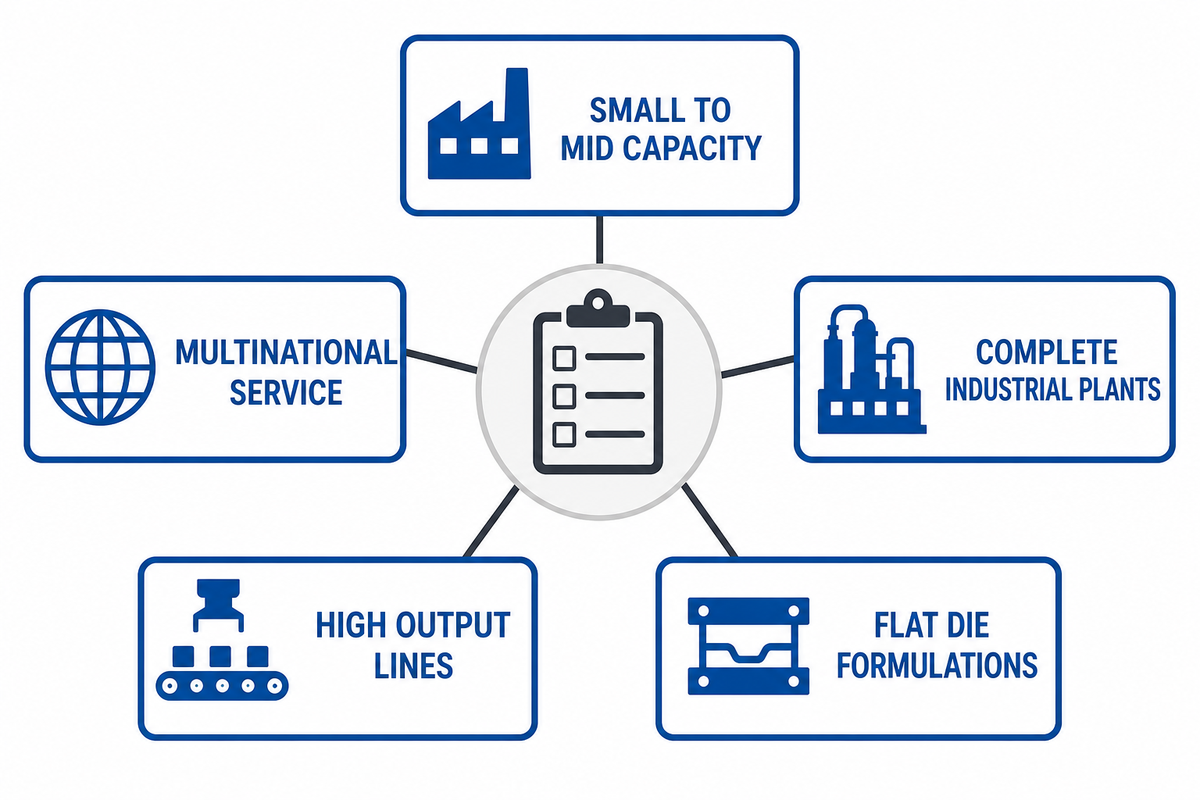
- Best for small-to-mid-capacity feed plants: TCPEL
- Best for multinational service coverage: Bühler
- Best for complete industrial feed plants: ANDRITZ
- Best for high-output automated lines: Van Aarsen
- Best for flat-die pelleting and unusual formulations: AMANDUS KAHL
These are illustrative examples and not absolute performance indicators. The numbers below are examples of reading order and not absolute market position.
Capacity figures become comparable only when formula, incoming moisture, conditioning, die geometry, continuous run duration and net saleable output basis are held constant.
How We Selected These Manufacturers
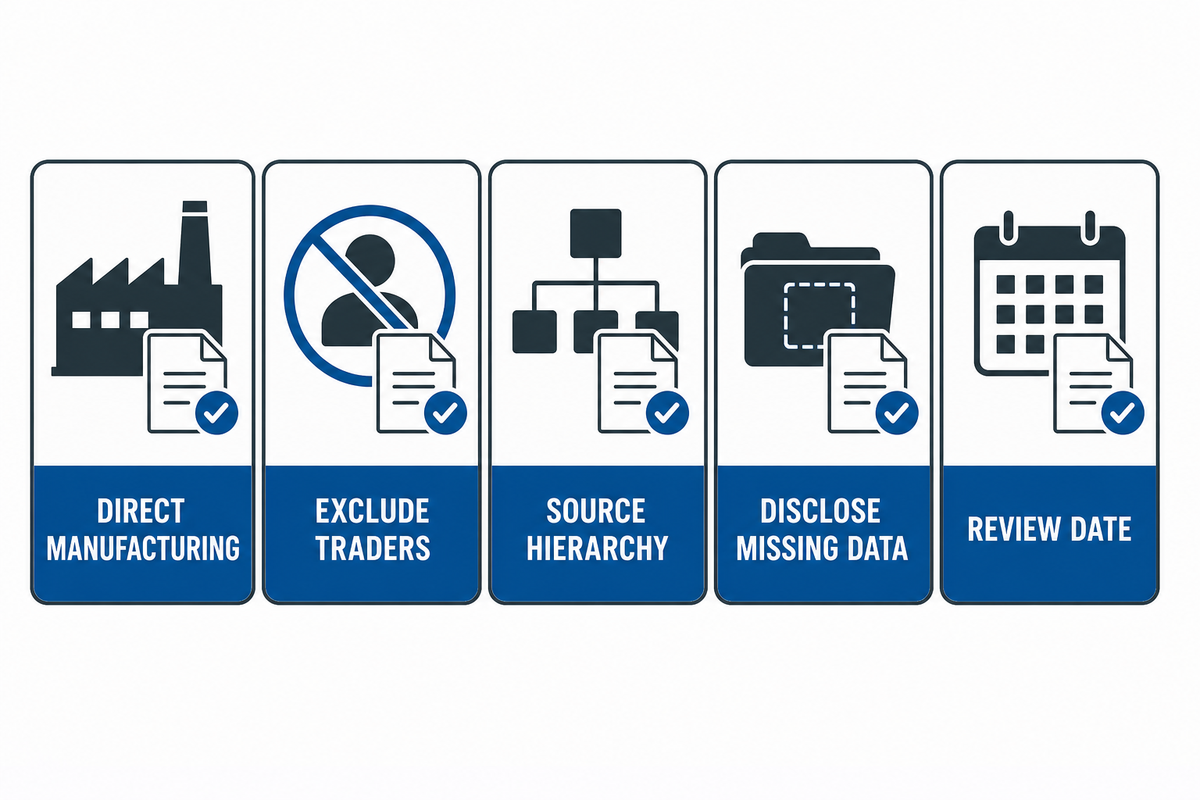
- Direct manufacturing evidence: Each of the companies in question had an official page displaying their respective animal-feed pellet mill, pellet press or complete feed-pelleting systems.
- Exclusions: We eliminated trader companies, marketplaces, directories, used-equipment dealers, finished-feed producers, parts-only vendors, and companies constrained to wood pellet equipment. An animal feed pellet machine had to be featured in the maker’s own current product line.
- Fact hierarchy: product scope, headquarters and company history came from official sites where available. University, peer-reviewed, government and trade publications were sources for process and safety checks.
- Missing data rule: When we were unable to authenticate a founding year, throughput, or other data, we used “Not publicly disclosed” rather than provide an estimate.
- Verification date: The company pages and public evidence were reviewed on October 5, 2026.
A branded product page indicates that a company sells the equipment, not that all components are made in-house. The legal manufacturer, system integrator, contracting seller, and warranty owner should be identified before purchasing. Our analysis of 20 official overview pages showed that only 10 provided a numerical output or plant capacity range. Since the numbers and limits varied, those figures can’t support a headline-capacity ranking. Therefore, pellet feed quality and net pellet production should be left for the acceptance test, and not for brochure comparisons.
20 Manufacturers at a Glance
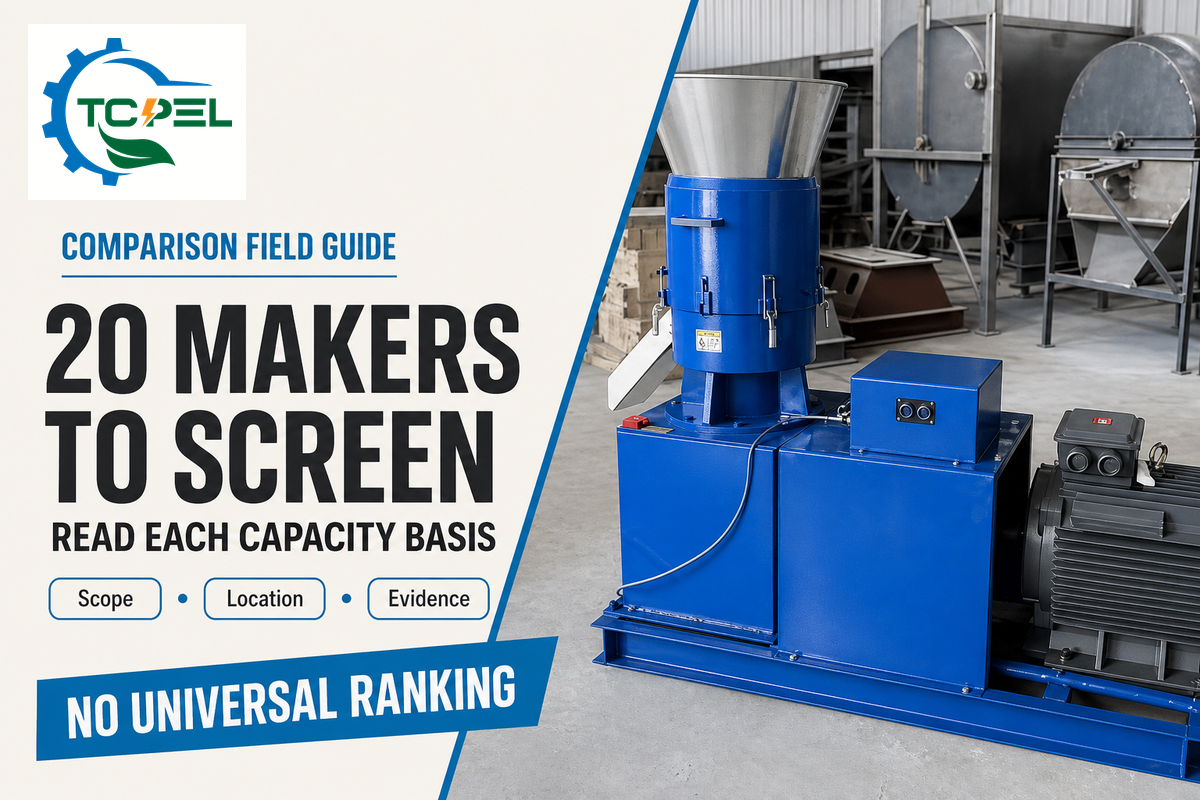
The table is a qualification aid. Capacity entries are shown as written on the reviewed pages (i.e. machine output, plant output, annual scope, power or “Not publicly disclosed”), rather than showing unlike values as a common, false scale.
| No. | Company Name | Country / Published Location | Founded Year | Best For | Brief Introduction | Main Products | Key Advantages | Potential Disadvantages | Official Website |
|---|---|---|---|---|---|---|---|---|---|
| 1 | TCPEL | Jinan, Shandong, China | 2020 | Small-to-mid-capacity feed plants | Manufacturer with 11 published TCF models. | Feed pelletizers, lines, grinders | 150–6,000 kg/h; 2–10 mm pellets | Published range stops at 6 t/h | www.tcpel.net |
| 2 | Bühler | Uzwil, Switzerland | 1860 | Multinational service coverage | Process group with Kubex feed mills. | Kubex mills, conditioning, feed systems | Broad applications and service network | Overview omits feed throughput ratings | www.buhlergroup.com |
| 3 | ANDRITZ | Graz, Austria | 1852 | Complete industrial feed plants | Industrial group offering FeedMax and Sprout mills. | Pellet mills, conditioners, complete plants | Plant integration and lifecycle services | May over-specify a small press purchase | www.andritz.com |
| 4 | CPM | United States | Not publicly disclosed | Many ring-die model families | Manufacturer with dedicated animal-feed and aqua lines. | Pellet mills, controls, process equipment | Broad model and aftermarket scope | No feed throughput table on overview | www.onecpm.com |
| 5 | Van Aarsen | Panheel, Netherlands | 1949 | Automated 5–70 t/h lines | Feed-equipment maker with four mill families. | Pellet mills, automation, feed plants | Published output and control features | Range begins at 5 t/h | www.vanaarsen.com |
| 6 | Ottevanger | Netherlands | 1909 | Configurable mills and maintenance access | Feed-plant specialist offering Progress mills. | Pellet mills, automation, feed plants | Roller options and variable die speed | No application throughput in t/h | www.ottevanger.com |
| 7 | FAMSUN | Yangzhou, Jiangsu, China | Not publicly disclosed | Species-specific feed programs | Manufacturer with pig, poultry, ruminant and aqua lines. | K, KN, KX, MUZL mills | Dedicated species and drive choices | Overview omits model outputs | en.famsun.com |
| 8 | AMANDUS KAHL | Reinbek/Glinde, Germany | 1876 | Flat-die and unusual formulations | German flat-die mill and plant manufacturer. | Flat-die mills, conditioners, plants | Wide die and pellet-diameter range | Power published, not t/h output | www.akahl.com |
| 9 | MÜNCH-Edelstahl | Hilden, Germany | Not publicly disclosed | Modular mid-power ring-die systems | Ring-die specialist offering RMP equipment. | RMP mills, hammer mills, crumblers | Drive, inlet and lubrication options | Power shown, not feed throughput | www.muench-edelstahl-gmbh.de |
| 10 | Yemmak | Türkiye | Not publicly disclosed | Flexible 3–30 t/h plants | Manufacturer of P and PM feed mills. | Pellet mills, feed machinery, plants | Published output, power and diameter | Single-machine range ends at 30 t/h | www.yemmak.com |
| 11 | La Meccanica | Cittadella, Italy | 1961 | Compact European-made feed mills | Italian maker of feed mills and wear parts. | Pellet mills, dies, rollers, lines | In-house equipment and wear parts | Limited public output detail | www.lameccanica.it |
| 12 | SKIOLD | Denmark | 1877 | Modular 2–40 t/h livestock plants | Farm and commercial feed-system manufacturer. | Pellet presses, feed plants, farm systems | Complete conditioning-to-sifting scope | Few press model specifications | www.skiold.com |
| 13 | Fragola S.p.A. | Assisi, Perugia, Italy | 1961 | Broad industrial output range | Plant builder with eight PGPM sizes. | Pellet mills, coolers, turnkey plants | Species-specific outputs and die sizes | Smallest range starts at 2.5 t/h | www.fragolaspa.com |
| 14 | Rosal-Mabrik | Barcelona, Spain | 1956 | Complete hygienizing and coating sections | Feed-plant group covering full pelleting sections. | Mills, hygienizers, coolers, coaters | Broad downstream equipment scope | General page omits throughput | www.rosal-feedmills.com |
| 15 | Alapala | Çorum, Türkiye | 1954 | Feed and grain-handling integration | Turnkey grain and feed-equipment group. | Pellet presses, feed mills, handling | Integrated grain and feed scope | No feed-specific t/h rating | www.alapala.com |
| 16 | Henan Herm Machinery | Zhengzhou, Henan, China | 2010 | Animal-feed preconditioning | Manufacturer of HMLH-Series feed equipment. | Pellet mills, extruders, dryers | Published model-dependent output table | Published range needs formula-specific testing | www.hermmachinery.com |
| 17 | Zhengchang | Jiangsu, China | Not publicly disclosed | Large livestock and poultry projects | Whole-plant feed-mill engineering provider. | SZLH mills, complete feed plants | Annual-capacity and moisture-control planning | Data is plant-level, not model-level | en.zcme.com |
| 18 | RICHI Machinery | Jiaozuo, Henan, China | 1995 | Export turnkey lines from 1–45 t/h | Exporter of mills and complete feed systems. | SZLH mills, plants, auxiliaries | Twelve models with published capacities | Local service varies by country | www.richimachinery.com |
| 19 | GEMCO Energy | Anyang, Henan, China | 2004 | Entry-level through medium plants | Maker of flat- and ring-die feed equipment. | ZLSP, STLP, BPM systems | 60 kg/h–15 t/h public range | Corporate scope is biomass-heavy | www.gemco-energy.com |
| 20 | Buskirk Engineering | Indiana, United States | Not publicly disclosed | Low-RPM custom on-farm systems | Indiana designer and fabricator of feed systems. | Custom mills, skid systems, handling | In-house design and fabrication | No standard throughput table | www.buskirkeng.com |
Global Process and Service Leaders
These companies publish broad product families, complete-line scope or multinational support. This can be of great help in a large, complex plant, but corporate size doesn’t replace a formula-specific acceptance test.
1. TCPEL: Best for Small-to-Mid-Capacity Feed Plants
Disclosure: This guide is published by TCPEL. We list ourselves first because this is our website, not because we claim to be the market leader. The other 19 manufacturers are grouped by what they’re best for, in no particular order within each group.
TCPEL’s official animal feed pelletizer range lists 11 TCF models from 150 to 6,000 kg/h and pellets from 2 to 10 mm. TCPEL’s page also identifies CE marking and ISO 9001:2015 certification; buyers should still match the relevant documents to the quoted machine and destination. These are the product page’s own statements; this guide has not independently verified a current ISO certificate or a model-specific EU declaration of conformity. Its range suits compact through mid-sized feed projects that need several published model steps. Its stated upper output is 6 t/h, so larger single-line duties need another configuration or supplier.
2. Bühler: Best for Multinational Service Coverage
Bühler’s official pellet-mill family includes Kubex 3, Kubex 5 and Kubex T 7. Kubex 3 is presented for poultry, swine, ruminant and aqua feed, while the corporate site reports more than 30 manufacturing locations and 100 service stations. That breadth suits multi-country processors that value one process ecosystem and a wide support footprint. Its reviewed overview doesn’t publish feed-specific output for each model, and the enterprise scope may be more than a small standalone buyer requires.
3. ANDRITZ: Best for Complete Industrial Feed Plants
ANDRITZ publishes FeedMax G7, G9 and G12 plus Sprout gear- and belt-driven animal-feed pellet mills. Its offer also covers conditioners, coolers and complete feed plants, with regional lifecycle contacts. This is a practical fit where one engineering group must coordinate several process stages. ANDRITZ’s overview doesn’t bind a universal t/h figure to a buyer’s formula, and a project-scale package can over-specify a small press replacement.
4. CPM: Best for Buyers Wanting Many Ring-Die Model Families
CPM lists CL, 1100, 3000, 7700, 7900, 9000 and 9900 families plus dedicated PM Series animal-feed equipment. It also links automation, aftermarket and aqua-feed variants, giving buyers several platform and lifecycle paths. This selection can help plants standardizing on one supplier across different production duties. Its reviewed overview omits model-by-model feed throughput, so the chosen press still needs a recipe-bound output and energy guarantee. IDAH is a CPM brand and isn’t counted as a separate manufacturer in this comparison.
5. Van Aarsen: Best for High-Output Automated Lines
Van Aarsen mentions C600, CU Basic, CU Dynamic and CU1200 Titan pellet mills across a stated 5-70 t/h range. Its page indicates roller-slip control and quick-die changes. Energy use is shown down to 8 kWh/t on the supplier’s stated basis. These features benefit larger, automated projects that seek control and access. Because the stated range begins at 5 t/h, micro and farm-scale plants should assess whether another product is a better fit.
6. Ottevanger: Best for Configurable Feed Mills and Maintenance Access
Ottevanger’s Progress pellet mill has a quick-dump chute, and comes with two- or three-roller configurations and variable die speed. Their published chart shows several die and power combinations, and helps engineering teams compare mechanical envelopes. Some maintenance-related features can be important when product changeovers and die work occur frequently. Its chart doesn’t state application throughput in t/h, leaving formula-specific output to the proposal and test.
7. FAMSUN: Best for Species-Specific Feed Programs
FAMSUN separates its pelleting portfolio into K, KN, KX and MUZL series for pig, poultry, ruminant and aqua applications. Gear and belt drive options are available across the portfolio to match the mechanics to feed programs and site preferences; the page doesn’t say every series has both. This suits operators handling multiple species or groups aiming to package an entire process. FAMSUN’s overview doesn’t show output data by model, so service response, die availability and guaranteed performance for a given formula must be obtained in writing.
European and Regional Specialists
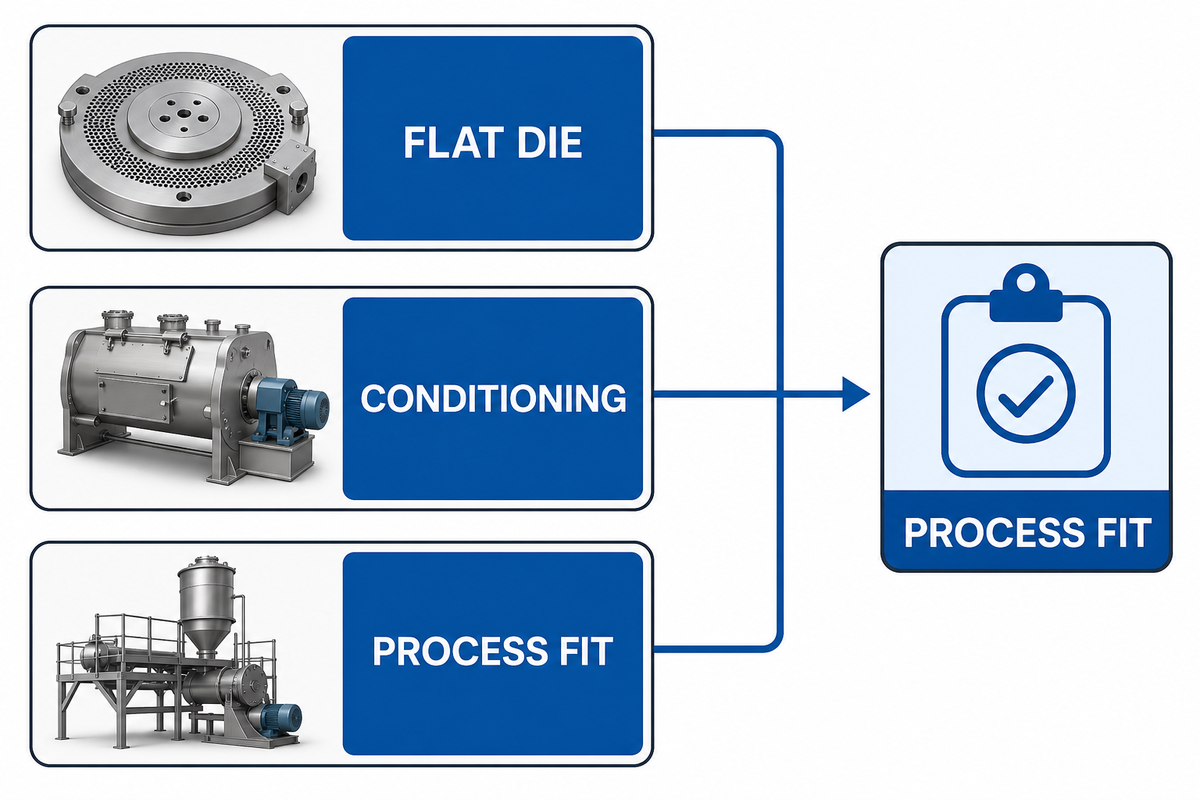
This group includes flat-die specialists and complete pelleting section builders and integrators. Their value is often process fit as opposed to corporate scale. Especially if the project is driven by die geometry, conditioning or treatment, they could add value.
8. AMANDUS KAHL: Best for Flat-Die Pelleting and Unusual Formulations
AMANDUS KAHL’s flat-die pellet mills cover 3–630 kW, dies from 175 to 1,500 mm and pellet diameters from 0.4 to 40 mm. AMANDUS KAHL also describes roller-gap adjustment during operation. That range can suit unusual formulas or buyers deliberately comparing flat-die and ring-die behavior. The official page gives power and dimensions rather than animal-feed t/h, so output can’t be inferred from motor size alone.
9. MÜNCH-Edelstahl: Best for Mid-Power Ring-Die Systems With Modular Options
MÜNCH-Edelstahl presents its RMP ring-die pellet mill for 7-450 hp. Features include dual synchronous drives, steam and liquid inlets, and automatic lubrication. MÜNCH-Edelstahl’s broader range features hammer mills and crumblers. Its modular design helps an engineering buyer define the press around an existing line. Public data show motor power, not feed-specific throughput, so an application test and exact auxiliary scope remain necessary.
10. Yemmak: Best for Flexible 3–30 t/h Feed Plants
Yemmak publishes P and PM pellet mills for bovine, poultry and fish feed at 3–30 t/h. Yemmak’s table covers 45 to 400 kW and pellet sizes from 1.8 to 16 mm, with automatic roller adjustment as a feature. This range is useful for preliminary line sizing across several feed types. Each project must bind its actual formula and conditioning basis against the 30 t/h published single-machine upper rate.
11. La Meccanica: Best for Compact European-Made Animal-Feed Pellet Mills
La Meccanica maintains a dedicated animal-feed pellet-mill line and manufactures dies and rollers in Italy. A public CLM 200 page reports 150–300 kg/h, providing a concrete compact-model reference. This combination can suit smaller projects in Europe when machine and wear parts come from one group, not merely the same region. Public output detail for the wider range is limited, so larger duties need a model-specific quotation.
12. SKIOLD: Best for Modular 2–40 t/h Livestock Feed Plants
SKIOLD’s official pelleting systems cover a published plant range of 2–40 t/h. The scope includes conditioning, cooling and sifting as part of farm and commercial feed plants. This is useful when a buyer wants a modular line rather than an isolated press. The public page provides few individual pellet-press specifications, so machine selection and acceptance values must be clarified during engineering.
13. Fragola S.p.A.: Best for a Broad Industrial Output Range
Fragola lists eight PGPM pellet mills with dies from 300 to 1,200 mm. Its page publishes 2.5–32 t/h for cattle feed and 3.5–50 t/h for poultry feed, showing why formula category matters. The documented range helps industrial buyers create a first model shortlist. The smallest published cattle-feed output is 2.5 t/h, so very small plants should compare other platforms.
14. Rosal-Mabrik: Best for Complete Pelleting Sections With Hygienizing and Coating
Rosal-Mabrik’s pelleting section combines Mabrik mills with conditioners, hygienizers, coolers, coaters and crumblers. That scope is relevant when feed safety, post-pellet liquid application or downstream handling is part of the same project. A single-section supplier can reduce some interface questions between the press and auxiliaries. The general page doesn’t publish throughput, so the process guarantee must be project-specific.
15. Alapala: Best for Feed Mills Integrated With Grain Handling
Alapala’s KPPM pellet press is presented for mash-feed pelleting with overload protection and die-handling features. Alapala and its group also provide feed mills and grain-handling systems that can be integrated for sites requiring storage, milling and feed production. This may simplify the responsibility map for a new plant. That product page omits feed-specific t/h ratings, so capacity and species suitability need contractual evidence.
16. Henan Herm: Best for Animal Feed With Preconditioning
Henan Herm publishes an HMLH series of animal-feed pellet mills. Its model table provides model-dependent output around 1.5–40 t/h and specifies feeder and conditioner power. This can help buyers comparing animal-feed programs under one equipment group. The published HMLH range ends at 40 t/h, and the actual rate needs verification with the buyer’s species and formula.
Export and Right-Sized Manufacturers
These manufacturers cover large turnkey projects, entry machines and custom on-farm systems. Published ranges are useful filters, but contracting entity, local service and scope boundaries deserve the same attention as purchase price.
17. Zhengchang: Best for Large Livestock and Poultry Feed-Mill Projects
Zhengchang’s official feed-mill solutions relate to engineering, manufacturing, installation and commissioning of SZLH pelleting equipment. The page states annual plant capacities in the range of 10,000 to 1,000,000 tonnes and describes automatic moisture control. This is relevant to customers planning an entire livestock or poultry facility. The value published is annual plant capacity, not model-level hourly output, hence can’t be compared to a standalone press.
18. RICHI Machinery: Best for Export Turnkey Lines Across 1–45 t/h
RICHI publishes 12 named SZLH feed-pelletizing models and lists capacities from 1-2 to 28-45 t/h. Some models share the same capacity band, and the portfolio covers single machines and complete livestock and poultry, cattle and aqua lines. This detail can help evaluate potential export projects. When assessing whether technicians will be available in the import country, buyers must verify coverage, response time and critical-spare stocking instead of assuming global reach.
19. GEMCO Energy: Best for Entry-Level and Small-to-Medium Feed Pellet Plants
GEMCO’s official feed-pellet equipment covers ZLSP, STLP and BPM systems from about 60 kg/h to 15 t/h. That range is useful for farms and developing commercial operations. Its corporate catalog is heavily oriented toward biomass, so feed-contact materials, sanitation and formula support should be confirmed for the quoted unit.
20. Buskirk Engineering: Best for Low-RPM Custom On-Farm Feed Systems
Buskirk says its animal-feed pellet systems are designed, engineered and manufactured in Indiana. It offers custom skids, low-RPM processing and food-grade and/or stainless systems. This can suit on-farm or specialty projects that need a custom layout and domestic fabrication. Because the public page has no standard throughput table, capacity, formula window and complete skid boundary need a written test proposal.
How to Choose an Animal Feed Pelletizer Manufacturer
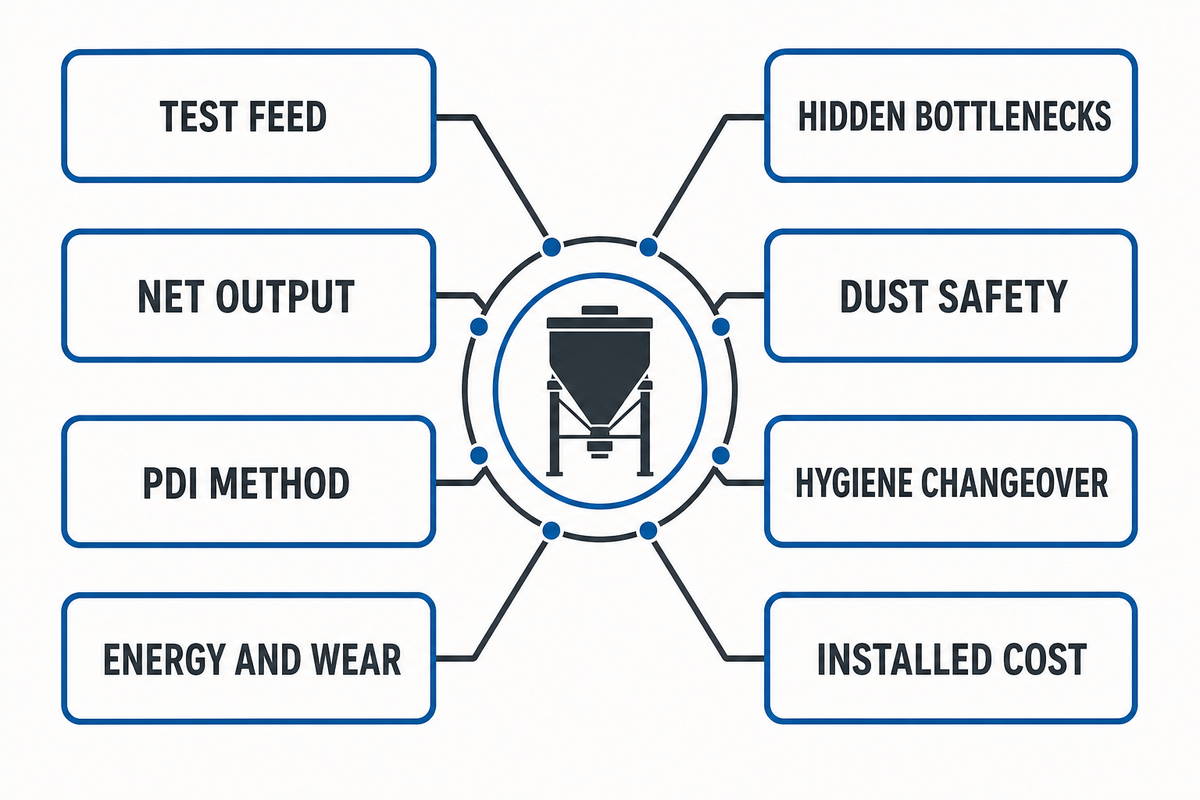
The engineering team at TCPEL suggests treating the pellet press as a single, controlled step in a line as opposed to a catalog capacity in isolation. Use the following eight checks prior to releasing a purchase order.
- Freeze the test feed. Specify the type of species, formula, fat and fiber levels, particle size distribution and the range of moisture in the feed. Collect and retain representative samples of the feed, so an unsuccessful run can’t be explained by an undocumented change in the material used.
- Bind sustained net output. Define saleable tonnes per hour after fines removal, not feeder rate. Specify continuous run duration, warm-up, permitted stops, restart treatment and whether recycled fines count toward output.
- Agree on a PDI method. Agree on the PDI method, fines percentage, bulk density, pellet diameter, discharge temperature and moisture. Faster production with unacceptable pellet breakage isn’t an acceptable end result.
- Record the energy consumption and wear. State and record the energy in kWh/t, the die specification and compression ratio, and the rolls’ condition before and after the run. Inspect the rolls and the die prior to and after the run. Cataloging the motor horsepower isn’t an acceptable means of determining specific energy.
- Audit hidden bottlenecks. Check steam quality, feeder stability, cooler residence, aspiration, crumbling, screening, fines return, conveying, and packing. An undersized cooler or an unstable steam supply can cap saleable output even when the press reaches its feed rate.
- Verify dust safety and hazardous-energy scope. Assign dust collection, isolation, interlocks, explosion protection and lockout/tagout responsibilities across the whole line. OSHA’s feed-mill grain-handling rule and the latest NFPA publications illustrate why a press certificate is insufficient; local requirements will apply.
- Test hygiene and changeover. Check access and cleanability of contact surfaces and examine controls for medicated feed carryover, cross contamination and batch traceability. Time a real changeover when multi-species production is planned.
- Normalize the installed cost and responsibility. Identify the legal manufacturer, integrator and warranty provider. Price the feeder, conditioner, steam system, cooler, crumbler, sieve, dust system, electrical work, freight, duties, commissioning, training and initial spares.
What Should a Feed Pellet Mill Factory Acceptance Test Measure?
A useful factory acceptance test freezes the formula, moisture range, grind distribution, die, conditioner settings and continuous test duration. It then records net saleable output, downtime, specific energy, PDI, fines, discharge temperature and moisture. Use calibrated instruments, a written sampling plan and agreed re-test remedies.
What Costs Are Usually Missing From an Animal Feed Pelletizer Quote?
Press prices usually don’t include the feeder, conditioner, boiler or steam piping, cooler, crumbler, sieve, fines return, aspiration, dust protection, conveyors, controls, electrical installation, civil works, freight, duties, commissioning, training or startup spares. Compare installed scope line by line carefully.
Pelletizer Hidden-Bottleneck Map
| Owner Role | Check | Acceptance Evidence | Hidden Cost if Missed |
|---|---|---|---|
| Plant manager | Steam, cooler and uptime balance | Continuous mass-balance run | Rated press with low saleable output |
| QA | PDI, fines, carryover and traceability | Agreed sampling and cleanout test | Rejected feed or cross-contamination |
| Finance | Installed scope and energy | Line-item cost plus metered kWh/t | Utility and auxiliary overruns |
| Procurement | Legal seller, warranty and spares | Contract schedule with lead times | Unowned interface and long downtime |
The map is an illustrative aid to procurement and isn’t a certification standard. Source basis: Kansas State and World Grain conditioning/die-speed evidence, OSHA/NFPA dust guidance, and reviewed manufacturer product pages.
12-Field Pelletizer FAT Card
Include these fields in the signed protocol: formula; incoming moisture; grind distribution; die and compression ratio; conditioning temperature and retention; continuous duration; permitted downtime; net output basis; specific energy; PDI method; fines limit; and discharge temperature/moisture. Changeover carryover shall be included in the protocol if the plant is making medicated or multi species feed.
Frequently Asked Questions
Which Is the Best Animal Feed Pelletizer Manufacturer for a Small or Mid-Sized Plant?
Consider suppliers with a published range meeting the output requirement; ignore undocumented maximum potential. TCPEL publishes 150–6,000 kg/h, while GEMCO covers small equipment through larger systems and Buskirk offers custom on-farm designs. For a small or mid-sized plant, start with suppliers whose published range covers the required output and whose complete scope matches the site. Compare the same formula, net output, PDI, energy, auxiliaries, service location and installed cost before choosing.
Which Is the Best Animal Feed Pelletizer Manufacturer for a High-Capacity Plant?
Consider companies that engineer complete processing lines and publish industrial range data (Van Aarsen, Fragola, RICHI, ANDRITZ, Bühler, CPM and Zhengchang). Their figures are published in different formats and bases, from hourly machine output to annual plant scope. A common mass balance, utility schedule, quality criteria, continuous run and site-service plan are required for a high-capacity shortlist.
Who Is the Largest Animal Feed Pelletizer Manufacturer in the World?
No current public data supports a definite company-level winner. Official industrial statistics compare products, industries or countries and may not disclose business level information, while broad corporate turnover and customer counts don’t distinguish animal-feed pelletizers. Before accepting any “largest” claim, define the metric, pelletizer revenue, unit sales, installed base, production capacity or service coverage, and request comparable dated evidence before treating company size as category leadership.
Are Chinese Animal Feed Pelletizer Manufacturers Reliable?
Not all companies from one country have the same reliability; country alone isn’t an acceptance criterion. Evaluating a company based on the country alone isn’t sufficient. Reliability screening should check the legal manufacturer, factory evidence, comparable feed references, material and electrical documentation, destination compliance, witnessed testing, local service and spare-part lead times. Write the same measurable obligations into every supplier’s request for quotation so Chinese, European and North American offers are judged on equivalent evidence. Require dated references and documents.
How Much Does an Animal Feed Pelletizer Cost?
A price breakdown isn’t available from comparable public sources for one defensible worldwide range. Price changes with output, die size, motor, conditioner, contact materials, controls, boiler and steam scope, cooling, crumbling, screening and dust protection. Freight, duties and commissioning also affect the installed cost. Ask suppliers for a line-item installed quotation against one process specification. A bare machine price shouldn’t be compared to a complete feed line package.
What Is the Difference Between a Manufacturer and a Supplier?
A supplier may be a reseller, system integrator or exporter, while a manufacturer controls design or production of the equipment. One entity can play multiple roles. Don’t assume the invoicing company owns the design, factory, warranty or technicians; verify each legal entity and assign acceptance obligations in the purchase contract before deposit. Name in the contract the legal manufacturer of the pellet press, system integrator, seller, warranty owner, and the party responsible for site acceptance and local service.
Conclusion
The best sourcing decision comes from evaluating a verified product line against the feed formula, sustained net output, quality of pellet, installed scope and service location. This list shouldn’t serve as a ranking of market share. Use the comparison to build a shortlist, then issue one normalized test and contract schedule to every candidate. To evaluate published TCPEL models and discuss acceptance basis for your project, visit the TCPEL animal feed pelletizer page.
Related TCPEL Resources
- Feed pellet machine overview
- Feed pellet production line
- Feed grinding hammer mill
- Pellet cooler guide
- About TCPEL
References and Verification Sources
References & Sources
[DOC_01]
WHY WE WRITE THIS
TCPEL publishes engineering-led buying guides for biomass, wood, and feed pellet projects. We write for plant owners, procurement teams, project engineers, and distributors who need practical information before selecting pellet machines, dryers, hammer mills, coolers, or a complete production line. Our goal is to explain the real process variables behind pellet production, including raw material size, moisture content, target capacity, pellet diameter, line matching, spare-parts planning, and long-term operating stability.
[DOC_02]
ABOUT OUR BUSINESS
TCPEL is the pellet machinery brand of ALLWIN INTERNATIONAL CO., LTD., a manufacturer based in Zhangqiu District, Jinan, Shandong, China. Established in 2020, the company operates a 20,000-square-meter factory with in-house R&D, production, sales, and after-sales coordination. Its product range covers wood pellet machines, biomass pellet mills, feed pellet machines, drum chippers, wood crushers, hammer mills, rotary dryers, pellet coolers, packing machines, and complete pellet production lines. TCPEL states that it has supplied customers in more than 60 countries and regions.
[DOC_03]
OUR SERVICES
We support buyers from early project evaluation to post-shipment follow-up. This includes raw-material review, capacity matching, machine-list recommendation, complete line configuration, voltage and export-document customization, production and testing, shipping coordination, installation and commissioning assistance, and spare-parts support. Buyers can contact the team by email or WhatsApp and, according to the company’s contact page, typically receive a reply within 12 working hours.
BIOMASS PELLET
WOOD PELLET
FEED PELLET
TURNKEY LINE
CHINA FACTORY
EXPORT SUPPLIER
MANUFACTURER PROFILE // SPECIFICATIONS
NICHE
Biomass, Wood & Feed Pellet Machinery
ROLE
Pellet Machine Manufacturer / Turnkey Pellet Line Supplier
BRAND
TCPEL
COMPANY
ALLWIN INTERNATIONAL CO., LTD.
LOCATION
Zhangqiu District, Jinan, Shandong, China
ESTABLISHED
2020
FACTORY FOOTPRINT
20,000㎡
TEAM
100+ Workshop Staff
PRODUCT SCOPE
Wood Pellet Machines, Biomass Pellet Mills, Feed Pellet Machines, Drum Chippers, Wood Crushers, Hammer Mills, Rotary Dryers, Pellet Coolers, Packing Machines, Complete Pellet Production Lines
LINE CAPACITY RANGE
0.5-20 T/H Complete-Line Throughput Range
EXPORT REACH
60+ Countries and Regions
INQUIRY RESPONSE
Within 12 Working Hours
ADDRESS
East Side, Second Factory, Zhangjia Industrial Park, Mingshui Street, Zhangqiu District, Jinan City, Shandong Province, China 250203
—SYSTEM LOG//ACTION
Start Your Pellet Project
Contact TCPEL engineers for early project evaluation, capacity matching, complete line configuration, and quotation based on your raw materials.
Contact Us ->