
Contacter TCPEL

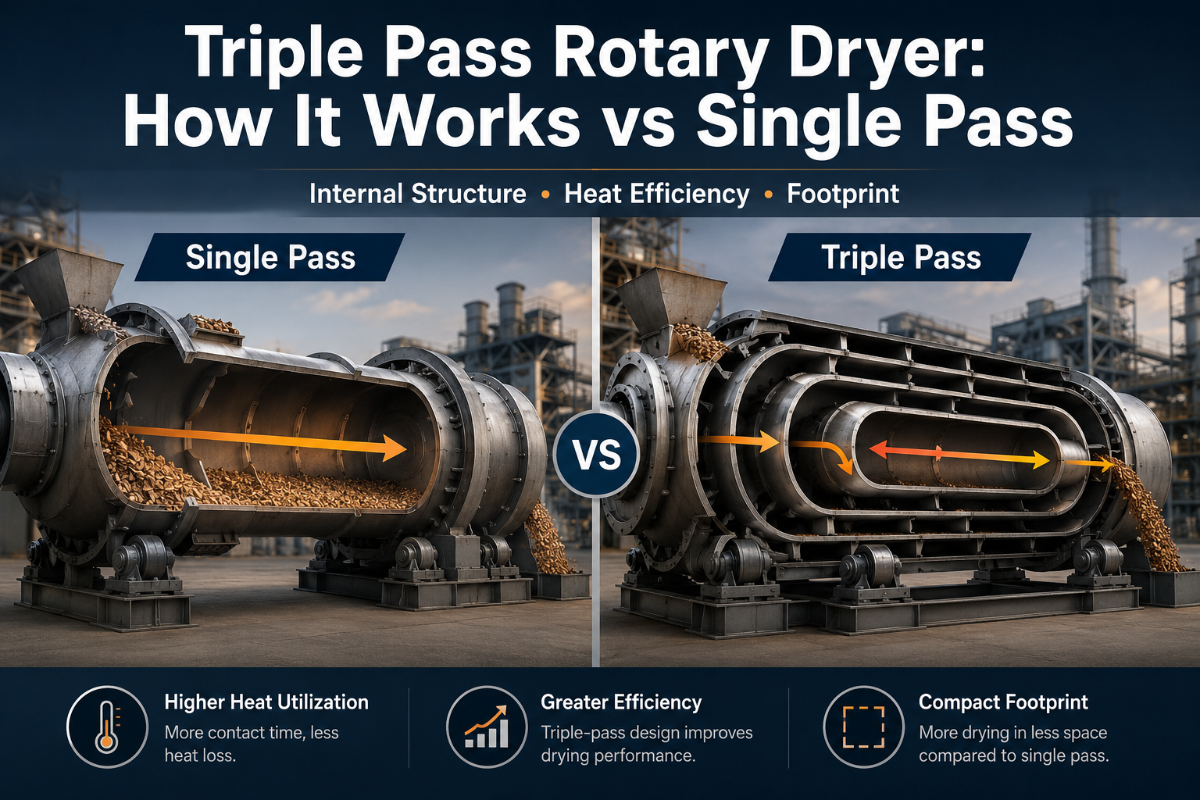
A sécheur rotatif triple passe fait progresser les matières humides dans trois tambours imbriqués — intérieur, intermédiaire et extérieur — de sorte qu’une longueur de machine procure environ trois longueurs de tambour de contact de séchage. Cet emboîtement explique pourquoi un séchoir à triple passage occupe beaucoup moins d’espace au sol qu’un seul long tambour et pourquoi il est devenu la solution par défaut pour la sciure de bois, les plaquettes de bois et les autres biomasses légères alimentant une ligne de granulation. Ce guide explique le fonctionnement réel de la conception à trois passages, quand elle surpasse un séchoir à un seul passage (et quand ce n’est pas le cas), ce qu’elle vous coûte en énergie et en entretien, et comment la dimensionner pour votre matière.
Spécifications rapides : séchoir rotatif à triple passage typique
| Configuration du tambour | 3 cylindres concentriques/emboîtés (intérieur → milieu → extérieur) |
| Débit gazeux | Chemin co-courant, entrée-sortie ; vitesse de l’air couramment citée autour de 0,5–2,5 m/s |
| Humidité d'entrée | Biomasse légère, couramment 50–63 % (base humide) |
| Humidité de sortie | ~10–15 % pour la granulation |
| Plage de capacité | ~2,6–115 t/h (selon le modèle) |
| Température maximale du gaz d'entrée | ~700–750 °C (chauffage direct) |
| Matériaux les mieux ajustés | Sciure de bois, copeaux de bois, plaquettes de bois, biomasse légère |
Les chiffres sont des plages typiques ; les valeurs exactes dépendent du matériau, du débit et de la source de chaleur. Demandez à n’importe quel fournisseur un test-séché sur votre propre matière première avant de commit.
Qu'est-ce qu'un séchoir rotatif Triple Pass ?
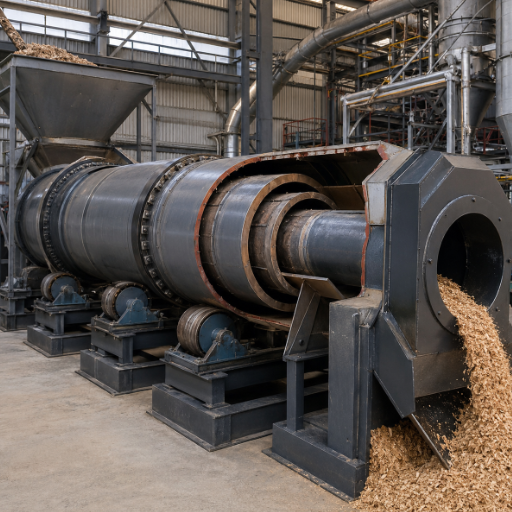
Un séchoir rotatif à triple passage est un séchoir à tambour rotatif constitué de trois tambours de diamètres différents imbriqués les uns dans les autres et tournant comme un seul corps rotatif. Le matériau humide et le gaz chaud entrent ensemble et suivent un trajet aller-retour-aller : ils descendent dans le tambour intérieur, reviennent par le tambour central puis avancent dans le tambour extérieur avant la décharge. Comme le gaz traverse le matériau trois fois dans une seule enveloppe, cette conception est aussi vendue comme séchoir à trois tambours, séchoir à tambour à triple passage ou séchoir rotatif à 3 passages.
Le point de tout ce qui est le contact. Les vols de levage à l'intérieur de chaque matériau de prélèvement de tambour se lèvent et le douchent à travers le flux de gaz chaud, et trois passages délivrent environ trois fois la longueur de contact du séchage rotatif ordinaire pour une empreinte donnée. Cette idée unique l'appelle le chemin de gaz sortant 10069999999999999999999999999999999999999999999999999999999999999999999999999999999999999999999999999999999999999999999999999999999999999999999999999999999999999999999999999999999999999999999999999999 types de séchoirs rotatifs.
Comment fonctionne le chemin de flux d'air triple passe
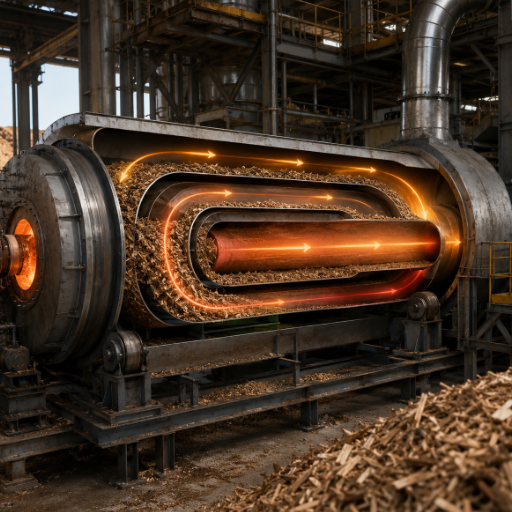
Le gaz chaud d'un four ou d'un aérotherme est tiré à travers le séchoir par un ventilateur à tirage induit. La matière humide pénètre d'abord dans le tambour le plus intérieur, où elle sèche le plus rapidement contre le gaz le plus chaud. Lorsque le corps tourne, des vols de levage soulèvent la matière et la laissent tomber en cascade à travers le gaz comme un rideau, où se produit la plupart des transferts de chaleur et d'humidité.
Ce qui distingue la version à trois passages est le comportement du gaz entre les tambours. Chaque tambour successif possède une section plus grande ; à mesure que le gaz se dilate de l'intérieur vers l'extérieur, sa vitesse change au cours des passages. L'écoulement à co-courant — gaz et matériau se déplaçant dans la même direction — est la norme pour la biomasse, car il maintient le gaz le plus chaud loin de la poussière la plus sèche et la plus inflammable à l'extrémité de décharge. .
Comment fonctionne un séchoir rotatif triple passage ?
En bref : le matériau suit le gaz à travers trois tambours imbriqués tandis que les aubes le soulèvent et le font tomber en pluie. Le passage intérieur gère l'évaporation la plus importante, le passage central poursuit le séchage lorsque le matériau inverse sa direction, et le passage extérieur le termine avant la décharge. La modélisation évaluée par les pairs de mouvement des particules de bois à travers un séchoir rotatif à triple passage simultané montre le temps de séjour des particules est défini par la géométrie du tambour, la vitesse de rotation et la traînée de gaz. Les trois mêmes leviers qu'un fournisseur accorde pour atteindre votre humidité cible. La vitesse de l'air rotatif est commonly citée dans le 0,5–2,5 m/s fourchette pour le droit à la biomasse.
📐 Note d’ingénierie
Le temps de séjour est le paramètre de conception, et non la longueur du tambour seule. Un temps de séjour plus long signifie davantage d'évaporation par passage, mais une machine plus grande. Comme les trois passages superposent la longueur de contact dans une même empreinte, un séchoir à triple passage atteint un temps de séjour utile dans une enveloppe beaucoup plus courte qu'un long tambour unique, ce qui explique réellement l'économie d'espace au sol.
Triple Pass vs Single Pass : Quand chacun gagne
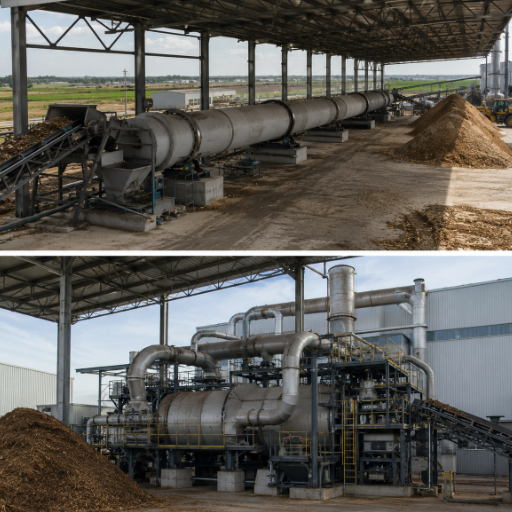
C'est la question que la plupart des acheteurs se posent réellement, et la réponse honnête est que le triple passage n'est pas simplement « meilleur ». Un séchoir à triple passage est une machine plus légère, optimisée pour le séchage compact et économe en énergie de matériaux légers. Un séchoir à passage unique est un tambour unique à parois épaisses, construit pour résister pendant des décennies à un service abrasif, grossier et à fort tonnage. Ils résolvent des problèmes différents.
| Facteur | Triple Pass | Pass unique |
|---|---|---|
| Empreinte (longueur) | ~20–35 % de la longueur d’un passage unique pour un service comparable (rapporté par le fournisseur) | Long tambour unique ; plus grande empreinte |
| Coque de tambour/durabilité | Coques plus légères ; durée de vie plus courte sous contrainte | Poids lourd ; les protéines depuis des décennies se retrouvent dans la réputation |
| Transport de matériaux | Nécessite une vitesse de l'air élevée + un ventilateur d'identification plus grand | Gravité sur un tambour incliné |
| Meilleure granulométrie | Fine, fluide, uniforme | Grossier, >1 pouce, variable |
| Matériau abrasif | Pauvres vols à porter vite | Tolére mieux l'abrasion |
| Coût de réparation majeure | 3–5× le coût d’une réparation de tambour unique (le tambour interne doit d’abord être retiré) | Accès direct ; plus bas |
| Durée de vie | Plus court sous contrainte (coquilles plus légères) | Décennies ;“réputation de”lourde |
| Matériau le mieux ajusté | Sciure de bois, plaquettes de bois, biomasse légère, minéraux <20–40 mm | Grossier, abrasif, dense, de fort tonnage |
| Coût d’investissement | Coût de fonctionnement initial plus élevé et inférieur | Inférieur à l'avant |
Quelle est la différence entre un séchoir rotatif à un seul passage et un séchoir rotatif à triple passage ?
La différence centrale est le nombre de tambours et le service. Un séchoir à un seul passage fait passer le matériau une fois à travers un tambour lourd par gravité ; un séchoir à triple passage le fait passer trois fois à travers des tambours plus légers imbriqués lors du flux d'air.
La règle pratique que nous appelons le croisement simple à triple « C'est le cas : choisissez le triple passage lorsque votre matériau est fin, fluide, non abrasif et que l'espace au sol ou le coût du carburant est important ; choisissez le passage unique lorsque le matériau est grossier, abrasif ou que vous utilisez un tonnage très élevé et avez besoin d'une machine qui ignore des décennies d'usure. Pour la famille plus large des types de tubes directs, indirects et à vapeur, consultez notre séchoir rotatif industriel guide.
️️ Erreur Common
Les acheteurs recherchent les économies de combustible et oublient le temps de clé. Pour atteindre le tambour central d’une machine à trois tambours, il faut d’abord retirer le tambour intérieur — un remplacement de roulement peut devenir un travail de plusieurs jours nécessitant des équipes de levage. Les installateurs rapportent couramment qu’une réparation majeure de triple passage coûte plusieurs fois la même réparation sur un séchoir à tambour unique — des facteurs de trois à cinq sont souvent cités — ce qui peut annuler les économies de combustible justifiant l’achat.
Efficacité thermique et économie de l'énergie
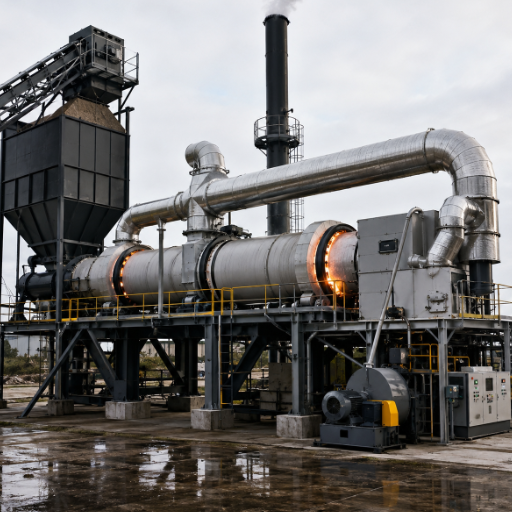
Le séchage est l'étape la plus gourmande en énergie de toute la chaîne de granulés, cette section mérite donc des chiffres réels plutôt que de la commercialisation. Partez de la physique : l’évaporation de l’eau prend environ 2,26 MJ par kilogramme de l'eau enlevée (la chaleur latente de vaporisation).Cette seule constante fixe le plancher sur votre facture de carburant.
En pratique, les mesures publiées évaluent la consommation directe de séchoir rotatif à environ 4,0–6,0 MJ par kg d’eau évaporée, les systèmes indirects étant plus proches de 2,8–3,6 MJ/kg. L'écart entre le plancher de chaleur latente de 2,26 MJ/kg et le besoin réel de 4–6 MJ/kg montre combien d'énergie n'atteint jamais l'eau : elle part sous forme d'échappement chaud, de chaleur sensible dans les solides et de rayonnement. Cet écart explique aussi pourquoi l'efficacité « >70 % » citée dans certaines brochures doit être lue avec prudence : elle décrit généralement la rétention de chaleur par auto-isolation, et non la consommation de combustible de l'ensemble du système.
“L'empreinte au sol est réelle, mais les économies qui comptent sont au brûleur. Spécifiez le sèche-linge autour de votre charge d'eau réelle kilogrammes d'eau par heure, juste des tonnes de produit et non le calcul du carburant décide simple contre triple bien avant le plan d'étage.”
La conception à trois passages aide réellement sur le volume. À 50% d’humidité d’entrée, une usine brûle environ 25–30% de son combustible simplement pour sécher la matière première avant tout travail utile. L’imbrication des passages permet de récupérer davantage de contact par mètre carré, et l’association du séchoir à une récupération de chaleur perdue — préchauffage de l’air de séchage par condensation des gaz de fumée — peut réduire la consommation annuelle d’énergie jusqu’à 41% avec un retour souvent inférieur à deux ans. .
Matériaux qu'il sèche le mieux : Biomasse Focus
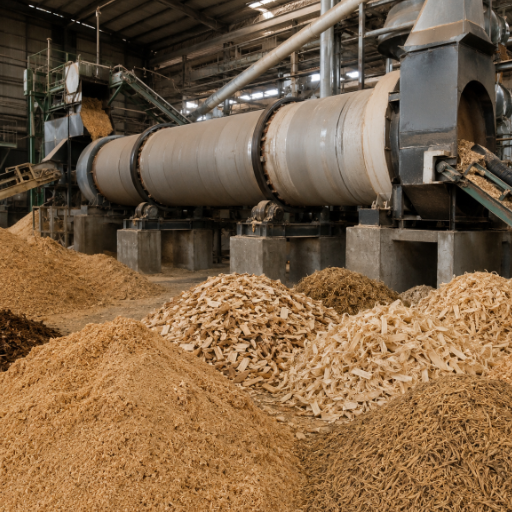
Les séchoirs rotatifs à triple passage ont été conçus pour les biomasses légères et fluides, et c’est toujours dans ce domaine qu’ils excellent. La sciure de bois, les copeaux de bois, les plaquettes de bois, les balles de riz, la paille et la bagasse se déplacent toutes bien dans le flux d’air et tolèrent la vitesse d’air élevée requise par cette conception. Ce sont également les matières premières qui alimentent le plus souvent une presse à granulés, ce qui explique pourquoi le séchoir et le presse à granulés de biomasse sont généralement spécifiés ensemble.
Quelle teneur en humidité un séchoir rotatif triple passage peut-il atteindre ?
La plupart des biomasses arrivent humides — couramment 50–63% d’humidité sur base humide — et la cible après séchage dépend de leur destination. De nombreuses lignes sèchent la matière première à environ 10–15% pour l’entrée de presse, tandis que certaines opérations de granulés sèchent davantage, autour de 5–7%, pour le produit fini ; les normes de granulés de bois classés selon ISO 17225-2 limite la teneur en humidité des granulés à environ 10%. Un séchoir à triple passage correctement dimensionné atteint la plage optimale que vous spécifiez en un fonctionnement continu.
La régularité de la matière première compte plus que le chiffre phare. Les espèces mélangées, les contaminants et les fines sous 0.5 mm sèchent de manière inégale, ce qui sursèche les petites particules et augmente à la fois le risque de poussière et d’incendie — un danger opérationnel principal signalé dans les recommandations de sécurité du secteur des granulés de bois. Une granulométrie régulière issue d’un broyeur à marteaux pour biomasse rend le séchage beaucoup plus uniforme et la poussière beaucoup plus gérable.
Au-delà de la biomasse : sable, minéraux et granulats
Les séchoirs triple passage ne se limitent pas au bois. La même conception à tambours imbriqués sèche le sable jaune, le sable siliceux, les scories, l’argile, le gypse et les granulés d’engrais, généralement sous 20–40 mm. Le séchage des minéraux est l’application où le flux d’air à grande vitesse et à passages multiples valorise le tonnage dans une faible empreinte.
Il y a cependant une mise en garde ferme, et c'est la même que celle du tableau de comparaison : l'abrasion. La recherche en tribologie identifie la taille, la forme et la dureté des particules comme les propriétés qui déterminent l'usure abrasive, et les minéraux tranchants ou le verre recyclé mâchent les vols internes et les points de transfert plus rapidement sur les composants internes plus légers d'une machine à triple passage que sur un tambour simple lourd.
Le dossier industriel publié renforce le point Séchage documenté minéral-concentré our exemple a sécheur concentré de zinc et de plomb étudié à 22,2 m de long et 3,9 m de diamètre use de séchoirs rotatifs à co-courant de style passe-unique long, pas d'unités à triple passage compactes, et lutte toujours avec l'accumulation de tartre et la consommation de carburant. En règle de travail : les minéraux granulaires et non abrasifs à tonnage modéré conviennent à triple passage ; le devoir minéral pointu, abrasif ou de très fort tonnage redescend vers le passage unique, où la durabilité surpasse la compacité.
Comment dimensionner et sélectionner un séchoir triple passe
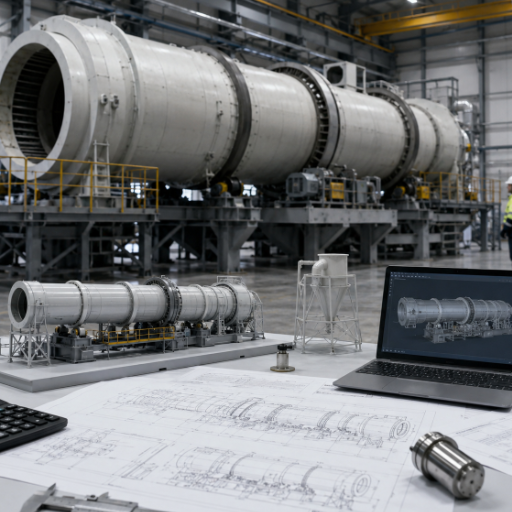
Le dimensionnement commence par l'eau, et non par les tonnes. Calculez combien de kilogrammes d'eau par heure vous devez retirer (débit × baisse d'humidité), multipliez par la chaleur latente, ajoutez les pertes du système, et vous obtenez la charge thermique qui détermine la taille du tambour et la puissance du brûleur. À partir de là, appliquez ce que nous appelons le test d'ajustement triple passe à 4 chèques avant de demander un devis à n'importe quel fournisseur.
Le test d'ajustement triple passe à 4 chèques
- Matériel: fine, fluide, non abrasive ? → ajustements triple passage grossier ou abrasif ? → passage simple.
- Delta d'humidité : entrée et sortie cible % cela définit votre charge en eau et votre devoir thermique.
- Débit: tonnes/heure de produit, convertie en kg/hour d'eau enlevée.
- Source de chaleur: four à biomasse, air chaud ou chaleur perdue ? décide du coût direct ou indirect du carburant.
Répondez honnêtement à ces quatre points et le choix entre simple et triple passage se fait généralement de lui-même, avec une taille de tambour réaliste. Un fournisseur qui demande ces quatre données avant d'établir un devis dimensionne votre séchoir ; celui qui établit un devis à partir d'un seul numéro de modèle vous vend un tambour. Parcourez la gamme complète. ligne de machine à granulés de bois si le séchoir fait partie d’une usine de production de granulés plus vaste.
Où il s'intègre dans une chaîne de production de granulés
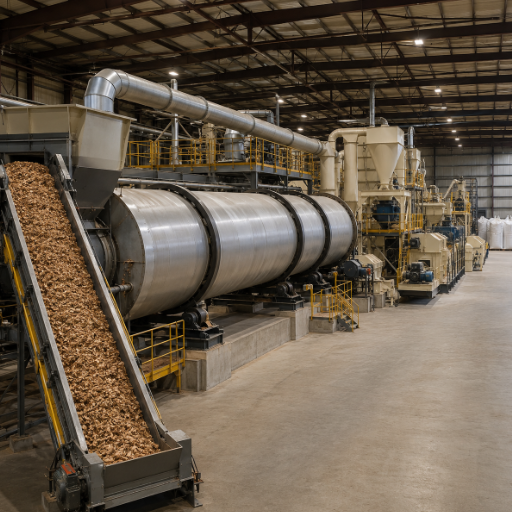
Un séchoir à triple passage fonctionne rarement seul. Dans une usine de production de granulés de biomasse, il se situe au milieu d’une chaîne, recevant une matière première dimensionnée et humide et transmettant la matière sèche à la presse. La séquence habituelle est la suivante : déchiquetage, broyage, séchage, granulation, refroidissement et ensachage.
- ✔ Tondeuse à tambour réduit les grumes et les dosses en plaquettes de bois.
- ✔ Broyeur à bois ou hammer broyeur ramène la taille des particules à une alimentation uniforme.
- ✔ Sèche-rotative triple passe réduit l’humidité jusqu’à la plage de granulation d’environ 10–15 %.
- ✔ La presse à granuler, le refroidisseur de granulés et l’ensachage terminent la ligne.
Obtenir la bonne humidité de sortie du séchoir est ce qui permet à toute la ligne de bien fonctionner. Alimentez la presse avec un matériau trop humide et les granulés s'effritent ; trop sec et ils ne se lient pas. Le séchoir est le gardien de l'humidité pour tout l'aval, c'est pourquoi il est dimensionné par rapport à la presse, et non isolément. Pour adapter un séchoir à votre matière première et à votre capacité spécifiques, parlez-nous d'un sécheur rotatif triple passe pour votre ligne.
Perspectives de l'industrie : séchage de la biomasse axé sur l'efficacité
La demande de meilleurs séchoirs vient du marché des granulés lui-même, que les sociétés d’études de marché estiment à des dizaines de milliards de dollars et en croissance d’environ 7 % par an — les chiffres exacts varient considérablement selon la définition de “granulé de bois” par rapport à “granulé de biomasse” — le Japon et la Corée du Sud développant le plus rapidement la co-combustion de biomasse. Comme la chaleur de l’étape de séchage domine l’énergie de la chaîne de production des granulés, chaque gain d’efficacité du séchoir améliore directement le résultat net.
Quatre évolutions méritent d'être suivies en 2025–2026. Premièrement, la récupération de chaleur résiduelle passe du statut d'option à celui d'attente : récupérer la chaleur des fumées pour préchauffer l'air de séchage peut réduire la consommation annuelle d'énergie jusqu'à 41%. Deuxièmement, les règles sur les poussières combustibles se durcissent : NFPA 664 et la nouvelle norme consolidée NFPA 660 imposent un contrôle plus strict des poussières, et certains assureurs ont commencé à exclure les séchoirs rotatifs de leur couverture dans les usines de produits du bois. Troisièmement, les règles de chaîne de traçabilité REDIII de l'UE redéfinissent les matières premières admissibles.
Le quatrième changement est celui que les acheteurs sous-estiment : les émissions et les incendies. Des séchoirs rotatifs ont été construits à l'origine pour les minéraux non fibreux, et le séchage de la biomasse fibreuse introduit un risque d'incendie réel plus une exposition permettant l'air sur du bois résineux frais, un séchoir peut s'approcher du Titre V Seuil de COV de 100 tonnes/an et est souvent la plus grande source d'émissions d'une usine C'est aussi pourquoi les alternatives à faible teneur en oxygène telles que le séchage à la vapeur surchauffée, qui signale une consommation d'énergie bien inférieure, attirent l'attention des grandes installations. Rien de tout cela ne disqualifie un séchoir à triple passage ; cela signifie simplement que les barrières de sécurité et les permis appartiennent à la décision de sélection, et non après coup.
L'action pratique pour un acheteur en 2026 est concrète : spécifications des coques auto-isolantes et une option de récupération de chaleur résiduelle, confirmez que votre configuration de séchoir et de poussière répond aux limites actuelles de la NFPA et vérifiez votre exposition aux COV/HAP avant de signer.
Questions fréquentes
Q : Combien un séchoir rotatif triple passage peut-il réduire l'humidité en un seul passage ?
Voir la réponse
Un séchoir triple passage correctement dimensionné fait passer une biomasse légère d’une humidité d’entrée typique de 50–63% à la plage de 10–15% requise pour la granulation, en un cycle continu. La baisse exacte dépend de la température du gaz, du temps de séjour et du débit ; une même machine peut donc être réglée pour un écart d’humidité plus faible ou plus grand en modifiant le débit d’alimentation et le réglage du brûleur.
Q : Un séchoir rotatif triple passage est-il plus efficace qu'un séchoir simple passage ?
Voir la réponse
Pour la biomasse légère et fine, les coûts d'exploitation sont généralement inférieurs, car les passes imbriquées remplissent davantage de contacts de séchage dans un encombrement plus petit et un débit d'air à température plus basse et à vitesse plus élevée. Mais les allégations de“ supérieures à 70% décrivent généralement la rétention de chaleur, et non l'utilisation de carburant dans l'ensemble du système, où une grande partie de l'énergie reste sous forme d'échappement et de chaleur sensible. Un seul passage peut toujours gagner sur le coût total lorsque les réparations et la durabilité sont prises en compte.
Q : Quels matériaux est un séchoir rotatif triple passage le mieux adapté pour ?
Voir la réponse
Matériaux légers, fluides, non abrasifs et de granulométrie assez uniforme : sciure de bois, copeaux de bois, plaquettes de bois, balles de riz, paille et bagasse, ainsi que des minéraux granulaires tels que le sable, les scories et le gypse inférieurs à environ 20–40 mm. Les matériaux coupants, abrasifs ou très grossiers conviennent mal, car ils usent les ailettes internes et favorisent un séchoir à un seul passage.
Q : De quelle surface au sol un séchoir rotatif triple passage a-t-il besoin ?
Voir la réponse
Bien moins qu'un séchoir à passage unique de même capacité. Les fournisseurs indiquent des longueurs de tambour d'environ 20–35 % de celles d'une machine équivalente à un seul tambour, car trois passages tiennent dans une seule enveloppe.
Q : Un séchoir rotatif triple passage peut-il sécher du sable ou des minéraux ?
Voir la réponse
Oui, le sable, la silice, les scories, l'argile et le gypse sont des tâches common. Regardez simplement l'abrasion : les minéraux pointus portent les vols plus rapidement qu'ils ne le feraient dans un tambour à passage unique plus lourd.
Q : Un séchoir triple passage nécessite-t-il plus d'entretien qu'un seul passage ?
Voir la réponse
Le nettoyage et l'inspection de routine sont similaires, mais les réparations majeures sont plus difficiles et plus coûteuses. Atteindre le tambour central ou intérieur signifie démonter partiellement l'ensemble emboîté, de sorte qu'une réparation de roulement ou de vol simple sur un seul tambour peut coûter trois à cinq fois plus cher sur une machine à trois tambours. Faire correspondre le séchoir à un matériau non abrasif est le meilleur moyen de garder ces réparations rares.
À propos de ce guide
Ce guide a été préparé par l’équipe d’ingénierie de TCPEL (ALLWIN INTERNATIONAL CO., LTD), fabricant au Shandong d’équipements de séchage et de granulation de biomasse exportés vers 60+ pays. Les chiffres d’énergie et de normes proviennent de recherches publiques et des sources ISO/NFPA citées ci-dessous ; les affirmations propres au fournisseur concernant l’efficacité et l’encombrement sont signalées comme telles plutôt que présentées comme des faits indépendants.
Références et sources
- Rapport sur la technologie de séchage de la biomasse — National Renewable Energy Laboratory (NREL)
- Simulation du mouvement des particules de bois à travers un séchoir rotatif simultané à triple passage 32 Technologie, vol. (Taylor et Francis)
- Modélisation du séchage du fourrage dans des séchoirs à tambour rotatifs à simple et triple passage 'TRADUCTION'
- Sécheurs indirects pour le séchage de la biomasse Comparaison des caractéristiques expérimentales 'chemEngineering' (MDPI)
- Analyse énergétique des séchoirs à bois intégrés aux unités de récupération de chaleur (ScienceDirect)
- Granulés de bois classés (ISO 17225-2) Ressources naturelles Canada
- NFPA 664 : Prévenir les incendies et les explosions — Canadian Biomass Magazine
- Fonctionnement plus sûr des séchoirs à tambour rotatifs Association des granulés de bois du Canada (WPAC)
- Conception des vols et distribution des particules dans les tambours rotatifs (billes de verre et sable de quartz) 'grand'l' Matière (Springer')
- Usure abrasive des particules de sable : effets de taille, de forme et de dureté Transactions tribales (Taylor et Francis)