Entre em Contato com a TCPEL

Linha Produção Pellets Alimentação
Linha de produção de pellets de alimentação: 11 modelos de rolos inclinados de 150 kg/h a 6 toneladas/h | Fabricante TCPEL
Linhas completas chave na mão de linhas de pellets para aves e aquicultura & aquacultura (lista de alimentos para animais de pequena escala industrial). 1TP21 preços e CE (MD testado, 20CrMnTi premium-die para aves, animais de fazenda e aquicultura & aquacultura para mais de 60 mercados em operação desde 2020.
Solicitar Cotação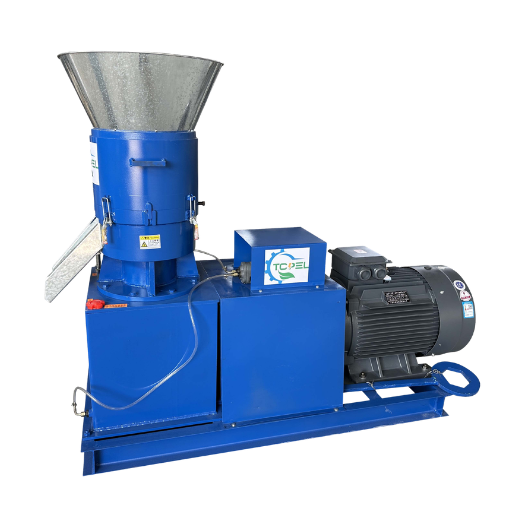
Solução Su Su TCPELP TCPEL Linha de Produção de Pellets Feed TCPEL
Faixa de capacidade
150TP79T 16 toneladas/h
Modelos disponíveis
11 (TCF150 → TCF800)
Matar Material
20CrMnTi HRC 58-62
Morrer Vida de Serviço
1.800 horas 2.500 horas
Diâmetro Pellet
2 (96T 1TP10 1TP9
Preço FOB Qingdao
jack@tcpel.com999T99T11K (4-tier)
Construindo uma planta de pellets de alimentação em 2026 Por que as linhas de rolos inclinados superam as configurações de rolos planos
Os compradores internacionais de pellets de ração parecem ver as mesmas três perdas de produção todos os anos Os operadores encontram matrizes quebradas na pilha de estoque após 18 meses, mapas de desgaste irregulares que aparam as janelas de produção e rosnam na caixa de engrenagens que sinalizam déficit de manutenção antes que o equipamento falhe Em todos os casos, essas perdas podem ser atribuídas a uma simples escolha de design: como os rolos entram em contato com a matriz.
Um moinho de pellets de rolo plano pesa a força centrífuga na superfície da matriz, então o equilíbrio EQOS rapidamente dá lugar ao desgaste irregular. Na análise de bola em três linhas para falha prematura da matriz do anel em 2025, o desgaste irregular ocupa o primeiro lugar, unindo rachaduras, aglomeração de alimentação e produção reduzida para ocupar o primeiro lugar. Esse sintoma de falha explica por que as matrizes precisam ser alteradas em 12 a 14 meses, quando a vida útil do design do catálogo indica uma vida útil esperada de 24 meses.
Com uma interface rolo-matriz 1TP71 T re-venturada de 2022 aprendeu que a configuração do rolo inclinado pode endereçar todo esse conjunto de modos de falha A face cônica do rolo permanece em contato em toda a zona da pelota Os rolos cônicos incorporam rolamentos cônicos do intermediário para aceitar cargas radiais & axiais como um, minimizando o esforço centrífugo no anel da matriz e fornecendo a pressão equilibrada durante toda a zona da pelota.
Resultado no cenário de fabricação:
Desgaste previsível da matriz; temperatura máxima do óleo; os operadores desfrutam da vida útil exata de 1.800-2.500 horas esperada do projeto 1TP36 T; a operação de qualidade alimentar tolera alimentações cruas de alta umidade sem a exigência de desidratação prévia Os fornecedores podem precificar em 1TP21 T 1TP92 T; os pedidos podem especificar o tipo de matriz, a tensão e as opções de variação.
Linha de produção de pelotas TC218 11 modelos Feed 11 de 150 jack@tcpel.com a 6 toneladas/h
A série TCF fabrica toda a linha de produção de pellets de ração animal O design de rolos inclinados desativa 11 modelos de fornecedor de linha de produção para toda a gama de aplicações de ração comercial co1TP96. A escala é: 200kg/hr [440 lb/h] para TCF150 a 6 toneladas/h [13.220 lb/h] para modelos TCF800. Cabeças operacionais de 2 rolos do TCF150-TCF450 [150kg/hr 2.5t/hr] lida com cargas pesadas de até 9TPH; Cabeças de três rolos do TCF550-TCF800 [2.5t/hr 6t/hr] permitem maior rendimento com zonas de compressão adicionais.
Tabela completa de especificações TCF verificada no catálogo de engenharia TCPEL
| Modelo | Capacidade | Poder | Energia Específica* | Rolo | Peso | Dimensões (mm) | FOB Qingdao USD |
|---|---|---|---|---|---|---|---|
| TCF150 | 150200 1TP | 7,5 kW | ~3850 1TP95/t | 2-incl. | 190 kg | 1220×620×840 | $900 |
| TCF200 | 3000 1TP | 11 kW | ~2837 1TP95/t | 2-incl. | 270 kg | 1420×670×1100 | $1,600 |
| TCF250 | 6000800 1TP | 15 kW | ~1925 1TP95/t | 2-incl. | 480 kg | 1660×740×1220 | $2,400 |
| TCF300 | 8001.000 kg/h | 22 kW | ~228 1TP95/t | 2-incl. | 650 kg | 1830×880×1560 | $2,700 |
| TCF350 | 1,000–1,200 kg/h | 30 kW | ~25–30 kWh/t | 2-incl. | 750 kg | 1960×920×1680 | $3,600 |
| TCF400 | 1,400–2,000 kg/h | 37 kW | ~19–26 kWh/t | 2-incl. | 900 kg | 2550×980×1600 | $4,300 |
| TCF450 | 2,000–2,500 kg/h | 45 kW | ~18–23 kWh/t | 2-incl. | 1,500 kg | 2780×1100×1700 | $6,300 |
| TCF550 | 2,500–3,500 kg/h | 75 kW | ~21–30 kWh/t | 3-incl. | 1,800 kg | 2900×1300×1900 | $9,500 |
| TCF650 | 3,000–4,000 kg/h | 90 kW | ~22–30 kWh/t | 3-incl. | 2,100 kg | 2950×1500×2000 | $14,500 |
| TCF700 | 4,000–5,000 kg/h | 110 kW | ~228 1TP95/t | 3-incl. | 2,500 kg | 3000×1600×2100 | $18,800 |
| TCF800 | 5,000–6,000 kg/h | 132 kW | ~22–26 kWh/t | 3-incl. | 2,900 kg | 3150×1800×2200 | $22,500 |
* Specific energy usage estimated from the ratio of rated power [sixty Hz] to nominal capacity [US] & agrees with published industry pellet-energy tests between 4 and 40 kWh/t. FOB Qingdao pricing list is simply indicative; final order depends on die type, 60Hz or 50Hz, and options.
Decision Matrix — Pick By Daily Output × Shift Pattern × Animal Type
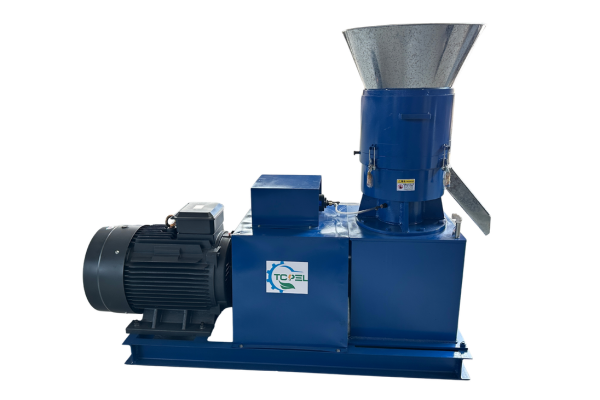
Mini Tier
TCF150 – TCF200 · 150–400 kg/h
- Family / contract farms
- Single-shift, ≤2 t/day output
- Poultry, rabbit, small livestock
- Low CapEx entry point
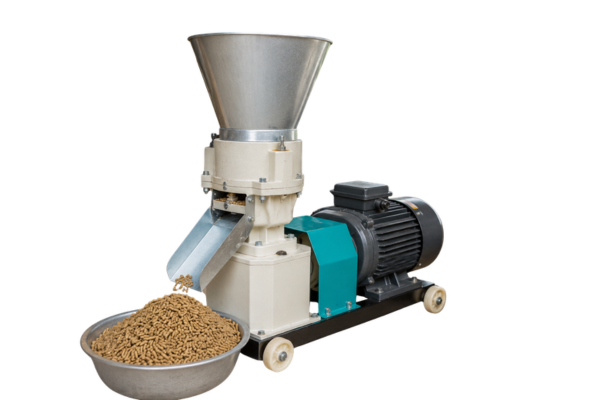
Small Tier
TCF250 – TCF350 · 600–1,200 kg/h
- Cooperative / SMB feed plants
- Two-shift, 5–10 t/day output
- Multi-species formulation
- Most popular tier for new plants
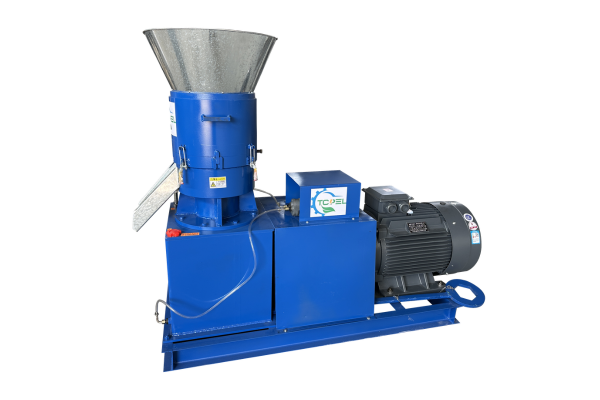
Medium Tier
TCF400 – TCF450 · 1,400–2,500 kg/h
- Commercial feed brands
- Two/three-shift, 15–25 t/day
- Auto oil pump from TCF300+
- Sweet spot for export markets
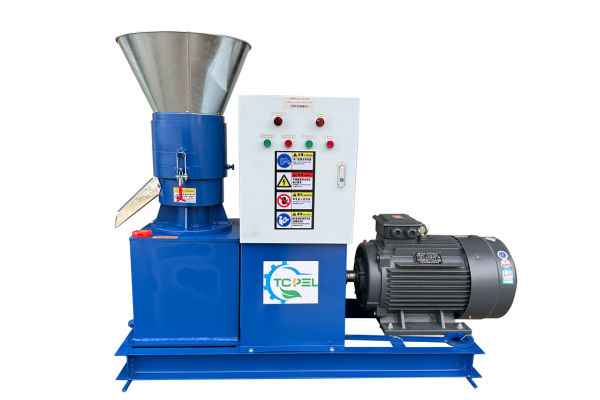
Large Tier
TCF550 – TCF800 · 2,500–6,000 kg/h
- Industrial / municipal scale
- Three-shift, 50–80 t/day
- 3-roller heads, 75–132 kW
- Counterflow SKLN6 cooler matched
Ishappy buyerl is simple: take your daily average daily output in tons / day then add 20% downtime margin for your working hour / day of your model of the lower-bound capacity. For example, a 12 t/day broiler-feed plant over 2 shifts / day of 8 hours will select TCF400 (1,400-2,000 kg/h) not TCF450 because actual uptime is closer to 80-85% instead of 100%
Connects the TCPEL Plant Sizing Calculator – enter daily output, shift schedule and animal type and get a model within 30-seconds.
Request Detailed Quote (Popup)The 8 Components Inside a TCPEL Feed Pellet Line
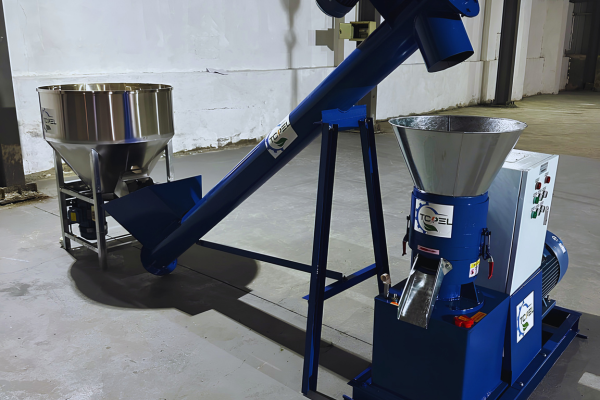
A turnkey feed pellet production line is one custom-built product, not a single unit. It is a production process train in which every unit is fed by the preceding unit and the lowest feeding rate so determines the effective output. TCPEL develops eight of the components in its own workshops directly to the specifications of our nine anchor TCF pellet mills- the first unit of that train.
1

Moinho Martelo
Direct-drive 3,000 r/min · MD-NTS2307071S
Presents raw-grain, legume, and grass straw to the pellet unit in pelleting-ingredient-ready form. Expanding dual-side discharge plate produces a high-volume cone of product to the pelleting chamber. Use with cyclone and bag vent to contain dust aerosols.
2
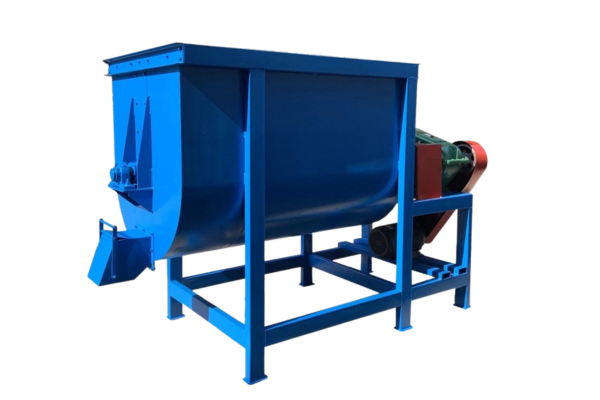
Mixer
Twin-shaft paddle / ribbon options
Ensures pellet consistency. Atomizing nozzles deposit liquid ingredients (fatty acids, molasses, vitamin mixes) during the mixing cycle. Single- double- and triple-shaft paddle, and ribbon mixes avail.
3
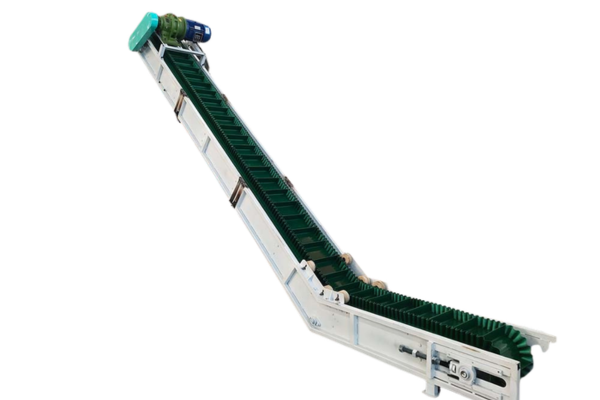
Screw / Belt Conveyor
Auger and baffled-belt options
Feeds the MC6610 pellet mill. Stainless steel contact surfaces; corrosion-resistant for moist crops and diets.
4

Pellet Mill (TCF series)
11 models · MD-NTS2307072S
The line’s foundation. Inclined-roller die holder; tool steel case-carburized die (HRC 58-62 surface, HRC 33-48 core); 100% copper winding in motor; double- universal-joint drive system for perfect axial alignment.
5
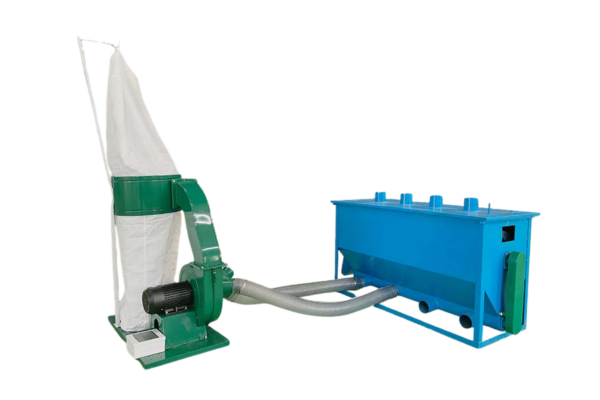
Refrigerador Contrafluxo
5 models · MD-NTS2307073S
Pellets are conveyed from the pellet mill top downward, ambient air from bottom upward. Cooled pellet temperature is maintained at no more than plus-5C of ambient temperature, dew point drop is 3.8%. Vibrating separator removes dust and fines before downstream sizing.
6
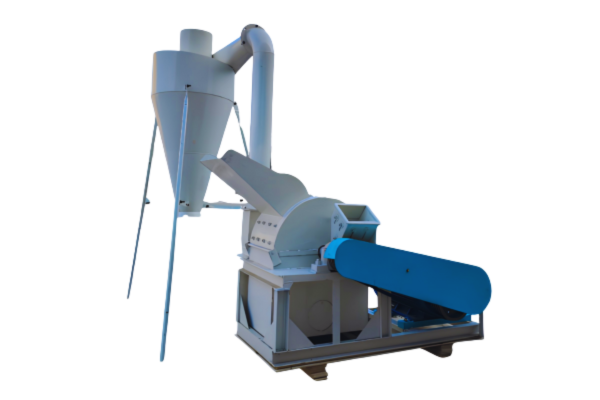
Crumbler (Optional)
Roll-type, double or three-roll
Necessity in duck and duckling diets; when crumbled to soy-broiler size. To size for hatchling or bass fingerling feeds without re-pelleting.
7
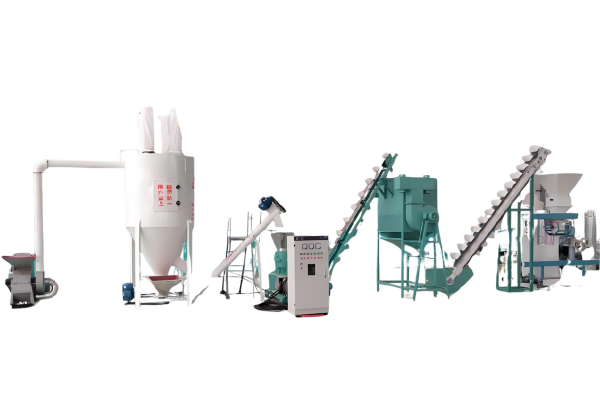
Vibrating Screen
Rotary grading sieve
Two-deck screen sort oversize, target sized, and fines. Crumbles of whatever size are separated from target-sized pellets and controlled for pellet and feed energy balances. Returns to mixer as needed, target-sized pellets move forward toward packaging. Recovers up to 95% of crumbles as saleable product.
8
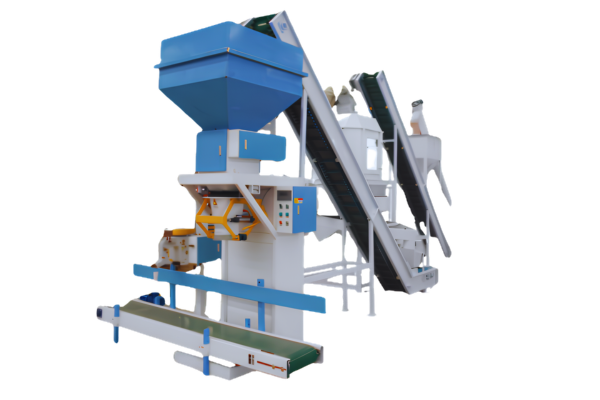
Packing Machine (BZ80)
15–50 kg bags · MD-NTS2307069S
Solid-state load cells and PLC-based microprocessor controls. Scale accuracy to 0.2%, flows of 200-300 bags / hour possible. Optional automatic thread cutter.
Integrated Controls & PLC
PLC-based electricity management components from China’s top electrical equipment suppliers, CHINT and Delixi. Wiring housed in customized weather- and-splatter-rated sealed [control] cabinet with a sub-panel for ease of maintenance and PLC feed, also designed for harsh dust conditions. Fully integrated automated controls for 24-hour operation available.
“We tested three roller geometries on the TCF300 before settling on the inclined design with tapered bearings. Flat-roller variant burned through a 20CrMnTi die in roughly 1,400 hours on the same feed mix; inclined geometry pushed that to 2,100 hours on the same test rig. That’s the only build we ship to customers.”
— TCPEL Engineering Team, R&D Workshop, Jinan
TCPEL vs Imports (ANDRITZ / Bühler / CPM) vs Domestic Low-Cost — Honest Comparison
A good cross supplier comparison for this market is rare so here it is. ANDRITZ, Bühler and CPM are clear leaders in the import class with decades of 3-80 t/h ring die systems to their credit and excellent track records of customer service. In the domestically priced latter it is possible to have a record that won’t be as robust past year two and to there is no inclusion of the metallurgy specification and warranty depth offered by the aforementioned three. Which TCPEL has.
| Dimensão | Import Tier (ANDRITZ / Bühler / CPM) | TCPEL Inclined-Roller | Low-Cost Domestic |
|---|---|---|---|
| Capacity Match | 3–80 t/h | 0.15–6 t/h (11 models) | 0.1–3 t/h (4–5 models typical) |
| Specific Energy | ~18–24 kWh/t (large) — undisclosed for small | ~18–28 kWh/t (medium-large) | ~30–50 kWh/t (rarely disclosed) |
| Matar Material | Chrome Plus / X46Cr13 / proprietary | 20CrMnTi case-carburized HRC 58-62 | Often unspecified GCr15 (HRC 50-55) |
| Morrer Vida de Serviço | 2,000–3,000 h (premium dies) | 1,800–2,500 h | 800–1,200 h typical |
| CapEx (medium tier) | $120K–$400K+ | $48K–$95K | $20K–$45K |
| Prazo de entrega | 16–32 weeks ex-works | 15 working days + ocean shipping | 15–30 working days (variable) |
| Warranty (main parts) | 12–24 months | 12 months + Qingdao spare parts stock | 3–6 months typical |
The numbers alone are not what counts. Which system you choose is very much a question of which of these factors you prioritize to your operation: lowest specific energy at a given size, fastest time to delivery, transparent metallurgy or lowest entry point.
Pick an Import If…
Your line is running >10 t/h three shifts a day and every down-day for each component costs >$5,000,, with your engineering group has got each component name brand training requirements written in to the purchase specification.
Pick TCPEL If…
You are looking for a 0.5-6 t/h line; you prefer high quality die metallurgy (20CrMnTi); you want to have detailed specifications of motor brand(CHINT/Delixi) in advance for planning, and you prefer 15 days lead time production rather than 4 months waiting.
Pick Low-Cost If…
You have a CapEx ceiling less than $30K, your output goal is less than 1 t/h, and you’re comfortable with the die-replacement and motor-failure costs in years 1-3 being greater than the initial saving.
Request a Custom Comparison Quote – provide your daily out-put goal and feed combination, receive a line-item comparison of these TCEPL worth vs Indirect imports in 24 hours.
Request ComparisonProduction Process — From Raw Material to Bagged Pellets
The animal feed pellet manufacturing process is a carefully managed conversion of loose powdered ingredients into uniform, dense, sterile, storable pellets. Over the course of each of these eight stages, one desired quality is achieved – particle size, formulation consistency, density, microbial safety, moisture content, final pellet dimensions, end-pack dimensions.
Stage-by-Stage Process Detail
1
Raw Material Reception & Grinding
Batch tasks of the following raw materials arrive in bulk or 25~50 kg bags: corn, wheat, soybean meal, fish meal, rape-seed cake and the forage straws. These are fed into a hammer mill, whose mesh size is adjusted to the feed pellet specifications (below 2.5mm for chicken feed, and below 1mm for aquatic feed). Over-sieving (= more particle size than required) reduces digestibility and over-rough grinding can weaken the properties of the pellet.
2
Batching & Mixing
The well-mixed mixer mixes the ground ingredients with the vitamin premix, calcium bicarbonate and stone powder as specified by the published formula of the target animal. The published broiler formula of RICHI is an example of variation at: soya bean meal 53%; cotton seed meal 18%; rape-seed cake 4.1%; maize protein meal 8%; DDGS 4%; calcium bicarbonate 4%; stone powder 4%. The liquid additives are added as a spray during the mix window.
3
Condicionamento
The operator injects live steam to raise the mash temperature to 75-90C, in the conditioner just above the pellet mill. The heat softens the binders, gelatinizes the starch and kills any pathogens. Follow the peer-reviewed pasteurization/ Salmonella-control papers and you will find that the conditioning temperature is the critical control point for pathogen reduction in feed. Conditioning reduces, but does not sterilize the material.
4
Peletização
Mash which has been conditioned is fed into the pellet mill chamber. Incline rollers are used to crush the mash in a radial fashion through the 20CrMnTi die holes. Pellets are extruded at 80-90c and 15-17% moisture content, cuts to length using an adjustable knife.
5
Counterflow Cooling
The hot pellet drops from the extruder and slides downward through the cooler. Ambient air enters from underneath. Counterflow geometry drops pellet temperature with ambient to within +5 C and moisture to at least 3.8%. Cooled pellet is structurally mature enough to endure screening, packing, and ocean shipment.
6
Crumbling (Optional)
Roll crumblers are used to reduce larger pellets to chick, fingerling, or hatchling size. Crumblers run only when formulation require pellet size less than the smallest hole in the die.
7
Screening & Grading
A two-deck rotary screen separates oversize lumps, target pellets, and fines in final finishes systems. Oversize lumps recycle into the crumbler; fines go back into the mixer; target pellets go onward to pack-off.
8
Embalagem
The BZ80 packing scale fills 15-50kg bags at 200-300 paper/second with 0.2% weighing accuracy. Thread-cutting sewing heads optionally close bag mouth automatically and avoid physical strain of manual labor.
Floating vs Sinking Fish Feed — Two Production Architectures
Aquaculture customers face a pivot point early in the fish feed procurement cycle: floating fish feed (for tilapia, catfish, koi, shrimp grower stages in the typical commercial fish farm) needs a fish feed extruder rather than a pressed pellet fish feed pellet mill. Sinking fish feed (for carp, bottom-dweller, juvenile fingerling and crab feeds) works with the standard TCF ring die mill – same feed pellet processing game plan as poultry and cattle feeds.
A floating fish feed production line works the extruding machine at 110-130 C with high pressure steam injection. The high temperature and pressure expands the dough, its trapped air makes the finished pellet float for 12-24 hours upon delivery to water surface. Floating fish feed pellet density ranges 350-450 g/L versus 600-700 g/L for sinking pressed pellets; a 100 kg/h or greater commercial fish feed machine line output reaches up to several tons per hour.
TCPEL offers engineered fish feed processing line projects consisting of a twin-screw feed pellet extruder, the TCSG triple pass dryer to reduce moisture below 10% for shelf stability, the ultra-fine hammer mill to meet the fine particle size specs demand in aquatic feeds and fish food manufacturing, and the generic mixer + cooler + pack-off modules. Capacity from 100 kg/h pilot fish feed pellet manufacturing plants up to 6 t/h fish feed manufacturing plants and commercial fish farm production lines – customize the topology on your target fish species and cycle.
Floating Fish Feed Architecture
Extruder + dryer + cooler
Twin screw extruder + TCSG triple pass dryer + counterflow cooler + pack off. Used for tilapia, catfish, shrimp growers, ornamental koi.
Sinking Fish Feed Architecture
TCF ring die mill
Standard TCF pellet mill + SKLN cooler + crumbler. Used for carp, bottom feeder species, juvenile fingerling, crab feeds.
Pellet density and float duration are the two service output factors that drive the configuration choice for any fish feed processing line. Fish feed manufacturers operating both product formats frequently erect two simultaneous sub-lines from the same TCPEL structure – one extrusion-based for floating output, one ring die-based for sinking sharing the upstream hammer mill and mixer, thus capital synergistic.
Pellet Size by Animal Stage — Production Reference
| Animal & Stage | Recommended Pellet Diameter | Feed Type |
|---|---|---|
| Baby chick (≤10 days) | 1.5 mm or powder | Starter (powder feeds preferred) |
| Middle chicken (10–30 days) | 2.5–3.0 mm | Grower pellet |
| Big chicken / broiler (30–45 days) | 3.5–4.0 mm | Finisher pellet |
| Laying hen | Powder feed preferred | Custom formula |
| Cattle / dairy | 6.0–8.0 mm | Total mixed ration pellet |
| Sheep / goat | 4.0–6.0 mm | Concentrate pellet |
| Floating fish feed (extruded) | 2.5–6.0 mm | Tilapia, catfish, shrimp grower |
| Sinking fish feed (pressed) | 2.0–4.0 mm | Carp, sinking aquaculture |
Real Customer Output — 3 TCPEL Project Configurations
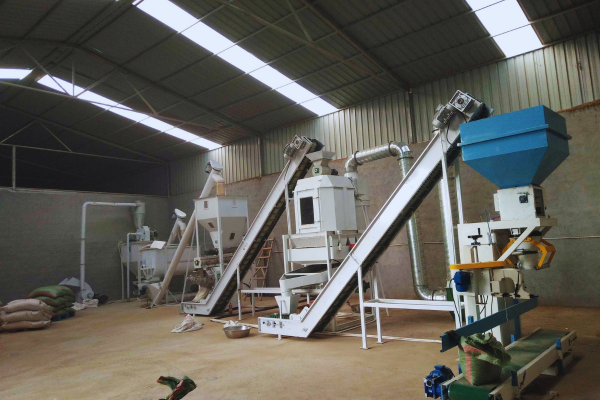
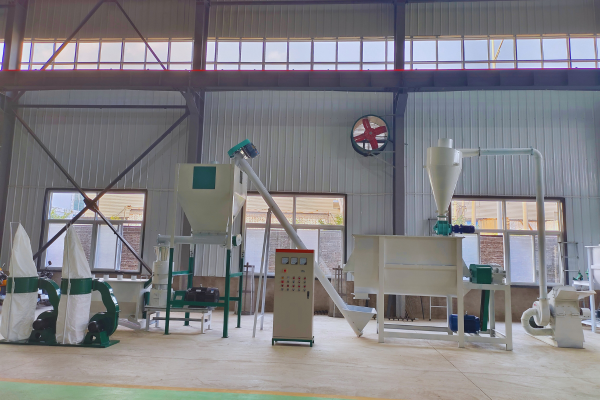
Since 2020 TCPEL has been exporting feed pellet production lines to over 60 nations, active lines installed in the subcontinent, South East Asia, Africa, European and Pacific Islands. Three sample line arrangement images exemplify anchoring lines built and delivered by TCPEL TCF series at differing production level.
Bangladesh — 1 t/h Poultry Feed Line
Configuration ships against rising domestic feed demand. Bangladesh feed and residual use reached 6.7 million MT in MY 2024/25.
Moinho Pellet
TCF300 · 22 kW · 800–1,000 kg/h
Auxiliary
Hammer mill + double-shaft mixer + SKLN2.5 cooler + BZ80 packing
Pellet Sizes
2.5 mm broiler / 3.0 mm layer
Investment Range
$28,000 – $34,000 FOB Qingdao (full line)
Prazo de entrega
15 working days production + ~25 days ocean to Chittagong
Pakistan — 500 kg/h Cattle Feed Line
Cooperative dairy farm cluster, focus on grass-straw cattle pellets.
Moinho Pellet
TCF250 · 15 kW · 600–800 kg/h
Auxiliary
Hammer mill + ribbon mixer + SKLN1.5 cooler + manual packing station
Pellet Sizes
6.0 mm grass-corn cattle pellet
Investment Range
$22,000 – $26,500 FOB Qingdao
Prazo de entrega
15 working days + ~30 days ocean to Karachi
Malaysia — Floating Fish Feed Line (Extruded)
Tilapia / catfish aquaculture, floating feed required. Aquaculture demand recognized in FAO State of World Fisheries 2024.
Core Equipment
Twin-screw extruder + TCSG20 triple-pass dryer · 2 t/h
Auxiliary
Ultra-fine hammer mill + mixer + cooler + BZ80 packing
Pellet Sizes
2.5–6.0 mm floating fish feed
Investment Range
$72,000 – $95,000 FOB Qingdao
Prazo de entrega
20 working days production + ~14 days ocean to Port Klang
Export Footprint — 60+ Countries Since 2020
🇩🇪 Germany
🇫🇮 Finland
🇷🇺 Russia
🇳🇿 New Zealand
🇰🇷 South Korea
🇵🇰 Pakistan
🇮🇳 India
🇧🇩 Bangladesh
🇻🇳 Vietnam
🇲🇾 Malaysia
🇹🇷 Turkey
+ 49 more
Silver — TCO Framework
Die-Replacement TCO: 20CrMnTi vs Standard GCr15
20CrMnTi premium die offering drastically increased lives of 1,800-2,500 hours vs standard GCr15 recipe of 1,200-1,800 hours. Running with a mid-tier line, 16 hours a day, the small add on of one fewer die change in a year yields a recurring saving of about $1,200 to $3,500 per year on a TCF400 scale operation. Field results show, premium die metallurgy pays on value, within the first 8-12 months.
TCO analysis of die-life benefits on different up front investment spend, from industry data. Exact savings are sensitive to feed batch size, moisture, and shift pattern – request a custom TCO analysis for your operation.
Certifications & Compliance — What’s Documented and What It Means
Every export machine order by TCPEL include CE marking and issuing China Mechanical Directive (MD) certification. Six different MD certification numbers are issued to each line equipment set ordered. CE marking meets EU Machinery Directive 2006/42/EC, which in turn has been given a transition into Regulation (EU) 2023/1230, starting January 1, 2027.
Procurement Guide — Pricing, Lead Time, Payment, After-Sales
TCPEL publishes FOB Qingdao USD benchmark pricing for every feed pellet machine model and SKLN Cooler model – unprecedented within the industry. List prices are benchmark reference; sign off on your quotation will be subject to factors like die spec, drive voltages, intended-country country electrical standard support, and included features.
4-Tier Pricing Reference — Complete Feed Pellet Production Lines
Mini Line
150–400 kg/h · TCF150–200
$11,200 – $15,500
Pellet mill + basic cooler + small hammer mill + manual mixer
Family farm / pilot scale
FOB Qingdao USD reference
Small Line
600–1,200 kg/h · TCF250–350
$24,500 – $32,000
Pellet mill + SKLN1.5/2.5 Cooler + hammer mill + ribbon mixer
SMB / cooperative feed plant
Most popular tier for new export buyers
Medium Line
1,400–2,500 kg/h · TCF400–450
$48,000 – $72,000
Pellet mill + SKLN4 Cooler + dryer + BZ80 packer
Commercial brand-owner feed plant
Auto oil pump and PLC option available
Large Line
2,500–6,000 kg/h · TCF550–800
$95,000 – $185,000
Pellet mill + SKLN6 + TCSG triple pass dryer + full automation PLC interface
Industrial / municipal scale
3-roller pellet head for high-throughput compression
Pricing points referenced are based on the TCPEL Feed Pellet Machine Quote and accessory price lists. Quoting will vary according to feed material characteristics, choices of features and shipping Incoterm.
Lead Time, Payment Terms, and After-Sales — Standard TCPEL Commitments
Procurement Stage
TCPEL Standard
Notas
Quotation response
Within 24 hours business day
Configuration questionnaire returned same day
Order confirmation
30% T/T deposit
L/C available for orders ≥ $50K
Production lead time
15 working days (single mill) / 20–25 days (full line)
Starts on deposit receipt
Pre-shipment payment
70% T/T balance before loading
Inspection photos shared before loading
Shipping (FOB Qingdao)
Ocean freight to buyer’s port
CIF/CFR available on request
Warranty (main parts)
12 months from BL date
Motor, gearbox, electrical cabinet covered
Spare parts availability
3-day Qingdao stock dispatch
Dies, rollers, bearings stocked locally
Installation support
Remote (video) standard; on-site available
On-site engineer fee + travel quoted separately
Engineering & Investment Calculators
Utilize our proprietary engineering tools to accurately forecast your project scope. These calculators are designed to provide procurement managers and facility engineers with instant, data-driven estimates for plant sizing, operational overhead, and initial capital expenditure prior to formal quotation.
Plant Sizing Calculator
Determine the exact physical footprint, structural requirements, and electrical load based on your target daily feed output.
Analysis Outputs
- Minimum workshop square meterage
- Estimated total KW electrical load
- Required ceiling clearance height
- Raw material storage volume
Pellet Die TCO Estimator
Compare the Total Cost of Ownership between standard alloy dies and premium 20CrMnTi case-carburized geometries.
Analysis Outputs
- Expected service life in hours
- Replacement frequency per annum
- Cost per ton of processed feed
- Downtime financial impact projection
Capacity vs. Investment
Calculate the estimated initial CapEx required for complete turnkey feed pellet lines based on your targeted throughput.
Analysis Outputs
- FOB benchmark equipment pricing
- Optional automation tier add-ons
- Estimated shipping container volume
- ROI timeline estimate
Perguntas frequentes
Buyer Decision Edition
FOB Qingdao USD indicator pricing for TCPEL lines covers $11,200 (Mini, 150-400 kg/h) through $185,000 (Large, 2,500-6,000 kg/h). The majority of new export buyers are in the Small tier ($24,500-$32,000) or Medium tier ($48,000-$72,000). Final pricing reflects die type, voltage, electrical code of target country and options configuration – request for line-item proposal.
Milho, trigo, farinha de soja, bolo de colza, farinha de sementes de algodão, farinha de peixe, palha de grama, alfafa, cascas de amendoim, casca de arroz e serragem são todos compatíveis com o moinho TCF. A linha accommodates todas as principais formulações de ração de pellets para atingir: pré-pellets de aves; pré-pellets de gado; concentrado de gado; pellet de aquicultura flutuante e afundando usando fórmula de pellet adequada e configurando o diâmetro do pellet. Ingredientes úmidos (>14% umidade) se alimentam através da configuração de rolo inclinado sem pré-secagem e trabalho para a maioria das aplicações de aves e gado.
Defina a produção diária alvo em toneladas e divida por horas de trabalho atribuídas em um turno; escolha um modelo que o limite inferior de capacidade possa fornecer a essa produção com margem de tempo de inatividade de 20%. A fábrica de frangos de corte de 12 t/d trabalhando em dois turnos de 8 horas precisa de cerca de 1.000 1TP79 T sustentados pelo TCF400 (1.400-2.0001TP79 T avaliado). Nossa Calculadora de Dimensionamento de Plantas completa uma tendência reco1TP96 em 30 segundos.
Como as fresas de matriz de anel TCF, as prensas de matriz de anel alimentam radialmente de dentro para fora e usam rolos que deslizam a circunferência interna do anel de matriz Prensas de matriz plana usam um formato de cima para baixo, passam por uma placa de matriz horizontal e têm faixas de capacidade nominal comparativamente menores Para a saída commercial acima de 5001TP79 T, as prensas de matriz de anel são virtualmente exclusivas porque realizam a maior saída por 1TP95 T que dura mais tempo entre as mudanças de matriz para matrizes de 1TP36 T cementadas em caixa.
Não diretamente A casca de uma planta flutuante de processamento de ração para peixes requer uma extrusora combinada com um secador para reduzir o teor de umidade abaixo de 101TP98 T, portanto, eles são estáveis em prateleira A ração para peixes afundando e a ração para gado são processadas através de prensas de matriz de anel padrão, como a série TCF Quando um comprador produz ambas, elas geralmente operam duas sub-linhas paralelas: o secador de passagem tripla TCSG é integrado ao processo de extrusora; a prensa TCF serve a linha de gado.
Em 1TP71 T, o prazo de execução da produção é 1TP8 T em uma linha da imprensa da pelota de TCF ou 20-21TP17 T na linha de produção completa uma vez que o depósito 1TP52 T limpa O tempo de frete do oceano de 1TP37 T é 14-35 dias, segundo o porto de destino Uma planta a Bangladesh chega ao redor 45-55 dias após ter recebido o depósito; a Nova Zelândia, 50-65 dias.
Padrão inclui a instalação remota suportethe vídeo e PDF guias Qualquer destino, o despacho engenheiro no local está disponível A taxa para o engenheiro mais voo internacional é cotado de acordo com o país e especificidades do projeto Muitos clientes 1TP71 T plantar sua linha remotamente com duas-três interações de vídeo; despacho no local para investidores pela primeira vez ou plantas maiores do que 2 1TP88 T faz sentido.
Cada máquina 1TP71 T deixou as nossas portas equipadas com uma marca CE de acordo com a Diretiva de Máquinas da UE 2006/42/CE; (transformada para o Regulamento 2023/1230 Jan, 2027)3. Seis papéis MD para equipamentos portados pela China conjunto: MD-NTS2307069 S (Embalagem), 070 S (Coletor de Pó), 071 S (Ha1TP96 Ter Mill), 072 S (Pellet Machine), 073 S (Cooler), 074 S (Wood Chipper).Todo o pacote completo de documentos de conformidade do equipamento/notas-Declaração CE de Conformidade + MD cópias em papel-são disponibilizadas mediante solicitação com cada pedido.
Em alta agora