Moinho Martelo

Industrial Hammer Mill — Biomass, Wood & Feed Grinding | TCPEL

Direct-coupled 3,000 RPM engine, twin-side discharge, capacity from 100kg/h to 6,000kg/h. Designed for biomass pellet manufacturers, wood processors, and animal feed plants exporting to over 60 countries worldwide.

Get Quote (Free Engineering Consult)
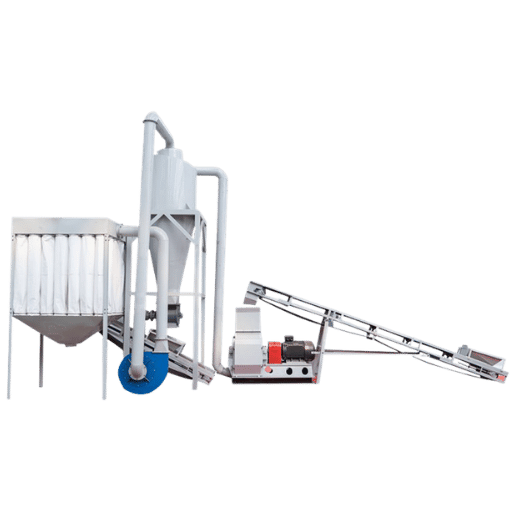
TCPEL Industrial Hammer Mill
100–6,000 kg/h

Capacity tier framework, four sizes

$900–$15,000

FOB Qingdao, USD published

CE + ISO 9001

EU machinery directive ready

2-Year Warranty

24-h engineer + 5-day spares

Why Generic Hammer Mills Fail Biomass, Wood-Pellet & Feed Producers

An industrial hammer mill is stage one in the chain for every biomass pellet, wood briquette, and animal feed process – yet four common failures keep customers awake. All are a consequence of sourcing behaviour, not matter-of-fact physics. We engineered our TCPEL design to eliminate all four from the transactions table.

ISSUE 01

Pricing is not transparent: every ask requires a one-time 2 week negotiation before a buyer has an end-cost numaric.

Published four level USD FOB price list for our entire hammer mill range, 900 USD-Powered.

ISSUE 02

Standards are unmanaged: many of our competitors technical data sheets include the ambiguous provision “industrial standard” without any baseline for CE, ISO, or EN.

CE 2006/42/EC + ISO 9001:2015 + ISO 12100 + EN 60204-1 specified.

ISSUE 03

Spares take 3 weeks to arrive, not 3 days when the screen bits blow out.

International courier: a 4-day maximum for consumables; 24 hours response from CNC dealer equipped engineer

ISSUE 04

Sizing is worked out directly with sales, instead of by a helpful thumb rule.

Capacity sizing calculator + 4 tier framework whatever the application allows a buyer to self assess in under five minutes.

This page details the engineering, the pricing and package levels, the application path through our three brand-specific product families, and the standards with which we comply – so a buying decision can go from “worth investigating” to “terminate a deal” without the need of a sales call. Select the tier table in 4 if you already know your required kg/h or use the application guide in 5 to help determine between biomass, wood, and feed.

How a Hammer Mill Works — Impact, Shear & Collision Forces

Threes forces degrade material as it passes through a hammer mill: impact from hammers whacking away at incoming feedstock, shear as particles rub against the breaker plate, collision as broken material bounces back off the side chamber into itself. Speed ranges from 1,500 and 3,600 RPM depending on particle size standard (Prater Industries). A perforated screen keeps anything too large the slit until further size reduction allows it to go through.

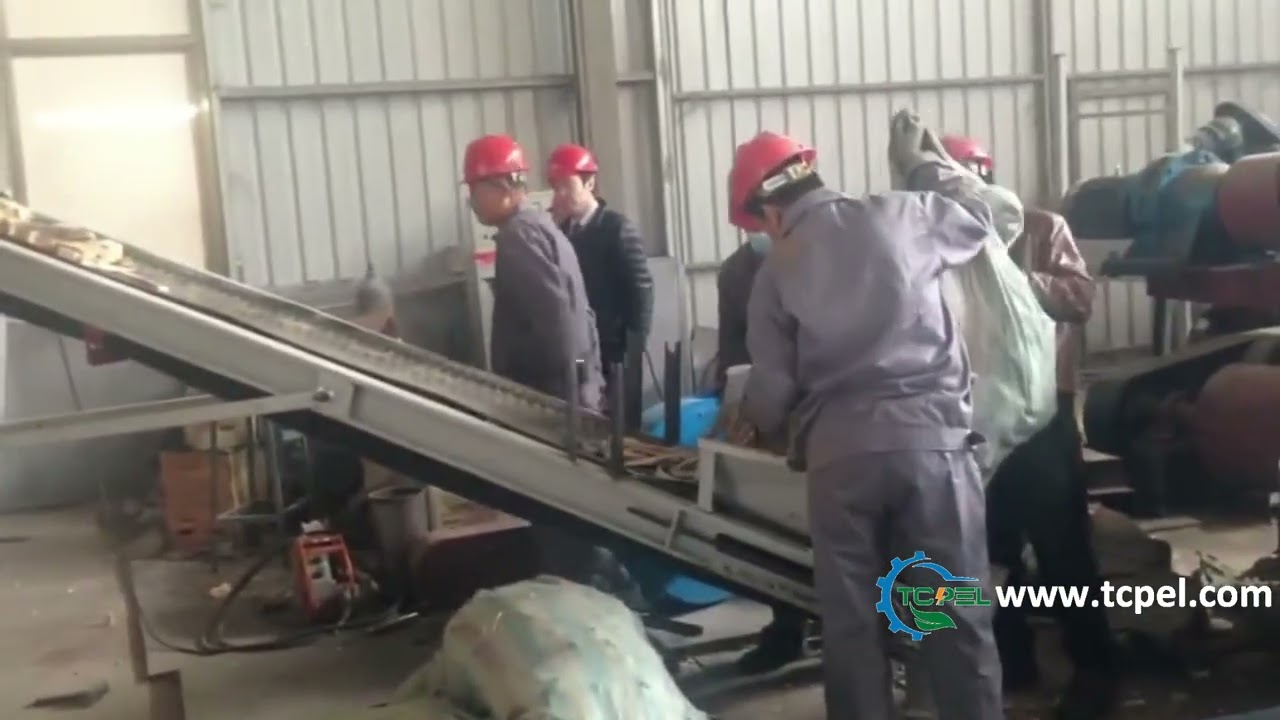
TCPEL Hammer Mill Machine Working Process

Hammer Mill Machine Working Video

RPM Speed Bands by Application

Coarse grinding at 1,500-1,800 RPM is used for the likes of biomass and wood chips – moves volume, highest throughput
Fine grinding at 3,000-3,600 RPM is used to produce animal feed flour, superfine biomass for sub-6mm pelleting, and food grade powders – highest particle uniformity.
While facing a direct-coupled 3,000 RPM our hammer mill function surfaces as both ends of the spectrum seamlessly with no need for a VFD purchase in most sites

Hammer Mill Components

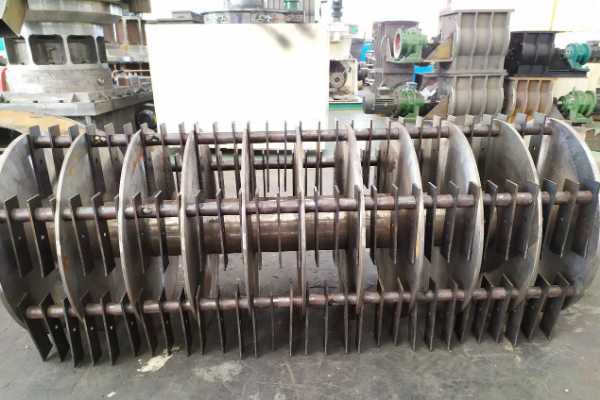
+ The mill’s central rotor and hammers are the dynamic elements to be fed through: 12 to 60 swinging hammers depending on tier.
+ The perforated screen apertures run from 1/64-inch to 2inch, and swap in less than 30 minutes (Meadows Mills standard).
+ Constructed from steel, the breaker plate is the play/hard point where shear-bending occurs at the pivoting hammer arc.
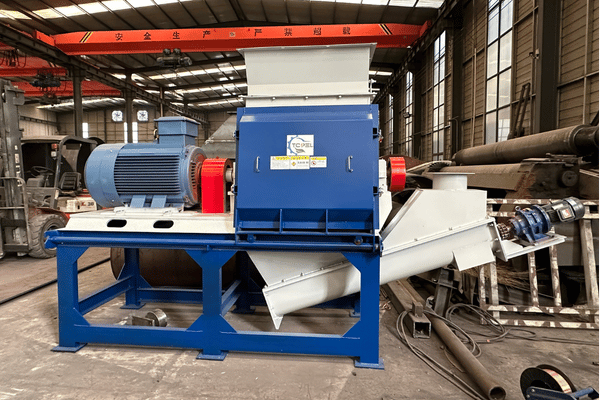
+ The value steel and one-piece construction of the grinding chamber housing on TCPEL items means delivery and installation is done in days not weeks
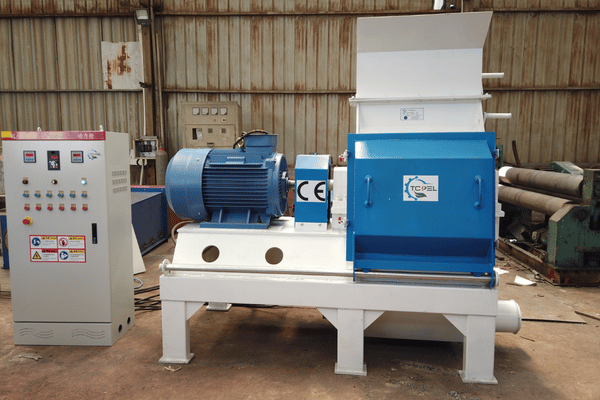
+ Our 7.5 kW (diesel) to 160 kW (direct-coupled) drive motors are designed with direct-coupling and zero belt-power-loss in mind.

TCPEL Hammer Mill Engineering — Direct-Coupled 3,000 RPM, Dual-Side Discharge

Four design decisions distinguish a TCPEL hammer mill from generic Chinese OEMs and from the more expensive European premium tier. All are simple enough to check on our 20,000m Jinan assembly floor, and all are subject to a quantifiable performance improvement. They combine to deliver a mill that operates closer to the patented closed-rotor benchmark Andritz reports for its Optimill series.
Direct-Coupled 3,000 RPM Motor

Direct-Coupled 3,000 RPM Motor

Motor shaft couples directly to the rotor – no drive belt, no pulleys, no slipping. Removes the 2-4% transmission loss which is common with belt driven hammer mills, and also removes the most common ‘unforseen’ downtime in your frugal machines.

Dual-Side Discharge

Dual-Side Discharge

Material is discharged from both sides of the grinding chamber at once, effectively doubling the dischargel area. For our 1,500kg/h Industrial-tier unit this yields roughly 1.7 times the throughput a single-discharge system would achieve at the same screen size and rotor speed:

One-Piece Welded Body

One-Piece Welded Body

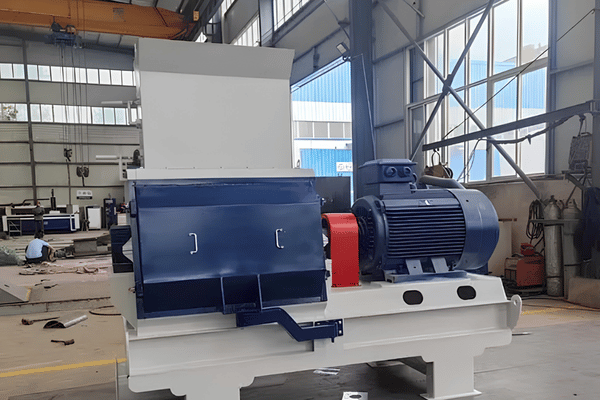
The grinding chamber and discharge housing are be welded together as one block. Since there are no bolted connections inside the chamber, there are no places where the dust from the biomass begins to settle, which can cause a gradual clogging in time (costing older machines 10-15% of their first year throughput).

Cyclone + Bag Filter Ready

Cyclone + Bag Filter Ready

Pneumatic discharge port is provided as standard on all Industrial and Heavy Industrial levels, it is directly connected to a TCPEL or third party cyclone separator and bag dust collector in biomass handling operations in accordance with EU dust-explosion safety limits under ATEX conditions.

TCPEL Hammer Mill Capacity Tiers — From 100 kg/h to 6,000 kg/h

Hammermill catalogue organizes into four power/capacity tiers designed to complement one of four TCPEL pellet mill lines. The tier system provides customers a self-qualify criteria based on desired throughput, avoiding discussion tolling capacity and sales interview. Power, USD price bracket, and pellet-line partner below:

Camada Capacidade Poder Motor FOB Qingdao USD Pairs With
Entry 100–300 kg/h 7.5–15 kW $900–$1,800 Small farm or pilot line, hobby pellet production
Small Commercial 300–1,000 kg/h 15–37 kW $1,800–$3,500 TCZL250–450 wood pellet line companion
Industrial 1,000–3,000 kg/h 37–90 kW $3,500–$8,500 TCZL550–650 wood pellet line + TCF feed pellet line
Heavy Industrial 3,000–6,000 kg/h 90–160 kW $8,500–$15,000 TCZL850 series, plant-scale biofuel production

Choosing the Right Tier — Three Decision Variables

01

Capacity target (kg/h) is the single most important number. For 2 t/h pellet line, it should be 55-75 kW for hammer mill (shandong changsheng pellet line case study).

02

First, is the feedstock—material density is critical: Soft biomass such as sawdust or straw will require 30-40% less power than dense feed grain. Hardwoods use 25-30% more power than soft-wood at the same throughput.

03

Next: power feed source— Industrial and Heavy Industrial tiers require three phase 250-400 amp service. Single phase rural sites are limited to Entry tier (15 kW); check transformer size before specifying.

04

For a 1.5 t/h pellet mill in the TCZL550 range at the lower power range, producing wood pellets from sawdust, power is suitably matched at the Industrial tier (37-55 kW.) For a 3 t/h poultry mash mill in TCF600 range, power is stepped up to the Industrial tier at (75-90 kW) with a 1mm fine screen.

Choose Your TCPEL Hammer Mill by Application

Cross-mapping a 100-6,000 Kg/h machine based off end point particle size and dust profile categories across three downstream applications, three different particle sizes, and third-party certification pathways – configuring the same base machine from different screen variables, rotor balance, optional cyclone sizing:

APP-01
Moinho Martelo Biomassa

Moinho Martelo Biomassa

For biomass fuel pellet producers—sawdust, EFB, palm shell, agricultural waste, straw, olive pomace:

Capacidade
300–6,000 kg/h
Particle output
3–8 mm (pre-pellet feedstock)
Pairs with
TCPEL wood pellet line + rotary dryer
Standards
CE + ENplus A1 downstream
APP-02
Moinho Martelo Madeira

Moinho Martelo Madeira

For wood pellet, briquette, and MDF producers—common-edge woods, pallet waste, planer shavings, large wood chips:

Capacidade
200–3,000 kg/h
Particle output
2–6 mm (pellet-ready)
Pairs with
TCPEL drum chipper + wood pellet line
Standards
CE + EN 60204-1
APP-03
Moagem de ração Moinho de martelo

Moagem de ração Moinho de martelo

For animal feed producers—grains, beans, oilseed cakes, lucerne/alfalfa, straw-mash:

Capacidade
200–3,000 kg/h
Particle output
1–3 mm (mash & pellet feed)
Pairs with
TCF feed pellet machine
Special spec
Fine screen for poultry mash

Hammer Mill Selection Guide Particle Size × Material Decision Matrix

Five common endmaterials across our 60-country export supply map assemblage produce four straightforward particle size endbands. The matrix below recommends a TCPEL tier and particle size end-band specific entry point for each material by screen aperture and working power matched to industry-proven capacity-to-horsepower ratios:

Material → / Output ↓
1–3 mm (fine)
3–6 mm (medium)
6–12 mm (coarse)
>12 mm (rough)

Serragem

Industrial · biomass child
Small Comm. · biomass child
Entry · biomass child
Drum chipper instead

Wood Chips

Heavy Ind. · wood child
Industrial · wood child
Small Comm. · wood child
Drum chipper pre-stage

Straw & EFB

Industrial · biomass child
Small Comm. · biomass child
Entry · biomass child

Corn & Grain

Industrial · feed child
Small Comm. · feed child
Entry · feed child

Cattle / Poultry Feed

Industrial · feed child (poultry mash spec)
Small Comm. · feed child
Entry · feed child

TCPEL vs Andritz vs Schutte vs CME vs Meadows — 5-Vendor Reference Matrix

There is no side-by-side comparison of our five most common hammer mill vendors against their competitors. We do, as the procurement decision is placed between a TCPEL tier, a European premium brand, and an American middle market brand. All five vendors are represented in the matrix below as of May 2026.
Vendor Origin Faixa de capacidade Pricing Disclosure Standards Listed Warranty Lead Time
TCPEL TCPEL Jinan, China 100–6,000 kg/h Public 4-tier USD CE + ISO 9001 + ISO 12100 + EN 60204-1 2 years 15 days
Andritz Feed & Biofuel Esbjerg, Denmark 100 kg/h to 60 t/h Sales-quoted only Patented closed-rotor design Standard contract 12–20 weeks typical
Schutte Hammermill Buffalo NY, USA Lab to 60 t/h Quote-gated Not listed on product page Standard contract 8–16 weeks
Colorado Mill Equipment Loveland CO, USA Compact to 400 HP PDF download gated Made-in-USA emphasis 1 year 6–12 weeks
Meadows Mills North Wilkesboro NC, USA 6 model sizes Phone-gated Not listed on product page Standard contract Quoted per order
TCPEL Compliance & Quality Assurance

Standards, Compliance & Quality Assurance

Every TCPEL hammer mill ships with four international machinery, electrical, and management standards – European and Australian authorities look for compliance before installation and buy-in. Our standards are published on the product page such that the procurement audit can move straight to a document request.

  • CE 2006/42/EC

    EU Machinery Directive- declaration of conformity supplied with shipment

  • ISO 9001:2015

    Quality Management System — Allwin International parent certification

  • ISO 12100:2010

    Safety of Machinery- general principles for machinery design, rotating mass guarding

  • EN 60204-1:2018

    Electrical Equipment of Machines- torque motor safety

The standards are not simply aesthetic. The TCPEL factory in Jinan has 100+ workshop staff, ships to 60+ countries since 2020, and its standards are carried to its international markets however large or small they are in the project’s final delivery form. Germany, Kemima, South Korea, New Zealand, Pakistan, Turkey etc.

CE / MD Equipment Certificates

Procurement Guide — Tier Pricing, Lead Time & Spare Parts

We publish our full hammer mill pricing in USD on this page for transparency, and copy the tier table below for purchasing decision use; same data shown in four order, with total freight, project supply/import cost added. Expect 3-6 weeks delivery.

Camada Capacidade USD FOB Qingdao Typical Application
Entry 100–300 kg/h $900–$1,800 Small farm pellet, hobby biomass, R&D pilot
Small Commercial 300–1,000 kg/h $1,800–$3,500 Mid-scale biomass pellet, regional feed mill
Industrial 1,000–3,000 kg/h $3,500–$8,500 Plant-scale biomass fuel, commercial feed mill
Heavy Industrial 3,000–6,000 kg/h $8,500–$15,000 Power-plant biofuel, large industrial feed line

Procurement Flow

  • 30% T/T deposit confirms order
  • 15-day production lead time
  • 70% T/T balance before shipment
  • FOB Qingdao to your destination

Spare Parts & After-Sales

  • 5-day international courier delivers all consumables via DHL or FedEx
  • 2-year warranty on all parts, measured from invoice receipt
  • 24 hours engineer response available by WhatsApp, email and telephone in English speaking time zones only
  • On-site commissioning ships worldwide with Industrial and Heavy Industrial tier installations

5-Year Total Cost of Ownership — Energy + Die Wear + Downtime

A hammer mill purchase price contributes a maximum of 25% of the model’s life-cycle cost, labor, energy and wear each contribute other factors along the lifecycle.

Worked Example — Industrial Tier 1,500 kg/h, 5-Year TCO

Use this industry case study (published) to estimate your own operational expense.
Initial CAPEX runs ~$6,000 FOB Qingdao at mid-Industrial tier
Screen and hammer wear costs ~$10,000′ (screens monthly, hammers every 2 years – pattern documented in RMS Roller-Grinder TCO study)
Labour budget runs ~$4,000 for one operator partial allocation
Downtime allowance ~$2,000 covers two days per year unplanned
5-year total is ~$46,000 – energy is 52% of total, CAPEX only 13%
The implication is for procurement is that mid-tier sticker price differences of $1,000-$3,000 between TCPEL and a higher priced competitor are offset with within one year of energy consumption. The final procurement decision should consider energy efficiency, spare parts logistics and warranty depth far more than upfront price differential of 10-20%.
The above TCO figures are calculated based on US energy cost ($0.10 /kWh, USA EIA mean), single-shift 8-hour operation, and 250-day production year. Actual TCO could be different as per the local energy rates ($0.06 /kWh in some Asian markets, $0.20 /kWh in some European markets), shift count (2 or 3 shifts doubling the energy portion), and material hardness (hardwoods consuming 25-30% more energy than softwoods).

TCPEL Hammer Mill Capacity Sizing Calculator

Enter your target throughput and material type to get a recommended TCPEL tier, motor power range, USD price band, and matched product line — instant technical validation for industrial procurement.

Operational Parameters

Range: 50 to 10,000 (Numeric value only)
⚠ Please enter a valid capacity number above zero.

Recommended Configuration

TCPEL Tier

Motor Power (kW)

USD FOB Qingdao

Target Screen

Perguntas frequentes

O que é um moinho hammer?

Um moinho ha1TP96 Ter é um tipo de equipamento industrial de redução de tamanho de partícula que usa ha1TP96 Ters rotativos de alta velocidade para moer a matéria-prima até que as partículas sejam pequenas o suficiente para serem transportadas através da tela perfurada. 1TP71 T oferece moinhos ha1TP96 Ter para plantas de pellets de biomassa, processadores de madeira e moinhos de ração animal, com configuração de quatro níveis e capacidades de 1001TP79 T a 6.000kg/h.

Qual é a diferença entre um moinho ha1TP96 Ter e um triturador de impacto?

Tanto os moinhos de impacto quanto os de ha1TP96 Ter aplicam força de impacto; no entanto, suas geometrias diferem Um moinho hammer tem ha1TP96 Ters oscilantes mais leves voando em um rotor de alta velocidade (1.500-3,60 RPM) com uma tela perfurada na descarga adequada para tamanhos de partículas finas a médias em alimentação, biomassa e processamento de alimentos Um triturador de impacto tem barras de sopro rígidas mais pesadas voando em um rotor mais lento (500-1,500 RPM) sem tela de descarga adequada para esmagamento de agregados grossos em mineração e construção. Há também diferenças na classificação de saída do produto; os moinhos ha1TP96 produzem saída uniforme através da retenção de tela, enquanto os trituradores de impacto produzem saída graduada através da descarga por gravidade.

Quais são os problemas de common com moinhos hammer, e como TCPEL os previne?

The four most common problems through out the industry are: (1) V-belt slippage (causes under-power and unscheduled downtime) – TCPEL disables this with direct-coupled motors; (2) screening clogging from high-moisture biomass – TCPEL installs dual-side discharge output port to maintain throughput; (3) hammer wear condition (causes rotor unbalance) – TCPEL builds it with hardened-alloy swinging hammers with proven 2-year service life in similar conditions; (4) dust explosion risk (during fine biomass processing) – TCPEL equips with pneumatic discharge ports with connect to ATEX-rated cyclone and bag filter systems.

Como funciona um moinho hammer?

Existem três forças de ação simultânea dentro da câmara de moagem: impacto (ha1TP96 Ters atingindo o material que entra a 1.500-3.600 RPM), cisalhamento (arrasto de partículas em uma placa de disjuntor endurecida) e colisão (rebote de fragmentos entre as paredes da câmara e entre si).O material permanece na câmara de moagem até que sejam pequenos o suficiente para serem transportados através da tela perfurada na porta de descarga. Os moinhos 1TP71 T ha1TP96 Ter operam a 3.000 RPM sem acionamento de frequência variável; sua alta velocidade é adequada tanto para aplicações de moagem grossa de biomassa quanto para aplicações de moagem fina de alimentação.

Que tamanho hammer moinho EU preciso para X toneladas por hora?

Siga esta regra prática usando dados documentados de capacidade-potência da indústria: biomassa de madeira macia a 1 t/h 30-37 kW (Small Commercial); a 2 t/h 55-75kW (inferior Industrial); a 3t/h 75-110 kW (inferior Industrial;).A madeira dura requer 25-30% mais potência No mesmo rendimento, o grão de ração animal utiliza 15-20% menos potência A Matriz de Decisão 6 acima mapeia essas combinações em relação ao tipo de matéria-prima e ao tamanho de partícula alvo.

O moinho 1TP71 T ha1TP96 Ter vem com um ciclone e coletor de pó?

If hard wood is to be ground at 1 Tph target consider specifying 39-46 kW (Small Commercial); at 2 tph specify 65-90 kW (lower Industrial); at 3 Tph specify 110150 kW (upper Industrial;). Hardwood requires 25-30% more power. Then ask us to specify a complete grinding line – hammer mill plus cyclone plus bag filter – because this will be necessary when dust control is needed for biomass processing under ATEX dust explosion guidance in the European Union.

Qual é a política de garantia e peças de reposição?

Todos os moinhos 1TP71 T ha1TP96 Ter incluem uma garantia de peças e montagem de 2 anos, incluindo rotores, carcaças, conjuntos de motores e rolamentos Telas, ha1TP96 Ters e placas de ruptura são classificados como consumíveis e chegarão via DHL ou FedEx com entrega de 4-5 dias na maioria das regiões em todo o mundo Suporte pós-hora disponível para solução de problemas por Whats App, e-mail ou chamada de voz Os serviços completos de commissioning estão disponíveis para todas as instalações de nível Industrial e Industrial Pesado em todo o mundo O custo está incluído na proposta assim que os requisitos do local e a logística forem estabelecidos.

Posso ver os moinhos 1TP71 T ha1TP96 Ter em operação? você fornece estudos de caso?

Sim! as usinas 1TP71 T ha1TP96 Ter estão operando em mais de 50 países em todo o mundo e podemos fornecer recommendations, referências, vídeos, desenhos 3-D do engenheiro de amostras, seções estruturais, close-ups de câmaras de trabalho e instalações do local, mediante solicitação Consultas sobre implantação em sua região podem ser agendadas em qualquer região com base nas expectativas de nossos clientes.