Entre em Contato com a TCPEL


A practical engineering and buyer’s guide, Updated June 2026.
A wood pellet machine is a press (also called a wood pellet maker) that compresses loose sawdust, shavings, and chipped wood waste into dense, uniform fuel pellets, but the gap between a $900 home unit and a 10-ton-per-hour industrial line is enormous, and most buyers pick the wrong class. This guide explains how a wood pellet machine works, the difference between flat-die and ring-die designs, realistic costs and output, the ENplus and ISO 17225 quality standards that define a “good” pellet, and a clear framework for choosing the right machine for your scale.
In short: A wood pellet machine compresses dried, ground biomass through a hardened steel die; friction heats the material to roughly 90–100 °C, softening the wood’s natural lignin so it binds each pellet as it cools, no glue required. Capacity ranges from about 50 kg/h (home flat-die) to 20+ t/h (industrial ring-die lines), with feed moisture held at 10–15%.
Quick Specs: Wood Pellet Machine at a Glance
| Capacity range | 50 kg/h (home flat-die) → 20+ t/h (industrial ring-die line) |
| Tipo de matriz | Flat die (home/farm) · Ring die (commercial/industrial) |
| Power / drive | 3 kW → 250+ kW; electric, diesel, gasoline, or tractor PTO |
| Pellet diameter | 6 mm or 8 mm (±1 mm); 6mm is the heating standard |
| Feed moisture | 10–15% (≈12% target) |
| Feed particle size | Below the die-hole diameter (≤5 mm typical) |
| Finished pellet density | 600–750 kg/m³ bulk density |
How a Wood Pellet Machine Works
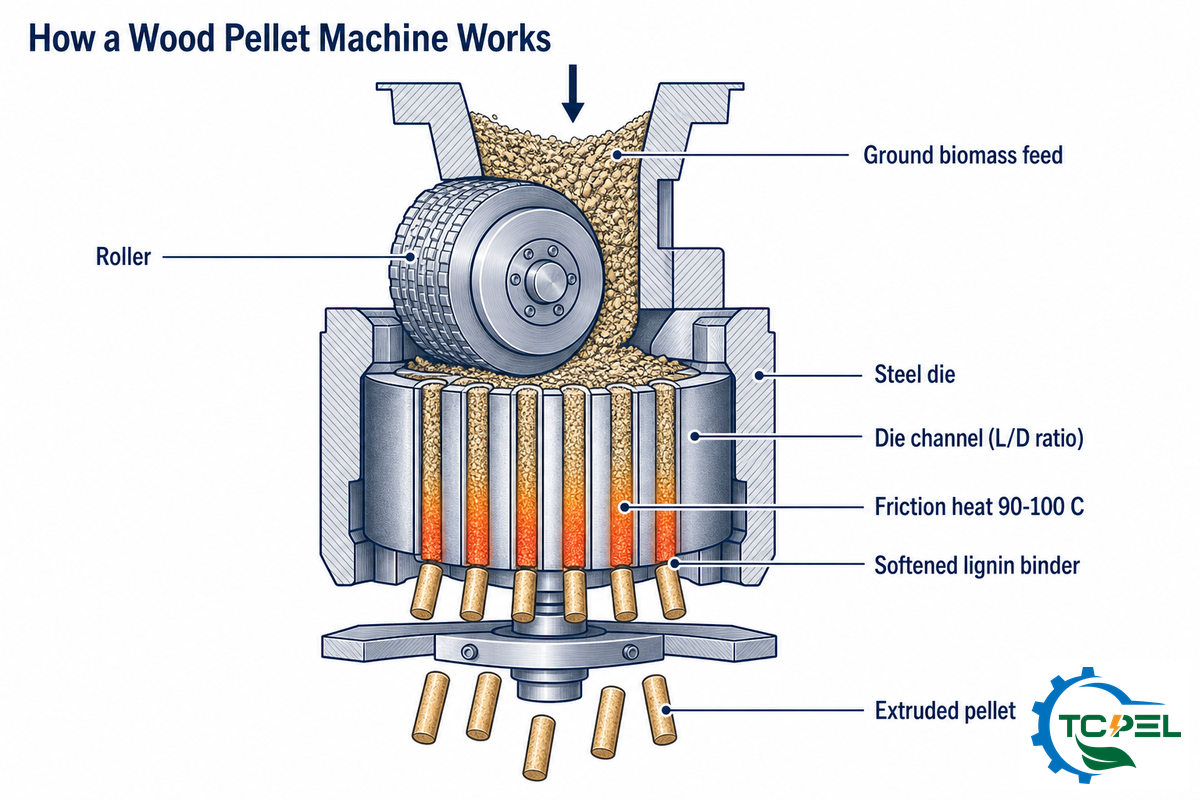
A wood pellet machine works by forcing dried, finely ground biomass through the holes of a thick hardened-steel die (often stainless steel on contact parts) under intense mechanical pressure from rotating rollers. As the material is squeezed through each channel, friction raises the temperature to roughly 90–100 °C.
According to a biomass pelletization review from North Carolina State University, this heat push the wood’s natural lignin past its glass-transition point, it shifts from a glassy to a rubbery state and flows around the fibers, acting as a built-in binder. When the extruded pellet cool, the lignin re-hardens and locks the shape, which is why properly made wood pellets need no added glue.
Two moving parts do the work: the die and the rollers. USPTO-published pellet-mill patents describe the standard arrangement: rollers cooperate with a cylindrical or flat die so that one element rotate while the other presses the feed through the die channels. Machines are commonly built as “D-type” (the die rotate) or “R-type” (the rollers rotate); both achieve the same compression.
📐 Engineering Note — Die compression ratio (L/D)
A die’s single most important parameter is its compression ratio: the length of each die channel divided by its diameter (L/D). A higher L/D squeezes the material longer and produces denser, more durable pellets, but demands more power and resists flow. Softwoods (high natural lignin, easy to bind) run well at lower L/D ratios; dense hardwoods and low-lignin agricultural residues need higher ratios. A peer-reviewed review of pellet-die design and process parameters confirms die geometry is the dominant control on pellet quality. Matching the die’s L/D to your feedstock is the difference between firm pellets and a chamber full of dust.
What are wood pellets made of?
Wood pellets are made almost entirely of compressed wood fiber, typically clean sawdust, shavings, and chips from sawmills or wood-products manufacturing, with no chemical additives in most production. Lignin already present in the wood is the only binder needed. Higher grades (used in homes) come from low-bark mill residues; lower grades may include bark or arboricultural trimmings, which raises ash content.
Flat Die vs Ring Die: The Two Machine Architectures
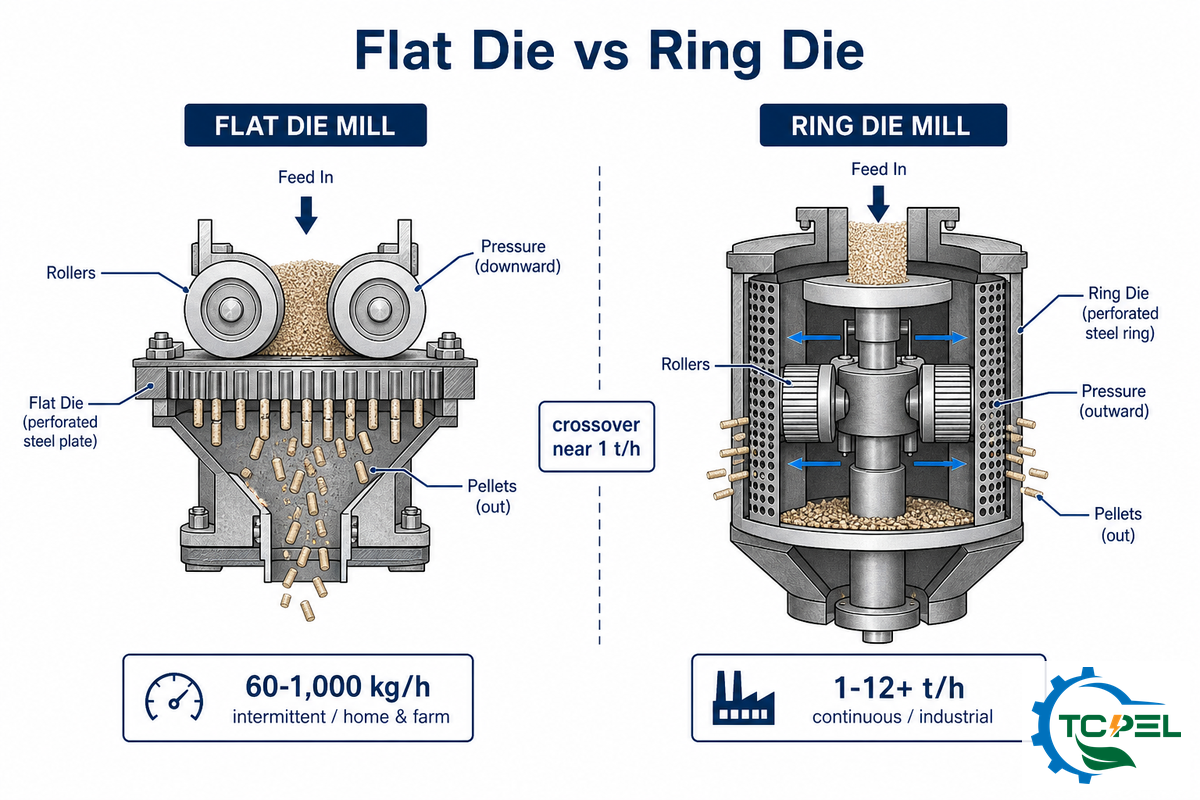
Almost every wood pellet machine is built on one of two architectures: a flat die or a ring die. That choice isn’t about quality, both press excellent pellets, but about scale and duty cycle. Flat-die mills are simple, affordable, and suited to intermittent home or farm use; ring-die mills are continuous-duty industrial machines that dominate above roughly 1 ton per hour.
| Attribute | Flat Die Mill | Ring Die Mill | Vertical Ring Die |
|---|---|---|---|
| Typical capacity | 60–1,000 kg/h | 1–12+ t/h | 0.5–3 t/h |
| Duty cycle | Intermittent / batch | Continuous 24/7 | Continuous |
| Drive layout | Single motor, simple gearbox | High-torque drive, gear/belt | Vertical feed by gravity |
| Die wear pattern | Uneven (smaller die area) | Even, longer service life | Even; easy feed for fibrous stock |
| Indicative price | ~$530–8,000 | ~$15,000–150,000+ | ~$10,000–60,000 |
| Best for | Home heating, small farms | Commercial fuel producers, exporters | Straw, grass, fibrous biomass |
Capacity and price bands are indicative and vary widely by manufacturer, motor size, and die specification, treat them as planning ranges, not fixed values.
Why does the ring die win above about 1 t/h? Its circular die presents far more open area, spreading wear evenly and sustaining output for continuous shifts, whereas a flat die’s smaller working face wears unevenly and overheats under non-stop load. For a deeper, side-by-side breakdown of the two design, see our guide to the flat die pellet mill and the vertical ring die pellet mill.
Capacity Tiers: Home, Small-Commercial & Industrial Lines

Sizing a wood pellet machine starts with one number: your target output in kilograms or tons per hour. Undersize it and you run the machine to death chasing volume; oversize it and capital sits idle. A small wood pellet machine for home use may only need 50 kg/h, while a business shopping for an industrial wood pellet machine for sale is sizing for tons per hour. Industrial machinery runs continuously, while compact home units stay efficient at low volume; large pellet output needs a full line, not a single machine. Production also splits into two categories, a single pellet machine, or a full production line where the pelletizer is one stage among many.
| Tier | Saída | Power | Machine vs Line | Typical buyer |
|---|---|---|---|---|
| Casa | 50–100 kg/h | 3–7.5 kW | Single flat-die machine | Households heating with pellets |
| Small-commercial | 300–800 kg/h | 15–37 kW | Mill + dryer + pelletizer | Farms, sawmills using own waste |
| Commercial | t/h | 75–160 kW | Full ring-die line | Regional fuel-pellet producers |
| Industrial | 5–20+ t/h | 250+ kW (multi-mill) | Turnkey plant, multiple mills | Exporters, power utilities |
Most first-time buyers underestimate the leap from “machine” to “line.” Above roughly 300 kg/h you rarely buy a pellet machine alone, you need a wood chipper or wood hammer mill for grinding, a dryer, the pelletizer, a cooler, and a packing machine, all matched in throughput. Industrial-scale buyers should start from the complete wood pellet machine and production-line range rather than a stand-alone unit. And beware a common sales myth: a bigger motor doesn’t equal more output, power must be matched to the die area, or you simply starve or burn the die.
Raw Materials & Feedstock Preparation
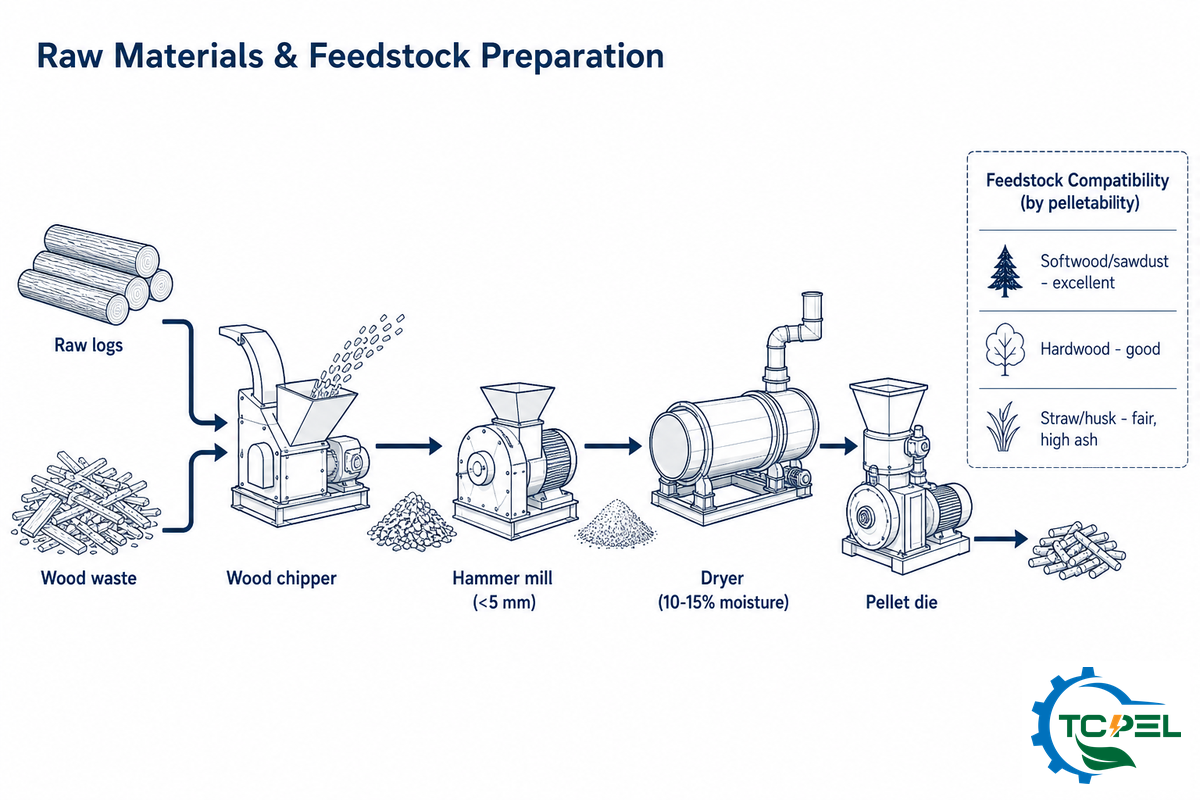
A wood pellet machine is only as good as what you feed it. Two numbers govern everything: moisture e particle size. Feedstock must be dried to 10–15% moisture (around 12% is the sweet spot) and ground below the die-hole diameter, typically 5 mm or finer. Particle size and feedstock chemistry drive how well a batch binds, a relationship detailed in the NC State biomass pelletization review. As one home producer put it on Reddit, the mill is “very sensitive to moisture content. Too wet and the mushy pellets fell apart. Too dry and the pellets wouldn’t form.” That single variable causes more failed batches than any machine fault. Beyond clean sawdust, corn stalks and cobs, yard debris, and other high-carbon residues each pellet differently — dirtier feedstocks wear dies faster.
A frequent misconception, flagged by U.S. energy data, deserves a correction: logs and roundwood are a legitimate raw material for pellets, but you can’t feed a whole log directly into the die. It must first be chipped and then hammer-milled to size, a distinction between the raw material and the direct machine input that trips up most beginners.
| Feedstock | Pelletability | Pre-treatment | Ash tendency |
|---|---|---|---|
| Pine / spruce (softwood) | Excellent (high lignin) | Grind, dry to ~12% | Low (≤0.7%) |
| Oak / beech (hardwood) | Good (needs higher L/D) | Chip, grind, dry | Low–moderate |
| Sawdust (mill residue) | Excellent (ready size) | Dry only; often no grinding | Low |
| Wood shavings | Very good | Light grinding, dry | Low |
| Bamboo | Good (hard, abrasive) | Crush, grind, dry | Moderate |
| Wheat / barley straw | Fair (low lignin) | Grind fine, dry; high L/D | High (5–8%) |
| Rice husk | Fair (very abrasive) | Grind, dry | Very high (15–20%) |
| Grass / leaves | Fair (binder varies) | Grind, dry carefully | Moderate–high |
| Agricultural residue / EFB | Variable | Clean, grind, dry | High |
Ash bands reflect typical ranges; clean softwood mill residue is the benchmark for low-ash fuel pellets. Grade ash limits are defined by ISO 17225-2 (see quality section).
📐 Engineering Note — The 12% moisture target
Aim for roughly 12% feed moisture. Above 15%, steam forms in the die and the pellets emerge soft and crumble; below about 8%, the fibers can’t fuse and you get fines and die slippage. The pelletizing process itself drives moisture down further, finished pellets cool to around 6%, comfortably under the ISO 17225-2 limit of ≤10%.
How to Make Wood Pellets: The Production Process
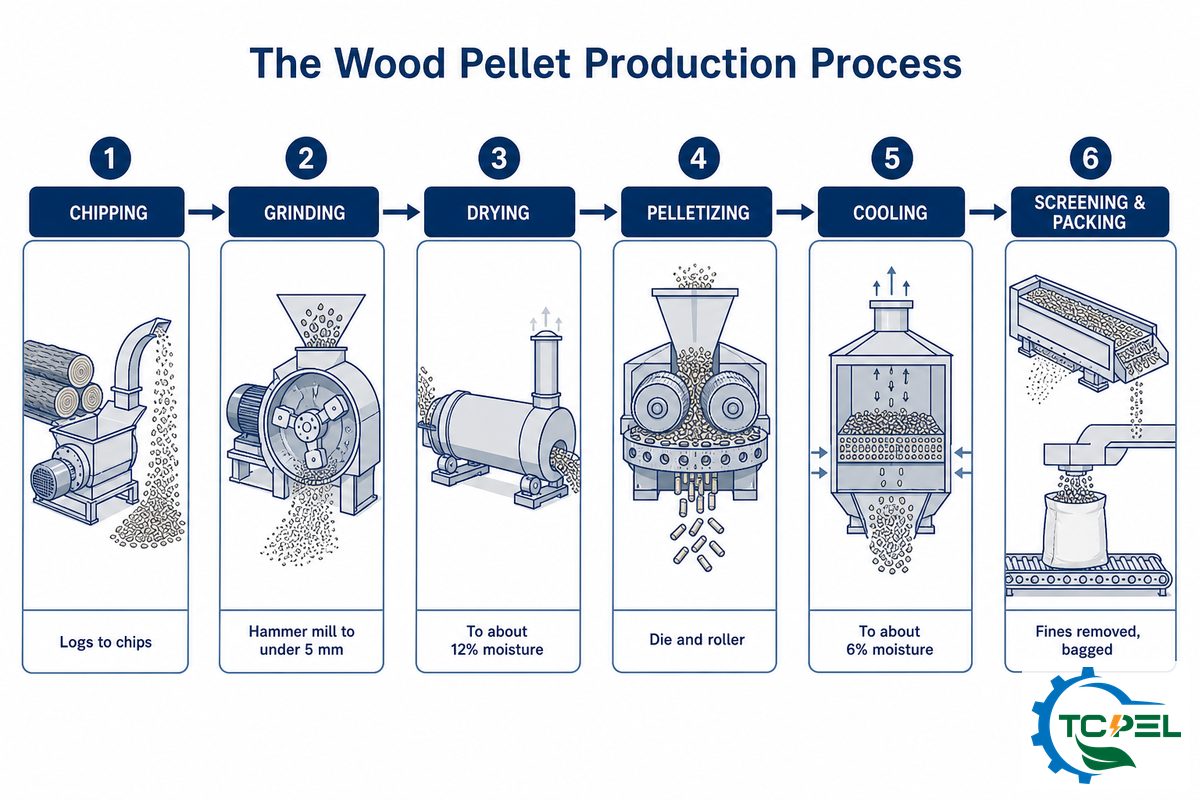
Making wood pellets at any scale follows the same sequence; the pellet making machine is one stage, and a commercial line automates and buffers each step. Here’s the end-to-end process from raw wood to bagged fuel:
- Chipping / crushingreduce logs, offcuts, and bulky waste to chips. A wood chipper typically outputs pieces a few millimetres thick and 10–30 mm long.
- Moagema hammer mill (running 3,000–8,000 RPM, with screens from 1mm to 10mm) reduces chips below the die-hole size, ≤5 mm.
- Secagema rotary drum or flash dryer brings moisture down to 10–15%.
- Conditioning — the ground, dried material is fed from a feed hopper into the pellet machine to produce pellets.
- Peletizaçãorollers force the biomass through the die; friction heat softens lignin and forms the pellet.
- Resfriamentohot, soft pellets are air-cooled to harden them and drop moisture to ~6%.
- Screening & packingfines are screened out and recycled; finished pellets are bagged for storage.
⚠️ Important — Wood dust is a combustible-dust hazard
Grinding and pelletizing generate fine wood dust. The U.S. Occupational Safety and Health Administration (OSHA) classifies wood flour as a combustible dust capable of causing flash fires and explosions when suspended in air. Any pellet operation above hobby scale should plan for dust collection, ignition-source control, routine housekeeping, and properly placed venting, controls competitor buying guides routinely omit but that insurers and inspectors don’t.
Can you make wood pellets from logs directly?
No, not directly. You can’t drop a whole log into a wood pellet machine. Logs are a perfectly valid raw material, but they must be chipped and then hammer-milled to a fine particle size first; the die only accepts material smaller than its hole diameter. Skipping the grinding stage is the most common beginner mistake.
What a Wood Pellet Machine Costs (and the Real ROI)
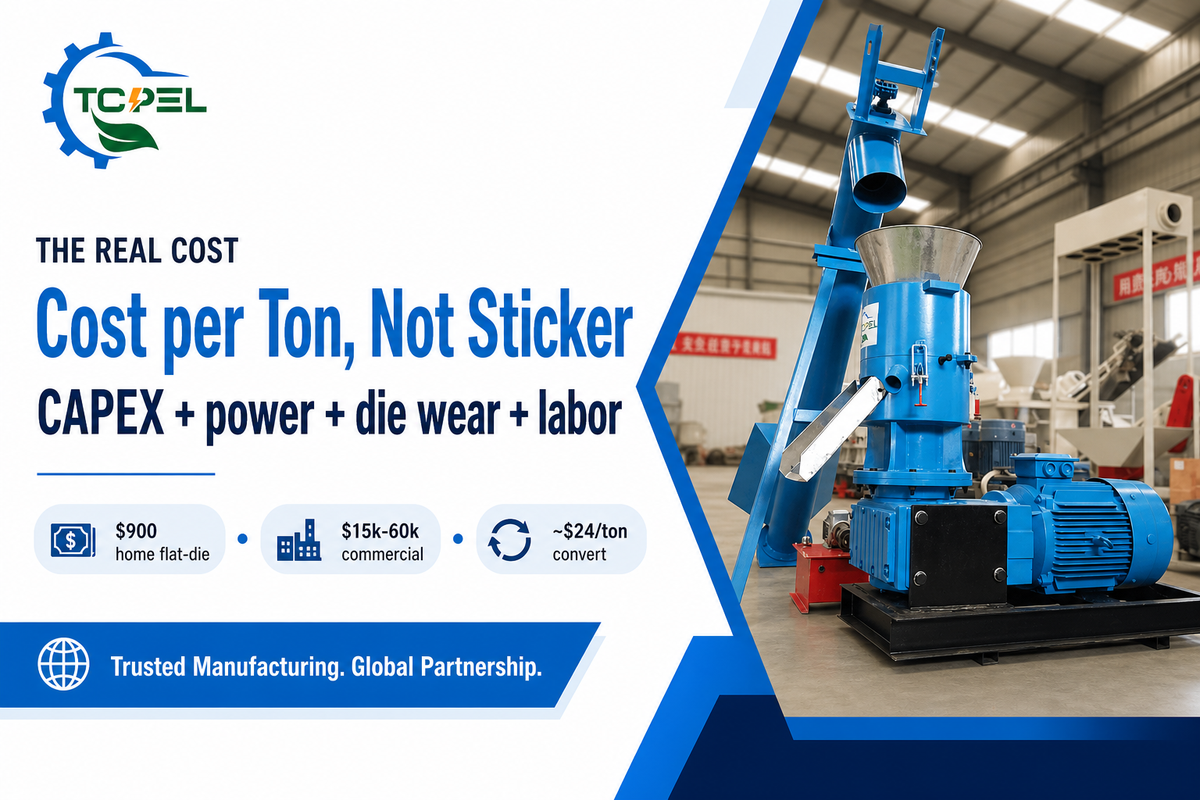
The advertised wood pellet machine price is the easy part; the cost that decides profitability is the all-in cost per ton produced. A home flat-die machine runs roughly $900–2,500; a small-commercial setup $3,500–8,000; a commercial ring-die line $15,000–60,000; and a turnkey industrial plant $150,000 and up. But those are capital numbers. The operating math is what separates a paying line from an expensive hobby.
| Cost element | Home flat-die | Small-commercial | Commercial ring-die line |
|---|---|---|---|
| Machine / line CAPEX | $900–2,500 | $3,500–8,000 | $15,000–60,000 |
| Throughput | 50–100 kg/h | 300–800 kg/h | t/h |
| Pelletizing power | ~90 kWh/ton | ~80 kWh/ton | ~75 kWh/ton |
| Power cost (≈$0.12/kWh) | ~$11/ton | ~$10/ton | ~$9/ton |
| Die & roller wear | ~$8/ton | ~$6/ton | ~$5/ton |
| Labor | Owner time | ~$12/ton | ~$10/ton |
| Drying energy | Varies (often sun/air) | $8–20/ton | $8–20/ton |
| All-in conversion (ex-feedstock) | High per ton | ~$40–50/ton | ~$30–45/ton |
| Realistic payback | Only vs buying bagged pellets | 2 anos | 1.5–3 years at full use |
Conversion costs are directional industry estimates; feedstock cost (free sawdust to $40+/ton) and local power prices dominate the final figure. Academic supply-chain analysis puts large-plant production near €136–143/ton all-in.
Here’s a worked example for a 1 t/h commercial ring-die line. At about 75 kWh per ton and $0.12/kWh, pelletizing power is roughly $9/ton; add ~$5/ton for die and roller wear and ~$10/ton labor, and conversion runs about $24/ton before feedstock and drying. For context, the U.S. Energy Information Administration reports that U.S. domestic densified-biomass sales (all product types, retail and wholesale combined) averaged about $238/ton in March 2026. That gap between conversion cost and sale price is real, which is exactly why scale matters.
And here’s the contrarian truth most vendors won’t print: making your own wood pellets rarely saves a household money. Once you count electricity, drying, and your own hours, home production seldom beats buying bagged pellets unless your feedstock is genuinely free. As one veteran on the Hearth.com forums summarized it, buying a mill for personal use is fine, but “buy a mill to sell pellets, NO, not unless you’ve a couple hundred grand for the correct equipment.” Pellet making is an economy of scale, not a home hack.
How to Choose: The 5-Lever Selection Framework
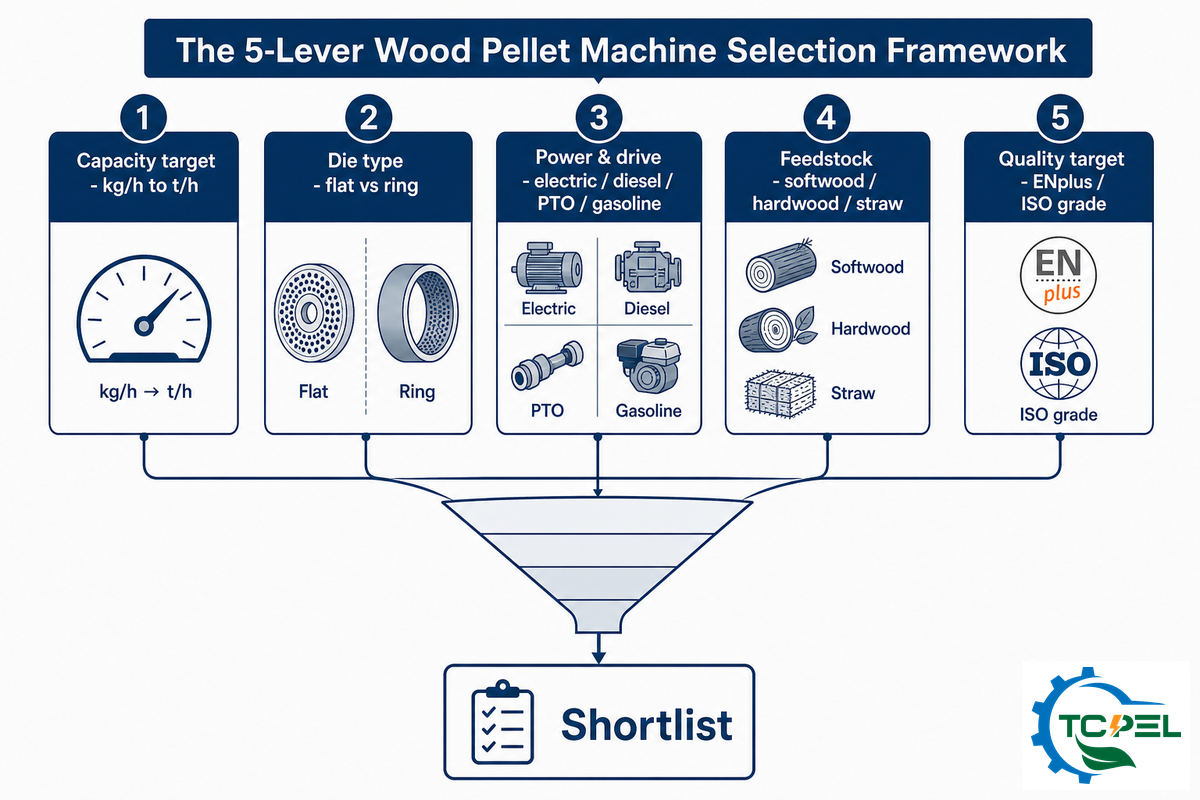
Cut through the sales noise by running your requirement through five levers, in order. Each one narrows the field before you ever compare brands.
The 5-Lever Wood Pellet Machine Selection Framework
- Capacity target, fix your kg/h or t/h first; it decides flat vs ring die.
- Die type, flat die below ~1 t/h, ring die above; match die L/D to feedstock.
- Power and drive, grid-electric, diesel, gasoline, or tractor PTO, based on your site.
- Feedstock, softwood is forgiving; straw and husk need a higher-ratio die and accept more ash.
- Quality target, selling certified fuel means designing the whole line around ENplus and ISO 17225 limits from day one.
Lever three, power and drive — trips up off-grid buyers most often (an electric pellet mill suits grid sites; a diesel engine drive fits remote ones):
| Drive | Best site fit | Caveat |
|---|---|---|
| Electric | Grid sites; most commercial use | ≥7.5 kW often needs 3-phase wiring |
| Diesel | Off-grid, remote operations | Higher fuel + maintenance cost |
| Tractor PTO | Farms with existing tractors | Ties up the tractor; output capped |
| Gasoline | Small, portable home use | Lowest capacity; not for continuous duty |
Finally, map your scenario straight to a machine class:
| Your situation | Recommended class |
|---|---|
| Off-grid farm, own straw/wood waste | PTO or diesel flat-die, 200–500 kg/h |
| Workshop, occasional home heating fuel | Electric flat-die, 50–100 kg/h |
| Sawmill turning residue into a product | Small ring-die line, 0.8–2 t/h |
| Regional fuel producer / exporter | Industrial ring-die line, 5–10+ t/h |
| Mixed feed + fuel operation | Wood-rated ring-die (handles both) |
Pellet Quality Standards: ENplus & ISO 17225
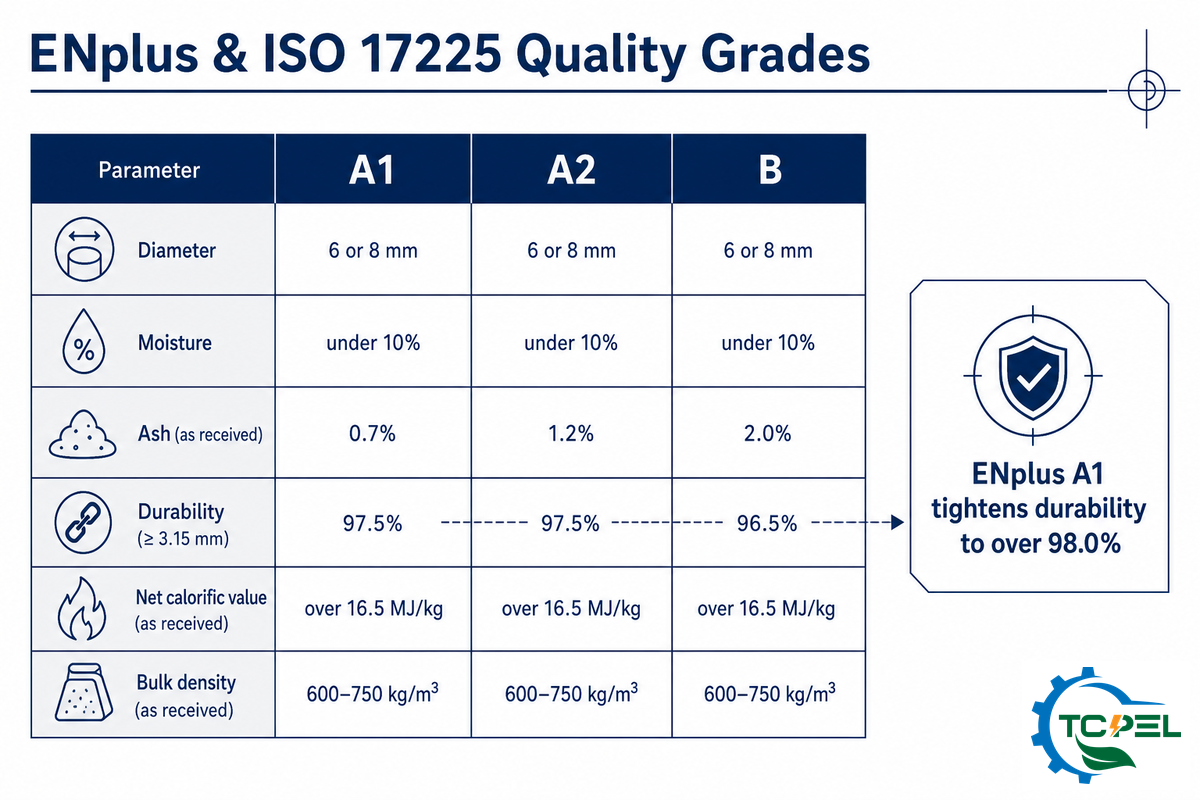
A wood pellet machine is judged by the pellet it produces, and “good” has a precise definition. Graded wood pellets are classified by international standard ISO 17225-2 into three classes, A1, A2, and B. The table below shows the thresholds, drawn from the CAN/CSA-ISO 17225-2 specification published by Natural Resources Canada.
| Property | Grade A1 | Grade A2 | Grade B |
|---|---|---|---|
| Diameter | 6 or 8 mm (±1) | 6 or 8 mm (±1) | 6 or 8 mm (±1) |
| Length | 3.15–40 mm | 3.15–40 mm | 3.15–40 mm |
| Moisture | ≤10% | ≤10% | ≤10% |
| Ash | ≤0.7% | ≤1.2% | ≤2.0% |
| Durability | ≥97,5% | ≥97,5% | ≥96.5% |
| Fines | ≤1% | ≤1% | ≤1% |
| Calorific value (net) | ≥16.5 MJ/kg | ≥16.5 MJ/kg | ≥16.5 MJ/kg |
| Bulk density | 600–750 kg/m³ | 600–750 kg/m³ | 600–750 kg/m³ |
Calorific value shown is the net (lower) heating value as received, the parameter ISO 17225-2 grades on; the gross (higher) heating value runs roughly 18.6 MJ/kg. Durability figures are the ISO base thresholds.
One distinction trips up nearly every buyer, and it is worth getting right: ENplus certification is stricter than the ISO 17225-2 base standard. Where ISO 17225-2 sets A1 durability at ≥97.5%, the ENplus scheme run by the European Pellet Council layers stricter requirements on top of that ISO base — its A1 mechanical-durability bar runs ≥98.0% versus the ISO base’s ≥97.5%, plus supply-chain controls such as on-site ash testing as producers approach the 0.7% limit and a pellet-temperature limit at the loading point. ENplus and ISO are not interchangeable labels; ENplus sits on top of ISO.
“For ENplus A1 the durability requirement is now ≥ 98.0, and for B grade it is ≥ 97.5. The ash limit for A2 grade is now ≤ 1.2 percent.”
For machine buyers, the practical takeaway is this: your die L/D, cooling, and screening stages, not just the pellet machine itself, determine whether output clears these durability and fines limits. If you intend to sell certified fuel, design the whole line around the target grade.
Maintenance & Common Problems
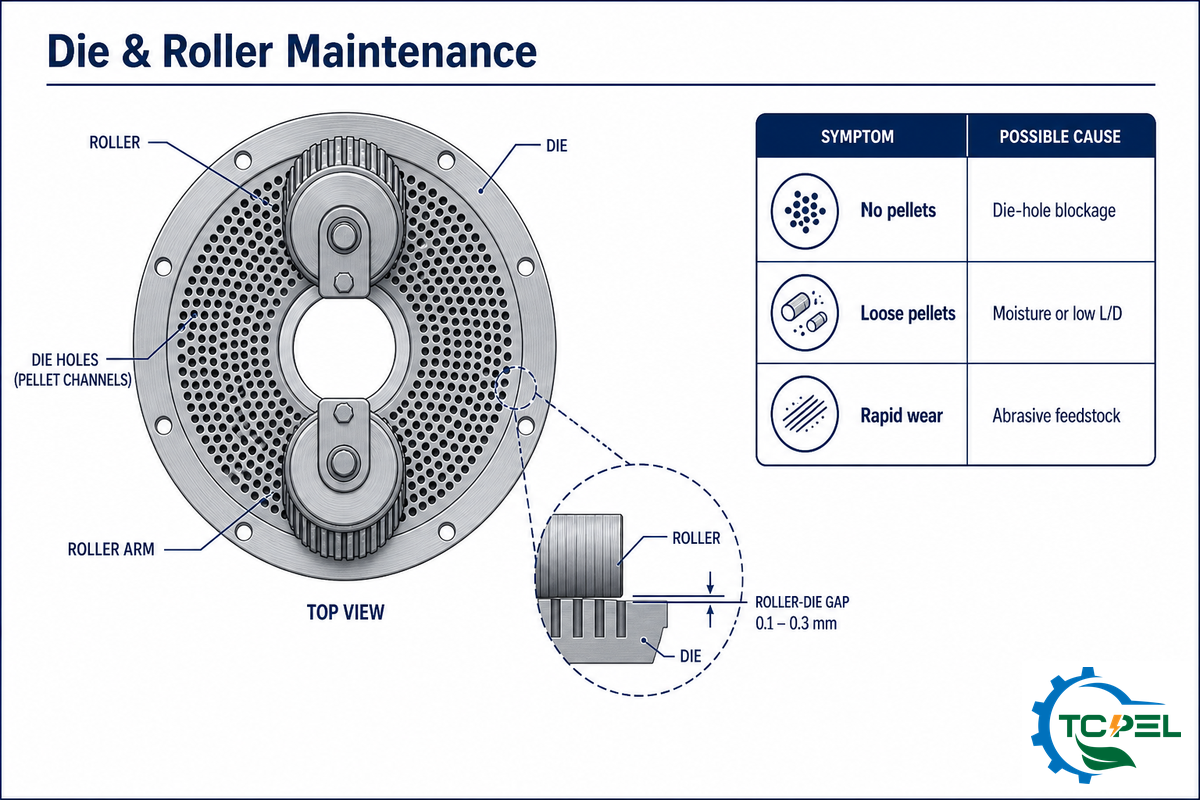
Most “machine faults” are really process faults. When a wood pellet machine stops making good pellets, the cause is usually moisture, die compression ratio, or worn rollers, rarely a broken machine. The diagnostic table below maps the symptoms you’ll actually see to their likely cause and fix. Note that die and roller service life varies widely with feedstock: abrasive materials such as straw and rice husk wear a die far faster than clean softwood, so exact replacement intervals are best tracked on your own line rather than taken from a spec sheet.
| Symptom | Likely cause | Fix |
|---|---|---|
| Material enters, no pellets out | Die-hole blockage / unseasoned die | Season die with oil + grit; clear holes |
| Loose, crumbling pellets | Moisture too high, or low die L/D | Dry to ~12%; fit higher-ratio die |
| Excessive fines / dust | Moisture too low; feedstock too dry | Add moisture to feed; recycle fines |
| Low output vs rating | Oversized feed, worn roller gap | Re-grind finer; reset roller-die gap |
| Die runs too hot | Over-compression / low feed rate | Increase feed; check L/D for feedstock |
| Motor overload / trips | Overfeeding; gap too tight | Reduce feed; loosen roller gap slightly |
| Uneven pellet length | Dull cutter; uneven feed | Adjust/replace cutter; even the feed |
| Rapid die / roller wear | Abrasive feedstock; grit / sand | Pre-clean feed; use hardened die |
| High power draw, normal output | Die channels polished/closing | Re-season or replace die |
Day to day, the roller-die gap is the adjustment that matters most (USPTO patents such as US4770621A describe the eccentric roller-carrier that sets it); too tight overloads the motor, too loose and the rollers skid without pressing. Set it per the manufacturer’s spec (commonly a fraction of a millimetre) and re-check it as the rollers wear.
Industry Outlook: What’s Driving Wood Pellet Demand

For anyone buying a wood pellet machine as an investment, the demand picture matter, and it’s more nuanced than “the market is growing.” Underneath the headlines, a structural shift is underway, from DIY and home pellet-making toward commercial and industrial biomass production. Search interest in “how to make wood pellets” has fallen sharply year over year, while interest in biomass and sawdust pellet machinery has climbed, the market is professionalizing.
Policy is the engine underneath that shift. European renewable-energy mandates pull industrial pellet demand; Forisk estimates global industrial wood pellet demand near 31 million metric tons. On the supply side, the picture is unusual: U.S. Department of Agriculture reporting notes EU pellet production “isn’t keeping up with the growing demand due to limited sustainable supply” — this is a supply-constrained market, not a demand-starved one. In 2025, the U.S. exported 10.09 million metric tons of wood pellets in 2025, worth $1.93 billion (USDA Foreign Agricultural Service data, via Biomass Magazine), with the UK, Japan, and Denmark the top destinations.
But buyers should weigh the downside too. USDA FAS also projects that UK biomass demand will gradually decline as large-scale subsidies fall from April 2027 and policy shifts toward wind and solar, a reminder that pellet demand in mature markets is policy-dependent. And exporters face a new compliance layer: the EU Deforestation Regulation (EUDR) applies to large and medium operators from 30 December 2026 and to micro and small operators from 30 June 2027, adding traceability requirements for wood-derived products entering the EU. For market sizing, analysts place the global wood pellet market near $10–17 billion with mid-to-high single-digit growth forecasts, useful as background, but secondary to the policy and supply signals above.
💡 Buyer takeaway
If you are sizing a line for 2026–2027, specify ENplus-capable cooling and screening now, even at small scale: off-take buyers increasingly require certified durability and ash, and feedstock security — not machine availability — is becoming the real constraint.
Frequently Asked Questions
How much does a wood pellet machine cost?
View Answer
A home flat-die wood pellet machine typically costs $900–2,500. A small-commercial setup runs $3,500–8,000, a commercial ring-die line $15,000–60,000, and a turnkey industrial plant $150,000 and up. Sticker price aside, the figure that decides profitability is the all-in cost per ton — power, die wear, labor, and drying — which favors larger, continuous-duty machines.
Is making your own wood pellets worth it?
View Answer
For most households, no. Once you count electricity, drying, and labor, home pellet production rarely beats buying bagged pellets — unless your feedstock (sawdust, yard waste) is genuinely free and you already own grinding and drying gear. Pellet making turns profitable at commercial scale, where a continuous ring-die line spreads fixed costs across tons of output.
What materials can a wood pellet machine process?
View Answer
Sawdust, wood shavings, chips, and chipped logs are ideal; bamboo, straw, grass, and agricultural residues also work but vary in binding and ash. Whatever the feedstock, it must be dried to 10–15% moisture and ground below the die-hole size (≤5 mm). High-ash materials like rice husk pellet well but produce lower-grade fuel and wear the die faster.
Can a wood pellet machine also make animal feed pellets?
View Answer
Yes — a wood-rated mill can press feed pellets, but pellet mills for feed cannot reliably press wood, because wood needs heavier-duty dies and drives. That is why wood pellet machines cost more. See our animal feed pelletizer guide for the feed-specific details.
Flat die or ring die, which should I buy?
View Answer
Let capacity decide. Below roughly 1 ton per hour — home heating, a small farm, occasional batches — a flat die pellet mill is simpler, cheaper, and easier to operate. Above 1 t/h, or for any continuous, profit-driven operation, a ring die mill is the only sensible choice: its larger die area spreads wear evenly and sustains 24/7 output, which a flat die cannot match without overheating. The two designs make equally good pellets; the difference is durability under sustained load and cost per ton at volume. If you expect to grow, buy for the capacity you’ll need in two years, not today.
What moisture content do wood pellets need?
View Answer
Feed the machine at 10–15% moisture (around 12% is ideal). Finished pellets cool to roughly 6%, under the ISO 17225-2 limit of ≤10%.
Get the Right Wood Pellet Machine for Your Scale
Whether you’re producing fuel for a single farm or exporting by the container, the right machine class and die specification make the difference between firm, certified pellets and a chamber full of dust.
About This Guide
This wood pellet machine guide draws on the ISO 17225-2 and ENplus fuel-quality standards, Natural Resources Canada and USDA Foreign Agricultural Service data, peer-reviewed pelletization research from North Carolina State University, and field reports from pellet-mill operators. It reflects TCPEL’s engineering experience building biomass pellet machines and complete production lines. Reviewed by the TCPEL technical team.
References & Sources
- ISO 17225-2:2021 Solid biofuels, Graded wood pelletsInternational Organization for Standardization
- Solid Biofuels Bulletin No. 4, Graded Wood Pellets (CAN/CSA-ISO 17225-2)Natural Resources Canada
- Recent Developments in Biomass Pelletization, A ReviewNorth Carolina State University (BioResources)
- Review of Die Design and Process Parameters in Biomass PelletingPowder Technology (Elsevier)
- Monthly Densified Biomass Fuel ReportU.S. Energy Information Administration
- USDA: US Wood Pellet Exports Top 10.09 Million Metric Tons in 2025USDA FAS via Biomass Magazine
- ENplus Wood Pellet Certification SchemeEuropean Pellet Council
- Combustible Dust, Wood Dust HazardsU.S. Occupational Safety and Health Administration
- ENplus Update: Navigating New ChangesBiomass Magazine
Related Articles
- Wood Pellet Machines & Production LinesTCPEL’s full machine and turnkey-line range
- Flat Die Pellet Mill: Complete Guide
- Vertical Ring Die Pellet Mill Guide
- Wood Hammer Mill: Grinding for Pellet Production
- Animal Feed Pelletizer Guide