Liên hệ với TCPEL

Hướng dẫn thực tiễn về kỹ thuật và mua hàng, cập nhật tháng Sáu 2026.
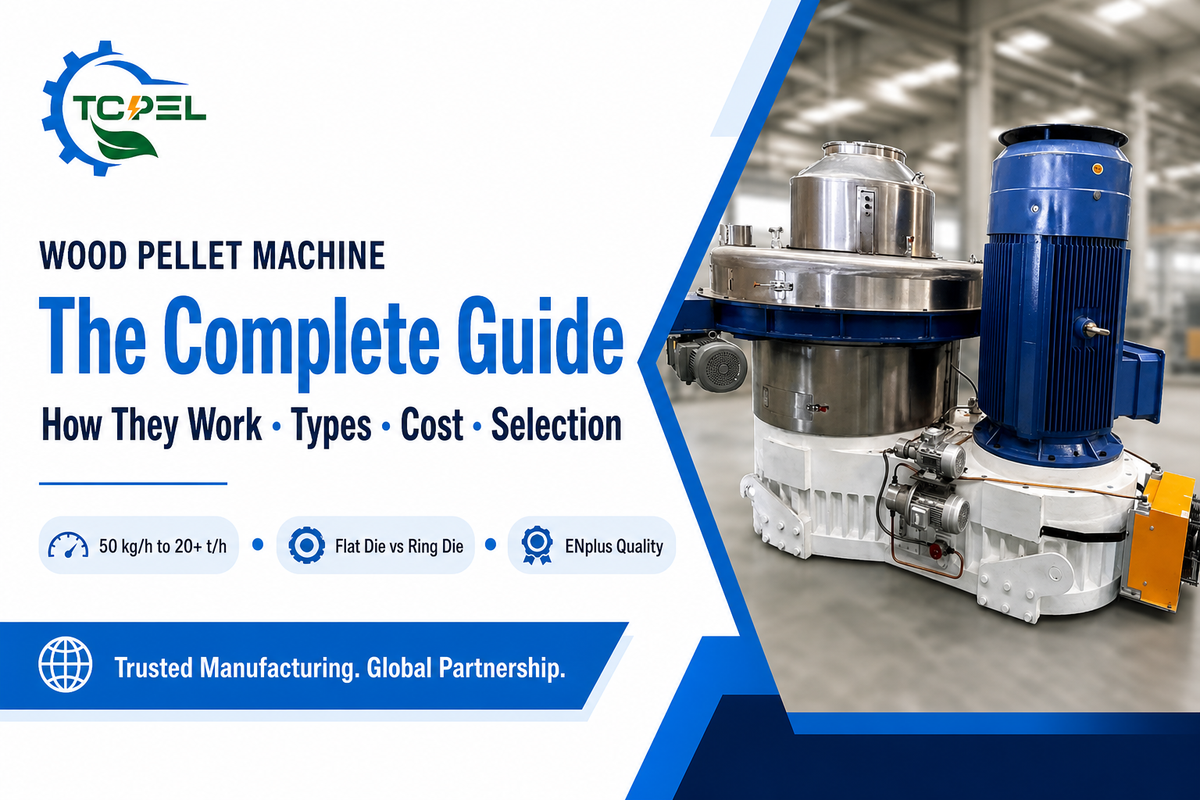
Máy ép viên nén gỗ là thiết bị ép (còn gọi là máy sản xuất viên nén gỗ) dùng để nén mùn cưa, dăm bào gỗ và phế liệu gỗ băm rời thành viên nhiên liệu đặc, đồng đều, nhưng khoảng cách giữa một máy gia đình giá $900 và một dây chuyền công nghiệp 10 tấn mỗi giờ là rất lớn, và phần lớn người mua chọn sai phân khúc. Hướng dẫn này giải thích nguyên lý hoạt động của máy ép viên nén gỗ, sự khác biệt giữa thiết kế khuôn phẳng và khuôn vòng, chi phí và năng suất thực tế, các tiêu chuẩn chất lượng ENplus và ISO 17225 quy định thế nào là viên nén “tốt”, cùng một khung rõ ràng để lựa chọn máy phù hợp với quy mô của quý khách.
Tóm lại: Máy ép viên nén gỗ nén sinh khối đã sấy và nghiền qua khuôn ép bằng thép tôi cứng; ma sát làm nguyên liệu nóng lên khoảng 90–100 °C, khiến lignin tự nhiên trong gỗ mềm ra và kết dính từng viên nén khi nguội, không cần dùng keo. Năng suất dao động từ khoảng 50 kg/h (máy khuôn phẳng gia đình) đến 20+ t/h (dây chuyền khuôn vòng công nghiệp), với độ ẩm nguyên liệu được duy trì ở 10–15%.
Thông số nhanh: Tổng quan về máy ép viên nén gỗ
| Dải năng suất | 50 kg/h (máy khuôn phẳng gia đình) → 20+ t/h (dây chuyền khuôn vòng công nghiệp) |
| Loại khuôn ép | Khuôn phẳng (gia đình/trang trại) · Khuôn vòng (thương mại/công nghiệp) |
| Công suất / bộ truyền động | 3 kW → 250+ kW; điện, diesel, xăng hoặc trục PTO của máy kéo |
| Đường kính viên nén | 6 mm hoặc 8 mm (±1 mm); 6mm là tiêu chuẩn dùng cho sưởi ấm |
| Độ ẩm nguyên liệu | 10–15% (mục tiêu ≈12%) |
| Kích thước hạt nguyên liệu | Nhỏ hơn đường kính lỗ khuôn (thông thường ≤5 mm) |
| Khối lượng riêng của viên nén thành phẩm | Khối lượng riêng đổ đống 600–750 kg/m³ |
Nguyên lý hoạt động của máy ép viên nén gỗ
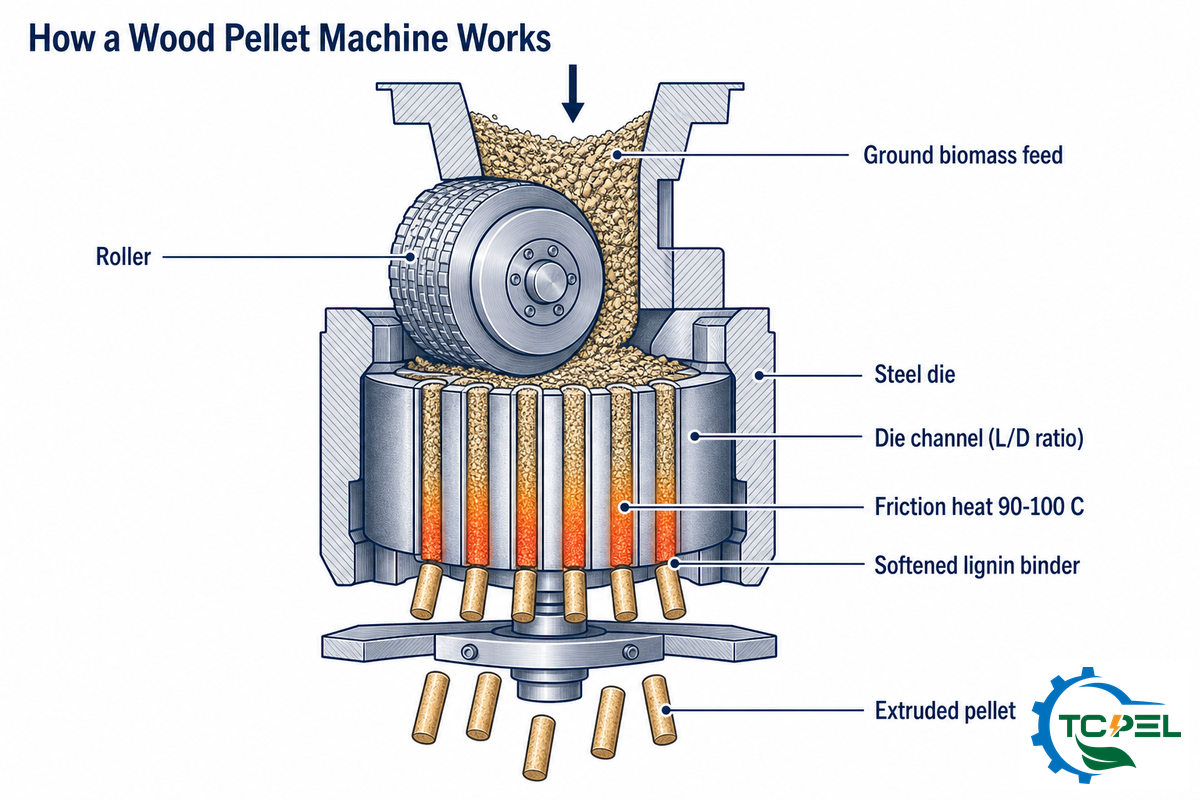
Máy ép viên nén gỗ hoạt động bằng cách sử dụng áp lực cơ học lớn từ các con lăn quay để ép sinh khối đã sấy và nghiền mịn qua các lỗ của khuôn ép dày bằng thép tôi cứng (các bộ phận tiếp xúc thường làm bằng thép không gỉ). Khi nguyên liệu bị ép qua từng kênh khuôn, ma sát làm nhiệt độ tăng lên khoảng 90–100 °C.
Theo một bài tổng quan về ép viên sinh khối của North Carolina State University, nhiệt lượng này đẩy lignin tự nhiên trong gỗ vượt qua điểm chuyển thủy tinh, khiến nó chuyển từ trạng thái thủy tinh sang trạng thái đàn hồi như cao su và chảy bao quanh các sợi, đóng vai trò là chất kết dính có sẵn. Khi viên nén vừa đùn ra nguội đi, lignin cứng trở lại và cố định hình dạng, vì vậy viên nén gỗ được sản xuất đúng cách không cần bổ sung keo.
Hai bộ phận chuyển động thực hiện công việc này: khuôn ép và các con lăn. Các bằng sáng chế máy ép viên do USPTO công bố mô tả cách bố trí tiêu chuẩn: các con lăn phối hợp với khuôn hình trụ hoặc khuôn phẳng để một bộ phận quay trong khi bộ phận còn lại ép nguyên liệu qua các kênh khuôn. Máy thường được chế tạo theo kiểu “D-type” (khuôn quay) hoặc “R-type” (con lăn quay); cả hai đều tạo ra cùng một cơ chế nén.
📐 Lưu ý kỹ thuật — Tỷ số nén của khuôn ép (L/D)
Thông số quan trọng nhất của khuôn ép là tỷ số nén: chiều dài của từng kênh khuôn chia cho đường kính của kênh đó (L/D). L/D cao hơn nén nguyên liệu lâu hơn và tạo ra viên nén đặc, bền hơn, nhưng đòi hỏi công suất lớn hơn và cản trở dòng nguyên liệu. Gỗ mềm (có hàm lượng lignin tự nhiên cao, dễ kết dính) vận hành tốt với tỷ lệ L/D thấp hơn; gỗ cứng có mật độ cao và phụ phẩm nông nghiệp ít lignin cần tỷ lệ cao hơn. Một bài tổng quan đã qua bình duyệt về thiết kế khuôn ép viên và các thông số quy trình xác nhận hình học khuôn là yếu tố chi phối chất lượng viên nén. Việc điều chỉnh L/D của khuôn phù hợp với nguyên liệu đầu vào quyết định quý khách thu được viên nén chắc hay một buồng máy đầy bụi.
Viên nén gỗ được làm từ gì?
Viên nén gỗ gần như hoàn toàn được làm từ sợi gỗ nén, thường là mùn cưa sạch, dăm bào gỗ và dăm gỗ từ xưởng cưa hoặc hoạt động sản xuất sản phẩm gỗ, và trong hầu hết quy trình sản xuất không có phụ gia hóa học. Lignin vốn có trong gỗ là chất kết dính duy nhất cần thiết. Loại cao cấp hơn (dùng trong gia đình) được sản xuất từ phế liệu xưởng cưa có ít vỏ cây; loại thấp hơn có thể chứa vỏ cây hoặc cành lá từ hoạt động chăm sóc cây xanh, làm tăng hàm lượng tro.
Khuôn phẳng và khuôn vòng: Hai cấu trúc máy
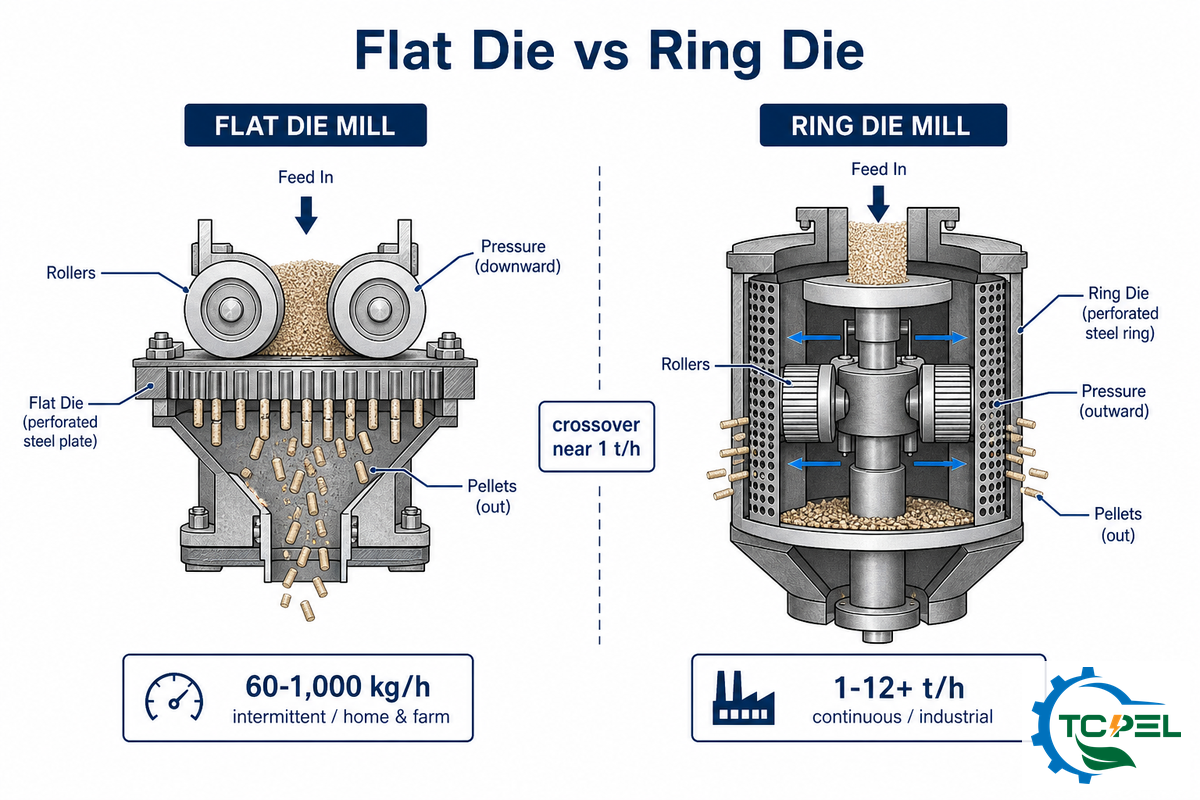
Hầu hết máy ép viên nén gỗ đều sử dụng một trong hai cấu trúc: khuôn phẳng hoặc khuôn vòng. Lựa chọn này không liên quan đến chất lượng, vì cả hai đều có thể ép viên nén chất lượng cao, mà phụ thuộc vào quy mô và chu kỳ vận hành. Máy ép viên khuôn phẳng có kết cấu đơn giản, giá phải chăng và phù hợp với nhu cầu sử dụng gián đoạn tại gia đình hoặc trang trại; máy ép viên khuôn vòng là thiết bị công nghiệp vận hành liên tục, chiếm ưu thế ở mức năng suất trên khoảng 1 tấn mỗi giờ.
| Thuộc tính | Máy ép viên khuôn phẳng | Máy ép viên khuôn vòng | Máy ép viên khuôn vòng trục đứng |
|---|---|---|---|
| Năng suất điển hình | 60–1.000 kg/h | 1–12+ t/h | 0,5–3 t/h |
| Chu kỳ vận hành | Gián đoạn / theo mẻ | Liên tục 24/7 | Liên tục |
| Bố trí bộ truyền động | Một động cơ, hộp giảm tốc đơn giản | Bộ truyền động mô-men xoắn cao, bánh răng/dây đai | Cấp liệu thẳng đứng bằng trọng lực |
| Dạng mòn của khuôn ép | Không đều (diện tích khuôn nhỏ hơn) | Đồng đều, tuổi thọ dài hơn | Đồng đều; dễ cấp nguyên liệu dạng sợi |
| Giá tham khảo | ~$530–8,000 | ~$15,000–150,000+ | ~$10,000–60,000 |
| Phù hợp nhất với | Sưởi ấm gia đình, trang trại nhỏ | Nhà sản xuất nhiên liệu thương mại, nhà xuất khẩu | Rơm, cỏ, sinh khối dạng sợi |
Các khoảng năng suất và giá chỉ mang tính tham khảo và thay đổi đáng kể tùy theo nhà sản xuất, công suất động cơ và thông số khuôn ép; hãy xem đây là các khoảng dùng để lập kế hoạch, không phải giá trị cố định.
Tại sao khuôn vòng chiếm ưu thế trên khoảng 1 t/h? Khuôn tròn có diện tích lỗ mở lớn hơn nhiều, giúp phân bổ độ mòn đồng đều và duy trì năng suất trong các ca liên tục, trong khi bề mặt làm việc nhỏ hơn của khuôn phẳng bị mòn không đều và quá nhiệt khi chịu tải không ngừng. Để xem phân tích chuyên sâu, đối chiếu trực tiếp hai thiết kế, hãy đọc hướng dẫn của chúng tôi về máy ép viên khuôn phẳng và máy ép viên khuôn vòng trục đứng.
Các phân khúc năng suất: Dây chuyền gia đình, thương mại nhỏ và công nghiệp
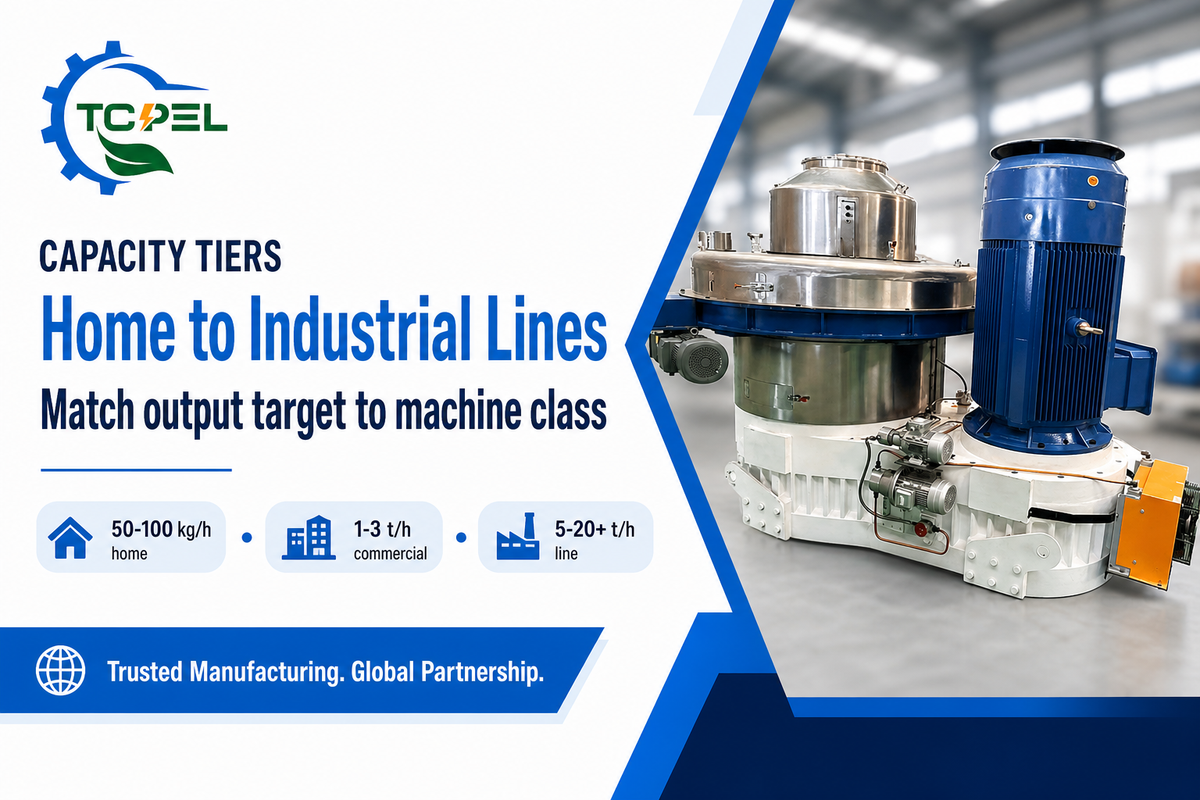
Việc tính chọn máy ép viên nén gỗ bắt đầu từ một con số: năng suất đầu ra mục tiêu tính bằng kilôgam hoặc tấn mỗi giờ. Chọn máy quá nhỏ sẽ khiến máy nhanh hỏng vì phải vận hành quá sức để chạy theo sản lượng; chọn máy quá lớn sẽ khiến vốn đầu tư nằm nhàn rỗi. Một máy ép viên nén gỗ nhỏ dùng trong gia đình có thể chỉ cần 50 kg/h, trong khi doanh nghiệp tìm mua máy ép viên nén gỗ công nghiệp sẽ tính toán theo đơn vị tấn mỗi giờ. Máy móc công nghiệp vận hành liên tục, còn thiết bị gia đình nhỏ gọn vẫn đạt hiệu quả ở sản lượng thấp; năng suất viên nén lớn cần cả dây chuyền chứ không phải một máy riêng lẻ. Hoạt động sản xuất cũng được chia thành hai loại: một máy ép viên riêng lẻ hoặc một dây chuyền sản xuất hoàn chỉnh, trong đó máy ép viên chỉ là một công đoạn trong nhiều công đoạn.
| Phân khúc | Năng suất đầu ra | Công suất | Máy riêng lẻ hay dây chuyền | Người mua điển hình |
|---|---|---|---|---|
| Gia đình | 50–100 kg/h | 3–7,5 kW | Một máy khuôn phẳng | Hộ gia đình sưởi ấm bằng viên nén |
| Thương mại nhỏ | 300–800 kg/h | 15–37 kW | Máy nghiền + máy sấy + máy ép viên | Trang trại, xưởng cưa tận dụng phế liệu của mình |
| Thương mại | 1–3 t/h | 75–160 kW | Dây chuyền khuôn vòng hoàn chỉnh | Nhà sản xuất viên nhiên liệu trong khu vực |
| Công nghiệp | 5–20+ t/h | 250+ kW (nhiều máy ép viên) | Nhà máy trọn gói, sẵn sàng vận hành với nhiều máy ép viên | Nhà xuất khẩu, đơn vị điện lực |
Hầu hết người mua lần đầu đánh giá thấp bước chuyển từ “máy” sang “dây chuyền.” Trên khoảng 300 kg/h, quý khách hiếm khi chỉ mua một máy ép viên; quý khách cần máy băm dăm gỗ hoặc máy nghiền búa gỗ để nghiền, máy sấy, máy ép viên, máy làm nguội viên nén và máy đóng bao, tất cả phải đồng bộ về năng suất xử lý. Người mua ở quy mô công nghiệp nên bắt đầu với danh mục máy ép viên nén gỗ và dây chuyền sản xuất hoàn chỉnh thay vì một thiết bị độc lập. Đồng thời, hãy thận trọng với một quan niệm bán hàng sai lầm phổ biến: động cơ lớn hơn không đồng nghĩa với năng suất cao hơn; công suất phải phù hợp với diện tích khuôn, nếu không quý khách chỉ khiến khuôn thiếu nguyên liệu hoặc bị cháy.
Nguyên liệu và công tác chuẩn bị nguyên liệu đầu vào
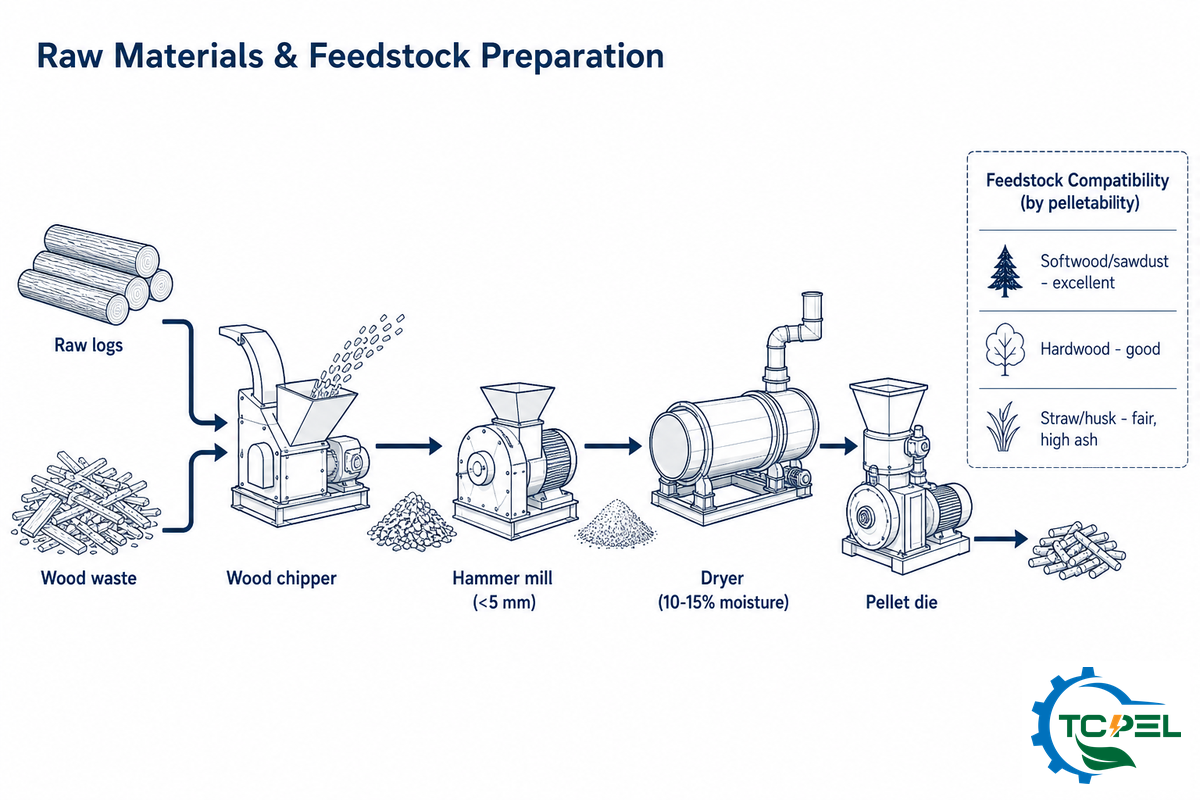
Hiệu quả của máy ép viên nén gỗ phụ thuộc vào nguyên liệu được đưa vào máy. Hai thông số chi phối mọi yếu tố là độ ẩm và kích thước hạt. Nguyên liệu đầu vào phải được sấy đến độ ẩm 10–15% (khoảng 12% là mức tối ưu) và nghiền nhỏ hơn đường kính lỗ khuôn, thường là 5 mm hoặc mịn hơn. Kích thước hạt và thành phần hóa học của nguyên liệu đầu vào quyết định khả năng kết dính của một mẻ sản xuất, mối quan hệ này được trình bày chi tiết trong bài tổng quan về ép viên sinh khối của NC State. Một người tự sản xuất tại nhà đã chia sẻ trên Reddit rằng máy ép viên “rất nhạy cảm với độ ẩm. Quá ướt thì viên nén nhão và vỡ vụn. Quá khô thì không thể tạo thành viên nén.” Chỉ riêng thông số này gây ra nhiều mẻ thất bại hơn bất kỳ lỗi máy nào. Ngoài mùn cưa sạch, thân và lõi ngô, phế liệu sân vườn cùng các loại phụ phẩm giàu carbon khác có đặc tính ép viên khác nhau — nguyên liệu càng bẩn càng làm khuôn mòn nhanh.
Một quan niệm sai lầm phổ biến đã được dữ liệu năng lượng của Hoa Kỳ chỉ ra cần được đính chính: gỗ khúc và gỗ tròn là nguyên liệu hợp lệ để sản xuất viên nén, nhưng không thể đưa nguyên cả khúc gỗ trực tiếp vào khuôn ép. Trước tiên, gỗ phải được băm thành dăm rồi nghiền bằng máy nghiền búa đến kích thước yêu cầu; sự khác biệt giữa nguyên liệu ban đầu và nguyên liệu trực tiếp đưa vào máy này thường khiến người mới nhầm lẫn.
| Nguyên liệu đầu vào | Khả năng ép viên | Tiền xử lý | Xu hướng tạo tro |
|---|---|---|---|
| Gỗ thông / gỗ vân sam (gỗ mềm) | Rất tốt (hàm lượng lignin cao) | Nghiền, sấy đến ~12% | Thấp (≤0,7%) |
| Gỗ sồi / gỗ dẻ gai (gỗ cứng) | Tốt (cần L/D cao hơn) | Băm dăm, nghiền, sấy | Thấp–trung bình |
| Mùn cưa (phế liệu xưởng cưa) | Rất tốt (kích thước đã phù hợp) | Chỉ cần sấy; thường không cần nghiền | Thấp |
| Dăm bào gỗ | Rất tốt | Nghiền nhẹ, sấy | Thấp |
| Tre | Tốt (cứng, có tính mài mòn) | Đập, nghiền, sấy | Trung bình |
| Rơm lúa mì / lúa mạch | Khá (ít lignin) | Nghiền mịn, sấy; L/D cao | Cao (5–8%) |
| Trấu | Khá (tính mài mòn rất cao) | Nghiền, sấy | Rất cao (15–20%) |
| Cỏ / lá cây | Khá (khả năng kết dính thay đổi) | Nghiền, sấy cẩn thận | Trung bình–cao |
| Phụ phẩm nông nghiệp / EFB | Thay đổi | Làm sạch, nghiền, sấy | Cao |
Các mức tro phản ánh khoảng điển hình; phế liệu gỗ mềm sạch từ xưởng cưa là tiêu chuẩn tham chiếu cho viên nhiên liệu ít tro. Các giới hạn tro theo cấp được quy định trong ISO 17225-2 (xem phần chất lượng).
📐 Lưu ý kỹ thuật — Mục tiêu độ ẩm 12%
Hãy đặt mục tiêu độ ẩm nguyên liệu ở khoảng 12%. Trên 15%, hơi nước hình thành trong khuôn khiến viên nén đi ra bị mềm và vỡ vụn; dưới khoảng 8%, các sợi không thể liên kết, tạo ra hạt vụn mịn và làm khuôn bị trượt. Bản thân quá trình ép viên tiếp tục làm giảm độ ẩm; viên nén thành phẩm nguội xuống với độ ẩm khoảng 6%, thấp hơn đáng kể so với giới hạn ≤10% của ISO 17225-2.
Cách sản xuất viên nén gỗ: Quy trình sản xuất
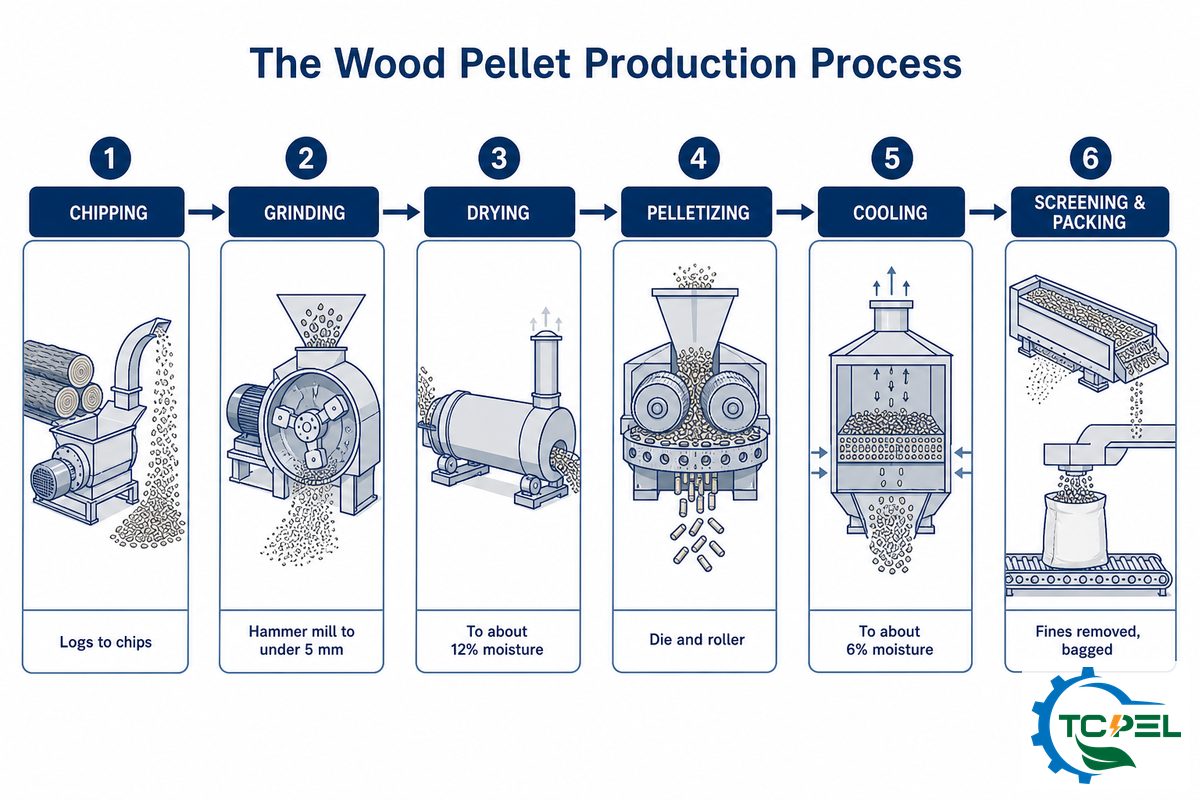
Quy trình sản xuất viên nén gỗ ở mọi quy mô đều theo cùng một trình tự; máy sản xuất viên nén chỉ là một công đoạn, còn dây chuyền thương mại sẽ tự động hóa và tạo vùng đệm cho từng bước. Dưới đây là toàn bộ quy trình từ gỗ nguyên liệu đến nhiên liệu đã đóng bao:
- Băm dăm / đập thô giúp biến gỗ khúc, đầu mẩu và phế liệu cồng kềnh thành dăm gỗ. Máy băm dăm gỗ thường tạo ra các mảnh dày vài milimét và dài 10–30 mm.
- Nghiền bằng máy nghiền búa (vận hành ở 3.000–8.000 RPM, sử dụng sàng từ 1mm đến 10mm) giúp giảm kích thước dăm gỗ xuống dưới kích thước lỗ khuôn, ≤5 mm.
- Sấy bằng máy sấy thùng quay hoặc máy sấy nhanh giúp hạ độ ẩm xuống 10–15%.
- Điều hòa phối liệu — nguyên liệu đã nghiền và sấy được cấp từ phễu nạp vào máy ép viên để sản xuất viên nén.
- Ép viên bằng các con lăn ép sinh khối qua khuôn; nhiệt ma sát làm mềm lignin và tạo thành viên nén.
- Làm mát bằng không khí giúp viên nén nóng, mềm cứng lại và hạ độ ẩm xuống ~6%.
- Sàng và đóng bao giúp loại bỏ rồi tái chế hạt vụn mịn; viên nén thành phẩm được đóng bao để lưu kho.
⚠️ Quan trọng — Bụi gỗ là mối nguy bụi cháy
Quá trình nghiền và ép viên tạo ra bụi gỗ mịn. Cơ quan Quản lý An toàn và Sức khỏe Nghề nghiệp Hoa Kỳ (OSHA) phân loại bột gỗ là bụi cháy có khả năng gây cháy bùng và nổ khi lơ lửng trong không khí. Mọi hoạt động sản xuất viên nén trên quy mô sở thích cá nhân đều phải có phương án thu gom bụi, kiểm soát nguồn gây cháy, vệ sinh định kỳ và bố trí hệ thống thoát áp phù hợp; đây là những biện pháp kiểm soát mà các hướng dẫn mua hàng của đối thủ thường bỏ qua nhưng các công ty bảo hiểm và thanh tra viên thì không.
Có thể sản xuất viên nén gỗ trực tiếp từ gỗ khúc không?
Không, không thể trực tiếp. Quý khách không thể đưa nguyên cả khúc gỗ vào máy ép viên nén gỗ. Gỗ khúc hoàn toàn có thể dùng làm nguyên liệu, nhưng trước tiên phải được băm thành dăm rồi nghiền bằng máy nghiền búa đến kích thước hạt nhỏ; khuôn ép chỉ tiếp nhận nguyên liệu nhỏ hơn đường kính lỗ khuôn. Bỏ qua công đoạn nghiền là sai lầm phổ biến nhất của người mới.
Chi phí máy ép viên nén gỗ (và ROI thực tế)
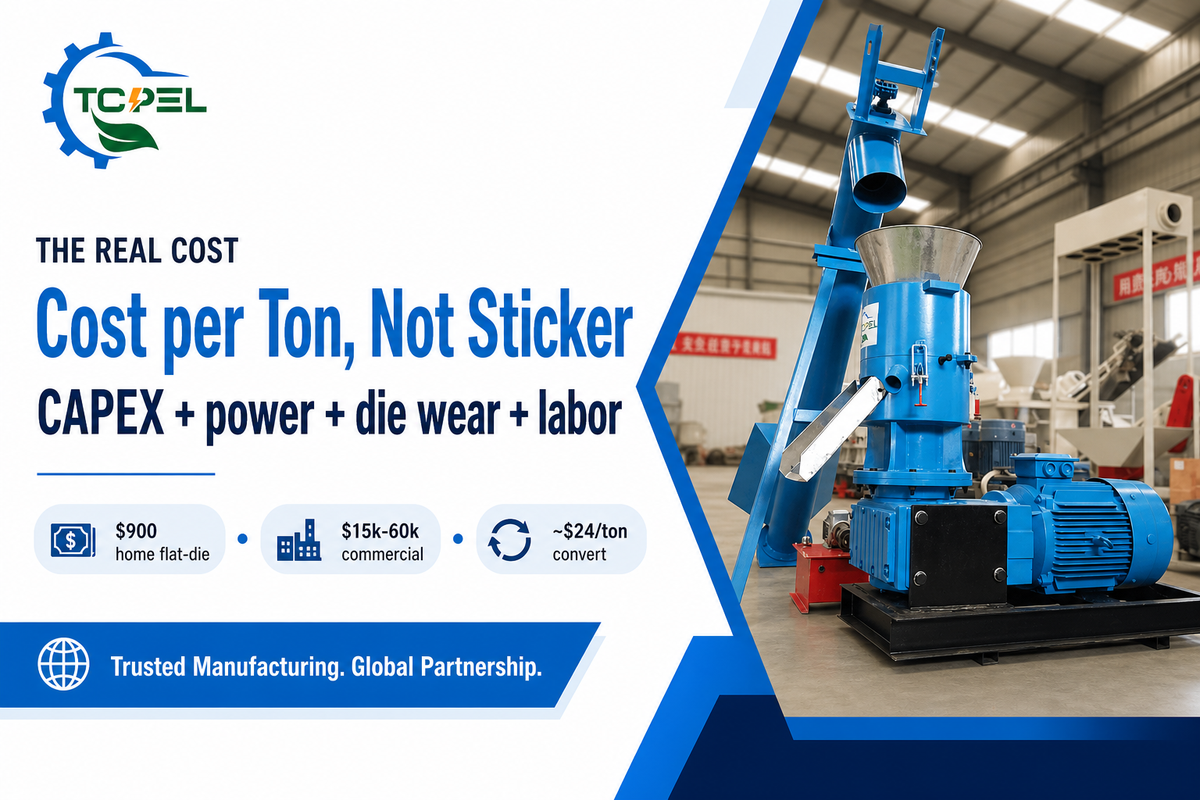
Giá máy ép viên nén gỗ được quảng cáo là phần dễ tính; chi phí quyết định khả năng sinh lời là tổng chi phí trên mỗi tấn thành phẩm. Một máy khuôn phẳng gia đình có giá khoảng $900–2.500; hệ thống thương mại nhỏ có giá $3.500–8.000; dây chuyền khuôn vòng thương mại có giá $15.000–60.000; còn nhà máy công nghiệp trọn gói, sẵn sàng vận hành có giá từ $150.000 trở lên. Tuy nhiên, đó là các con số về vốn đầu tư. Bài toán chi phí vận hành mới là yếu tố phân biệt một dây chuyền sinh lời với một thú vui tốn kém.
| Hạng mục chi phí | Máy khuôn phẳng gia đình | Thương mại nhỏ | Dây chuyền khuôn vòng thương mại |
|---|---|---|---|
| CAPEX của máy / dây chuyền | $900–2,500 | $3,500–8,000 | $15,000–60,000 |
| Năng suất xử lý | 50–100 kg/h | 300–800 kg/h | 1–3 t/h |
| Điện năng ép viên | ~90 kWh/ton | ~80 kWh/ton | ~75 kWh/ton |
| Chi phí điện (≈$0.12/kWh) | ~$11/ton | ~$10/ton | ~$9/ton |
| Độ mòn khuôn ép và con lăn | ~$8/ton | ~$6/ton | ~$5/ton |
| Nhân công | Thời gian của chủ sở hữu | ~$12/ton | ~$10/ton |
| Năng lượng sấy | Thay đổi (thường phơi nắng/thông gió) | $8–20/ton | $8–20/ton |
| Tổng chi phí chế biến (không gồm nguyên liệu đầu vào) | Cao trên mỗi tấn | ~$40–50/ton | ~$30–45/ton |
| Thời gian hoàn vốn thực tế | Chỉ hoàn vốn so với mua viên nén đóng bao | 2–4 năm | 1,5–3 năm khi khai thác hết công suất |
Chi phí chế biến là ước tính định hướng của ngành; chi phí nguyên liệu đầu vào (từ mùn cưa miễn phí đến $40+/ton) và giá điện tại địa phương chi phối con số cuối cùng. Phân tích học thuật về chuỗi cung ứng ước tính tổng chi phí sản xuất tại nhà máy lớn vào khoảng €136–143/ton.
Dưới đây là ví dụ tính toán cho một dây chuyền khuôn vòng thương mại có năng suất 1 t/h. Với mức tiêu thụ khoảng 75 kWh mỗi tấn và giá điện $0.12/kWh, chi phí điện cho công đoạn ép viên vào khoảng $9/tấn; cộng thêm khoảng ~$5/tấn cho hao mòn khuôn ép và con lăn cùng khoảng ~$10/tấn tiền nhân công, tổng chi phí chế biến sẽ vào khoảng $24/tấn, chưa tính nguyên liệu đầu vào và công đoạn sấy. Để tham khảo, U.S. Energy Information Administration báo cáo rằng doanh số sinh khối nén đặc nội địa Hoa Kỳ (gồm tất cả các loại sản phẩm, kết hợp cả bán lẻ và bán buôn) đạt trung bình khoảng $238/tấn vào tháng Ba 2026. Khoảng chênh lệch giữa chi phí chế biến và giá bán là có thật, và đó chính là lý do quy mô có vai trò quan trọng.
Và đây là sự thật trái chiều mà hầu hết nhà cung cấp không công bố: tự sản xuất viên nén gỗ hiếm khi giúp một hộ gia đình tiết kiệm tiền. Khi tính cả điện, sấy và thời gian lao động của chính mình, sản xuất tại nhà hiếm khi rẻ hơn mua viên nén đóng bao, trừ khi nguyên liệu đầu vào thực sự miễn phí. Một thành viên lâu năm trên diễn đàn Hearth.com đã tóm tắt rằng mua máy ép viên để dùng cá nhân thì không sao, nhưng “mua máy ép viên để bán viên nén thì KHÔNG, trừ khi quý khách có vài trăm nghìn đô la để mua đúng thiết bị.” Sản xuất viên nén là ngành kinh tế theo quy mô, không phải mẹo tiết kiệm tại nhà.
Cách lựa chọn: Khung lựa chọn theo 5 yếu tố
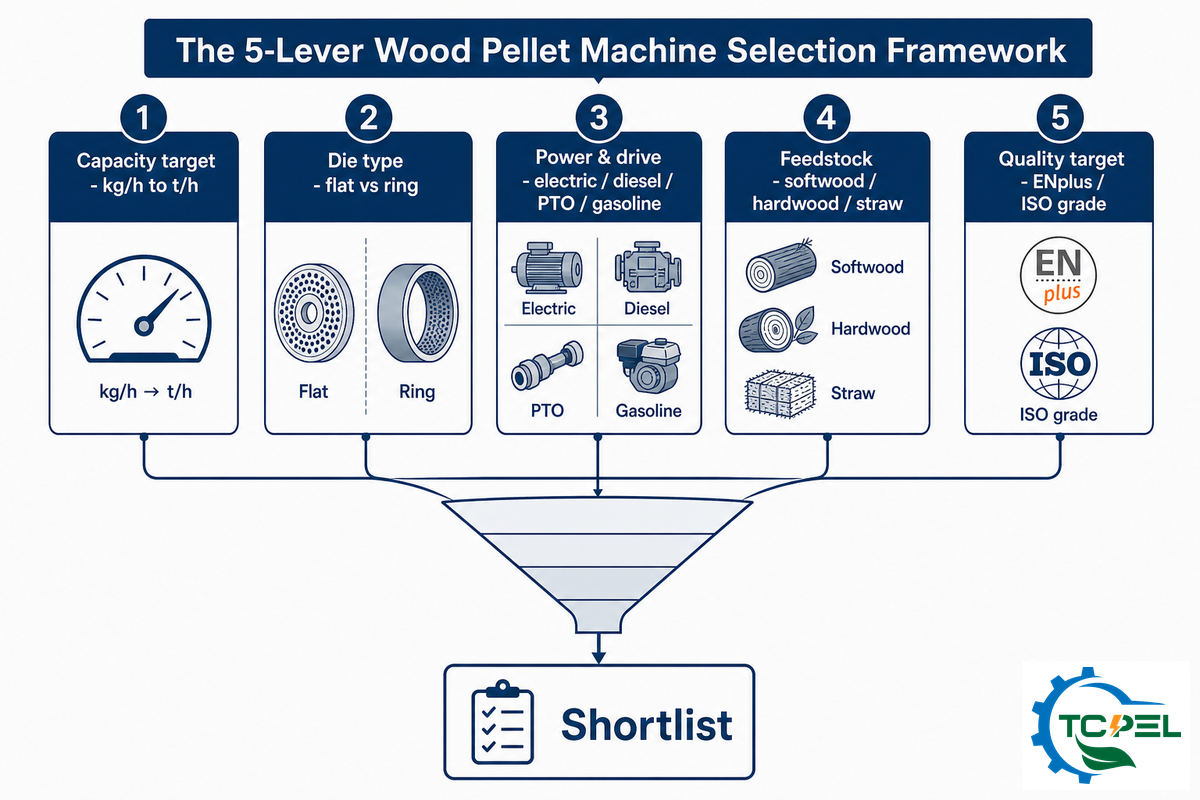
Hãy loại bỏ nhiễu từ thông tin bán hàng bằng cách lần lượt đánh giá yêu cầu của quý khách theo năm yếu tố. Mỗi yếu tố sẽ thu hẹp phạm vi lựa chọn trước cả khi quý khách so sánh các thương hiệu.
Khung lựa chọn máy ép viên nén gỗ theo 5 yếu tố
- Mục tiêu năng suất, trước tiên hãy xác định kg/h hoặc t/h; thông số này quyết định chọn khuôn phẳng hay khuôn vòng.
- Loại khuôn ép, chọn khuôn phẳng dưới ~1 t/h và khuôn vòng ở mức cao hơn; điều chỉnh L/D của khuôn phù hợp với nguyên liệu đầu vào.
- Nguồn công suất và bộ truyền động, chọn điện lưới, diesel, xăng hoặc trục PTO của máy kéo dựa trên điều kiện tại cơ sở.
- Nguyên liệu đầu vào, gỗ mềm dễ xử lý; rơm và vỏ trấu cần khuôn có tỷ số nén cao hơn và phải chấp nhận lượng tro lớn hơn.
- Mục tiêu chất lượng, nếu bán nhiên liệu được chứng nhận thì phải thiết kế toàn bộ dây chuyền theo các giới hạn của ENplus và ISO 17225 ngay từ đầu.
Yếu tố thứ ba, nguồn công suất và bộ truyền động — thường gây khó khăn nhất cho người mua ở nơi không có điện lưới (máy ép viên chạy điện phù hợp với địa điểm có điện lưới; bộ truyền động bằng động cơ diesel phù hợp với địa điểm xa xôi):
| Bộ truyền động | Địa điểm phù hợp nhất | Lưu ý |
|---|---|---|
| Điện | Địa điểm có điện lưới; lựa chọn phổ biến nhất cho mục đích thương mại | ≥7,5 kW thường cần hệ thống điện 3 pha |
| Diesel | Hoạt động ở nơi xa xôi, không có điện lưới | Chi phí nhiên liệu + bảo trì cao hơn |
| Trục PTO của máy kéo | Trang trại đã có máy kéo | Chiếm dụng máy kéo; năng suất đầu ra bị giới hạn |
| Xăng | Sử dụng nhỏ lẻ, cơ động tại gia đình | Năng suất thấp nhất; không phù hợp để vận hành liên tục |
Cuối cùng, hãy đối chiếu trực tiếp tình huống của quý khách với phân khúc máy:
| Tình huống của quý khách | Phân khúc đề xuất |
|---|---|
| Trang trại không có điện lưới, có sẵn rơm/phế liệu gỗ | Máy khuôn phẳng dùng trục PTO hoặc diesel, 200–500 kg/h |
| Xưởng sản xuất, thỉnh thoảng cần nhiên liệu sưởi ấm gia đình | Máy khuôn phẳng chạy điện, 50–100 kg/h |
| Xưởng cưa muốn biến phế liệu thành sản phẩm | Dây chuyền khuôn vòng nhỏ, 0,8–2 t/h |
| Nhà sản xuất / xuất khẩu nhiên liệu trong khu vực | Dây chuyền khuôn vòng công nghiệp, 5–10+ t/h |
| Cơ sở kết hợp sản xuất thức ăn chăn nuôi + nhiên liệu | Máy khuôn vòng dùng được cho gỗ (xử lý được cả hai) |
Tiêu chuẩn chất lượng viên nén: ENplus và ISO 17225
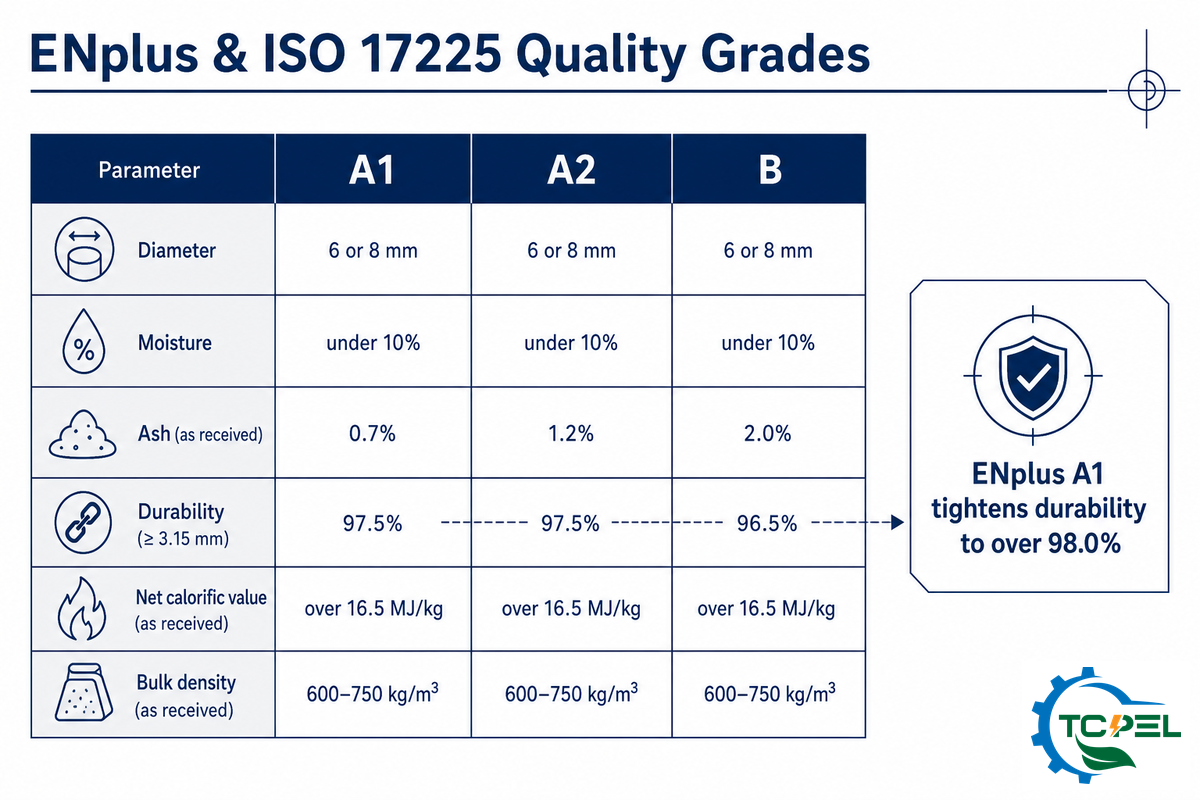
Máy ép viên nén gỗ được đánh giá qua viên nén mà máy tạo ra, và “tốt” có một định nghĩa chính xác. Viên nén gỗ phân cấp được tiêu chuẩn quốc tế ISO 17225-2 chia thành ba cấp: A1, A2 và B. Bảng dưới đây trình bày các ngưỡng lấy từ quy cách CAN/CSA-ISO 17225-2 do Natural Resources Canada công bố.
| Đặc tính | Cấp A1 | Cấp A2 | Cấp B |
|---|---|---|---|
| Đường kính | 6 hoặc 8 mm (±1) | 6 hoặc 8 mm (±1) | 6 hoặc 8 mm (±1) |
| Chiều dài | 3,15–40 mm | 3,15–40 mm | 3,15–40 mm |
| Độ ẩm | ≤10% | ≤10% | ≤10% |
| Tro | ≤0.7% | ≤1.2% | ≤2.0% |
| Độ bền viên nén | ≥97,5% | ≥97,5% | ≥96.5% |
| Hạt vụn mịn | ≤1% | ≤1% | ≤1% |
| Nhiệt trị (thực) | ≥16,5 MJ/kg | ≥16,5 MJ/kg | ≥16,5 MJ/kg |
| Khối lượng riêng đổ đống | 600–750 kg/m³ | 600–750 kg/m³ | 600–750 kg/m³ |
Nhiệt trị được nêu là nhiệt trị thực (thấp) ở trạng thái tiếp nhận, thông số được ISO 17225-2 sử dụng để phân cấp; nhiệt trị toàn phần (cao) vào khoảng 18,6 MJ/kg. Các chỉ số độ bền viên nén là ngưỡng cơ sở của ISO.
Một điểm khác biệt khiến gần như mọi người mua nhầm lẫn và cần được hiểu đúng là: chứng nhận ENplus nghiêm ngặt hơn tiêu chuẩn cơ sở ISO 17225-2. Trong khi ISO 17225-2 quy định độ bền viên nén cấp A1 ở mức ≥97,5%, chương trình ENplus do European Pellet Council quản lý bổ sung các yêu cầu nghiêm ngặt hơn trên nền tảng ISO đó — ngưỡng độ bền cơ học A1 của chương trình là ≥98,0% so với ngưỡng cơ sở ≥97,5% của ISO, cùng các biện pháp kiểm soát chuỗi cung ứng như kiểm tra tro tại cơ sở khi nhà sản xuất tiến gần giới hạn 0,7% và giới hạn nhiệt độ viên nén tại điểm xếp hàng. ENplus và ISO không phải là các nhãn có thể dùng thay thế cho nhau; ENplus được xây dựng trên nền tảng ISO.
“Đối với ENplus A1, yêu cầu về độ bền hiện là ≥ 98.0, còn đối với cấp B là ≥ 97.5. Giới hạn tro đối với cấp A2 hiện là ≤ 1.2 phần trăm.”
Đối với người mua máy, kết luận thực tế là: L/D của khuôn, các công đoạn làm mát và sàng, chứ không chỉ riêng máy ép viên, quyết định năng suất đầu ra có đáp ứng các giới hạn về độ bền viên nén và hạt vụn mịn này hay không. Nếu quý khách dự định bán nhiên liệu được chứng nhận, hãy thiết kế toàn bộ dây chuyền theo cấp chất lượng mục tiêu.
Bảo trì và các sự cố thường gặp
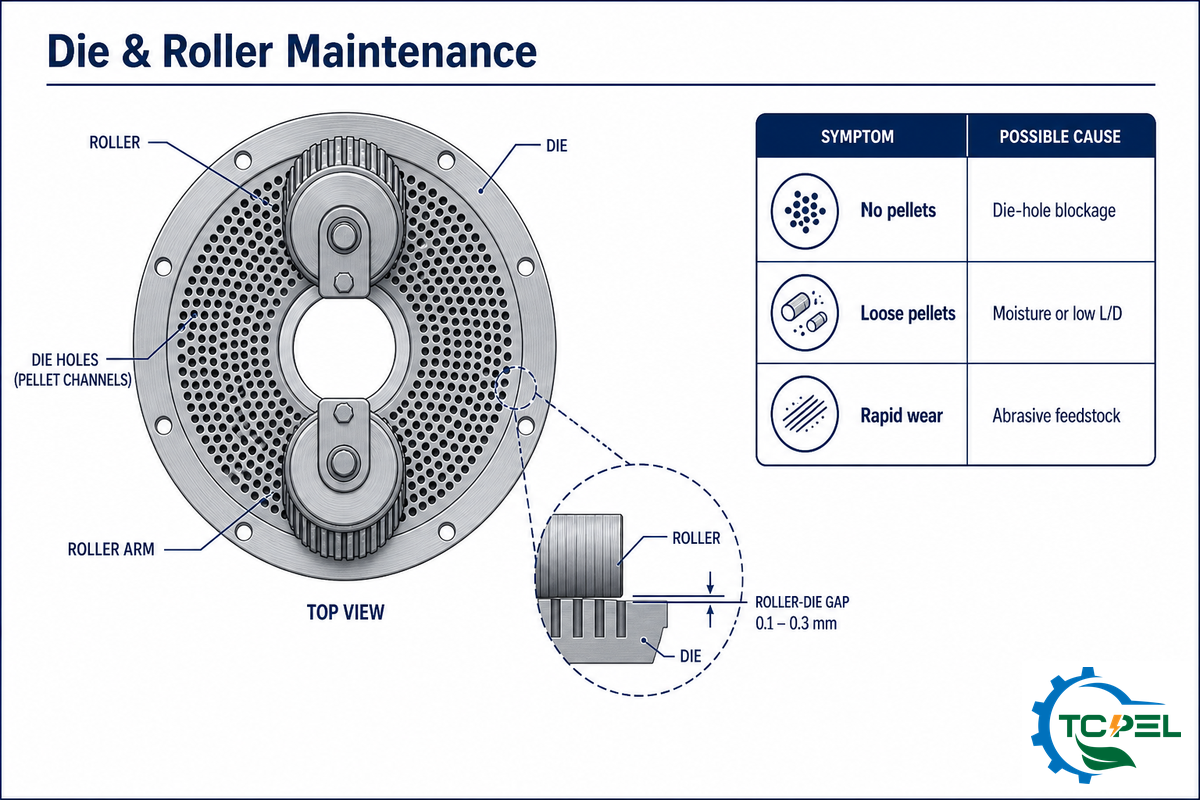
Hầu hết “lỗi máy” thực chất là lỗi quy trình. Khi máy ép viên nén gỗ không còn tạo ra viên nén đạt chất lượng, nguyên nhân thường là độ ẩm, tỷ số nén của khuôn ép hoặc con lăn bị mòn, hiếm khi do máy hỏng. Bảng chẩn đoán dưới đây đối chiếu các triệu chứng thực tế với nguyên nhân có thể xảy ra và cách khắc phục. Lưu ý rằng tuổi thọ của khuôn ép và con lăn thay đổi đáng kể theo nguyên liệu đầu vào: các vật liệu có tính mài mòn như rơm và trấu làm khuôn ép mòn nhanh hơn nhiều so với gỗ mềm sạch, vì vậy nên theo dõi chu kỳ thay thế thực tế trên dây chuyền của quý khách thay vì dựa vào bảng thông số kỹ thuật.
| Triệu chứng | Nguyên nhân có thể xảy ra | Cách khắc phục |
|---|---|---|
| Nguyên liệu đi vào nhưng không có viên nén đi ra | Lỗ khuôn bị tắc / khuôn ép chưa được chạy rà | Chạy rà khuôn ép bằng dầu + hạt mài; thông sạch các lỗ |
| Viên nén rời, dễ vỡ vụn | Độ ẩm quá cao hoặc tỷ lệ L/D của khuôn ép quá thấp | Sấy xuống ~12%; lắp khuôn ép có tỷ lệ cao hơn |
| Quá nhiều hạt vụn mịn / bụi | Độ ẩm quá thấp; nguyên liệu đầu vào quá khô | Bổ sung độ ẩm cho nguyên liệu; tái sử dụng hạt vụn mịn |
| Năng suất đầu ra thấp hơn định mức | Nguyên liệu quá cỡ, khe hở con lăn bị sai lệch do mòn | Nghiền lại mịn hơn; điều chỉnh lại khe hở giữa con lăn và khuôn ép |
| Khuôn ép quá nóng | Nén quá mức / tốc độ cấp liệu thấp | Tăng lượng cấp liệu; kiểm tra tỷ lệ L/D theo nguyên liệu đầu vào |
| Động cơ quá tải / nhảy bảo vệ | Cấp liệu quá nhiều; khe hở quá nhỏ | Giảm lượng cấp liệu; nới nhẹ khe hở con lăn |
| Chiều dài viên nén không đồng đều | Dao cắt cùn; cấp liệu không đều | Điều chỉnh/thay dao cắt; ổn định lượng cấp liệu |
| Khuôn ép / con lăn mòn nhanh | Nguyên liệu đầu vào có tính mài mòn; hạt mài / cát | Làm sạch sơ bộ nguyên liệu; sử dụng khuôn ép đã tôi cứng |
| Điện năng tiêu thụ cao, năng suất đầu ra bình thường | Các lỗ khuôn bị nhẵn/thu hẹp | Chạy rà lại hoặc thay khuôn ép |
Trong vận hành hằng ngày, khe hở giữa con lăn và khuôn ép là thông số điều chỉnh quan trọng nhất (các bằng sáng chế USPTO như US4770621A mô tả giá đỡ con lăn lệch tâm dùng để thiết lập khe hở này); khe hở quá nhỏ sẽ làm động cơ quá tải, còn quá lớn sẽ khiến con lăn trượt mà không ép được nguyên liệu. Hãy điều chỉnh theo thông số của nhà sản xuất (thường là một phần nhỏ của milimét) và kiểm tra lại khi con lăn bị mòn.
Triển vọng ngành: Những yếu tố thúc đẩy nhu cầu viên nén gỗ

Đối với bất kỳ ai mua máy ép viên nén gỗ như một khoản đầu tư, triển vọng nhu cầu là yếu tố quan trọng và phức tạp hơn nhận định “thị trường đang tăng trưởng.” Đằng sau các tiêu đề nổi bật, một sự chuyển dịch mang tính cơ cấu đang diễn ra, từ tự làm và sản xuất viên nén tại nhà sang sản xuất sinh khối quy mô thương mại và công nghiệp. Mức độ quan tâm tìm kiếm đối với “cách làm viên nén gỗ” đã giảm mạnh so với cùng kỳ năm trước, trong khi mức độ quan tâm đến máy móc sản xuất viên nén sinh khối và mùn cưa lại tăng lên, cho thấy thị trường đang chuyên nghiệp hóa.
Chính sách là động lực phía sau sự chuyển dịch đó. Các quy định bắt buộc về năng lượng tái tạo của châu Âu thúc đẩy nhu cầu viên nén công nghiệp; Forisk ước tính nhu cầu viên nén gỗ công nghiệp toàn cầu ở mức gần 31 triệu tấn. Ở phía cung, tình hình khá khác thường: báo cáo của U.S. Department of Agriculture cho biết sản lượng viên nén của EU “không theo kịp nhu cầu ngày càng tăng do nguồn cung bền vững còn hạn chế” — đây là thị trường bị hạn chế về nguồn cung, không phải thiếu nhu cầu. Trong 2025, Hoa Kỳ đã xuất khẩu 10,09 triệu tấn viên nén gỗ trong 2025, trị giá $1,93 tỷ (dữ liệu của USDA Foreign Agricultural Service, qua Biomass Magazine), trong đó Vương quốc Anh, Nhật Bản và Đan Mạch là những thị trường hàng đầu.
Tuy nhiên, người mua cũng nên cân nhắc các bất lợi. USDA FAS cũng dự báo nhu cầu sinh khối tại Vương quốc Anh sẽ giảm dần khi các khoản trợ cấp quy mô lớn suy giảm từ tháng Tư 2027 và chính sách chuyển hướng sang điện gió và điện mặt trời, cho thấy nhu cầu viên nén tại các thị trường trưởng thành phụ thuộc vào chính sách. Các nhà xuất khẩu còn phải đáp ứng thêm một lớp yêu cầu tuân thủ mới: Quy định chống phá rừng của EU (EUDR) áp dụng cho các đơn vị vận hành lớn và vừa từ ngày 30 tháng Mười hai 2026, đồng thời áp dụng cho các đơn vị siêu nhỏ và nhỏ từ ngày 30 tháng Sáu 2027, qua đó bổ sung các yêu cầu về truy xuất nguồn gốc đối với sản phẩm có nguồn gốc từ gỗ nhập vào EU. Về quy mô thị trường, các nhà phân tích ước tính thị trường viên nén gỗ toàn cầu đạt khoảng $10–17 tỷ, với dự báo tăng trưởng ở mức một chữ số từ trung bình đến cao; thông tin này hữu ích để tham khảo nhưng vẫn kém quan trọng hơn các tín hiệu về chính sách và nguồn cung nêu trên.
💡 Điểm chính dành cho người mua
Nếu quý khách đang tính toán chọn cỡ dây chuyền cho 2026–2027, hãy chỉ định ngay hệ thống làm mát và sàng đáp ứng ENplus, kể cả ở quy mô nhỏ: khách mua bao tiêu ngày càng yêu cầu độ bền viên nén và hàm lượng tro được chứng nhận, còn khả năng đảm bảo nguồn nguyên liệu đầu vào — chứ không phải khả năng cung ứng máy — đang trở thành hạn chế thực sự.
Câu hỏi thường gặp
Máy ép viên nén gỗ có giá bao nhiêu?
Xem câu trả lời
Máy ép viên nén gỗ khuôn phẳng dùng tại nhà thường có giá $900–2,500. Một hệ thống thương mại nhỏ có giá $3.500–8,000, dây chuyền khuôn vòng thương mại có giá $15.000–60,000, còn nhà máy công nghiệp trọn gói, sẵn sàng vận hành có giá từ $150.000 trở lên. Ngoài giá niêm yết, chỉ số quyết định khả năng sinh lời là tổng chi phí trên mỗi tấn — điện năng, hao mòn khuôn ép, nhân công và sấy — nên máy cỡ lớn, vận hành liên tục sẽ có lợi thế hơn.
Tự sản xuất viên nén gỗ có đáng không?
Xem câu trả lời
Với hầu hết các hộ gia đình, câu trả lời là không. Khi tính cả điện năng, công đoạn sấy và nhân công, sản xuất viên nén tại nhà hiếm khi tiết kiệm hơn mua viên nén đóng bao — trừ khi nguyên liệu đầu vào (mùn cưa, phế thải sân vườn) thực sự miễn phí và quý khách đã có thiết bị nghiền và sấy. Sản xuất viên nén bắt đầu có lợi nhuận ở quy mô thương mại, nơi dây chuyền khuôn vòng vận hành liên tục phân bổ chi phí cố định trên nhiều tấn sản lượng.
Máy ép viên nén gỗ có thể xử lý những vật liệu nào?
Xem câu trả lời
Mùn cưa, dăm bào gỗ, dăm gỗ và gỗ khúc đã băm là những nguyên liệu lý tưởng; tre, rơm, cỏ và phụ phẩm nông nghiệp cũng có thể sử dụng nhưng khác nhau về khả năng kết dính và hàm lượng tro. Dù sử dụng nguyên liệu đầu vào nào, nguyên liệu cũng phải được sấy xuống độ ẩm 10–15% và nghiền nhỏ hơn kích thước lỗ khuôn (≤5 mm). Các vật liệu có hàm lượng tro cao như trấu có thể ép viên tốt nhưng tạo ra nhiên liệu cấp thấp hơn và làm khuôn ép mòn nhanh hơn.
Máy ép viên nén gỗ có thể sản xuất cả viên thức ăn chăn nuôi không?
Xem câu trả lời
Có — máy ép viên được thiết kế cho gỗ có thể ép viên thức ăn chăn nuôi, nhưng máy ép viên thức ăn chăn nuôi không thể ép gỗ một cách ổn định vì gỗ cần khuôn ép và bộ truyền động chịu tải nặng hơn. Đó là lý do máy ép viên nén gỗ có giá cao hơn. Xem hướng dẫn về máy ép viên thức ăn chăn nuôi của chúng tôi để biết thông tin chuyên biệt về thức ăn chăn nuôi.
Nên mua máy khuôn phẳng hay khuôn vòng?
Xem câu trả lời
Hãy để năng suất quyết định. Với mức dưới khoảng 1 tấn mỗi giờ — sưởi ấm gia đình, trang trại nhỏ, các mẻ sản xuất không thường xuyên — máy ép viên khuôn phẳng đơn giản hơn, rẻ hơn và dễ vận hành hơn. Trên 1 t/h hoặc với mọi hoạt động cần vận hành liên tục và hướng đến lợi nhuận, máy ép viên khuôn vòng là lựa chọn hợp lý duy nhất: diện tích khuôn lớn hơn giúp phân bổ độ mòn đồng đều và duy trì năng suất đầu ra 24/7, điều mà khuôn phẳng không thể đạt được nếu không bị quá nhiệt. Hai thiết kế tạo ra viên nén có chất lượng tương đương; khác biệt nằm ở độ bền khi chịu tải liên tục và chi phí trên mỗi tấn ở sản lượng lớn. Nếu dự kiến mở rộng, hãy mua theo năng suất quý khách sẽ cần sau hai năm, không phải nhu cầu hôm nay.
Viên nén gỗ cần độ ẩm bao nhiêu?
Xem câu trả lời
Cấp nguyên liệu vào máy ở độ ẩm 10–15% (khoảng 12% là lý tưởng). Viên nén thành phẩm sau khi nguội đạt khoảng 6%, thấp hơn giới hạn ≤10% của ISO 17225-2.
Chọn đúng máy ép viên nén gỗ cho quy mô của quý khách
Dù quý khách sản xuất nhiên liệu cho một trang trại hay xuất khẩu theo container, việc chọn đúng loại máy và thông số khuôn ép sẽ quyết định thành phẩm là viên nén chắc, đạt chứng nhận hay một buồng máy đầy bụi.
Khám phá máy ép viên nén gỗ TCPEL →Giới thiệu về hướng dẫn này
Hướng dẫn về máy ép viên nén gỗ này dựa trên các tiêu chuẩn chất lượng nhiên liệu ISO 17225-2 và ENplus, dữ liệu của Natural Resources Canada và USDA Foreign Agricultural Service, nghiên cứu bình duyệt về ép viên của North Carolina State University và báo cáo thực địa từ các đơn vị vận hành máy ép viên. Nội dung phản ánh kinh nghiệm kỹ thuật của TCPEL trong chế tạo máy ép viên nén sinh khối và dây chuyền sản xuất hoàn chỉnh. Đã được đội ngũ kỹ thuật TCPEL rà soát.
Tài liệu tham khảo & nguồn
- ISO 17225-2:2021 Nhiên liệu sinh học rắn, viên nén gỗ phân hạngInternational Organization for Standardization
- Bản tin nhiên liệu sinh học rắn số 4, viên nén gỗ phân hạng (CAN/CSA-ISO 17225-2)Natural Resources Canada
- Những phát triển gần đây trong ép viên sinh khối, bài tổng quanNorth Carolina State University (BioResources)
- Tổng quan về thiết kế khuôn ép và các thông số quy trình trong ép viên sinh khốiPowder Technology (Elsevier)
- Báo cáo hằng tháng về nhiên liệu sinh khối nén chặtU.S. Energy Information Administration
- USDA: Xuất khẩu viên nén gỗ của Hoa Kỳ vượt 10,09 triệu tấn trong 2025USDA FAS qua Biomass Magazine
- Chương trình chứng nhận viên nén gỗ ENplusEuropean Pellet Council
- Nguy cơ từ bụi dễ cháy và bụi gỗU.S. Occupational Safety and Health Administration
- Cập nhật ENplus: Thích ứng với những thay đổi mớiBiomass Magazine
Bài viết liên quan
- Máy ép viên nén gỗ & dây chuyền sản xuấtToàn bộ danh mục máy và dây chuyền trọn gói, sẵn sàng vận hành của TCPEL
- Máy ép viên khuôn phẳng: Hướng dẫn đầy đủ
- Hướng dẫn về máy ép viên khuôn vòng trục đứng
- Máy nghiền búa gỗ: Nghiền nguyên liệu để sản xuất viên nén
- Hướng dẫn về máy ép viên thức ăn chăn nuôi