Entre em Contato com a TCPEL

Atualizado em junho de 2026 · Avaliado pela equipe técnica TCPEL.
A triturador paletes é uma máquina industrial que reduz paletes de madeira inteiros a pequenos pedaços de madeira reutilizáveis, triturando, moendo ou lascando. Ele transforma o problema da câmera lenta no canto de cada pátio de armazém, uma pilha crescente de paletes de madeira quebradas, em uma conta de descarte recorrente ou em um fluxo de material recuperado. Aqui está o problema: os compradores raramente lutam se Para reduzir paletes; eles lutam com qual máquina comprar, qual é realmente a produção triturada e quão rápido ela compensa Os fornecedores agravam a confusão usando “crusher,” “shredder,” “grinder,” e “chipper” de forma intercambiável, mesmo que essas máquinas se comportem de maneira muito diferente em um palete carregado de pregos O que quer que você chame de máquina, o trabalho é o mesmo: paletes triturados e outros resíduos de madeira até uma fração de madeira triturada que você pode reutilizar, vender ou seguir em frente em uma fração do volume original Este guia separa os termos, percorre como as máquinas funcionam e, a parte quase nenhuma página do produto cobre, mapeia o que um palete de madeira triturada se torna, desde cobertura vegetal paisagística até combustível de biomassa limpa.
Especificações rápidas: esmagamento e trituração de paletes
| Classes máquina | Retalhadora de eixo único, trituradora de eixo duplo, moedor (ha1TP96 Ter/impacto), picador |
| Rendimento | ~50 15 working days faixa industrial (dependente do modelo) |
| Tamanho da partícula de saída | ~2060 jack@tcpel.com (grosso) até 200 1TPTT (gr fino) |
| Potência de acionamento | ~15 30 kW dependendo do tamanho e da taxa de alimentação |
| Manuseio unhas | Rotor tolerante a metais + ímã de banda superior para recuperação de aço |
| Redução de volume | ~60080% (motorista de custo de transporte) |
| Faixa de preço | ~$500 (pequeno) para $100.000+ (linha industrial) |
| Saídas típicas | Redução de volume, cobertura morta, cama de animais, combustível de biomassa limpa |
Triturador de paletes vs Triturador vs Moedor vs Picador: Qual é a diferença?
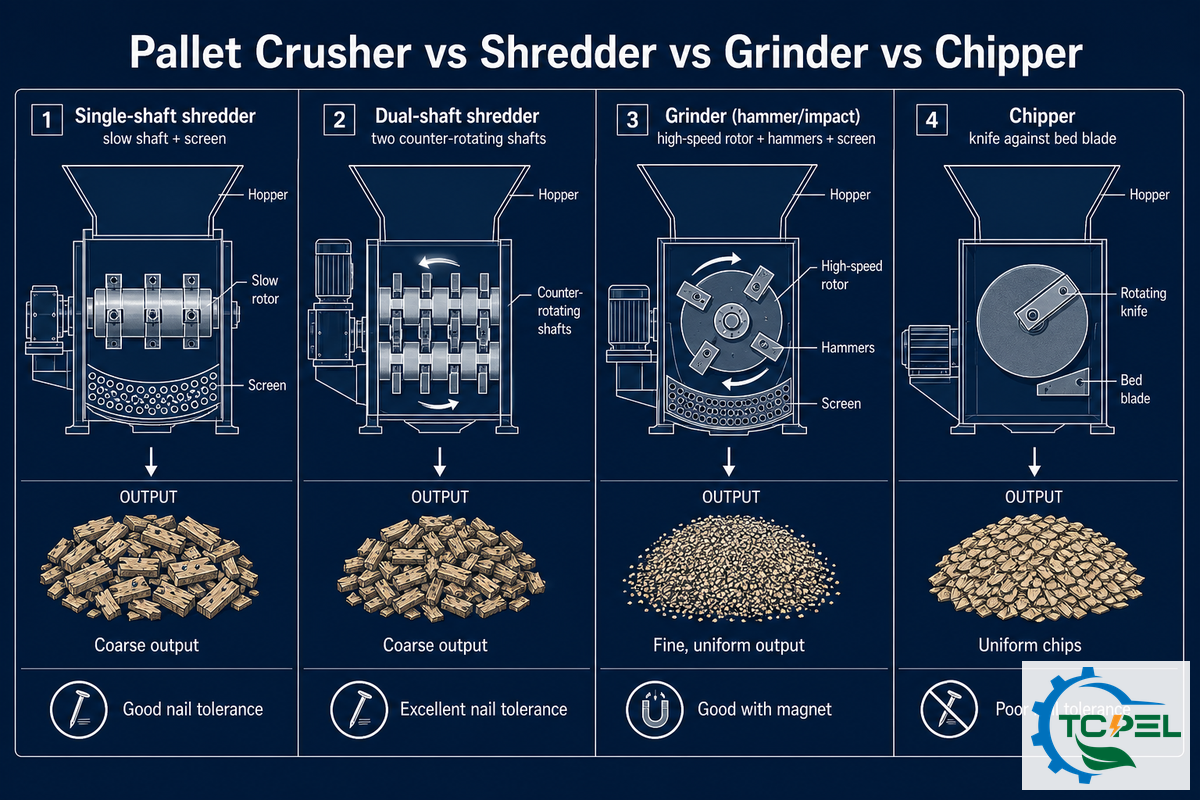
Triturador, triturador, moedor e picador nomeiam quatro mecanismos de redução diferentes, não máquinas intercambiáveis Um triturador rasga paletes com eixos lentos e de alto torque; um moedor os esmaga contra uma tela para uma saída mais fina e uniforme; e um picador corta madeira limpa, mas não pode sobreviver a pregos. “Pallet triturador” é simplesmente o termo guarda-chuva que os compradores usam para qualquer um deles.
Em termos mecânicos, a triturador paletes usa um ou dois eixos de giro lento (aproximadamente 50 rpm) carregados com cortadores enganchados que separam o palete em alto torque A moedor (muitas vezes um moinho ha1TP96 Ter ou triturador de impacto) gira um rotor em alta velocidade para que ha1TP96 Ters esmagar a madeira contra uma tela até que as peças passam, que é o que lhe dá saída uniforme, mais fina A picador paletes senta-se na extremidade de madeira limpa desta família de equipamentos de trituração, enquanto um triturador industrial resistente ancora a extremidade de redução de volume, todos eles construídos para quebrar paletes feitas de madeira (e às vezes plástico) Na prática, um triturador de paletes de madeira ou um moedor é o que a maioria dos compradores realmente precisa.
A Árvore de Decisão de Redução de Paletes de 4 Máquinas
| Máquina | Mecanismo | Saída | Tolerância ungueal | Melhor quando seu objetivo é |
|---|---|---|---|---|
| Retalhadora eixo único | Eixo de velocidade lenta + tela | Grosseiro, bastante uniforme | Bom | Tamanho controlado do chip para reutilização downstream |
| Retalhadora de eixo duplo | Dois eixos contra-rotativos, alto torque | Grosseiro, irregular | Excelente | Redução pura do volume de paletes mistas e com pregos pesados |
| Moedor (hammer/impacto) | Rotor de alta velocidade + hammers + tela | Bem, uniforme | Bom (com ímã) | Cobertura morta/cama de animais/matéria-prima de biomassa |
| Picador | Faca contra lâmina de cama | Lascas uniformes | Pobre | Limpe apenas madeira despregnada |
Características do comportamento da máquina compiladas da literatura sobre equipamentos industriais de processamento de madeira.
Se você se lembra de uma regra, faça-a assim: as trituradoras são escolhidas para paletes porque toleram metal; os moedores são escolhidos quando a saída deve ser uniforme. Um picador de alta velocidade produzirá lindos chips e depois destruirá suas facas na primeira vez que encontrar uma embreagem de pregos Para a maioria das instalações, a primeira pergunta honesta é se você precisa de redução de volume bruto ou de um produto vendável e de tamanho, e essa resposta única reduz a escolha de quatro vias para um. As diferenças entre um triturador paletes industriais e um moedor estilo hammer fica muito mais claro quando você sabe qual saída está vendendo.
Esmagamento no local
- ~60801TP98 redução de volume antes de transportar
- A produção pode se tornar cobertura morta, roupa de cama ou receita de combustível
- Remove pilhas de paletes feias e com risco de incêndio
– Remoção terceirizada
- Sem desembolso de capital, mas uma taxa permanente por tração
- Valor zero do subproduto capturado
- Escalas de custos com volume, todos os anos
Dentro da Câmara de Corte: Como funciona um Triturador de Paletes
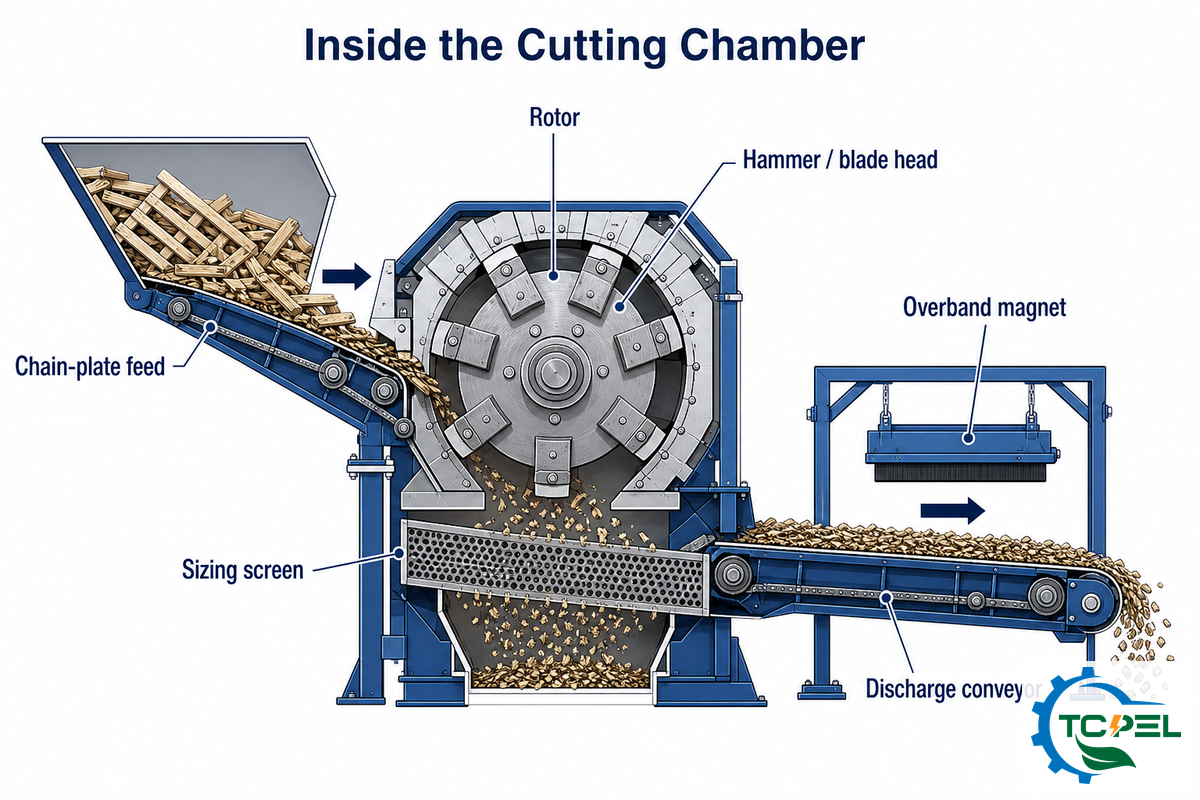
Tirar os nomes das marcas e um triturador de paletes são quatro coisas: uma tremonha de alimentação ou transportador de corrente que lida com as volumosas placas de madeira, uma câmara de corte segurando o rotor ou eixos com suas pás rotativas, uma tela de dimensionamento e uma correia transportadora de descarga, às vezes um sem-fim, que muitas vezes correm sob um ímã de banda superior Em um triturador de baixa velocidade, a queda do palete em eixos contra-rotativos cujos cortadores agarram e rasgam as tábuas; torque, não velocidade, o trabalho, que é exatamente por isso que pregos e parafusos passam com apenas desgaste gradual do cortador Em uma moedeira estilo ha1TP96 Ter, um rotor de alta velocidade lança ha1TP96 Ters na madeira e apenas fragmentos menores que as aberturas da tela escapam, tudo maior continua circulando em uma espécie de moagem de vários estágios até que seja material pré-triturado Fed de um triturador a montante, que o mesmo moedor corre mais rápido e usa menos Uma patente concedida pela US para uma câmara de redução (redução de redução de madeira)US10507469B2) descreve esta mesma geometria: uma lâmina de leito fixo proporcionando ação de corte constante contra os cortadores em movimento.
Nota de Engenharia
Os trituradores de torque de baixa velocidade normalmente acionam seus eixos a aproximadamente 50 rpm e mais de 20 rpm com rolamentos de eixo de liga tratados termicamente. A compensação de design é direta: velocidade mais baixa e maior tolerância de torque para comprar pregos e um chip mais grosso; se você precisar de uma partícula fina e uniforme para cobertura morta ou pellets de combustível, você aceita um moedor de alta velocidade e um separador magnético à frente de qualquer equipamento a jusante. Combine a classe rpm/torque com a saída que você pretende vender, não com o número de taxa de transferência da linha principal na folha de especificações.
O problema das unhas: esmagar paletes cheias de metal
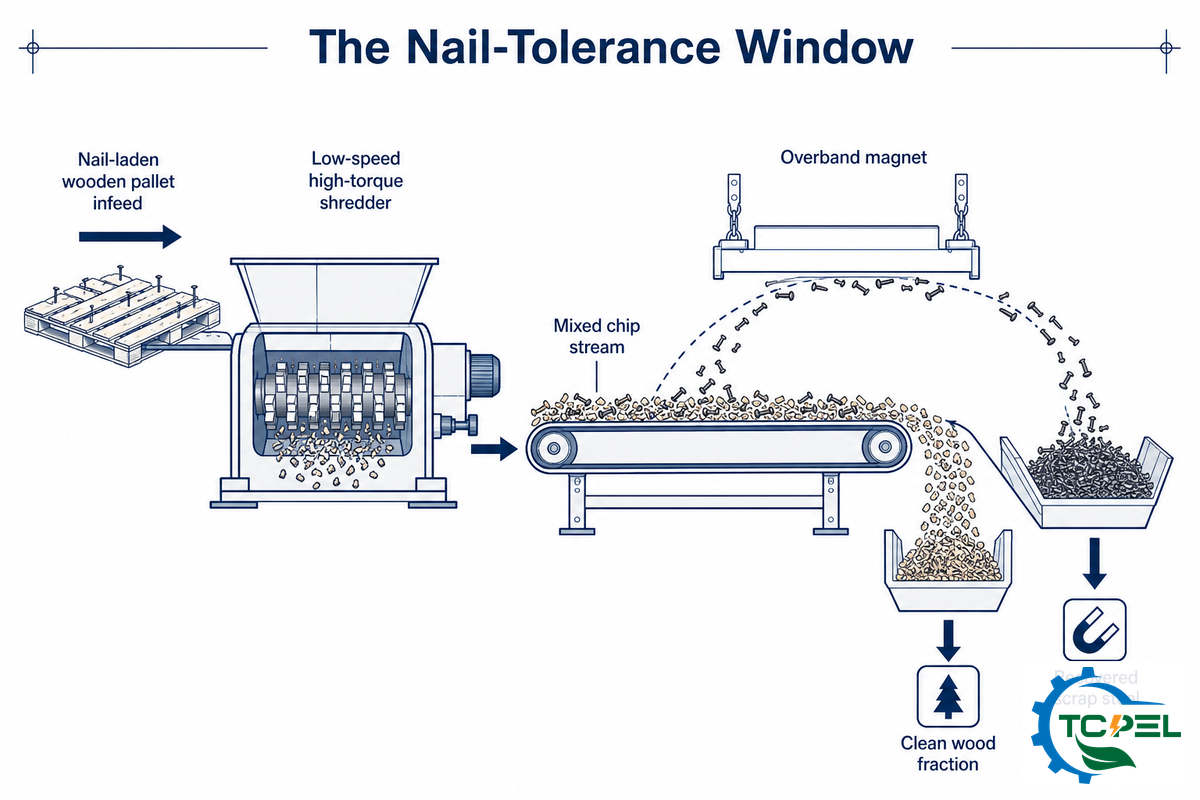
This is the question that sinks the wrong purchase. A standard wooden pallet carries dozens of nails or screws, and the machine that ignores them fails fast, wood shredding and metal aren’t a friendly mix unless the machine is built for it. Answering it reliably is mechanical, not optional: choose a low-speed, high-torque shredder or a reinforced grinder, then put an overband or drum magnet, a simple separation device, on the discharge conveyor to pull the loosened steel out of the chip stream. A pallet shredder with magnet turns that recovered metal into a scrap-revenue line instead of a contaminant, and a flimsy DIY pallet crusher is exactly what cannot do this. Feeding pallets with nails this way turn what was contaminated pallet scrap into a clean wood fraction plus a sellable steel fraction.
| Machine class | Tolerância ungueal | Metal separation | Wear impact |
|---|---|---|---|
| Low-speed dual-shaft shredder | Excelente | Overband magnet downstream | Gradual, controlled cutter wear |
| Retalhadora eixo único | Bom | Magnet + screen | Moderate; periodic knife/screen service |
| Hammer/impact grinder | Good (hardened hammers) | Magnet essential before reuse | Hammer/screen wear; rebuildable |
| High-speed chipper | Pobre | Not designed for it | Severe — knife damage on first nail strike |
Um triturador de paletes pode lidar com pregos e peças de metal?
Yes, provided you pick the right class. Low-speed shredders and reinforced grinders are built to chew through pallets “with nails and all,” because their high torque and heavy shafting absorb the impact that would chip a high-speed chipper’s knives. The nails aren’t destroyed; they’re loosened from the wood and then pulled out by a magnetic separator on the discharge belt, leaving a clean wood fraction and a sellable scrap-steel fraction.
What you should not do is feed nail-laden pallets to a machine designed for clean wood and hope for the best.
Scenario. A mid-sized furniture maker started reducing its scrap pallets with a fast disc chipper it already owned for offcuts. Within weeks the knives were chipped and the maintenance log filled with unplanned blade changes, the nails the crew never fully removed were doing the damage. Switching the pallet stream to a low-speed shredder with a discharge magnet ended the knife failures, recovered a bin of scrap steel each week, and turned an erratic repair cost into a predictable wear-part schedule. The lesson practitioners repeat is blunt: the cheapest machine you already own is the most expensive one if it was never meant to eat metal.
Dimensionando um triturador de paletes em seu volume
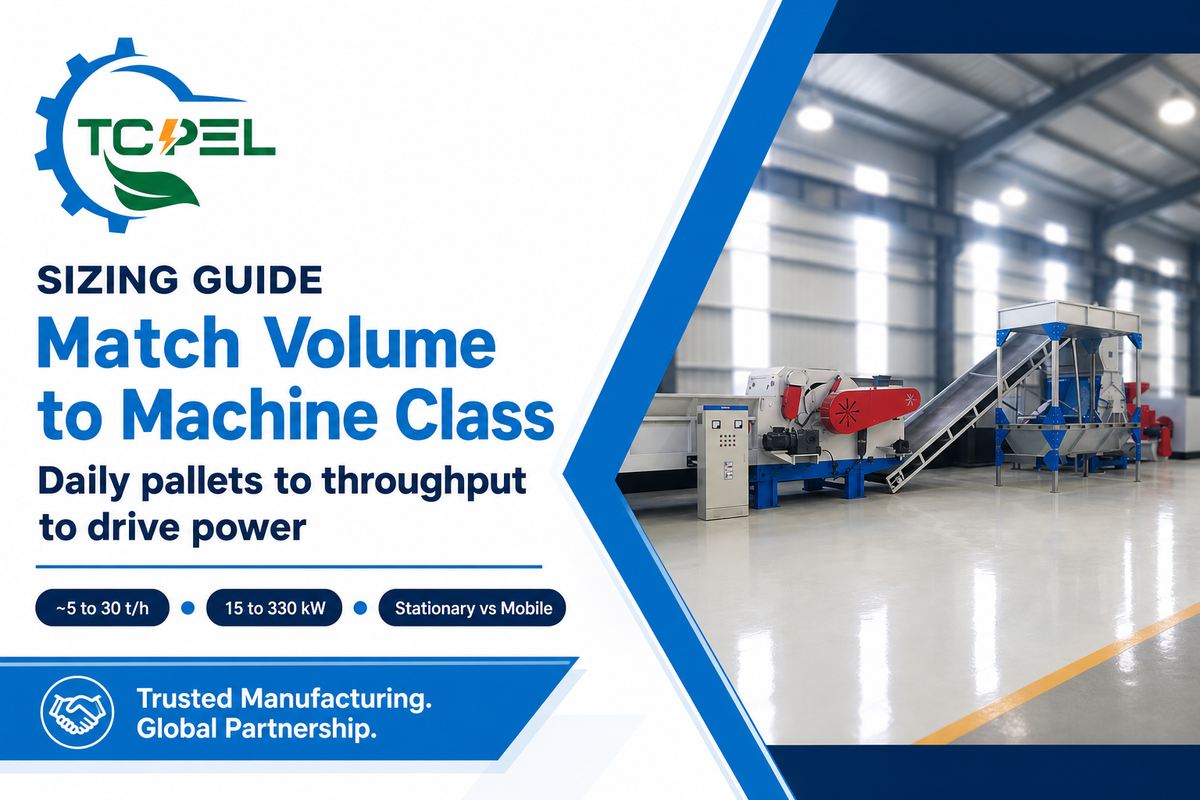
Whether the vendor calls it a wood pallet crusher, a pallet crushing machine, or pallet grinding equipment, sizing starts with a number most buyers can estimate in five minutes: pallets per day. Industrial wood shredders and grinders typically process roughly 5 to 30 tons per hour, with the actual figure swinging on pallet condition, nail content, and how fine you want the output. Because an average wooden pallet weighs roughly 30–65 lb (about 14–30 kg), you can convert your daily pallet count into an hourly tonnage and read off the machine class you need.
💡 Worked example: from pallets to motor size
Say you scrap 300 pallets per day at ~20 kg each. That’s 300 × 20 kg = 6,000 kg ≈ 6 t/day. Over one 8-hour shift, 6 ÷ 8 = 0.75 t/h, but real feeding is uneven, so size for the peak, not the average. Apply a ~2× peak factor and you’re designing around ~1.5 t/h. That points to a compact single-shaft shredder in the lower power band (roughly 30–55 kW), not a 300 kW line built for a regional recycler. Buying for the average is the classic costly mistake, undersize and the machine run flat-out and overheats; oversize and you pay for capacity that idles.
| Daily pallets | Approx. throughput | Machine class | Potência de acionamento | Typical best output |
|---|---|---|---|---|
| Under 50 | <0.4 t/h | Small single-shaft shredder | ~15–30 kW | Redução de volume |
| 50–150 | 0.4–1 t/h | Compact single-shaft shredder | ~30–45 kW | Mulch / bedding |
| 150–300 | 1–1.5 t/h | Retalhadora eixo único | ~45–75 kW | Mulch / bedding |
| 300–600 | 1.5–3 t/h | Retalhadora de eixo duplo | ~75–110 kW | Mixed / nail-heavy reduction |
| 600–1,000 | 3–6 t/h | Dual-shaft shredder + grinder | ~110–160 kW | Bedding / biomass feed |
| 1,000–2,000 | 6–12 t/h | Grinder line | ~160–250 kW | Biomass feedstock |
| Over 2,000 | 12–30 t/h | Heavy-duty grinder line | ~250–330 kW | Recycler-scale feedstock |
| Multi-site / service | Varies | Mobile shredder (engine-driven) | Diesel / PTO | On-site reduction as a service |
| Contaminated / mixed stream | Varies | Dual-shaft + overband magnet | Per volume | Volume reduction only |
Ranges synthesized from published industrial throughput (5–30 t/h) and drive-power data; treat as a starting point, not a substitute for a vendor capacity rating.
Os britadores de paletes móveis valem o custo?
A mobile pallet shredder (trailer- or skid-mounted) earns its premium only in two situations: when you process pallets across more than one site, or when you sell on-site reduction as a service. For a single fixed warehouse, a stationary shredder machine almost always wins on price per ton because you aren’t paying for the chassis, engine, and road-readiness you’ll never use.
Whichever you pick, plan the material handling, how full pallets reach the infeed and how the output leave, before you pick the industrial pallet shredder model itself. Your deciding question isn’t “is mobile better” but “does my material move, or do I move to it?” If the pallets pile up in one yard, buy stationary and put the savings into a better magnet and conveyor.
Da cobertura morta ao combustível de biomassa: o que as paletes esmagadas se tornam
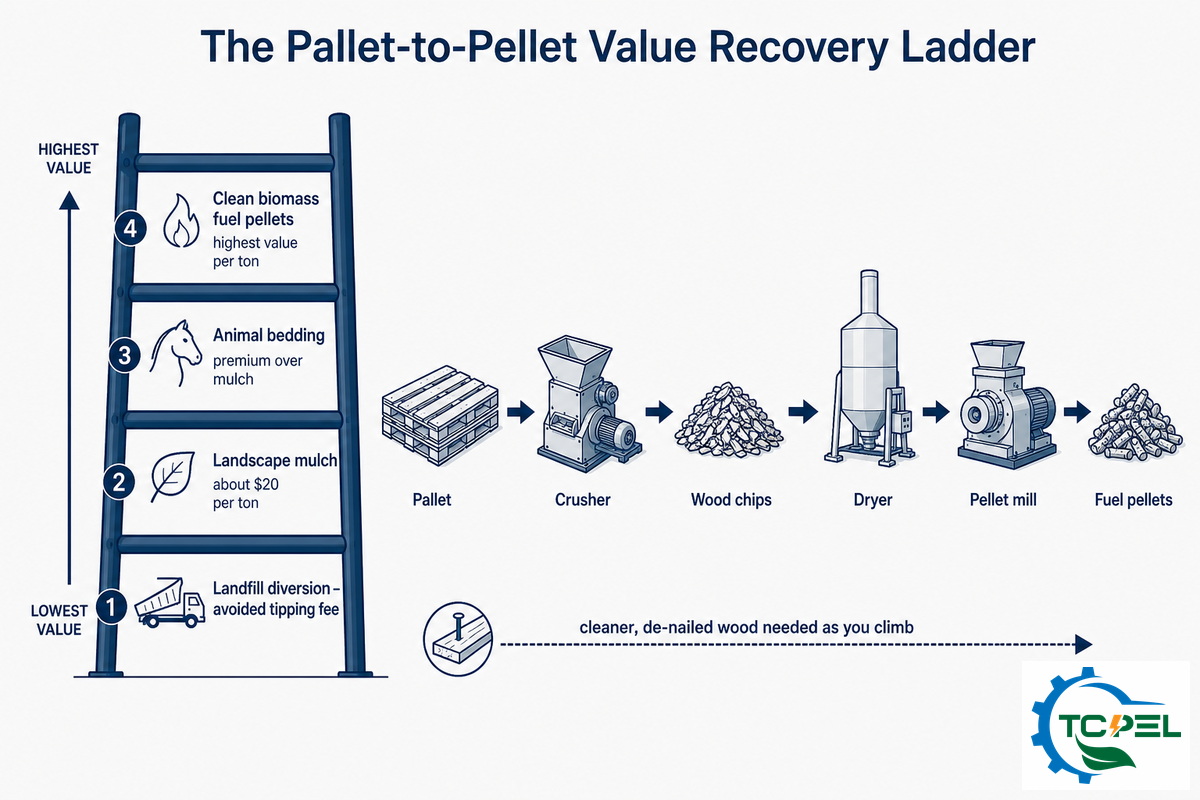
This is where most product pages stop and the real economics begin. Crushed pallet wood isn’t one product; it climbs a ladder of value, and each rung asks for cleaner wood and a little more processing. The U.S. Department of Energy notes that municipal and packaging wood is “both a disposal challenge and a potential resource for feedstock production,” and Virginia Tech’s unit-load researchers found that clean shredded pallet particles are low in moisture and ash with a relatively high net heating value, in their words, “an excellent industrial fuel.” An honest caveat, confirmed by the U.S. Energy Information Administration, is that the commercial wood-pellet industry runs mostly on sawmill residues, not recovered pallets, so pallet wood is a viable on-site fuel and a secondary feedstock, not the backbone of the pellet market.
The Pallet-to-Pellet Value Recovery Ladder
- Landfill diversion onlycoarse shred, ~60–80% volume reduction. Value = avoided tipping fees, nothing more. Requires the least clean wood.
- Landscape mulchuniform grind of clean, untreated wood. A state forestry program reports wood waste sold for roughly $20 per ton as mulch or bedding.
- Animal beddingfine, low-dust grind; commands a premium over mulch where livestock markets are nearby.
- Clean biomass fueldried, sized particles or pellets from de-nailed, untreated wood. Highest value per ton, but the cleanliness bar is also highest.
That ladder is the whole strategy: a basic triturador paletes captures the bottom rung on day one, and you climb only as far as your wood cleanliness and your local markets allow. To reach the top rung, the crushed chip usually pass through a dryer and a pellet press, the same equipment chain TCPEL builds for biomass producers, from hammer-mill fine grinding through a flat-die pellet mill or a higher-capacity ring-die pellet mill. The point isn’t that every yard should make pellets; it’s that knowing the full ladder tell you exactly how much machine to buy now and what to add later.
Scenario. A third-party logistics warehouse generates about 200 pallets a week. Outsourced removal was a flat weekly fee with zero return. After installing a single-shaft shredder with a magnet, the operation kept the bottom two rungs: it diverted the volume from the dumpster and sold clean grindings to a nearby stable as bedding. The scrap steel from the magnet covered part of the wear-parts budget. The team deliberately skipped the fuel rung, their pallet stream included too many heat-stamped export boards of unknown coating to guarantee a clean fuel product, so they sold what they could verify was clean and landfill-diverted the rest.
A Economia: Poupança de Eliminação e Payback
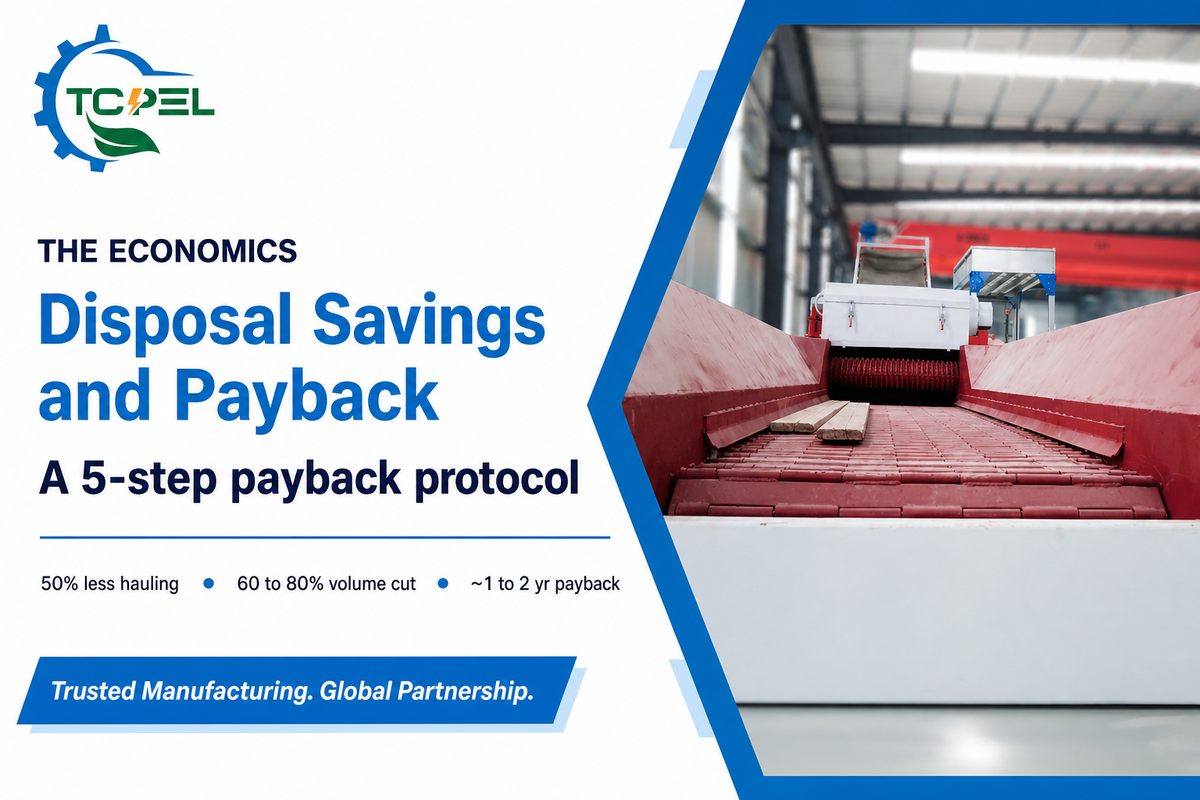
A pallet crusher pays for itself by erasing a recurring waste-disposal cost, then adding a small revenue stream on top, the return on investment most buyers underestimate because they only count the machine, not the hauling it eliminate. Independent equipment guidance puts on-site reduction at roughly a 50% cut in hauling frequency and 60–80% less loose volume, with facilities reporting annual savings “in the tens of thousands of dollars.” Larger programs go further: one managed pallet-recycling program documented combined disposal-and-purchasing savings exceeding $2 million a year. You don’t need to model that scale to make the decision, you need five lines.
The 5-Step Disposal-Cost Payback Protocol
- Current disposal cost / yearpulls or hauls per month × fee, plus any landfill tipping.
- Capital + installmachine, magnet, conveyor, electrical.
- Operating cost / yearpower, wear parts, and labor to feed it.
- Recovered value / yearavoided hauling + byproduct sales (mulch/bedding/fuel) + scrap steel.
- Payback (months) = Capital ÷ ((Step 1 + Step 4 recovered) − Step 3 operating) ÷ 12.
💡 Worked payback
Suppose a plant pays for two dumpster pulls a week at $250 each, about $26,000/year (Step 1). A compact shredder line installs for ~$45,000 (Step 2). Power, wear, and part-shift labor run ~$9,000/year (Step 3). It diverts the volume and sells clean grindings plus scrap steel for ~$6,000/year (Step 4). Payback = $45,000 ÷ (($26,000 + $6,000) − $9,000) = $45,000 ÷ $23,000 ≈ 1.95 years. Swap in your own pull fees and the same five lines give you a defensible number to take to procurement.
Como os trituradores de paletes reduzem os custos de descarte?
Three ways, stacked. First, volume: shredding removes 60–80% of the bulk, so the same dumpster holds far more wood and you pay for fewer pulls. Second, diversion: reduced wood can be sold or reused instead of landfilled, cutting tipping fees that, as the Department of Energy notes, keep rising as landfill capacity shrinks.
Third, recovery: the magnet turns the nails that used to be a contaminant into a small scrap-steel revenue line. The biggest single lever is almost always hauling frequency, that’s the cost that compounds every week you do nothing.
Operação e manutenção de um britador de paletes
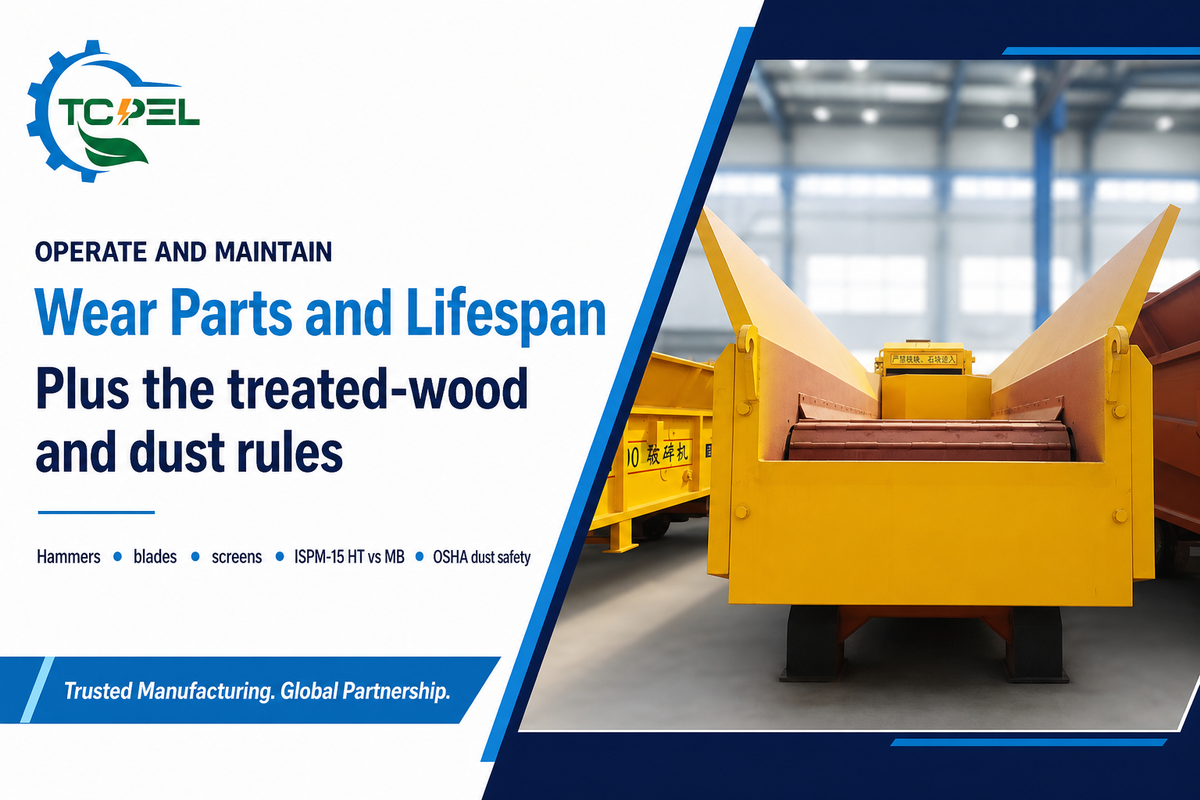
A well-matched pallet crusher is a long-lived asset; the variables that shorten its life are nails on the high end and contamination on the chemical end. Routine maintenance centers on the wear parts, cutters or hammers, screens, and bearings, inspected on a schedule and rebuilt rather than replaced wholesale. But one rule protect both your machine and your output markets, and it’s about which pallets you feed it.
⚠️ Treated and contaminated pallets: the hard limit
Not every pallet can become mulch or fuel. Older pallets may be treated with chromated arsenicals (CCA); the U.S. EPA states that CCA-treated wood “should not be reused in products such as mulch” and shouldn’t be burned because of toxic chemicals in the smoke and ash. For businesses, the EPA notes that treated-wood waste may require a hazardous-waste determination under RCRA. Export pallets carry an ISPM-15 markbut that stamp certifies only heat treatment (HT) for pests at a 56 °C core for at least 30 minutes; it’s a phytosanitary measure, not a guarantee that the board is free of paint, coatings, or contamination. Screen for paint, chemical staining, and unknown stamps before any pallet enters a mulch or fuel stream.
📐 Engineering Note — guarding and combustible dust
Pallet reduction creates two EHS exposures worth designing for from day one. Rotating shafts, hammers, and nip points need machine guarding at the point of operation. And fine wood dust is a documented explosion hazard: U.S. OSHA classifies combustible dust as “fine particles that present an explosion hazard when suspended in air,” and wood processing is among the most affected industries. Specify dust collection, bonding/grounding, and housekeeping alongside the crusher, not after the first incident.
Com que frequência um triturador de paletes precisa de manutenção e quanto tempo dura?
Treat it like any high-torque industrial machine: daily visual checks, scheduled lubrication, and wear-part inspection at intervals set by your throughput and pallet condition. Cutters, hammers, and screens are consumables sized to be rebuilt; bearings and shafting on a properly matched, heavy-built machine last for many years of service.
The fastest way to shorten that life is to run a machine flat-out because it was undersized for the volume, which loops straight back to sizing it correctly in the first place.
Perspectivas da indústria: por que a britagem de paletes no local está crescendo
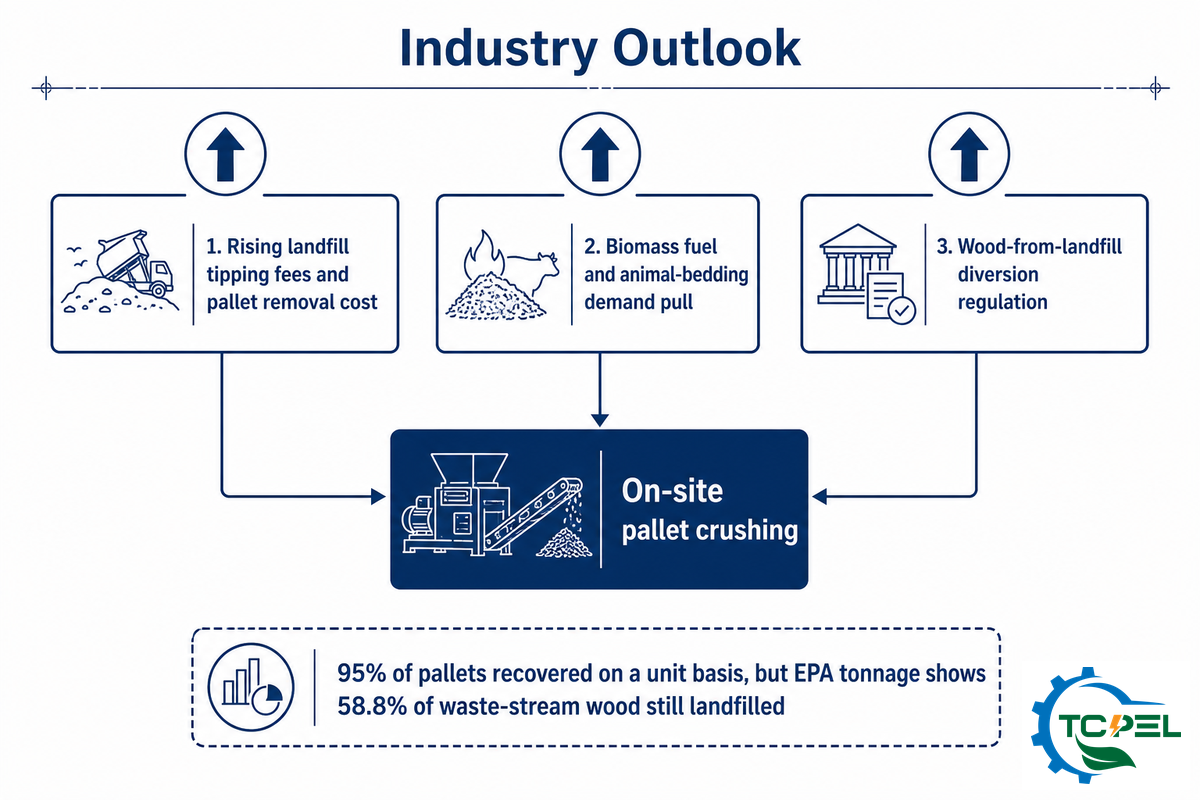
What drives on-site pallet crushing isn’t a market-size headline, it’s cost and compliance pressure that rises every year. The U.S. Department of Energy points to “reduced landfill capacity, increasing tipping fees” as a structural squeeze on anyone hauling waste, and that squeeze is what improves a crusher’s payback math regardless of how many people search for the machine. At the same time, demand for clean wood feedstock, for bedding, mulch, and biomass fuel, pulls recovered pallet wood up the value ladder rather than into the ground. That’s why heavy-duty shredders and recycling shredders keep showing up not just at dedicated recyclers but inside the warehouses and plants generating the waste wooden pallets and crates in the first place.
Research with the National Wooden Pallet & Container Association and the USDA Forest Service found that roughly 95% of wooden pallets are recovered into usable materials rather than landfilled, the question for most operations is no longer whether to divert pallets, but which tier of value to capture.
Summarizing the landfill-avoidance study led by Laszlo Horvath, PhD, Center for Packaging and Unit Load Design, Virginia Tech
That 95% figure deserves a careful reading, because the U.S. EPA’s material-flow data tell a complementary story. Counting pallet units, recovery is very high, most pallets are repaired and put back into service and never reach the waste stream. But counting tonnage of the wood packaging that does reach municipal solid waste, EPA estimated that in 2018 about 11.5 million tons were generated, roughly 3.1 million tons were recycled (chiefly chipped into mulch or bedding), and about 58.8% was still landfilled. Both numbers are right; they answer different questions. The practical takeaway for a buyer is that the landfilled tonnage, not the recovered units, is the on-site value you haven’t captured yet. A regulatory tailwind is forming too: in 2026 the wooden-pallet industry secured an exclusion for wooden pallets from California’s new extended-producer-responsibility rules, a sign that policy increasingly treats pallets as a recovered material rather than single-use waste. If your pallet pile is growing and your hauling invoice is rising, the timing argument is simply that the cost gap widens every quarter you wait.
Perguntas frequentes
Q: Quanto custa um triturador de paletes?
View Answer
Os preços abrangem uma faixa muito ampla, desde cerca de $500 para uma unidade pequena até bem mais de $100.000 para uma linha industrial completa com transportadores de alimentação e descarga e separação magnética. O valor é impulsionado pela taxa de transferência, potência de acionamento, qualidade de construção e se você adiciona equipamentos downstream, como um ímã ou uma tela. O número mais útil não é o preço do adesivo, mas o retorno: uma linha compacta que apaga taxas de transporte recorrentes geralmente é paga em aproximadamente um a dois anos, o que importa muito mais do que o custo do título.
P: Qual é a diferença entre um triturador de paletes e um triturador de paletes?
View Answer
“Pallet crusher” is the umbrella search term; “shredder” is one specific mechanism under it. A shredder uses slow, high-torque shafts to tear pallets apart and tolerates nails well, while a grinder uses a high-speed rotor and screen to make finer, more uniform output for mulch or fuel. When a vendor says “crusher,” ask which mechanism they mean and what output size it produces — that answer, not the label, tells you whether the machine fits your job.
Q: Que é o tempo de vida de um triturador da pálete?
View Answer
Uma máquina construída corretamente e de tamanho correto dura muitos anos, porque sua estrutura, eixo e rolamentos são projetados para tarefas industriais contínuas. Os consumidores (cortadores) ou hajack@tcpel.com4, telas, telas e consumíveis são destinados a serem inspecionados em um cronograma e reconstruídos, não funcionar até falhar O maior encurtador de vida é o subdimensionamento crônico: uma máquina forçada a executar superaquecedores, congestionamentos e desgastes planos muito mais rápido do que um combinado com o volume diário.
P: Você pode realmente ganhar dinheiro reciclando paletes com um triturador?
View Answer
The first and most reliable “money” is money you stop spending: a crusher cuts hauling frequency and tipping fees, which for many facilities is tens of thousands of dollars a year. On top of that, the output can be sold — clean grindings as landscape mulch (a state forestry program cites around $20 per ton) or animal bedding, and the nails recovered by the magnet as scrap steel. Reaching the highest-value rung, clean biomass fuel, takes drier, de-nailed, untreated wood and usually a pellet press, so most operations capture the avoided-cost and mulch/bedding tiers first and add fuel later only if their wood stream is verifiably clean. The honest answer is that the savings are nearly guaranteed and the revenue is real but volume- and market-dependent.
Q: Que indústrias usam mais trituradores de paletes?
View Answer
Qualquer operação que receba mercadorias em paletes e acumule quebradas: armazéns e centros de distribuição, fábricas, instalações de reciclagem, serrarias e paisagismo ou fornecedores agrícolas que possam utilizar a produção. Para estes processos de reciclagem, a redução no local é simplesmente uma melhor gestão de resíduos do que transportar paletes soltas.
Q: Pode um triturador de paletes processar paletes de plástico também?
View Answer
Muitos trituradores de baixa velocidade lidam com paletes de madeira e plástico, mas os fluxos de saída devem ser mantidos separados porque têm mercados a jusante diferentes. A madeira torna-se cobertura morta, ou combustível, enquanto a reafiação de plástico é reciclada como polímero. Se você executar paletes mistas, confirme se a máquina é classificada para plástico e planeje a classificação; não presuma que uma pilha de cavacos possa atender ambos os mercados.
Q: Eu tenho que remover as unhas antes de esmagar?
View Answer
Não 'se você escolher uma máquina construída para ele Trituradores de baixa velocidade e trituradores reforçados processo paletes pregos-e-tudo, em seguida, um ímã puxa o metal da saída Um picador de alta velocidade, por outro lado, precisa de madeira limpa.
Por que escrevemos isso
1TP71 T constrói a cadeia completa de equipamentos de madeira para pellets, trituradores, moinhos ha1TP96 Ter, secadores e moinhos de pellets, por isso vemos a redução de paletes não como uma tarefa de descarte, mas como o primeiro estágio de uma linha de recuperação de valor Este guia reflete esse ponto de vista: o objetivo é ajudá-lo a comprar a quantidade certa de máquina para o nível de valor que você pode realmente alcançar hoje Revisado pela equipe técnica TCPEL.
Artigos Relacionados
Referências e fontes
- Containers and Packaging: Product-Specific DataU.S. Environmental Protection Agency (2018 wood packaging generation, recycling, landfill data)
- Chromated Arsenicals (CCA)U.S. Environmental Protection Agency (treated-wood reuse and disposal)
- ISPM-15 Wood Packaging MaterialUSDA Animal and Plant Health Inspection Service
- Municipal Solid Waste Feedstock ReportU.S. Department of Energy, Bioenergy Technologies Office
- Combustible Dusts (OSHA 3371)U.S. Occupational Safety and Health Administration
- Biomass ExplainedU.S. Energy Information Administration
- Properties of Shredded Wooden PalletsCenter for Packaging and Unit Load Design, Virginia Tech
- Woody Biomass FeedstockIndiana Department of Natural Resources, Division of Forestry