Entre em Contato com a TCPEL

A practical engineering guide to the machine that turns chips and sawdust into pellet-ready feedstock, updated June 2026.
A wood hammer mill is a high-speed impact grinder that turns wood chip, sawdust, and shavings into pellet-ready particles, usually 2–10 mm, set by the screen. It sits between the chipper and the pellet mill in almost every biomass line, and it’s the only machine in that chain that give you screen-controlled output at industrial throughput. This guide cover how it actually grinds, how to pick a screen size, what goes wrong, and how to keep one running.
In short: A wood hammer mill grinds wood by impact and attrition, swinging hammers on a high-speed rotor strike the feed until particles are small enough to pass a perforated screen. The screen aperture, not the rotor speed, is the dominant control over the finished particle size.
Wood Hammer Mill at a Glance
| Typical input size | ≤80 mm chips, sawdust, shavings (chipper-prepared) |
| Output size | 2–10 mm, screen-controlled (down to fine powder with finer screens) |
| Rotor speed | ~1,500–3,600 rpm |
| Hammer tip speed | ~70–115 m/s for lignocellulosic biomass |
| Grinding energy | ~19–250 kWh per ton (varies sharply with screen size and species) |
| Common screens | 2 / 4 / 6 / 8 / 10 mm |
Five things most buyers get wrong
- The screen, not the rotor speed, is the dominant control over your particle size.
- Higher tip speed grinds finer but uses more energy, not less.
- Pelleting needs ≤6 mm feed; a chipper’s 20–80 mm output can’t substitute.
- The biggest dust-explosion risk is the cyclone/dust collector, not the mill chamber.
- Grind coarse→fine in two stages; single-stage fine grinding blinds screens and overloads the motor.
If you’re specifying a mill for a pellet plant, this guide pairs with the configured industrial wood hammer mill models that ship with matched cyclones and screen sets. Here we focus on the engineering, so the spec you request actually fits your feedstock.
What Is a Wood Hammer Mill?
A wood hammer mill is a size-reduction and wood-crushing machine that grinds woody material into smaller particles using rows of swinging hammers spun at high speed inside a steel chamber. As a crushing machine it can pulverize chips and bark into processed wood of a controlled particle size: the ground particles leave only when they’re small enough to fall through a replaceable screen, so the output is a consistent product rather than random chunks of varied wood materials.
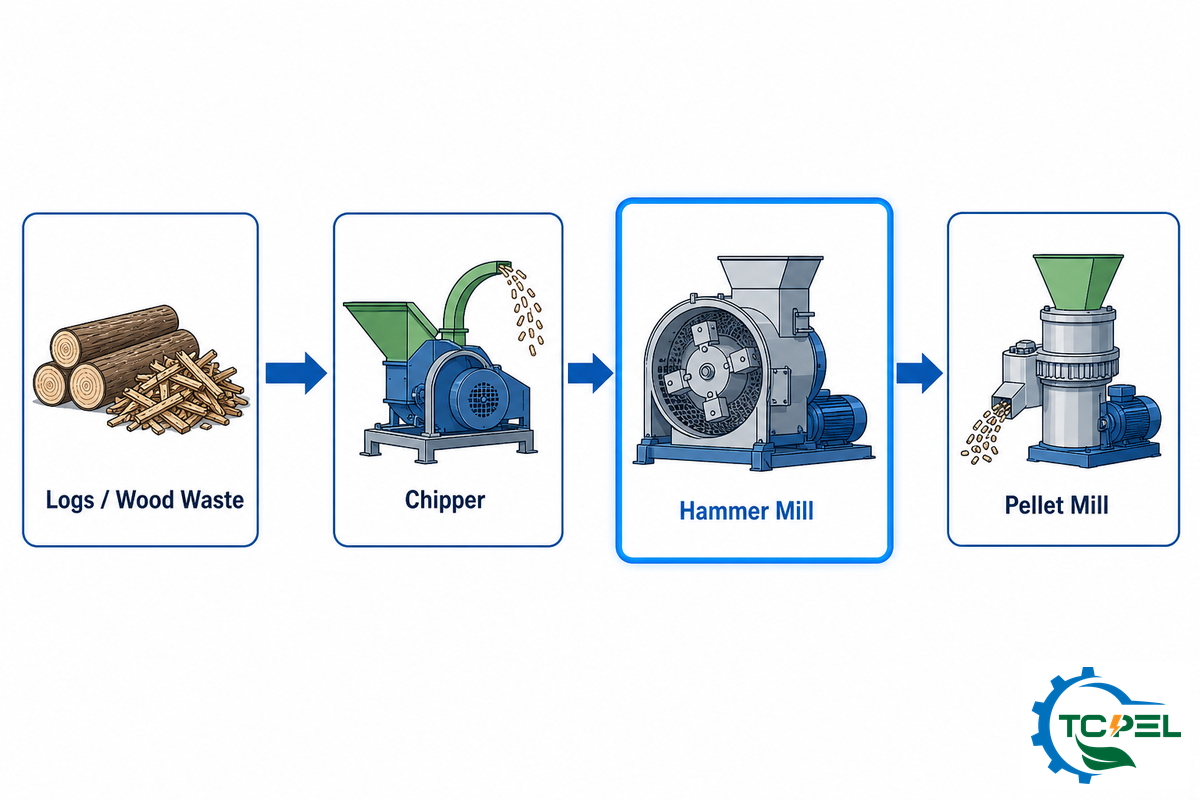
In a biomass line the hammer mill is the middle stage. A wood chipper first cuts logs and branches into 20–80 mm chips; the hammer mill then grinds those chips to the few-millimetre size a pellet mill needs; a dryer and a flat die pellet mill finish the job. Skip the hammer mill and the pellet die simply won’t feed.
💡 Why it matters
Particle size after milling is a documented critical control point for pellet plants: it directly governs press throughput, pellet durability, and bulk density. Get the grind wrong and every downstream machine pays for it.
How Does a Wood Hammer Mill Work? The Impact-Attrition Grinding Cycle
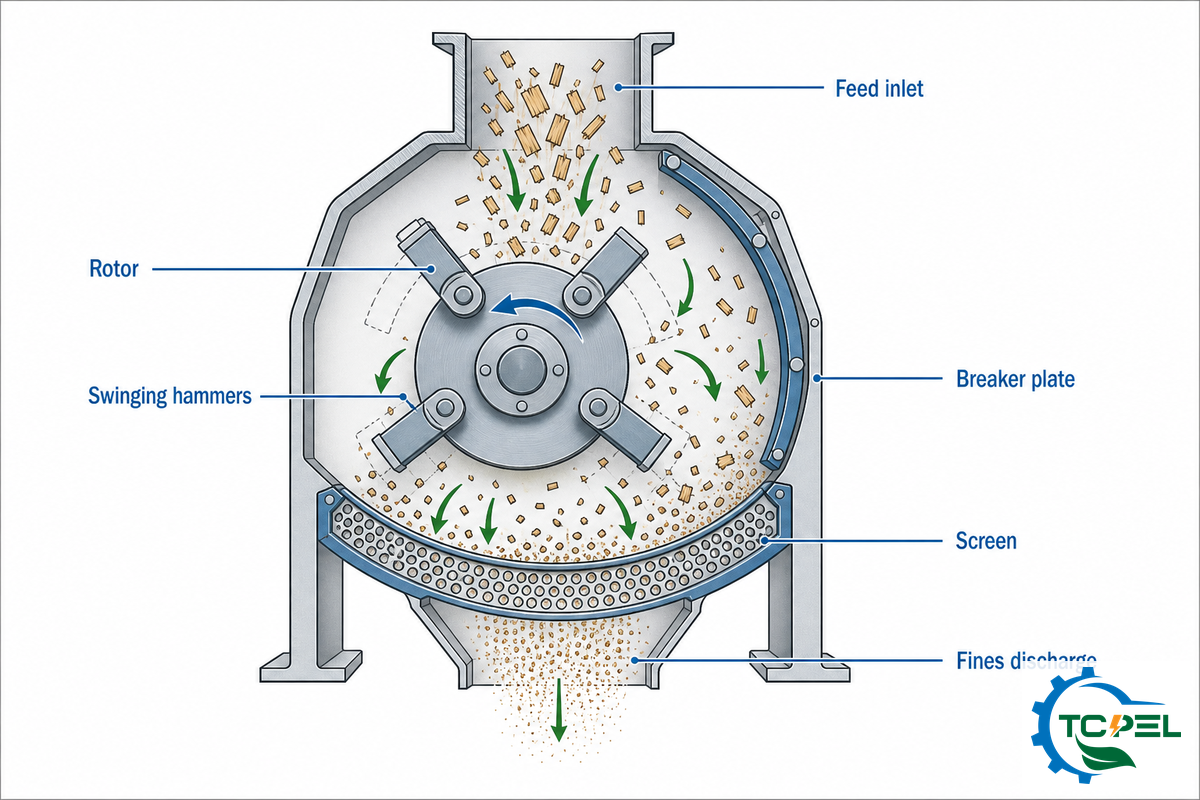
The working principle of a wood hammer mill is a repeating Impact-Attrition Grinding Cyclea grinding process where material is metered into the grinding chamber, free-swinging hammers on a spinning rotor strike it (impact), the fragments then abrade against each other and the screen (attrition), and only particles smaller than the screen aperture escape. Everything else stays in the chamber for another pass.
The sequence has four moving parts working together:
- Feed. A gravity or metered feed system drops chips and sawdust into the chamber. A steady, even feed matters more than people expect, surges let hammers rock on their pins and accelerate wear.
- Impact. Hammers spinning at high tip speed fracture the wood on contact. The rotor and the breaker plates do the heavy work here.
- Attrition. Fragments grind against each other and the screen surface, shaving particles down to final fineness.
- Discharge. Particles that pass the screen exit by gravity or are pulled out by an air stream that conveys them into a cyclone and blower.
There’s a hidden cost in that cycle. In a U.S. Forest Products Laboratory pilot study, the net energy for hammer milling Douglas-fir was about 74% of total energy draw, meaning roughly a quarter of the power just spin the empty machine. That’s why a well-fed mill is an efficient mill.
Why are tip speeds important?
Tip speed, how fast the hammer ends travel, controls how fine and how fast a mill grind, and how much energy it burns. Higher tip speed makes finer particles and more throughput, but it doesn’t save energy: peer-reviewed grinding data shows total specific energy is positively correlated with tip speed, so spinning faster to grind finer costs more per ton, not less.
📐 Engineering Note — tip speed in one line
Tip speed = π × rotor diameter × rpm ÷ 60. A 0.61 m rotor at 3,600 rpm gives π × 0.61 × 60 ≈ 115 m/sthe speed the Forest Products Laboratory used for fine wood grinding. Drop the same rotor to 1,800 rpm and you’re at ~57 m/s: coarser, more uniform, easier on hammers. For lignocellulosic biomass, the useful band is roughly 70–115 m/s.
The Anatomy of a Wood Hammer Mill: 6 Core Components
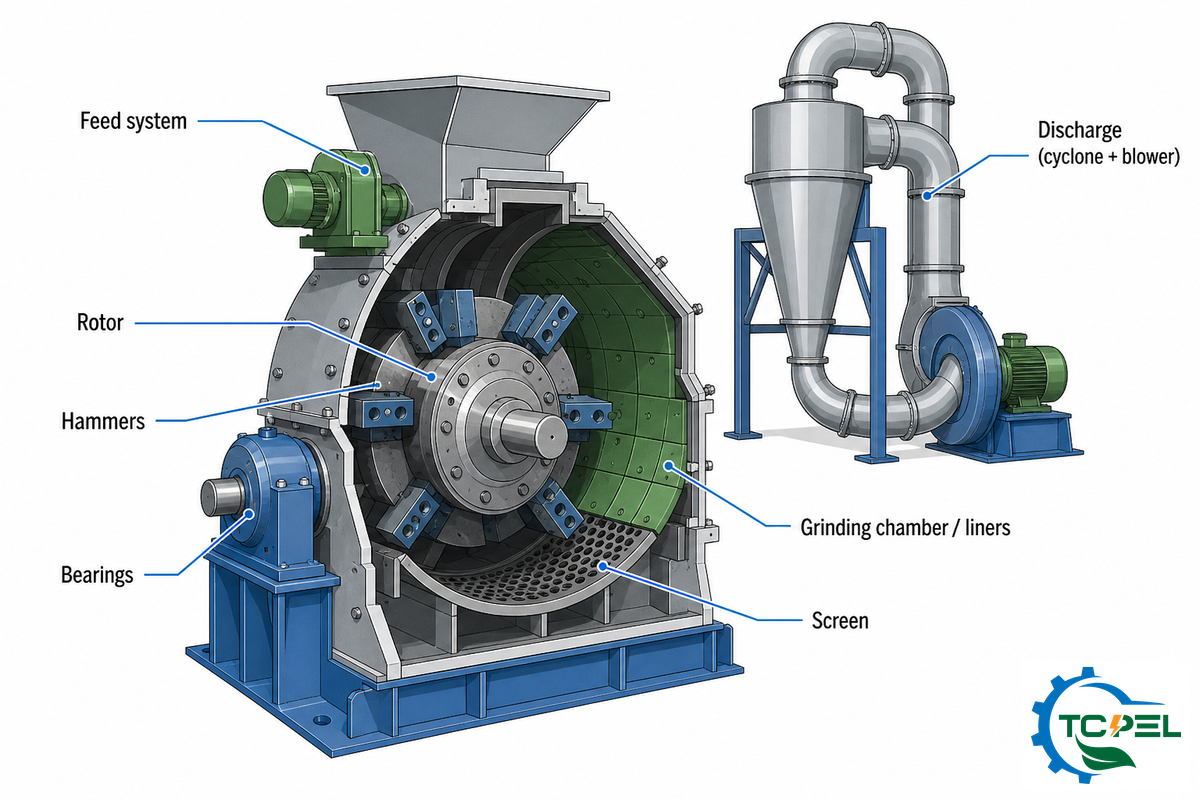
Knowing the parts, and which ones wear, tells you what to inspect and what to keep in spares. This Component-to-Wear-Item Map lays out the rotor, hammers, screen, chamber, feed, and discharge train, plus the bearings that quietly decide machine life.
| Component | Function | Wear item / note |
|---|---|---|
| Rotor / shaft | Carries the hammers; spun by the motor | Imbalance from uneven hammers damages bearings |
| Hammers | Strike and fracture the wood (swing or fixed; one-step or multi-step edge) | Leading corners round off; simpler one-step hammers cut grinding energy ~17% in one peer-reviewed trial |
| Screen / sieve | Sets the output particle size | Holes elongate and blind; the dominant size lever |
| Grinding chamber & breaker plates | Contains the impact zone; adds attrition surface | Liners abrade with bark and reclaim wood |
| Feed system | Meters material into the chamber | Surge feeding causes hammer-pin wear |
| Discharge (gravity or pneumatic) | Removes ground particles | Pneumatic adds a blower load (~11 kW class) |
| Cyclone | Separates fine particles from the air stream | Highest dust-explosion risk node — design carefully |
| Airlock / blower | Moves and seals the air-conveyed flow | Vanes wear; affects discharge balance |
| Bearings | Support the rotor | Over-greasing is as bad as under-greasing; watch temperature |
Two geometry numbers set the working envelope, the diameter of the hammer circle and the feed throat, while liners and hammers run heavy-duty, wear-resistant alloy steel. Hammer design is an active patent area: forged free-swinging hammers (e.g., US7140569B2) trade weight for strength to extend run time.
Wood Hammer Mill Screen Size and Particle-Size Control
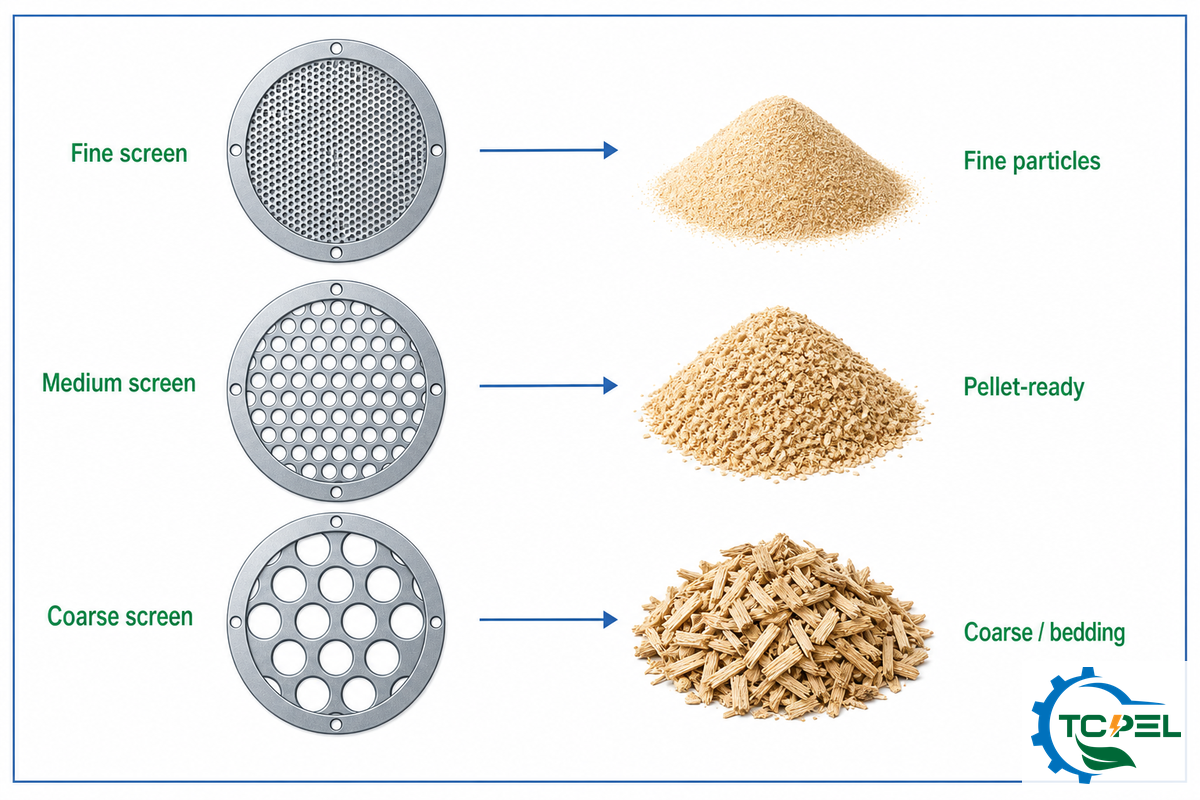
The screen aperture is the single biggest decision you make on a wood hammer mill. Across published grinding trials the screen is the dominant control over finished particle size, while rotor speed, hammer count, and tip speed are secondary, the clearest proof is energy, where changing nothing but the screen swings grinding power more than tenfold (below). Pick the screen for your product first; tune speed second.
Use this Screen-to-Particle-Size Window as a starting point, then confirm with a test run on your own feedstock:
| Screen aperture | Typical output | Best for |
|---|---|---|
| 2–3 mm | Fine sawdust / powder | Premium pellets, incense, fine briquettes |
| 4–6 mm | Pellet-ready feedstock (≤6 mm) | Wood-pellet production to EN ISO 17225-2 |
| 8–10 mm | Coarse particles / shavings | Animal bedding, mulch, lower power draw |
Source: EN ISO 17225-2 pellet feed requirement plus published hammer-mill sieve trials.
For the finest output, a 0.8mm or 2 mm screen, expect a consistent product but a steep energy jump, and watch feed moisture content, which blinds fine screens fastest. Screen choice also swings your power bill more than any other single setting. In the Forest Products Laboratory trials, the specific energy for grinding Douglas-fir fell from about 250 kWh per ton at a 0.69 mm screen to 66 kWh per ton at 3.175 mm and just 19 kWh per ton at 12.7 mma roughly 13-fold spread driven by screen size alone. Going one step finer always costs energy: dropping a willow grind from a 16 mm to a 10 mm sieve raised specific energy by 5–15%.
⚠️ Don’t chase one screen
Grinding green chips straight to a fine 0.69 mm screen in a single pass blinded the screen, broke it, and overloaded the motor in testing. For fine output, stage it: a coarse pass (say 6 mm) followed by a fine pass. Two stages beat one heroic stage.
Wood Hammer Mill vs Chipper, Crusher, and Grinder
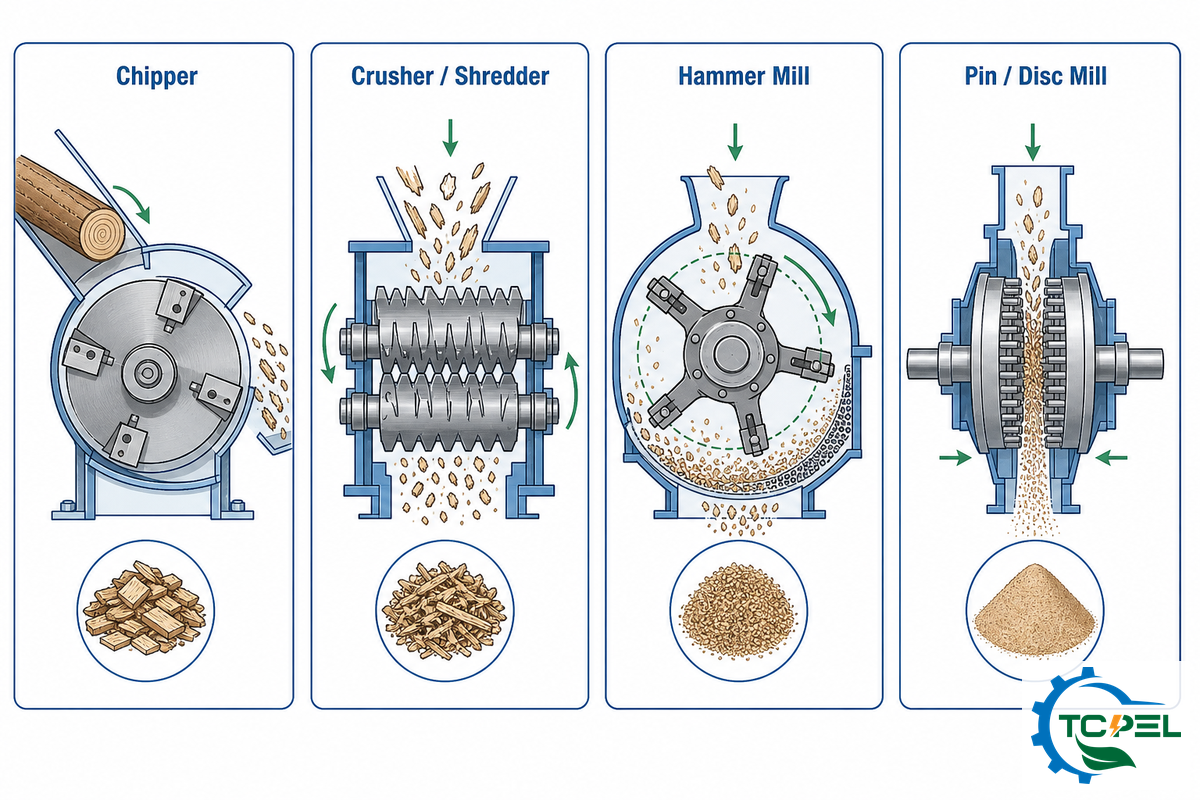
These machines are a sequence, not substitutes. Each acts on the wood differently and produces a different size, which is why a pellet line usually needs more than one.
| Machine | Action | Typical output |
|---|---|---|
| Wood chipper | Knife cut | 20–80 mm chips |
| Wood crusher / shredder | Heavy impact + shear | 10–40 mm chunks |
| Wood hammer mill | Impact + attrition (screen-controlled) | 2–10 mm particles |
| Pin / disc mill | Fine attrition | Fine powder (<1 mm) |
What is the difference between a grinder and a hammer mill?
A hammer mill is one type of grinder, it reduces size by impact from swinging hammers and then screens the result to a set size. “Grinder” is the broader category that also include pin mills and disc mills, which use attrition between surfaces to make very fine powder. For wood headed to a pellet press, the hammer mill is the workhorse of the group.
Pin and disc mills come in only when you need sub-millimetre fineness. For the upstream choice between coarse size-reduction machines, see our guide on wood crusher vs shredder.
The common mistake is assuming a chipper can replace a hammer mill. It can’t: pellet feed must be ≤6 mm, and the largest chipper output is many times that. Anyone who has tried to make pellets straight from chips learns this fast.
Types and Configurations of Wood Hammer Mills

Wood hammer mills scale from a 60 kg/h farm unit to industrial mills running several tons an hour. The configuration choices that matter most are drive, discharge, and rotor speed.
- ✔ Small vs industrial: small mills use single-phase power and gravity discharge; industrial hammer mills justify three-phase motors, pneumatic discharge, cyclone/dust-collection, and are built for low maintenance at high duty.
- ✔ Electric vs diesel vs PTO: electric drive dominates fixed plants; diesel and PTO models serve sites without reliable grid power.
- ✔ High-speed vs slow-speed: most wood mills run high tip speed for fineness, but deliberately slow-speed designs exist (patent CA2226045C) to cut wear and noise on chips.
- ✔ Wet-chip mills: green-wood configurations grind high-moisture material to a coarse size for drying before a second pass.
For the industrial end of that range, TCPEL’s biomass hammer mill series spans the small-plant to multi-ton tiers with matched cyclone and screen options.
What a Wood Hammer Mill Can Process
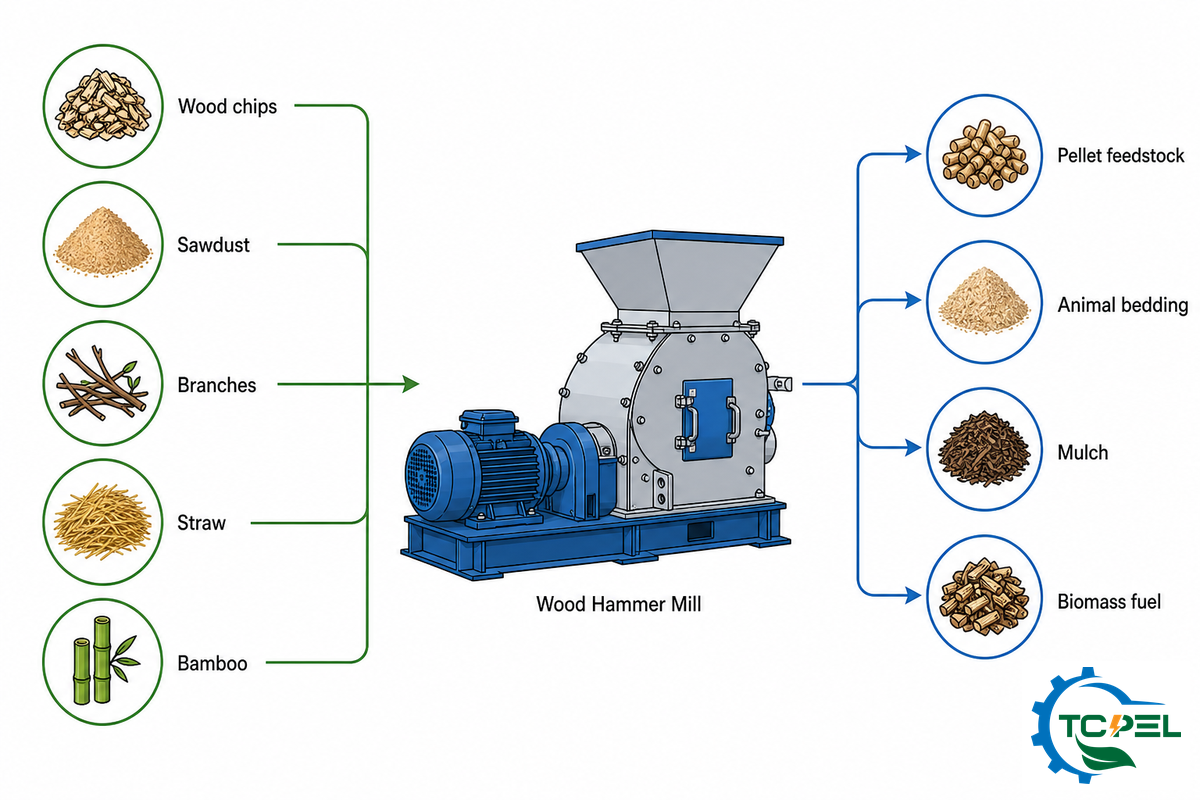
A wood hammer mill handles most clean, chipper-prepared woody material: wood chips, sawdust, shavings, small branches, reclaimed pallet wood (wood-waste recycling), plus straw, wheat straw, agricultural waste, and bamboo. These raw materials and biomass materials feed several end markets, pelletizing into biomass-energy fuel, animal feed and animal bedding, mulch, and other wood products.
The two limits are size and moisture content: large wood and oversized chunks need chipping first, and wet feed both clogs screens and burns energy. In a biomass-processing or wood-processing plant, the hammer mill is the processing equipment that makes the rest of the chain possible.
Moisture is the cross-cutting lever most operators underuse, it drives grinding energy, screen blinding, finished particle size, and even dust explosibility at the same time. Idaho National Laboratory found hammer-mill energy consumption rises sharply as feedstock moisture climbs, so air-drying chips toward 10–15% before grinding is often the cheapest energy saving available.
💡 Pro Tip — pre-clean reclaim wood
Stones, sand, nails, and other tramp material smaller than 3.15 mm slip past inspection and chew up screens and hammers. A magnetic pre-stage and pre-cleaning protect the mill on reclaim and forestry-residue feed. The output then serves pellet feedstock, animal bedding, mulch, or biomass fuel prep.
A worked example: a pellet plant in Eastern Europe runs softwood and mixed pine at about 12% moisture into a roughly 1 t/h mill feeding a ring-die press. By chipping first, grinding to a 6 mm screen, and keeping feed steady, the operator hold a consistent pellet feedstock without screen blinding, the kind of stable result a complete wood pellet production line is built to deliver.
Common Wood Hammer Mill Problems and How to Fix Them
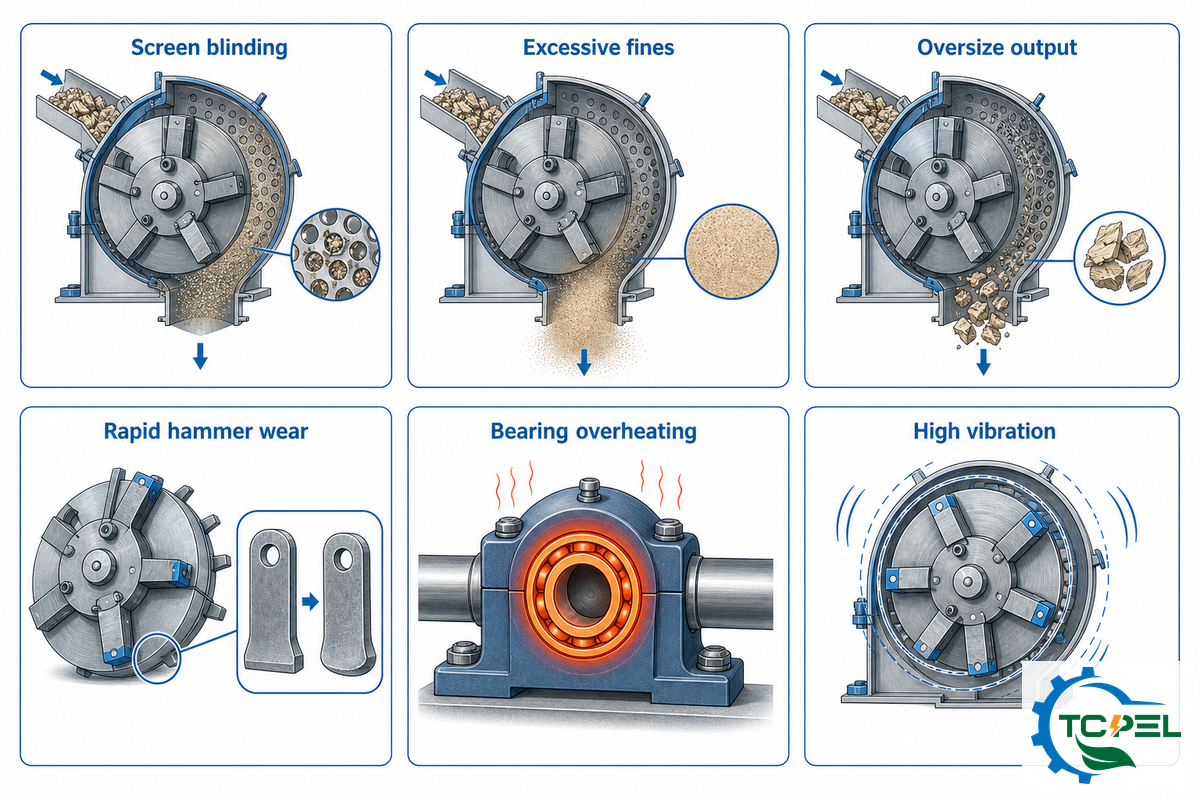
Most hammer-mill trouble shows up as one of ten recurring failure modes. This Wood Hammer Mill Failure-Mode Atlas maps each symptom to its usual root cause and the fix that addresses it, the troubleshooting layer competitor product pages leave out entirely.
| Failure mode | Symptom | Root cause & fix |
|---|---|---|
| Screen blinding | Throughput drops, mill heats up | Wet feed or too-fine a screen — dry feed, stage coarse→fine |
| Excessive fines | Dust, low bulk density | Tip speed too high — lower rotor rpm or open the screen |
| Oversize output | Particles too big for the pellet die | Worn screen/hammers — replace at ~5% hole elongation |
| Low throughput | Below rated capacity | Too little screen area — keep ≥14 in² of screen per HP |
| Rapid hammer wear | Frequent hammer changes | Contaminated feed — pre-clean, add a magnet, rotate hammers |
| High vibration | Shaking, noise | Rotor imbalance — replace hammers as matched sets within ~15 g |
| Bearing overheating | Bearing >40°C above ambient | Over/under-greasing — fill housing only 1/3–1/2 |
| Motor overload | 10–15% amperage rise, tripping | Blinded screen or single-stage fine grind — stage the grind |
| Metal contamination damage | Sudden hammer/screen failure | Tramp metal — magnetic separation pre-stage is mandatory on reclaim |
| Excess dust / emissions | Visible dust, compliance risk | Under-sized cyclone — the collector is the highest fire-risk node |
What are the common problems with hammer mills?
The most frequent issues are screen blinding from wet feed, excessive fines from too-high tip speed, and accelerated wear from contaminated feedstock. Two warning signs are worth memorising: a blinded or rounded screen shows up as a 10–15% rise in motor amperage at constant feed, and a bearing running more than 40°C above ambient is telling you it’s in trouble. Catch those early and most failures stay small.
“The ideal microchip size feeding the pellet process is 12 mm, about a half-inch, or less; chips larger than half an inch should be screened out.”
How to Size and Choose a Wood Hammer Mill

Sizing a wood hammer mill is a chain of seven decisions taken in order, capacity first, then motor power, screen set, hammer alloy, discharge type, dust control, and a contamination pre-stage. Work top to bottom and each choice narrows the next, so the spec write itself instead of turning into a guessing game between vendor brochures with very different rating assumptions.
Wood hammer mill spec checklist
- Size on capacity (kg/h or t/h) — your real, feedstock-adjusted throughput, not the brochure peak.
- Match motor power and voltage to capacity and your site’s electrical supply.
- Pick the screen set for your product from the screen window above, and keep spares.
- Hammer alloystandard for clean softwood; reinforced for hardwood and reclaim.
- Discharge typegravity for small mills, pneumatic + cyclone for industrial.
- Dust controlcyclone and collector sized for combustible-dust compliance.
- Contamination pre-stagemagnetic separation for reclaim or mixed-source feed.
Work an example. A plant targeting 1 t/h of pellet-ready feed from mixed softwood at 12% moisture starts at the capacity step: 1 t/h plus a margin points to a mill rated around 1.2–1.5 t/h, because feedstock-adjusted throughput runs below the brochure peak. That sizes the rest of the chain, a roughly 22 kW three-phase rotor for the ~1 t/h class, a 6 mm screen for the ≤6 mm pellet feed, and a standard hammer alloy for clean softwood, plus a cyclone and dust collector for combustible-dust compliance. The same plant running reclaim pallet wood instead would step up to a reinforced hammer alloy and make the magnetic pre-stage mandatory, same capacity, very different machine.
A common mistake here’s sizing on the brochure peak. One operator who ordered a mill rated at exactly 1 t/h found real throughput closer to 0.7 t/h once the higher-moisture, lower-density feed hit the chamber, the kind of shortfall that stalls a whole pellet line. Capacity ratings depend heavily on feedstock bulk density and moisture, so two mills with the same kg/h label can behave very differently. To pin numbers to your species and screen, run them through a wood hammer mill species sizing worksheet, then confirm against the configured TCPEL wood hammer mill models.
Operation, Maintenance, and Hammer Wear
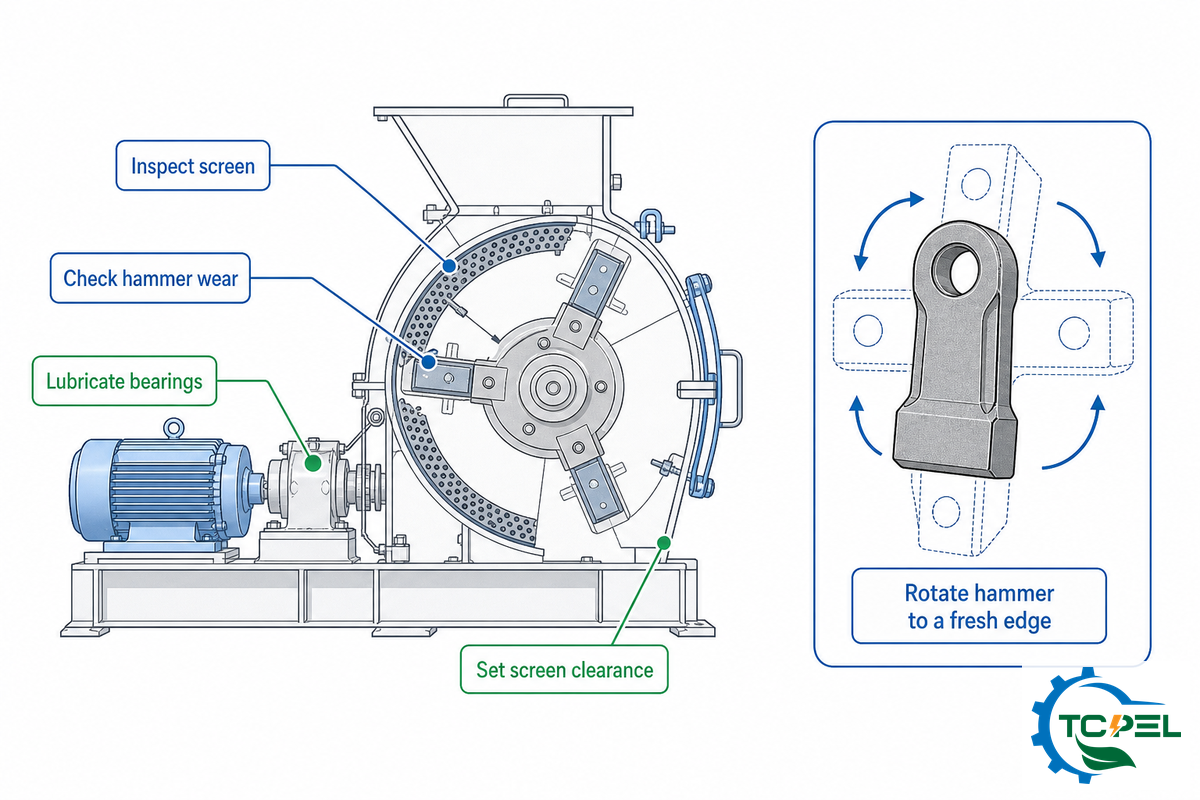
A wood hammer mill rewards a routine. The high-value habits are metering the feed, rotating hammers on schedule, watching the bearings, and replacing wear parts before they fail, not after.
- ✔ Rotate hammers when the leading corner has rounded more than about a quarter of its width; this holds grind efficiency and limits heat buildup.
- ✔ Replace hammers as matched sets and keep opposite rows within ~15 g, mismatched hammers are a top cause of rotor imbalance and bearing damage.
- ✔ Grease conservatively: fill bearing housings only 1/3 to 1/2 full and treat any bearing running 40°C above ambient as a warning.
- ✔ Change screens at roughly 5% hole elongation (a 10 mm hole worn to ~10.5 mm) before oversize particles reach the pellet die.
- ✔ Keep it fed. A steady, metered feed keeps hammers from rocking on their pins and keeps that ~25% idle-energy penalty from growing.
The economics reward attention. Industry maintenance data puts the energy cost of running a mill at roughly 5–10 times the cost of the wear parts per ton, so the screen, hammer, and feed choices that lower energy matter far more than shaving a few dollars off spare parts. Running a mill on consistent, well-prepared feed (often after a rotary dryer stage) is the quiet difference between a profitable line and a frustrating one.
Where Wood Hammer-Milling Is Heading in 2026
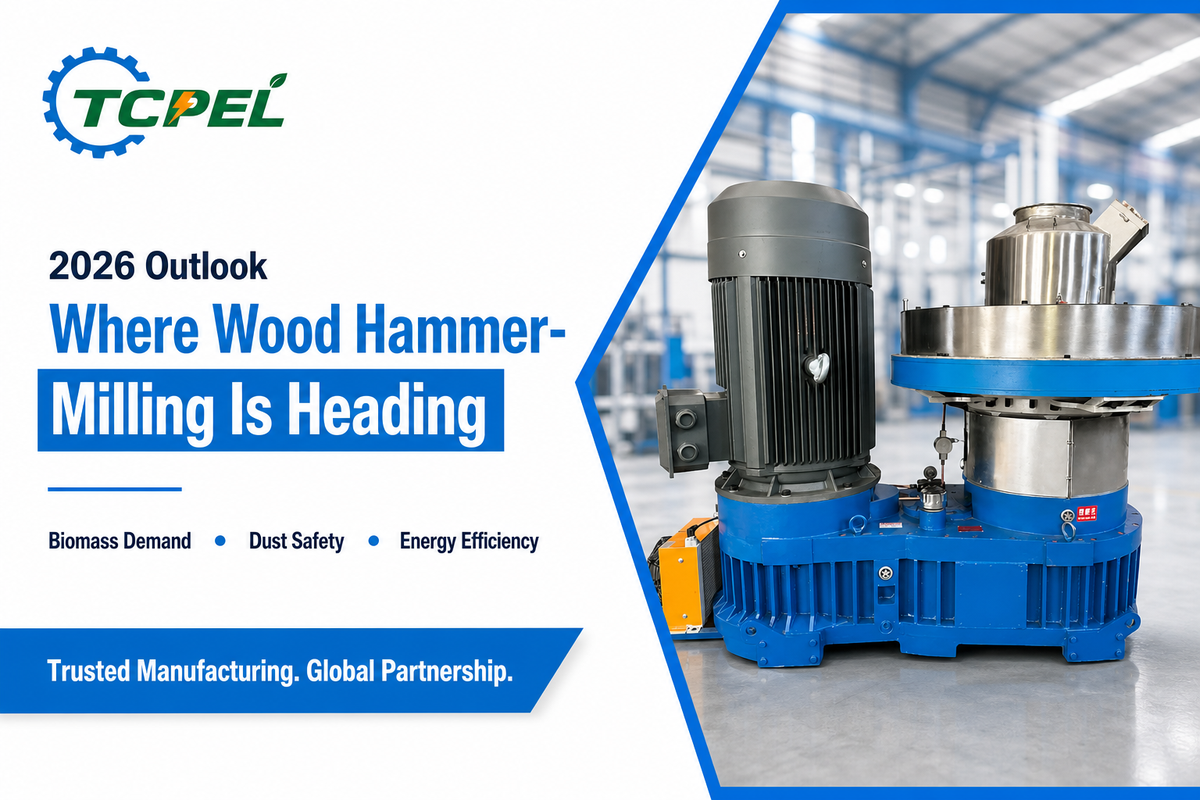
The demand for screen-controlled wood grinding is being pulled by policy more than by any single market number. Europe’s renewable-energy mandates and Member-State incentives keep pellet plants investing, and the sustainability criteria in the Renewable Energy Directive push producers toward consistent, certified feedstock, which starts at the hammer mill.
After dipping to 22.6 million tonnes of wood pellets in 2024 (down 5.9% from 2023), EU consumption was forecast to recover to roughly 23.45 million tonnes in 2025, and a new traceability rule, the EU Deforestation Regulation, is set to reshape pellet and chip sourcing from 2026, putting a premium on documented, consistent feedstock. Both keep screen-controlled grinding capacity in demand.
On the equipment side, two engineering trends matter for buyers. Energy-efficient hammer geometry, forged hammers and simpler single-edge profiles that cut specific energy by around 17% in published trials, lowers the kWh-per-ton that dominates operating cost. And tightening combustible-dust enforcement (OSHA guidance and NFPA 664) is raising the bar on cyclone and dust-collector design, the node where most dust explosions actually occur, the hazard being dry, fine dust below about 500 µm, since green wood at or above roughly 25% moisture is generally not treated as explosible. The practical takeaway for a 2026 project: spec the dust system and the energy efficiency now, not as an afterthought.
Market-research firms estimate the wood-pellet market at a reported $11 billion or so, growing in the mid-single digits, but treat that as directional, order-of-magnitude background only, your investment case rests on local energy price, feedstock, and uptime, not on a global market estimate.
Wood Hammer Mill FAQ
What is the difference between a hammer mill and a wood chipper?
View Answer
A wood chipper uses knives to cut logs and branches into 20–80 mm chips. A wood hammer mill then grinds those chips into 2–10 mm particles using swinging hammers and a screen. They run in series, not as substitutes: a chipper cannot make the ≤6 mm feedstock a pellet mill needs, so most pellet lines use both machines one after the other.
What screen size do I need for wood pellets?
View Answer
For standard wood pellets, grind to a 4–6 mm screen, which produces the ≤6 mm feed that EN ISO 17225-2 graded pellets require. Use 2–3 mm screens for premium or fine output and 8–10 mm for animal bedding or mulch. Remember that finer screens sharply raise energy use, so do not go finer than your product needs.
Can a wood hammer mill grind wet or green wood?
View Answer
A wood hammer mill can grind wet or green wood, but at a cost. Hammer-mill energy consumption rises sharply with feed moisture, and wet material clogs and blinds the screen, dropping throughput. For fine grinding, best practice is feed below about 15% moisture. Dedicated green-wood or wet-chip mills are built to grind high-moisture material to a coarse size first, so it can be dried and then re-ground to final fineness in a second pass.
If your feed arrives wet, the cheapest fix is usually to dry it before grinding rather than push a wet load through a fine screen, you spend the energy either way, and drying wastes far less of it while protecting the screen and hammers.
What is the difference between a grinder and a hammer mill?
View Answer
A hammer mill is one kind of grinder — it reduces size by impact and then screens the output to a set size. “Grinder” also covers pin and disc mills, which make a finer powder by attrition between surfaces rather than by impact against a screen, so the right choice depends on how fine your product needs to be.
How long do hammer mill hammers last?
View Answer
It depends almost entirely on feedstock cleanliness, not throughput. A high-volume mill on clean softwood can outlast a low-volume mill grinding dirty bark or reclaim wood full of grit and metal. Rotate hammers when corners round, and pre-clean contaminated feed to extend service life.
What is the difference between a pin mill and a hammer mill?
View Answer
A hammer mill grinds by impact and screens the output to 2–10 mm; a pin mill grinds by attrition between rotating pins to make a much finer powder. Wood headed for a pellet press uses a hammer mill, not a pin mill, because the pellet die needs millimetre-scale feed rather than flour-fine dust.
Can wood waste be turned into biomass fuel?
View Answer
Yes. Clean wood waste, sawdust, offcuts, pallet wood, is chipped, ground in a hammer mill to pellet-ready size, dried, and then pressed into pellets or briquettes for biomass fuel. Contamination control and a consistent grind are what separate fuel-grade output from scrap that jams the press and fails the pellet durability spec.
Matching a wood hammer mill to your feedstock, capacity, and dust-control needs takes a configured spec, not a catalogue guess.
About This Guide
This wood hammer mill guide was compiled from peer-reviewed grinding studies, government laboratory data, and field practice across the biomass-pelleting equipment TCPEL has supplied to more than 60 countries. Where a figure depend on your specific species, moisture, and screen, we say so rather than quote a false precision. Reviewed by the TCPEL technical team.
References & Sources
- Specific Energy Consumption in Hammer Mill Grinding of Wood Chips (Wang et al., 2018)USDA Forest Products Laboratory
- Review of Biomass Size Reduction by Hammer MillBioengineering (peer-reviewed)
- Hammer Mill Energy and Hammer Geometry StudySustainability (MDPI, peer-reviewed)
- OSHA Technical Manual, Combustible DustU.S. Department of Labor
- Biomass Size Reduction Techno-Economic AnalysisIdaho National Laboratory
- EU Wood Pellets Annual 2025USDA Foreign Agricultural Service (GAIN)
- Forged Hammermill Hammer (US7140569B2)USPTO via Google Patents
- Slow-Speed Hammermill for Wood Chips (CA2226045C)CIPO via Google Patents
- The Continual Pursuit of Fiber ConsistencyBiomass Magazine
Related Articles
- Drum Chipper Guidethe chipping stage before the hammer mill
- Linha Produção Pellet Madeirahow the full chain fit together
- Guia de máquinas de pellets de biomassaengineering the densification step