Póngase en contacto con TCPEL

¿cómo se fabrican los pellets de biomasa? Proceso de fabricación paso a paso

Contenidos
mostrar
Updated July 2026 · Technical process guide
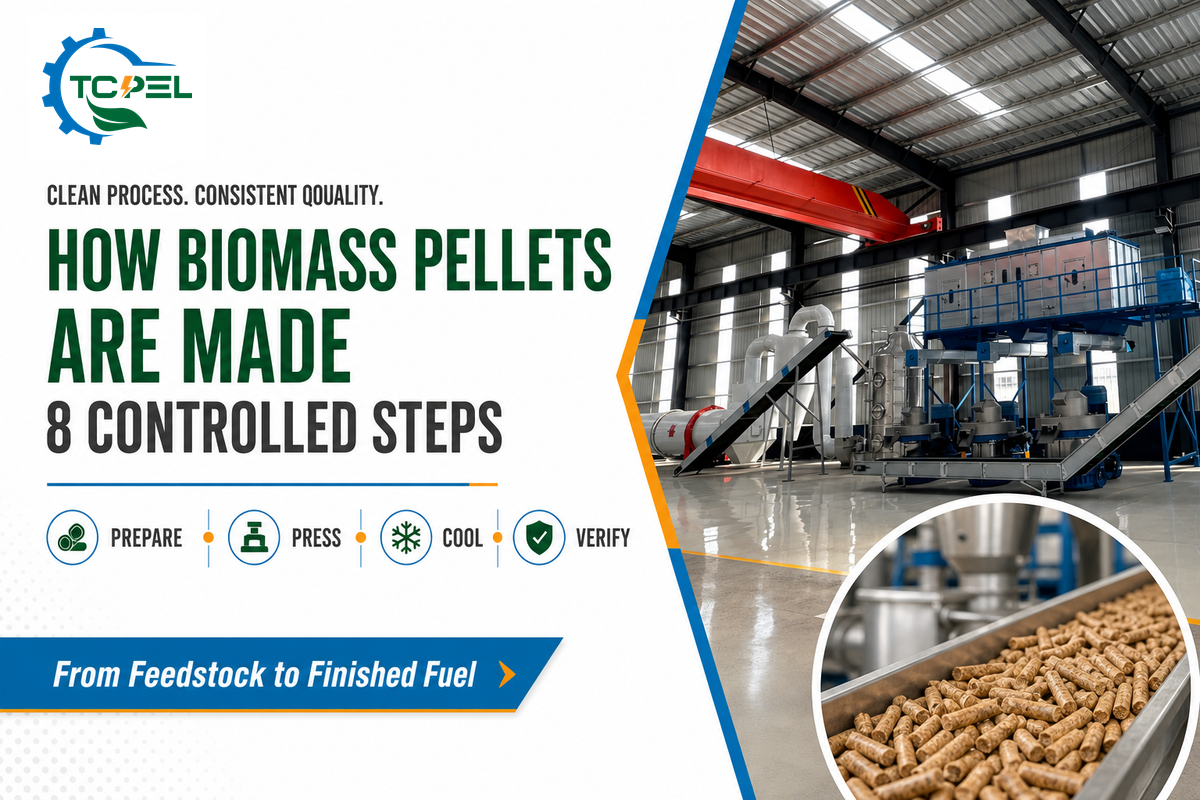
How are biomass pellets made means “What controlled industrial sequence converts prepared biomass into saleable pellets?” as a search question. Prepared biomass is cleaned, reduced to a controlled size, dried or conditioned to a pressable moisture range, compressed through a die, cooled, screened, tested, and packed. Every handoff matters because feedstock, water, particles, heat, and throughput interact.
Quick answer
Stable pellet production controls eight gates: receiving, pre-sizing, moisture balancing, fine grinding, conditioning, pelletizing, cooling and screening, then quality release. There’s no universal moisture or particle-size setting. Correct operating windows come from the raw material, mill and die combination, target specification, and trial evidence.
Biomass Pellet Process: Quick Specs
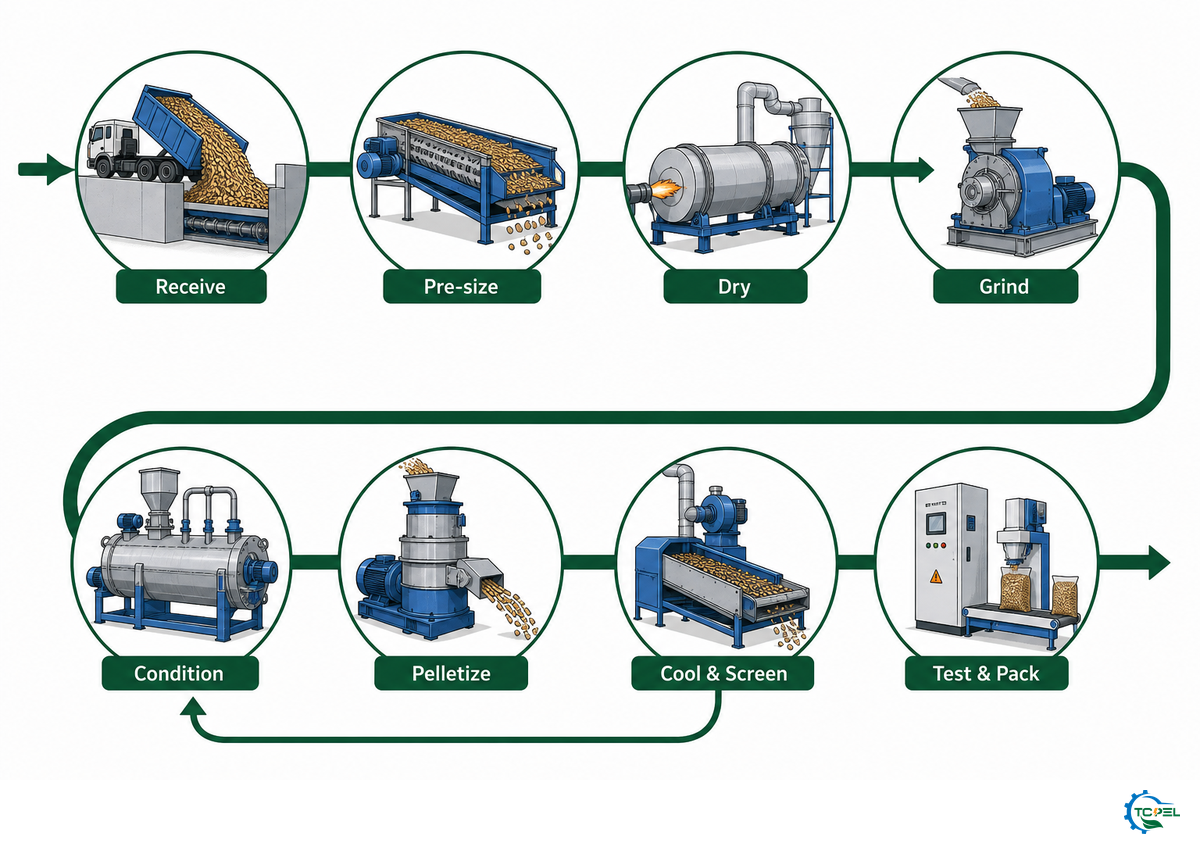
| Typical line order | Clean → pre-size → dry → grind → condition → pelletize → cool/screen → test/pack |
|---|---|
| Main control inputs | Feedstock identity, moisture, size distribution, ash/contamination, flow stability |
| Main process outputs | Throughput, energy use, temperature, fines, durability, density, moisture, ash |
| Key design rule | Size every upstream and downstream machine for the same sustained mass flow, including recycle |
Engineering note: Size the line on sustained saleable mass flow, including screened fines and planned recycle. An isolated pellet-press nameplate capacity is not the same as guaranteed finished-line output.
How Biomass Fuel Pellets Are Made, and What Changes in the Production Process
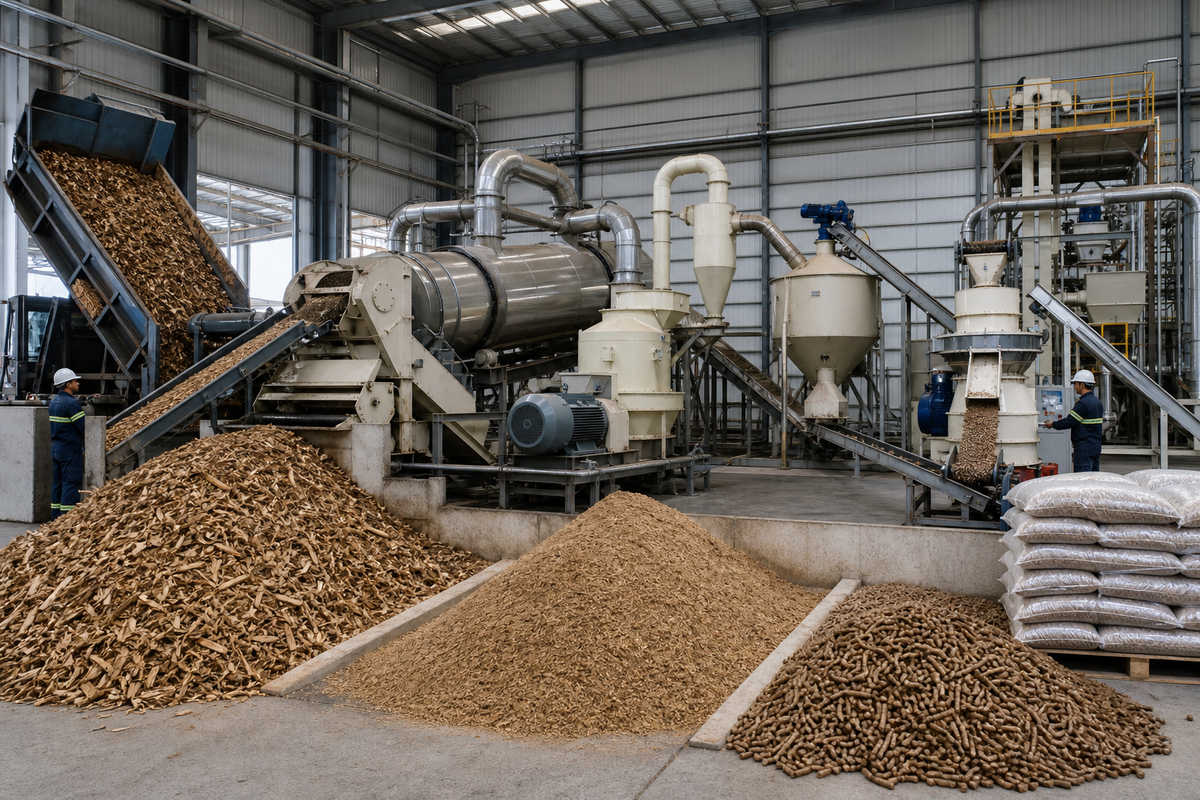
Across many plants, the basic sequence is consistent, but the settings are not. Penn State Extension describes preparation, moisture adjustment, milling, pellet formation, cooling, screening, and storage as linked operations. It also notes that feed size and moisture must suit the chosen pellet mill and material. That distinction is central: a flow diagram can be standard while the operating recipe remains feedstock-specific.
Terminology varies between buyers and regions. Engineers may call the same scope fuel pellet production, pellet making, or the fuel pellets production process. In this guide, capacidad de producción means sustained saleable output after cooling and fines removal—not the press nameplate alone. That definition prevents misleading comparisons between offers in the pellet market.
Keep the energy claim separate from the manufacturing claim. Biomass and bioenergy discussions may describe pellets as a renewable energy source, an energy source for power generation, or a solid biomass fuel source for energy production. This process guide does not establish that a specific supply chain is a carbon neutral fuel, meets renewable energy targets, or delivers a lifecycle carbon dioxide advantage over natural gas. Those questions require their own boundary, data, and policy evidence.
Pellet fuel is one densified form used in renewable energy and wider bioenergy systems, from domestic heating to selected power plants. Unlike a larger briquette, its small, repeatable geometry supports automated feeding. Projects may use biomass to displace or blend with fossil fuel, but a renewable label does not make every material suitable for every appliance. Biomass energy projects still need a declared fuel specification.
Inside the pellet mill, rollers force conditioned particles into die channels under high pressure. Friction and heat promote particle bonding. Natural lignin contributes to binding in woody material, but it does not erase poor preparation. Contamination, unstable moisture feed, erratic metering, or a mismatched die can still produce soft pellets, plugged channels, excessive fines, or a sharp rise in motor load.
| Gate | Operación | Question before release |
|---|---|---|
| 1 | Receive and clean | Is this lot identified, sampled, and free of harmful contamination? |
| 2 | Pre-size | Can the dryer and fine grinder accept the material safely? |
| 3 | Balance moisture | Is water removal or addition based on a measured mass balance? |
| 4 | Grind and screen | Is the full particle distribution acceptable, not just the average? |
| 5 | Condition and meter | Is feed to the press uniform enough for a stable load? |
| 6 | Compress through the die | Does the material–die combination hold throughput and quality? |
| 7 | Cool and screen | Are pellets stable before storage, and is the fines loop controlled? |
| 8 | Test and release | Does the lot meet the buyer’s declared fuel specification? |
Which Raw-Material Route Fits Wood Pellets, Biomass Wood Pellets, and Agricultural Residues?
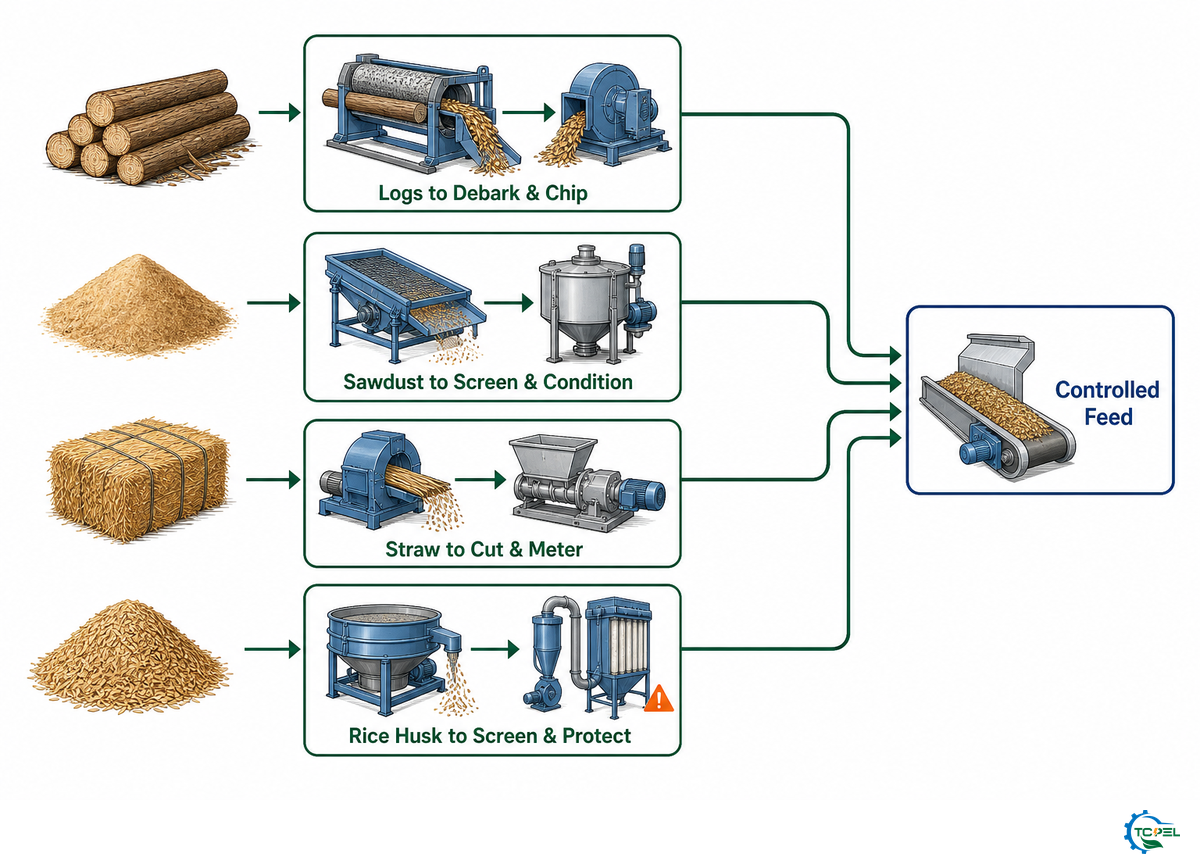
“Biomass” is a category, not a recipe. Clean sawdust may enter near the fine-grinding stage. Logs need debarking or contamination control and primary chipping. Straw needs cutting and reliable metering. Rice husk is already small but carries different ash and abrasion concerns. Fibrous palm residues may need shredding, drying, and repeated screening before they flow consistently.
Feedstock planning also starts outside the factory gate. Wood waste, energy crops, materials made from grass, and by-products from other biomass production systems may all be considered for biofuel production, but only after origin, contamination, seasonality, and contract volume are defined. The cost of feedstock should include sorting, rejected loads, storage loss, and preparation—not just the purchase price. Material sold for animal bedding follows a different use specification and should not be treated as combustion fuel without appropriate testing.
In 2025, a comparison of nine feedstocks under one laboratory protocol still found marked differences in pellet properties. Its useful lesson is not the laboratory’s single preparation setting; it is that identical treatment does not make unlike materials behave alike. Each plant should therefore define a route and acceptance evidence for every material family.
| Feedstock route | First preparation task | Main handoff risk | Evidence to record |
|---|---|---|---|
| Clean softwood sawdust | Screen and sample | Moisture drift | Lot moisture and screen profile |
| Hardwood sawdust | Segregate species mix | Higher press load | Motor load and durability trend |
| Sawmill chips | Dry and hammer mill | Uneven chip moisture | Multi-point moisture samples |
| Roundwood or branches | Debark as required, chip | Metal, stone, oversize | Contaminant and chip-size log |
| Construction wood | Sort and remove prohibited material | Coatings and hardware | Origin declaration and inspection |
| Wheat or rice straw | Cut and meter | Bridging and variable ash | Flow test and ash result |
| Corn stalk or stover | Bale break and cut | Field dirt and moisture spread | Ash and moisture distribution |
| Cáscara de arroz | Clean and meter | Silica-related wear | Wear inspection and ash result |
| Bagazo | Dewater and dry | High, uneven moisture | Inlet/outlet water balance |
| Fibra EFB de palma | Shred, dry, screen | Long fibre and contaminants | Fibre-length and contamination check |
| Grass or alfalfa | Cut and condition | Elastic fibre and seasonal change | Season-lot trial record |
| Blended residues | Dose each stream separately | Recipe drift | Mass ratio and feeder calibration |
Before selecting machinery, define the incoming size range, moisture distribution, hourly availability, contamination, ash, target pellet diameter, required fuel class, and destination packaging. You can use TCPEL’s feedstock readiness checker to organize those inputs before a line discussion.
Step 1: Receive, Sample, Clean, and Store the Biomass Feedstock
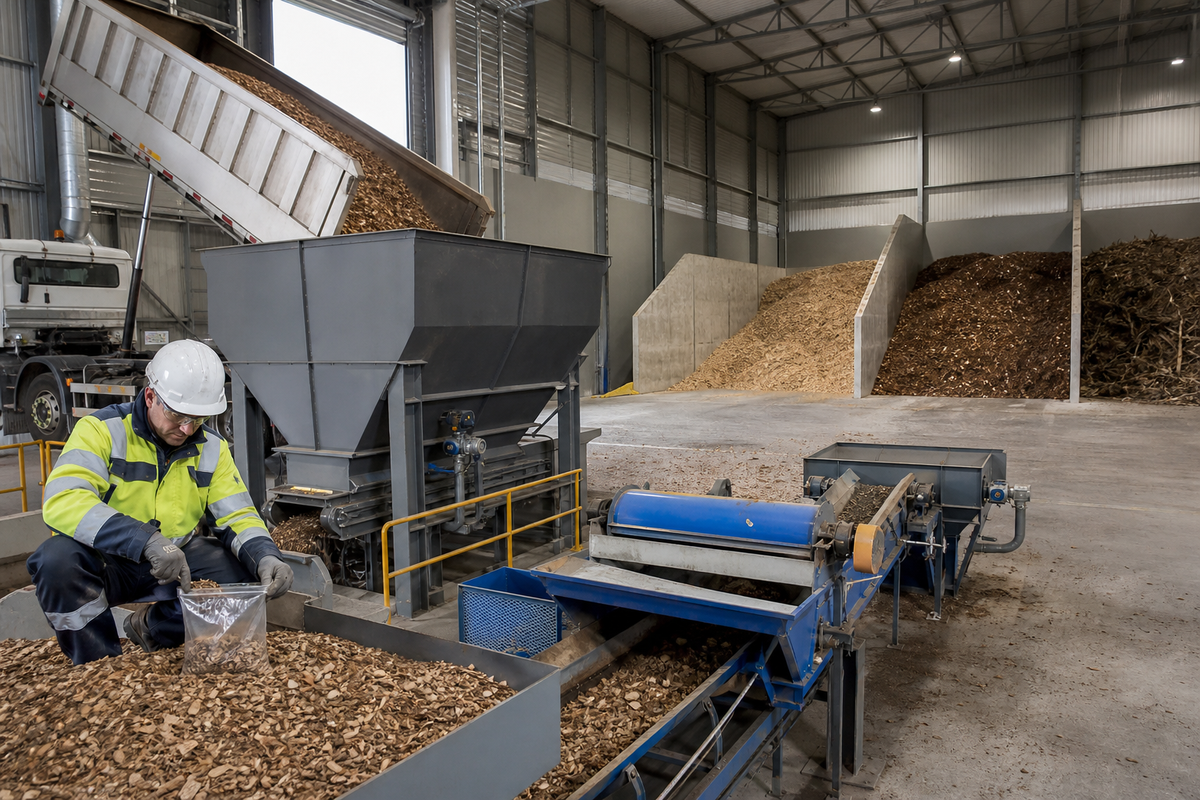
Pellet manufacturing begins at the weighbridge or receiving hopper, not at the pellet mill. Record the supplier, source, material family, arrival mass, visible condition, and sampling location. One surface reading is a weak basis for wet chips or baled residues because water can vary across a pile or bale. Use a sampling plan that captures different depths and positions, then retain a labelled counterpart sample when a disputed lot would matter commercially.
Remove tramp metal, stones, soil, plastic, and oversize debris before high-speed equipment. Magnets, stone traps, screens, and visual inspection protect more than the die: they also protect chippers, grinders, conveyors, and dust systems. Keep questionable or unusually wet lots segregated until testing is complete. Mixing first and investigating later turns a contained problem into a full-bin problem.
Plant quality managers interviewed by Revista Biomasa described in-house testing, retained samples, third-party correlation, and tracking across months and seasons. That practice is useful because an “average” certificate cannot explain a sudden operating change unless the incoming-lot record can be matched to press and finished-pellet data.
Gate 1 release record
Release the material only after identity, sample, moisture, contamination, and storage location are recorded. If a plant accepts several feedstocks, use separate bins or a controlled blending plan. First-in, first-out stock rotation and fire monitoring belong in the storage design, especially where warm material, dust, or biological activity could accumulate.
Step 2: Chip, Cut, or Pre-Break Oversize Material
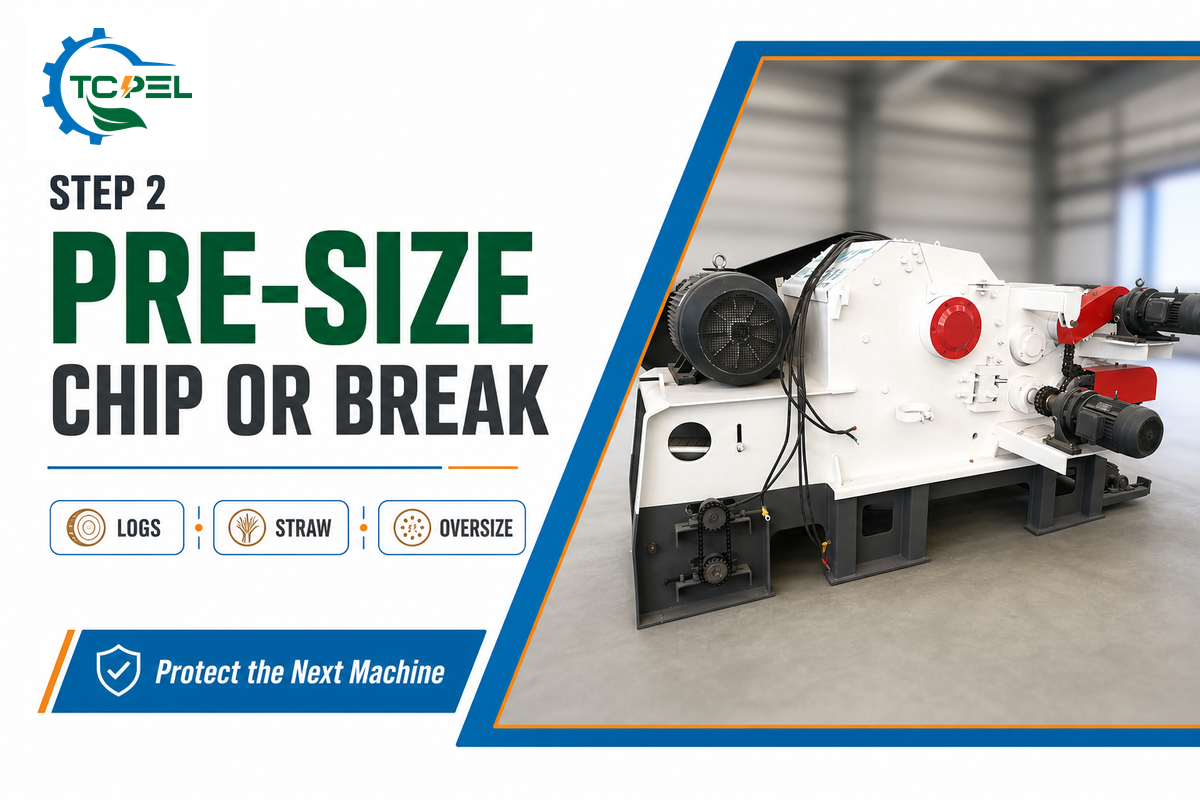
Primary sizing converts logs, slabs, branches, stalks, or fibrous residues into pieces the next machine can receive. It is not the final grinding step. Device choice depends on shape and toughness: drum chippers suit woody pieces, while bale breakers, shredders, or cutters are often more appropriate for straw and long fibre.
As a first-party equipment example, TCPEL lists drum-chipper configurations across a 3–60 t/h range and a nominal 30–50 mm chip output. Those figures describe that product family, not a universal pellet-line requirement. Actual targets must match dryer inlet limits, hammer-mill duty, raw-material shape, and the line’s sustained throughput.
Useful acceptance testing asks more than whether “the chipper ran.” Check the oversize fraction, long pieces, foreign material, current draw, and steady mass flow. Machines can meet nominal tonnes per hour while producing enough oversize to overload the next stage. For woody feedstocks, compare industrial drum chipper options for primary biomass sizing against the maximum input dimensions and downstream opening size.
Step 3: Calculate the Moisture Balance and Dry Only What Is Needed
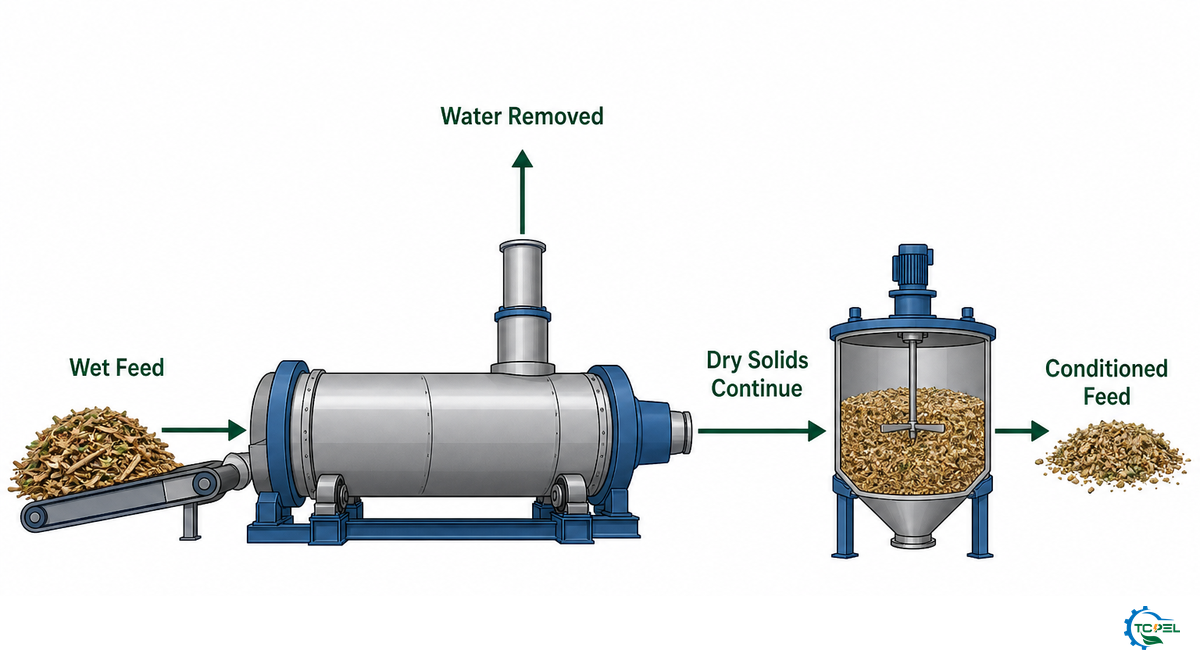
Dryer sizing begins with dry solids, not a remembered moisture percentage. Wet-basis moisture is the mass of water divided by total wet mass. If a feed stream changes from 45% to 35% moisture, the dryer duty changes even when the incoming mass flow stays the same. Final conditioning may also be needed after drying, so “dryer outlet moisture” and “pellet-mill inlet condition” should not be treated as one uncontrolled number.
1.000 kg/hincoming flow at 45% moisture
550 kg/hdry solids carried forward
375 kg/hwater removed to illustrative 12%
Worked example: moisture mass balance
Here is the full calculation. At 45% moisture, a 1,000 kg/h stream contains 550 kg/h dry solids and 450 kg/h water. If 12% is used only as an illustrative conditioned target, dry solids are 88% of the outgoing flow: 550 ÷ 0.88 = 625 kg/h. That stream contains 75 kg/h water, so the theoretical removal is 450 − 75 = 375 kg/h before leakage, evaporation outside the dryer, recycle, or other process losses. Replace 12% with a trial-supported target for the actual feedstock and press.
Heat for drying should therefore be sized from the water-removal duty and the material’s safe temperature window. A low moisture content is not automatically better: overdrying can waste energy, increase dust, and leave the press short of the condition that the selected feedstock and die need.
Published Idaho National Laboratory research illustrates why universal moisture rules fail. Its defined flat-die corn-stover route pelletized material at 33%, 36%, and 39% wet-basis moisture, then dried the formed pellets below 9%. That is not permission to run an industrial ring-die wood line at those values; it is evidence that moisture sequence can change with material and process design.
Measure inlet and outlet moisture often enough to see drift, and compare the result with dryer temperature, residence time, fuel use, and throughput. Overdrying wastes energy and can worsen handling or press behaviour. Underdrying may cause unstable feeding, low durability, plugging, or storage risk. For an engineered duty calculation, review industrial rotary-dryer sizing for biomass feedstocks using real inlet data rather than a catalogue capacity alone.
Step 4: Grind and Screen to a Controlled Particle Distribution
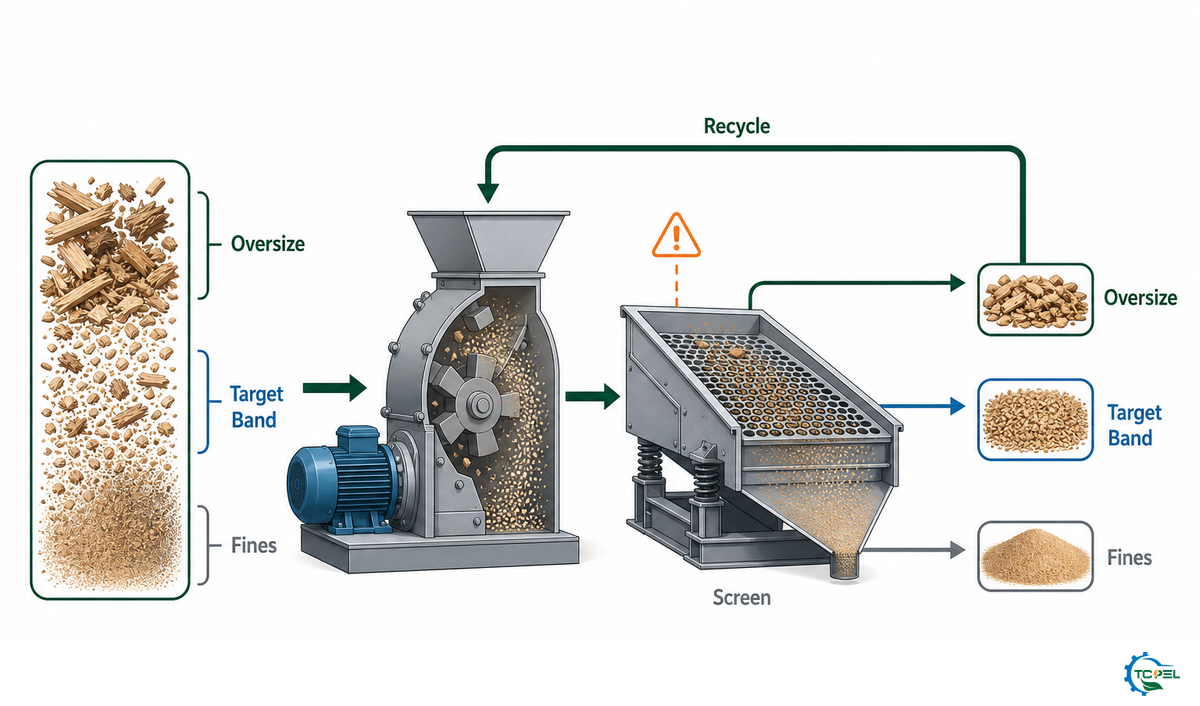
Fine grinding increases the contact area available for compaction and makes metering more predictable. Penn State cites particle sizes below roughly 3 mm as common guidance for many pellet mills, but immediately ties the suitable size to the equipment and material. Treat that number as a starting reference, not a purchase specification.
Research reviewed in BioResources in 2012 explains the less obvious part: smaller particles can increase friction, and laboratory density results do not always predict industrial behaviour. Excessive fines can also hurt quality. Operators therefore need the distribution—oversize, useful middle fraction, and fines—not just one average particle size.
Hacer
- Sample after the grinder under stable load
- Record the full sieve distribution
- Track screen wear and motor current
- Trial changes with the intended die
No
- Assume finer always means stronger
- Judge output from one handful
- Ignore long fibres in a low average
- Change screen and moisture together
When troubleshooting, change one controlled variable at a time. A new screen can alter both size distribution and throughput; a moisture correction can change grinder behaviour; recycled fines can change the apparent recipe. If all three move at once, the trial cannot identify the cause. See biomass hammer mills for controlled particle sizing when matching screen area and motor duty to the material.
Step 5: Condition the Feed Before the Pellet Machine
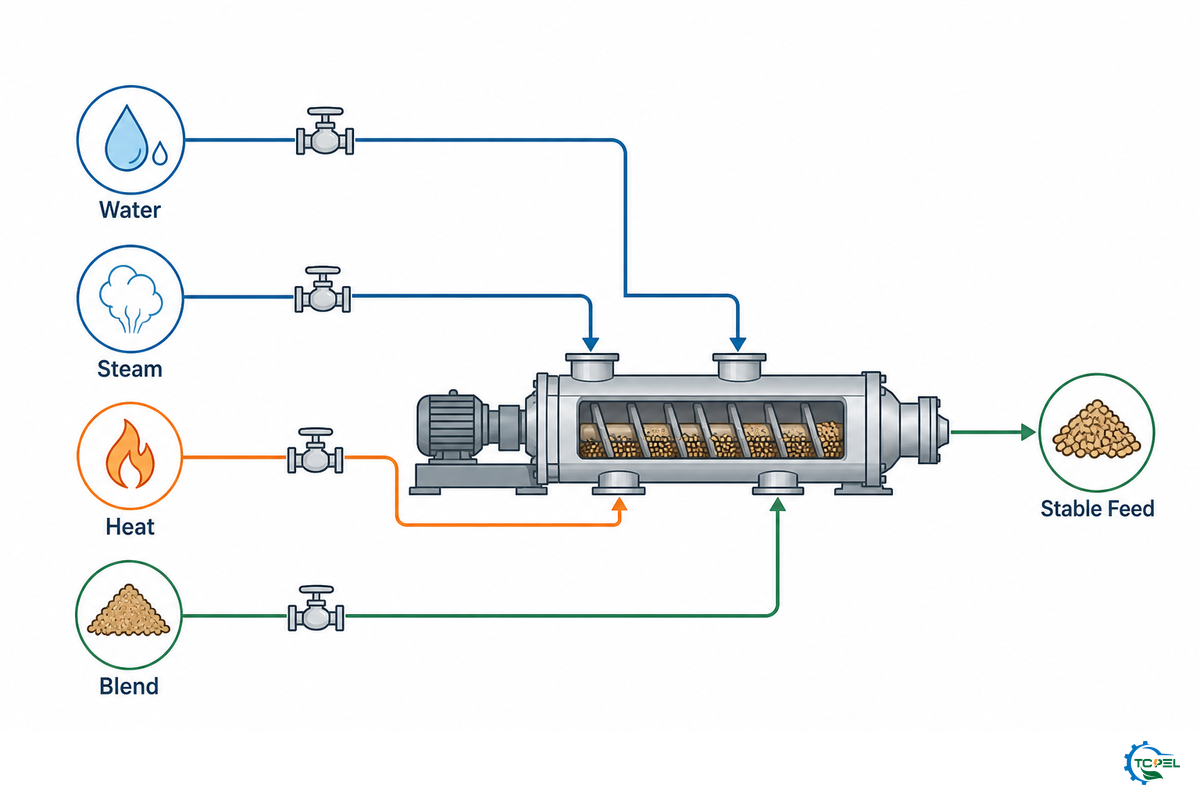
Conditioning helps create a relatively uniform and stable feedstock for the press. Depending on the feedstock, operating route, and available equipment, conditioning may involve injected water, steam, heating, material blending, a binder addition, simple mixing, or controlled residence time before the press. The aim is consistent flow, not an arbitrary “target value” that may hurt press performance.
While lignin in wood helps create bonds under heat and pressure, simply stating that “wood contains lignin” doesn’t constitute a viable process control. Lignin availability and behaviour vary with species, bark content, storage history, particle size, and moisture content. Similarly, agricultural residues behave differently from woody feedstocks due to differences in fibre structure, ash, extractive content, and natural binding properties. Binders should be used to solve a measured problem verified in carefully conducted trials, not to cover up dirt, metal, an improper grind, or unstable drying conditions.
No single ingredient always holds the pellet together. Bonding comes from the measured combination of material chemistry, particle contact, moisture, temperature, pressure, die resistance, and any permitted additive used in the validated recipe.
In the described high-moisture corn-stover flat-die experiment, adding 4% by weight of corn starch reduced specific energy usage by 20-40% compared with the control condition. That result is specific to that feedstock, test equipment, and procedure. While it provides a rationale for the approach, it isn’t a prescription for using binders with mixed agricultural and woody feedstocks in industrial ring-die production.
Conditioning trial record
Record these fields for every trial: incoming material, sieve distribution, wet-basis moisture method, addition rate, mixing time, feed temperature where measured, press motor load, tonnes produced, post-cooling fines, and finished-pellet test results. Keep the baseline recipe available for comparison. Without baseline data, even a short run that appears smooth can hide lower output or a heavier recycle load.
Step 6: Compress the Biomass Through a Die
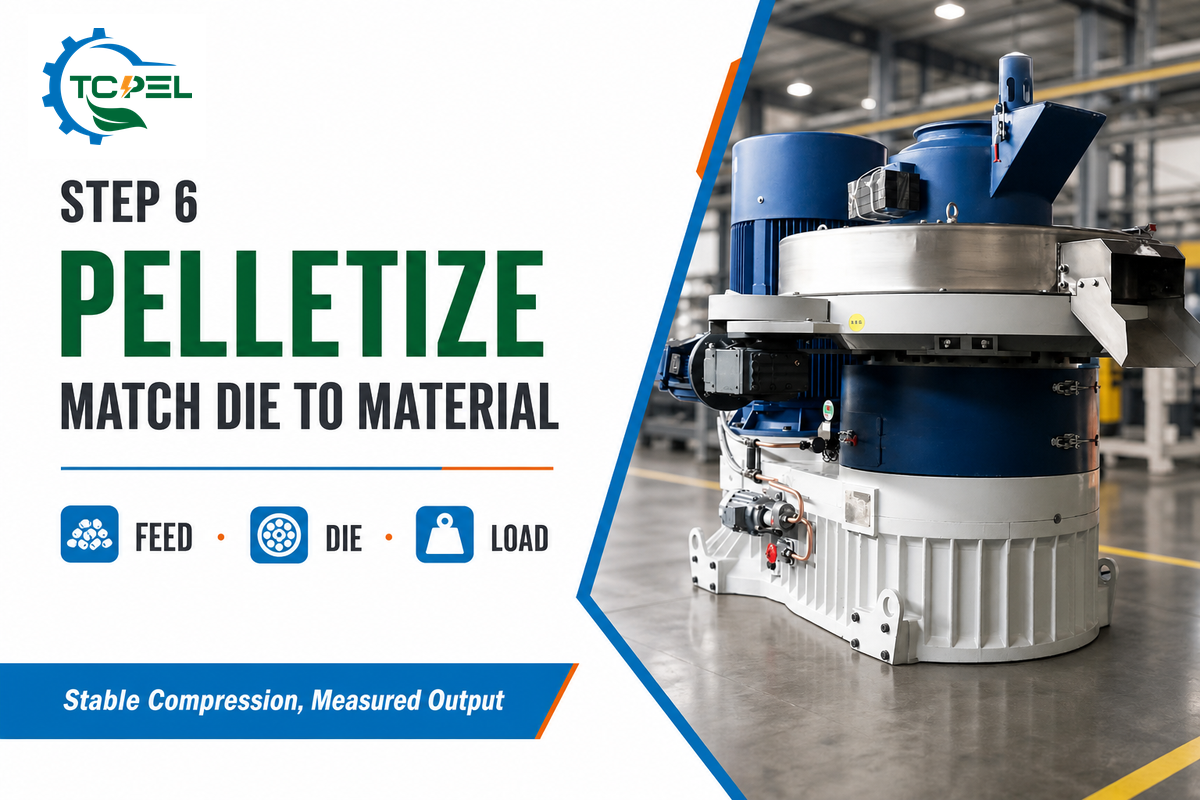
Conditioned biomass enters the press through a metering feeder. Rollers work the material across a flat or ring die, and the material is forced through channels that create the pellet’s diameter and resistance path. Knives cut the extruded strands to length. Operators watch load stability, feed rate, temperature trend, sound, vibration, blockage, and the appearance of fresh pellets.
Die choice is a material decision as much as a capacity decision. Channel geometry, effective compression, hole diameter, metal condition, roller clearance, and wear interact with the feed. A die-and-conditioning recipe developed for clean softwood may overload the press when applied to a high-ash residue; dies that make strong pellets may sacrifice output or energy efficiency if resistance is excessive.
TCPEL’s current range includes ring-die, vertical-ring-die, and flat-die configurations, with several models offering 6 mm or 8 mm output and other diameters on selected configurations. These are first-party product specifications. For a project-specific match, compare biomass pellet machine options for different feedstocks and output targets, then require a material trial and a written operating basis before final selection.
Commissioning tests should run long enough to expose heat build-up, feeding drift, recycle accumulation, and upstream bottlenecks. Record saleable output, not merely press discharge. If 1.0 t/h leaves the die but 12% returns as fines, packaging does not receive 1.0 t/h of product. Conveyor, cooler, screener, and dust-system capacities must be checked at the same operating point.
Step 7: Cool, Screen, and Control the Fines Loop
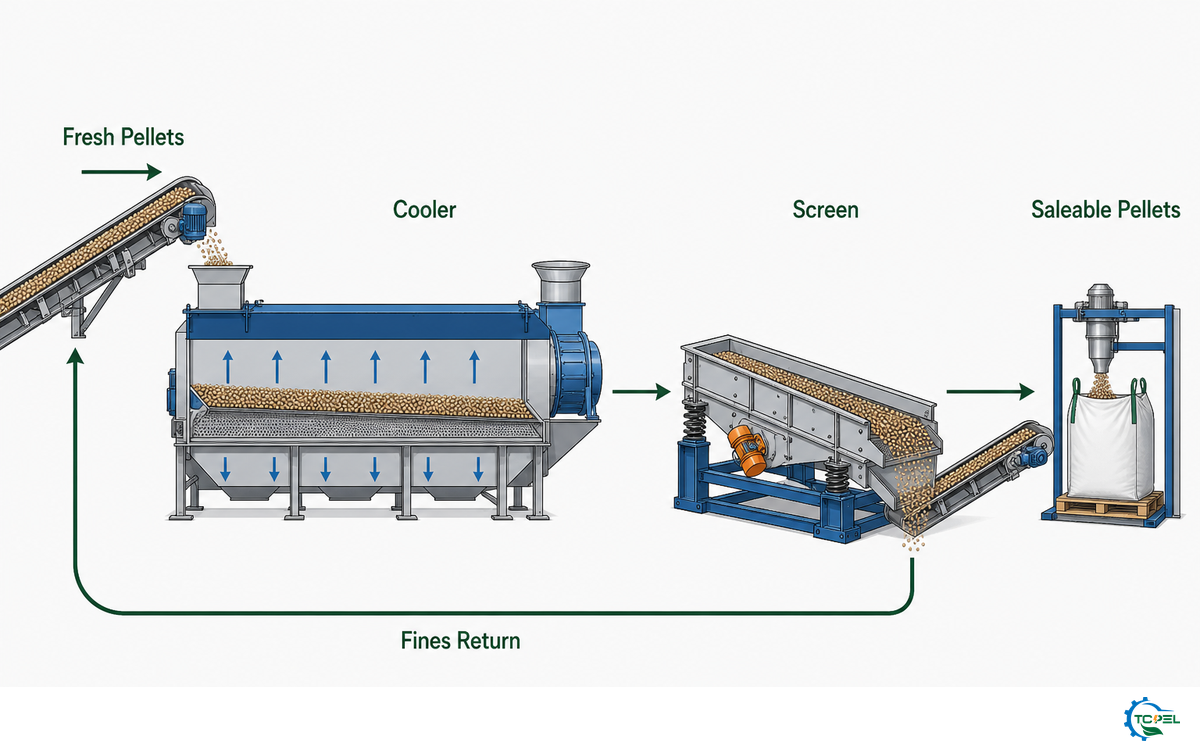
Fresh pellets are hot and mechanically vulnerable. One 2025 industrial study at two Swedish plants reported press-exit temperatures around 70–90°C and described a common cooling aim near ambient temperature plus 5°C. That work found that air temperature and airflow affected durability, hardness, cracks, and storage behaviour. Those plant observations are bounded evidence, not a universal cooler setpoint.
Cooling too gently can leave a warm, unstable product; very cold or aggressive airflow can increase thermal stress and cracking. Control residence time, airflow, bed depth, inlet condition, and discharge temperature as a system. Compare cooler inlet and outlet samples rather than assuming every broken pellet came from the press.
After cooling, a screener removes loose fines and off-size pieces. Some screened material may return to the process, but recycled material still counts toward mass flow. Unmeasured recycle can quietly overload the conditioner or press, concentrate dry material, and distort reported yield. If finished pellets produce excessive fines during handling, sample before and after each transfer rather than blaming the press first. Install a sampling point and either measure the return stream or estimate it through timed mass checks. For equipment layout, see counterflow pellet coolers for post-die stabilization.
Storage and transportation begin at the cooler discharge. Do not load a silo or sealed bag with pellets that are still warm, wet, or shedding excessive fines. Record the condition at the cooler outlet and again at packing so damage caused by conveying or drop height is not blamed on the press.
Industry practitioners have warned that conveyors, loading, unloading, and screening can drive downtime even when attention is fixed on the dryer and press. Respond with a capacity-chain test: run receiving, thermal processing, grinding, pressing, cooling, screening, recycle, and packing together and identify the first stage that cannot sustain the target. That bottleneck, rather than the largest nameplate figure, sets sustained pellet plant output.
Step 8: Verify Pellet Quality, Emissions-Relevant Properties, Pack, and Store
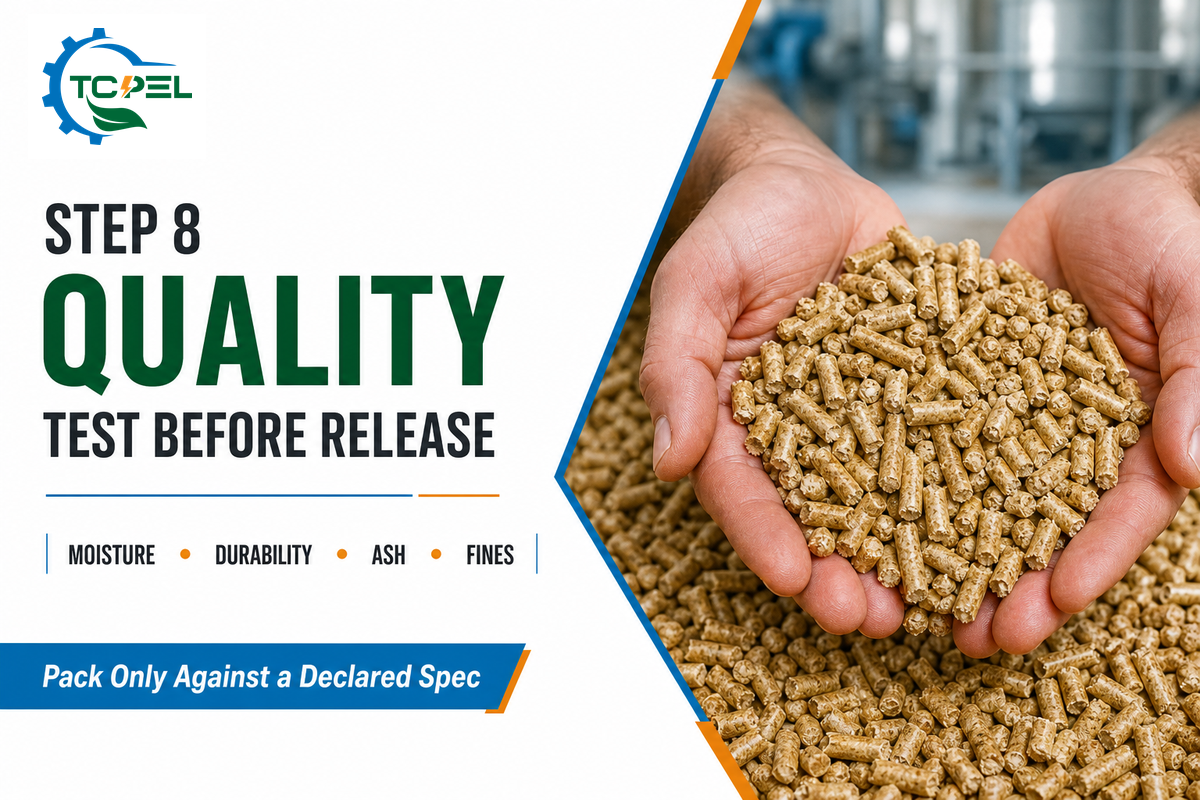
Finished pellets are released against a declared end-use specification, not their appearance. Requirements may differ among domestic heating fuel, industrial boiler fuel, non-woody pellets, export cargo, and a buyer’s private contract. Define the governing document and sampling method before production. Otherwise, the plant may improve a property the buyer does not use while missing one that controls acceptance.
Pellets are typically selected for a stated heating system, and pellets are commonly used in pellet boilers, residential and industrial boilers, wood pellet stoves, and selected power-generation systems. Buyers who use biomass pellets for cooking and heating should confirm that the fuel class, appliance instructions, local rules, and storage design agree; the fact that a pellet burns does not prove that it suits every appliance.
Combustion efficiency and emissions belong to the end-use system, not the pellet shape alone. Pellets can emit carbon dioxide and particulate matter during combustion, while ash chemistry and operating conditions can change the result. Any claim about production and use should therefore name the fuel class, appliance, test method, and comparison boundary.
PFI’s 2022 specification for residential and commercial densified woody fuel includes mandatory properties such as fines, bulk density, diameter, length, heating value, chloride, moisture, durability index, ash, and heavy metals. This scope matters: it should not be presented as a catch-all standard for every agricultural or industrial pellet.
ISO 17225-2:2021 defines graded wood-pellet classes for listed woody raw materials and excludes thermally treated pellets from that part’s scope. ENplus ST 1001:2022 applies its A1, A2, and B framework within the ENplus wood-pellet scheme. Confirm the current contractual edition and the exact class table with the certifier or buyer rather than copying limits from a secondary web page.
| Release decision | Relevant ISO document | How to use it |
|---|---|---|
| General fuel classification | ISO 17225-1:2021 | Define the applicable biomass origin and general class before choosing product-specific limits. |
| Wood or non-woody class | ISO 17225-2:2021 for wood; ISO 17225-6:2021 for graded non-woody pellets | Do not transfer a wood-pellet class table to grass, fruit, aquatic biomass, or an undeclared blend. |
| Routine moisture | ISO 18134-2:2024 | Use an agreed wet-basis method and sampling plan for production control. |
| Durabilidad mecánica | ISO 17831-1:2025 | Test resistance to handling and abrasion with the contractual edition. |
| Ash and energy value | ISO 18122:2022 for ash; ISO 18125:2017 for calorific value | Match laboratory results to the buyer’s declared property limits and reporting basis. |
| Minor elements | ISO 16968:2015 | Use when the fuel class or contract requires trace-element evidence. |
This crosswalk is not an automatic test package. The buyer, certifier, or governing scheme must identify the applicable properties, editions, limits, sampling rules, and competent laboratory. A plant should not claim conformance merely because it measured the same property by a different method.
Use calibrated tests and a traceable lot code. At minimum, the release plan should connect the sample to production time, feedstock lot, recipe, die, operator, and packaging batch. Retain results long enough to investigate storage or customer complaints. Pack only cooled, screened product in packaging suited to the route; protect bags or bulk material from rain, condensation, broken pallets, and cross-contamination. Review pellet packing equipment only after bag size, weighing tolerance, dust control, and hourly saleable output are defined.
Variable Feedstocks Raise the Evidence Bar: The 8-Gate Feedstock-to-Pellet Control Map
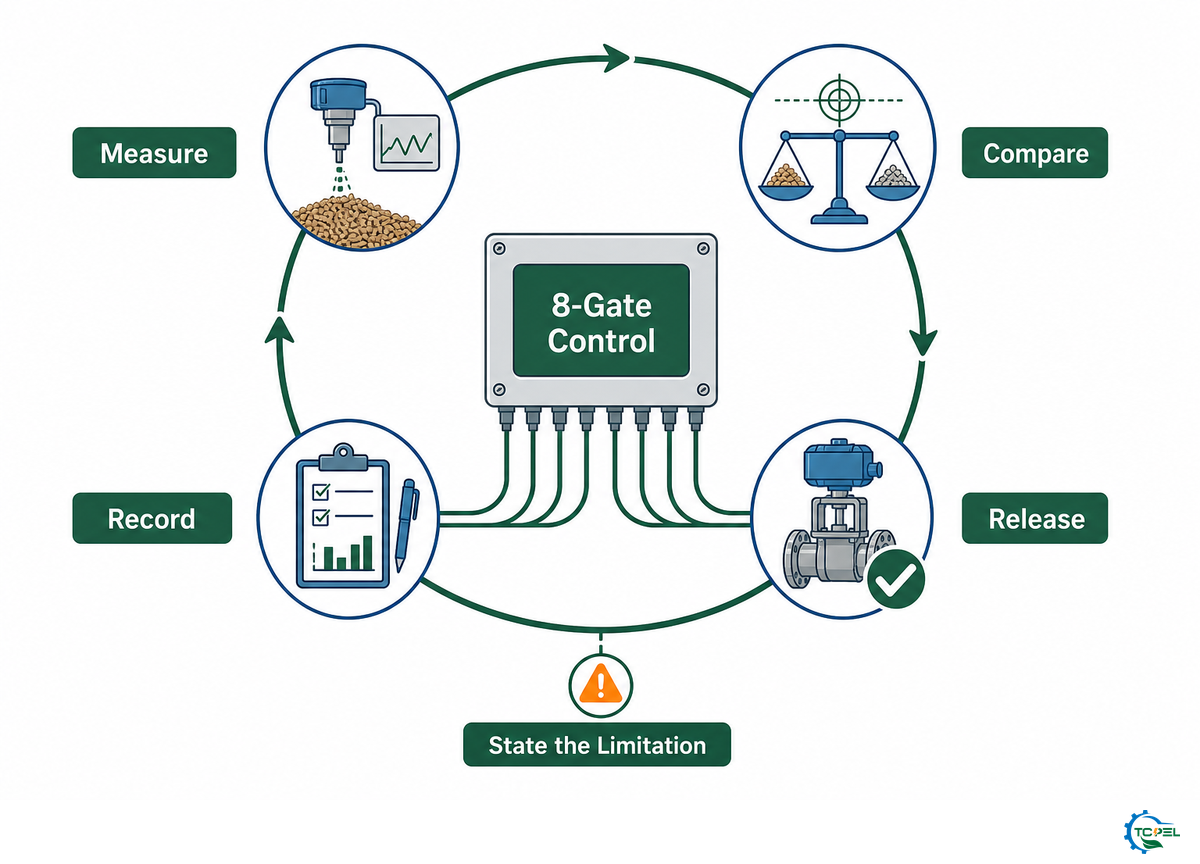
Strong process-control plans pair each gate with a measurement, a release decision, and a stated limitation. This makes a trial transferable to procurement and operations. It also prevents a supplier’s maximum machine capacity from being mistaken for guaranteed line output on an untested residue.
| Gate / decision | Measure | Release evidence | Limitation |
|---|---|---|---|
| 1. Material identity | Origin and composition | Supplier and lot record | A name does not capture seasonal variation |
| 1. Contamination | Metal, stone, soil, prohibited matter | Inspection and removal log | Visual checks miss chemical contaminants |
| 2. Primary size | Oversize and long-piece fraction | Representative screen result | One sample may miss feeder surges |
| 3. Inlet moisture | Wet-basis distribution | Multi-point sample and method | Surface meters may not represent the pile |
| 3. Dryer duty | kg/h water removed | Dry-solids mass balance | Theoretical duty excludes process losses |
| 4. Fine size | Full sieve distribution | Oversize/middle/fines profile | Average size hides tails |
| 5. Conditioning | Addition rate and mixing stability | Calibrated feeder and batch record | Short trials may miss drift |
| 6. Press load | Current, throughput, temperature trend | Stable run log | No-load ratings do not predict material response |
| 6. Die match | Geometry, wear, pellet response | Feedstock trial with named die | A result may not transfer to another material |
| 7. Cooling | Inlet/outlet temperature and airflow | Paired sample and cooler log | Ambient conditions change performance |
| 7. Fines loop | Return mass per hour | Timed mass check | Intermittent recycle can be missed |
| 8. Lot release | Contracted fuel properties | Traceable lab result and lot code | A certificate applies only to the sampled lot |
This map can be copied into a factory acceptance test. Add the agreed sample count, test method, acceptance band, responsible party, and action to take after a failed result. Then run the whole biomass pellet production line configuration at the promised sustained condition. Trials on the pellet press alone cannot prove cooler, screening, recycle, or packing capacity.
Conclusión clave
Biomass pellets are made by controlling eight handoffs; the winning line is the one that holds saleable quality and mass flow with the buyer’s actual feedstock, not the one with the highest isolated nameplate capacity.
FAQ: Biomass Pellets, Pellet Stoves, Boiler Fuel, Binders, and Home Production
¿Qué materias primas se utilizan para fabricar pellets de biomasa?
Answer
Common inputs include clean sawdust, wood chips, forestry residues, straw, corn stover, rice husk, bagasse, palm residues, grass, and selected blends. The acceptable source depends on the intended fuel specification and combustion system. Woody and agricultural materials can’t be treated as interchangeable: ash chemistry, contamination, fibre form, moisture behaviour, abrasion, and natural binding response can differ. Before equipment selection, document the material’s origin, seasonal range, hourly supply, size distribution, wet-basis moisture, ash, contaminants, and the finished-pellet requirements.
¿los pellets de biomasa necesitan un aglutinante?
Answer
No siempre. Muchas materias primas leñosas pueden formar gránulos duraderos a través de la presión, el calor por fricción, el entrelazado mecánico y la contribución de la lignina natural cuando las condiciones de preparación y matriz son adecuadas. Un aglutinante puede ayudar a un residuo específico de baja unión o difícil, pero debe evaluarse mediante una prueba controlada y compararse con las reglas de combustible del comprador. Primero descarte humedad inestable, distribución incorrecta de partículas, contaminación, medición deficiente, herramientas desgastadas o un troquel que no coincida. Registre la identidad y la dosis del aglutinante para que la calidad y las propiedades relevantes para las emisiones sigan siendo rastreables.
¿Puedo hacer pellets de biomasa en casa?
Answer
Las máquinas pequeñas de matriz plana pueden producir pellets a escala de taller o granja, pero la prensa es sólo una parte de la tarea. El material aún debe estar limpio, dimensionado correctamente, medido para detectar humedad, alimentado consistentemente, enfriado, tamizado y almacenado de manera segura. El polvo, la maquinaria giratoria, los pellets calientes, el riesgo de incendio, la carga eléctrica y la madera tratada inadecuada hacen que los experimentos casuales sean peligrosos. Comience con un material limpio conocido y el rango operativo documentado del fabricante de la máquina. Si los pellets se venderán o quemarán en un aparato específico, pruebe el combustible terminado en lugar de juzgarlo únicamente por su forma.
¿qué contenido de humedad es mejor para fabricar pellets de biomasa?
Answer
There’s no defensible universal value. The suitable inlet condition depends on material, particle distribution, conditioning route, die geometry, press scale, and target quality. Published routes range widely, including a high-moisture flat-die corn-stover study that formed pellets before final drying. Use a bounded starting window from the equipment supplier and literature, then establish the operating range through measured trials. Specify whether every number is wet-basis or dry-basis and distinguish dryer outlet from conditioned press inlet. For a useful trial, sample the same feed at several points, state the test method, and change one variable at a time. Hold the die, screen, feed rate, and recycle policy steady while moisture changes. Record motor load, stable throughput, fresh-pellet appearance, cooled fines, durability, and any blockage. Repeat the winning condition with a new material lot before calling it an operating window. A value that works during a short warm-weather run may shift when storage age, ambient humidity, species mix, or residue source changes. Dryer control should therefore use a measured range and response plan, while the purchase specification should state the feedstock envelope used to prove capacity.
Why do biomass pellets crumble after leaving the pellet mill?
Answer
Crumbling can begin upstream, in the die, or during handling. Compare samples at the press discharge, cooler outlet, and packing point. Then check moisture distribution, particle tails, conditioning stability, die wear, press load, cooler airflow, drop heights, screen action, and recycle rate. The first location where fines rise identifies the stage to investigate.
Are wood pellets and biomass pellets the same?
Answer
No. Wood pellets are one biomass-pellet category. Agricultural residues can have different ash, chemistry, durability, and combustion behaviour, so match the declared fuel class to the stove or boiler specification.
About TCPEL
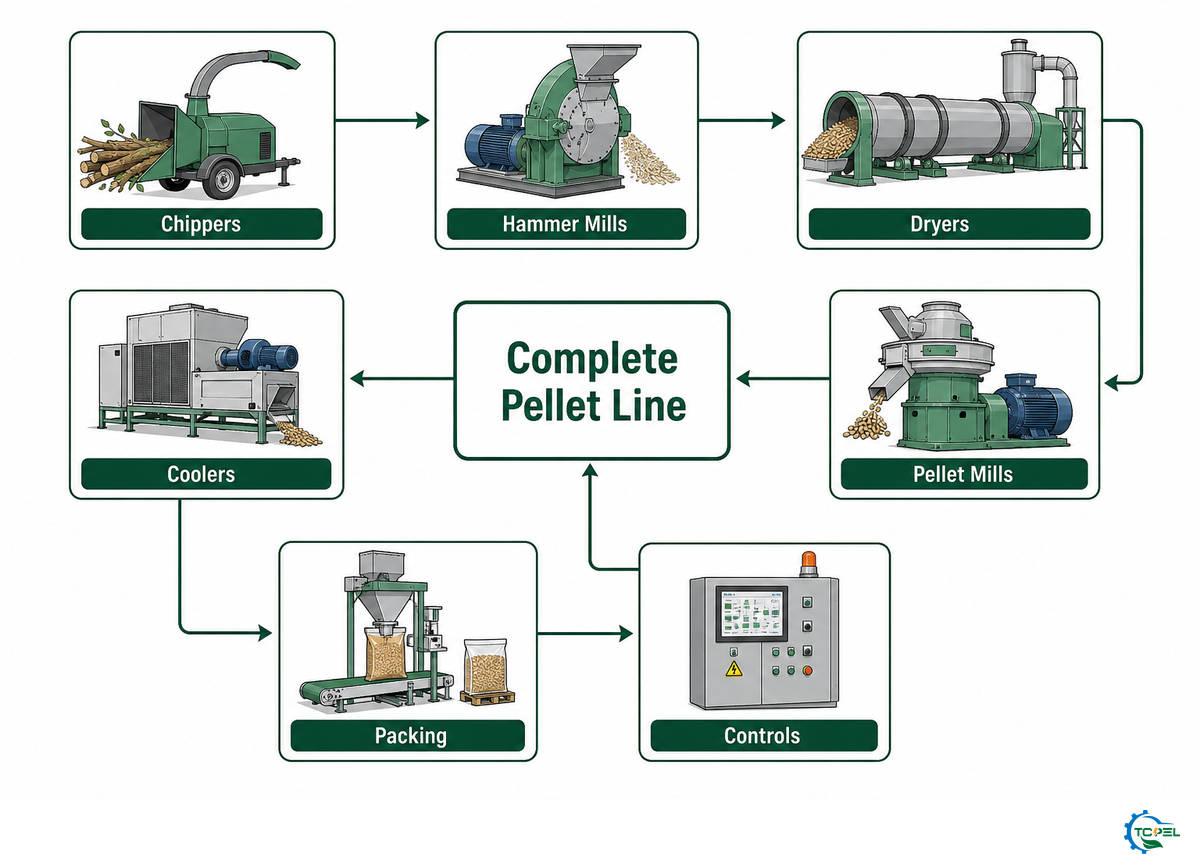
TCPEL is the machinery brand of ALLWIN INTERNATIONAL CO., LTD, a China-based pellet-equipment manufacturer operating since 2020. The user-provided company profile states that the company operates a 20,000 m² factory, employs more than 100 workshop staff, and exports to more than 60 countries and regions. Its equipment scope covers drum chippers, hammer mills, rotary dryers, pellet machines, feed pellet machines, production lines, coolers, and packing machines. This article separates those first-party company facts from independently sourced process and standards evidence.
Plan the Line Around Your Material

Send a representative raw-material description, current and seasonal moisture range, hourly availability, target pellet diameter, required standard, destination voltage, desired saleable output, and packaging format. TCPEL can use those inputs to discuss a preparation route and test basis.
Artículos relacionados
Referencias y fuentes
- Penn State Extension. Fabricación de pellets de combustible a partir de biomasa.
- North Carolina State Extension. Energy Pellets: A Heating Fuel Resource for North Carolina Farms and Homes.
- Stelte et al. Recent Developments in Biomass Pelletization. BioResources, 2012.
- Idaho National Laboratory research team. High-moisture corn-stover pelletization study, 2016.
- BioResources. Impact of cooling air temperature and airflow on wood fuel pellets, 2025.
- Agriculture. Comparative pelletization study of nine biomass feedstocks, 2025.
- International Organization for Standardization. ISO 17225-2:2021.
- Pellet Fuels Institute. Standard Specification for Residential/Commercial Densified Fuel, October 4, 2022.
- European Pellet Council. ENplus ST 1001:2022.
[DOC_01]
POR QUÉ ESCRIBIMOS ESTO
TCPEL publica guías de compra basadas en ingeniería para proyectos de biomasa, madera y pellets de alimentación. Escribimos para propietarios de plantas, equipos de adquisiciones, ingenieros de proyectos y distribuidores que necesitan información práctica antes de seleccionar máquinas de pellets, secadoras, molinos de martillos, refrigeradores o una línea de producción completa. Nuestro objetivo es explicar las variables reales del proceso detrás de la producción de pellets, incluido el tamaño de la materia prima, el contenido de humedad, la capacidad objetivo, el diámetro de los pellets, la coincidencia de líneas, la planificación de piezas de repuesto y la estabilidad operativa a largo plazo.
[DOC_02]
SOBRE NUESTRO NEGOCIO
TCPEL es la marca de maquinaria de pellets de ALLWIN INTERNATIONAL CO., LTD., un fabricante con sede en el distrito de Zhangqiu, Jinan, Shandong, China. Fundada en 2020, la empresa opera una fábrica de 20.000 metros cuadrados con coordinación interna de investigación y desarrollo, producción, ventas y posventa. Su gama de productos cubre máquinas de pellets de madera, molinos de pellets de biomasa, máquinas de pellets de alimentación, trituradoras de tambor, trituradoras de madera, molinos de martillos, secadores rotativos, enfriadores de pellets, máquinas empacadoras y líneas completas de producción de pellets. TCPEL afirma que ha abastecido a clientes en más de 60 países y regiones.
[DOC_03]
NUESTROS SERVICIOS
Apoyamos a los compradores desde la evaluación temprana del proyecto hasta el seguimiento posterior al envío. Esto incluye revisión de materias primas, coincidencia de capacidad, recomendación de lista de máquinas, configuración completa de la línea, personalización de voltaje y documentos de exportación, producción y pruebas, coordinación de envío, asistencia de instalación y puesta en servicio, y soporte de repuestos. Los compradores pueden comunicarse con el equipo por correo electrónico o WhatsApp y, según la página de contacto de la empresa, normalmente reciben una respuesta dentro de las 12 horas hábiles.
PELLET DE BIOMASA
PELLET DE MADERA
ALIMENTAR PELLET
LÍNEA LLAVE EN MANO
FÁBRICA CHINA
PROVEEDOR EXPORTADOR
PERFIL DEL FABRICANTE // ESPECIFICACIONES
NICHO
Maquinaria para pellets de biomasa, madera y piensos
ROL
Fabricante de máquinas de pellets / Proveedor de líneas de pellets llave en mano
MARCA
TCPEL
EMPRESA
ALLWIN INTERNACIONAL CO., LTD.
UBICACIÓN
Distrito de Zhangqiu, Jinan, Shandong, China
ESTABLECIDO
2020
HUELLA DE FÁBRICA
20.000m2
EQUIPO
Más de 100 empleados del taller
ALCANCE DEL PRODUCTO
Máquinas de pellets de madera, Molinos de pellets de biomasa, Máquinas de pellets de alimentación, Astilladoras de tambor, Trituradoras de madera, Molinos de martillos, Secadores rotativos, Enfriadores de pellets, Máquinas empacadoras, Líneas completas de producción de pellets
RANGO DE CAPACIDAD DE LÍNEA
Rango de rendimiento de línea completa de 0,5-20 T/H
EXPORTAR ALCANCE
Más de 60 países y regiones
RESPUESTA A LA CONSULTA
Dentro de las 12 horas hábiles
DIRECCIÓN
East Side, Second Factory, Parque Industrial Zhangjia, Calle Mingshui, Distrito Zhangqiu, Ciudad de Jinan, Provincia de Shandong, China 250203
«SYSTEM LOG//ACTION
Comience su proyecto Pellet
Comuníquese con los ingenieros de TCPEL para una evaluación temprana del proyecto, coincidencia de capacidad, configuración completa de la línea y cotización basada en sus materias primas.
Contáctenos ->
Publicaciones relacionadas
Tendencia ahora