
Póngase en contacto con TCPEL

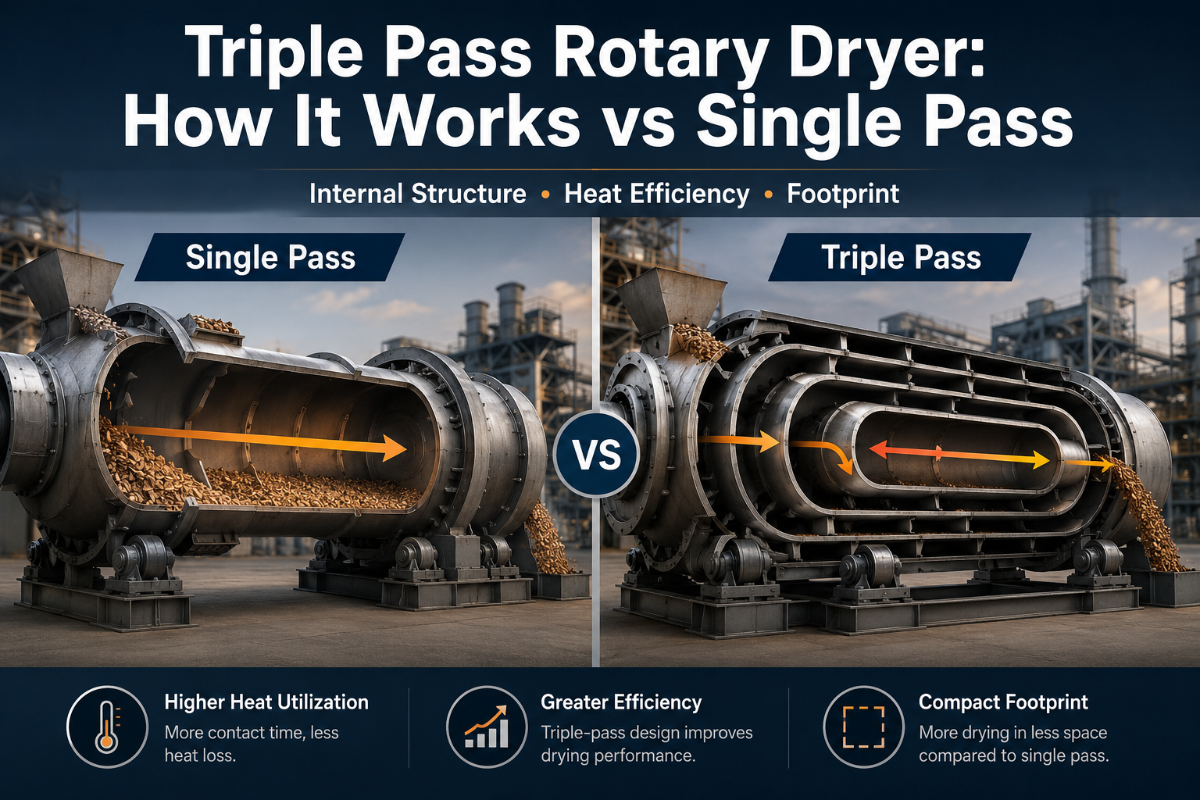
Una secador rotativo de triple paso transporta material húmedo a través de tres tambores anidados — interior, central y exterior — por lo que una longitud de máquina proporciona una longitud de contacto de secado equivalente a tres tambores. Ese anidamiento explica por qué un secador de triple paso ocupa mucho menos espacio en planta que un tambor largo de un solo paso y por qué se ha convertido en la opción predeterminada para el aserrín, las astillas de madera y otra biomasa ligera que alimenta una línea de producción de pellets. Esta guía explica cómo funciona realmente el diseño de tres pasos, cuándo supera a un secador de un solo paso (y cuándo no), qué costos implica en energía y mantenimiento y cómo dimensionarlo para su material.
Especificaciones rápidas: secador rotativo de triple paso típico
| Configuración de tambores | 3 cilindros concéntricos/anidados (interior → central → exterior) |
| Flujo de gas | Flujo concurrente, trayectoria hacia afuera-hacia adentro-hacia afuera; velocidad del aire normalmente situada en torno a 0,5–2,5 m/s |
| Humedad de entrada | Biomasa ligera normalmente 50–63% (base húmeda) |
| Humedad de salida | ~10–15% para peletización |
| Rango de capacidad | ~2,6–115 t/h (según el modelo) |
| Temperatura máxima del gas de entrada | ~700–750 °C (combustión directa) |
| Materiales más adecuados | Aserrín, virutas de madera, astillas de madera, biomasa ligera |
Las cifras son intervalos típicos; los valores exactos dependen del material, la capacidad de procesamiento y la fuente de calor. Solicite a cualquier proveedor una prueba de secado con su propia materia prima antes de comprometerse.
¿Qué es un secador rotativo de triple paso?
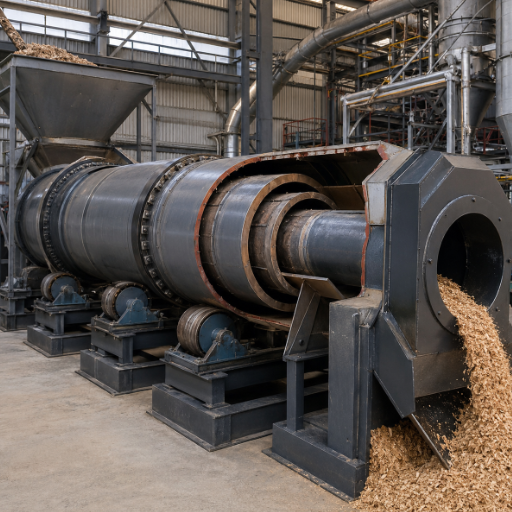
Un secador rotativo de triple paso es un secador de tambor rotativo compuesto por tres tambores de distintos diámetros anidados uno dentro de otro, que giran como un único cuerpo rotativo. El material húmedo y el gas caliente entran juntos y recorren una trayectoria hacia afuera-hacia adentro-hacia afuera: bajan por el tambor interior, regresan por el tambor central y avanzan de nuevo por el tambor exterior antes de la descarga. Como el gas atraviesa el material tres veces en una sola carcasa, este diseño también se comercializa como secador de tres tambores, secador de tambor de triple paso o secador rotativo de 3 pasos.
El objetivo de todo ese anidamiento es el contacto. Las paletas elevadoras internas de cada tambor levantan el material y lo hacen caer en cascada a través de la corriente de gas caliente, y los tres pasos proporcionan aproximadamente tres veces la longitud de contacto del secado rotativo convencional para una superficie dada. Esa única idea — llámela la trayectoria del gas hacia afuera-hacia adentro-hacia afuera — impulsa cada ventaja práctica de la máquina: su huella compacta, su comportamiento energético y, como verá, sus contrapartidas de mantenimiento. Para conocer la posición de este secador entre otros tipos de secado, consulte nuestra descripción general de tipos de secadores rotativos.
Cómo funciona la trayectoria del flujo de aire de triple paso
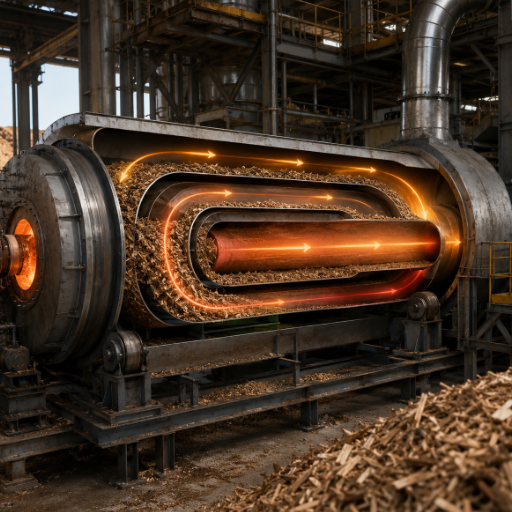
El gas caliente de un horno o calentador de aire es aspirado a través del secador por un ventilador de tiro inducido. El material húmedo entra primero en el tambor más interior, donde se preseca con mayor rapidez en contacto con el gas más caliente. A medida que el cuerpo gira, las paletas elevadoras internas levantan el material y lo dejan caer a través del gas formando una cortina, donde ocurre la mayor parte de la transferencia de calor y humedad.
Lo que distingue a la versión de tres pasos es lo que hace el gas entre los tambores. Cada tambor sucesivo tiene una sección transversal mayor, por lo que, a medida que el gas se expande desde el interior hacia el exterior, su velocidad cambia entre los pasos. El flujo concurrente — gas y material moviéndose en la misma dirección — es el estándar para biomasa, porque mantiene el gas más caliente alejado del polvo más seco y más inflamable en el extremo de descarga .
¿Cómo funciona un secador rotativo de triple paso?
En resumen: el material se desplaza con el gas a través de tres tambores anidados mientras las paletas elevadoras internas lo levantan y lo hacen caer en cascada. El paso interior se encarga de la mayor evaporación, el paso central continúa el secado mientras el material invierte su dirección y el paso exterior lo termina antes de la descarga. El modelado revisado por pares de movimiento de partículas de madera a través de un secador rotativo concurrente de triple paso muestra que el tiempo de residencia de las partículas está determinado por la geometría del tambor, la velocidad de rotación y el arrastre del gas — las mismas tres variables que un proveedor ajusta para alcanzar su humedad objetivo. La velocidad del aire en el secador rotativo se cita comúnmente en el intervalo de 0,5–2,5 m/s para aplicaciones de biomasa.
📐 Nota de ingeniería
El tiempo de retención es la variable de diseño, no solo la longitud del tambor. Una retención más prolongada implica más evaporación por paso, pero una máquina más grande. Como los tres pasos concentran la longitud de contacto en una sola superficie, un secador de triple paso alcanza un tiempo de retención útil en una carcasa mucho más corta que un tambor largo de un solo paso — esa es la verdadera razón por la que ahorra espacio en planta.
Triple paso frente a paso único: cuándo conviene cada uno
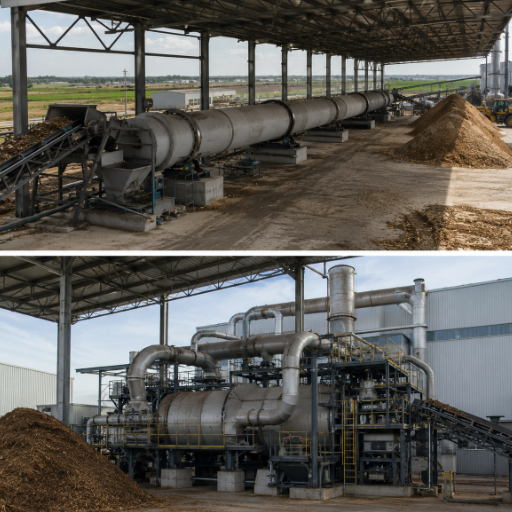
Esta es la pregunta con la que realmente llegan la mayoría de los compradores, y la respuesta honesta es que el triple paso no es simplemente «mejor». Un secador de triple paso es una máquina de servicio más ligero, optimizada para el secado compacto y energéticamente eficiente de material liviano. Un secador de paso único es un solo tambor de paredes gruesas construido para soportar durante décadas un servicio abrasivo, grueso y de alto tonelaje. Resuelven problemas diferentes.
| Factor | Triple paso | Paso único |
|---|---|---|
| Huella (longitud) | ~20–35% de la longitud de un solo paso para una capacidad similar (según proveedores) | Tambor único largo; mayor huella |
| Carcasa del tambor / durabilidad del pellet | Carcasas más ligeras; menor vida útil bajo esfuerzo | Servicio pesado; reputación de «dura décadas» |
| Transporte de material | Requiere alta velocidad de aire + ventilador de tiro inducido más grande | Gravedad en un tambor inclinado |
| Mejor tamaño de partícula | Fino, de flujo libre, uniforme | Grueso, >1 pulgada, variable |
| Material abrasivo | Deficiente — las paletas elevadoras internas se desgastan rápido | Tolera mejor la abrasión |
| Costo de reparaciones mayores | 3–5× el costo de una reparación de un solo tambor (primero debe retirarse el tambor interior) | Acceso directo; menor |
| Vida útil | Más corta bajo esfuerzo (carcasas más ligeras) | Décadas; reputación de «servicio pesado» |
| Material más adecuado | Aserrín, astillas de madera, biomasa ligera, minerales <20–40 mm | Grueso, abrasivo, denso, de alto tonelaje |
| Inversión inicial | Mayor inversión inicial, menor costo operativo | Menor inversión inicial |
¿Cuál es la diferencia entre un secador rotativo de un solo paso y uno de triple paso?
La diferencia esencial es la cantidad de tambores y la aplicación. Un secador de un solo paso hace pasar el material una vez por un tambor pesado mediante gravedad; un secador de triple paso lo hace pasar tres veces por tambores más ligeros anidados mediante flujo de aire.
La regla práctica — lo que llamamos el punto de cambio de paso único a triple paso — es esta: elija triple paso cuando su material sea fino, de flujo libre y no abrasivo, y el espacio en planta o el costo del combustible sean importantes; elija paso único cuando el material sea grueso, abrasivo o procese un tonelaje muy alto y necesite una máquina que resista décadas de desgaste. Para conocer la familia más amplia de tipos directos, indirectos y de tubos de vapor, consulte nuestro secador rotativo industrial guía.
⚠¦ Error común
Los compradores persiguen el ahorro de combustible y olvidan el tiempo de trabajo con herramientas. Para acceder al tambor central en una máquina de tres tambores, primero debe retirar el tambor interior — cambiar un rodamiento puede convertirse en un trabajo de varios días que requiere equipos de izaje. Los instaladores suelen informar que una reparación mayor de triple paso cuesta varias veces más que la misma reparación en un secador de un solo tambor — a menudo se citan cifras de tres a cinco veces — lo que puede eliminar el ahorro de combustible que justificaba la compra.
Eficiencia térmica y economía energética
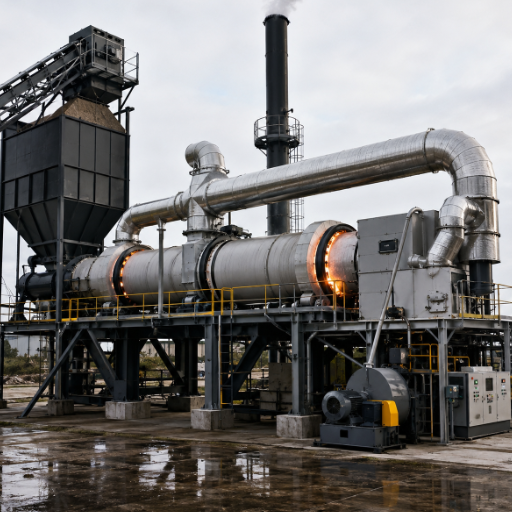
El secado es el paso que más energía consume en toda la cadena de pellets, por lo que esta sección merece cifras reales en lugar de marketing. Partamos de la física: evaporar agua requiere aproximadamente 2,26 MJ por kilogramo de agua eliminada (el calor latente de vaporización). Esa única constante establece el mínimo de su factura de combustible.
En la práctica, las mediciones publicadas sitúan el consumo de los secadores rotativos de combustión directa aproximadamente en 4,0–6,0 MJ por kg de agua evaporada, con sistemas indirectos más cercanos a 2,8–3,6 MJ/kg. La diferencia entre el mínimo de calor latente de 2,26 MJ/kg y ese consumo real de 4–6 MJ/kg muestra cuánta energía nunca llega al agua —se pierde como escape caliente, calor sensible en los sólidos y radiación. Esa diferencia también explica por qué las afirmaciones de eficiencia «>70%» de algunos folletos deben leerse con cuidado: normalmente describen la retención de calor por autoaislamiento, no el uso de combustible de todo el sistema.
«La huella compacta es real, pero los ahorros que importan están en el quemador. Especifique el secador según su carga real de agua —kilogramos de agua por hora, no solo toneladas de producto— y el cálculo del combustible decide entre paso único y triple mucho antes que el plano de planta».
Donde el diseño de tres pasos realmente ayuda es en el volumen. Con una humedad de entrada de 50%, una planta consume aproximadamente 25–30% de su combustible solo para secar la materia prima antes de que haga algún trabajo útil. El anidamiento de los pasos permite recuperar más contacto por metro cuadrado, y combinar el secador con recuperación de calor residual — condensación de gases de combustión para precalentar el aire de secado — puede reducir el uso anual de energía hasta 41% con un periodo de recuperación de la inversión que a menudo es inferior a dos años .
Materiales que seca mejor: enfoque en biomasa
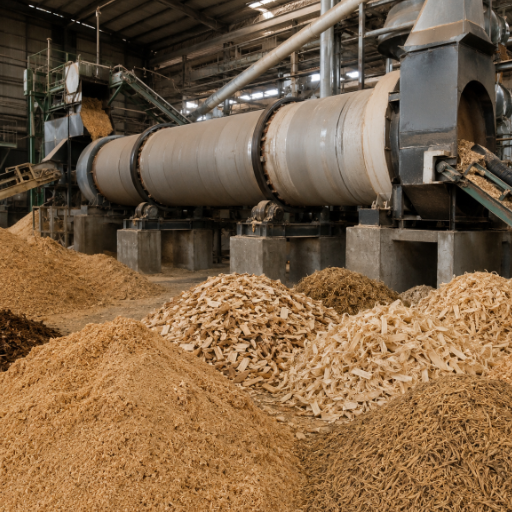
Los secadores rotativos de triple paso se diseñaron para biomasa ligera y de flujo libre, y ahí siguen destacando. El aserrín, las virutas de madera, las astillas de madera, la cascarilla de arroz, la paja y el bagazo se desplazan bien mediante flujo de aire y toleran la alta velocidad de aire que requiere el diseño. Estas también son las materias primas que con mayor frecuencia se dirigen a una prensa peletizadora, por lo que el secador y la peletizadora de biomasa normalmente se especifican juntos.
¿Qué contenido de humedad puede alcanzar un secador rotativo de triple paso?
La mayor parte de la biomasa llega húmeda —habitualmente con 50–63% de humedad en base húmeda— y el objetivo después del secado depende de la etapa siguiente. Muchas líneas secan la materia prima hasta aproximadamente 10–15% para la alimentación de la prensa peletizadora, mientras que algunas operaciones de pellets secan más, hasta alrededor de 5–7%, para el producto terminado; las normas de pellets de madera clasificados según ISO 17225-2 limitan la humedad de los pellets a cerca de 10%. Un secador rotativo de triple paso correctamente dimensionado alcanza el intervalo óptimo que usted especifique en una sola operación continua.
La consistencia de la materia prima importa más que la cifra principal. Las especies mezcladas, los contaminantes y los finos inferiores a 0,5 mm se secan de manera desigual, lo que reseca las partículas pequeñas y aumenta tanto el polvo como el riesgo de incendio —un peligro operativo principal señalado en las guías de seguridad del sector de pellets de madera. Un tamaño de partícula uniforme proveniente de un molino de martillos para biomasa hace que el secado sea mucho más uniforme y que el polvo sea mucho más manejable.
Más allá de la biomasa: arena, minerales y agregados
Los secadores de triple paso no se limitan a la madera. El mismo diseño de tambores concéntricos seca arena amarilla, arena de sílice, escoria, arcilla, yeso y gránulos de fertilizante, normalmente con tamaños inferiores a 20–40 mm. El secado de minerales es donde el flujo de aire de alta velocidad y múltiples pasos demuestra su valor para procesar toneladas en un espacio reducido.
Sin embargo, hay una advertencia clara, y es la misma de la tabla comparativa: la abrasión. La investigación tribológica identifica el tamaño, la forma y la dureza de las partículas como las propiedades que impulsan el desgaste abrasivo, y los minerales afilados o el vidrio reciclado desgastan las paletas elevadoras internas y los puntos de transferencia más rápido en los componentes internos más ligeros de una máquina de triple paso que en un tambor único pesado.
El historial industrial publicado refuerza este punto. El secado documentado de concentrados minerales —por ejemplo, un secador de concentrado de zinc y plomo estudiado con 22,2 m de longitud y 3,9 m de diámetro — utiliza secadores rotativos de flujo cocorriente largos, de tipo paso único, no unidades compactas de triple paso, y aun así enfrenta acumulación de incrustaciones y consumo de combustible. Como regla práctica: los minerales granulares, no abrasivos y de tonelaje moderado son adecuados para el triple paso; el procesamiento de minerales afilados, abrasivos o de muy alto tonelaje se inclina nuevamente hacia el paso único, donde la durabilidad prevalece sobre la compacidad.
Cómo dimensionar y seleccionar un secador de triple paso
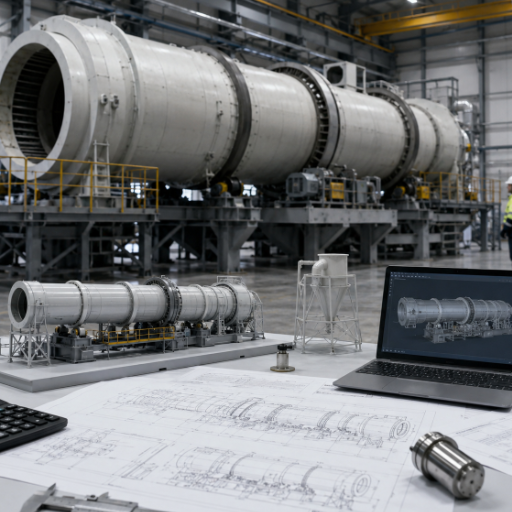
El dimensionamiento comienza con el agua, no con las toneladas. Calcule cuántos kilogramos de agua por hora debe eliminar (capacidad de procesamiento × reducción de humedad), multiplíquelo por el calor latente, agregue las pérdidas del sistema y tendrá la carga térmica que determina el tamaño del tambor y la potencia del quemador. A partir de ahí, realice lo que llamamos la prueba de ajuste de triple paso de 4 verificaciones antes de solicitar una cotización a cualquier proveedor.
La prueba de ajuste de triple paso de 4 verificaciones
- Material: ¿fino, de flujo libre y no abrasivo? → el triple paso es adecuado. ¿Grueso o abrasivo? → paso único.
- Diferencia de humedad: Porcentaje de entrada y % objetivo de salida: esto determina su carga de agua y demanda térmica.
- Capacidad de procesamiento: toneladas/hora de producto, convertidas a kg/h de agua eliminada.
- Fuente de calor: ¿horno de biomasa, aire caliente o calor residual? — determina si es directo o indirecto y el costo del combustible.
Responda esas cuatro preguntas con honestidad y la elección entre paso único y triple paso normalmente se definirá sola, junto con un dimensionamiento realista del tambor. Un proveedor que solicita estas cuatro entradas antes de cotizar está dimensionando su secador; uno que cotiza solo con un número de modelo le está vendiendo un tambor. Consulte la línea completa de peletizadoras de madera si el secador es una pieza de una planta más grande.
Dónde encaja en una línea de producción de pellets
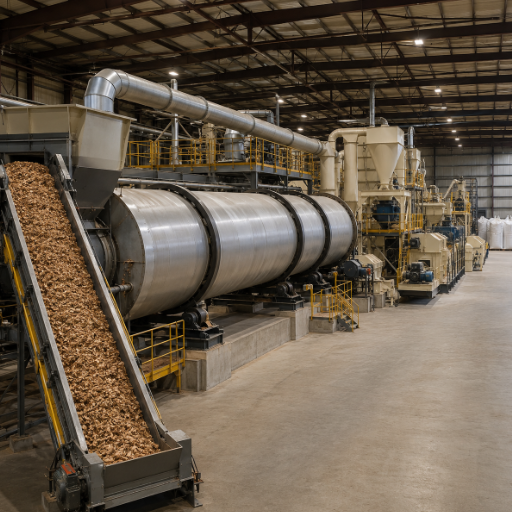
Un secador de triple paso rara vez funciona por sí solo. En una planta de pellets de biomasa, se ubica en medio de una cadena, recibe materia prima húmeda y dimensionada y entrega material seco a la prensa peletizadora. La secuencia habitual es: astillado, molienda, secado, peletización, enfriamiento y ensacado.
- ✔ Astilladora de tambor reduce troncos y tablas a astillas.
- ✔ Trituradora de madera o un molino de martillos reduce el tamaño de partícula hasta obtener una alimentación uniforme.
- ✔ Secador rotativo de triple paso reduce la humedad al intervalo óptimo de peletización de ~10–15%.
- ✔ La peletizadora, el enfriador de pellets y el ensacado completan la línea.
Lograr la humedad de salida correcta del secador es lo que hace que toda la línea funcione correctamente. Alimente la prensa peletizadora con material demasiado húmedo y los pellets se desmoronarán; demasiado seco y no se aglomerarán. El secador controla la humedad de todo lo posterior en la línea, por eso se dimensiona en función de la prensa peletizadora, no de forma aislada. Para adaptar un secador a su materia prima y capacidad de producción específicas, hable con nosotros sobre un secador rotativo de triple paso para su línea.
Perspectivas del sector: secado de biomasa impulsado por la eficiencia
El impulso detrás de mejores secadores es el propio mercado de pellets, que las empresas de investigación de mercado estiman en decenas de miles de millones de dólares y con un crecimiento de aproximadamente 7% al año —las cifras exactas varían mucho según cómo se defina «pellet de madera» frente a «pellet de biomasa»—, con Japón y Corea del Sur ampliando más rápidamente la combustión conjunta de biomasa. Como el calor en la etapa de secado domina el consumo energético de la cadena de pellets, cada mejora de eficiencia del secador repercute directamente en la rentabilidad.
Hay cuatro cambios que vale la pena observar durante 2025–2026. Primero, la recuperación de calor residual está pasando de ser una opción a una expectativa —recuperar el calor de los gases de combustión para precalentar el aire de secado puede reducir la energía anual hasta 41%. Segundo, las normas sobre polvo combustible se están endureciendo: NFPA 664 y la nueva norma consolidada NFPA 660 impulsan un control de polvo más estricto, y algunas aseguradoras han comenzado a excluir la cobertura de secadores rotativos en plantas de productos de madera. Tercero, las normas de cadena de custodia REDIII de la UE están redefiniendo qué materias primas califican.
El cuarto cambio es el que los compradores subestiman: las emisiones y el fuego. Los secadores rotativos se construyeron originalmente para minerales no fibrosos, y el secado de biomasa fibrosa introduce un riesgo real de incendio además de exposición a permisos de emisiones atmosféricas —con madera blanda fresca, un secador puede acercarse al umbral de 100 toneladas/año de VOC del Título V y suele ser la mayor fuente individual de emisiones de una planta. Por eso las alternativas de menor oxígeno, como el secado con vapor sobrecalentado, que reporta un uso de energía mucho menor, están ganando atención para las plantas grandes. Nada de esto descarta un secador de triple paso; simplemente significa que las barreras de seguridad y los permisos deben formar parte de la decisión de selección, no considerarse después.
La acción práctica para un comprador en 2026 es concreta: especifique carcasas autoaislantes y una opción de recuperación de calor residual, confirme que su configuración de secador y control de polvo cumpla los límites actuales de NFPA y revise su exposición a permisos de VOC/HAP antes de firmar.
Preguntas frecuentes
P: ¿Cuánto puede reducir la humedad un secador rotativo de triple paso en una pasada?
Ver respuesta
Un secador de triple paso correctamente dimensionado reduce la humedad de biomasa ligera desde una humedad de entrada típica de 50–63% hasta el intervalo de 10–15% que requiere la peletización, en una operación continua. La reducción exacta depende de la temperatura del gas, el tiempo de retención y la capacidad de procesamiento, por lo que la misma máquina puede ajustarse para una diferencia de humedad menor o mayor cambiando la tasa de alimentación y la configuración del quemador.
P: ¿Un secador rotativo de triple paso es más eficiente que un secador de un solo paso?
Ver respuesta
Para biomasa liviana y fina, normalmente tiene menores costos operativos, porque los pasos concéntricos concentran más contacto de secado en una huella menor y un flujo de aire de menor temperatura y mayor velocidad. Pero las afirmaciones de «eficiencia» superiores a 70% generalmente describen la retención de calor, no el uso de combustible de todo el sistema, donde gran parte de la energía aún sale como escape y calor sensible. El paso único aún puede resultar mejor en el costo total cuando se consideran las reparaciones y la durabilidad.
P: ¿Para qué materiales es más adecuado un secador rotativo de triple paso?
Ver respuesta
Materiales ligeros, de flujo libre, no abrasivos y con un tamaño de partícula bastante uniforme: aserrín, virutas de madera, astillas de madera, cascarilla de arroz, paja y bagazo, además de minerales granulares como arena, escoria y yeso de menos de aproximadamente 20–40 mm. Los materiales afilados, abrasivos o muy gruesos no son adecuados porque desgastan las paletas elevadoras internas y favorecen un secador de un solo paso.
P: ¿Cuánto espacio en planta requiere un secador rotativo de triple paso?
Ver respuesta
Mucho menos que un secador de un solo paso con la misma capacidad. Los proveedores informan longitudes de tambor de aproximadamente 20–35% de las de una máquina equivalente de un solo tambor, porque tres pasos caben en una sola carcasa.
P: ¿Un secador rotativo de triple paso puede secar arena o minerales?
Ver respuesta
Sí — la arena amarilla, la sílice, la escoria, la arcilla y el yeso son aplicaciones comunes. Solo tenga en cuenta la abrasión: los minerales afilados desgastan las paletas elevadoras internas más rápido que en un tambor más robusto de un solo paso.
P: ¿Un secador de triple paso requiere más mantenimiento que uno de un solo paso?
Ver respuesta
La limpieza e inspección rutinarias son similares, pero las reparaciones mayores son más difíciles y costosas. Acceder al tambor central o interior implica desmontar parcialmente el conjunto anidado, por lo que una reparación de rodamiento o de paleta elevadora interna que es sencilla en un solo tambor puede costar de tres a cinco veces más en una máquina de tres tambores. Adaptar el secador a un material no abrasivo es la mejor manera de que esas reparaciones sean poco frecuentes.
Acerca de esta guía
Esta guía fue preparada por el equipo de ingeniería de TCPEL (ALLWIN INTERNATIONAL CO., LTD), un fabricante con sede en Shandong de equipos para secado y peletización de biomasa que exporta a más de 60 países. Las cifras sobre energía y normas aquí se basan en investigaciones públicas y fuentes ISO/NFPA citadas a continuación; las afirmaciones de proveedores sobre eficiencia y espacio ocupado se señalan como tales en lugar de presentarse como hechos independientes.
Referencias y fuentes
- Informe sobre tecnología de secado de biomasa — National Renewable Energy Laboratory (NREL)
- Simulación del movimiento de partículas de madera a través de un secador rotativo de triple paso de flujo cocorriente — Drying Technology, vol. 32 (Taylor & Francis)
- Modelado del secado de forraje en secadores rotativos de tambor de paso único y triple paso — ASABE
- Secadores indirectos para el secado de biomasa — comparación de características experimentales — ChemEngineering (MDPI)
- Análisis energético de secadores de madera integrados con unidades de recuperación de calor — Energy (ScienceDirect)
- Pellets de madera clasificados (ISO 17225-2) — Natural Resources Canada
- NFPA 664: prevención de incendios y explosiones — Canadian Biomass Magazine
- Operación más segura de secadores rotativos de tambor — Wood Pellet Association of Canada (WPAC)
- Diseño de paletas elevadoras internas y distribución de partículas en tambores rotativos (perlas de vidrio y arena de cuarzo) — Granular Matter (Springer)
- Desgaste abrasivo por partículas de arena: efectos del tamaño, la forma y la dureza — Tribology Transactions (Taylor & Francis)