Liên hệ với TCPEL

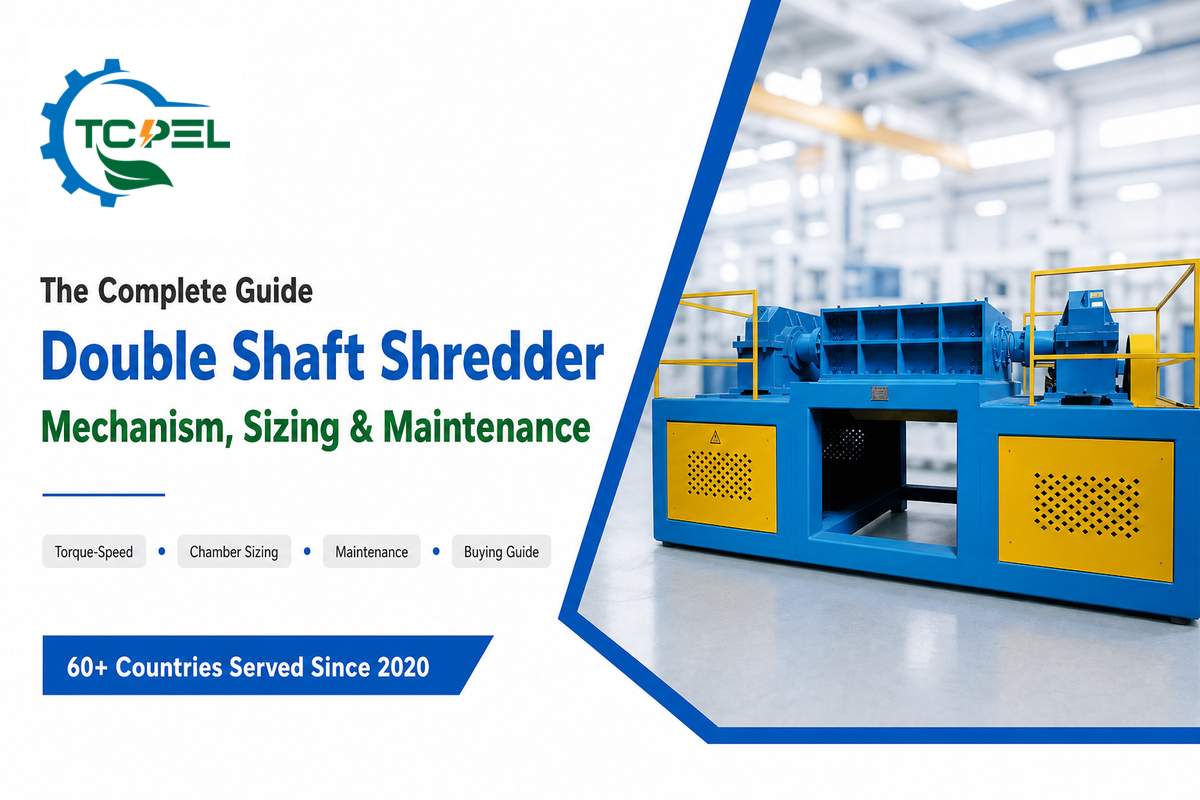
A double shaft shredder is an industrial size-reduction machine that rips material apart between two counter-rotating, low-speed cutter shafts running under high torque, instead of slicing it apart at high speed like a granulator or a chipper. It’s designed to shred contaminated, bulky-loaded materials that would stop a lesser shredding machine cold.
That single engineering choice explains just about everything else about the machine — why it shrugs off stray metal that would destroy a faster cutter, why its output resembles uneven strips rather than uniform pellets, and why choosing the wrong number of shafts is the #1 buying error for this category of equipment. Vendor catalogs use the terms loosely: dual-shaft shredders, two shaft shredder units, waste shredder, and general shredding equipment often show up interchangeably in the same product line, so it pays to check the mechanism, not just the label, before you request a quote.
💡 In Short
Double-shaft shredders rotate in the 5-45 RPM range, with two counter-rotating cutter shafts producing coarsely sized strips rather than fine particles. They’re ideal for contaminated, bulky, mixed material applications-metal, e-waste, tire shred, plastic, wood-that would seize a high-speed single-shaft cutter. Selecting the incorrect machine design is a far more common mistake than picking the wrong specific machine model; most people assume a larger number of shafts always results in a better machine, but each of the three architectures (single, double, and quad-shaft) is designed to solve a distinct set of problems.
Thông số kỹ thuật nhanh
| Shaft speed | roughly 5–45 RPM (model-dependent) |
| Cutting action | low-speed, high-torque tearing/shearing (not high-speed slicing) |
| Blade material | D2/SKD-11-family tool steel, HRC 55–62 |
| Sản lượng điển hình | coarse, irregular strips (screenless, unlike single-shaft units) |
| Công suất động cơ | roughly 15–200+ kW per shaft, model-dependent, commonly rated for continuous 24-hour duty |
| Best suited for | contaminated, bulky, or mixed waste streams — metal, tires, e-waste, plastics, wood/pallets |
What Is a Double-Shaft Shredder? (And How Is It Different From Single- or Quad-Shaft Machines?)
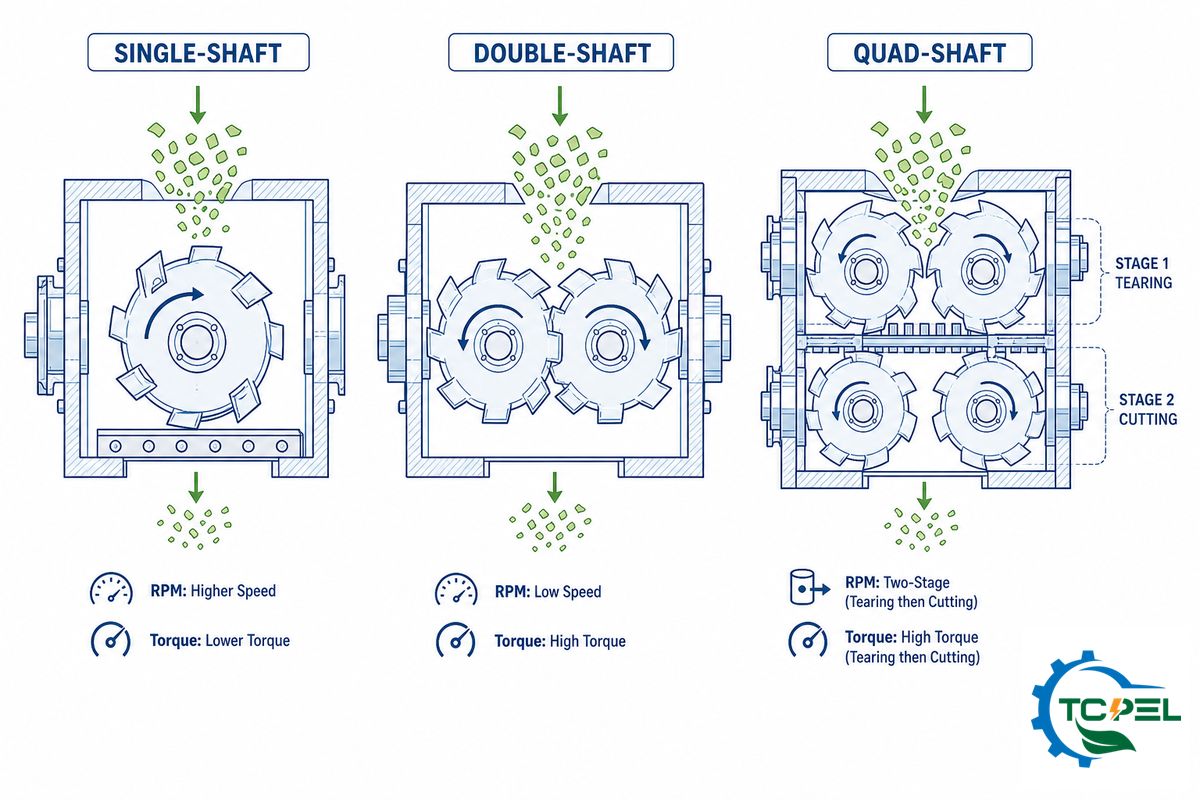
A double shaft shredder (sometimes called a dual-shaft or twin-shaft shredder) consists of two parallel shafts fitted with hooked or intermeshing cutting discs, spinning at low speed toward one another. Material fed into the cutting chamber gets grabbed from opposite directions and shredded apart under high torque instead of being sliced, the same mechanism described in industrial shredder patent US20050242221A1.
Its two counter-rotating shafts, each carrying multiple cutters, provide a broad shredding surface for efficient reduction of even tough, contaminated materials. This dual-shaft mechanism is only one part of the machine’s capabilities, though, and the number of shafts has a significant impact on what it’s capable of handling; this is where buyers make the most mistakes. “No one machine is perfect for all applications,” David Wilson of SSI Shredding Systems said in Recycling Today magazine. Three designs on the market actually address fundamentally different applications, not just variations of the same task at different price points.
“The specific application requirements of the customer need to be clearly identified prior to the evaluation of any type of shredder… a buyer-beware attitude is appropriate given all of the different types of equipment available and their seemingly unlimited capabilities.”
Here’s a look at what the shaft count actually influences, according to independent equipment guides: A single-shaft shredder (or single-shaft) operates much faster than other models, often at 80-110 RPM. This high speed uses small, replaceable cutters on each shaft that push material against a fixed anvil and then recirculate any oversized pieces back into the cutting chamber until they pass through a sizing screen. That sizing screen is what makes single-shaft designs unique: they deliver true particle uniformity. Precision comes at the cost of durability, though, single-shaft cutters are vulnerable to damage from nails or chunks of metal, and abrasive items like carpet backing can cause frequent wear.
A máy hủy tài liệu trục đôi trades that uniform sizing for robustness. Because there’s no sizing screen, it spits out strips of variable lengths (a few inches to several feet depending on the material) but its massive, low-speed cutting discs and the built-in automatic shaft-reversal logic ensure that the machine just chugs along even when there are tramp materials or contaminants present that would grind a single-shaft machine to a halt. A quad-shaft shredder isn’t just “a stronger double-shaft machine”-it couples the tough two-shaft primary tear stage with a screen, giving you both impact tolerance and output size control at the cost of considerably more expense and complexity. It’s ideal for taking highly mixed and dirty material and turning it into something reasonably uniform; that’s how e-scrap and medical waste are usually processed.
| Yếu tố | Single-Shaft | Double-Shaft | Quad-Shaft |
|---|---|---|---|
| Typical speed | 80–110 RPM | roughly 5–45 RPM | low-speed, dual-stage |
| Output control | uniform, screen-set size | irregular strips, no screen | uniform, screen-set size |
| Contaminant tolerance | low — metal/grit risks cutter damage | high — auto-reverse clears jams | high, with sizing control |
| Chất liệu phù hợp nhất | clean plastics, foam, fiber, paper | metal, tires, pallets, mixed/bulky waste | e-scrap, medical waste, tightly mixed streams |
| Relative cost/complexity | lower | moderate | highest |
Model size uses the same principles, scaled down. A compact or mini double shaft shredder follows the same low-speed, high-torque concept, just at a smaller width and lower power rating for operations not requiring industrial-scale output. If your primary requirement is output particle size, and the feed material is relatively clean, a double-shaft machine probably isn’t what you’re looking for (that would be a single-shaft or a quad-shaft). If, on the other hand, you’ve a load of bulky, mixed municipal, or just a bit of scrap steel, then the abuse tolerance of the double-shaft is what you’re buying.
Inside the Machine, Blade, Shaft, and the Torque-Speed Engineering Behind the Cut
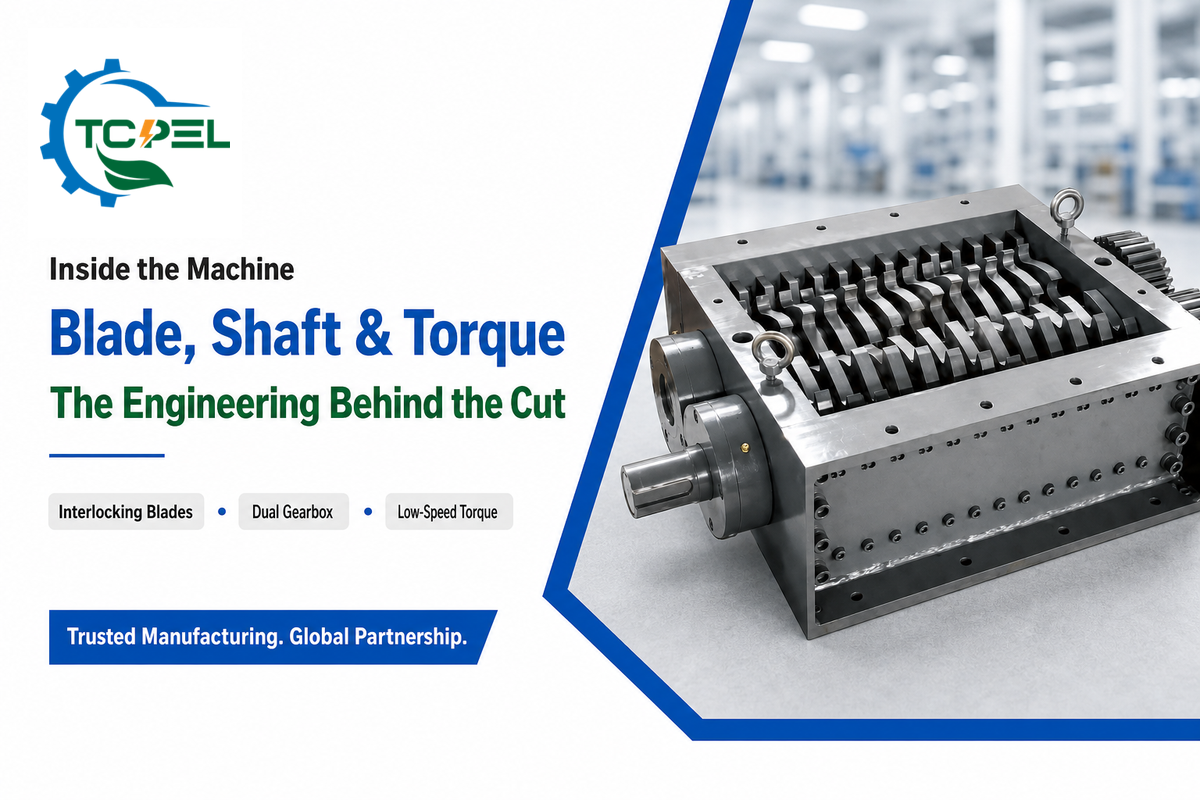
This low-speed, high-torque process isn’t a trade-off, it’s a different physics from the chopping and granulating of fast, high-speed systems, and it lines up with the size-reduction mechanics described in DOE/Argonne biomass size-reduction research. Perry’s Chemical Engineers’ Handbook defines high-speed cutters as anything operating in the 500-3,500 RPM range, a method built around clean cutting action. Two orders of magnitude slower than that, the two double-shaft shredder shafts engage each other and apply sustained high torque that effectively grabs and tears apart the material, rather than trying to slice through it with blade sharp edges. This is why a double-shaft machine can tear right through a piece of rebar or a steel drum lid without the blade damage a high-speed cutter would sustain. That same low-speed tearing action runs noticeably quieter than high-speed cutting too, low noise is a byproduct of the mechanism, not a separate design feature bolted on afterward.
📐 Ghi chú Kỹ thuật
The type of blade is just as important as the machine architecture. Cutting discs, sometimes called shear blades, are typically heat-treated tool steels in the D2/SKD11 steel range, and hardened to somewhere between HRC 55 and 62 (a range verified by various blade manufacturers), chosen for long service life across the cutting area rather than raw hardness alone. Higher hardnesses (around 58-60 HRC) are typically achievable through heat-treatment and can increase disc life by 20-30% without making the blade prone to cracking or chipping when impact loads are applied. Shafts are most often keyed (hexagonal or some other non-round shape) as opposed to plain round so that the discs can’t slip out of alignment when a shaft torques up against the material during a jam, a risk with a plain-round shaft without keys. Disc thicknesses typically range from 20 mm to 40 mm, with larger, heavier-duty machines using the thicker end of that band.
How Does the Auto-Reverse System Prevent Jams?
Most double-shaft shredders have the PLC monitor motor current in real time. If a jam-prone piece of feed pulls current draw beyond the allowable limit, the controller reverses shaft rotation to back out and clear the load, then resumes forward shredding without operator intervention or a tripped breaker.
That reversal logic handles a knotted root ball, a strapped pallet bundle, or a cable-tied bale the same way, automatically. It’s a deceptively simple bit of logic that carries a good portion of the “handles anything” heavy lifting double-shaft machines are known for — without it, every jam becomes a manual stop-and-clear procedure.
Here, again, the two independently driven shafts earn their keep: since each shaft has its own gearbox and drive train, one shaft can react to a local jam without causing the other to bog, and a gearbox requiring repair doesn’t tie up the entire machine. Heavy-duty blade mounting, often on a split type housing that opens for direct access to the cutting chamber, allows replacement of a damaged cutting disc with less work than pulling the entire shaft; measured in hours, not days.
What a Double-Shaft Shredder Can (and Can’t) Shred
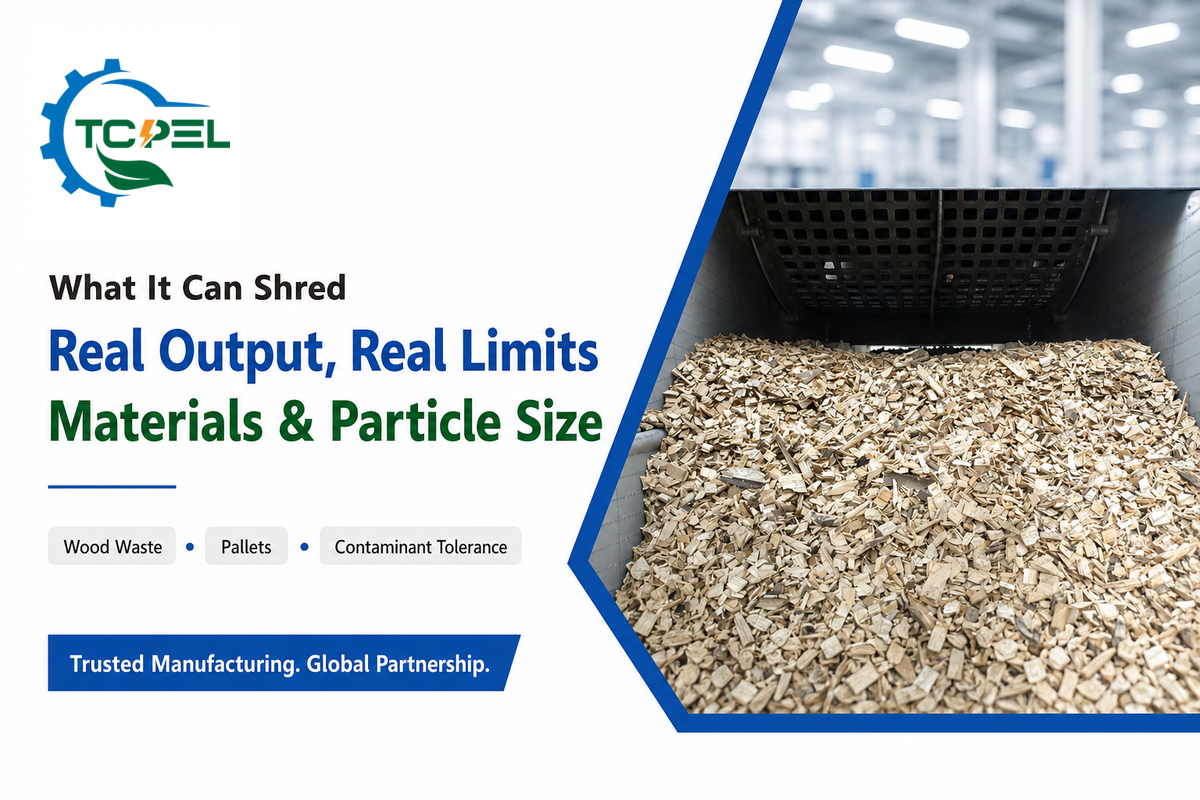
Double-shaft shredders are found across a more varied array of industrial waste streams than any one application, with tires, scrap metal, e-waste, mixed municipal solid waste, plastics, and wood or pallet waste all common feedstocks — a broader range than any single machine builder readily advertises. What’s consistent is feedstock condition, not material type: bulky, irregular, contaminated material is what this architecture shreds, which is why it turns up across so many waste recycling operations.
That wide range of materials also includes hazardous waste streams — drums, IBCs, and other demanding materials — plus large plastic parts and other bulky items that a smaller machine can’t physically accept, which is why this equipment shows up at high-capacity recycling and waste-to-energy sites as much as at biomass plants.
| Material Type | Contamination to Plan For | Typical Downstream Step |
|---|---|---|
| Tires | embedded steel belt/cord | crumb rubber recovery, tire-derived fuel |
| Scrap metal & steel drums | welds, coatings, residual contents | metal recovery and baling |
| Electronic waste (WEEE) | circuit boards, mixed plastics/metals | copper and precious-metal recovery |
| Municipal solid waste (MSW) | mixed inert material, grit | waste-to-energy prep or landfill diversion |
| Plastics & film | labels, caps, mixed resin types | regrind and pelletizing |
| Wood pallets (nailed) | nails, staples, wire strapping | magnetic separation, hammer-mill feedstock |
| Clean biomass/wood waste | bark, soil residue | hammer mill sizing for pellet feedstock |
| Construction & demolition debris | rebar, concrete fragments | sorted recycling streams |
| Textile / rubber scrap | mixed fiber blends, bonded rubber | fiber or rubber-crumb recovery |
✔ Ưu điểm
- Tolerates embedded metal, nails, wire strapping without catastrophic damage
- Handles bulky, irregular feed shapes a screen-fed machine would choke on
- Auto-reverse clears jams without operator intervention
- Large, low-speed cutting discs often run for years in non-abrasive applications
⚠ Hạn chế
- No sizing screen – results are irregular strips rather than uniform particles
- Poor suitability for very wet, sticky, or fibrous, stringy materials that will wrap around the shaft
- Not the correct equipment for jobs requiring strict control of particle size
- Highly abrasive feedstock such as sand or grit can wear down blade components even with heavy-duty shafts
The biggest application for this equipment family by volume consists of tires and scrap metal, followed by the wood and biomass use case which dominates many manufacturer’s sales materials. For wood waste and pallet recycling, in particular, the configuration of choice is often a double-shaft shredder coupled with a linear magnetic separator – a pallet shredder configuration-often used for nail-laden pallet processing; see the pallet crushers from TCPEL for a specific application-built variation of this. When the purpose is primary biomass reduction feeding into a pellet mill, the resultant material would need further sizing downstream, most likely via a sinh khối hammer mill, as the strips produced by the double-shaft machine wouldn’t be small enough for direct pelletizing.
How to Size a Double-Shaft Shredder (Capacity, Chamber Width, Motor Power)
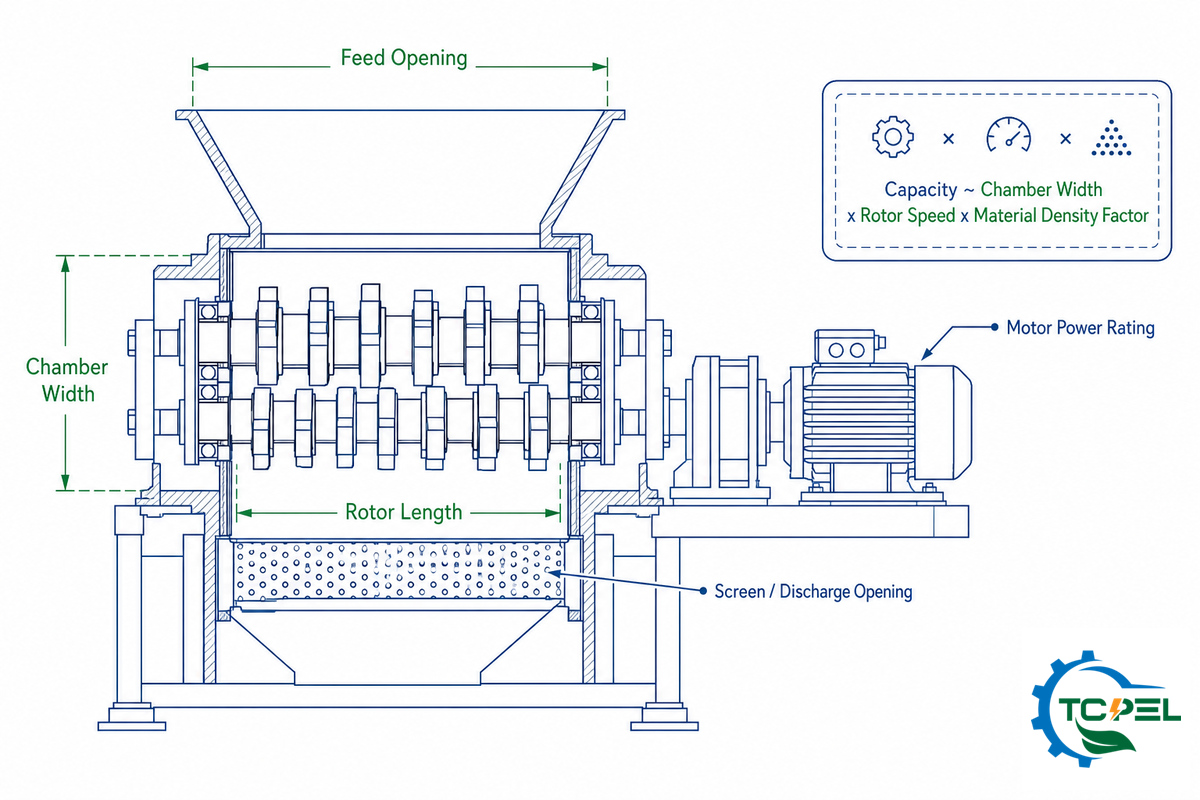
In this equipment category, sizing errors follow a predictable path: buyers typically spec a “particle size” the same way they would for a screen-fed machine, failing to appreciate that the strip width achieved from a screen-less double-shaft shredder isn’t a true three-dimensional particle size. As David Wilson writes in an SSI Shredding Systems piece for Recycling Today, if you “spec 50-millimeter output, then be sure that a 50-millimeter strip of material isn’t acceptable.” The specs aren’t equivalent, and the adding of a screen later to hit a real particle size spec completely shifts the sizing conversation due to screens’ negative impact on throughput and their tendency to clog with non-shreddable material.
The Chamber-Width Throughput Rule
💡 Sizing shortcut
Actual throughput generally rises linearly with chamber width and shaft speed at any given material density. Wider chambers and faster speeds increase theoretical maximum tons-per-hour output. The motor nameplate does not represent maximum throughput; factors like material bulk density and moisture content are much more significant constraints. Performance often falls 10-25% below maximum theoretical throughput due to such things as feed consistency, and the U.S. EPA’s own waste-to-energy engineering analysis states plainly that the relationship between rated and actual plant capacity is “not always clear.” Always use the spec sheet tonnage as an upper planning limit, not a budget number.
Here’s a working example: Suppose you need to process 4 tons per hour of mixed wood pallets. Let’s say a supplier offers a model with a 4-8 tons per hour capacity at a 1000-millimeter chamber. Given the 10-25% de-rate, the typical sustained output you can expect once feed variations, moisture, and human operation are factored in is 3-3.6 tons per hour at the lower end of the range. In this scenario, to ensure 4 tons per hour of throughput, you must select the next size up-not the minimum of a rated range. This is, by far, the most common cause of “my machine doesn’t make its numbers” claims and is a planning mistake rather than equipment deficiency.
Maintenance and the Failure Modes That Actually Take These Machines Down
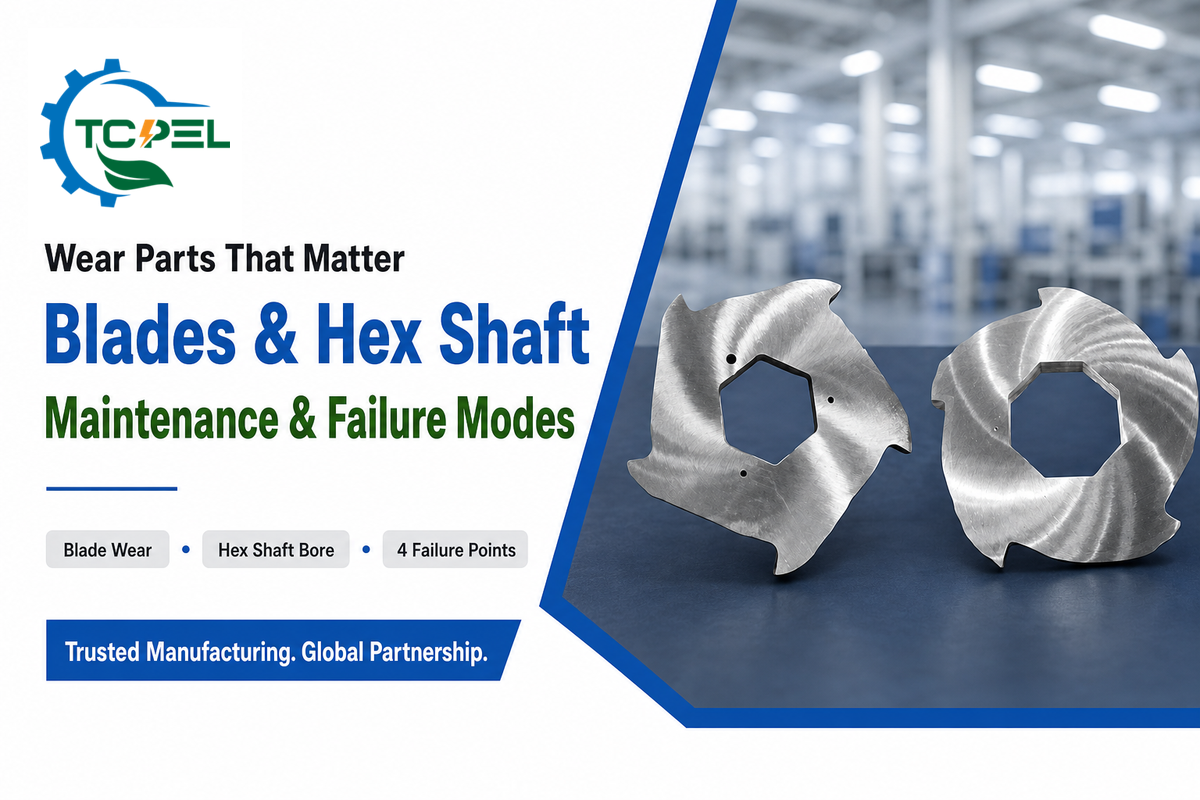
With a double-shaft shredder, wear on the cutting discs is much more closely related to contaminants in the feed stock than the actual hardness of the material being processed. The cutting edges of clean hardwood and plastic can wear less than softer materials with embedded dirt, sand, or fasteners because contaminants will wear down an edge more quickly than pure material hardness. This explains why pre-screening or on-board magnetic separation is as critical as blade specs for a recycled pallet or demolition waste stream.
The 4-Point Failure Framework for Double-Shaft Shredders
⚠️ Root causes and prevention
- Contamination-driven blade wear — wear from grit, sand, and embedded metal outpaces wear from clean but hard materials. Mitigation strategies include the use of pre-screening, if feasible, and inline magnetic separators on the discharge conveyor.
- Shaft misalignment from repeated jam-clearing — occurs due to recurrent jam clearings; the keyless, round-shaft designs described in cutter/spacer patent filings such as US5580009A are particularly susceptible to the individual cutting discs becoming misaligned during repeated high-torque reversals. Mitigating measures: Use hexagonal or keyed shaft geometry and perform periodic alignment checks.
- Bearing and gearbox degradation from sustained shock load — the same automated reversing feature that clears jams imposes repeated stress on the bearings and gear teeth of the gear box. Mitigating factors: regular lubrication and gearbox oil checks as a preventive measure rather than as a run-to-failure procedure.
- Operator-error jams misdiagnosed as equipment failure — jams attributed to the operator instead of a machine breakdown, over-feeding, wet material, or ignored interlock warnings are responsible for the vast majority of jam events industry-wide. Treating every jam as a mechanical failure delays addressing the true issue, which is generally feed discipline. Most jamming problems come from human error, not a breakdown in the machine itself, according to industrial shredder troubleshooting guides.
For non-abrasive material, large low-speed cutting discs are frequently reported to operate for years before replacement of one of the units on the arbor; for abrasive or contaminated feedstock, the same blade may require attention in a matter of months. There’s no one “replace every N hours” figure that applies to all feedstock, the most honest answer is that blade life is dictated by contamination load, and a visual inspection at the time of scheduled downtime is more reliable than any time interval.
Safety Standards and Compliance a Shredder Buyer Should Demand
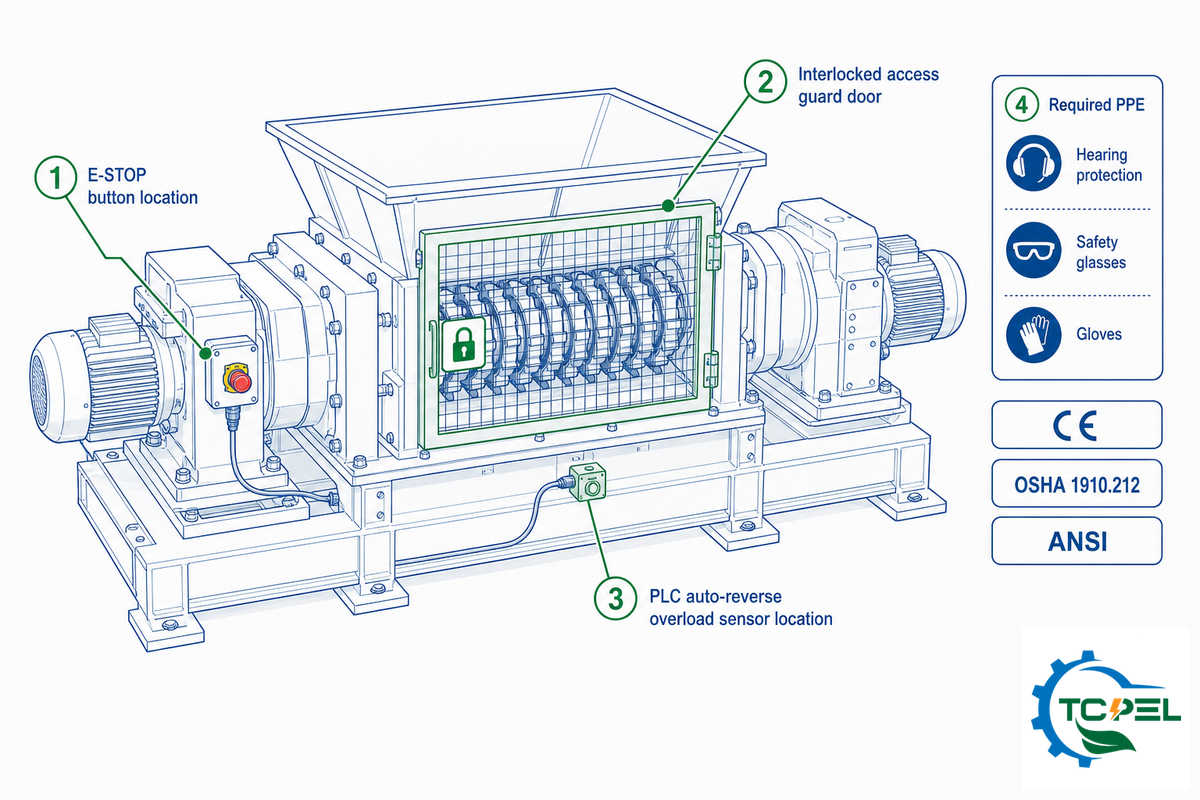
Worth stating in simple terms: there is no specific US federal standard published with industrial double-shaft shredders in mind. In fact the only thing regulating this machine in practical terms is OSHA’s general requirement for machine-guarding found in 29 CFR 1910.212, which stipulates “one or more methods of machine guarding which will effectively protect the operator from hazards at the point of operation” — a general regulation that applies to shredders, and indeed almost all industrial shredding equipment, not a specific code of practice written for shredders by name. One can infer much from neighboring equipment classes: for instance the OSHA Hazards of Wood Chippers safety bulletin cites ANSI Z133.1’s requirement for an emergency stop and safety interlock on chipping equipment, and 1910.261 mandates an emergency stop that engages adequate braking on paper-machine equipment. No code named above is written for shredders specifically, but together they outline the industry consensus: a reasonably accessible e-stop and an interlocked braking/reverse mechanism that intervenes automatically during overload, rather than waiting for the machine to be stopped physically.
For any machinery destined for sale into the European Union, CE marking of conformity to the Machinery Directive (2006/42/EC) has been the established baseline, but that’s mid-transition: the new EU Machinery Regulation 2023/1230 will supersede the Directive and move machine-safety compliance from a directive to a regulation that applies directly and uniformly across the EU. That declaration of conformity will state whether a vendor complies with the Directive or the Regulation, so in the near future, any customer buying into the EU should be prepared to ask specifically rather than assume the old directive still applies.
💡 Compliance Checklist
- ✔ Accessible emergency-stop circuit, tested and documented
- ✔ Interlocked guarding on hopper access and maintenance doors
- • automatic overload/jam protection that reverses rather than requiring a manual reset
- • for EU import: current Declaration of Conformity specifying Directive 2006/42/EC or Regulation 2023/1230
Buying a Double-Shaft Shredder, New vs Used, and the RFQ Questions That Separate Real Vendors From Brochure-Ware
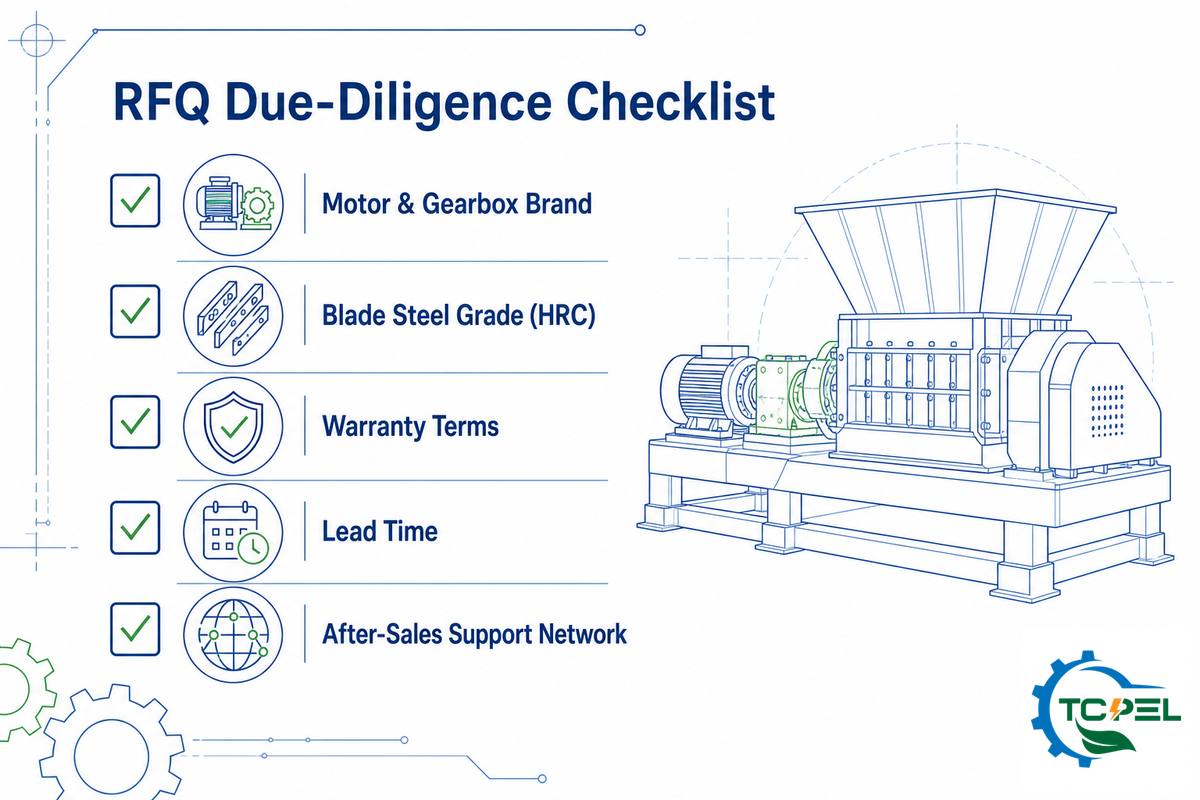
Vendor spec sheets rarely list identical shredder features side by side. Getting an effective comparison across vendor offerings means asking all vendors the same set of questions in the same units, covering high-torque operation, feed bucket capacity, and the shredding process itself, and then weighting a vendor’s willingness to process your actual material at the top of your list — the same “buyer-beware” discipline David Wilson recommends for this whole equipment category.
The RFQ Due-Diligence Checklist
- • output particle size in mm -and ask for clarification of whether it’s true particle size (screen dependent) or strip width (screen-less)
- • Rated throughput based on your actual material’s moisture content and density rather than best-case sheet figures
- • Installed motor power and drive system configuration (electric, hydraulic, or hybrid)
- Wear-part replacement schedule and blade material spec (alloy, hardness)
- CE or equivalent compliance documentation, and which regulatory framework it’s certified under
- Lead time for standard vs customized configurations
- Will the vendor run a test with your actual feedstock before you commit to a PO
On new vs used: browsing a used dual shaft shredder for sale, or even a used single shaft shredder listing, can be a legitimate way to get into this equipment category cheaply, but the inspection priorities are specific. Blade and bearing wear are the two costliest line items to discover after purchase – request wear measurements, not just a visual “good condition” assurance. Confirm the auto-reverse/overload system still functions correctly under load, since a used machine with a disabled or bypassed safety interlock is a liability, not a bargain. And check that safety guarding and compliance paperwork transferred with the machine – a used shredder missing its Declaration of Conformity often ends up costing more once guarding and paperwork are brought back into compliance than the discount was worth.
If your primary application is biomass or wood-waste primary reduction feeding into a pellet line, TCPEL’s MS Series double shaft shredder covers seven models across a 0.5-20 t/h capacity range, purpose-built for that use case with the alloy blade and auto-reverse features described above.
Why Shredders Are Outpacing Other Recycling Equipment
The demand pressure behind this equipment category is regulatory, not just cyclical. In the U.S., the EPA’s National Recycling Goal targets a 50% national recycling rate by 2030, with construction-and-demolition debris explicitly part of that measurement — a target that only gets hit if more C&D and mixed waste streams get shredded and sorted instead of landfilled.
In market-segment terms, shredders are reported as the fastest-growing piece of recycling equipment, ahead of balers, which still hold more total market share but are growing more slowly. Several industry analysts attribute this to the same driver: waste-diversion mandates and rising plastic and metal waste-stream volumes specifically favor pre-size-reduction equipment over sorting or baling alone (background context only, directional figures vary across sources: recycling-equipment market estimates for 2025 range roughly $31-35 billion with mid-single-digit forecast CAGRs into the early 2030s).
That same versatility, machines covering everything from tires to e-waste, is why double-shaft shredding solutions keep showing up across such common applications. It’s a longevity story as much as a growth story: a shredder specified correctly for its waste stream can stay in front-line service for a decade or more of continuous industrial shredding.
For a buyer timing a purchase in 2026: if your facility is adding a C&D, e-waste, or tire-recycling line to meet incoming diversion requirements, lead times on double-shaft shredders are a real planning variable – new product launches from multiple manufacturers in the 2025-2026 window (Amos Manufacturing’s 125-horsepower dual-shaft unit and Badger’s B2060T among them) suggest active order books industry-wide, which is worth factoring into how far ahead you request quotes rather than assuming a short lead time by default.
Câu hỏi thường gặp
Q: What’s the difference between a double-shaft shredder and a single-shaft shredder?
Show Answer
This dual shaft shredder architecture uses two counter-rotating shafts fitted with interlocking or hook-type blades, tearing material between two rotor sets at roughly 5-45 RPM. Single-shaft designs instead use one rotor turning against a fixed bed knife or screen, which gives more control over final particle size but less tolerance for oversized, mixed, or contaminated feed. In practice, double-shaft machines handle bulkier, dirtier material as a primary reducer; single-shaft units are often the secondary, size-controlling stage.
Q: What materials can a double-shaft shredder process?
See Answer
Double-shaft shredders are made for tough, bulky, or contaminated materials like scrap metal and steel drums, tires, plastics and film, electronic waste (WEEE), municipal solid waste, and wood waste such as pallets and biomass. Low-speed, high-torque tearing tolerates embeded metal, variable moisture and odd shapes much better than high-speed cutting shredders, although it’s not suited to extremely wet, sticky, or fibrous-stringy material that can wind around the shaft instead of cleanly shearing.
Q: How much does a double-shaft shredder cost?
Reveal Answer
There’s no single double shaft shredder price you can quote off a chart — it varies by the equipment’s size tier (width of chamber and size of motor), the type of blade selected, any added features such as a magnetic separator or hydraulic feed, and if CE compliant safety guarding is desired. Vendors typically bid by RFQ rather than public pricing list due to the variations in material type and required throughput. Try to get a line item breakdown from each supplier so quotes are actually comparable and not just an all-in cost.
Q: How often do the blades need to be replaced?
Open Answer
Blade life mainly tracks contamination, not hardness: clean plastic or wood can run years between rotations, while nail-laden pallets or gritty scrap cut that interval down fast.
Q: Can a double-shaft shredder handle wet or high-moisture material?
Expand Answer
Yes, but not in unlimited quantities. While the low-speed tearing process is not as affected by moisture as a high-speed cutting shredder, a highly sticky or waterlogged feed can still bind the chamber. Always ask the vendor what level of moisture they used for the stated throughput.
Q: What safety features should I look for?
View Details
It should at a minimum include an E-stop button, interlocked guarding on the feeding opening and maintenance access, and auto-reverse/overload functions to prevent the motor from stalling and protect the shafts. If exporting the machine to Europe, verify compliance documentation against either the machinery Directive or the more recent Machinery Regulation.
Q: New vs used, what should I check on a used machine?
Read Answer
The costs are driven primarily by blade and bearing wear (the two largest consumables), but also by motor and gearbox run hours, and whether the auto-reverse/overload function still works, and most importantly whether the machine is still in compliance with the appropriate directives and has valid guarding and documentation. A cheaper used shredder with a worn out set of blades and outdated compliance will quickly cost more in part replacement and safety retrofits.
Get a Sizing Recommendation →
If the desired output is the primary reduction of biomass or wood waste, our engineers can specify an appropriate MS Series double shaft shredder for your feedstock and throughput requirements.
Why We Write This
TCPEL manufactures double-shaft shredders as part of integrated biomass primary-reduction and pelletizing lines that also include drum chippers, hammer mills and pellet mills. This article was developed to assist purchasers with selecting shaft-count, sizing, and maintenance factors for this category of equipment, not just our MS Series lineup, because the wrong shredder will cost you more in downtime than the purchase price differences. Reviewed by ALLWIN INTERNATIONAL CO., LTD (TCPEL).
Tài liệu tham khảo & Nguồn
- 29 CFR 1910.212, General Requirements for All Machines ure Cơ quan Quản lý An toàn và Sức khỏe Nghề nghiệp Hoa Kỳ
- Hazards of Wood Chippers (Safety and Health Information Bulletin) — U.S. OSHA
- 29 CFR 1910.261, Pulp, Paper, and Paperboard Mills — U.S. OSHA
- Directive 2006/42/EC, Machinery Directive — EU-OSHA
- Engineering and Economic Analysis of Waste-to-Energy Systems 'Cơ quan Bảo vệ Môi trường Hoa Kỳ
- US20050242221A1, Two-Shaft Industrial Shredder — USPTO / Google Patents
- Shredder Selection Basics — David Wilson, Recycling Today