Póngase en contacto con TCPEL

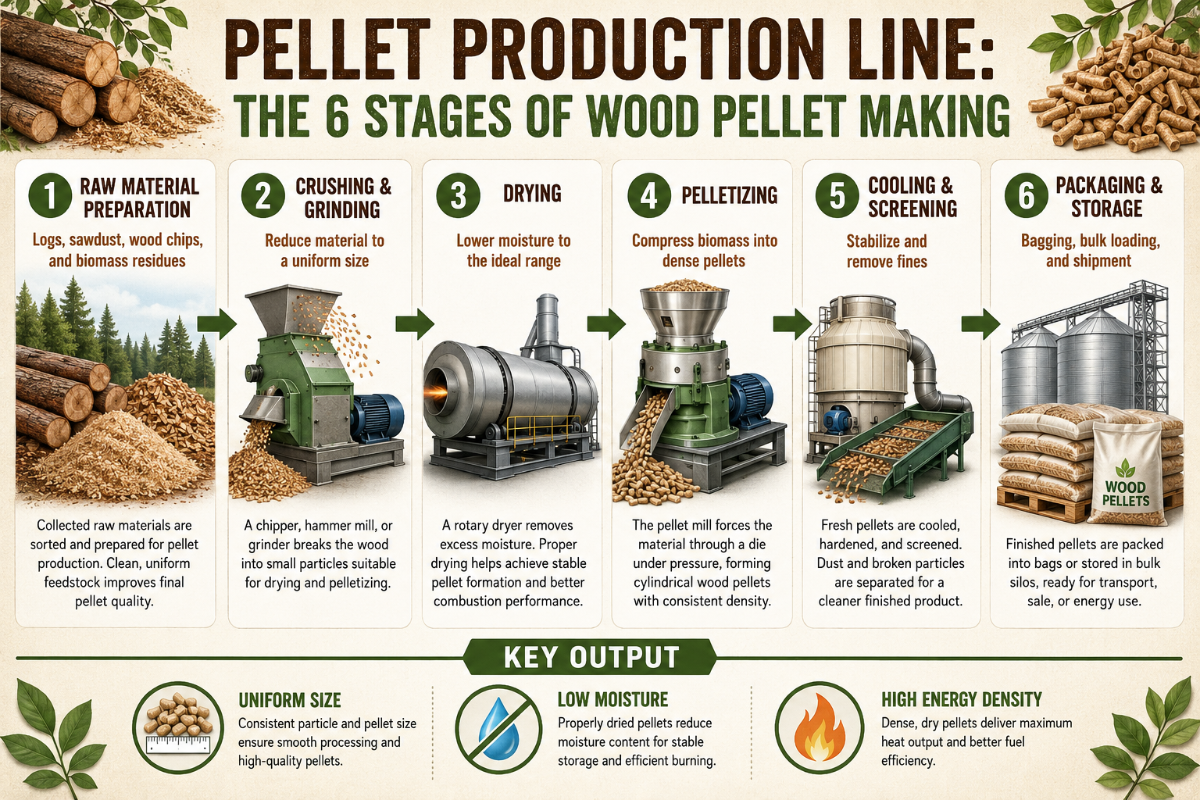
Una línea de producción de pellets es la cadena integrada de máquinas que transforma biomasa suelta — aserrín, astillas de madera, virutas de madera, corteza y paja — en pellets densos y uniformes pellets de madera para combustible. No es una sola máquina. Seis etapas trabajan en secuencia, y la línea solo funciona tan bien como su etapa más débil. Esta guía recorre cada etapa de la producción de pellets, las cifras que determinan la calidad del pellet y cómo ajustar una línea a su materia prima y capacidad de producción. Para obtener ayuda con la configuración, consulte nuestra línea completa de producción de pellets página.
Especificaciones rápidas: una línea de producción de pellets de madera de un vistazo
| Etapas | 6 — triturar → moler → secar → peletizar → enfriar → cribar y ensacar |
| Capacidad típica | 0,3–1,5 t/h pequeña · 3–5 t/h mediana · 10–20+ t/h industrial |
| Humedad de la materia prima | 25–55% en bruto → secado a ~10–15% → pellet terminado ≤8–10% |
| Tamaño de partícula antes de la matriz de peletizado | ≤3 mm (≤ el diámetro del orificio de la matriz de peletizado) |
| Diámetro del pellet | Grado de combustible de 6 mm u 8 mm; longitud ≤38 mm |
| Demanda eléctrica | ≈50–100 kW por t/h de capacidad |
| Máquinas principales | astilladora, molino de martillos, secador rotativo, peletizadora de matriz anular, enfriador, ensacadora |
¿Qué es una línea de producción de pellets?

Una línea de producción de pellets — también llamada una planta de pellets de madera, planta de pellets de biomasa o línea de peletizado — es un sistema conectado de maquinaria que comprime biomasa suelta biomasa en pellets cilíndricos pellets para combustible. En esencia, el proceso es la densificación: la materia prima con una densidad aparente baja e incómoda se convierte en un producto uniforme, lo bastante denso para almacenarse, transportarse y quemarse eficientemente.
Una peletizadora independiente solo realiza la etapa de prensado; una línea completa línea de producción de pellets de madera añade todo lo necesario antes y después — reducción de tamaño, secado, enfriamiento, cribado y ensacado — para que la biomasa suelta pellet de biomasa la materia prima entre por un extremo de la planta de producción y el producto ensacado salga por el otro.
Piense en la línea como seis secciones funcionales, no como una lista de máquinas independientes. Cada sección entrega material a la siguiente con un tamaño, humedad y temperatura específicos. Si una transferencia sale mal, toda la producción de pellets de biomasa cadena se resiente. Esa interdependencia es la idea más útil de esta guía y determina cada decisión a continuación — desde la preparación de la materia prima hasta el dimensionamiento de la capacidad de producción dimensionamiento. (La misma familia de maquinaria también opera alimento para animales peletizado; la diferencia radica principalmente en la matriz de peletizado y el acondicionamiento, no en la disposición de la línea.)
Las seis etapas de la producción de pellets de madera
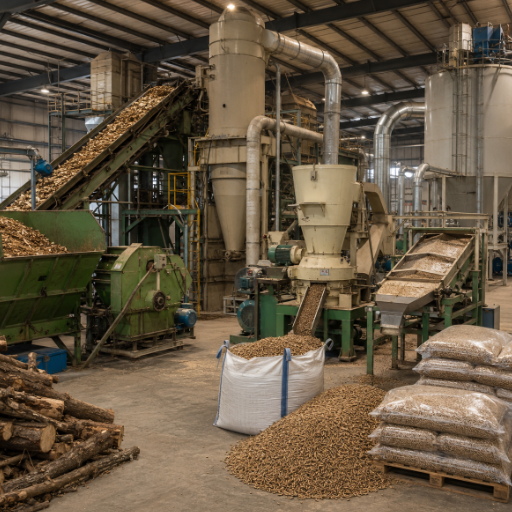
Toda línea de producción de pellets de madera , desde una unidad de taller de 0,3 t/h hasta una planta que produce cientos de miles de toneladas al año, sigue el mismo flujo. A continuación se presenta el Plan maestro de una línea de producción de pellets de 6 etapas — qué hace cada etapa, el objetivo que debe alcanzar y el cuello de botella que aparece con mayor frecuencia en ella.
| Etapa | Equipo | Función | Objetivo | Cuello de botella común |
|---|---|---|---|---|
| 1. Reducción de tamaño | Astilladora de tambor / trituradora de madera | Desmenuzar troncos y recortes en astillas | Astillas de madera < ~30 mm | Metal extraño, alimentación sobredimensionada |
| 2. Molienda | Molino de martillos | Reducir astillas de madera/aserrín a polvo | Partículas de ≤3 mm | Desgaste de la criba, capacidad de procesamiento |
| 3. Secado | Secador rotativo de tambor | Eliminar el exceso de agua | ~10–15% de humedad | Por lo general, el cuello de botella de la línea |
| 4. Peletización | Molino de pellets de matriz anular | Comprimir el polvo a través de una matriz de peletizado | Pellets de 6/8 mm | Desgaste de la matriz de peletizado, desajuste de humedad |
| 5. Enfriamiento | Enfriador de contraflujo | Endurecer y estabilizar los pellets | ≈ ambiente +10 °C | Pellets calientes y desmenuzables si se acelera el proceso |
| 6a. Cribado | Criba vibratoria | Eliminar finos y recircularlos a la peletizadora | Finos ≤1% | Exceso de finos por materia prima demasiado seca |
| 6b. Ensacado | Máquina ensacadora / silo | Ensacar o almacenar el producto a granel | Sacos de 15 kg / a granel | Finos por altura de caída, absorción de humedad |
Lea esa tabla como una cadena, no como un menú. El material fluye en una sola dirección y nunca mejora en una etapa posterior — una materia prima húmeda que el secador no puede corregir se convierte en una obstrucción en la peletizadora; una partícula molida en exceso que pasa el molino de martillos se convierte en un pellet débil.
Diseñar una línea implica lograr que cada etapa tenga la misma capacidad de procesamiento. Un proceso de EE. UU. descrito por Penn State Extension sigue la misma secuencia, y las revisiones académicas sobre peletización de biomasa describen la misma física de compactación en tres etapas dentro de la matriz de peletizado.
Etapas 1–2: preparación de la materia prima mediante astillado y molienda
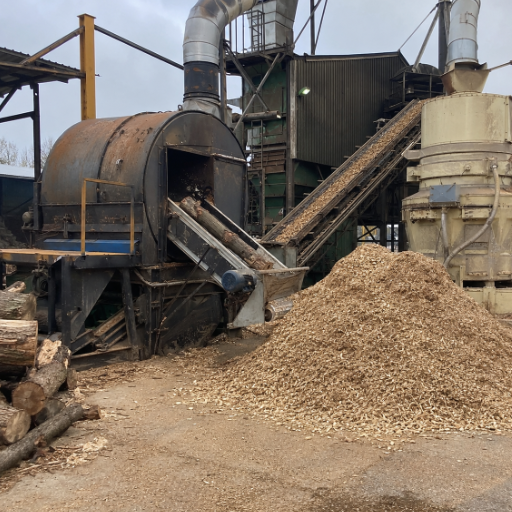
La peletización es un proceso de polvo. Antes de que cualquier materia prima material llegue a la matriz de peletizado, debe ser pequeño y uniforme. Una regla rige esta etapa: el tamaño de partícula debe ser igual o inferior al diámetro del orificio de la matriz de peletizado. Las peletizadoras estándar necesitan biomasa material molido a no más de aproximadamente 3 mm, porque la matriz de peletizado comprime partículas individuales entre sí — cualquier elemento más grande obstruye el orificio y lo atasca.
¿Qué materiales puede procesar una línea de peletizado?
Casi cualquier material seco y lignocelulósico biomasa funciona: aserrín, astillas de madera, virutas de madera de cepillado, troncos de madera, corteza, paja, cascarilla de arroz y otros residuos de cultivos. La forma de entrada determina la ruta de procesamiento. El material voluminoso —troncos y costeros— pasa por una astilladora de tambor primero, luego por un molino de martillos para la molienda final.
El material que ya es pequeño — aserrín procedente de un aserradero— puede alimentar directamente el molino de martillos. Cuando la entrada es una mezcla de residuos irregulares, una trituradora de madera o desgarradora se encarga de la reducción gruesa. Una astilladora de madera y una trituradora no son intercambiables; la astilladora de madera produce astillas limpias a partir de madera limpia, mientras que la trituradora tolera contaminación.
📐 Nota de ingeniería
Ajuste la criba del molino de martillos a la matriz de peletizado. Para una matriz de 6 mm, una criba que mantenga la producción por debajo de ~3 mm proporciona la alimentación más limpia. Las partículas sobredimensionadas no solo reducen la calidad: obstruyen los orificios de la matriz de peletizado y detienen el molino. Esta es la razón más común por la que una línea nueva «no fabrica pellets».
Etapa 3: secado hasta el intervalo óptimo de humedad
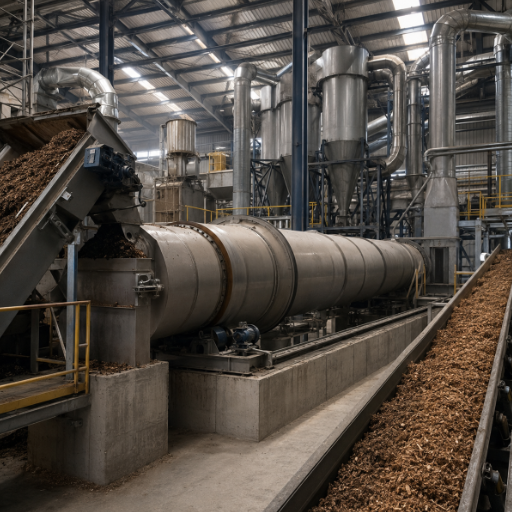
La humedad es el número más importante de toda la línea y el que más se malinterpreta. La lignina —el polímero natural de la madera— es lo que mantiene unido un pellet. Solo se ablanda y fluye cuando hay suficiente agua y suficiente calor de la matriz de peletizado. Muy poca agua y la lignina nunca se activa; demasiada y el agua se convierte en vapor dentro de la matriz de peletizado.
Apunte a un intervalo óptimo, no a un mínimo. Para la madera, la materia prima suele secarse hasta aproximadamente 10–15% de humedad antes de la peletizadora, aunque el óptimo varía según el material; los estudios académicos sobre peletización reportan buenos pellets a partir de material de alimentación en el 8–12% intervalo para algunas especies. Si baja de aproximadamente 10% los pellets se desmoronan hasta volver a ser polvo por falta de aglutinación; si supera aproximadamente 15%, se forman bolsas de vapor en la matriz de peletizado, que separan los pellets durante la descarga. Después del enfriamiento, el pellet terminado se estabiliza en ≤8-10% humedad.
La cascada de pérdida de humedad —adónde va la masa
El agua es la masa que sale de la línea. Comience con aproximadamente una tonelada de madera verde aserrín con 50% de humedad. Secarla hasta ~10% elimina la mayor parte de esa agua, dejando solo aproximadamente 0,55 toneladas de pellets. Por eso, la capacidad de secado, no la capacidad de la prensa peletizadora, suele determinar el tamaño de toda la planta, y por eso un secador se dimensiona según la húmeda entrada, mientras que la peletizadora se dimensiona según la seca capacidad de producción.
El secado también es la etapa que más energía consume. La demanda eléctrica de la maquinaria de peletización ronda 50–100 kW por t/h de capacidad, pero la energía total, incluida la carga térmica del secado rotativo de tambor es mucho mayor; los análisis publicados la sitúan muy por encima de 2.000 kWh por tonelada cuando la materia prima entra muy húmeda. Por lo tanto, elegir un secador adaptado a la humedad de su materia prima es el factor más importante para el costo operativo.
«Un lote frustrante se seguía desmoronando y estaba seguro de que la matriz de peletizado tenía una falla, pero las virutas de madera simplemente estaban demasiado húmedas. Después de secarlas correctamente, el problema desapareció.»
⚠¦ Error común: «mientras más seco, siempre es mejor»
No lo es. El material de alimentación excesivamente seco es la causa más común de polvo excesivo y pellets que se desmoronan, porque ya no hay suficiente humedad para fundir el aglutinante de lignina. Compre un medidor de humedad, analice la materia prima y apunte al intervalo óptimo, no al mínimo.
Etapa 4: peletización — matriz anular frente a matriz plana
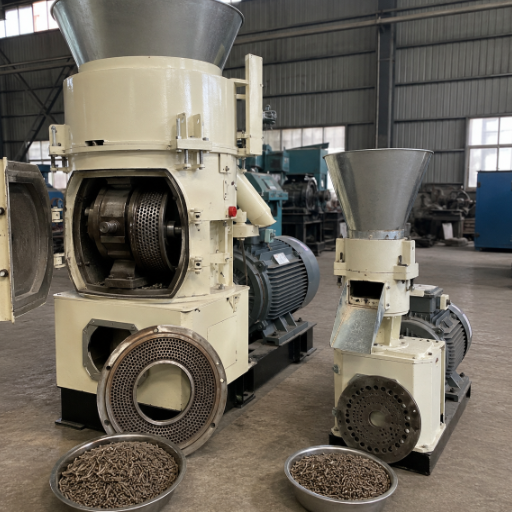
Este es el corazón de la línea. Dentro de la peletizadora, los rodillos fuerzan el polvo acondicionado a través de los orificios de una matriz de peletizado de acero endurecido bajo alta presión; el calor de fricción ablanda la lignina y el material sale como una barra continua que se corta a la longitud requerida. Predominan dos geometrías de matriz de peletizado, y la elección es una de las decisiones más claras en producción de pellets.
| Factor | Matriz plana | Matriz anular |
|---|---|---|
| Capacidad típica | ~0.1–1 t/h | ~1–20+ t/h |
| Mejor para | Pequeña / en granja / pruebas | Capacidad de producción industrial continua |
| Vida útil de la matriz de peletizado | Más corta, fácil de cambiar | ~1,000–1,500 h, luego reemplazar |
| Inversión inicial | Menor inversión inicial | Mayor, menor costo por tonelada |
¿Por qué las líneas industriales de peletizado usan peletizadoras de matriz anular?
Porque tanto la capacidad de producción por hora como el costo por tonelada favorecen a la matriz anular a gran escala. Una peletizadora de matriz anular distribuye el trabajo entre una gran matriz circular y varios rodillos, manteniendo la capacidad de procesamiento que necesita una línea continua. Las peletizadoras de matriz plana tienen su lugar en el extremo pequeño —pruebas piloto, uso en granja y alimento para animales—, donde la simplicidad y un bajo precio inicial importan más que las toneladas por hora.
El desgaste de la matriz de peletizado es real de cualquier forma: espere reemplazar una matriz de peletizado en funcionamiento aproximadamente cada 1,000–1,500 horas de operación, y presupuéstela como un consumible, no como una sorpresa. Las mejoras patentadas siguen reduciendo los márgenes —enfriamiento de rodillos y sistemas de alimentación mejorados (por ejemplo US 6,299,430 y US 4,162,881)—, pero la compensación fundamental entre matriz anular y matriz plana se ha mantenido durante décadas.
⚠¦ Una trampa para compradores que debe conocer
Las peletizadoras de matriz plana se fabrican en dos configuraciones que parecen casi idénticas: una alimentación modelo en el que gira la matriz, y una madera modelo en el que giran los rodillos. El modelo para madera puede costar aproximadamente el doble que el modelo para alimento balanceado, y las unidades económicas vendidas para «madera» suelen ser molinos para alimento balanceado que no resistirán. Confirme cuál está comprando.
Etapas 5–6: enfriamiento, cribado y ensacado
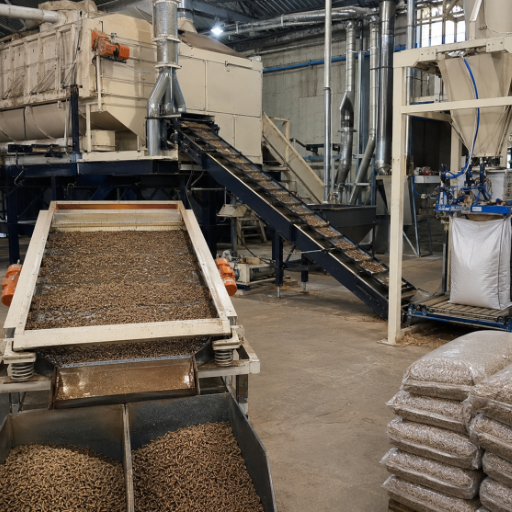
Los pellets salen de la matriz de peletizado calientes —alrededor de 80–90 °C — y blandos. No están terminados. Un enfriador de contraflujo extrae aire ambiente a través del lecho, endureciendo los pellets a medida que la lignina vuelve a fijarse y bajando su temperatura hasta cerca de la temperatura ambiente.
Si omite o apresura este paso, los pellets se desmoronan y luego reabsorben humedad durante el almacenamiento. Después del enfriamiento, una criba vibratoria elimina finos (polvo y piezas rotas), que se reciclan de vuelta a la peletizadora en lugar de desperdiciarse.
Trate estas etapas finales como preservación de la calidad, no como algo secundario. Un pellet que cumplía la especificación en la matriz de peletizado puede dejar de cumplirla después de su manipulación: un estudio a gran escala encontró que una sola caída de 7.8 m elevó la proporción de finos menores de 3.15 mm de 4.82% a 9.01%. Las caídas de los transportadores, la descarga del enfriador y la línea final de ensacado agregan finos, por lo que un diseño bien concebido enfriador de pellets, un manejo cuidadoso y una criba final antes de la máquina de ensacado son lo que mantiene el producto terminado dentro de los límites de ENplus.
📐 Nota de ingeniería —el polvo combustible es un peligro en toda la línea
El secado, la molienda, el enfriamiento y el cribado generan polvo fino de madera, que es combustible. OSHA ha citado operaciones de pellets por carecer de detección de chispas, supresión de incendios y aislamiento de explosiones entre la peletizadora, el enfriador y el colector de polvo. Considere el control de polvo, la detección de chispas y el aislamiento (según NFPA 664) como parte de la especificación de la línea, no como un complemento opcional.
Ajuste de la materia prima, la capacidad y la configuración a su línea
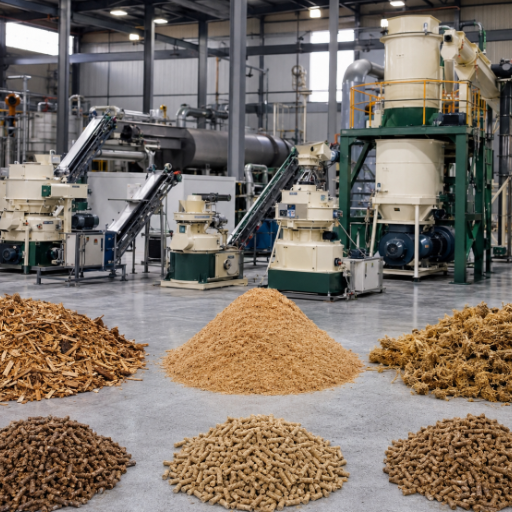
Comprar una peletizadora grande peletizadora y dejarla sin materia prima es el error más costoso en este mercado. Esta es la regla que lo evita.
La regla de la etapa más débil
La capacidad de producción real de una línea equivale a la capacidad de procesamiento de su más lenta etapa, y esa etapa casi siempre es el secador, no el molino. En un caso documentado, un secador rotativo subdimensionado redujo tanto la alimentación de una planta que la peletizadora operaba muy por debajo de su capacidad nominal; el operador tuvo que elevar la capacidad de secado de 3.5 t/h a al menos 10 t/h antes de que el molino pudiera alcanzar su capacidad de producción nominal. Dimensione primero el secador según la alimentación húmeda y luego equilibre todas las demás etapas con respecto a este.
Con esa regla en mano, configurar una línea se reduce a cuatro datos de entrada. El configurador de líneas con 4 datos de entrada los convierte en una especificación:
- 1. Humedad de entrada de la materia prima — >30% de humedad significa que un secador rotativo más grande domina el presupuesto; por debajo de 15% solo se necesita un secador pequeño, o ninguno.
- 2. Forma de la materia prima: troncos → agregue una astilladora de madera; limpio aserrín → solo molino de martillos.
- 3. Capacidad objetivo (t/h): determina el tamaño de la matriz anular y la potencia del motor (~50–100 kW por t/h).
- 4. Calidad del pellet — el combustible de grado ENplus necesita un cribado, enfriamiento y control de humedad más estrictos que el combustible básico de uso interno.
La capacidad también determina el presupuesto. Penn State Extension sitúa el costo de los equipos aproximadamente en $70,000–$250,000 por t/h de capacidad, con aproximadamente la mitad de ese monto en la peletizadora misma. Los precios de los proveedores en el mercado coinciden con ese rango:
| Escala | Capacidad | Inversión indicativa (USD) | Comprador típico |
|---|---|---|---|
| Pequeña | 0,5–1 t/h | $30k–$80k | En granja, autoabastecimiento |
| Media | 3–4 t/h | $95k–$430k | Productor regional de combustible |
| Grande | 10–20 t/h | $500k–$1.6M | Planta comercial |
| Industrial | 20–40+ t/h | $570k–$3M+ | Exportación / suministro para empresas de servicios públicos |
Las cifras son indicativas a partir de 2026 y varían según el nivel de automatización, la materia prima y el alcance llave en mano; considérelas como un rango de planificación, no como una cotización.
¿No está seguro de qué escala se ajusta a su material? Envíenos la humedad de su materia prima y las toneladas por hora objetivo, y dimensionaremos una línea según esos datos.
¿Qué determina la calidad del pellet? Durabilidad, humedad y ENplus
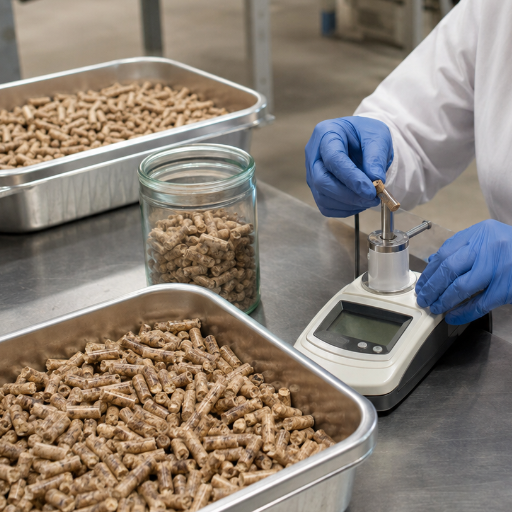
Independientemente de lo que produzca la línea, el mercado lo evalúa frente a normas publicadas. Para el combustible sólido de pellets, la referencia europea es ENplus, basada en ISO 17225-2, y ENplus A1 es la categoría residencial premium. Estas son las cifras que un pellet de combustible de calidad pellet de combustible debe cumplir:
| Propiedad | Requisito de ENplus A1 |
|---|---|
| Diámetro | 6 ± 1 u 8 ± 1 mm |
| Longitud | 3,15 < L ≤ 40 mm |
| Humedad | ≤ 10% |
| Ceniza | ≤0,7% |
| Durabilidad mecánica | ≥ 98,0% (A2/B: 97,5%) |
| Finos (< 3,15 mm) | ≤ 1,0% a granel · ≤ 0,5% ensacado |
| Valor calorífico neto | ≥ 4,6 kWh/kg (≈16,5 MJ/kg) |
| Densidad aparente | 600–750 kg/m³ |
La durabilidad es el indicador que se relaciona con toda la línea. La durabilidad mecánica del pellet mide qué tan bien un pellet resiste la manipulación sin desprender polvo, y se determina en las etapas previas, por el tamaño de partícula, el contenido de humedad intervalo óptimo y una compresión adecuada en la matriz de peletizado. ISO 17225-2 elevó el mínimo de durabilidad A1 a 98%, por lo que una línea orientada al mercado prémium no tiene margen de error en los fundamentos. Los requisitos completos están publicados por ENplus y en ISO 17225-2.
Hacia dónde se dirige la peletización industrial
La demanda es el contexto de cada decisión de dimensionamiento de línea. A nivel mundial, el mercado de pellets de madera tenía un valor aproximado de USD 17,25 mil millones en 2025 y se prevé que alcance cerca de USD 26 mil millones para 2031, con una tasa de crecimiento compuesto cercana al 7%. La calefacción industrial ya representa cerca de la mitad de todo el combustible de biomasa en forma de pellets, y Europa —impulsada por mandatos de energía renovable como RED III— representa alrededor del 58% del consumo, mientras que Asia-Pacífico es la región de mayor crecimiento a medida que Japón y Corea del Sur amplían la co-combustión de biomasa.
Dos cambios son importantes para quienes especificarán una línea en los próximos años. Primero, la automatización y el monitoreo continuo de la línea se están extendiendo desde las plantas más grandes hacia las más pequeñas, reforzando el control de humedad y reduciendo los ajustes manuales que históricamente provocaban finos y atascos.
Segundo, torrefactados los pellets «negros» —biomasa tostada hasta una mayor densidad energética— están surgiendo para la co-combustión con carbón; tenga en cuenta que estos se rigen por una norma independiente, ISO 17225-8, no la familia ISO 17225-2 que cubre los pellets blancos convencionales. En la práctica, incorpore ahora a la línea flexibilidad para la variedad de materias primas y calidad de grado ENplus®, porque tanto las normas de cadena de custodia como los compradores son cada vez más exigentes, no menos.
Preguntas frecuentes
P: ¿Cuánto cuesta una línea de producción de pellets?
Ver respuesta
Los equipos cuestan aproximadamente $70,000–$250,000 por tonelada por hora de capacidad de producción, y cerca de la mitad corresponde a la peletizadora. En la práctica, eso significa aproximadamente $30,000–$80,000 para una línea pequeña de 0,5–1 t/h, $95,000–$430,000 para una planta de 3–4 t/h y $500,000 hasta varios millones para sistemas industriales de 10–40+ t/h. El nivel de automatización, la humedad de la materia prima y el alcance llave en mano modifican la cifra dentro de esos rangos.
P: ¿Qué materias primas puede procesar una línea de producción de pellets?
Ver respuesta
La mayoría de la biomasa lignocelulósica seca: aserrín, astillas de madera, virutas de madera de cepillado, corteza, troncos, paja, cáscara de arroz y otros residuos agrícolas. La forma determina la etapa inicial: los troncos necesitan una astilladora de madera antes del molino de martillos, mientras que el aserrín puede alimentar directamente el molino. Las constantes son el tamaño de partícula (molido a ≤3 mm) y la humedad (acondicionada a aproximadamente 10–15% antes del prensado), independientemente del material de origen.
P: ¿Cuánta electricidad utiliza una línea de peletizado por tonelada?
Ver respuesta
La demanda eléctrica de la maquinaria de peletización es de aproximadamente 50–100 kW por tonelada por hora de capacidad de producción, lo que equivale aproximadamente a 90–150 kWh de electricidad por tonelada de pellets. Si se considera la energía térmica necesaria para secar materia prima muy húmeda, la energía total puede superar 2,000 kWh por tonelada, precisamente por eso el secado, y no el prensado, domina la factura energética.
P: ¿Puede una línea producir pellets tanto para combustible como para alimento para animales?
Ver respuesta
A menudo sí, con cambios en la matriz de peletizado y el acondicionamiento. La disposición de la línea es similar, pero los pellets de alimento balanceado usan acondicionamiento con vapor y una matriz de grado para alimento balanceado, mientras que los pellets para combustible priorizan los objetivos de humedad y durabilidad anteriores.
P: ¿Con qué capacidad debería comenzar una primera planta de pellets?
Ver respuesta
La mayoría de los nuevos participantes comerciales comienzan con alrededor de 1–1,5 t/h, lo que equilibra una inversión manejable con una capacidad de producción significativa. Rara vez lo determina la peletizadora: lo determina cuánta materia prima puede secar de forma confiable. Dimensione primero el secador para la materia prima más húmeda prevista y luego ajuste la peletizadora a la capacidad de producción en seco, para no dejar nunca capacidad de la peletizadora limitada por un secador subdimensionado.
P: ¿Cuánto dura una matriz de peletizado?
Ver respuesta
Planee reemplazar una matriz de peletizado en funcionamiento aproximadamente cada 1,000–1,500 horas de operación. Considere las matrices como un consumible presupuestado; operar con una matriz desgastada desperdicia energía y produce pellets débiles y polvorientos.
P: ¿Puede una línea de peletizado producir pellets de grado ENplus A1?
Ver respuesta
Sí, si toda la línea está especificada para ello. ENplus A1 exige ≥98% de durabilidad, ≤10% de humedad, ≤0,7% de cenizas y ≤0,5% de finos en sacos — objetivos que dependen de un tamaño de partícula preciso, la humedad correcta, un enfriamiento completo y un cribado final. ENplus A1 es un resultado de toda la línea, no un ajuste de la peletizadora.
Referencias y fuentes
- Fabricación de pellets combustibles a partir de biomasa — Extensión de Penn State
- Desarrollos recientes en la peletización de biomasa: una revisión — NC State, BioResources
- Mejora de las propiedades de la biomasa mediante densificación — Ohio State Extension (Ohioline)
- Esquema de calidad ENplus — European Pellet Council
- ISO 17225-2 — Pellets de madera clasificados — International Organization for Standardization
- OSHA 29 CFR 1910 — polvo combustible / seguridad de procesos — Administración de Seguridad y Salud Ocupacional de EE. UU.
- El arte de la peletización de biomasa — Biomass Magazine
Por qué escribimos esto
TCPEL fabrica maquinaria para biomasa — astilladoras de tambor, molinos de martillos, secadores rotativos, peletizadoras de matriz anular, enfriadores y unidades de ensacado — y configura líneas completas de producción de pellets para clientes en más de 60 países. Esta guía refleja cómo dimensionamos esas líneas etapa por etapa: el secador para la materia prima húmeda, la peletizadora para la capacidad de producción en seco y la calidad diseñada desde el tamaño de partícula.
Artículos relacionados
- Guía del secador rotativo — dimensionamiento de la etapa que normalmente limita su línea
- Guía del comprador de astilladoras de tambor — cómo realizar correctamente la reducción de tamaño en la primera etapa
- Trituradora de madera vs. desgarradora de madera — elección de reducción gruesa para residuos mezclados
- Línea completa de producción de pellets — modelos, capacidades y configuración