Liên hệ với TCPEL

Updated June 2026 Reviewed by the TCPEL technical team
A feed pelletizer is an animal feed equipment to compress easily-flowing, ground mash into compact cylindrical pellets to feed animals without segregation or spillage. It’s often called a pellet mill, feed pellet machine, feed pellet press, pellet maker machine, or feed pelletizing machine. This article clarifies how the machine actually work, the complete process line it’s part of, the variation between flat-die and ring-die technology, what determines pellet hardness, and how to troubleshoot the problems that emerge on the shop floor. For equipment options and prices, see the TCPEL animal feed pelletizer range, of which this article details the engineering considerations.
In summary: an animal feed pelletizer is a machine that condenses conditioned, ground feed through the apertures of a steel die, so heat from the friction sets the gelatinized starch and binds the particles into 2-10 mm pellets. The Pellet Durability Index (PDI) – is used to measure the quality of the finished pellet; standards are given in ASABE S269.5, with a guide to pellet quality from Kansas State University, and is more dependent on die geometry and proper conditioning than the formula balancing the diet.
Những điều quan trọng cần làm
- A die compression ratio (L/D) too high can lead to a reduced feed intake and broiler performance, and result in excessive chocking of the die and burner.
- Steam conditioning together with the shape of the dies influence the strength of a pellet more than the formula – the nutrients in the recipe weigh in as a lasti! action.
- Pelleted feed sinks; floating aquafeed requires an extruder not a pelletizer.
- Pelleting costs about $5-6 per ton over mash, but quickly recovers through improved feed conversion and minimal wastage – hitting a single digit-to-mid-teens increase in efficiency, not the 300% hit some manufacturers quote.
- Most faults experienced with pellet machines are caused primarily by moisture and inadequate conditioning, rather than the machine set-up per se.
Animal Feed Pelletizer at a Glance
| Typical capacity band | ~60 kg/h (small farm) to 6 t/h (commercial line) |
| Đường kính viên | 2–10 mm (die-dependent) |
| Two main architectures | Flat die (small/farm) · Ring die (commercial) |
| Core process | Grind → mix → condition → press → cool → pack |
| Conditioning target (corn-soy) | 17–18% moisture at the die, 180–200°F |
| Commercial pellet durability (PDI) | 88–92% poultry/pig · 92–95%+ aquafeed |
Bands are typical industry ranges for pellet mill die lifetime; actual figures vary with specie, diet and equipment. See the feed pellet mill manufacturer’s published TCF model documentation for measured values.
What Is an Animal Feed Pelletizer?
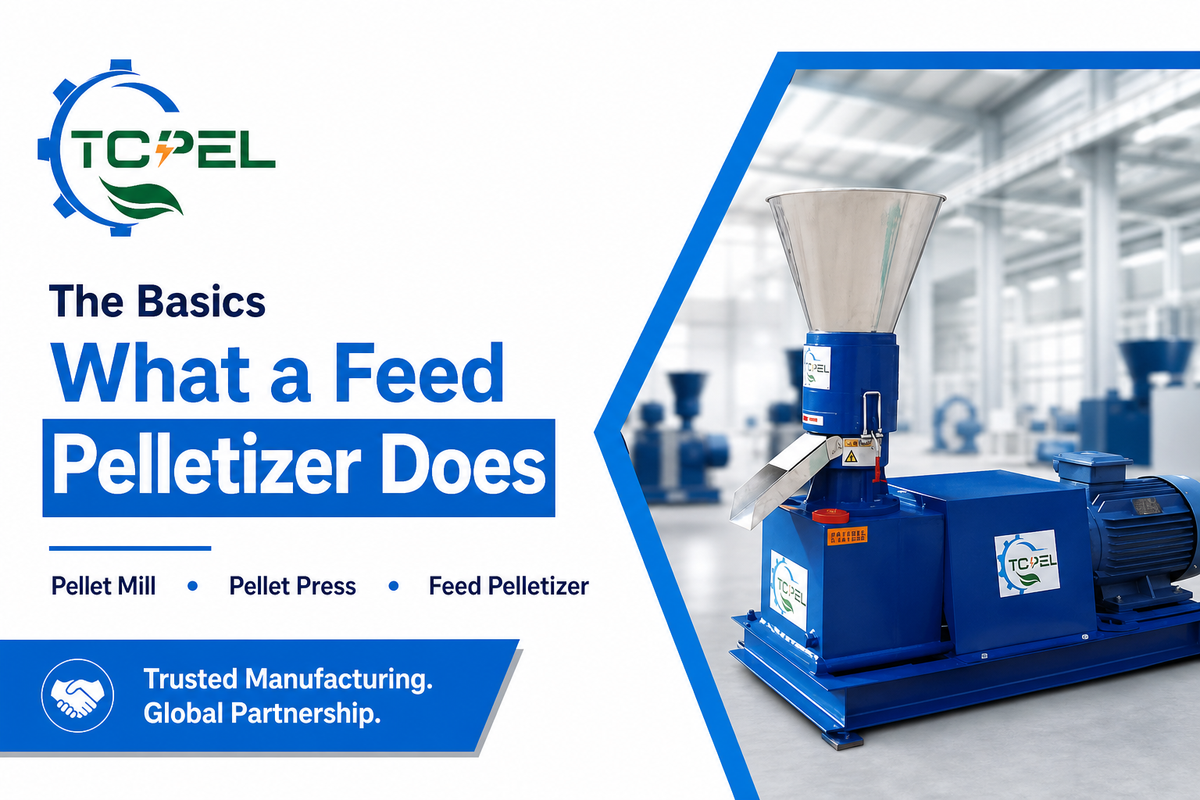
An animal feed pelletizer is a machine that presses ground, conditioned mash through a steel die into uniform, dense pellets animals can eat without sorting or wasting. It goes by several names depending on the supplier: pellet mill, feed pellet machine, feed pellet press, pellet maker machine, or feed pelletizing machine.
A single machine sits at the center of animal feed production and feed processing, batching raw grain, cake, and mash into finished feed. It scales from household use up to industrial production, and the same platform turns out poultry feed pellet, livestock, and pet feed rations.
Why pellet in the first place? Pelletizing offers a solution to an issue all mash feeders know. One poultry producer said, after observing his animals pull out the cracked corn and leave behind the vitamin powder, that loosely-formed mash allow animals to pick out only the ingredients they prefer. Pelletizing the entire mixture of the feed recipe to prevent them from sorting ingredients so you always provide the expected benefit in each bite. Kansas State University feed scientists share a list of advantages of feeding feed in pellet form: less ingredient segregation, increased bulk density, dust reduction, less bin bridging and improved swine and poultry average daily gain and feed-to-gain ratios, as noted in K-State’s feed manufacturing guide. Same principle, preserve nutrition, whether your pellet consists of poultry feed, pet food or aquafeed.
A pellet mill is one stage of a more complete feed production facility. By itself, it’s solely used for making pellets but will usually have one of the following processing operations prior, during and following. A pellet mill occupies the central portion of the larger sequence between grinding/mixing processes above, and a subsequent cooler and packaging station below. Our walkthrough through the feed pelletizing line appears below.
How an Animal Feed Pelletizer Works (Step by Step)
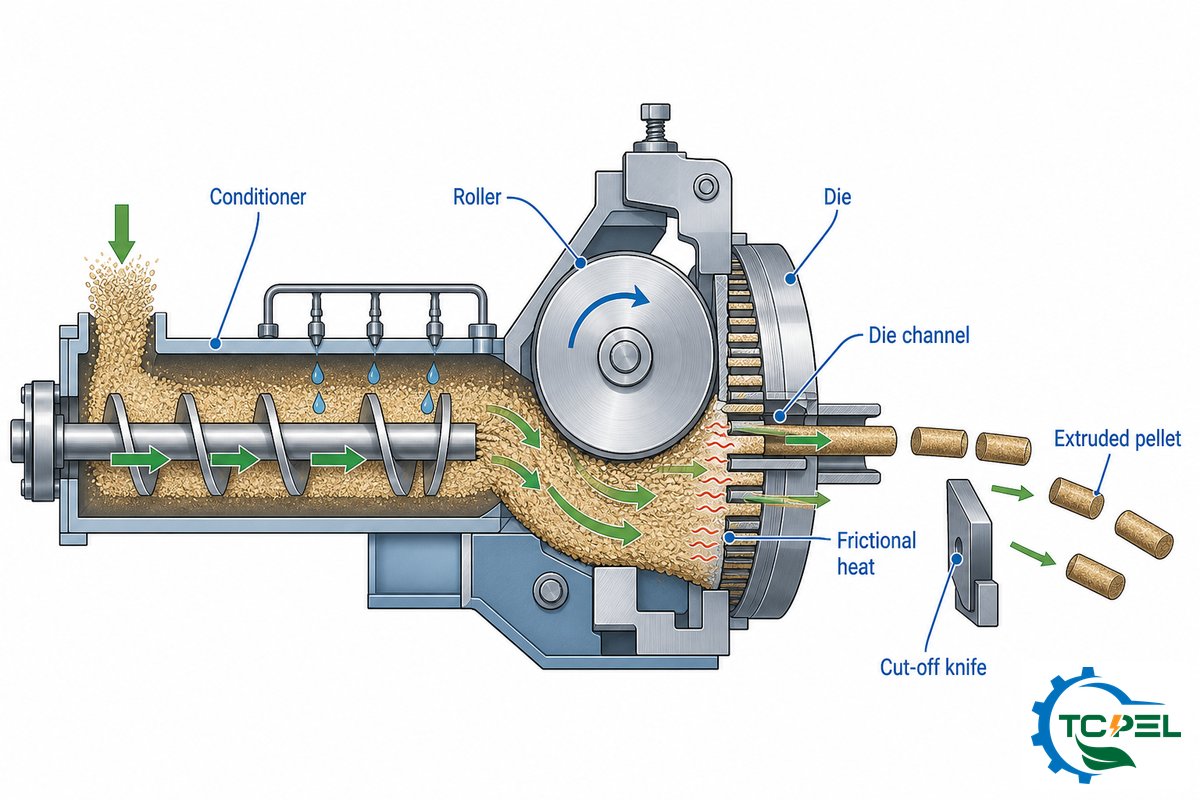
A feed pellet machine works by forcing conditioned mash through a die. A roller presses the soft feed into the die channels, where friction and pressure generate heat that gelatinizes the starch; the gelatinized starch then acts as the binder that holds the pellet together, and a knife shears the extruded strands to length.
Compacting feed at the die face brings it to a bulk density of about 0.5-0.6 g/cc as it exits, according to a ScienceDirect review of pelletizing.
Walk it through in order:
- Conditioning. When feed passes through a steam conditioner a combination of moisture and heat are provided to lubricate the die and soften feed components for enhanced pellet binding. For common corn-soybean diets at the Kansas State University Extension, feed manufacturers often maintain 17-18% moisture and 180-200°F at the mill and strive for 30-45 seconds of conditioner retention time.
- Pressing. Conditioned mash is then dropped onto the die where the roller turn and forces the particles into the passages. Increased resistance as it travels toward the outside, exiting side of the die develop increased pressure that causes it to heat up and compress.
- Starch gelatinization. Combined forces and water gelatinize the starches found in the feed, which causes the pellet to bond together when it has dried.
- Extrusion and cutting. Pelleted feed exits the die face of the mill where it then is cut by an adjustable knife into your desired pellet length.
- Cooling. Newly made hot pellets exit the mill and enter a pellet cooler where moisture and some of the heat is expelled, and where they achieve their final durability for shipment and use.
📐 Ghi chú Kỹ thuật
Increased conditioning temperature actually decreased pellet hot mill temperature, since steam provided needed lubrication and reduces frictional shear losses across the die. A practical field rule developed by KSU states that a 25°F increase in conditioning temperature adds about 1 percentage point of moisture, but the mill will start plugging and rollers will begin slipping over the die when total moisture exceeds approximately 18%.
That relationship between moisture, temperature, and pressure, at the point where it applies to the die, is why two different mills, both with the exact same recipe, can produce quite different pellets. Recipe has an impact, of course, but the machine adjustments ultimately determine what your recipe yields.
The Feed Pelleting Process: From Grinding to Packing
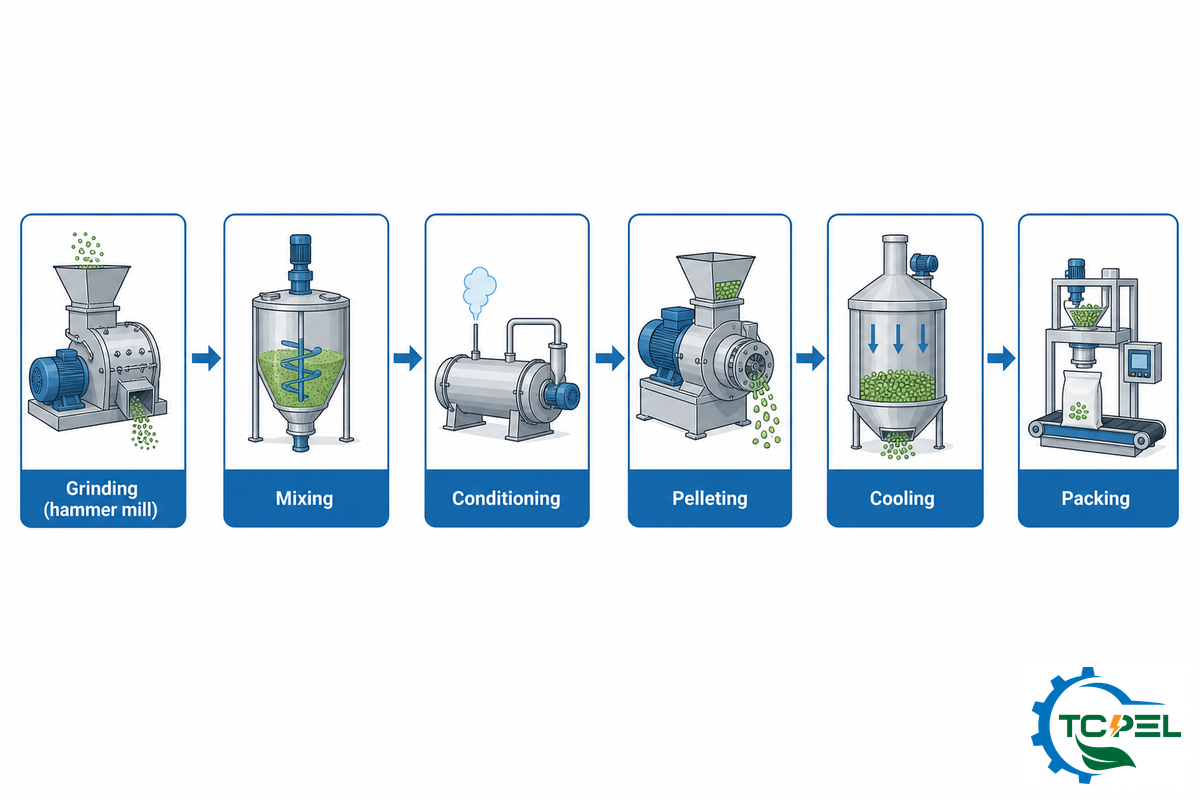
A pellet mill is only one of 6 machines on the line. Planning the entire line out as one is the most frequent planning error that occurs. It’s the hammer mill that’s too small, or the cooler that’s too big, and both will limit production irrespective of pellet press quality.
The 6-Stage Feed Pelleting Line Map
The 6-Stage Feed Pelleting Line Map is the connected chain that turns raw ingredients into bagged pellets: grinding, mixing, conditioning, pelleting, cooling, and packing.
| Giai đoạn | Thiết bị | Việc làm |
|---|---|---|
| 1. Grinding | Máy nghiền Hammer | Reduces raw grain to a uniform particle size so feed conditions and binds evenly. |
| 2. Mixing | Feed mixer | Blends ground grain, soybean meal, premix and (light) molasses into a consistent mash. |
| 3. Conditioning | Steam conditioner | Adds steam/moisture and heat to soften particles and lubricate the die. |
| 4. Pelleting | The pelletizer | Compresses mash through the die into formed pellets. |
| 5.làm mát | Counter-flow cooler | Removes conditioning moisture and hardens the pellet; fines are screened off. |
| 6. Packing | Packing scale | Weighs and bags finished pellets for storage and transport. |
Process sequence after Kansas State University feed manufacturing guidance.
There’s interdependence between all six steps, so a weak link caps the line: a too-small hammer mill or a rushed cooler limits the whole plant, and pellets that reach the bag still soft will crumble in transit. A complete animal feed dây chuyền sản xuất viênsometimes sold turnkey as a feed pellet plant, bundles these machines and equipment so the production rate of every stage is matched, while smaller operations run a compact pellet making set rather than complete feed pellet plants. Pelleting solutions scale from a single grinder machine plus mill up to integrated animal feed pellet production lines and feed processing machines; the machinery for feed pellet making is modular. For the full chain see the feed pellet production line, the upstream feed-grinding hammer mill (a feed hammer mill), and the downstream pellet cooler. Fitted with the right die, the same equipment class also presses wood pellets.
Flat Die vs Ring Die Pelletizers (and When You Need an Extruder)
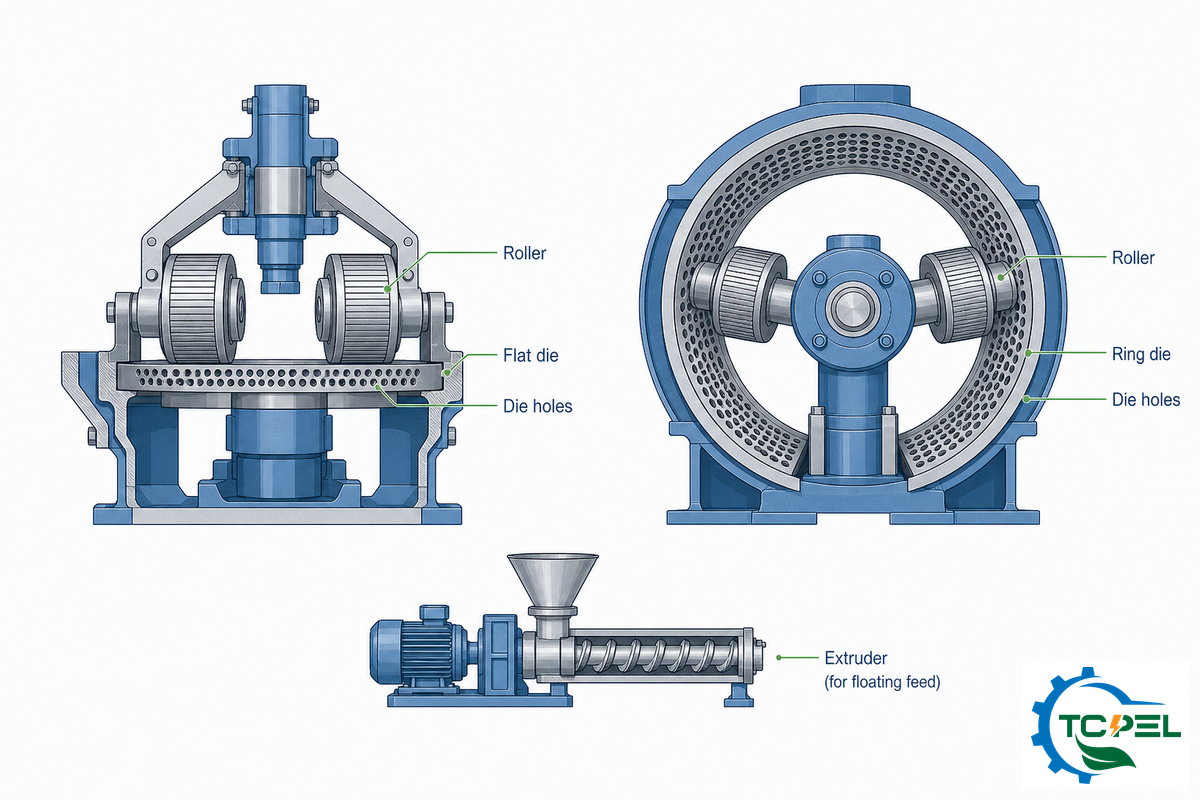
There are 2 types of animal feed pelletizers. The best kind for you depends almost entirely on throughput.
| Feature | Flat die | Ring die |
|---|---|---|
| Công suất điển hình | ~60–800 kg/h | 1–15 t/h |
| Phù hợp nhất | Farm, home, small commercial | Medium to large feed mills |
| Footprint & cost | Compact, lower capital | Larger, higher capital |
| Lái xe | Electric or diesel engine (220V/380V options) | High-power 3-phase, often with variable-speed drive |
| Đường kính viên | 2–10 mm | 2–10 mm |
✔ Flat die — advantages
- Low capital, simple to operate and service
- Small footprint, good for on-farm pelleting
- Handles coarse and higher-fiber inputs well
⚠ Ring die — trade-offs
- Higher capital and installed power
- Best economics only at commercial tonnage
- Needs trained operators and tighter QC
Both run interchangeable dies in conventional hole sizes — 2, 4, 6, 8 and 10 mm — and a die labelled 4mm, 6mm or 8mm simply states its hole diameter, deciding whether you press a small feed pellet for day-old chicks or a larger 10 mm pellet for cattle. Dedicated fish feed machines exist, but most sinking aquafeed comes off the same platform with a finer die. Both the flat dies and the vertical ring dies Pellet presses are dealt with in some detail within the next guides, listed beneath.
What Is the Difference Between Pelleting and Pelletizing?
Pelleting and pelletizing is a description of doing the same action, pressing loose feed into pellets, so the terms are interchangeable. An important difference for feed is pelleting versus extrusion: as Kansas State University documents the process, a pelletizer simply compresses conditioned mash, while an extruder uses a screw plus heat and moisture to cook and expand feed.
When Do You Need an Extruder Instead?
To make floating fish feed, it takes an extruder. Your pellet mill make heavy, sinkers-great for chicken, hogs, cattle, bottom dwellers and high durability aquafeeds 92%+. You simply can’t get surface-floating feeds without the air inclusion and expansion that only an extruder provide. If your animals are surface feeders, plan for extrusion from the start.
Die Compression Ratio and Pellet Durability (PDI), Explained
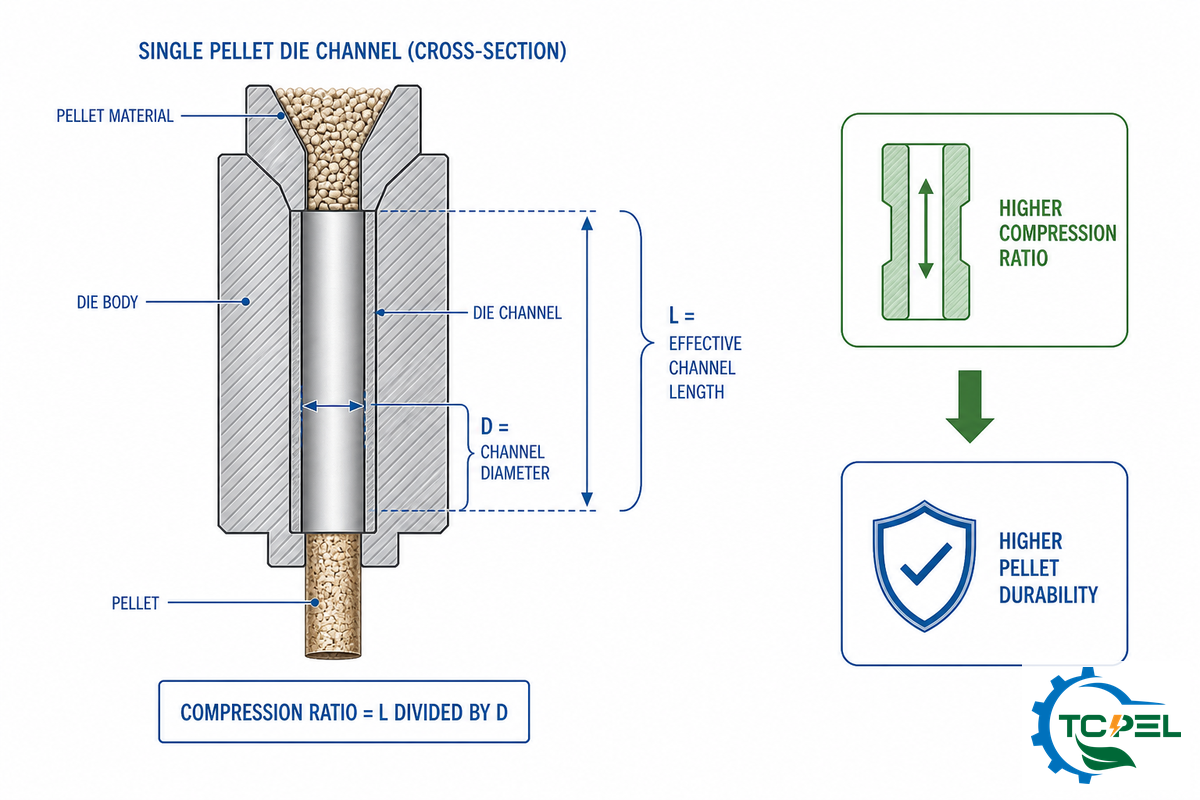
Pellet durability is the single top-rated feed milling quality criterion, and it’s more greatly influenced by your die than anything that you manage on an everyday basis. PDI measures pellets durability in terms of the weight percentage of pellets which endure through a predetermined tumble process. Original work on the pellet durability test methodology begun in 1962, then it was standardized in 1969, most recently in 2012, in the ASABE Standard S269.5. As Kansas State University’s extension guide describes the test, a 500 g sifted sample is tumbled for ten minutes at 50 rpm, after which the intact percentage is weighed.
But the biggest lever is the die’s “compression ratio,” designated as L/D (where the length of the “active” channel in the hole is L, and the “hole” has a diameter D). According to work at Kansas State University, the L/D has a significant impact on the PDI, whereas feed rate does very little. As the L/D increases, the PDI generally increases, provided the conditioning temperature is sufficient.
The L/D-to-PDI Crossover Curve
L/D to PDI crossover is where longer dies no longer help and start hurting you – where you “get negative returns”. Past the curve, any increase in “harder” PDI results in reduced food intake, reduced throughput, and reduced die life.
| As L/D ratio rises → | What improves | What gets worse |
|---|---|---|
| Low (soft pellets) | Higher throughput, longer die life, lower power | More fines, weak pellets |
| Matched to species | Target PDI met at reasonable energy | — |
| Too high (over-hard) | Maximum hardness | Die choking, more power, poor die life, and reduced nutrient availability/broiler performance |
This is the paradox and why many purchasers fall into the trap. WVA has cautioned that “an increase in the L/D ratio would be harmful to nutrient availability and, therefore, subsequent broiler performance,” and die field guides clearly list an overly high compression ratio for a layer feed as having a history of reduced die life, die choking, low, non-uniform PDI, and excessive power usage. Harder isn’t free — it’s a species-specific compromise, not an absolute you’re aiming to boost.
📐 Engineering Note — compute your own L/D
L/D=effective die-channel length divided by the hole diameter. You’ve got a 6mm die with a 60mm effective channel: That gives you 60/6 = 10:1 – a typical pig or poultry configuration. If you want to soft pellet at 48mm, at higher output, 48/6 = 8:1; If you want to get harder pellet, but have lower output and more motor torque per ton, and the die lasts only half as long, make it 72mm: 72/6=12:1, for harder pellets at the cost of throughput and die service life. Target the species, hold it under strict quality control, and check it’s right with a PDI test instead of guessing.
“In our workshop verification, the lever operators underestimate most is even, full-face contact between roller and die. When pressure is distributed across the whole die face instead of one zone, durability holds and the outer die holes stop wearing faster than the inner ones.”
On the buying end – to determine which die spec is included with each model and which species is the best match – the manufacturer’s species-die selector does the work of sorting it down to the actual die specification.
Troubleshooting Common Feed Pelleting Problems
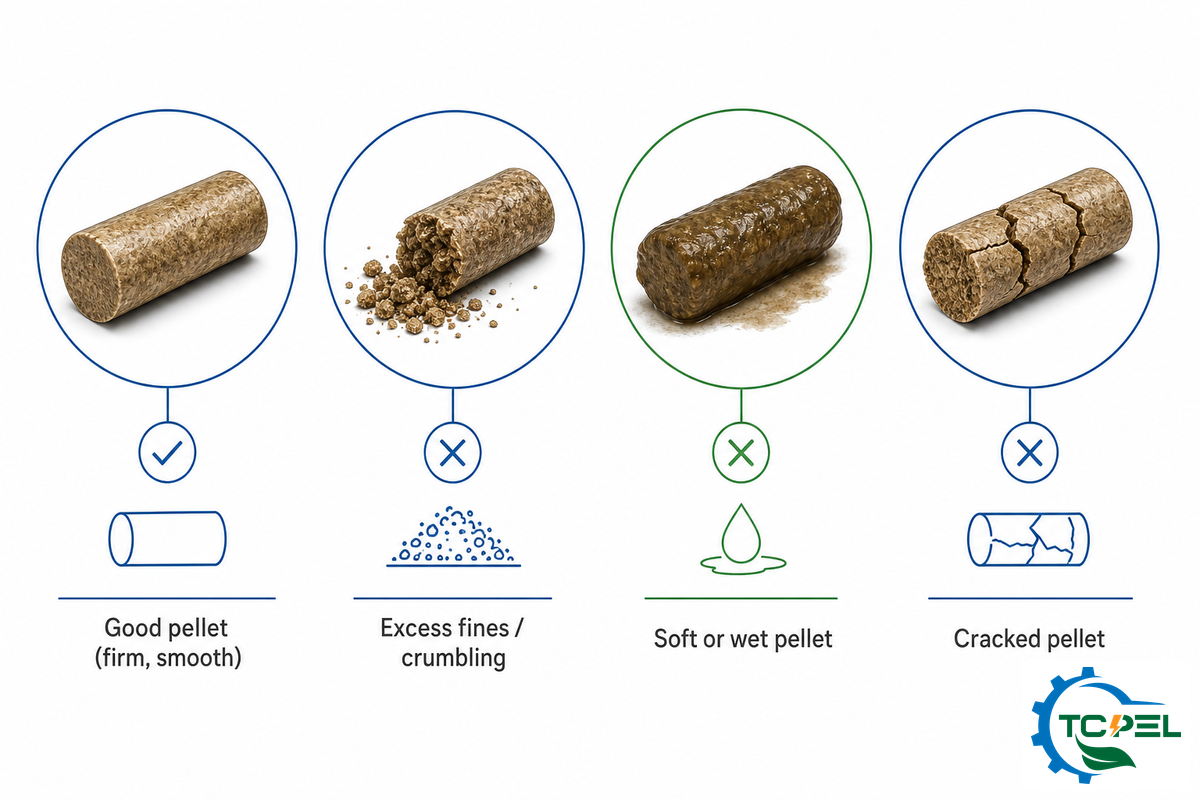
When pellets go wrong, the problem typically lies further upstream of the die. Of the more than two-dozen cases we’ve evaluated worldwide through TCPEL after sales service in 60+ countries, most have origins not in the recipe, which our clients will naturally check first. Most failures trace to conditioning moisture, an L/D mismatch, and the roller-gap setting — consistent with the pellet-quality limits published by K-State Research and Extension. Our atlas below relates the symptom you’re experiencing to its origin and our cure:
The Feed Pelleting Failure Mode Atlas
The Feed Pelleting Failure Mode Atlas is a symptom-to-cause-to-fix table for the faults that actually stop a feed line.
| Triệu chứng | Likely root cause | Sửa chữa |
|---|---|---|
| Low PDI / excessive fines | Under-conditioning, coarse grind, L/D too low | Raise conditioning moisture/temperature, grind finer, lengthen the die channel |
| Die choking / mill plugging | Total moisture above ~18%, L/D too high, rolls slipping | Cut steam, reset roller gap, drop to a lower compression die |
| Whisker cracks on the surface | Excess steam in high-starch/fiber feed | Tighten steam control; lower steam pressure on starchy feeds |
| Vertical cracks | Elastic/fluffy ingredients swelling after the conditioner | Use saturated dry steam, slow the feed rate, add a binder, lengthen the die |
| Horizontal cracks | Fiber expansion in fluffy feed | Raise die compression, control fiber fineness, extend tempering time |
| Soft / wet pellets, low output | Worn die, low compression, motor overload | Inspect for uneven die wear, replace die, re-balance roller contact |
| Uneven die wear | Uneven feed distribution or tramp metal | Even the feed spread, fit magnets, inspect die after each run |
| Radial cracks | Large raw particles can’t fully absorb heat/moisture in the conditioner | Control particle thickness and uniformity; grind finer |
| Over-hard pellets, poor feed conversion | L/D ratio set too high for the species | Drop to a lower-compression die and recheck growth response; protect production rate |
| Hot, soft pellets at the cooler | Cooler overloaded or uneven bed depth | Even the cooler bed depth; extend cooling time and airflow |
Crack typology after Anitox pellet-integrity guidance; operating limits after Kansas State University; field frequency from TCPEL after-sales records.
⚠️ Common mistake from the field
A surprising share of DIY operators reach for “more pressure” or pour in molasses to force a weak pellet together. Field experience runs the other way: excess molasses and fat lubricate the die and crack the pellet, and too much moisture makes the rolls slip. First thing to check is almost always conditioning, not compression.
Operating and Maintaining a Feed Pelletizer
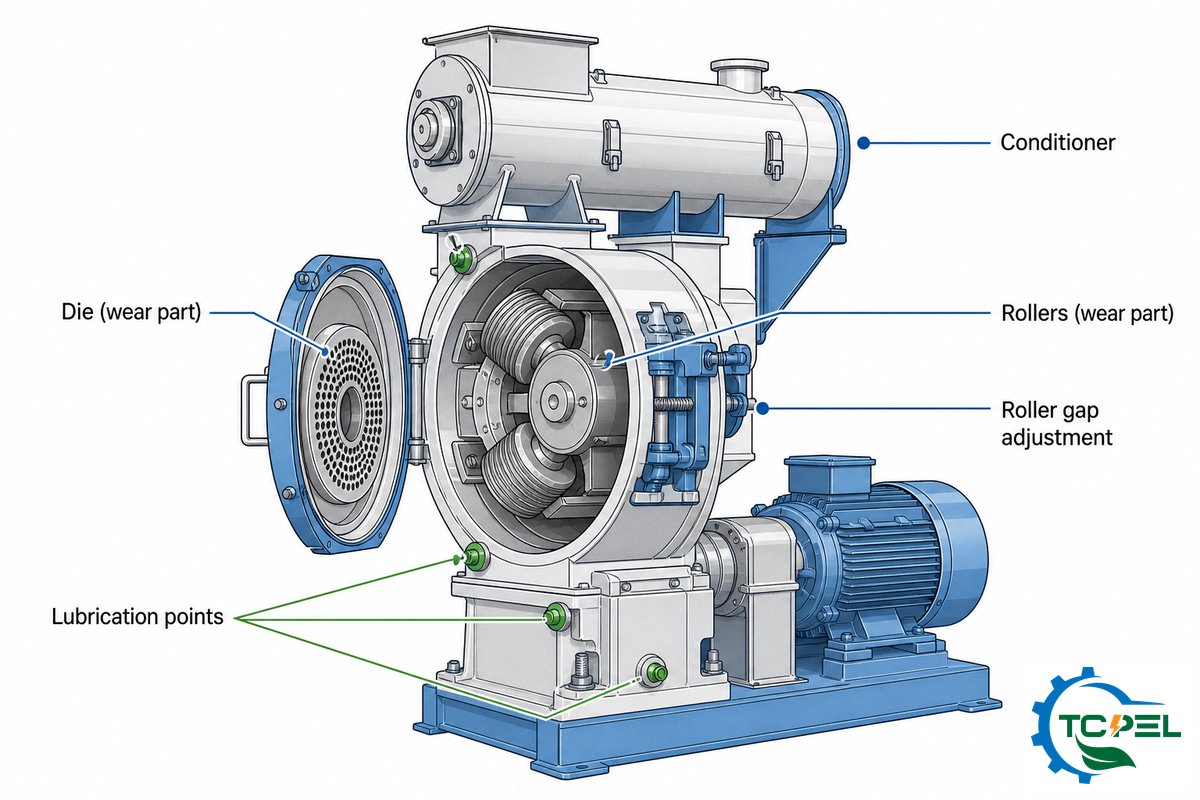
Are pellet mills expensive to maintain? They’re moderate – the recurring cost are die and roller wear, lubrication, and energy per ton, all of which you can plan for. The die is the heart of the machine and the most-replaced wear part, so most maintenance discipline centers on it.
- Record tons-per-die, run hours, and die specs each run so you can predict replacement instead of reacting to a failure.
- Inspect higher-throughput dies weekly for uneven wear; replace when the rolls no longer contact the die or fines spike.
- Choose die material to the feed: carburized alloy dies resist breakage on high-mineral feeds, while carburized stainless gives the best pellet quality with the least corrosion, per Kansas State University die guidance.
- Keep the main shaft and gearbox lubricated – an integrated auto-oil pump removes the most common cause of operator downtime.
- Clean steam traps weekly; wet steam slips the rolls, plugs the mill, and lowers durability.
Conditioning consistency is where running cost is won or lost. TCPEL targets an inlet conditioning moisture window of about 14.0-15.5%, expecting roughly 4% of that moisture to come back off in the cooler – keep the window tight and the die runs at steady amperage instead of swinging between slip and choke. Energy use is the other lever: modern ring-die geometry with variable-speed drives has measurably cut steam use during pelleting (one industry analysis put the reduction near 18%), so spec the conditioning and drive package, not just the nameplate capacity.
Raw Materials, Binders, and Conditioning Basics
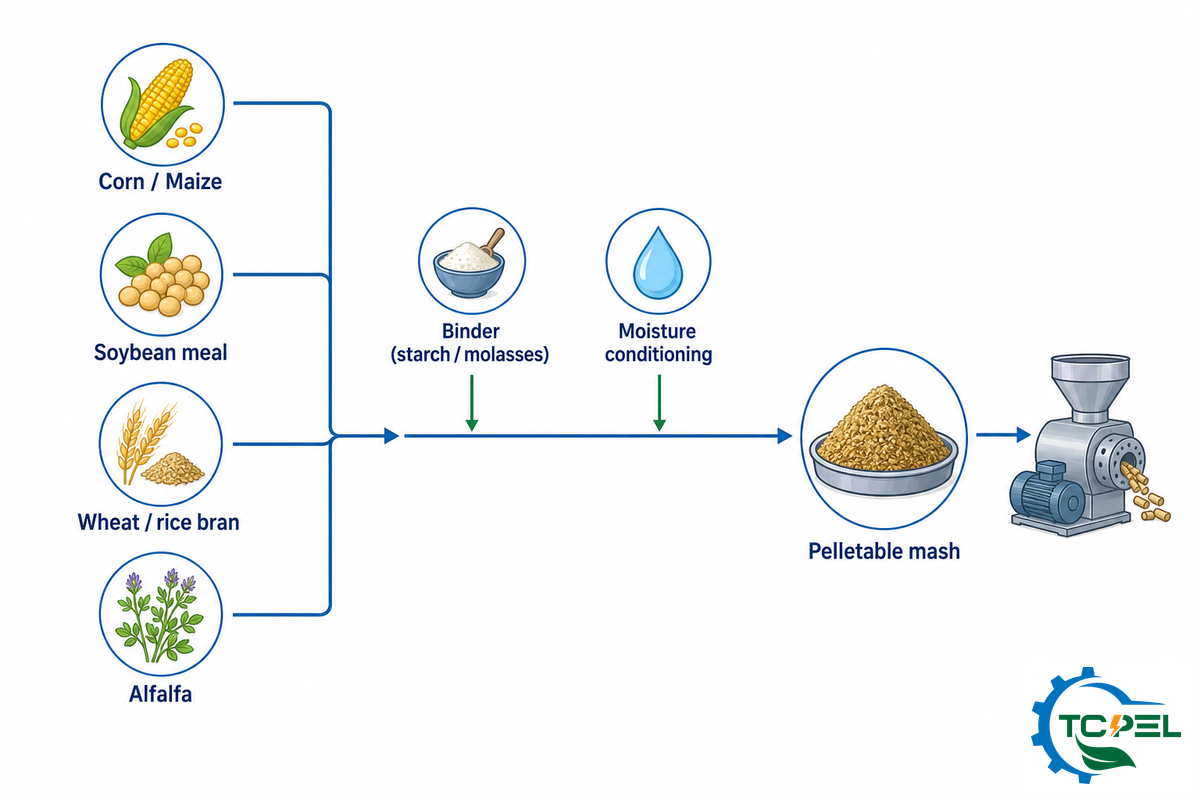
A feed pelletizer handle most dry-ground ingredients: corn and maize, soybean meal, wheat and rice bran, cottonseed and sunflower meal, alfalfa, fish meal, and vitamin-mineral premix. At the mixer, the goal is a uniform mash that conditions evenly – coarse or fluffy particles are the root of many of the cracks in the atlas above. Our table below groups the common raw materials by what they do in the pellet and how they behave under high temperature and pressure.
| Material type | Role in the pellet | Pelleting behavior |
|---|---|---|
| Corn / maize | Starch + energy base | Gelatinizes well; the main natural binder |
| Bột đậu nành | Protein | Binds moderately; good pelletability |
| Wheat / rice bran | Fiber + protein | Fluffy; can crack if ground too coarse |
| Alfalfa / grass meal | Fiber + protein | High fiber; needs a finer grind |
| Fish meal | Protein (aquafeed) | Pellets well; watch fat content |
| Molasses | Binder / palatability | Helps in moderation; excess cracks pellets |
| Fat / oil | Năng lượng | Lubricates the die and lowers PDI; cap ~1% in the mixer |
| Đá vôi/khoáng sản | Minerals | Abrasive; wears dies faster |
| Vitamin premix | Micronutrients | Heat-sensitive; conditioning protects nutritional value |
| Buckwheat / minor grains | Năng lượng | Variable starch; test pelletability first |
Ingredient behavior after Kansas State University and Feed Pelleting Reference Guide ingredient guidance.
What Binder Do Feed Pellets Need?
Most feed pellets need no added binder; they rely on gelatinized starch from the grain itself, activated by proper steam conditioning and the right die. You add a supplemental binder — a lignosulfonate, or molasses in moderation — only when conditioning and die selection alone cannot reach the hardness you need.
This was evident when one homesteader tried to pellet spent brewers grains at 50% moisture; no matter how many extra ingredients they added, the wet, under-conditioned feed would not form durable pellets.
Be mindful of added fat as a compromise. Animals benefit from the energy but the fat itself lubricates the die, decreasing pellet durability. As a result, commercial feed mills will typically limit in-mixer fat to no more than about 1% (usually a max of around 6% total) and postapply remaining fat onto the pellet after it passes through the die. This is a clear illustration of the recurring tension we explore in this guide: the very factors that benefit the animal can create friction for the machine, and successful pelleting always requires balancing the two. Different species sit at different points along the spectrum, see the dedicated cattle feed pellet machine guide và chicken feed pellet machine guide.
How to Choose an Animal Feed Pelletizer (Scale, Species & Budget)
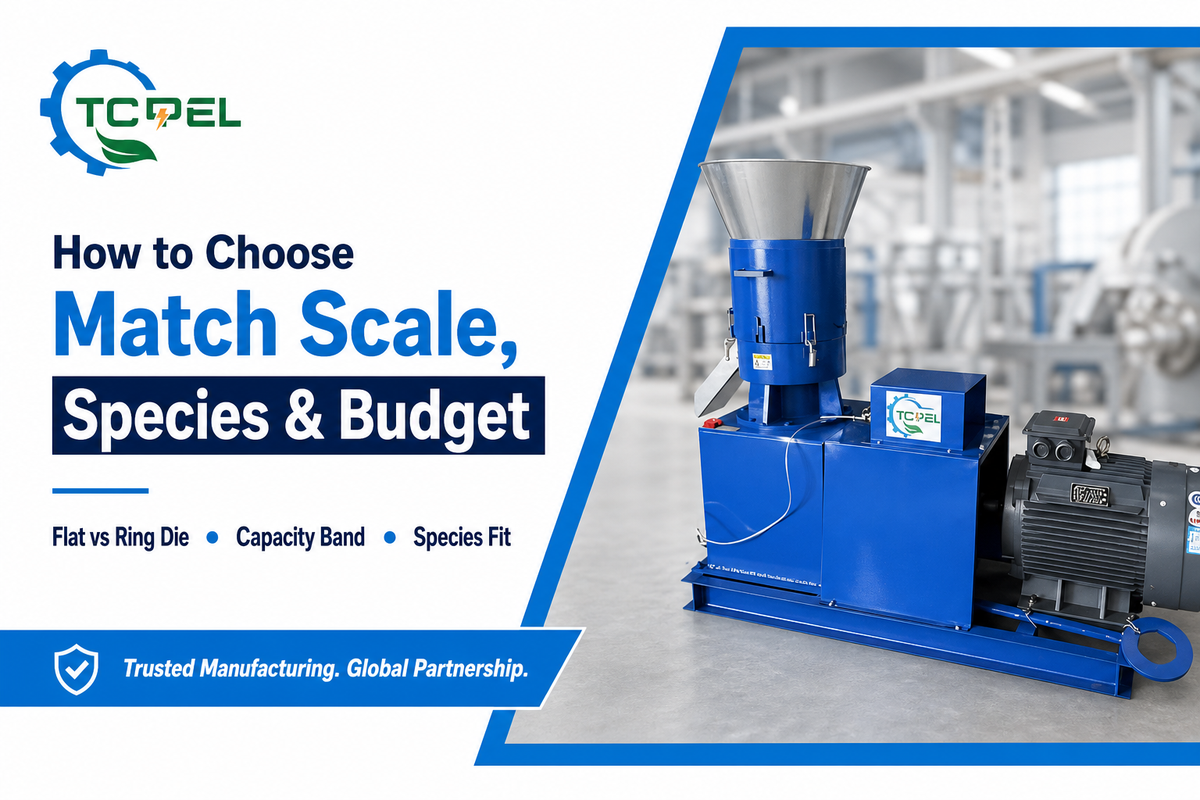
Choosing an animal feed pelletizer comes down to three questions answered in order: scale first, then species, then budget. Work that sequence and the shortlist gets short fast — fix the throughput band to a flat-die or ring-die architecture, confirm the die suits your dominant species, and only then weigh price against the capacity you actually need.
A simple selection logic
- Operating on a tight budget with an output of under approximately 100 kg per hour? Look for a small, flat-die pellet making machine — ideal for household use, hobby, or farm use, a genuinely small-scale feed pellet operation.
- For larger commercial operations of 1 to 6 tons per hour, handling multiple species, investigate a ring-die line with strong conditioning and cooling.
- Floating aquafeed? Choose an extruder, not a pelletizer.
- Choose the L/D and hole size for the die according to the main species you work with and the target pellet diameter.
Is pelleting your feed worthwhile? For most commercial farms, it typically is. While you might add $5-$6 per ton in processing costs by pelleting in-house, the increase in feed efficiency and the reduction in waste usually make it more cost-effective than purchasing pre-pelleted feed at a premium. For home hobbyists, the economics are more delicate. Although small pellet makers function well for home use, achieving consistent quality requires practice, and many underestimate the role of proper conditioning. Whether you’re selecting an animal feed pellet machine for poultry, livestock, or pet feed, approach pelletizing as a process to be fine-tuned, rather than simply buying a machine. To pinpoint a specific machine size and price for your application, use the online capacity and cost-per-ton tools across the feed pellet machine lineup.
Industry Outlook: Feed Pelleting Trends for 2026 and Beyond

The forces that will shape the equipment to produce pellets in 2026 are less about brute-force demand and more about two distinct factors shifting buyers’ decision frameworks. First is biosecurity: the FDA’s FSMA Preventive Controls for Animal Food rule designates pelleting and heat treatment as manufacturing processes subject to hazard analysis, making the conditioner no longer simply a quality tool but a certified mechanism for mitigating biological hazards such as Salmonella. Second is energy: Precision-engineered ring-die geometry in combination with variable-speed drives are reducing the energy required for pelleting. Some market researchers estimate this can be as high as 18%, and peer-reviewed publications in 2025 used sophisticated finite element analysis to further boost energy efficiency during pelleting (see Nature Scientific Reports, 2025).
For the equipment purchased in 2026 this clearly means: prioritize conditioning, die quality, and drive efficiency in your buying decision – not simply throughput rated on paper. Food safety and operational efficiency will now depend on these technologies and the changing regulatory environment rather than on bulk purchasing capacity figures. Analysts project an annual growth rate of five to six percent through the early 2030s for this segment, though such market projections will have less influence on buying choices than the advancements and regulations discussed above.
Câu hỏi thường gặp
Q: What is the difference between a pellet mill and a pelletizer?
Xem Câu Trả Lời
These terms are synonymous: pellet mill, pelletizer, feed pellet machine, and feed pellet press all name a machine that presses prepared ground feed through a die to form dense cylindrical pellets, varying mainly by region and marketing. The distinction that matters is between a pelletizer and an extruder. A pelletizer compacts and presses material into dense feed that sinks in water, while an extruder cooks, hydrates, and expands feed into floating aquaculture food.
Q: Can I make animal feed pellets at home?
Xem Câu Trả Lời
Yes, with a small flat-die pellet machine rated around 60-200 kg/h, many running on a single-phase motor or a small diesel engine. The machine is the easy part; consistent pellet quality is harder, because home users often skip or under-do conditioning. Start with well-ground, properly dried mash rather than wet material like 50%-moisture brewers grains, match the die hole to your animal, and expect a learning curve before durability is reliable.
Q: Is making your own animal feed pellets profitable?
Xem Câu Trả Lời
For commercial producers it usually is. Pelleting adds roughly $5-6 per ton of processing cost, but it improves feed conversion and average daily gain and sharply cuts feed waste, so on-site pelleting typically beats the premium on purchased finished feed once volume is steady. Be skeptical of claims that pelleting raises nutrient absorption by hundreds of percent; documented feed-conversion gains sit in the single-digit to mid-teens range, still well worth it at scale.
Q: Can a feed pelletizer make floating fish feed?
Xem Câu Trả Lời
No. A pellet mill makes dense, sinking pellets suited to bottom-feeding fish like carp and catfish at 92-95%+ durability. Floating feed has to trap air and stay buoyant, which needs the cooking and expansion of an extruder — a separate machine class from a pelletizer.
Q: What is a good PDI for animal feed pellets?
Xem Câu Trả Lời
Commercial poultry and pig feed targets an 88-92% Pellet Durability Index, while aquafeed needs 92-95% or higher for water stability. There is no universal number; the practical goal is minimizing fines at the feeder, measured by the ASABE S269.5 tumble test.
Q: Bao lâu một viên chết kéo dài?
Xem Câu Trả Lời
Die life depends on feed abrasiveness, the compression ratio, and the die material. High-mineral feeds and very high L/D ratios wear dies faster. Track tons-per-die and run hours, and replace the die when the rolls stop touching it or fines start climbing at the cooler.
Q: What raw materials can an animal feed pelletizer process?
Xem Câu Trả Lời
An animal feed pelletizer processes most dry-ground ingredients: corn and maize, soybean meal, wheat and rice bran, cottonseed and sunflower meal, alfalfa, grass meal, fish meal, and vitamin-mineral premix. Grind them to a uniform particle size and condition to about 14-18% moisture before the die.
Convinced you can identify and choose the die and tonnage for your species now?
Why We Wrote This Guide
We build flat-die and ring-die animal feed pelletizers and the surrounding grinding, conditioning, cooling and packing equipment, so the failure patterns and conditioning windows here come from our own after-sales work across more than 60 countries, cross-checked against Kansas State University, West Virginia University and ASABE feed-science sources. Where the evidence is genuinely mixed, as with steam-conditioning temperature, we’ve said so rather than picking the tidy answer. Reviewed by the TCPEL technical team.
Tài liệu tham khảo & Nguồn
- Quality Feed Manufacturing Guide: Pelleting — Kansas State University Feed Science
- MF3228 Evaluating Pellet Quality (ASABE S269.5) — K-State Research and Extension
- Durability and Breakage of Feed Pellets — USDA Agricultural Research Service
- FSMA Final Rule: Preventive Controls for Animal Food — U.S. Food and Drug Administration
- Improvement of the Physical and Nutritional Quality of Pelleted Feed — West Virginia University
- Pelletizing: An Overview 'Khoa học trực tiếp
- Feed Pelleting Reference Guide — WATT Global Media & Kansas State University
- Design and Performance Assessment of an Energy-Efficient Pelleting Machine — Nature Scientific Reports, 2025
Bài viết liên quan
- Flat Die Pellet Mill: Buyer & Operator Guide — the small-scale architecture
- Dọc Ring Die Pellet Mill — the commercial architecture
- Hướng dẫn làm mát viên — the downstream cooling stage
- Biomass Pellet Machine: Engineering Guide — the fuel-pellet sibling